

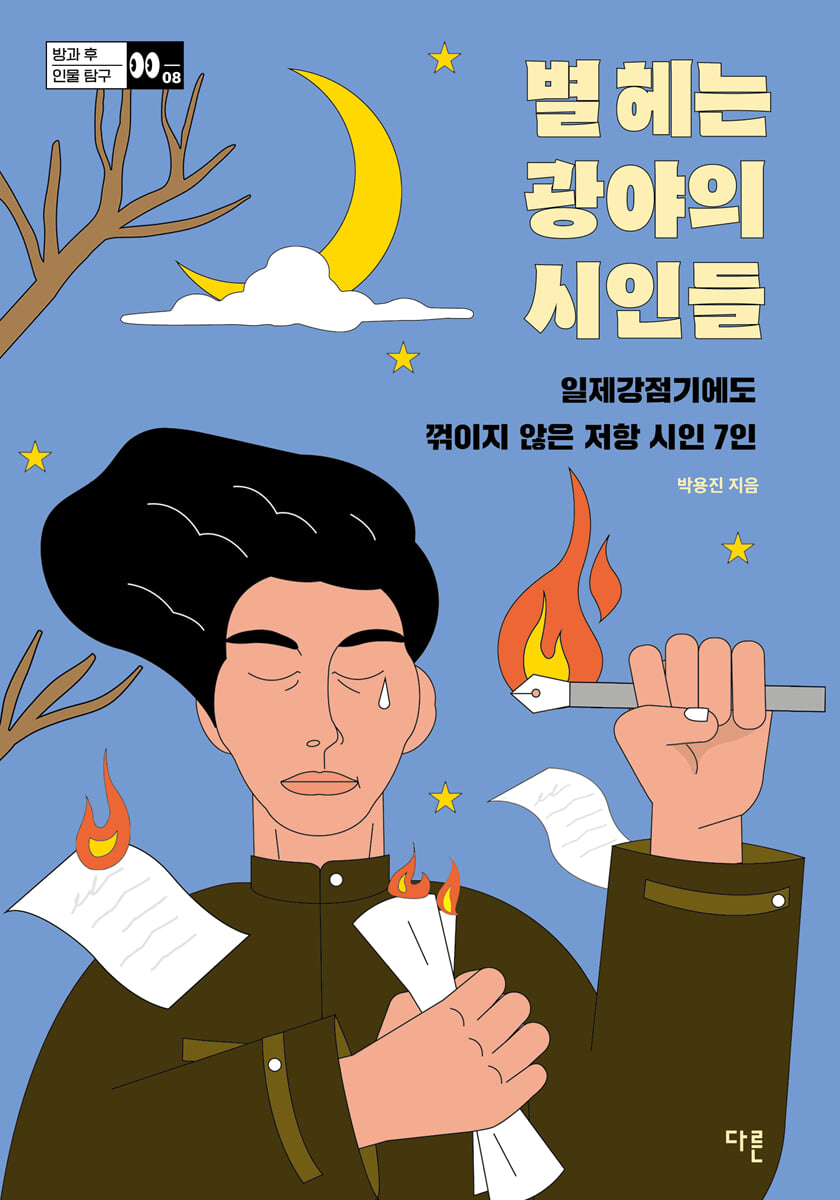
Poets of the Star-Counting Wilderness
 |
Description
Book Introduction
More interesting and romantic than poetry
Stories of the lives of poets who resisted Japanese colonial rule
Teenagers are mainly exposed to poetry during Korean language classes.
But as you try to understand the hidden meaning of poetry and memorize the grammar used, the romanticism will soon disappear, and you will only be left with the impression that poetry is difficult.
But poets never wrote poetry to make it difficult for readers.
If you learn about the historical background that forced them to write poetry and their romantic lives, you will be able to appreciate poetry more deeply and enjoyably.
"Poets of the Star-Counting Wilderness" covers the lives of seven resistance poets, from Han Yong-un to Yi Yuk-sa, who did not give up their pens for independence even during the dark times of Japanese colonial rule.
You can see not only the integrity of an independence activist who never opened his mouth despite being imprisoned and tortured 17 times, but also the heartbreaking love story of a man whose first love was stolen by his best friend.
As you follow the trajectories of these fascinating people's lives, the poetry will come to life as if you were hearing it directly from their mouths.
Stories of the lives of poets who resisted Japanese colonial rule
Teenagers are mainly exposed to poetry during Korean language classes.
But as you try to understand the hidden meaning of poetry and memorize the grammar used, the romanticism will soon disappear, and you will only be left with the impression that poetry is difficult.
But poets never wrote poetry to make it difficult for readers.
If you learn about the historical background that forced them to write poetry and their romantic lives, you will be able to appreciate poetry more deeply and enjoyably.
"Poets of the Star-Counting Wilderness" covers the lives of seven resistance poets, from Han Yong-un to Yi Yuk-sa, who did not give up their pens for independence even during the dark times of Japanese colonial rule.
You can see not only the integrity of an independence activist who never opened his mouth despite being imprisoned and tortured 17 times, but also the heartbreaking love story of a man whose first love was stolen by his best friend.
As you follow the trajectories of these fascinating people's lives, the poetry will come to life as if you were hearing it directly from their mouths.
- You can preview some of the book's contents.
Preview
index
What happened during the Japanese colonial period?
1.
Unbreakable Bamboo_Han Yong-un
A Mark in the Buddhist World | A National Representative Who Broke the Silence | A Powerful Will Transformed into Poetry | A Light that Illuminates the Darkness
[A Romantic Poetry Story_Bastard is not a curse word]
2.
A Romantic Who Waited for the Spring of the Stolen Fields_Lee Sang-hwa
A nobleman who longed for freedom and independence | Who is the poet's Madonna? | Surviving the Great Kanto Earthquake | The poem that brought Yun Bong-gil to tears | Spring, yet to come
[Romantic Poetry Stories_Lee Sang-hwa's Literary Journey]
3.
The evergreen tree that waited for that day_Sim Hoon
An independence activist from a pro-Japanese family | Sim Hoon won't tolerate it | A versatile artist | A model of resistance poetry, "When That Day Comes" | His final work, written on the back of a newspaper
[A Romantic Poetry Story: Poets and Baseball]
4.
Poet Kim Young-rang, who waited for peonies while holding poison
A name like a bead in your mouth, Yeongrang | Fateful companions | Who is the poet's peony? | Poetry like music | The Taegeukgi, drawn and painted to your heart's content
[Romantic Poetry Stories: The Character of Korean Literature during the Japanese Colonial Period]
5.
The lonely, tall, and desolate seagull_Baekseok
Modern Boy's Modern Poetry | Why Do Uneasy Premonitions Always Come True? | Capturing the Scenery of My Longed-for Hometown in Poetry | Poor, Lonely, High, and Desolate
[A Romantic Poetry Story_Baek Seok, the Lonely Gourmet]
6.
Even the wind blowing through the leaves is painful_Yoon Dong-ju
A shy, handsome poet | Waiting is chronic | A man in pain | The sin of writing poetry in Korean | A poet who became the sky, the wind, and the stars
[A Romantic Poetry Story_Yoon Dong-ju is Our Poet]
7.
The Superman Who Dreamed of a Steel Rainbow_Yuksa Lee
264, the number that became my name | Silence is my weapon | Alone on the cold and lonely plateau | I will fight with my pen in hand
[Romantic Poetry Stories_Yuksa (六四), Yuksa (戮史), Yuksa (肉瀉), Yuksa (陸史)]
1.
Unbreakable Bamboo_Han Yong-un
A Mark in the Buddhist World | A National Representative Who Broke the Silence | A Powerful Will Transformed into Poetry | A Light that Illuminates the Darkness
[A Romantic Poetry Story_Bastard is not a curse word]
2.
A Romantic Who Waited for the Spring of the Stolen Fields_Lee Sang-hwa
A nobleman who longed for freedom and independence | Who is the poet's Madonna? | Surviving the Great Kanto Earthquake | The poem that brought Yun Bong-gil to tears | Spring, yet to come
[Romantic Poetry Stories_Lee Sang-hwa's Literary Journey]
3.
The evergreen tree that waited for that day_Sim Hoon
An independence activist from a pro-Japanese family | Sim Hoon won't tolerate it | A versatile artist | A model of resistance poetry, "When That Day Comes" | His final work, written on the back of a newspaper
[A Romantic Poetry Story: Poets and Baseball]
4.
Poet Kim Young-rang, who waited for peonies while holding poison
A name like a bead in your mouth, Yeongrang | Fateful companions | Who is the poet's peony? | Poetry like music | The Taegeukgi, drawn and painted to your heart's content
[Romantic Poetry Stories: The Character of Korean Literature during the Japanese Colonial Period]
5.
The lonely, tall, and desolate seagull_Baekseok
Modern Boy's Modern Poetry | Why Do Uneasy Premonitions Always Come True? | Capturing the Scenery of My Longed-for Hometown in Poetry | Poor, Lonely, High, and Desolate
[A Romantic Poetry Story_Baek Seok, the Lonely Gourmet]
6.
Even the wind blowing through the leaves is painful_Yoon Dong-ju
A shy, handsome poet | Waiting is chronic | A man in pain | The sin of writing poetry in Korean | A poet who became the sky, the wind, and the stars
[A Romantic Poetry Story_Yoon Dong-ju is Our Poet]
7.
The Superman Who Dreamed of a Steel Rainbow_Yuksa Lee
264, the number that became my name | Silence is my weapon | Alone on the cold and lonely plateau | I will fight with my pen in hand
[Romantic Poetry Stories_Yuksa (六四), Yuksa (戮史), Yuksa (肉瀉), Yuksa (陸史)]
Into the book
Han Yong-un did not give up hope for independence.
The title of the poem is “The End of Love,” but the meaning contained within is that it was the beginning of true love.
So the last 'Yes, yes, I'm going now, I'm going soon' resonates with us even more.
Many writers, even those who participated in the independence movement, eventually surrendered to the Japanese and betrayed them, but Han Yong-un never gave in to the continuous surveillance and oppression.
He did not write a single line praising the Japanese colonial rule and refused to visit Shinto shrines or change his name to a Japanese one.
---From "Unbreakable Bamboo_Han Yong-un"
In the June 1926 issue, two months before Gaebyeok was discontinued, Lee Sang-hwa's poem "Does Spring Come to the Stolen Fields?" was published.
Doctor Yun Bong-gil had read every single volume of “Gaebyeok” without fail, but as soon as he read this poem, he burst into tears.
For a long time, large tears streamed down from his eyes.
Deeply impressed, Yun Bong-gil decided to do something for his country, and wrote the phrase "Jangbu Chulga Saeng Bul Hwan" (a man who leaves home never returns alive), strengthening his resolve, before going into exile in China.
---From "Romantic Singer Lee Sang-hwa, Who Waited for the Spring of the Stolen Fields"
Shim Hoon is known as a literary figure who wrote famous works such as the novel “Evergreen Tree” and the poem “When That Day Comes,” but he was also an outstanding filmmaker.
Sim Hoon, who went to China, showed great interest in theater and film when he entered the Department of Dramatic Literature at Zhejiang University.
Since dramatic literature is easier and more enjoyable for people to enjoy than other literary genres, there must have been an intention to effectively convey the desire for independence through plays and films.
---From "The Evergreen Tree Waiting for That Day_Sim Hoon"
Kim Young-rang not only incorporated lyricism into his poetry, but also musicality, which was uncommon in our poetry at the time.
In particular, we actively utilized phonemes, the smallest unit that creates the meaning of words, and connected sounds and meanings.
In that respect, he is evaluated as having gone one step further than Kim So-wol, who wrote poetry based on folk song rhythms.
---From "The Poet Who Waited for Peonies While Drinking Poison_Kim Young-rang"
Baek-seok loved Jaya very much, and once this happened.
Baek-seok led the school soccer team to Gyeongseong, and while he was there, he went to see Jaya, who was in Gyeongseong.
But in the meantime, the students caused an accident and I ended up getting fired from my teaching job.
Baek Seok was that deeply in love with Jaya.
It is also said that 'Natasha' in 'Me, Natasha and the White Dandelion', one of the most beautiful love poems in our country, refers to Jaya.
---From "The Lonely, Tall, and Desolate Seagull_Baekseok"
They say this poem was Lee Yuk-sa's favorite.
His wife also said that she really liked the image of the white silk towel.
The speaker of this poem is waiting for a 'guest'.
I prepared a 'mosi towel' to wipe his forehead when he was tired.
When he finally comes, he says he'll eat 'green grapes' with me until both hands are soaked.
So who is this "guest"? It could mean many things, but perhaps it's the independence of the country that Lee Yuk-sa so desperately desired?
The title of the poem is “The End of Love,” but the meaning contained within is that it was the beginning of true love.
So the last 'Yes, yes, I'm going now, I'm going soon' resonates with us even more.
Many writers, even those who participated in the independence movement, eventually surrendered to the Japanese and betrayed them, but Han Yong-un never gave in to the continuous surveillance and oppression.
He did not write a single line praising the Japanese colonial rule and refused to visit Shinto shrines or change his name to a Japanese one.
---From "Unbreakable Bamboo_Han Yong-un"
In the June 1926 issue, two months before Gaebyeok was discontinued, Lee Sang-hwa's poem "Does Spring Come to the Stolen Fields?" was published.
Doctor Yun Bong-gil had read every single volume of “Gaebyeok” without fail, but as soon as he read this poem, he burst into tears.
For a long time, large tears streamed down from his eyes.
Deeply impressed, Yun Bong-gil decided to do something for his country, and wrote the phrase "Jangbu Chulga Saeng Bul Hwan" (a man who leaves home never returns alive), strengthening his resolve, before going into exile in China.
---From "Romantic Singer Lee Sang-hwa, Who Waited for the Spring of the Stolen Fields"
Shim Hoon is known as a literary figure who wrote famous works such as the novel “Evergreen Tree” and the poem “When That Day Comes,” but he was also an outstanding filmmaker.
Sim Hoon, who went to China, showed great interest in theater and film when he entered the Department of Dramatic Literature at Zhejiang University.
Since dramatic literature is easier and more enjoyable for people to enjoy than other literary genres, there must have been an intention to effectively convey the desire for independence through plays and films.
---From "The Evergreen Tree Waiting for That Day_Sim Hoon"
Kim Young-rang not only incorporated lyricism into his poetry, but also musicality, which was uncommon in our poetry at the time.
In particular, we actively utilized phonemes, the smallest unit that creates the meaning of words, and connected sounds and meanings.
In that respect, he is evaluated as having gone one step further than Kim So-wol, who wrote poetry based on folk song rhythms.
---From "The Poet Who Waited for Peonies While Drinking Poison_Kim Young-rang"
Baek-seok loved Jaya very much, and once this happened.
Baek-seok led the school soccer team to Gyeongseong, and while he was there, he went to see Jaya, who was in Gyeongseong.
But in the meantime, the students caused an accident and I ended up getting fired from my teaching job.
Baek Seok was that deeply in love with Jaya.
It is also said that 'Natasha' in 'Me, Natasha and the White Dandelion', one of the most beautiful love poems in our country, refers to Jaya.
---From "The Lonely, Tall, and Desolate Seagull_Baekseok"
They say this poem was Lee Yuk-sa's favorite.
His wife also said that she really liked the image of the white silk towel.
The speaker of this poem is waiting for a 'guest'.
I prepared a 'mosi towel' to wipe his forehead when he was tired.
When he finally comes, he says he'll eat 'green grapes' with me until both hands are soaked.
So who is this "guest"? It could mean many things, but perhaps it's the independence of the country that Lee Yuk-sa so desperately desired?
---From "The Superman Who Dreamed of a Steel Rainbow_Yuksa Lee"
Publisher's Review
A masterpiece born under oppression
The deep emotion felt within it
The seven poets featured in this book each resisted Japanese colonial rule in their own way.
What they have in common is that, first, they wrote resistance poetry, and second, they did not give in to any pressure.
Han Yong-un, who wrote “Your Silence,” was one of the 33 national representatives. After reading the Declaration of Independence on behalf of the nation, he was arrested and imprisoned.
Sim Hun, who wrote the model poem of resistance, “When That Day Comes,” was taken to prison for leading the independence movement, but shouted, “Even if Japan cuts off my head, I will fight for independence until my last breath!”
Baek Seok, who expressed our unique emotions in his poetry, did not publish a single poem in Japanese, and Lee Yuk-sa, who left behind many beautiful resistance poems during his lifetime, eventually died in prison while fighting for the independence of his country.
The figures of poets who fought to the end for what they believed was right are deeply inspiring to us living in this day and age.
We can remember and celebrate their lives by appreciating their poetry.
I hope that by reading this book, young people will not only enjoy poetry but also learn from the lives of poets.
The deep emotion felt within it
The seven poets featured in this book each resisted Japanese colonial rule in their own way.
What they have in common is that, first, they wrote resistance poetry, and second, they did not give in to any pressure.
Han Yong-un, who wrote “Your Silence,” was one of the 33 national representatives. After reading the Declaration of Independence on behalf of the nation, he was arrested and imprisoned.
Sim Hun, who wrote the model poem of resistance, “When That Day Comes,” was taken to prison for leading the independence movement, but shouted, “Even if Japan cuts off my head, I will fight for independence until my last breath!”
Baek Seok, who expressed our unique emotions in his poetry, did not publish a single poem in Japanese, and Lee Yuk-sa, who left behind many beautiful resistance poems during his lifetime, eventually died in prison while fighting for the independence of his country.
The figures of poets who fought to the end for what they believed was right are deeply inspiring to us living in this day and age.
We can remember and celebrate their lives by appreciating their poetry.
I hope that by reading this book, young people will not only enjoy poetry but also learn from the lives of poets.
GOODS SPECIFICS
- Date of issue: July 25, 2023
- Page count, weight, size: 176 pages | 264g | 140*200*10mm
- ISBN13: 9791156335474
- ISBN10: 1156335477
You may also like
카테고리
korean


korean

![GQ KOREA Mark (Monthly): December [2025]](http://librairie.coreenne.fr/cdn/shop/files/8ef265dbbfbf186523ed75ba7319009d.jpg?v=1765340328&width=3840)


