

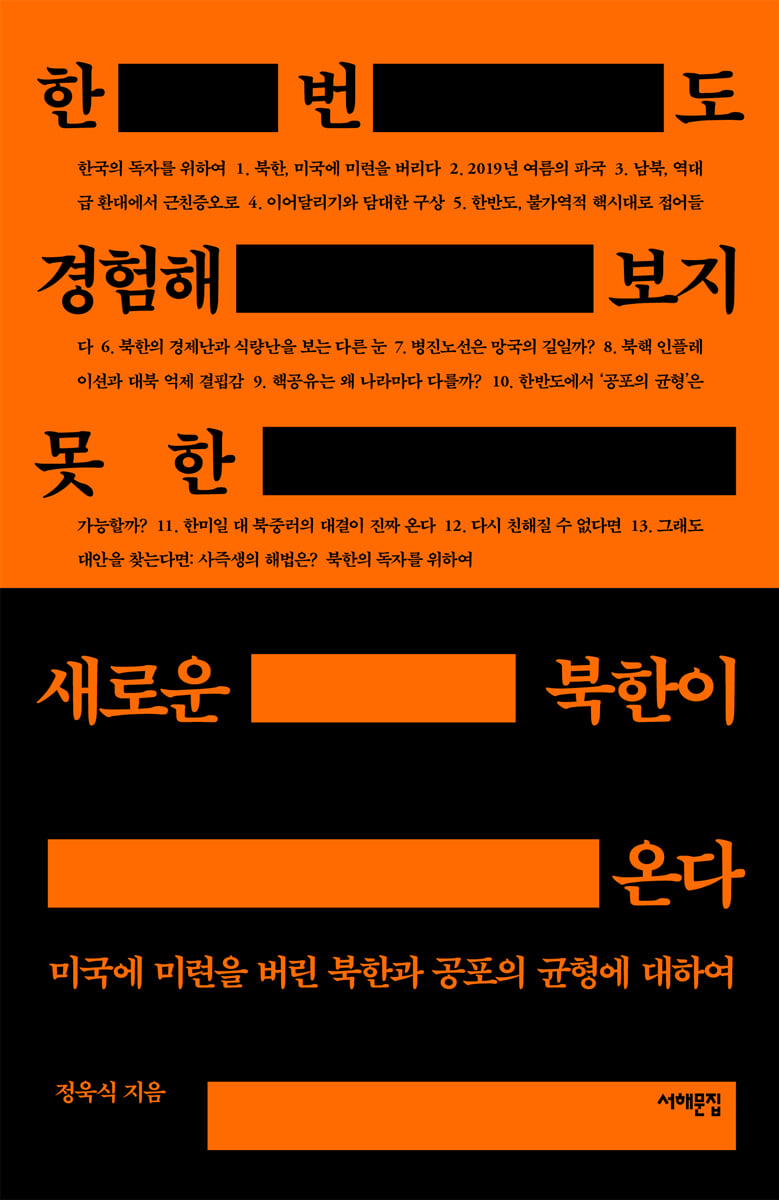
A new North Korea, one you've never experienced before, is coming.
 |
Description
Book Introduction
Why did Kim Yo-jong suddenly start referring to South Korea and South Korea as the "Republic of Korea"? Why has Kim Jong-un remained silent for years on US demands for denuclearization talks? Why has North Korea refused South Korea's offer of humanitarian aid for over a decade? Will a confrontation between South Korea, the US, and Japan versus North Korea, China, and Russia, unprecedented even during the Cold War, really unfold? "North Korea's nuclear weapons vs.
Is a "balance of terror" possible on the Korean Peninsula, where the irreversible nuclear age of the "US nuclear program" has arrived? Jeong Wook-sik, Korea's leading researcher on the ROK-US alliance and North Korean nuclear issue, examines North Korea's drastically different behavior since 2019 and anticipates the resulting shifts in inter-Korean and US-North Korea relations, as well as the tectonic shifts in the East Asian order.
Is a "balance of terror" possible on the Korean Peninsula, where the irreversible nuclear age of the "US nuclear program" has arrived? Jeong Wook-sik, Korea's leading researcher on the ROK-US alliance and North Korean nuclear issue, examines North Korea's drastically different behavior since 2019 and anticipates the resulting shifts in inter-Korean and US-North Korea relations, as well as the tectonic shifts in the East Asian order.
- You can preview some of the book's contents.
Preview
index
● Prologue: For Korean Readers
1.
North Korea abandons its obsession with the United States
30 Years of Diverging Dreams on North Korea's Nuclear Program
Kim Jong-un's two resolutions
27 personal letters guiding the "new North Korea"
2.
The catastrophe of summer 2019
○The North and South Korea-US Panmunjom meeting and two promises
Kim Jong-un's ultimatum
The U.S.'s Intentions and North Korea's 'New Path'
3.
From historic hospitality to incestuous hatred
Kim Jong-un calls for Moon Jae-in's passing
○The declaration of the end of the war and the easing of sanctions became bad checks.
○“We gave the fools in the South a little surprise.”
○Post-Cold War thinking and Cold War defense policy
○ Roh Moo-hyun's legacy and Moon Jae-in's obsession
4.
Relay race and bold ideas
Why Conservatives Have an Advantage in North Korea Policy
Yoon Seok-yeol's self-contradiction, lacking both "boldness" and "concept."
○The New Normal of the Korean Peninsula Crisis
○Repeated 'first-ever' confrontation
○South Korea, the US, and North Korea are becoming more alike
5.
The Korean Peninsula Enters an Irreversible Nuclear Era
○Nine Characteristics of North Korea's Nuclear Weapons
○ North Korea's nuclear program: From a variable to a constant on the Korean Peninsula
○North Korea's nuclear doctrine vs.
Extended deterrence between South Korea and the United States
What the Evolution of Nuclear Doctrine Indicates
○Washington Declaration and Dual Deterrence
First port call in 42 years
6.
A Different Perspective on North Korea's Economic and Food Crises
Why Kim Jong-un restored communication lines
○ A new North Korea and a South Korea stuck in inertia
○North Korea's economic growth rate -0.9% vs.
5.1%
○ In addition to sanctions in resolving sanctions
○ Are there a lot of deaths due to starvation?
○The illusion that it is still being distributed
7.
Is the Byungjin Line the path to national ruin?
○The precedents of Eisenhower and Deng Xiaoping
○Three economic feasibility aspects of the parallel route
8.
North Korean nuclear inflation and the lack of deterrence against North Korea
○North Korean nuclear inflation
○Is deterrence against North Korea insufficient?
○The price of excessive restraint
9.
Why does nuclear sharing vary from country to country?
○Differences between NATO and the ROK-US alliance
Why Japan Refuses to Share Nuclear Weapons
10.
Is a 'balance of terror' possible on the Korean Peninsula?
○More dangerous than the Cold War
○There is no arbitrator
11.
The confrontation between South Korea, the US, and Japan versus North Korea, China, and Russia is truly coming.
○1950-1997, each for himself and the division of the two
○1998-2018, MD-conceived Korea-US-Japan vs. North Korea-China-Russia
○South and North Korea's realization of South Korea-US-Japan vs. North Korea-China-Russia
12.
If we can't become friends again
○ In the place where the relationship disappeared
○Reconstruction of guardrails and dialogue
13.
Still, if you are looking for an alternative: What is the solution to death and life?
○To save denuclearization, you must give up denuclearization.
Harmony of freezing and fusion
Epilogue: For North Korean Readers
● Week
1.
North Korea abandons its obsession with the United States
30 Years of Diverging Dreams on North Korea's Nuclear Program
Kim Jong-un's two resolutions
27 personal letters guiding the "new North Korea"
2.
The catastrophe of summer 2019
○The North and South Korea-US Panmunjom meeting and two promises
Kim Jong-un's ultimatum
The U.S.'s Intentions and North Korea's 'New Path'
3.
From historic hospitality to incestuous hatred
Kim Jong-un calls for Moon Jae-in's passing
○The declaration of the end of the war and the easing of sanctions became bad checks.
○“We gave the fools in the South a little surprise.”
○Post-Cold War thinking and Cold War defense policy
○ Roh Moo-hyun's legacy and Moon Jae-in's obsession
4.
Relay race and bold ideas
Why Conservatives Have an Advantage in North Korea Policy
Yoon Seok-yeol's self-contradiction, lacking both "boldness" and "concept."
○The New Normal of the Korean Peninsula Crisis
○Repeated 'first-ever' confrontation
○South Korea, the US, and North Korea are becoming more alike
5.
The Korean Peninsula Enters an Irreversible Nuclear Era
○Nine Characteristics of North Korea's Nuclear Weapons
○ North Korea's nuclear program: From a variable to a constant on the Korean Peninsula
○North Korea's nuclear doctrine vs.
Extended deterrence between South Korea and the United States
What the Evolution of Nuclear Doctrine Indicates
○Washington Declaration and Dual Deterrence
First port call in 42 years
6.
A Different Perspective on North Korea's Economic and Food Crises
Why Kim Jong-un restored communication lines
○ A new North Korea and a South Korea stuck in inertia
○North Korea's economic growth rate -0.9% vs.
5.1%
○ In addition to sanctions in resolving sanctions
○ Are there a lot of deaths due to starvation?
○The illusion that it is still being distributed
7.
Is the Byungjin Line the path to national ruin?
○The precedents of Eisenhower and Deng Xiaoping
○Three economic feasibility aspects of the parallel route
8.
North Korean nuclear inflation and the lack of deterrence against North Korea
○North Korean nuclear inflation
○Is deterrence against North Korea insufficient?
○The price of excessive restraint
9.
Why does nuclear sharing vary from country to country?
○Differences between NATO and the ROK-US alliance
Why Japan Refuses to Share Nuclear Weapons
10.
Is a 'balance of terror' possible on the Korean Peninsula?
○More dangerous than the Cold War
○There is no arbitrator
11.
The confrontation between South Korea, the US, and Japan versus North Korea, China, and Russia is truly coming.
○1950-1997, each for himself and the division of the two
○1998-2018, MD-conceived Korea-US-Japan vs. North Korea-China-Russia
○South and North Korea's realization of South Korea-US-Japan vs. North Korea-China-Russia
12.
If we can't become friends again
○ In the place where the relationship disappeared
○Reconstruction of guardrails and dialogue
13.
Still, if you are looking for an alternative: What is the solution to death and life?
○To save denuclearization, you must give up denuclearization.
Harmony of freezing and fusion
Epilogue: For North Korean Readers
● Week
Detailed image

Into the book
If a new North Korea were to emerge, what would be the most fundamental and impactful change? Above all, I believe it would be North Korea's abandonment of any desire to normalize relations with the United States.
While the "familiar North Korea" we know has consistently sought to improve relations with the United States, regardless of its radical rhetoric, the "new North Korea" is putting that aside and developing a national strategy.
And these changes mean that the 'rules of the game' have completely changed.
--- p.25
The United States, which does not find improving inter-Korean relations particularly attractive, and North Korea, which must bring such a partner to the negotiating table.
This is when the nuclear card appeared.
Since the early days of the Cold War, the United States has steadily strengthened international regulations on nuclear weapons, including by establishing the International Atomic Energy Agency (IAEA, 1957) and leading the Treaty on the Non-Proliferation of Nuclear Weapons (NPT, 1970).
(…) But North Korea rebelled against this.
Ironically, North Korea's goal in going against the Empire's will was to become friendly with the Empire.
--- p.27
North Korea's nuclear weapons were not just a card for North Korea.
If North Korea used its nuclear development as leverage to normalize relations with the United States, the United States sought to maintain and strengthen the "status quo on the Korean Peninsula" using North Korea's nuclear program as a pretext.
The phenomenon the United States desires on the Korean Peninsula is an armistice system, the ROK-US alliance, and tensions between South and North Korea, North Korea and the US, and North Korea and Japan.
However, the resolution of the North Korean nuclear issue will immediately mean a fundamental change in the situation on the Korean Peninsula.
In the end, from the US perspective, the North Korean nuclear issue was a problem that was more advantageous to leave as a problem than to solve.
--- p.28
As Clinton said, Kim Jong-un was different.
He (…) placed North Korea at a crossroads of fate: either to become a nuclear power or to negotiate with the United States.
(…) This can be interpreted as a ‘determination’ to come to the table and negotiate denuclearization, as it has achieved a ‘balance of power’ against the United States.
(…) provoked Trump, who calls himself a ‘master of negotiation.’
Finally, he readily agreed to Kim Jong-un's proposal for negotiations, saying, "I am the only one who can solve the North Korean nuclear issue."
Another key player who stepped forward as a mediator in the historic negotiations between North America and the United States across the Pacific was the Moon Jae-in administration.
This is the beginning of the 2018 Korean Peninsula Peace Process, which now remains a vague dream.
--- p.33~34
In his letter, Kim Jong-un asked, “What has Your Excellency done for you, and how should I explain to the people what has changed since we met?”
He even used the word "fool" to refer to himself, saying, "Unless Your Majesty sees our relationship as a stepping stone that only benefits you, I wouldn't make myself look like a fool who just gives and gets nothing in return."
He added that, unlike before when he showed impatience, “we are in a different situation than then, and there is no reason to rush.”
--- p.46~47
It is a lazy analysis to attribute Kim Jong-un's change of heart solely to the failure of the Hanoi summit.
(…) If the Hanoi no-deal was a ‘shock’ to Kim Jong-un, it is because the series of events following the Panmunjom meeting led Kim Jong-un to another ‘decision’ rather than a change of heart.
Kim Jong-un's second resolution is that North Korea has abandoned its obsession with inter-Korean relations and North Korea-US relations and has made nuclear weapons the "national system of the Democratic People's Republic of Korea," encompassing politics, security, economy, and diplomacy.
--- p.34~35
“I hope to discuss the issue of denuclearization of the Korean Peninsula directly with Your Excellency, rather than with South Korean President Moon Jae-in in the future, and I believe that the excessive interest President Moon is currently showing in our issue is unnecessary.” This is an excerpt from a personal letter Kim Jong-un sent to Trump on September 21, 2018.
(…) This is a personal letter written a day after the conclusion of the Pyongyang North-South Summit.
At the time, North Korea offered ‘unprecedented hospitality’ to the South Korean delegation, including President Moon Jae-in.
(…) Why did Kim Jong-un ask Trump to ‘exclude Moon Jae-in’?
--- p.56~57
It's not that the Yoon Seok-yeol administration has no way out.
The starting point for that path is the realization that in South Korea, conservative governments are in a much more advantageous political position than centrist and progressive governments.
Even when looking at North Korea policy alone, conservative governments are relatively free from political controversies over whether they are pro-North Korea or pro-China, even if they pursue a forward-looking stance or policy.
(…) In May 2022, Unification Minister Kwon Young-se said this at his confirmation hearing.
"Fundamentally, North Korea policy should be a 'continuation,' and I don't think it's a good idea to completely ignore the previous administration and start anew." However, since then (...) the Yoon Seok-yeol administration, far from continuing its legacy, has turned around and is beating up the previous administration. The phrase "ABM" (Anything But Moon) has even emerged, showing a relentless pursuit of erasing the Moon Jae-in administration's traces in every field.
--- p.76~78
Why does this phenomenon occur? From the conservative administration's perspective, North Korea policy is a "battle with itself."
This means that the key to North Korea policy is overcoming the temptation to exploit North Korea or inter-Korean relations in times of political crisis or defensiveness.
(…) The conservative regime, which failed to ‘fight with itself,’ has kicked away every opportunity to solve the Korean Peninsula problem.
(…) The keynote of the Yoon Seok-yeol government’s North Korea policy, dubbed the “bold plan,” is “If North Korea puts down its nuclear weapons one by one, we will fire a big shot.”
(…) The Yoon Seok-yeol administration has been indiscriminately disparaging Moon Jae-in’s peace policy, saying that it relies solely on North Korea’s goodwill.
But isn't Yoon Seok-yeol's bold plan essentially demanding North Korea denuclearize, saying, "Please believe in my good intentions"?
--- p.78~81
The nuclear policies of North Korea and the United States are becoming more similar as they fight.
While trying to stop this, the Yoon Seok-yeol administration, which should be protecting the lives and property of the people, is instead pouring oil on the 'war of terror and apocalypse' between North Korea and the United States.
Of course, the goal is to suppress hostile actions by the other side, but the method used – the Korean Peninsula-style balance of terror – is extremely fragile and unstable.
--- p.116~117
The basis for the stereotype about North Korea, namely its chronic economic difficulties, is the Bank of Korea's estimate.
(…) According to this, North Korea’s average annual economic growth rate is approximately -0.9%.
However, North Korea's Voluntary National Review Report submitted to the UN's High-Level Political Forum on Sustainable Development shows completely different figures.
(…) This figure is 6% higher than the Bank of Korea’s estimate for the same period.
At the time, North Korea was strongly demanding a resolution to the sanctions, complaining that its economic development was seriously hindered by US sanctions.
North Korea, which wants to emphasize the pain of sanctions, has no reason to falsely report high growth rates to the UN.
--- p.127~128
Economic sanctions have been a powerful tool in North Korea policy, including denuclearization.
This is because North Korea, which is suffering from economic difficulties, desperately needs the lifting of sanctions.
North Korea has changed its position on sanctions.
(…) it has no value as a means of pressuring or negotiating nuclear abandonment.
And that's not all.
Resolving sanctions is essential for resuming economic cooperation between the South and the North.
Nevertheless, the fact that North Korea chose 'sanctions and cooperation' means that it has also abandoned its desire for inter-Korean economic cooperation.
The paradigm of inter-Korean relations is changing.
--- p.133~134
The Moon Jae-in administration has offered to help North Korea at every opportunity, but North Korea has either not responded or refused.
The Yoon Seok-yeol administration is threatening to once again suspend aid to North Korea, which has already been suspended.
Because of this, the people still have the illusion that South Korea and the international community are helping North Korea.
This discrepancy, coupled with the perception that "the people are starving while the Kim Jong-un regime is obsessed with nuclear weapons and missiles," is making it even more difficult to establish a new North Korea policy.
--- p.141
If we take off our colored glasses and look at it, North Korea's choice is not unusual.
The core of the parallel development line is the ‘economic feasibility of security.’
And this is a time-honored logic that follows in the footsteps of the Eisenhower administration's "New Look" in the US, which sought to offset the reduction of conventional armaments by increasing nuclear power, Khrushchev of the Soviet Union who copied it, and Deng Xiaoping of China who sought economic development by completing the "two bombs, one star" (atomic bomb, hydrogen bomb, and artificial satellite).
The Park Chung-hee regime, which pursued both economic development and independent national defense, also attempted to develop nuclear weapons in the same context.
--- p.146~147
The more South Korea clings to the already strong US extended deterrence, the more the US will boldly present South Korea with an unfair bill.
From the demand to increase the defense cost-sharing despite the fact that South Korea has given the United States a surplus of money, to the Inflation Reduction Act (IRA) and the Semiconductor Act, America's selfish behavior knows no restraint.
We must break the vicious cycle of enduring America's oppression and unfair bills in exchange for filling non-existent needs and compulsions.
--- p.172
The argument that ‘nuclear weapons must be countered with nuclear weapons’ is gaining ground, but on the Korean Peninsula, the nuclear weapons of the United States and North Korea are already in a sharp confrontation.
However, the more we cling to America's trouser legs by saying that American nuclear weapons outside of Korean territory cannot be trusted, the more trust we gain will be superficial and we will end up handing over the real benefits.
The Yoon Seok-yeol administration, fixated solely on "nuclear sharing" as the core agenda of Korea-U.S. relations, failed to address America's "semiconductor egoism," and ultimately resulted in Korea's status as a "semiconductor powerhouse" being shaken.
On the other hand, Japan, which has drawn the line that nuclear sharing discussions are unnecessary, is moving forward with a semiconductor joint venture with the United States.
--- p.183
The prevailing rhetoric among North and South Korean authorities today can be summarized as, "We do not want war, but we will not avoid it either."
We need to shift this to, 'If we don't want war, let's find a way to prevent it.'
Furthermore, while South Korea and the United States talk about “unconditional dialogue” with North Korea, they are still attaching the condition of “complete denuclearization of the Korean Peninsula,” which is an impossible and currently unrealizable ultimate goal.
Meanwhile, North Korea, which has firmly closed the door to dialogue, is demanding the "withdrawal of its hostile policy" as a condition for resuming dialogue.
Now, the ROK-US alliance and North Korea must face reality.
The more South Korea and the United States emphasize denuclearization, the further away it becomes, and the more North Korea demands the withdrawal of its hostile policies as a condition for dialogue, the more its hostile policies are strengthened.
--- p.224
Finally, I would like to ask Chairman Kim Jong-un and make an appeal.
What kind of future do you want to leave to your children?
The future of children, including my daughter known as 'Kim Ju-ae', cannot be considered separately from the climate crisis.
Moreover, the Korean Peninsula is one of the regions vulnerable to climate change.
North Korea is more vulnerable than South Korea.
(…) Wouldn’t seeking a virtuous cycle of peace and carbon emissions reduction through arms control and disarmament be the best gift for children and a way for South and North Korea to become role models for the rest of the world?
While the "familiar North Korea" we know has consistently sought to improve relations with the United States, regardless of its radical rhetoric, the "new North Korea" is putting that aside and developing a national strategy.
And these changes mean that the 'rules of the game' have completely changed.
--- p.25
The United States, which does not find improving inter-Korean relations particularly attractive, and North Korea, which must bring such a partner to the negotiating table.
This is when the nuclear card appeared.
Since the early days of the Cold War, the United States has steadily strengthened international regulations on nuclear weapons, including by establishing the International Atomic Energy Agency (IAEA, 1957) and leading the Treaty on the Non-Proliferation of Nuclear Weapons (NPT, 1970).
(…) But North Korea rebelled against this.
Ironically, North Korea's goal in going against the Empire's will was to become friendly with the Empire.
--- p.27
North Korea's nuclear weapons were not just a card for North Korea.
If North Korea used its nuclear development as leverage to normalize relations with the United States, the United States sought to maintain and strengthen the "status quo on the Korean Peninsula" using North Korea's nuclear program as a pretext.
The phenomenon the United States desires on the Korean Peninsula is an armistice system, the ROK-US alliance, and tensions between South and North Korea, North Korea and the US, and North Korea and Japan.
However, the resolution of the North Korean nuclear issue will immediately mean a fundamental change in the situation on the Korean Peninsula.
In the end, from the US perspective, the North Korean nuclear issue was a problem that was more advantageous to leave as a problem than to solve.
--- p.28
As Clinton said, Kim Jong-un was different.
He (…) placed North Korea at a crossroads of fate: either to become a nuclear power or to negotiate with the United States.
(…) This can be interpreted as a ‘determination’ to come to the table and negotiate denuclearization, as it has achieved a ‘balance of power’ against the United States.
(…) provoked Trump, who calls himself a ‘master of negotiation.’
Finally, he readily agreed to Kim Jong-un's proposal for negotiations, saying, "I am the only one who can solve the North Korean nuclear issue."
Another key player who stepped forward as a mediator in the historic negotiations between North America and the United States across the Pacific was the Moon Jae-in administration.
This is the beginning of the 2018 Korean Peninsula Peace Process, which now remains a vague dream.
--- p.33~34
In his letter, Kim Jong-un asked, “What has Your Excellency done for you, and how should I explain to the people what has changed since we met?”
He even used the word "fool" to refer to himself, saying, "Unless Your Majesty sees our relationship as a stepping stone that only benefits you, I wouldn't make myself look like a fool who just gives and gets nothing in return."
He added that, unlike before when he showed impatience, “we are in a different situation than then, and there is no reason to rush.”
--- p.46~47
It is a lazy analysis to attribute Kim Jong-un's change of heart solely to the failure of the Hanoi summit.
(…) If the Hanoi no-deal was a ‘shock’ to Kim Jong-un, it is because the series of events following the Panmunjom meeting led Kim Jong-un to another ‘decision’ rather than a change of heart.
Kim Jong-un's second resolution is that North Korea has abandoned its obsession with inter-Korean relations and North Korea-US relations and has made nuclear weapons the "national system of the Democratic People's Republic of Korea," encompassing politics, security, economy, and diplomacy.
--- p.34~35
“I hope to discuss the issue of denuclearization of the Korean Peninsula directly with Your Excellency, rather than with South Korean President Moon Jae-in in the future, and I believe that the excessive interest President Moon is currently showing in our issue is unnecessary.” This is an excerpt from a personal letter Kim Jong-un sent to Trump on September 21, 2018.
(…) This is a personal letter written a day after the conclusion of the Pyongyang North-South Summit.
At the time, North Korea offered ‘unprecedented hospitality’ to the South Korean delegation, including President Moon Jae-in.
(…) Why did Kim Jong-un ask Trump to ‘exclude Moon Jae-in’?
--- p.56~57
It's not that the Yoon Seok-yeol administration has no way out.
The starting point for that path is the realization that in South Korea, conservative governments are in a much more advantageous political position than centrist and progressive governments.
Even when looking at North Korea policy alone, conservative governments are relatively free from political controversies over whether they are pro-North Korea or pro-China, even if they pursue a forward-looking stance or policy.
(…) In May 2022, Unification Minister Kwon Young-se said this at his confirmation hearing.
"Fundamentally, North Korea policy should be a 'continuation,' and I don't think it's a good idea to completely ignore the previous administration and start anew." However, since then (...) the Yoon Seok-yeol administration, far from continuing its legacy, has turned around and is beating up the previous administration. The phrase "ABM" (Anything But Moon) has even emerged, showing a relentless pursuit of erasing the Moon Jae-in administration's traces in every field.
--- p.76~78
Why does this phenomenon occur? From the conservative administration's perspective, North Korea policy is a "battle with itself."
This means that the key to North Korea policy is overcoming the temptation to exploit North Korea or inter-Korean relations in times of political crisis or defensiveness.
(…) The conservative regime, which failed to ‘fight with itself,’ has kicked away every opportunity to solve the Korean Peninsula problem.
(…) The keynote of the Yoon Seok-yeol government’s North Korea policy, dubbed the “bold plan,” is “If North Korea puts down its nuclear weapons one by one, we will fire a big shot.”
(…) The Yoon Seok-yeol administration has been indiscriminately disparaging Moon Jae-in’s peace policy, saying that it relies solely on North Korea’s goodwill.
But isn't Yoon Seok-yeol's bold plan essentially demanding North Korea denuclearize, saying, "Please believe in my good intentions"?
--- p.78~81
The nuclear policies of North Korea and the United States are becoming more similar as they fight.
While trying to stop this, the Yoon Seok-yeol administration, which should be protecting the lives and property of the people, is instead pouring oil on the 'war of terror and apocalypse' between North Korea and the United States.
Of course, the goal is to suppress hostile actions by the other side, but the method used – the Korean Peninsula-style balance of terror – is extremely fragile and unstable.
--- p.116~117
The basis for the stereotype about North Korea, namely its chronic economic difficulties, is the Bank of Korea's estimate.
(…) According to this, North Korea’s average annual economic growth rate is approximately -0.9%.
However, North Korea's Voluntary National Review Report submitted to the UN's High-Level Political Forum on Sustainable Development shows completely different figures.
(…) This figure is 6% higher than the Bank of Korea’s estimate for the same period.
At the time, North Korea was strongly demanding a resolution to the sanctions, complaining that its economic development was seriously hindered by US sanctions.
North Korea, which wants to emphasize the pain of sanctions, has no reason to falsely report high growth rates to the UN.
--- p.127~128
Economic sanctions have been a powerful tool in North Korea policy, including denuclearization.
This is because North Korea, which is suffering from economic difficulties, desperately needs the lifting of sanctions.
North Korea has changed its position on sanctions.
(…) it has no value as a means of pressuring or negotiating nuclear abandonment.
And that's not all.
Resolving sanctions is essential for resuming economic cooperation between the South and the North.
Nevertheless, the fact that North Korea chose 'sanctions and cooperation' means that it has also abandoned its desire for inter-Korean economic cooperation.
The paradigm of inter-Korean relations is changing.
--- p.133~134
The Moon Jae-in administration has offered to help North Korea at every opportunity, but North Korea has either not responded or refused.
The Yoon Seok-yeol administration is threatening to once again suspend aid to North Korea, which has already been suspended.
Because of this, the people still have the illusion that South Korea and the international community are helping North Korea.
This discrepancy, coupled with the perception that "the people are starving while the Kim Jong-un regime is obsessed with nuclear weapons and missiles," is making it even more difficult to establish a new North Korea policy.
--- p.141
If we take off our colored glasses and look at it, North Korea's choice is not unusual.
The core of the parallel development line is the ‘economic feasibility of security.’
And this is a time-honored logic that follows in the footsteps of the Eisenhower administration's "New Look" in the US, which sought to offset the reduction of conventional armaments by increasing nuclear power, Khrushchev of the Soviet Union who copied it, and Deng Xiaoping of China who sought economic development by completing the "two bombs, one star" (atomic bomb, hydrogen bomb, and artificial satellite).
The Park Chung-hee regime, which pursued both economic development and independent national defense, also attempted to develop nuclear weapons in the same context.
--- p.146~147
The more South Korea clings to the already strong US extended deterrence, the more the US will boldly present South Korea with an unfair bill.
From the demand to increase the defense cost-sharing despite the fact that South Korea has given the United States a surplus of money, to the Inflation Reduction Act (IRA) and the Semiconductor Act, America's selfish behavior knows no restraint.
We must break the vicious cycle of enduring America's oppression and unfair bills in exchange for filling non-existent needs and compulsions.
--- p.172
The argument that ‘nuclear weapons must be countered with nuclear weapons’ is gaining ground, but on the Korean Peninsula, the nuclear weapons of the United States and North Korea are already in a sharp confrontation.
However, the more we cling to America's trouser legs by saying that American nuclear weapons outside of Korean territory cannot be trusted, the more trust we gain will be superficial and we will end up handing over the real benefits.
The Yoon Seok-yeol administration, fixated solely on "nuclear sharing" as the core agenda of Korea-U.S. relations, failed to address America's "semiconductor egoism," and ultimately resulted in Korea's status as a "semiconductor powerhouse" being shaken.
On the other hand, Japan, which has drawn the line that nuclear sharing discussions are unnecessary, is moving forward with a semiconductor joint venture with the United States.
--- p.183
The prevailing rhetoric among North and South Korean authorities today can be summarized as, "We do not want war, but we will not avoid it either."
We need to shift this to, 'If we don't want war, let's find a way to prevent it.'
Furthermore, while South Korea and the United States talk about “unconditional dialogue” with North Korea, they are still attaching the condition of “complete denuclearization of the Korean Peninsula,” which is an impossible and currently unrealizable ultimate goal.
Meanwhile, North Korea, which has firmly closed the door to dialogue, is demanding the "withdrawal of its hostile policy" as a condition for resuming dialogue.
Now, the ROK-US alliance and North Korea must face reality.
The more South Korea and the United States emphasize denuclearization, the further away it becomes, and the more North Korea demands the withdrawal of its hostile policies as a condition for dialogue, the more its hostile policies are strengthened.
--- p.224
Finally, I would like to ask Chairman Kim Jong-un and make an appeal.
What kind of future do you want to leave to your children?
The future of children, including my daughter known as 'Kim Ju-ae', cannot be considered separately from the climate crisis.
Moreover, the Korean Peninsula is one of the regions vulnerable to climate change.
North Korea is more vulnerable than South Korea.
(…) Wouldn’t seeking a virtuous cycle of peace and carbon emissions reduction through arms control and disarmament be the best gift for children and a way for South and North Korea to become role models for the rest of the world?
--- p.243~244
Publisher's Review
The irreversible nuclear age has finally arrived.
Beyond the ‘balance of terror’, towards ‘true peace’
Inter-Korean Relations Literacy
In July 2023, North Korea released two statements under the name of Kim Yo-jong, vice department director of the Central Committee of the Workers' Party of Korea.
The reason why the usual criticism of the US and South Korea has drawn special attention is because of the unfamiliar yet obvious references to South Korea.
In her speech, Kim Yo-jong used the expression “Republic of Korea” four times instead of “South Korea” or “South Korea.”
According to the Ministry of Unification, there has never been a case in which North Korea referred to the South as the Republic of Korea in an official statement or other statement.
Since the 1991 Inter-Korean Basic Agreement defined inter-Korean relations as a “special relationship aiming for unification” rather than a “state-to-state” relationship, the two Koreas have referred to each other as South and North, or South Korea and North Korea, rather than by their official names, the Republic of Korea and the Democratic People’s Republic of Korea.
The use of 'entry/exit' instead of 'entry/exit' and the use of 'visa' instead of passport when traveling between the two countries are also in the same context.
Regarding Kim Yo-jong's actions, which directly violate the "basic agreement" between the South and the North, peace researcher and activist Jeong Wook-sik (Peace Network representative, Hankyoreh Peace Institute director), who has focused on the ROK-US alliance and the North Korean nuclear issue with disarmament, anti-nuclear weapons, and a peace regime as the axes, interprets them as a signal of a "changed North Korea."
Furthermore, we define this not as a one-time gesture, but as part of North Korea's fundamentally transformed foreign policy strategy.
What does it mean? The detailed story is included in a book that just came out.
The topic is the changes in North Korea that have begun in earnest since the breakdown of denuclearization negotiations in 2018-2019, the destabilizing inter-Korean and North Korea-US relations caused by North Korea, and the turbulent landscape of the six East Asian countries.
In short, “A new North Korea like you’ve never experienced before is coming!”
The North Korea we knew no longer exists.
Four New Signals from North Korea
① Give up your obsession with America
The key change is that North Korea has abandoned its desire for normalization of relations with the United States, including the easing of sanctions.
Since the collapse of the socialist bloc in the early 1990s, North Korea's consistent foreign policy for the past 30 years has been to establish diplomatic relations with the United States and establish a peace regime.
Nuclear development was both a lifeline for the regime and a trump card to bring the United States to the negotiating table.
The three rounds of North Korea-US summit talks in 2018-2019 were the culmination of this trend, and the "Hanoi no-deal"—the breakdown of denuclearization talks—led to the abandonment of that keynote.
Since then, nuclear weapons have transformed from a means of exchange for the regime to the regime itself, the very foundation of North Korea's "state."
The author revisits Kim Jong-un's expectations and disillusionment, his regrets and change of heart toward the United States through various documents, including 27 personal letters exchanged between Kim Jong-un and Trump during this period.
The subsequent change in North Korea's position will cause a tectonic shift in inter-Korean relations as well as the dynamics surrounding the Korean Peninsula.
② From nationalism to stateism
The second is that the blueprint for inter-Korean relations has changed.
President Yoon Seok-yeol attacks the previous administration, accusing it of neglecting national security while intoxicated by "fake peace."
Former President Moon Jae-in is complaining that the friendship between the South and the North that he built was ruined by his successor government.
According to the author, both are lies.
Contrary to Yoon Seok-yeol's words, the Moon Jae-in administration was a government that went all-in on security, especially military buildup.
And paradoxically, this obsession with security—that is, the obsession with introducing cutting-edge weapons and strengthening military power while demanding that North Korea give up its nuclear weapons—has made North Korea sick.
It took less than a year for North Korea's "unprecedented hospitality" in 2018 to devolve into fierce "incestuous hatred."
A series of events that followed: the 2019 bombing of the Kaesong Liaison Office, a joint diplomatic mission between North and South Korea; the 2023 statement banning Hyundai Group Chairwoman Hyun Jeong-eun's visit to North Korea issued by the Ministry of Foreign Affairs, not the Department for South Korean Affairs (United Front Department); and Kim Yo-jong's remarks about the "Republic of Korea" all point to the end of the "South and North Korea era" based on nation-first principles and the beginning of the "nation-versus-nation" era.
Through this, the author announces that the two major paradigms of North Korea policy over the past 30 years—the engagement policy (a progressive hopeful path of an exchange of economy and peace) and the pressure policy (a conservative hopeful path of unification through absorption after collapse)—have reached the end of their usefulness.
③ The misconception that there is an economic crisis, the illusion that they are giving away money, and the delusion that they expect support
The third is the change within North Korea.
Of particular note is the reevaluation of the "parallel development of economy and nuclear weapons" (parallel development), which has been ridiculed as a contradiction in terms.
Nuclear weapons are an asymmetrical force boasting the best 'cost-effectiveness', and investing the conventional military budget saved from nuclear development in economic development is a strategy that has proven effective, as evidenced by precedents such as Eisenhower's New Look policy and Deng Xiaoping's Two Bullets, One Star policy.
The author also presents a cautious but different view on North Korea's economic difficulties and food situation, examining official UN reports rather than estimates that are commonly accepted as common sense.
Above all, it points out that North Korea has refused aid from South Korea and the international community for over a decade, even during the COVID-19 pandemic, and points out that the stereotype of a "poor North Korea" is an obstacle to dealing with the new North Korea. (Indeed, the Moon Jae-in administration squandered the last opportunity to restore inter-Korean relations by insisting on humanitarian aid while refusing to compromise on joint South Korea-US military exercises in the latter half of its term.)
④ Reorganization of the East Asian order: South Korea, the US, and Japan vs. North Korea, China, and Russia
The fourth is the emergence of a new landscape in East Asia, namely the 'South Korea-US-Japan vs. North Korea-China-Russia' structure.
Contrary to popular belief, the Korean Peninsula and its six surrounding countries have repeatedly engaged in alliances and cooperation based on their own interests rather than confrontation between factions since the Cold War.
However, since the United States incorporated Japan and South Korea into its missile defense system (MD) and designated North Korea, China, and Russia as common enemies, the 2019 North Korea-US denuclearization talks broke down, and China and Russia have shown de facto tolerance for North Korea's nuclear weapons (in order to check the United States, a hegemonic rival), the structure of South Korea, the US, and Japan versus North Korea, China, and Russia is becoming a reality.
The Korean Peninsula has emerged as East Asia's largest powder keg.
About the changing rules of the game and the 'balance of terror'
The failure of North Korea-US denuclearization negotiations and the resulting changes in North Korea ultimately ushered in an "irreversible nuclear age."
Some people are talking about nuclear sharing between South Korea and the US, or even South Korea's independent nuclear armament, referring to the "balance of terror" between the US and the US during the Cold War.
However, as an expert on the ROK-US alliance and the North Korean nuclear issue, the author's view is sober. He points out in detail why South Korea's independent nuclear armament, as a member of the Nuclear Non-Proliferation Treaty (NPT), is absurd and why the idea of nuclear sharing is nothing more than political rhetoric.
Rather, the author finds the cause of the failure of all governments, regardless of progressive or conservative, in their North Korea and peace policies since democratization, in their excessive pro-Americanism (dependence on the ROK-US alliance) and their pursuit of “peace through strength.”
According to him, the current military power of the ROK-US alliance alone is sufficient to deter North Korea's nuclear weapons, and any further military buildup is a political and strategic handshake that will only lead to a high bill for the US and provocations from North Korea.
Ultimately, the answer lies not in a "balance of terror," but in disarmament based on reciprocity.
Is this even possible today, with the largest-ever joint South Korea-U.S. military exercise continuing for decades and North Korea responding with a missile show? The author urges a "new peace process" between the two Koreas, recalling what the U.S. and the Soviet Union achieved half a century ago and what China and the U.S. are partially achieving today.
Beyond the ‘balance of terror’, towards ‘true peace’
Inter-Korean Relations Literacy
In July 2023, North Korea released two statements under the name of Kim Yo-jong, vice department director of the Central Committee of the Workers' Party of Korea.
The reason why the usual criticism of the US and South Korea has drawn special attention is because of the unfamiliar yet obvious references to South Korea.
In her speech, Kim Yo-jong used the expression “Republic of Korea” four times instead of “South Korea” or “South Korea.”
According to the Ministry of Unification, there has never been a case in which North Korea referred to the South as the Republic of Korea in an official statement or other statement.
Since the 1991 Inter-Korean Basic Agreement defined inter-Korean relations as a “special relationship aiming for unification” rather than a “state-to-state” relationship, the two Koreas have referred to each other as South and North, or South Korea and North Korea, rather than by their official names, the Republic of Korea and the Democratic People’s Republic of Korea.
The use of 'entry/exit' instead of 'entry/exit' and the use of 'visa' instead of passport when traveling between the two countries are also in the same context.
Regarding Kim Yo-jong's actions, which directly violate the "basic agreement" between the South and the North, peace researcher and activist Jeong Wook-sik (Peace Network representative, Hankyoreh Peace Institute director), who has focused on the ROK-US alliance and the North Korean nuclear issue with disarmament, anti-nuclear weapons, and a peace regime as the axes, interprets them as a signal of a "changed North Korea."
Furthermore, we define this not as a one-time gesture, but as part of North Korea's fundamentally transformed foreign policy strategy.
What does it mean? The detailed story is included in a book that just came out.
The topic is the changes in North Korea that have begun in earnest since the breakdown of denuclearization negotiations in 2018-2019, the destabilizing inter-Korean and North Korea-US relations caused by North Korea, and the turbulent landscape of the six East Asian countries.
In short, “A new North Korea like you’ve never experienced before is coming!”
The North Korea we knew no longer exists.
Four New Signals from North Korea
① Give up your obsession with America
The key change is that North Korea has abandoned its desire for normalization of relations with the United States, including the easing of sanctions.
Since the collapse of the socialist bloc in the early 1990s, North Korea's consistent foreign policy for the past 30 years has been to establish diplomatic relations with the United States and establish a peace regime.
Nuclear development was both a lifeline for the regime and a trump card to bring the United States to the negotiating table.
The three rounds of North Korea-US summit talks in 2018-2019 were the culmination of this trend, and the "Hanoi no-deal"—the breakdown of denuclearization talks—led to the abandonment of that keynote.
Since then, nuclear weapons have transformed from a means of exchange for the regime to the regime itself, the very foundation of North Korea's "state."
The author revisits Kim Jong-un's expectations and disillusionment, his regrets and change of heart toward the United States through various documents, including 27 personal letters exchanged between Kim Jong-un and Trump during this period.
The subsequent change in North Korea's position will cause a tectonic shift in inter-Korean relations as well as the dynamics surrounding the Korean Peninsula.
② From nationalism to stateism
The second is that the blueprint for inter-Korean relations has changed.
President Yoon Seok-yeol attacks the previous administration, accusing it of neglecting national security while intoxicated by "fake peace."
Former President Moon Jae-in is complaining that the friendship between the South and the North that he built was ruined by his successor government.
According to the author, both are lies.
Contrary to Yoon Seok-yeol's words, the Moon Jae-in administration was a government that went all-in on security, especially military buildup.
And paradoxically, this obsession with security—that is, the obsession with introducing cutting-edge weapons and strengthening military power while demanding that North Korea give up its nuclear weapons—has made North Korea sick.
It took less than a year for North Korea's "unprecedented hospitality" in 2018 to devolve into fierce "incestuous hatred."
A series of events that followed: the 2019 bombing of the Kaesong Liaison Office, a joint diplomatic mission between North and South Korea; the 2023 statement banning Hyundai Group Chairwoman Hyun Jeong-eun's visit to North Korea issued by the Ministry of Foreign Affairs, not the Department for South Korean Affairs (United Front Department); and Kim Yo-jong's remarks about the "Republic of Korea" all point to the end of the "South and North Korea era" based on nation-first principles and the beginning of the "nation-versus-nation" era.
Through this, the author announces that the two major paradigms of North Korea policy over the past 30 years—the engagement policy (a progressive hopeful path of an exchange of economy and peace) and the pressure policy (a conservative hopeful path of unification through absorption after collapse)—have reached the end of their usefulness.
③ The misconception that there is an economic crisis, the illusion that they are giving away money, and the delusion that they expect support
The third is the change within North Korea.
Of particular note is the reevaluation of the "parallel development of economy and nuclear weapons" (parallel development), which has been ridiculed as a contradiction in terms.
Nuclear weapons are an asymmetrical force boasting the best 'cost-effectiveness', and investing the conventional military budget saved from nuclear development in economic development is a strategy that has proven effective, as evidenced by precedents such as Eisenhower's New Look policy and Deng Xiaoping's Two Bullets, One Star policy.
The author also presents a cautious but different view on North Korea's economic difficulties and food situation, examining official UN reports rather than estimates that are commonly accepted as common sense.
Above all, it points out that North Korea has refused aid from South Korea and the international community for over a decade, even during the COVID-19 pandemic, and points out that the stereotype of a "poor North Korea" is an obstacle to dealing with the new North Korea. (Indeed, the Moon Jae-in administration squandered the last opportunity to restore inter-Korean relations by insisting on humanitarian aid while refusing to compromise on joint South Korea-US military exercises in the latter half of its term.)
④ Reorganization of the East Asian order: South Korea, the US, and Japan vs. North Korea, China, and Russia
The fourth is the emergence of a new landscape in East Asia, namely the 'South Korea-US-Japan vs. North Korea-China-Russia' structure.
Contrary to popular belief, the Korean Peninsula and its six surrounding countries have repeatedly engaged in alliances and cooperation based on their own interests rather than confrontation between factions since the Cold War.
However, since the United States incorporated Japan and South Korea into its missile defense system (MD) and designated North Korea, China, and Russia as common enemies, the 2019 North Korea-US denuclearization talks broke down, and China and Russia have shown de facto tolerance for North Korea's nuclear weapons (in order to check the United States, a hegemonic rival), the structure of South Korea, the US, and Japan versus North Korea, China, and Russia is becoming a reality.
The Korean Peninsula has emerged as East Asia's largest powder keg.
About the changing rules of the game and the 'balance of terror'
The failure of North Korea-US denuclearization negotiations and the resulting changes in North Korea ultimately ushered in an "irreversible nuclear age."
Some people are talking about nuclear sharing between South Korea and the US, or even South Korea's independent nuclear armament, referring to the "balance of terror" between the US and the US during the Cold War.
However, as an expert on the ROK-US alliance and the North Korean nuclear issue, the author's view is sober. He points out in detail why South Korea's independent nuclear armament, as a member of the Nuclear Non-Proliferation Treaty (NPT), is absurd and why the idea of nuclear sharing is nothing more than political rhetoric.
Rather, the author finds the cause of the failure of all governments, regardless of progressive or conservative, in their North Korea and peace policies since democratization, in their excessive pro-Americanism (dependence on the ROK-US alliance) and their pursuit of “peace through strength.”
According to him, the current military power of the ROK-US alliance alone is sufficient to deter North Korea's nuclear weapons, and any further military buildup is a political and strategic handshake that will only lead to a high bill for the US and provocations from North Korea.
Ultimately, the answer lies not in a "balance of terror," but in disarmament based on reciprocity.
Is this even possible today, with the largest-ever joint South Korea-U.S. military exercise continuing for decades and North Korea responding with a missile show? The author urges a "new peace process" between the two Koreas, recalling what the U.S. and the Soviet Union achieved half a century ago and what China and the U.S. are partially achieving today.
GOODS SPECIFICS
- Date of issue: July 21, 2023
- Page count, weight, size: 248 pages | 362g | 130*200*15mm
- ISBN13: 9791192988184
You may also like
카테고리
korean


korean

![GQ KOREA Mark (Monthly): December [2025]](http://librairie.coreenne.fr/cdn/shop/files/8ef265dbbfbf186523ed75ba7319009d.jpg?v=1765340328&width=3840)


