

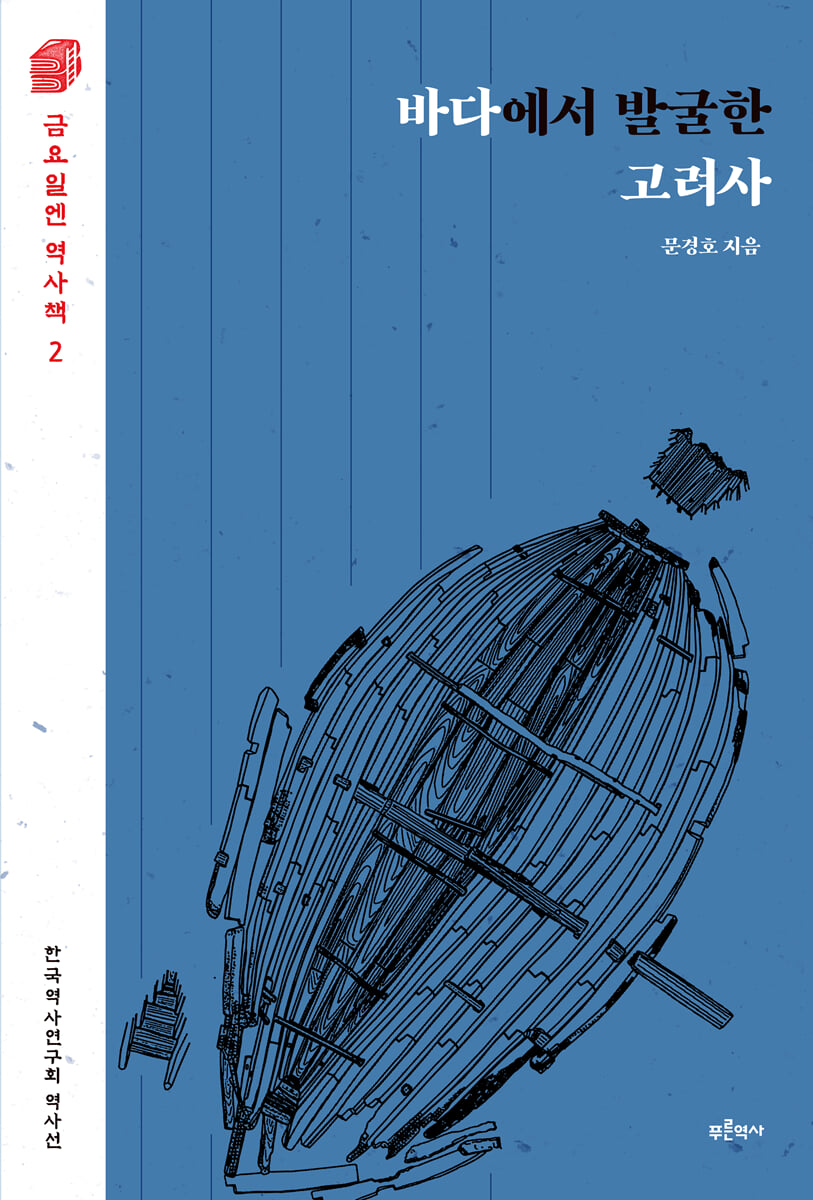
Goryeo history excavated from the sea
 |
Description
Book Introduction
Goryeo, Running the Sea
The Goryeo Dynasty's Sea Story We Didn't Know
The Goryeo treasure ship discovered by Jjukkumi
On May 14, 2007, a fisherman fishing for cuttlefish off the coast of Taean, South Chungcheong Province, caught a cuttlefish with a suction cup attached to a porcelain bowl.
The excavation team of the National Research Institute of Maritime Cultural Heritage, which began investigating after receiving a report from a fisherman, recovered a total of 24,887 artifacts from the site, including 8,000 pieces of celadon, a ship's hull, wooden tablets, and daily necessities on board.
In 2009, Taean Mado Line 1 was revealed for the first time in 800 years.
And then, Taean Madong Line 2 and Line 3 were launched.
In just five to six years, four Goryeo Dynasty ships that had been dormant for 700 to 800 years were brought back to light.
Inside the ship, there were various wooden tablets that served as cargo tags, as well as cargo such as pottery and grain, and daily necessities for sailors such as spoons, chopsticks, combs, and chess pieces.
The Goryeo Dynasty time capsule, which had been sealed for a long time, was opened all at once without warning.
The Goryeo Dynasty's Sea Story We Didn't Know
The Goryeo treasure ship discovered by Jjukkumi
On May 14, 2007, a fisherman fishing for cuttlefish off the coast of Taean, South Chungcheong Province, caught a cuttlefish with a suction cup attached to a porcelain bowl.
The excavation team of the National Research Institute of Maritime Cultural Heritage, which began investigating after receiving a report from a fisherman, recovered a total of 24,887 artifacts from the site, including 8,000 pieces of celadon, a ship's hull, wooden tablets, and daily necessities on board.
In 2009, Taean Mado Line 1 was revealed for the first time in 800 years.
And then, Taean Madong Line 2 and Line 3 were launched.
In just five to six years, four Goryeo Dynasty ships that had been dormant for 700 to 800 years were brought back to light.
Inside the ship, there were various wooden tablets that served as cargo tags, as well as cargo such as pottery and grain, and daily necessities for sailors such as spoons, chopsticks, combs, and chess pieces.
The Goryeo Dynasty time capsule, which had been sealed for a long time, was opened all at once without warning.
- You can preview some of the book's contents.
Preview
index
preface
Prologue_Setting Off on the Mado Line 1
01_A Goryeo Dynasty Time Capsule Protected by the Tidal Flats
1_A promise from 800 years ago
Cargo tag and wooden tag containing recipient information│What is the purpose of the coal loaded on the ship?
2_ Goryeo Dynasty ships discovered in the Mado waters
Treasure Ship Discovered by Jjukkumi│The Celadon Bottles onboard Mado Ship No. 2: A Honey Jar? A Sesame Oil Jar?│The Goryeo People Loved Meat?│Mado Ship No. 3 Carrying Goods for Kim Jun, the Powerhouse│Chestnuts and Cucumbers, Also Enjoyed by Goryeo People
3_Is the cargo on Mado Lines 1-3 a tax or a gift?
Why it's difficult to view lines 1-3 of the Madou line as a diagonal line│Cases where officials' charters were transported by transport ships
02_Goryeo's Transport System: The Backbone of the Nation's Livelihood
1_What is Jo-un?
From 12 to 13 warehouses│Warehouses concentrated in Jeolla Province… Gyeongsang Province primarily relied on land routes│Later transportation system shaken by Japanese pirate raids
2_Materials transported through sea transport
Blood was treated better than soybeans, red beans, and barley│Mussels also seemed to be enjoyed
3_The lives of the people of Jochang
The Jinseongchang site, which preserves the appearance of Goryeo's Jochang as it was. The sailors who didn't wear pants. The life of Jochangmin, so difficult that he chose death.
03_Goryeo's ships sail the West Sea
1_Pears of the Goryeo Dynasty as seen through literature
The Sambyeolcho, who left Ganghwa Island with over 1,000 ships│Goryeo ships mobilized for the Yuan Dynasty's expedition to Japan│The mystery of the Penglai No. 3 ship launched from China
2_Goryeo's ships as seen through the eyes of foreigners
A ship with iron horns on the front│A Goryeo ship seen by Seo Geung│Goryeo ships can't cross the open sea?
3_Is the pear in the longing of the Emperor Huang Feichang Tianming a Goryeo pear?
Appearance of Goryeo's unique patterns, such as the three-legged crow, toad, and rabbit.
04_Goryeo's Sea, Goryeo's Sea Routes
1_From Happo to Yesong Port
From Geoje Island's Gyeonnaeryang to Yeosu's Gamak Bay│Jangheung's Cheongwansan, where a Goryeo-era shipyard was located│Byeonsan's Jukmak-dong, a hub of exchange between Baekje, Gaya, and Wa
2_Taean Peninsula, which almost became an island
Mission: Impossible: Dig a Canal│Canal Project Fails Due to Bedrock
3_All ships are on the way to Byeokrando: Truths and misconceptions about Byeokrando
Three sea routes from Goryeo to Song │ Buildings built on the island to receive Song envoys │ Su Dongpo criticized the preferential treatment of Goryeo envoys │ The traffic of Arabian merchants was exaggerated │ More than 100 ships were stationed on Byeokrando Island
Epilogue: Where Did All Those Ships Go?
Under the Mongol Empire, land routes were more developed than sea routes. │ Joseon's Sinocentrism led to international isolation. │ Joseon's Joseon-style craftsmanship was cut off during the Japanese colonial period.
More books to read
Search
Prologue_Setting Off on the Mado Line 1
01_A Goryeo Dynasty Time Capsule Protected by the Tidal Flats
1_A promise from 800 years ago
Cargo tag and wooden tag containing recipient information│What is the purpose of the coal loaded on the ship?
2_ Goryeo Dynasty ships discovered in the Mado waters
Treasure Ship Discovered by Jjukkumi│The Celadon Bottles onboard Mado Ship No. 2: A Honey Jar? A Sesame Oil Jar?│The Goryeo People Loved Meat?│Mado Ship No. 3 Carrying Goods for Kim Jun, the Powerhouse│Chestnuts and Cucumbers, Also Enjoyed by Goryeo People
3_Is the cargo on Mado Lines 1-3 a tax or a gift?
Why it's difficult to view lines 1-3 of the Madou line as a diagonal line│Cases where officials' charters were transported by transport ships
02_Goryeo's Transport System: The Backbone of the Nation's Livelihood
1_What is Jo-un?
From 12 to 13 warehouses│Warehouses concentrated in Jeolla Province… Gyeongsang Province primarily relied on land routes│Later transportation system shaken by Japanese pirate raids
2_Materials transported through sea transport
Blood was treated better than soybeans, red beans, and barley│Mussels also seemed to be enjoyed
3_The lives of the people of Jochang
The Jinseongchang site, which preserves the appearance of Goryeo's Jochang as it was. The sailors who didn't wear pants. The life of Jochangmin, so difficult that he chose death.
03_Goryeo's ships sail the West Sea
1_Pears of the Goryeo Dynasty as seen through literature
The Sambyeolcho, who left Ganghwa Island with over 1,000 ships│Goryeo ships mobilized for the Yuan Dynasty's expedition to Japan│The mystery of the Penglai No. 3 ship launched from China
2_Goryeo's ships as seen through the eyes of foreigners
A ship with iron horns on the front│A Goryeo ship seen by Seo Geung│Goryeo ships can't cross the open sea?
3_Is the pear in the longing of the Emperor Huang Feichang Tianming a Goryeo pear?
Appearance of Goryeo's unique patterns, such as the three-legged crow, toad, and rabbit.
04_Goryeo's Sea, Goryeo's Sea Routes
1_From Happo to Yesong Port
From Geoje Island's Gyeonnaeryang to Yeosu's Gamak Bay│Jangheung's Cheongwansan, where a Goryeo-era shipyard was located│Byeonsan's Jukmak-dong, a hub of exchange between Baekje, Gaya, and Wa
2_Taean Peninsula, which almost became an island
Mission: Impossible: Dig a Canal│Canal Project Fails Due to Bedrock
3_All ships are on the way to Byeokrando: Truths and misconceptions about Byeokrando
Three sea routes from Goryeo to Song │ Buildings built on the island to receive Song envoys │ Su Dongpo criticized the preferential treatment of Goryeo envoys │ The traffic of Arabian merchants was exaggerated │ More than 100 ships were stationed on Byeokrando Island
Epilogue: Where Did All Those Ships Go?
Under the Mongol Empire, land routes were more developed than sea routes. │ Joseon's Sinocentrism led to international isolation. │ Joseon's Joseon-style craftsmanship was cut off during the Japanese colonial period.
More books to read
Search
Into the book
In 2007, a Goryeo celadon vessel called the Taean Ship was launched, and in 2009, the Taean Mado Ship No. 1 was unveiled after 800 years.
And then, Taean Madong Line 2 and Line 3 were launched.
In just five to six years, four Goryeo Dynasty ships that had been dormant for 700 to 800 years were brought back to light.
Inside the ship, there were various wooden tablets that served as cargo tags, as well as cargo such as pottery and grain, and daily necessities for sailors such as spoons, chopsticks, combs, and chess pieces.
It was like a time capsule that had been sealed for a long time was suddenly opened without warning.
--- p.7
What must have been going through the minds of the sailors who, on a spring day in the early 1200s, were sailing from the Jeolla Province coast, laden with celadon and grain, to Gaeseong? Did they escape safely when the ship sank? How devastated must those waiting in Gaeseong for food and side dishes have been upon hearing the news of the ship's sinking? Rather than simply presenting artifacts salvaged from the sea, I wanted to capture their emotions in this writing.
I also had a desire to inform readers about stories about artifacts that were previously unknown or misunderstood.
--- p.8~9
The key to unlocking the secrets of the Madou Line 1 is a wooden tablet that corresponds to a cargo tag.
… … The wooden board of the Mado Line 1 contained very specific information, including the sender (or person responsible for shipping), the place of shipment, the type and quantity of the goods being sent, and the recipient in Gaegyeong.
--- p.24
The coal extracted from the Madou Line 1 is a very rare artifact.
There is disagreement as to whether it is a relic from the Goryeo Dynasty or a later addition.
However, it is undoubtedly a very special event that coal was discharged from a Goryeo ship.
--- p.27
The first old ship launched in Korea was the Shinan Ship.
The Shinan Ship is known to have sunk in 1323 while traveling from the Yuan Dynasty to Japan via Goryeo.
… … In 1984, a Goryeo Dynasty ship that appears to have sunk in the mid-to-late 12th century was recovered from the beach at Eoduri, Yaksan-myeon, Wando-gun.
This ship, named Wando Line, contained approximately 30,000 pieces of porcelain.
Afterwards, the Anjwaseon, Dallidoseon, Sipidongpadoseon, and Daebudo ships were launched one after another along the southwestern coast.
--- p.34
The first Goryeo Dynasty ship was launched from the waters off Taean Island in 2007.
On May 14th of that year, a fisherman catching cuttlefish off the coast of Taean, South Chungcheong Province, caught a cuttlefish with its suction cups attached to a celadon bowl.
--- p.35
Taean Mado Line 2 was launched near Line 1 in 2009.
The remaining ship is approximately 12.6 meters long and 4.4 meters wide, and its shape is very similar to that of the Madou No. 1.
The exact date of the ship's sinking is unclear, but considering the period in which the people written on the wooden tablet were active, it is estimated to have been around 1208 or slightly earlier.
--- p.41
It can be seen that the Madou Line 2, like Line 1, was a transport ship heading to Gaegyeong carrying grain and various foodstuffs to be delivered to central government officials.
The grain and porcelain loaded on the second Madou ship are also thought to be items with a strong tax or tribute nature sent from the provinces to the soldiers in Seoul.
--- p.47
Taean Mado Line 3, launched in 2011, was also discovered in the waters of Mado near Lines 1 and 2.
The remaining ship is 12 meters long and 8 meters wide, and its overall shape is a flat box-shaped bottom, foreign objects, and stern, just like the previously launched ships No. 1 and 2.
--- p.49
With the exception of the Taean Line, Mado Lines 1 to 3 are largely similar in appearance and relics, so they can be considered official ships.
There is some difference of opinion among researchers as to whether the goods loaded on lines 1 to 3 of Madou were land rent produced on private land or land rent collected from land given to officials.
--- p.59
It is also very interesting that the period in which Taean Mado Lines 1-3 sank corresponds to the period of military rule.
According to the wooden tablet, the majority of the shipped goods were military personnel such as generals, generals, generals, and dragons.
There are several possibilities, including whether the frequent occurrence of maritime accidents occurred during this period as supplies increased from the provinces to the central government, or whether the government transported supplies produced in the reservoirs of low-ranking military officers located far from Gaeseong after the military regime.
… … During this period, as the military plundered goods, intentional shipwrecks may have increased.
--- p.70
In pre-modern times, taxes were usually collected in kind rather than currency.
Usually, rice and soybeans were collected, and after the autumn harvest, they were stored in granaries set up on the coast or riverside, and then transported by sea in February of the following year when the river water began to thaw.
During the Goryeo and Joseon Dynasties, this was called Joun, Jojeon, or Joman.
--- p.72
Goryeo's transportation system was an optimal one that took into account the country's geographical characteristics and circumstances, and can be evaluated accordingly.
It was also possible because the seas of Goryeo were peaceful until around the mid-14th century after the founding of Goryeo.
The transport system, which was founded in Goryeo, was briefly shaken by the Japanese invasions at the end of the Goryeo Dynasty, but was soon restored and continued even after the founding of Joseon.
--- p.74
The Zhao Yun system, which had been gradually unstable since the 12th century, underwent many changes during the Mongol invasion.
As the system of transporting taxes centered around 13 warehouses began to falter, a transportation system for each county and district gradually emerged.
The county-by-county transportation system refers to a system in which each county sets up a transportation ship and pays its own taxes instead of paying taxes to the warehouse to which each county belongs.
--- p.81
The goods transported through the colander were very diverse, ranging from grains to seasoned foods, pottery, textiles, and medicinal herbs.
The largest amount among them was grain collected as taxes.
--- p.83
During the Goryeo Dynasty, officials could collect taxes in items other than rice from private land they received from the state and transport them.
In fact, wooden tablets proving this were also found on the 3rd line of the Mado Line.
It is a wooden tablet that says to offer salted abalone and three pheasants, or live abalone, in lieu of a transfer of land.
--- p.87
During the Goryeo Dynasty, Jochang was an independent administrative district to which officials called pan-gwan were dispatched.
Below the judges were the seori (色吏) who were in charge of practical administration, the boatmen who were in charge of sailing the ships, and the gyeokgun or susu (水手) who rowed the oars and loaded and unloaded the cargo.
--- p.93~4
The life of the people of Jochang was hard and difficult.
Not only were they required to risk their lives on a voyage once a year, but they were also mobilized to repair or build new ships whenever they had time.
It was fortunate to successfully reach Gaegyeong, but if the transport ship sank or the grain being transported was damaged, they had to take responsibility for compensation.
It was also their duty to guard the remaining taxes in the warehouse to prevent thieves from stealing them.
--- p.100
Goryeo's flat-bottomed ships sail by pressing down on the seawater.
Therefore, although the speed is somewhat slow, the outer panels are firmly fixed by digging out the ends and overlapping them with wooden nails, and the resilience is good, so there is less damage even when subjected to impact or strong winds.
The fact that Goryeo ships were able to return from the Yuan expedition to Japan in 1274 without being defeated is closely related to this shipbuilding technology.
--- p.114
Among the people who left behind abundant information about Goryeo ships, we cannot leave out Seo Geung, who came to Goryeo in 1123.
… … He said about Goryeo’s ships, “Even though Goryeo is located on the sea, its shipbuilding technology is very simple.
“There was one mast erected in the middle, and there were no pavilions on the ship, only oars and a rudder,” he wrote.
--- p.125
The Huangbi Changcheonmyeong bronze mirror is a mirror cast with a sailing ship in the center and the inscription “Huangbi Changcheon” on the top.
… … The reason why this mirror has been attracting attention from Korean ship researchers is because of the assumption that the ship in the mirror is a Goryeo ship.
… … However, a recent study of ancient ships and Tokyo in Korea and China reveals several problems with such estimates.
--- p.132~33
It can be said that the previous Hwangbi Changcheonmyeong bronze mirror was made by imitating a Chinese version, and then completely reinterpreted and made in the Goryeo style around the time the original bronze mirror was made.
--- p.139
By referring to the literature of the Joseon Dynasty, which records the coastal shipping routes of the Joseon Dynasty in relatively detail, the locations of Goryeo-era warehouses, and the excavation sites of Goryeo-era ships, it will be possible to restore the coastal sea routes of the Goryeo Dynasty to some extent.
--- p.144~45
There were attempts to build a canal during the Goryeo and Joseon Dynasties.
… … During the Goryeo Dynasty, attempts were made to capture the border between Seosan and Taean, from Bupyeong to Gimpo, and during the Joseon Dynasty, attempts were made to capture the border between Seosan and Taean, Uihang in Taean, Anmyeondo, and other places.
--- p.158
During the Goryeo Dynasty, there was a lot of transport of goods using coastal routes, but international trade was also active.
Countries that traded with Goryeo included Song, Khitan, Jurchen, Japan, Tamna, Usan-guk, and Arabia, which was called Daesik-guk.
--- p.168
What would have been the appearance of Byeokrando, the international trading port of Goryeo, where many countries came and went? ... ... Byeokrando was also a place where warships and merchant ships mobilized for wartime gathered.
… … There must have been over 100 ships anchored in the area around Byeokrando Island that could be mobilized.
--- p.178~80
Korean maritime history research is expanding beyond its previous literature-centric approach to include underwater excavations, ship restoration, and collaborative research with various countries around the world.
… … I hope that a culture of maritime history research that combines theory and practice will take root based on materials from the Goryeo Dynasty.
And then, Taean Madong Line 2 and Line 3 were launched.
In just five to six years, four Goryeo Dynasty ships that had been dormant for 700 to 800 years were brought back to light.
Inside the ship, there were various wooden tablets that served as cargo tags, as well as cargo such as pottery and grain, and daily necessities for sailors such as spoons, chopsticks, combs, and chess pieces.
It was like a time capsule that had been sealed for a long time was suddenly opened without warning.
--- p.7
What must have been going through the minds of the sailors who, on a spring day in the early 1200s, were sailing from the Jeolla Province coast, laden with celadon and grain, to Gaeseong? Did they escape safely when the ship sank? How devastated must those waiting in Gaeseong for food and side dishes have been upon hearing the news of the ship's sinking? Rather than simply presenting artifacts salvaged from the sea, I wanted to capture their emotions in this writing.
I also had a desire to inform readers about stories about artifacts that were previously unknown or misunderstood.
--- p.8~9
The key to unlocking the secrets of the Madou Line 1 is a wooden tablet that corresponds to a cargo tag.
… … The wooden board of the Mado Line 1 contained very specific information, including the sender (or person responsible for shipping), the place of shipment, the type and quantity of the goods being sent, and the recipient in Gaegyeong.
--- p.24
The coal extracted from the Madou Line 1 is a very rare artifact.
There is disagreement as to whether it is a relic from the Goryeo Dynasty or a later addition.
However, it is undoubtedly a very special event that coal was discharged from a Goryeo ship.
--- p.27
The first old ship launched in Korea was the Shinan Ship.
The Shinan Ship is known to have sunk in 1323 while traveling from the Yuan Dynasty to Japan via Goryeo.
… … In 1984, a Goryeo Dynasty ship that appears to have sunk in the mid-to-late 12th century was recovered from the beach at Eoduri, Yaksan-myeon, Wando-gun.
This ship, named Wando Line, contained approximately 30,000 pieces of porcelain.
Afterwards, the Anjwaseon, Dallidoseon, Sipidongpadoseon, and Daebudo ships were launched one after another along the southwestern coast.
--- p.34
The first Goryeo Dynasty ship was launched from the waters off Taean Island in 2007.
On May 14th of that year, a fisherman catching cuttlefish off the coast of Taean, South Chungcheong Province, caught a cuttlefish with its suction cups attached to a celadon bowl.
--- p.35
Taean Mado Line 2 was launched near Line 1 in 2009.
The remaining ship is approximately 12.6 meters long and 4.4 meters wide, and its shape is very similar to that of the Madou No. 1.
The exact date of the ship's sinking is unclear, but considering the period in which the people written on the wooden tablet were active, it is estimated to have been around 1208 or slightly earlier.
--- p.41
It can be seen that the Madou Line 2, like Line 1, was a transport ship heading to Gaegyeong carrying grain and various foodstuffs to be delivered to central government officials.
The grain and porcelain loaded on the second Madou ship are also thought to be items with a strong tax or tribute nature sent from the provinces to the soldiers in Seoul.
--- p.47
Taean Mado Line 3, launched in 2011, was also discovered in the waters of Mado near Lines 1 and 2.
The remaining ship is 12 meters long and 8 meters wide, and its overall shape is a flat box-shaped bottom, foreign objects, and stern, just like the previously launched ships No. 1 and 2.
--- p.49
With the exception of the Taean Line, Mado Lines 1 to 3 are largely similar in appearance and relics, so they can be considered official ships.
There is some difference of opinion among researchers as to whether the goods loaded on lines 1 to 3 of Madou were land rent produced on private land or land rent collected from land given to officials.
--- p.59
It is also very interesting that the period in which Taean Mado Lines 1-3 sank corresponds to the period of military rule.
According to the wooden tablet, the majority of the shipped goods were military personnel such as generals, generals, generals, and dragons.
There are several possibilities, including whether the frequent occurrence of maritime accidents occurred during this period as supplies increased from the provinces to the central government, or whether the government transported supplies produced in the reservoirs of low-ranking military officers located far from Gaeseong after the military regime.
… … During this period, as the military plundered goods, intentional shipwrecks may have increased.
--- p.70
In pre-modern times, taxes were usually collected in kind rather than currency.
Usually, rice and soybeans were collected, and after the autumn harvest, they were stored in granaries set up on the coast or riverside, and then transported by sea in February of the following year when the river water began to thaw.
During the Goryeo and Joseon Dynasties, this was called Joun, Jojeon, or Joman.
--- p.72
Goryeo's transportation system was an optimal one that took into account the country's geographical characteristics and circumstances, and can be evaluated accordingly.
It was also possible because the seas of Goryeo were peaceful until around the mid-14th century after the founding of Goryeo.
The transport system, which was founded in Goryeo, was briefly shaken by the Japanese invasions at the end of the Goryeo Dynasty, but was soon restored and continued even after the founding of Joseon.
--- p.74
The Zhao Yun system, which had been gradually unstable since the 12th century, underwent many changes during the Mongol invasion.
As the system of transporting taxes centered around 13 warehouses began to falter, a transportation system for each county and district gradually emerged.
The county-by-county transportation system refers to a system in which each county sets up a transportation ship and pays its own taxes instead of paying taxes to the warehouse to which each county belongs.
--- p.81
The goods transported through the colander were very diverse, ranging from grains to seasoned foods, pottery, textiles, and medicinal herbs.
The largest amount among them was grain collected as taxes.
--- p.83
During the Goryeo Dynasty, officials could collect taxes in items other than rice from private land they received from the state and transport them.
In fact, wooden tablets proving this were also found on the 3rd line of the Mado Line.
It is a wooden tablet that says to offer salted abalone and three pheasants, or live abalone, in lieu of a transfer of land.
--- p.87
During the Goryeo Dynasty, Jochang was an independent administrative district to which officials called pan-gwan were dispatched.
Below the judges were the seori (色吏) who were in charge of practical administration, the boatmen who were in charge of sailing the ships, and the gyeokgun or susu (水手) who rowed the oars and loaded and unloaded the cargo.
--- p.93~4
The life of the people of Jochang was hard and difficult.
Not only were they required to risk their lives on a voyage once a year, but they were also mobilized to repair or build new ships whenever they had time.
It was fortunate to successfully reach Gaegyeong, but if the transport ship sank or the grain being transported was damaged, they had to take responsibility for compensation.
It was also their duty to guard the remaining taxes in the warehouse to prevent thieves from stealing them.
--- p.100
Goryeo's flat-bottomed ships sail by pressing down on the seawater.
Therefore, although the speed is somewhat slow, the outer panels are firmly fixed by digging out the ends and overlapping them with wooden nails, and the resilience is good, so there is less damage even when subjected to impact or strong winds.
The fact that Goryeo ships were able to return from the Yuan expedition to Japan in 1274 without being defeated is closely related to this shipbuilding technology.
--- p.114
Among the people who left behind abundant information about Goryeo ships, we cannot leave out Seo Geung, who came to Goryeo in 1123.
… … He said about Goryeo’s ships, “Even though Goryeo is located on the sea, its shipbuilding technology is very simple.
“There was one mast erected in the middle, and there were no pavilions on the ship, only oars and a rudder,” he wrote.
--- p.125
The Huangbi Changcheonmyeong bronze mirror is a mirror cast with a sailing ship in the center and the inscription “Huangbi Changcheon” on the top.
… … The reason why this mirror has been attracting attention from Korean ship researchers is because of the assumption that the ship in the mirror is a Goryeo ship.
… … However, a recent study of ancient ships and Tokyo in Korea and China reveals several problems with such estimates.
--- p.132~33
It can be said that the previous Hwangbi Changcheonmyeong bronze mirror was made by imitating a Chinese version, and then completely reinterpreted and made in the Goryeo style around the time the original bronze mirror was made.
--- p.139
By referring to the literature of the Joseon Dynasty, which records the coastal shipping routes of the Joseon Dynasty in relatively detail, the locations of Goryeo-era warehouses, and the excavation sites of Goryeo-era ships, it will be possible to restore the coastal sea routes of the Goryeo Dynasty to some extent.
--- p.144~45
There were attempts to build a canal during the Goryeo and Joseon Dynasties.
… … During the Goryeo Dynasty, attempts were made to capture the border between Seosan and Taean, from Bupyeong to Gimpo, and during the Joseon Dynasty, attempts were made to capture the border between Seosan and Taean, Uihang in Taean, Anmyeondo, and other places.
--- p.158
During the Goryeo Dynasty, there was a lot of transport of goods using coastal routes, but international trade was also active.
Countries that traded with Goryeo included Song, Khitan, Jurchen, Japan, Tamna, Usan-guk, and Arabia, which was called Daesik-guk.
--- p.168
What would have been the appearance of Byeokrando, the international trading port of Goryeo, where many countries came and went? ... ... Byeokrando was also a place where warships and merchant ships mobilized for wartime gathered.
… … There must have been over 100 ships anchored in the area around Byeokrando Island that could be mobilized.
--- p.178~80
Korean maritime history research is expanding beyond its previous literature-centric approach to include underwater excavations, ship restoration, and collaborative research with various countries around the world.
… … I hope that a culture of maritime history research that combines theory and practice will take root based on materials from the Goryeo Dynasty.
--- p.197~98
Publisher's Review
The sea, sea routes, and ships of the Goryeo Dynasty
The second book in the newly planned 'History Books on Fridays' (History Ship of the Korean History Research Association), 'Goryeo History Excavated from the Sea', examines the lives of the Goryeo people and the system of transportation based on artifacts excavated from a Goryeo treasure ship that was unsealed after being buried in the tidal flats for a long time, and examines the ships and sea routes of the Goryeo Dynasty that sailed the West Sea.
Author Moon Kyung-ho (Associate Professor, Department of History Education, Kongju National University), who became interested in ancient ships after seeing the rotten and broken Shinan Ship in 2006, goes beyond a simple introduction to the artifacts recovered from the Goryeo treasure ship and vividly portrays the lives of the Goryeo people through detailed explanations of previously unknown or misunderstood artifacts.
It tells various stories surrounding the Goryeo Dynasty ships that sailed the West Sea.
It provides detailed information by estimating the coastal routes of the Goryeo Dynasty through various historical materials.
What did the sea, sea routes, and ships of the Goryeo Dynasty look like as described by the author?
Let's go into it.
The unfamiliar yet colorful Goryeo Sea
The history of Goryeo that the author unearthed from the sea is unfamiliar but colorful.
The author also tells us through the unearthed relics that the Goryeo people enjoyed eating chestnuts, cucumbers, and mussels, and that blood was treated more highly than soybeans, red beans, or barley.
It examines why the Jo-un system, which was “the optimal transportation system created with careful consideration of geographical characteristics and circumstances,” was able to function as a pillar of the nation’s livelihood, and introduces the characteristics of Goryeo ships that were even mobilized for the Yuan Dynasty’s expedition to Japan.
The passages that convey the hardships of the Goryeo Dynasty sailors, who not only had to risk their lives on a voyage once a year, but also had to repair or rebuild ships whenever they had time, and even guard the granaries to prevent thieves, are so difficult that they even chose death. It is heartbreaking to hear about them.
The fact that the period in which Taean Mado Lines 1-3 sank corresponds to the military regime allows for a wide range of possibilities, such as whether maritime accidents increased during that period due to the increased flow of goods from the provinces to the central government, or whether intentional shipwrecks increased as the military increased their plunder of goods.
About ten Goryeo ships have already been excavated.
It is not difficult to determine its size and shape through various domestic and international records.
Nevertheless, public interest in the maritime history of the Goryeo Dynasty is not very high.
The author emphasizes that “there is a need to reexamine the maritime history of the Goryeo Dynasty.”
This book, which outlines “The Sea, Ships, and Routes of the Goryeo Dynasty” based on various relics and materials, contains the author’s wishes.
As the author hopes, “a research culture of maritime history that combines theory and practice based on materials from the Goryeo Dynasty will take root.”
The second book in the newly planned 'History Books on Fridays' (History Ship of the Korean History Research Association), 'Goryeo History Excavated from the Sea', examines the lives of the Goryeo people and the system of transportation based on artifacts excavated from a Goryeo treasure ship that was unsealed after being buried in the tidal flats for a long time, and examines the ships and sea routes of the Goryeo Dynasty that sailed the West Sea.
Author Moon Kyung-ho (Associate Professor, Department of History Education, Kongju National University), who became interested in ancient ships after seeing the rotten and broken Shinan Ship in 2006, goes beyond a simple introduction to the artifacts recovered from the Goryeo treasure ship and vividly portrays the lives of the Goryeo people through detailed explanations of previously unknown or misunderstood artifacts.
It tells various stories surrounding the Goryeo Dynasty ships that sailed the West Sea.
It provides detailed information by estimating the coastal routes of the Goryeo Dynasty through various historical materials.
What did the sea, sea routes, and ships of the Goryeo Dynasty look like as described by the author?
Let's go into it.
The unfamiliar yet colorful Goryeo Sea
The history of Goryeo that the author unearthed from the sea is unfamiliar but colorful.
The author also tells us through the unearthed relics that the Goryeo people enjoyed eating chestnuts, cucumbers, and mussels, and that blood was treated more highly than soybeans, red beans, or barley.
It examines why the Jo-un system, which was “the optimal transportation system created with careful consideration of geographical characteristics and circumstances,” was able to function as a pillar of the nation’s livelihood, and introduces the characteristics of Goryeo ships that were even mobilized for the Yuan Dynasty’s expedition to Japan.
The passages that convey the hardships of the Goryeo Dynasty sailors, who not only had to risk their lives on a voyage once a year, but also had to repair or rebuild ships whenever they had time, and even guard the granaries to prevent thieves, are so difficult that they even chose death. It is heartbreaking to hear about them.
The fact that the period in which Taean Mado Lines 1-3 sank corresponds to the military regime allows for a wide range of possibilities, such as whether maritime accidents increased during that period due to the increased flow of goods from the provinces to the central government, or whether intentional shipwrecks increased as the military increased their plunder of goods.
About ten Goryeo ships have already been excavated.
It is not difficult to determine its size and shape through various domestic and international records.
Nevertheless, public interest in the maritime history of the Goryeo Dynasty is not very high.
The author emphasizes that “there is a need to reexamine the maritime history of the Goryeo Dynasty.”
This book, which outlines “The Sea, Ships, and Routes of the Goryeo Dynasty” based on various relics and materials, contains the author’s wishes.
As the author hopes, “a research culture of maritime history that combines theory and practice based on materials from the Goryeo Dynasty will take root.”
GOODS SPECIFICS
- Date of issue: June 26, 2023
- Page count, weight, size: 212 pages | 352g | 140*205*14mm
- ISBN13: 9791156122548
- ISBN10: 1156122546
You may also like
카테고리
korean


korean

![GQ KOREA Mark (Monthly): December [2025]](http://librairie.coreenne.fr/cdn/shop/files/8ef265dbbfbf186523ed75ba7319009d.jpg?v=1765340328&width=3840)


