

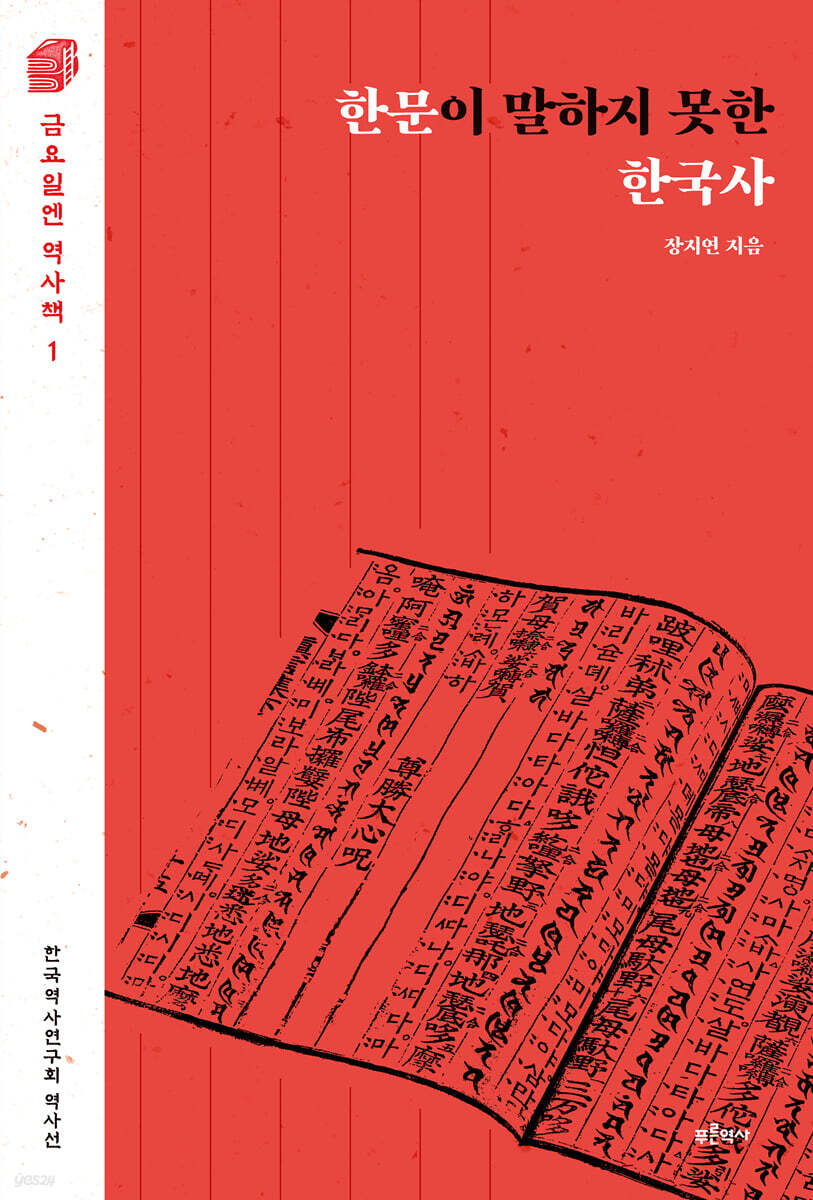
Korean history that Chinese characters cannot tell
 |
Description
Book Introduction
Hyangchal, Hangul, Hanmun… Korean history somewhere in between
Imagining Korean History Differently
If language disappears, what happens to the "reality" it contains?
In 2021, Rodrigo Kamahanlier, a biologist at the University of Zurich in Switzerland, and others published a study in the Proceedings of the National Academy of Sciences of the United States of America (PNAS) that found that medical knowledge related to traditional herbal medicines was in danger of disappearing.
Less than 5 percent of indigenous plants used for medicinal purposes are classified as endangered.
So, what basis did Rodrigo Kamahanli and others have for their warnings of a crisis? Their warning was that the humans who possessed knowledge about the plants, rather than the plants themselves, were at risk of losing their knowledge as the plants faced a crisis.
Most knowledge about medicinal herbs is known only in certain languages, and as the tribes that speak these languages are in danger of extinction, this knowledge is also at risk of disappearing (Hankyoreh, June 14, 2021).
If the language that identifies and gives meaning to medicinal herbs disappears, wouldn't that mean, even if the herbs actually exist, they don't exist to humans? If language disappears, wouldn't the "reality" it embodies also disappear? Thus, despite the profound meaning language carries, we tend to take it for granted because it's so familiar.
If language contains reality and the past can only be recognized through language, then various languages/scripts can show various realities of the past.
Imagining Korean History Differently
If language disappears, what happens to the "reality" it contains?
In 2021, Rodrigo Kamahanlier, a biologist at the University of Zurich in Switzerland, and others published a study in the Proceedings of the National Academy of Sciences of the United States of America (PNAS) that found that medical knowledge related to traditional herbal medicines was in danger of disappearing.
Less than 5 percent of indigenous plants used for medicinal purposes are classified as endangered.
So, what basis did Rodrigo Kamahanli and others have for their warnings of a crisis? Their warning was that the humans who possessed knowledge about the plants, rather than the plants themselves, were at risk of losing their knowledge as the plants faced a crisis.
Most knowledge about medicinal herbs is known only in certain languages, and as the tribes that speak these languages are in danger of extinction, this knowledge is also at risk of disappearing (Hankyoreh, June 14, 2021).
If the language that identifies and gives meaning to medicinal herbs disappears, wouldn't that mean, even if the herbs actually exist, they don't exist to humans? If language disappears, wouldn't the "reality" it embodies also disappear? Thus, despite the profound meaning language carries, we tend to take it for granted because it's so familiar.
If language contains reality and the past can only be recognized through language, then various languages/scripts can show various realities of the past.
- You can preview some of the book's contents.
Preview
index
Entering
fishy smell, gamey smell, raw smell, military smell
Since when did humans start using letters like that?
01_Different worlds revealed by different characters
Unique knowledge that may have been lost
The different Hanyangs in 《Han-gyeong-ji-ryak》 and 〈Han-yang-ga〉
Seoul, and the countless Chinese characters that refer to Seoul
02_From the era of Idu and Hyangchal to the era of Chinese characters
Idu, Hyangchal, and Gugyeol, written for 1,400 years
Hyangga and Hansi, hanging side by side
The loan system that Uicheon and Kim Bu-sik were displeased with
Goryeo transmitted Chinese culture to Mongolia.
03_The Beginning of Hangul, an Unexpected Success
Did Hunminjeongeum suddenly appear?
The rapidly increasing number of 'educated people'
Hunminjeongeum, which even includes dialects
Beyond Fonts and Writing Instruments, Type and Technology
04_The gap in Joseon society opened by the vernacular
During the reign of King Jeongjo, even noblemen used Hangul.
Women, dreaming of immortality, scream
Transforming Family Life and Relationships
A new reading that grows from change
Coming out
References
Search
fishy smell, gamey smell, raw smell, military smell
Since when did humans start using letters like that?
01_Different worlds revealed by different characters
Unique knowledge that may have been lost
The different Hanyangs in 《Han-gyeong-ji-ryak》 and 〈Han-yang-ga〉
Seoul, and the countless Chinese characters that refer to Seoul
02_From the era of Idu and Hyangchal to the era of Chinese characters
Idu, Hyangchal, and Gugyeol, written for 1,400 years
Hyangga and Hansi, hanging side by side
The loan system that Uicheon and Kim Bu-sik were displeased with
Goryeo transmitted Chinese culture to Mongolia.
03_The Beginning of Hangul, an Unexpected Success
Did Hunminjeongeum suddenly appear?
The rapidly increasing number of 'educated people'
Hunminjeongeum, which even includes dialects
Beyond Fonts and Writing Instruments, Type and Technology
04_The gap in Joseon society opened by the vernacular
During the reign of King Jeongjo, even noblemen used Hangul.
Women, dreaming of immortality, scream
Transforming Family Life and Relationships
A new reading that grows from change
Coming out
References
Search
Into the book
Looking at the flow of human history, the ability to read and understand text can be said to be a relatively recent acquisition and widespread ability.
… … These days, students lament that they don’t even know how to spell properly, but even a hundred years ago, our spelling wasn’t properly established… … We are a very unique generation in human history, and we are WEIRD. It is a very modern phenomenon that anyone can read and write long, formatted texts… … Furthermore, it hasn’t even been a hundred years since a single character, the Korean alphabet, has been representative and represents all of our languages.
--- p.11~13
If language contains reality and the past can only be recognized through language, then various languages/scripts will show various realities of the past.
… … What new past will diverse language/character environments show us?
This book is a thesis that encourages us to think about this together.
--- p.14~5
During the Goryeo Dynasty, there were only borrowed character notation methods such as Idu and Hyangchal, which borrowed the sounds and meanings of Chinese characters along with Chinese characters to write Korean.
However, as time went by, understanding of the borrowed characters declined, and the perception that sentences written in borrowed characters were old-fashioned and low-quality spread.
--- p.21
Indigenous languages and scripts contain indigenous knowledge.
When the indigenous language or its means of expression is lost, that knowledge is also lost.
In our country, such knowledge could have been transmitted through Chinese characters, but it was not easy for various reasons, including the barrier of writing, language, and the hierarchy of knowledge.
So much of the knowledge of the past has now vanished without us even knowing what was lost.
--- p.25
The two books [Yu Bon-ye's "Han-gyeong-ji-ryak" and Hansan Geosa's "Hanyang-ga"] show the different desires of different types of people.
One of them was a noisy depiction of the city's splendor and colorful people, and people loved this story that conveyed a splendid cityscape.
The other one contains the desire to not forget that he is the one who leads the world, even though he is of no use to the world.
In this way, diverse desires and diverse images of Hanyang are conveyed in writings of different genres and characters, and they are passed down to this day.
--- p.36
Looking only at the superficial declarations of Chinese characters, it is meaningful to see that the Joseon people, who seemed to have lived in an environment of vestment and tribute and who were making a fuss to avoid being 'presumptuous,' actually avoided using Chinese characters that clearly revealed their ranks and mainly used alternative words.
Moreover, in the world of our language and spoken language, we lived mainly using words that did not reveal such ranks.
Contrary to our perception, they were not fully assimilated into the world of Han, or they were resisting the pull of assimilation, and still had their own distinct worldview.
--- p.48~9
When we talk about the 'pre-modern era with its dual character life', it is easy to imagine only the use of Hunminjeongeum and Chinese characters.
… … But in fact, the first method of writing the sounds of our language was a borrowed writing method that used the meaning and sound of Chinese characters, such as Hyangchal or Idu.
--- p.54
When the Chaja system was used to write our language, wasn't there a memory it contained that has now been lost? ... ... As we went through the 13th and 14th centuries, the status and content of the Chaja system were not the same as before.
There has been a major change in the status and usability of letters.
It is believed that the tradition of recording the entire Korean language phonetically using the loanwords as in Hyangchal was virtually cut off around this time.
In this way, the culture of the national-Buddhist-teacher system also began to be forgotten.
--- p.55~58
During the Mongol Empire, Koryo people did not just stand on the linear line between Mongolia and Koryo, but they were also the mediators of the triangular relationship between Mongolian culture, Koryo culture, and Korean culture, and the triangular relationship between Mongolian language, Koryo language, and Han language.
The reason Goryeo's desire for Chinese characters as a universal language grew during this era is because Goryeo people actively utilized and understood Chinese characters during the process of mediation.
--- p.82~3
Basically, the birth of writing is directly related to the birth of civilization and nation.
As anthropologist Jack Goody has argued, building a sophisticated bureaucracy and managing complex administrative and financial tasks would be impossible without the power of writing.
For a nation's central power to extend to the periphery, it is impossible without the smooth exchange of information between the center and the provinces, and writing is essential for this.
--- p.87
King Sejong's creation of Hunminjeongeum also does not deviate significantly from the trend of 'creating writing after establishing a nation'.
--- p.88
Sejong's ambition was aimed at something higher.
Rather than simply thinking of something that “the people could easily use,” he attempted to translate the scriptures containing the words of the saints into Korean and even correct the pronunciation of Chinese characters.
--- p.91
Hunminjeongeum was spread with great momentum.
Considering that throughout the Joseon Dynasty, it was considered inferior to Chinese characters, and that knowing it did not necessarily lead to great success, its spread was surprising.
--- p.96
When Hunminjeongeum was used as the basis for character education, the time spent teaching Chinese characters was drastically reduced.
Here's a comparative example to give you an idea of how much could have been reduced.
This is a literacy campaign in China in the 1950s.
--- p.104
It is easy to think schematically that during the Joseon Dynasty, only women used Hunminjeongeum and elite men looked down on it and did not use it, but in fact, Hunminjeongeum was the basis of all literacy education, although it was not revealed.
Whether male or female, when they began learning to read and write, they first learned Hangul, and elite males also moved on to study Chinese characters based on this.
The only difference was whether Hangul was used in official sectors or not.
--- p.104
Is sensitivity to dialect inherent and natural? Here, I propose that it may not have been inherent, but rather that the creation of Hunminjeongeum served as a catalyst for heightened sensitivity in the transcription of spoken sounds.
… … In a time when the momentum of native Korean songs was fading and Chinese-style songs with the same style of singing were popular, would it have been possible to preserve our language, which distinguishes between ‘malrangmalrang’, ‘molrangmolrang’, and ‘mulleongmulleong’, without Hunminjeongeum?
--- p.111~114
When looking at the upper class elite, the literary lives of men and women were different.
In that respect, the literary life of the Joseon Dynasty was gendered.
However, the difference should not be understood as a structure such as 'men's use of Chinese characters' and 'women's use of Hangul', but rather as a difference in attitudes and methods toward using Hangul even though both used it.
--- p.136~37
One can imagine a meeting where all the family members gathered together to formulate the logic and wording, and to decide on Mrs. Kim as the person in question. At this time, it is necessary to fully consider the political significance of the choice to use the Korean language as the text and format for the petition.
… … Didn't the Noron women who read Mrs. Kim's letter leverage their gender to inform their political strategies? It would be narrow-minded to interpret this phenomenon simply as indicating that some women participated in politics.
Rather, we must recognize that the politics of this period were driven by women's political participation.
--- p.141
The reason women from noble families in Yeongnam copied classical novels with Jo Seong's handwriting was because they had a strong desire to preserve and commemorate the handwriting beyond simply appreciating the work.
… … The awareness of immortality through letters also influences the active awareness and praise of one’s own genealogy.
… … When my grandmother came to get married, she brought your family tree with her.
In the past, when a person got married, the son-in-law's name was listed in the family tree instead of the daughter's name.
Your grandmother brought you the last and only version of the genealogy that included your name.
The memory of genealogy is another face of the desire for immortality.
--- p.145~147
The natural mingling of men and women in a family through novel readings or translations, the closeness of fathers and daughters, husbands and wives through Korean translation, and the formation of their own league through novel reading or lyric writing.
But are these family routines universal, or are they historical? The scope of the family and the way attachments are formed change socially and historically.
--- p.159
Throughout the Joseon Dynasty, while Chinese characters were the true writing system and the only meaningful 'letter', Hunminjeongeum was looked down upon and called 'Angeul' or 'Amkeul', meaning 'a woman's writing system' or 'Eonmun', meaning 'a woman's writing system'.
This was something that all Koreans living at the time knew, and it was something that all foreigners who came to Korea in the late 19th and early 20th centuries witnessed.
There were some who occasionally argued that “Hunminjeongeum has its own uses” and “it is better than Chinese characters in some ways,” but such people were rare.
It is true that Hangul was looked down upon, but there was a world of Hangul that was possible thanks to these changes.
--- p.161
Change is also a realm of new possibilities.
Various cultures fuse to create new ones, central ideologies disintegrate, and existing hierarchical order is overturned.
Hangul represented a shift in the hegemony of writing systems, and its significance is worth exploring.
--- p.169
What I want to suggest in this article is neither a strict disclosure of the reality of language and writing, nor is it an attempt to present a conclusion about what the reality of a certain language/writing was like in a certain era.
The important thing is to consider how we can ask new and meaningful questions through Korean history.
My small wish is that this article will broaden the boundaries of historical imagination, even if only a little.
… … These days, students lament that they don’t even know how to spell properly, but even a hundred years ago, our spelling wasn’t properly established… … We are a very unique generation in human history, and we are WEIRD. It is a very modern phenomenon that anyone can read and write long, formatted texts… … Furthermore, it hasn’t even been a hundred years since a single character, the Korean alphabet, has been representative and represents all of our languages.
--- p.11~13
If language contains reality and the past can only be recognized through language, then various languages/scripts will show various realities of the past.
… … What new past will diverse language/character environments show us?
This book is a thesis that encourages us to think about this together.
--- p.14~5
During the Goryeo Dynasty, there were only borrowed character notation methods such as Idu and Hyangchal, which borrowed the sounds and meanings of Chinese characters along with Chinese characters to write Korean.
However, as time went by, understanding of the borrowed characters declined, and the perception that sentences written in borrowed characters were old-fashioned and low-quality spread.
--- p.21
Indigenous languages and scripts contain indigenous knowledge.
When the indigenous language or its means of expression is lost, that knowledge is also lost.
In our country, such knowledge could have been transmitted through Chinese characters, but it was not easy for various reasons, including the barrier of writing, language, and the hierarchy of knowledge.
So much of the knowledge of the past has now vanished without us even knowing what was lost.
--- p.25
The two books [Yu Bon-ye's "Han-gyeong-ji-ryak" and Hansan Geosa's "Hanyang-ga"] show the different desires of different types of people.
One of them was a noisy depiction of the city's splendor and colorful people, and people loved this story that conveyed a splendid cityscape.
The other one contains the desire to not forget that he is the one who leads the world, even though he is of no use to the world.
In this way, diverse desires and diverse images of Hanyang are conveyed in writings of different genres and characters, and they are passed down to this day.
--- p.36
Looking only at the superficial declarations of Chinese characters, it is meaningful to see that the Joseon people, who seemed to have lived in an environment of vestment and tribute and who were making a fuss to avoid being 'presumptuous,' actually avoided using Chinese characters that clearly revealed their ranks and mainly used alternative words.
Moreover, in the world of our language and spoken language, we lived mainly using words that did not reveal such ranks.
Contrary to our perception, they were not fully assimilated into the world of Han, or they were resisting the pull of assimilation, and still had their own distinct worldview.
--- p.48~9
When we talk about the 'pre-modern era with its dual character life', it is easy to imagine only the use of Hunminjeongeum and Chinese characters.
… … But in fact, the first method of writing the sounds of our language was a borrowed writing method that used the meaning and sound of Chinese characters, such as Hyangchal or Idu.
--- p.54
When the Chaja system was used to write our language, wasn't there a memory it contained that has now been lost? ... ... As we went through the 13th and 14th centuries, the status and content of the Chaja system were not the same as before.
There has been a major change in the status and usability of letters.
It is believed that the tradition of recording the entire Korean language phonetically using the loanwords as in Hyangchal was virtually cut off around this time.
In this way, the culture of the national-Buddhist-teacher system also began to be forgotten.
--- p.55~58
During the Mongol Empire, Koryo people did not just stand on the linear line between Mongolia and Koryo, but they were also the mediators of the triangular relationship between Mongolian culture, Koryo culture, and Korean culture, and the triangular relationship between Mongolian language, Koryo language, and Han language.
The reason Goryeo's desire for Chinese characters as a universal language grew during this era is because Goryeo people actively utilized and understood Chinese characters during the process of mediation.
--- p.82~3
Basically, the birth of writing is directly related to the birth of civilization and nation.
As anthropologist Jack Goody has argued, building a sophisticated bureaucracy and managing complex administrative and financial tasks would be impossible without the power of writing.
For a nation's central power to extend to the periphery, it is impossible without the smooth exchange of information between the center and the provinces, and writing is essential for this.
--- p.87
King Sejong's creation of Hunminjeongeum also does not deviate significantly from the trend of 'creating writing after establishing a nation'.
--- p.88
Sejong's ambition was aimed at something higher.
Rather than simply thinking of something that “the people could easily use,” he attempted to translate the scriptures containing the words of the saints into Korean and even correct the pronunciation of Chinese characters.
--- p.91
Hunminjeongeum was spread with great momentum.
Considering that throughout the Joseon Dynasty, it was considered inferior to Chinese characters, and that knowing it did not necessarily lead to great success, its spread was surprising.
--- p.96
When Hunminjeongeum was used as the basis for character education, the time spent teaching Chinese characters was drastically reduced.
Here's a comparative example to give you an idea of how much could have been reduced.
This is a literacy campaign in China in the 1950s.
--- p.104
It is easy to think schematically that during the Joseon Dynasty, only women used Hunminjeongeum and elite men looked down on it and did not use it, but in fact, Hunminjeongeum was the basis of all literacy education, although it was not revealed.
Whether male or female, when they began learning to read and write, they first learned Hangul, and elite males also moved on to study Chinese characters based on this.
The only difference was whether Hangul was used in official sectors or not.
--- p.104
Is sensitivity to dialect inherent and natural? Here, I propose that it may not have been inherent, but rather that the creation of Hunminjeongeum served as a catalyst for heightened sensitivity in the transcription of spoken sounds.
… … In a time when the momentum of native Korean songs was fading and Chinese-style songs with the same style of singing were popular, would it have been possible to preserve our language, which distinguishes between ‘malrangmalrang’, ‘molrangmolrang’, and ‘mulleongmulleong’, without Hunminjeongeum?
--- p.111~114
When looking at the upper class elite, the literary lives of men and women were different.
In that respect, the literary life of the Joseon Dynasty was gendered.
However, the difference should not be understood as a structure such as 'men's use of Chinese characters' and 'women's use of Hangul', but rather as a difference in attitudes and methods toward using Hangul even though both used it.
--- p.136~37
One can imagine a meeting where all the family members gathered together to formulate the logic and wording, and to decide on Mrs. Kim as the person in question. At this time, it is necessary to fully consider the political significance of the choice to use the Korean language as the text and format for the petition.
… … Didn't the Noron women who read Mrs. Kim's letter leverage their gender to inform their political strategies? It would be narrow-minded to interpret this phenomenon simply as indicating that some women participated in politics.
Rather, we must recognize that the politics of this period were driven by women's political participation.
--- p.141
The reason women from noble families in Yeongnam copied classical novels with Jo Seong's handwriting was because they had a strong desire to preserve and commemorate the handwriting beyond simply appreciating the work.
… … The awareness of immortality through letters also influences the active awareness and praise of one’s own genealogy.
… … When my grandmother came to get married, she brought your family tree with her.
In the past, when a person got married, the son-in-law's name was listed in the family tree instead of the daughter's name.
Your grandmother brought you the last and only version of the genealogy that included your name.
The memory of genealogy is another face of the desire for immortality.
--- p.145~147
The natural mingling of men and women in a family through novel readings or translations, the closeness of fathers and daughters, husbands and wives through Korean translation, and the formation of their own league through novel reading or lyric writing.
But are these family routines universal, or are they historical? The scope of the family and the way attachments are formed change socially and historically.
--- p.159
Throughout the Joseon Dynasty, while Chinese characters were the true writing system and the only meaningful 'letter', Hunminjeongeum was looked down upon and called 'Angeul' or 'Amkeul', meaning 'a woman's writing system' or 'Eonmun', meaning 'a woman's writing system'.
This was something that all Koreans living at the time knew, and it was something that all foreigners who came to Korea in the late 19th and early 20th centuries witnessed.
There were some who occasionally argued that “Hunminjeongeum has its own uses” and “it is better than Chinese characters in some ways,” but such people were rare.
It is true that Hangul was looked down upon, but there was a world of Hangul that was possible thanks to these changes.
--- p.161
Change is also a realm of new possibilities.
Various cultures fuse to create new ones, central ideologies disintegrate, and existing hierarchical order is overturned.
Hangul represented a shift in the hegemony of writing systems, and its significance is worth exploring.
--- p.169
What I want to suggest in this article is neither a strict disclosure of the reality of language and writing, nor is it an attempt to present a conclusion about what the reality of a certain language/writing was like in a certain era.
The important thing is to consider how we can ask new and meaningful questions through Korean history.
My small wish is that this article will broaden the boundaries of historical imagination, even if only a little.
--- p.175
Publisher's Review
Walking through Korean history through language and characters
The first book in the newly planned 'History Books on Fridays' (History Line of the Korean History Research Association) series, 'Korean History Unspoken in Chinese Characters', seeks to answer these questions by examining the languages and characters we used in the past, such as Idu, Hyangchal, Gugyeol, Chinese characters, Hangeul, and Eonmun, and thereby broaden the boundaries of imagination about Korean history.
Author Jang Ji-yeon (Professor of History and Culture at Hyehwa Liberal Arts College, Daejeon University), who is interested in examining the historical nature of space through language, rituals, and ideology, comprehensively examines the history of our language/letters, including how we transitioned from the era of Idu and Hyangchal to the era of Chinese characters, how Hangul emerged in the era of Chinese characters, and what uses Hangul experienced after its emergence.
Through various examples, it easily answers various questions surrounding language/letters, such as how letters are created and disappear, how the perspective on an object changes depending on which letters are used, how letters assign political and social ranks and distinguish differences, and how the emergence of new letters changes society.
Rich examples and interesting arguments
The world of our past language and writing, as guided by the author, is unfamiliar but fascinating.
Through Yu Bon-ye's prose "Hangyeongjiryak" written in Chinese characters and Hansan Geosa's verse "Hanyangga" written in Korean, we can see how the appearance of Hanyang in the 19th century was depicted differently depending on the character and how the author's desires were projected differently depending on the character.
It contrasts how Chinese characters and Chinese characters distinguished ranks between nations and how this corresponded to the feudalistic order of investiture and tribute, while the world of spoken language and Hangul was indifferent to such order.
The author's reflections on Hangul are particularly meaningful in that they remove prejudices about Hangul.
Throughout the Joseon Dynasty, Chinese characters were “treated as true writing and the only meaningful ‘letter’” while Hunminjeongeum was considered a ‘letter’ that was “looked down upon and called ‘An-geul’ or ‘Am-keul’, meaning ‘written by women’ or ‘Eonmun,’ or ‘Eon-seo.’”
However, the author says that Hunminjeongeum was “the basis of all written education, though it was not revealed” and showed remarkable spread.
“It is easy to think schematically that only women used Hunminjeongeum during the Joseon Dynasty and elite men looked down on it and did not use it,” but in reality, “the only difference was whether Hangeul was used in official sectors or not,” he emphasizes, “whether men or women, when they began literacy education, they learned Hangeul first, and elite men also moved on to study Chinese characters based on this.”
It is a continuation of freshness and surprise.
The author poses the question, “What kind of new past will diverse language/character environments show us?” and says that this book is “a thesis that encourages us to think about this together.”
Although short, this book is worthy of being considered a thesis in that it raises various questions related to language and writing and explores a new world of Korean history through ample examples.
I am confident that many readers will sympathize with the author's "small wish" that this book "expands the boundaries of historical imagination, even if only a little."
The first book in the newly planned 'History Books on Fridays' (History Line of the Korean History Research Association) series, 'Korean History Unspoken in Chinese Characters', seeks to answer these questions by examining the languages and characters we used in the past, such as Idu, Hyangchal, Gugyeol, Chinese characters, Hangeul, and Eonmun, and thereby broaden the boundaries of imagination about Korean history.
Author Jang Ji-yeon (Professor of History and Culture at Hyehwa Liberal Arts College, Daejeon University), who is interested in examining the historical nature of space through language, rituals, and ideology, comprehensively examines the history of our language/letters, including how we transitioned from the era of Idu and Hyangchal to the era of Chinese characters, how Hangul emerged in the era of Chinese characters, and what uses Hangul experienced after its emergence.
Through various examples, it easily answers various questions surrounding language/letters, such as how letters are created and disappear, how the perspective on an object changes depending on which letters are used, how letters assign political and social ranks and distinguish differences, and how the emergence of new letters changes society.
Rich examples and interesting arguments
The world of our past language and writing, as guided by the author, is unfamiliar but fascinating.
Through Yu Bon-ye's prose "Hangyeongjiryak" written in Chinese characters and Hansan Geosa's verse "Hanyangga" written in Korean, we can see how the appearance of Hanyang in the 19th century was depicted differently depending on the character and how the author's desires were projected differently depending on the character.
It contrasts how Chinese characters and Chinese characters distinguished ranks between nations and how this corresponded to the feudalistic order of investiture and tribute, while the world of spoken language and Hangul was indifferent to such order.
The author's reflections on Hangul are particularly meaningful in that they remove prejudices about Hangul.
Throughout the Joseon Dynasty, Chinese characters were “treated as true writing and the only meaningful ‘letter’” while Hunminjeongeum was considered a ‘letter’ that was “looked down upon and called ‘An-geul’ or ‘Am-keul’, meaning ‘written by women’ or ‘Eonmun,’ or ‘Eon-seo.’”
However, the author says that Hunminjeongeum was “the basis of all written education, though it was not revealed” and showed remarkable spread.
“It is easy to think schematically that only women used Hunminjeongeum during the Joseon Dynasty and elite men looked down on it and did not use it,” but in reality, “the only difference was whether Hangeul was used in official sectors or not,” he emphasizes, “whether men or women, when they began literacy education, they learned Hangeul first, and elite men also moved on to study Chinese characters based on this.”
It is a continuation of freshness and surprise.
The author poses the question, “What kind of new past will diverse language/character environments show us?” and says that this book is “a thesis that encourages us to think about this together.”
Although short, this book is worthy of being considered a thesis in that it raises various questions related to language and writing and explores a new world of Korean history through ample examples.
I am confident that many readers will sympathize with the author's "small wish" that this book "expands the boundaries of historical imagination, even if only a little."
GOODS SPECIFICS
- Date of issue: June 26, 2023
- Page count, weight, size: 188 pages | 316g | 140*205*13mm
- ISBN13: 9791156122531
- ISBN10: 1156122538
You may also like
카테고리
korean


korean

![GQ KOREA Mark (Monthly): December [2025]](http://librairie.coreenne.fr/cdn/shop/files/8ef265dbbfbf186523ed75ba7319009d.jpg?v=1765340328&width=3840)


