

The Story of Chemistry That Changed World History 2
 |
Description
Book Introduction
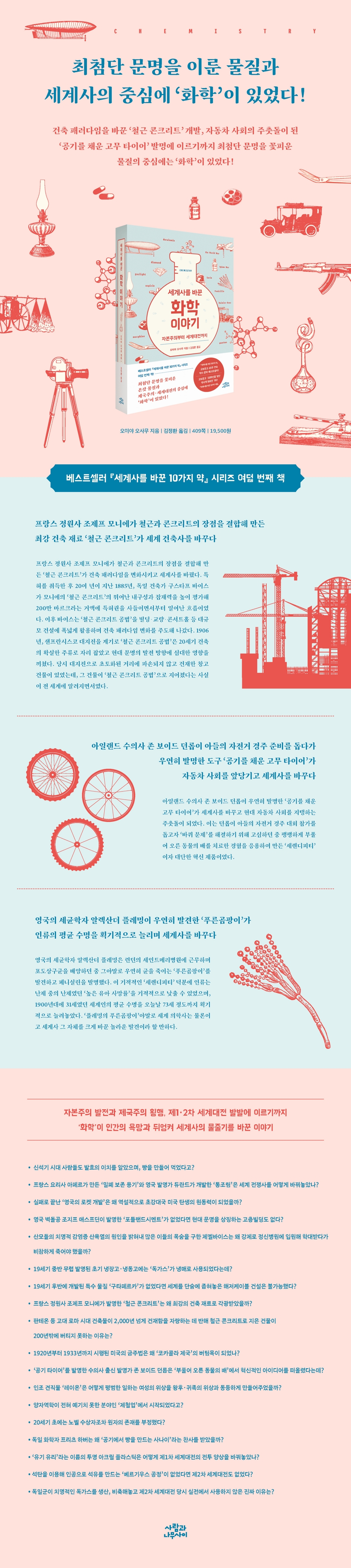
The development of 'reinforced concrete', which changed the architectural paradigm, became the cornerstone of the automobile society.
The cutting-edge civilization blossomed, leading to the invention of the 'pneumatic rubber tire'.
At the center of matter was 'chemistry'!
French gardener Joseph Monnier created 'reinforced concrete' by combining the advantages of steel and concrete, which changed the architectural paradigm and turned the tide of world history.
This change began in 1885, 19 years after obtaining the patent, when German architect Gustav Weiss, highly acknowledging the outstanding durability and potential of Monier's 'reinforced concrete', purchased the patent rights for the enormous sum of 2 million marks.
Since then, Vice has been leading the change in the architectural paradigm by widely utilizing the 'reinforced concrete method' for large-scale construction such as buildings, bridges, and concert halls.
In 1906, the Great San Francisco Earthquake established reinforced concrete construction as a definite mainstream of 20th-century architecture and had a profound impact on the development of modern civilization.
What happened in the San Francisco earthquake? Amidst the devastated streets, a warehouse building remained undamaged, and the fact that it was built using reinforced concrete became known worldwide.
The accidental invention of the pneumatic rubber tire by Irish veterinarian John Boyd Dunlop changed world history and became the cornerstone of the modern automobile society.
This was a 'serendipity' and a great innovation product that Dunlop created by applying his experience of treating bloated animal bellies while struggling to solve the 'wheel problem' to help his son participate in a bicycle race.
This book is full of exciting and brain-stimulating stories about chemistry, including the story of the French chef Appert's "airtight preservation container" and the British inventor Durand's invention of "canned food," which changed the history of war by solving the problem of long-term food preservation that mankind had been unable to solve for thousands of years; the ironic story of how Britain's "failure in rocket development" became the driving force behind the birth of the United States as a superpower; the chilling story of how "poison gas" was used as a refrigerant in the early days of refrigerators and freezers; the story of "organic glass," a transparent acrylic plastic that changed the battlefield of World War I; and the story of "improved gasoline," which was the key to victory in World War II.
The cutting-edge civilization blossomed, leading to the invention of the 'pneumatic rubber tire'.
At the center of matter was 'chemistry'!
French gardener Joseph Monnier created 'reinforced concrete' by combining the advantages of steel and concrete, which changed the architectural paradigm and turned the tide of world history.
This change began in 1885, 19 years after obtaining the patent, when German architect Gustav Weiss, highly acknowledging the outstanding durability and potential of Monier's 'reinforced concrete', purchased the patent rights for the enormous sum of 2 million marks.
Since then, Vice has been leading the change in the architectural paradigm by widely utilizing the 'reinforced concrete method' for large-scale construction such as buildings, bridges, and concert halls.
In 1906, the Great San Francisco Earthquake established reinforced concrete construction as a definite mainstream of 20th-century architecture and had a profound impact on the development of modern civilization.
What happened in the San Francisco earthquake? Amidst the devastated streets, a warehouse building remained undamaged, and the fact that it was built using reinforced concrete became known worldwide.
The accidental invention of the pneumatic rubber tire by Irish veterinarian John Boyd Dunlop changed world history and became the cornerstone of the modern automobile society.
This was a 'serendipity' and a great innovation product that Dunlop created by applying his experience of treating bloated animal bellies while struggling to solve the 'wheel problem' to help his son participate in a bicycle race.
This book is full of exciting and brain-stimulating stories about chemistry, including the story of the French chef Appert's "airtight preservation container" and the British inventor Durand's invention of "canned food," which changed the history of war by solving the problem of long-term food preservation that mankind had been unable to solve for thousands of years; the ironic story of how Britain's "failure in rocket development" became the driving force behind the birth of the United States as a superpower; the chilling story of how "poison gas" was used as a refrigerant in the early days of refrigerators and freezers; the story of "organic glass," a transparent acrylic plastic that changed the battlefield of World War I; and the story of "improved gasoline," which was the key to victory in World War II.
- You can preview some of the book's contents.
Preview
index
Introduction_ From 'airtight preservation containers' and 'canned food', 'reinforced concrete', 'gutta-percha' (insulating material for submarine cables), 'pneumatic rubber tires', and even 'rayon' (man-made silk fabric), 'chemistry' was at the center of the substances and materials that created cutting-edge civilization!
1 History of Chemistry
From capitalism to imperialism
† 1804
Invention of food preservation technology - Humanity's wisdom in sterilizing and preserving food
Formaldehyde, a substance that protects living things by attacking and destroying bacteria and fungi; Nicolas Appert, a chef who invented airtight storage containers and changed the world of cooking and the history of war; Peter Durand, a British inventor who completed the millennia-old challenge of long-term food preservation with the innovative technology of canning.
† 1806
The Tragedy of Alkali Manufacturing: A Betrayed Invention
France faced a serious alkali shortage due to the British naval blockade | Le Blanc, a doctor-turned-chemist who invented an innovative sodium carbonate production method but lost both his money and reputation and committed suicide with a pistol | Britain, which accelerated the rapid development of the chemical industry by utilizing the Le Blanc process, which France had neglected
† 1808
Modern Atomic Theory - Dalton Advocates Modern Atomic Theory
Dalton, the British scientist who revived the word "atom," which originated in ancient Greece, in modern times | Why was Dalton's element symbol not widely used, unlike Berzelius's?
† 1809
A Chemical Perspective on Agriculture: The Beginning of Modern Capitalist Farming
The Norfolk method of dividing farmland into equal parts and rotating crops dramatically improved productivity. Albrecht Thaer, a German agronomist who pursued modernization by incorporating economics into agriculture.
† 1811
Molecular theory so far ahead of its time—a genius ignored for 50 years before being rediscovered
What chemical reactions can't be explained even by Dalton's atomic theory? | Avogadro's molecular theory, completely ignored by the chemistry community for 50 years
† 1812
The Defeat of Napoleon's Army: The Invincible French Army Failed in the Face of Infectious Disease
Typhus, the terrifying infectious disease that even brought down the "god of war," Napoleon.
† 1812
Gaslights that illuminate the darkness - sending energy through pipes
Murdoch's Gaslight, born from the development of the steel industry, changed world history.
† 1814
Rocket development ended in failure
─ Was the British rocket failure a small driving force for the superpower America?
The U.S. presidential residence was renamed the "White House" because it was burned down by a British rocket attack during the Revolutionary War? | The Battle of Fort McHenry in Baltimore Harbor, which changed the course of the American Civil War | The failure of British rocket weapons was a key factor in the emergence of the United States as a modern-day superpower?
† 1824
The Resurrection of Cement: How Invisible Theory Supports Massive Structures
John Smeaton, a civil engineer who pioneered the field of "fired cement" during the construction of a stone lighthouse and changed the history of global architecture; Joseph Aspdin, a British bricklayer who developed "Portland cement" and made possible the construction of skyscrapers that symbolize modern civilization.
† 1825
The birth of a groundbreaking rubber product—the rubber era begins to change the world.
Charles Mackintosh, who succeeded in industrializing coal tar, which was once called the "devil's substance" and was considered a nuisance, by making it into a waterproof cloth.
† 1827
The Invention of Photography - Photographic Technology Also Used in Semiconductor Manufacturing
Did 17th-century Dutch painter Vermeer even use a camera obscura to paint? | Photolithography technology creates semiconductors by engraving devices like 1 million diodes onto silicon smaller than a postage stamp.
† 1834
Analyzing Coal Tar: Discovering Values No One Could Imagine
Friedlich Runge, the German chemist who extracted the artificial dyes phenol and aniline from coal tar, a nuisance, and turned it into a treasure island. Which chemist recognized the value of Runge's two innovative inventions, phenol and aniline, which were ignored by everyone, and achieved success?
† 1837
The Practical Application of Photography: Silver Halide Photography, Color Photography, and the Evolution of Digital Cameras
The daguerreotype, an invention by French chemist Daguerre that paved the way for the practical application of photography.
† 1839
Rubber Practical Applications ─ The Age of Rubber, the Support of Modern Civilization
Charles Goodyear, the American inventor who persistently challenged himself to commercialize rubber and succeeded in developing a rubber with elasticity and durability | Goodyear's accidental discovery of the "vulcanization method" sparked a global craze for new rubber materials | 30,000 Native Americans sacrificed to obtain 4,000 tons of raw rubber? | What are the two structures of polyisoprene, the giant molecule that makes up rubber?
† 1839
Opium Wars - The Chinese Empire's collapse before Britain's overwhelming naval power
Two historical trends created by the Chinese merchants' monopoly on tea: the 'Opium Wars' and the birth of Indian tea, 'Assam black tea and Darjeeling black tea' | The Taiping Rebellion, which broke out as a result of the Opium Wars, resulted in a great disaster that killed 20 million people | The reason why China's firearms improvement was bound to be slower than that of the European powers | Why did Serturner name the substance isolated from the poppy extract 'morphine' after the Greek god of dreams?
† 1841
The Convergence of Agriculture and Chemistry: The Era of Industrially Synthetic Fertilizers Arrives
Why did the bicycle get invented due to the effects of climate change? | The era of industrially synthesized fertilizers begins.
† 1845
The End of Black Powder: A New Age of Gunpowder
The desperate reason why European armies had to become increasingly extravagant | The miraculous invention that came about by chance from an apron used to wipe off nitric and sulfuric acid | The decisive reason why Schönbein's "cotton powder" became a practical new explosive.
† 1846
Ether Anesthesia Surgery - The Era of Painless Surgery
Horace Wells, a dentist who successfully developed an anesthetic using nitrous oxide gas; William Morton, a dentist who successfully removed a jaw tumor by anesthetizing a patient with ether.
† 1846
The discovery of nitroglycerin—a major contribution to the later establishment of the Nobel Prize.
Nitroglycerin, a groundbreaking angina treatment | The tiny amounts of nitric oxide it produces dilate blood vessels, preventing angina attacks? | How can highly explosive nitroglycerin be used to extinguish oilfield fires?
† 1847
Invention of a Disinfection Method - Saving the Lives of Many Mothers Through Disinfection and Hospital Infection Prevention
Semmelweis, a physician and scientist who first taught humanity the importance of simple disinfection, such as handwashing, to prevent infectious diseases | An era when childbirth was a life-threatening event | Hypochlorous acid destroys pathogens by stealing electrons from their tissues and changing their molecular structure | Semmelweis, who was expelled from the medical community for revealing that doctors' hands had been a medium for transmitting puerperal fever
† 1851
Invention of the refrigeration system—mechanical ice making and mechanical refrigeration made transportation possible.
John Gorrie, an American physician and scientist who invented the groundbreaking refrigerator and freezer, lived a miserable life. Is it true that early refrigerators used poison gas?
† 1853
Perry's Inner Harbor and Whaling ─ The Main Source of Lamp Oil Changed from Whale Oil to Petroleum
Why did the surge in demand for margarine in the 20th century lead to whale suffering?
† 1855
New Steel Technology: Laying the Foundation for Technology That Will Significantly Contribute to the Development of the Steel Industry
Henry Bessemer, the British inventor who invented the technology that laid the foundation for the electric furnace and revolutionized ironmaking | Why were Bessemer's electric furnaces initially met with a barrage of complaints? | How did court clerk Sidney Thomas solve this conundrum?
† 1855
Aluminum Rod - The Age of Aluminum Arrives as Mass Production Becomes Possible 113
It costs as much to produce one gram of aluminum as it does to produce one kilogram of pure gold? | Why aluminum manufacturing is incomparably more difficult than any other metal.
† 1856
The Birth of Synthetic Dye: A Chance Discovery Leads to the Birth of Chemical Companies That Changed World History
Prussia, which devoted itself to improving science and technology and modernization after being defeated by Napoleon's army in half a day | Hoffmann, a German chemist who devoted himself to research, believing that 'coal tar research is a treasure trove of organic substances' | Hoffmann, who attempted to synthesize quinine molecules to eradicate malaria, a terrifying infectious disease that even defeated Alexander the Great | Why did the British stationed in colonial India make tonic water with cinchona bark extract? | The Perkins, who amassed enormous wealth by accidentally discovering a synthetic dye while experimenting with the artificial synthesis of quinine | Why did synthetic dyes fail to develop in Britain despite Perkin's invention of synthetic dyes and pioneering a new industrial field? | Famous German chemical companies that emerged in the late 19th century and became the driving force that 'changed world history' | Greve and Libermann, who were the first to succeed in artificially synthesizing molecules that are exactly the same as natural dyes
† Around 1860
Unraveling the Principles of Fermentation: Achievements of Pasteur, the "Father of Microbiology"
Pasteur is the historical figure who coined the term "vaccine"? | Pasteur proved that microorganisms cause decay and that life cannot be born from a state of nothingness.
† 1861
Mass production of alkaline products: Inventing and patenting a smart manufacturing method.
Solvay, who became a tycoon by inventing the alkaline manufacturing method, held the "Solvay Conference" and sponsored Marie Curie, Einstein, and others, advancing quantum mechanics. | How did "sesquicarbonate" come to replace the Solvay process?
† 1865
Aseptic Surgery – The Era of Safe Surgery
Joseph Lister, the surgeon who established the concept of "sterilization" and contributed greatly to the birth of modern medicine | Why did Lister praise Semmelweis as "the great inventor of antisepsis"?
† 1866
The invention of dynamite—the enormous wealth gained from explosives contributed to the advancement of science.
Nobel discovered that impregnating diatomaceous earth with nitroglycerin stabilized and controlled explosions. | How Nobel's invention, dynamite, changed the world map.
† 1866
German Unification: The Birth of a Giant Conglomerate
An ironic era in which both enemy and friendly forces fought wars using the same manufacturer's artillery | Prussian Chancellor Bismarck, who pursued German unification through a policy of military expansion under the "Blood and Iron Policy" | Both Prussia and Austria fought at Küniggrätz using Krupp cannons, but why did Prussia win a landslide victory?
† 1866
Wireless and Undersea Cables: The Evolution of Long-Distance Communications Makes the World Smaller
Electric wireless communication, fueled by inventions like Volta's battery and Morse's electrical code, changed the course of world history. Gutta-percha, the special material that enabled the construction of submarine cables that instantly narrowed the globe.
† 1866
Diamond Element - There are stars in the universe made of diamond.
Why diamonds were less than a tenth the price of gemstones like sapphires before the advent of diamond polishing | Cecil Rhodes, the "Napoleon of South Africa," who monopolized South Africa's diamonds through cunning methods
† 1867
The invention of reinforced concrete—a symbol of modern civilization
French gardener Joseph Monnier invented "reinforced concrete," the most powerful building material, by combining the strengths of steel and concrete. Why, while ancient Roman concrete structures boasted a 2,000-year durability, reinforced concrete buildings last only 200 years?
† 1869
The substance that governs heredity - Laying the foundation for molecular biology
Vaccine technology, a culmination of astonishing scientific and medical advances | Michel discovered the mysterious acidic substance "nuclein" in the nucleus of white blood cells by analyzing corpses of white blood cells, but unfortunately, his discovery was not recognized.
† 1869
The Meaning of the Periodic Table of Elements - The Chemist Who Created a 'Map' for Material Exploration
A mysterious letter arrived one day from Russia to French chemist Boisbaudran | Mendeleev's periodic table of elements, which established the scientific view of matter that there are certain rules for the combination and reactions of substances.
† 1870
Invention of celluloid – the world's first plant-derived plastic
Hyatt, a printer-turned-inventor who solved the ivory shortage with the first plastic in human history, based on natural cellulose | Why did the once-popular celluloid chemical suddenly lose its popularity and be replaced by new synthetic resins?
† 1879
What is the Guano War? ─ Resources Fuel War
Why Bolivia, a country with no ocean access, can't give up its navy | What is the identity of the "guano" that sparked war between nations?
† 1882
Bordeaux mixture and grapevines - the age of pesticides
Talleyrand-Périgord, who saved France from a near-death experience with his culinary diplomacy | Millarde, the savior who saved wine from extinction by solving the problem of downy mildew.
† 1884
Classifying Bacteria Using the Gram Stain - A Method for Classifying Bacteria into Two Types
Danish bacteriologist Hans Christian Gram, who devised a method of distinguishing transparent cells by staining them with dye when observing them under a microscope.
† 1884
Invention of artificial silk ─ silk-like luster but flammable
Why did the invention of a method to turn cheap, natural cellulose into high-quality fibers like silk become so popular that it led to a disaster?
† 1885
The Invention of the Automobile: How the Automobile Transformed 20th-Century Society
Why is Benz nicknamed the "Father of the Automobile"? | What is the ambitious meaning behind Benz's star-shaped emblem? | The "spark plug," the device that made small gasoline engines possible
† 1885
The Exploitation of Africa: African Societies Destroyed for the Cultivation of Luxury Goods
King Leopold II of Belgium, who purchased Congo with his personal wealth and committed atrocities that reduced the Congolese population by 10 million.
† 1886
Mass production of aluminum - from $10,000 per kilogram to 40 cents
Aluminum traded at a price far higher than pure gold? | The Hall-Héru and Bayer processes, the primary contributors to mass aluminum production.
† 1886
The Birth of Coca-Cola: The 20th-Century Beverage That Changed World History
Coca-Cola inventor John Pemberton vs.
Pepsi-Cola Inventor Caleb Bradham | Without Prohibition, There Would Be No Coca-Cola Empire?!
† 1888
invention of pneumatic tires
─ A tool accidentally invented while helping his son prepare for a bicycle race helped advance the automobile society.
John Boyd Dunlop, a veterinarian turned inventor who came up with the idea of an air-filled tire from a "bloated animal belly."
† 1889
The invention of roll film—a series of inventions that popularized photography.
George Eastman, a banker-turned-inventor who revolutionized photography by developing roll-type paper film | Eastman's camera and film business became the foundation for the invention of the first synthetic plastic and the blossoming of the Hollywood film industry in the 20th century.
† 1889
The Fall of Black Powder: The Collapse of a 1,000-Year-Old System of Dominance
Cordite, a new explosive developed by the inventor of the thermos flask, became the "unsettling seed" of World War II. | The Civil War shifted the paradigm of naval warfare from wooden ships and cannonballs to ironclad ships and armor-piercing shells. | How did Japan, a small nation in Asia, win a naval battle against the mighty Russia?
† 1892
The Fashion Revolution: Advances in Textile Chemistry That Liberated Women and Changed the Era
Viscose, a silk-like thread made from chemically treated wood pulp, revolutionized the textile industry. Rayon, an artificial silk fabric, elevated the status of ordinary working women to that of queens and nobles.
† 1892
The Invention of the Thermos Flask—The Everyday Scientific Principle That Launched Humanity into Space
How the thermos flask became a remarkable tool, not only for transporting medicines and reagents, but also for transporting people into space through the recoil of high-temperature combustion gases.
† 1892
Virus Discovery: A Mysterious Pathogen Much Smaller Than Bacteria
If a human cell is the size of Mount Fuji, then a virus is the size of a three-story house?
† 1894
The discovery of the plague bacillus by Shibasaburo Kitazato, who contributed greatly to the development of bacteriology.
Kitasato, Japan's greatest bacteriologist who first discovered the plague bacillus and established serum therapy | A researcher at the Pasteur Institute, who discovered it at the same time as Alexandre Yersin, but was unfortunate enough not to receive the honor of being the first to discover the plague bacillus.
† 1895
The Age of Cinema - The Lumière Brothers usher in the era of cinema.
A time when watching a movie was a life-threatening affair
† 1896
Uranium Radiation - Nobel Prize Winner for the Discovery of Radioactivity
Radiation, the energy released when atoms within a substance break down | Do uranium compounds 'excited' by solar energy fluoresce on their own?
† 1897
Enzyme Discovery - Life is a chemical reaction triggered by enzymes.
Fermentation is a chemical reaction of substances that have nothing to do with life?
† 1898
Discoverer of radioactive elements—the only woman to win two Nobel Prizes in science
Maria Skłodowska, a poor Polish student studying abroad, graduated with honors from the Department of Physics at the University of Paris through her unwavering determination. | She discovered radium, a substance that emits 900 times more intense radiation than uranium. | Radium, the complex and intricate element that brought Marie the honor of a Nobel Prize but ultimately took her life.
† 1899
The launch of aspirin—the dawn of an era in which any desired drug could be manufactured.
Which pharmaceutical company was the first to market a completely synthetic drug? | Bayer, which grew from synthetic dyes to become a huge success in pharmaceutical manufacturing, particularly aspirin. | What was the first drug to land on the moon with humans?
2 History of Chemistry
The beginning of the 20th century
† 1900
The Birth of Quantum Mechanics - From the Study of Electron Movement to the Era of Designing Materials
Quantum mechanics began in the unexpected field of steelmaking? | "Light is a particle with discrete, discrete energies—a 'quantum'!"
† 1905
Disinfection of tap water with chlorine gas - Hypochlorite ions with powerful sterilizing effects
Hypochlorite ions launch oxygen atoms like missiles, attaching to pathogen proteins and destroying them. | Disinfecting water with chlorine gas, still used as a basic disinfection method in water purification plants today.
† 1906
The Invention of Duralumin: How Aluminum Alloys Changed World History
Successfully Creating a Stronger Aluminum Alloy Through Age Hardening | Why Is Duralumin the Ideal Material for Aircraft?
† 1907
The Birth of Artificial Synthetic Plastics: A Turning Point for a Mass Consumer Society
Plastic, a material used in everything from cup noodles to fighter jets, is a modern material. | Baekeland, the Belgian chemist who achieved his dream of making a fortune through chemistry | The first time in history that humanity obtained a completely synthetic resin without relying on natural substances.
† 1910
The invention of chemotherapy—the era of using molecules to attack pathogens has arrived.
Paul Ehrlich, the German bacteriologist who pioneered 'chemotherapy,' and his disciple Sahachiro Hata | Discovering the 'magic bullet': a molecule that seeks out and kills only pathogens | Is the reason women in European society wear low-cut evening dresses related to syphilis? | The true 'magic bullet' that eradicates spirochetes and cures incurable syphilis (No. 606)
† 1913
The Beginning of the Petrochemical Industry: The Coal Age Ends, the Oil Age Begins
The Rockefeller family monopolized the oil industry, becoming the world's richest people and the new emperors of capitalism. | Why did MIT establish the world's first chemical engineering department?
† 1913
Atoms actually exist - a time when even Nobel Prize winners denied the existence of atoms.
Jean-Baptiste Perrin, who first scientifically proved that matter is composed of atoms and molecules
† 1913
Making 'Bread' from Air - The Age of Heavy Chemical Industry
How to convert nitrogen gas, which makes up 78 percent of the air, into fertilizer emerged as a crucial challenge for all chemists. | The Haber-Bosch process succeeded in producing an average of 100 kilograms of ammonia per day. | Why Fritz Haber was praised as "the man who made bread out of air."
3 History of Chemistry
World War I
† 1914
The emergence of a new explosive: German-invented TNT explosives dominate the battlefield.
German forces used 'megaton-class' high-powered TNT explosives in combat during World War I.
† 1915
The Birth of Poison Gas - Who is the unexpected person who devised the plan to mass-produce poison gas?
Why did Clara Immerwahr, wife of Fritz Haber, the "Man Who Made Bread Out of Air," commit suicide by pulling the trigger of a pistol? | The emergence of Iperite, the "ultimate poison gas," the "most toxic of poison gases."
† 1916
The Balfour Declaration: Britain's irresponsible diplomacy led to chronic international conflict.
Chaim Weizmann, a Jewish chemist who completed a British mass-production project for acetone and became the "savior of British military explosives production," | The Balfour Declaration, a letter to the Rothschilds, led to the establishment of a Jewish state in Palestine.
† 1917
Radium fever leads to the tragic death of the "Radium Girls."
The craze for the newly discovered radioactive element radium brings disaster.
4 History of Chemistry
Between the two world wars
† 1920
The Plastic Age: Proving the Existence of Giant Molecules
Starch.
Early 20th century chemists scoffed at the claim that cellulose is made up of giant molecules, saying it was "as absurd as the claim that a 45-meter-tall elephant had been discovered in Africa."
† 1921
Invention of gasoline additives - causing serious air pollution
Antinock agents, additives used to create high-octane gasoline | French chemist Eugene Houdry developed a method to improve the octane rating of gasoline itself without relying on additives.
† 1928
Penicillin Saves Humanity: The Ultimate Antibiotic Discovered Accidentally
Alexander Fleming's accidental discovery of blue mold, which dramatically increased the average lifespan of people worldwide, changed the course of world medicine. Blue mold spores, which accidentally entered a petri dish after being carried by air from the mold laboratory below Fleming's laboratory, changed the course of world medicine.
† 1928
The Pros and Cons of Freon Gas - What You Gain, You Lose
Why Thomas Midgley, the discoverer of freon, is considered one of the "worst men" in human history | The truth about freon, a chemical that represents 20th-century civilization, being responsible for the evil deed of "depleting the ozone layer" has been revealed.
† 1931
The invention of the electron microscope brought significant benefits to fields ranging from biology to materials engineering.
Max Knoll and Ernst Ruska revolutionized the history of science and medicine by inventing the electron microscope, enabling the observation of viruses much smaller than cells and bacteria.
† 1933
The Birth of Organic Glass: A Transparent Plastic Safer Than Glass
A transparent acrylic plastic called "organic glass" changed the course of World War I combat.
† 1933
Nazi Germany – The IBM Record System That Powered the Concentration Camps
The rise of Hitler and the Nazis, who championed the "Restoration of the German Empire" and the "Extermination of the Jews" | Did American auto magnate Henry Ford become an ardent supporter of the Nazis, who advocated the exclusion of Jews?
† 1933
Manufacture of Artificial Petroleum - The Artificial Petroleum That Supported Germany's National Power
If there had been no Bergius process, which artificially produced oil from coal, there would have been no World War II?
† 1935
Chemotherapy Development: A Powerful Weapon to Fight Infections is Emerging
German biochemist Domagk tackles sepsis treatment with an antimicrobial agent made from a synthetic dye molecule | Saves daughter from sepsis and limb amputation with newly developed antimicrobial agent 'Prontosil' | Pasteur Institute research couple uncovers secret of 'Prontosil' | Humanity gains weapon against various pathogenic microorganisms such as protozoa and fungi with groundbreaking chemotherapy
† 1935
The advent of color film ─ the era of color movies and animation
Oskar Barnack, a German engineer at Leitz, who pioneered the popularization of cameras and the era of color photography and color film.
† 1935
Invention of Nylon – the world's first completely artificial fiber
Carothers, an accounting professor, became an organic chemistry instructor at Harvard before being recruited as a researcher by DuPont. | Why did Carothers, who was highly likely to win the Nobel Prize in Chemistry for inventing nylon, one of the greatest inventions of the 20th century, commit suicide by drinking potassium cyanide? | Nylon, the first fully synthetic fiber in human history, covers the world.
† 1936
High-performance gasoline - contributing to improved automobile and aircraft performance.
Eugene Hoodry, who developed the 'fluid catalytic cracking process' to enable the production of high-performance gasoline, thereby improving the performance of automobile and aircraft engines.
† 1936
The ultimate poison gas - a terrifying nerve gas that could wipe out humanity.
What's the real reason the Germans produced and stockpiled deadly poison gas but never used it in combat during World War II?
† 1937
Poison Gas Warfare in Asia: Japan's Obsession with Poison Gas Development
The Japanese government even erased the island from maps to conceal the existence of a poison gas production plant.
† 1937
The invention of polyethylene—the weapon that determined the outcome of the war.
Without polyethylene, which is also used in convenience store plastic bags, there would be no radar?! | The Cavity Magnetron: A "Small but Big Device" That Changed the Course of World War II | Why did the Japanese government overlook the importance of radar technology, even though the technology behind it was developed by Japanese scientists?
† 1938
The invention of Teflon—the new material that made the development of the atomic bomb possible
DuPont researcher Plunkett accidentally discovered a new and innovative plastic molecule. Along with nylon, Teflon, DuPont's greatest invention, emerged as a vital material for the Manhattan Project, the U.S. plan to develop the atomic bomb.
5 History of Chemistry
World War II
† 1940
British Technology: 21 Cutting-Edge Technologies That Astonished American Scientists
What was the amazing development project written on three pieces of paper by a British physicist?
† 1941
The invention of the plastic bottle—a series of new plastic materials emerges.
PET, a new material invented by Winfield and Dixon, which made the 20th century the 'plastic age'
† 1941
Invention of the printed circuit board – miniaturizing electronic circuits for mass production
Printed circuit board manufacturing technology that dramatically improved the performance of anti-aircraft guns and anti-aircraft missiles used to shoot down aircraft | What if today's IT technology could be used to make printed circuit boards or vacuum tubes from 80 years ago?
† 1941
The Outbreak of the Pacific War - Why Did Japan Attack Pearl Harbor?
Japan's surprise attack, without even a declaration of war, instantly galvanized the American people's fighting spirit. | Four massive projects that fully demonstrated America's incredible power.
† 1942
The Atomic Bomb Development Program: Humanity's Obsession with Developing the Ultimate Weapon of Destruction
Fritz Strassmann, who discovered that when a neutron collides with the nucleus of a giant uranium atom, the nucleus is destroyed and disintegrated | The terrifying nuclear fission, in which a huge amount of energy is released as heat or light even when a very small amount of mass is converted into energy | Why the U.S. military chose physicist Oppenheimer as the leader of the scientists who would promote the 'Manhattan Project' to develop the atomic bomb | Two types of atomic bombs, 'uranium type' and 'plutonium type' | Why is 'Teflon' absolutely necessary in the uranium enrichment process? | Why the plutonium type atomic bomb must be detonated simultaneously within 2 millionths of a second when causing a nuclear explosion with the shock wave of the explosive.
† 1942
Penicillin's commercialization: The ultimate weapon against infectious diseases emerges.
Even as London, the capital of England, was threatened by German air raids, two pathologists, Florey and Chain, devoted themselves to penicillin research. | The accidental discovery of the beautiful "golden melon mold," which cultivates 70 times more penicillin than blue mold. | How did penicillin change world history?
† 1943
Germany's Atomic Bomb Development - Stunned by Relentless British Sabotage
“When uranium or plutonium undergoes nuclear fission, it releases so much energy that a city the size of London could be destroyed by a bomb the size of a piece of fruit.” | The British bomber who dealt a fatal blow to Germany’s atomic bomb development plan by bombing the heavy water production plant in Telemark.
† 1943
Air raids on Germany—electronic warfare using radio waves and radar
A whole new dimension of 'electronic warfare' unfolds in the European night skies | Was improving gasoline performance the key to victory? | Chemical technologies to enhance aircraft gasoline performance at the molecular level were competitively developed during World War II.
† 1943
DDT Use: The Magical Pesticide Appears
Why did the US military spray DDT on 3 million civilians and soldiers in occupied Naples? | Why many countries around the world today ban the use of DDT and BHC.
† 1943
The invention of napalm—burning everything with high temperatures
Napalm, a terrifying new weapon used by the Allied forces, including the US military, to burn down wooden houses during air raids on the Japanese mainland.
† 1944
The Popularization of War: Weapons Anyone Can Use Appear One After Another
Some of Germany's ultimate weapons that changed the paradigm by "popularizing war."
† 1944
The V-2, humanity's first giant rocket—the first man-made object in history to reach space.
Germany invented the world's first ballistic missile with a range of nearly 300 kilometers.
† 1945
Germany's Surrender: The Fall of Hitler's Third Reich
The German army was isolated and helpless. The US and Soviet Union fought a mudslinging battle for Germany's advanced technology, scientists, and engineers.
† 1945
Dropping the atomic bomb - releasing the enormous energy contained in the atomic nucleus.
Scientists are shocked and dismayed by the atomic bomb test | The first atomic bomb in human history, dropped on Hiroshima, killed over 90,000 people | Kokura and Nagasaki, two cities whose weather caused mixed reactions to the atomic bombing.
Reviews
We will eventually find the answer.
Chemistry + History, and the World History of Chemistry!
References
Search
1 History of Chemistry
From capitalism to imperialism
† 1804
Invention of food preservation technology - Humanity's wisdom in sterilizing and preserving food
Formaldehyde, a substance that protects living things by attacking and destroying bacteria and fungi; Nicolas Appert, a chef who invented airtight storage containers and changed the world of cooking and the history of war; Peter Durand, a British inventor who completed the millennia-old challenge of long-term food preservation with the innovative technology of canning.
† 1806
The Tragedy of Alkali Manufacturing: A Betrayed Invention
France faced a serious alkali shortage due to the British naval blockade | Le Blanc, a doctor-turned-chemist who invented an innovative sodium carbonate production method but lost both his money and reputation and committed suicide with a pistol | Britain, which accelerated the rapid development of the chemical industry by utilizing the Le Blanc process, which France had neglected
† 1808
Modern Atomic Theory - Dalton Advocates Modern Atomic Theory
Dalton, the British scientist who revived the word "atom," which originated in ancient Greece, in modern times | Why was Dalton's element symbol not widely used, unlike Berzelius's?
† 1809
A Chemical Perspective on Agriculture: The Beginning of Modern Capitalist Farming
The Norfolk method of dividing farmland into equal parts and rotating crops dramatically improved productivity. Albrecht Thaer, a German agronomist who pursued modernization by incorporating economics into agriculture.
† 1811
Molecular theory so far ahead of its time—a genius ignored for 50 years before being rediscovered
What chemical reactions can't be explained even by Dalton's atomic theory? | Avogadro's molecular theory, completely ignored by the chemistry community for 50 years
† 1812
The Defeat of Napoleon's Army: The Invincible French Army Failed in the Face of Infectious Disease
Typhus, the terrifying infectious disease that even brought down the "god of war," Napoleon.
† 1812
Gaslights that illuminate the darkness - sending energy through pipes
Murdoch's Gaslight, born from the development of the steel industry, changed world history.
† 1814
Rocket development ended in failure
─ Was the British rocket failure a small driving force for the superpower America?
The U.S. presidential residence was renamed the "White House" because it was burned down by a British rocket attack during the Revolutionary War? | The Battle of Fort McHenry in Baltimore Harbor, which changed the course of the American Civil War | The failure of British rocket weapons was a key factor in the emergence of the United States as a modern-day superpower?
† 1824
The Resurrection of Cement: How Invisible Theory Supports Massive Structures
John Smeaton, a civil engineer who pioneered the field of "fired cement" during the construction of a stone lighthouse and changed the history of global architecture; Joseph Aspdin, a British bricklayer who developed "Portland cement" and made possible the construction of skyscrapers that symbolize modern civilization.
† 1825
The birth of a groundbreaking rubber product—the rubber era begins to change the world.
Charles Mackintosh, who succeeded in industrializing coal tar, which was once called the "devil's substance" and was considered a nuisance, by making it into a waterproof cloth.
† 1827
The Invention of Photography - Photographic Technology Also Used in Semiconductor Manufacturing
Did 17th-century Dutch painter Vermeer even use a camera obscura to paint? | Photolithography technology creates semiconductors by engraving devices like 1 million diodes onto silicon smaller than a postage stamp.
† 1834
Analyzing Coal Tar: Discovering Values No One Could Imagine
Friedlich Runge, the German chemist who extracted the artificial dyes phenol and aniline from coal tar, a nuisance, and turned it into a treasure island. Which chemist recognized the value of Runge's two innovative inventions, phenol and aniline, which were ignored by everyone, and achieved success?
† 1837
The Practical Application of Photography: Silver Halide Photography, Color Photography, and the Evolution of Digital Cameras
The daguerreotype, an invention by French chemist Daguerre that paved the way for the practical application of photography.
† 1839
Rubber Practical Applications ─ The Age of Rubber, the Support of Modern Civilization
Charles Goodyear, the American inventor who persistently challenged himself to commercialize rubber and succeeded in developing a rubber with elasticity and durability | Goodyear's accidental discovery of the "vulcanization method" sparked a global craze for new rubber materials | 30,000 Native Americans sacrificed to obtain 4,000 tons of raw rubber? | What are the two structures of polyisoprene, the giant molecule that makes up rubber?
† 1839
Opium Wars - The Chinese Empire's collapse before Britain's overwhelming naval power
Two historical trends created by the Chinese merchants' monopoly on tea: the 'Opium Wars' and the birth of Indian tea, 'Assam black tea and Darjeeling black tea' | The Taiping Rebellion, which broke out as a result of the Opium Wars, resulted in a great disaster that killed 20 million people | The reason why China's firearms improvement was bound to be slower than that of the European powers | Why did Serturner name the substance isolated from the poppy extract 'morphine' after the Greek god of dreams?
† 1841
The Convergence of Agriculture and Chemistry: The Era of Industrially Synthetic Fertilizers Arrives
Why did the bicycle get invented due to the effects of climate change? | The era of industrially synthesized fertilizers begins.
† 1845
The End of Black Powder: A New Age of Gunpowder
The desperate reason why European armies had to become increasingly extravagant | The miraculous invention that came about by chance from an apron used to wipe off nitric and sulfuric acid | The decisive reason why Schönbein's "cotton powder" became a practical new explosive.
† 1846
Ether Anesthesia Surgery - The Era of Painless Surgery
Horace Wells, a dentist who successfully developed an anesthetic using nitrous oxide gas; William Morton, a dentist who successfully removed a jaw tumor by anesthetizing a patient with ether.
† 1846
The discovery of nitroglycerin—a major contribution to the later establishment of the Nobel Prize.
Nitroglycerin, a groundbreaking angina treatment | The tiny amounts of nitric oxide it produces dilate blood vessels, preventing angina attacks? | How can highly explosive nitroglycerin be used to extinguish oilfield fires?
† 1847
Invention of a Disinfection Method - Saving the Lives of Many Mothers Through Disinfection and Hospital Infection Prevention
Semmelweis, a physician and scientist who first taught humanity the importance of simple disinfection, such as handwashing, to prevent infectious diseases | An era when childbirth was a life-threatening event | Hypochlorous acid destroys pathogens by stealing electrons from their tissues and changing their molecular structure | Semmelweis, who was expelled from the medical community for revealing that doctors' hands had been a medium for transmitting puerperal fever
† 1851
Invention of the refrigeration system—mechanical ice making and mechanical refrigeration made transportation possible.
John Gorrie, an American physician and scientist who invented the groundbreaking refrigerator and freezer, lived a miserable life. Is it true that early refrigerators used poison gas?
† 1853
Perry's Inner Harbor and Whaling ─ The Main Source of Lamp Oil Changed from Whale Oil to Petroleum
Why did the surge in demand for margarine in the 20th century lead to whale suffering?
† 1855
New Steel Technology: Laying the Foundation for Technology That Will Significantly Contribute to the Development of the Steel Industry
Henry Bessemer, the British inventor who invented the technology that laid the foundation for the electric furnace and revolutionized ironmaking | Why were Bessemer's electric furnaces initially met with a barrage of complaints? | How did court clerk Sidney Thomas solve this conundrum?
† 1855
Aluminum Rod - The Age of Aluminum Arrives as Mass Production Becomes Possible 113
It costs as much to produce one gram of aluminum as it does to produce one kilogram of pure gold? | Why aluminum manufacturing is incomparably more difficult than any other metal.
† 1856
The Birth of Synthetic Dye: A Chance Discovery Leads to the Birth of Chemical Companies That Changed World History
Prussia, which devoted itself to improving science and technology and modernization after being defeated by Napoleon's army in half a day | Hoffmann, a German chemist who devoted himself to research, believing that 'coal tar research is a treasure trove of organic substances' | Hoffmann, who attempted to synthesize quinine molecules to eradicate malaria, a terrifying infectious disease that even defeated Alexander the Great | Why did the British stationed in colonial India make tonic water with cinchona bark extract? | The Perkins, who amassed enormous wealth by accidentally discovering a synthetic dye while experimenting with the artificial synthesis of quinine | Why did synthetic dyes fail to develop in Britain despite Perkin's invention of synthetic dyes and pioneering a new industrial field? | Famous German chemical companies that emerged in the late 19th century and became the driving force that 'changed world history' | Greve and Libermann, who were the first to succeed in artificially synthesizing molecules that are exactly the same as natural dyes
† Around 1860
Unraveling the Principles of Fermentation: Achievements of Pasteur, the "Father of Microbiology"
Pasteur is the historical figure who coined the term "vaccine"? | Pasteur proved that microorganisms cause decay and that life cannot be born from a state of nothingness.
† 1861
Mass production of alkaline products: Inventing and patenting a smart manufacturing method.
Solvay, who became a tycoon by inventing the alkaline manufacturing method, held the "Solvay Conference" and sponsored Marie Curie, Einstein, and others, advancing quantum mechanics. | How did "sesquicarbonate" come to replace the Solvay process?
† 1865
Aseptic Surgery – The Era of Safe Surgery
Joseph Lister, the surgeon who established the concept of "sterilization" and contributed greatly to the birth of modern medicine | Why did Lister praise Semmelweis as "the great inventor of antisepsis"?
† 1866
The invention of dynamite—the enormous wealth gained from explosives contributed to the advancement of science.
Nobel discovered that impregnating diatomaceous earth with nitroglycerin stabilized and controlled explosions. | How Nobel's invention, dynamite, changed the world map.
† 1866
German Unification: The Birth of a Giant Conglomerate
An ironic era in which both enemy and friendly forces fought wars using the same manufacturer's artillery | Prussian Chancellor Bismarck, who pursued German unification through a policy of military expansion under the "Blood and Iron Policy" | Both Prussia and Austria fought at Küniggrätz using Krupp cannons, but why did Prussia win a landslide victory?
† 1866
Wireless and Undersea Cables: The Evolution of Long-Distance Communications Makes the World Smaller
Electric wireless communication, fueled by inventions like Volta's battery and Morse's electrical code, changed the course of world history. Gutta-percha, the special material that enabled the construction of submarine cables that instantly narrowed the globe.
† 1866
Diamond Element - There are stars in the universe made of diamond.
Why diamonds were less than a tenth the price of gemstones like sapphires before the advent of diamond polishing | Cecil Rhodes, the "Napoleon of South Africa," who monopolized South Africa's diamonds through cunning methods
† 1867
The invention of reinforced concrete—a symbol of modern civilization
French gardener Joseph Monnier invented "reinforced concrete," the most powerful building material, by combining the strengths of steel and concrete. Why, while ancient Roman concrete structures boasted a 2,000-year durability, reinforced concrete buildings last only 200 years?
† 1869
The substance that governs heredity - Laying the foundation for molecular biology
Vaccine technology, a culmination of astonishing scientific and medical advances | Michel discovered the mysterious acidic substance "nuclein" in the nucleus of white blood cells by analyzing corpses of white blood cells, but unfortunately, his discovery was not recognized.
† 1869
The Meaning of the Periodic Table of Elements - The Chemist Who Created a 'Map' for Material Exploration
A mysterious letter arrived one day from Russia to French chemist Boisbaudran | Mendeleev's periodic table of elements, which established the scientific view of matter that there are certain rules for the combination and reactions of substances.
† 1870
Invention of celluloid – the world's first plant-derived plastic
Hyatt, a printer-turned-inventor who solved the ivory shortage with the first plastic in human history, based on natural cellulose | Why did the once-popular celluloid chemical suddenly lose its popularity and be replaced by new synthetic resins?
† 1879
What is the Guano War? ─ Resources Fuel War
Why Bolivia, a country with no ocean access, can't give up its navy | What is the identity of the "guano" that sparked war between nations?
† 1882
Bordeaux mixture and grapevines - the age of pesticides
Talleyrand-Périgord, who saved France from a near-death experience with his culinary diplomacy | Millarde, the savior who saved wine from extinction by solving the problem of downy mildew.
† 1884
Classifying Bacteria Using the Gram Stain - A Method for Classifying Bacteria into Two Types
Danish bacteriologist Hans Christian Gram, who devised a method of distinguishing transparent cells by staining them with dye when observing them under a microscope.
† 1884
Invention of artificial silk ─ silk-like luster but flammable
Why did the invention of a method to turn cheap, natural cellulose into high-quality fibers like silk become so popular that it led to a disaster?
† 1885
The Invention of the Automobile: How the Automobile Transformed 20th-Century Society
Why is Benz nicknamed the "Father of the Automobile"? | What is the ambitious meaning behind Benz's star-shaped emblem? | The "spark plug," the device that made small gasoline engines possible
† 1885
The Exploitation of Africa: African Societies Destroyed for the Cultivation of Luxury Goods
King Leopold II of Belgium, who purchased Congo with his personal wealth and committed atrocities that reduced the Congolese population by 10 million.
† 1886
Mass production of aluminum - from $10,000 per kilogram to 40 cents
Aluminum traded at a price far higher than pure gold? | The Hall-Héru and Bayer processes, the primary contributors to mass aluminum production.
† 1886
The Birth of Coca-Cola: The 20th-Century Beverage That Changed World History
Coca-Cola inventor John Pemberton vs.
Pepsi-Cola Inventor Caleb Bradham | Without Prohibition, There Would Be No Coca-Cola Empire?!
† 1888
invention of pneumatic tires
─ A tool accidentally invented while helping his son prepare for a bicycle race helped advance the automobile society.
John Boyd Dunlop, a veterinarian turned inventor who came up with the idea of an air-filled tire from a "bloated animal belly."
† 1889
The invention of roll film—a series of inventions that popularized photography.
George Eastman, a banker-turned-inventor who revolutionized photography by developing roll-type paper film | Eastman's camera and film business became the foundation for the invention of the first synthetic plastic and the blossoming of the Hollywood film industry in the 20th century.
† 1889
The Fall of Black Powder: The Collapse of a 1,000-Year-Old System of Dominance
Cordite, a new explosive developed by the inventor of the thermos flask, became the "unsettling seed" of World War II. | The Civil War shifted the paradigm of naval warfare from wooden ships and cannonballs to ironclad ships and armor-piercing shells. | How did Japan, a small nation in Asia, win a naval battle against the mighty Russia?
† 1892
The Fashion Revolution: Advances in Textile Chemistry That Liberated Women and Changed the Era
Viscose, a silk-like thread made from chemically treated wood pulp, revolutionized the textile industry. Rayon, an artificial silk fabric, elevated the status of ordinary working women to that of queens and nobles.
† 1892
The Invention of the Thermos Flask—The Everyday Scientific Principle That Launched Humanity into Space
How the thermos flask became a remarkable tool, not only for transporting medicines and reagents, but also for transporting people into space through the recoil of high-temperature combustion gases.
† 1892
Virus Discovery: A Mysterious Pathogen Much Smaller Than Bacteria
If a human cell is the size of Mount Fuji, then a virus is the size of a three-story house?
† 1894
The discovery of the plague bacillus by Shibasaburo Kitazato, who contributed greatly to the development of bacteriology.
Kitasato, Japan's greatest bacteriologist who first discovered the plague bacillus and established serum therapy | A researcher at the Pasteur Institute, who discovered it at the same time as Alexandre Yersin, but was unfortunate enough not to receive the honor of being the first to discover the plague bacillus.
† 1895
The Age of Cinema - The Lumière Brothers usher in the era of cinema.
A time when watching a movie was a life-threatening affair
† 1896
Uranium Radiation - Nobel Prize Winner for the Discovery of Radioactivity
Radiation, the energy released when atoms within a substance break down | Do uranium compounds 'excited' by solar energy fluoresce on their own?
† 1897
Enzyme Discovery - Life is a chemical reaction triggered by enzymes.
Fermentation is a chemical reaction of substances that have nothing to do with life?
† 1898
Discoverer of radioactive elements—the only woman to win two Nobel Prizes in science
Maria Skłodowska, a poor Polish student studying abroad, graduated with honors from the Department of Physics at the University of Paris through her unwavering determination. | She discovered radium, a substance that emits 900 times more intense radiation than uranium. | Radium, the complex and intricate element that brought Marie the honor of a Nobel Prize but ultimately took her life.
† 1899
The launch of aspirin—the dawn of an era in which any desired drug could be manufactured.
Which pharmaceutical company was the first to market a completely synthetic drug? | Bayer, which grew from synthetic dyes to become a huge success in pharmaceutical manufacturing, particularly aspirin. | What was the first drug to land on the moon with humans?
2 History of Chemistry
The beginning of the 20th century
† 1900
The Birth of Quantum Mechanics - From the Study of Electron Movement to the Era of Designing Materials
Quantum mechanics began in the unexpected field of steelmaking? | "Light is a particle with discrete, discrete energies—a 'quantum'!"
† 1905
Disinfection of tap water with chlorine gas - Hypochlorite ions with powerful sterilizing effects
Hypochlorite ions launch oxygen atoms like missiles, attaching to pathogen proteins and destroying them. | Disinfecting water with chlorine gas, still used as a basic disinfection method in water purification plants today.
† 1906
The Invention of Duralumin: How Aluminum Alloys Changed World History
Successfully Creating a Stronger Aluminum Alloy Through Age Hardening | Why Is Duralumin the Ideal Material for Aircraft?
† 1907
The Birth of Artificial Synthetic Plastics: A Turning Point for a Mass Consumer Society
Plastic, a material used in everything from cup noodles to fighter jets, is a modern material. | Baekeland, the Belgian chemist who achieved his dream of making a fortune through chemistry | The first time in history that humanity obtained a completely synthetic resin without relying on natural substances.
† 1910
The invention of chemotherapy—the era of using molecules to attack pathogens has arrived.
Paul Ehrlich, the German bacteriologist who pioneered 'chemotherapy,' and his disciple Sahachiro Hata | Discovering the 'magic bullet': a molecule that seeks out and kills only pathogens | Is the reason women in European society wear low-cut evening dresses related to syphilis? | The true 'magic bullet' that eradicates spirochetes and cures incurable syphilis (No. 606)
† 1913
The Beginning of the Petrochemical Industry: The Coal Age Ends, the Oil Age Begins
The Rockefeller family monopolized the oil industry, becoming the world's richest people and the new emperors of capitalism. | Why did MIT establish the world's first chemical engineering department?
† 1913
Atoms actually exist - a time when even Nobel Prize winners denied the existence of atoms.
Jean-Baptiste Perrin, who first scientifically proved that matter is composed of atoms and molecules
† 1913
Making 'Bread' from Air - The Age of Heavy Chemical Industry
How to convert nitrogen gas, which makes up 78 percent of the air, into fertilizer emerged as a crucial challenge for all chemists. | The Haber-Bosch process succeeded in producing an average of 100 kilograms of ammonia per day. | Why Fritz Haber was praised as "the man who made bread out of air."
3 History of Chemistry
World War I
† 1914
The emergence of a new explosive: German-invented TNT explosives dominate the battlefield.
German forces used 'megaton-class' high-powered TNT explosives in combat during World War I.
† 1915
The Birth of Poison Gas - Who is the unexpected person who devised the plan to mass-produce poison gas?
Why did Clara Immerwahr, wife of Fritz Haber, the "Man Who Made Bread Out of Air," commit suicide by pulling the trigger of a pistol? | The emergence of Iperite, the "ultimate poison gas," the "most toxic of poison gases."
† 1916
The Balfour Declaration: Britain's irresponsible diplomacy led to chronic international conflict.
Chaim Weizmann, a Jewish chemist who completed a British mass-production project for acetone and became the "savior of British military explosives production," | The Balfour Declaration, a letter to the Rothschilds, led to the establishment of a Jewish state in Palestine.
† 1917
Radium fever leads to the tragic death of the "Radium Girls."
The craze for the newly discovered radioactive element radium brings disaster.
4 History of Chemistry
Between the two world wars
† 1920
The Plastic Age: Proving the Existence of Giant Molecules
Starch.
Early 20th century chemists scoffed at the claim that cellulose is made up of giant molecules, saying it was "as absurd as the claim that a 45-meter-tall elephant had been discovered in Africa."
† 1921
Invention of gasoline additives - causing serious air pollution
Antinock agents, additives used to create high-octane gasoline | French chemist Eugene Houdry developed a method to improve the octane rating of gasoline itself without relying on additives.
† 1928
Penicillin Saves Humanity: The Ultimate Antibiotic Discovered Accidentally
Alexander Fleming's accidental discovery of blue mold, which dramatically increased the average lifespan of people worldwide, changed the course of world medicine. Blue mold spores, which accidentally entered a petri dish after being carried by air from the mold laboratory below Fleming's laboratory, changed the course of world medicine.
† 1928
The Pros and Cons of Freon Gas - What You Gain, You Lose
Why Thomas Midgley, the discoverer of freon, is considered one of the "worst men" in human history | The truth about freon, a chemical that represents 20th-century civilization, being responsible for the evil deed of "depleting the ozone layer" has been revealed.
† 1931
The invention of the electron microscope brought significant benefits to fields ranging from biology to materials engineering.
Max Knoll and Ernst Ruska revolutionized the history of science and medicine by inventing the electron microscope, enabling the observation of viruses much smaller than cells and bacteria.
† 1933
The Birth of Organic Glass: A Transparent Plastic Safer Than Glass
A transparent acrylic plastic called "organic glass" changed the course of World War I combat.
† 1933
Nazi Germany – The IBM Record System That Powered the Concentration Camps
The rise of Hitler and the Nazis, who championed the "Restoration of the German Empire" and the "Extermination of the Jews" | Did American auto magnate Henry Ford become an ardent supporter of the Nazis, who advocated the exclusion of Jews?
† 1933
Manufacture of Artificial Petroleum - The Artificial Petroleum That Supported Germany's National Power
If there had been no Bergius process, which artificially produced oil from coal, there would have been no World War II?
† 1935
Chemotherapy Development: A Powerful Weapon to Fight Infections is Emerging
German biochemist Domagk tackles sepsis treatment with an antimicrobial agent made from a synthetic dye molecule | Saves daughter from sepsis and limb amputation with newly developed antimicrobial agent 'Prontosil' | Pasteur Institute research couple uncovers secret of 'Prontosil' | Humanity gains weapon against various pathogenic microorganisms such as protozoa and fungi with groundbreaking chemotherapy
† 1935
The advent of color film ─ the era of color movies and animation
Oskar Barnack, a German engineer at Leitz, who pioneered the popularization of cameras and the era of color photography and color film.
† 1935
Invention of Nylon – the world's first completely artificial fiber
Carothers, an accounting professor, became an organic chemistry instructor at Harvard before being recruited as a researcher by DuPont. | Why did Carothers, who was highly likely to win the Nobel Prize in Chemistry for inventing nylon, one of the greatest inventions of the 20th century, commit suicide by drinking potassium cyanide? | Nylon, the first fully synthetic fiber in human history, covers the world.
† 1936
High-performance gasoline - contributing to improved automobile and aircraft performance.
Eugene Hoodry, who developed the 'fluid catalytic cracking process' to enable the production of high-performance gasoline, thereby improving the performance of automobile and aircraft engines.
† 1936
The ultimate poison gas - a terrifying nerve gas that could wipe out humanity.
What's the real reason the Germans produced and stockpiled deadly poison gas but never used it in combat during World War II?
† 1937
Poison Gas Warfare in Asia: Japan's Obsession with Poison Gas Development
The Japanese government even erased the island from maps to conceal the existence of a poison gas production plant.
† 1937
The invention of polyethylene—the weapon that determined the outcome of the war.
Without polyethylene, which is also used in convenience store plastic bags, there would be no radar?! | The Cavity Magnetron: A "Small but Big Device" That Changed the Course of World War II | Why did the Japanese government overlook the importance of radar technology, even though the technology behind it was developed by Japanese scientists?
† 1938
The invention of Teflon—the new material that made the development of the atomic bomb possible
DuPont researcher Plunkett accidentally discovered a new and innovative plastic molecule. Along with nylon, Teflon, DuPont's greatest invention, emerged as a vital material for the Manhattan Project, the U.S. plan to develop the atomic bomb.
5 History of Chemistry
World War II
† 1940
British Technology: 21 Cutting-Edge Technologies That Astonished American Scientists
What was the amazing development project written on three pieces of paper by a British physicist?
† 1941
The invention of the plastic bottle—a series of new plastic materials emerges.
PET, a new material invented by Winfield and Dixon, which made the 20th century the 'plastic age'
† 1941
Invention of the printed circuit board – miniaturizing electronic circuits for mass production
Printed circuit board manufacturing technology that dramatically improved the performance of anti-aircraft guns and anti-aircraft missiles used to shoot down aircraft | What if today's IT technology could be used to make printed circuit boards or vacuum tubes from 80 years ago?
† 1941
The Outbreak of the Pacific War - Why Did Japan Attack Pearl Harbor?
Japan's surprise attack, without even a declaration of war, instantly galvanized the American people's fighting spirit. | Four massive projects that fully demonstrated America's incredible power.
† 1942
The Atomic Bomb Development Program: Humanity's Obsession with Developing the Ultimate Weapon of Destruction
Fritz Strassmann, who discovered that when a neutron collides with the nucleus of a giant uranium atom, the nucleus is destroyed and disintegrated | The terrifying nuclear fission, in which a huge amount of energy is released as heat or light even when a very small amount of mass is converted into energy | Why the U.S. military chose physicist Oppenheimer as the leader of the scientists who would promote the 'Manhattan Project' to develop the atomic bomb | Two types of atomic bombs, 'uranium type' and 'plutonium type' | Why is 'Teflon' absolutely necessary in the uranium enrichment process? | Why the plutonium type atomic bomb must be detonated simultaneously within 2 millionths of a second when causing a nuclear explosion with the shock wave of the explosive.
† 1942
Penicillin's commercialization: The ultimate weapon against infectious diseases emerges.
Even as London, the capital of England, was threatened by German air raids, two pathologists, Florey and Chain, devoted themselves to penicillin research. | The accidental discovery of the beautiful "golden melon mold," which cultivates 70 times more penicillin than blue mold. | How did penicillin change world history?
† 1943
Germany's Atomic Bomb Development - Stunned by Relentless British Sabotage
“When uranium or plutonium undergoes nuclear fission, it releases so much energy that a city the size of London could be destroyed by a bomb the size of a piece of fruit.” | The British bomber who dealt a fatal blow to Germany’s atomic bomb development plan by bombing the heavy water production plant in Telemark.
† 1943
Air raids on Germany—electronic warfare using radio waves and radar
A whole new dimension of 'electronic warfare' unfolds in the European night skies | Was improving gasoline performance the key to victory? | Chemical technologies to enhance aircraft gasoline performance at the molecular level were competitively developed during World War II.
† 1943
DDT Use: The Magical Pesticide Appears
Why did the US military spray DDT on 3 million civilians and soldiers in occupied Naples? | Why many countries around the world today ban the use of DDT and BHC.
† 1943
The invention of napalm—burning everything with high temperatures
Napalm, a terrifying new weapon used by the Allied forces, including the US military, to burn down wooden houses during air raids on the Japanese mainland.
† 1944
The Popularization of War: Weapons Anyone Can Use Appear One After Another
Some of Germany's ultimate weapons that changed the paradigm by "popularizing war."
† 1944
The V-2, humanity's first giant rocket—the first man-made object in history to reach space.
Germany invented the world's first ballistic missile with a range of nearly 300 kilometers.
† 1945
Germany's Surrender: The Fall of Hitler's Third Reich
The German army was isolated and helpless. The US and Soviet Union fought a mudslinging battle for Germany's advanced technology, scientists, and engineers.
† 1945
Dropping the atomic bomb - releasing the enormous energy contained in the atomic nucleus.
Scientists are shocked and dismayed by the atomic bomb test | The first atomic bomb in human history, dropped on Hiroshima, killed over 90,000 people | Kokura and Nagasaki, two cities whose weather caused mixed reactions to the atomic bombing.
Reviews
We will eventually find the answer.
Chemistry + History, and the World History of Chemistry!
References
Search
Detailed image
Into the book
Nicolas Appert published a book on food preservation.
It was 1810.
Not long after that, someone appeared who invented and patented 'canning', a method of preserving food for long periods of time using tin cans (iron plated with tin) instead of bottles.
He is a British inventor named Peter Durand (1766-1822).
Durand finally solved the problem that had plagued mankind for thousands of years: how to preserve food freshness, through the innovative technology of canning.
British businessmen Bryan Donkin and John Hall bought Durand's patent and built a factory to produce canned goods.
This happened in 1812.
After that, canned food quickly became a huge success as a preserved food for the navy, army, and expeditionary forces.
However, at the time, the price of canned food was so expensive that it was not available to the general public for a while.
That was understandable, because at the time, a factory worker could only produce about 60 to 70 cans per day.
At first, people called this type of can 'tin canister'.
Then, as time passed, it was shortened to 'can'.
By the way, the 'kang' in can comes from 'kan'
---From "Peter Durand, a British inventor who completed the thousands of years of human challenge of preserving food for a long time with the innovative technology of canning," p.44
It is no exaggeration to say that British rocket weapons changed the course of American, British, and world history.
This is understandable, for the fact that the United States today reigns as the superpower United States of America rather than remaining a member of the British Commonwealth is almost entirely due to the failure of British rocket weapons and the subsequent failure of Fort McHenry.
Rocket weapons had a fatal limitation in that their accuracy dropped significantly due to the center of gravity shifting during the fuel combustion process.
In other words, the rocket weapons of the time were only used to suppress the attack point by firing randomly and continuously, and it was difficult to precisely hit the target.
However, this flawed rocket continued to be developed steadily, and during World War II, Germany developed a rocket that became the origin of the intercontinental ballistic missile (ICBM).
And in that extension, rockets will carry humans to the moon.
---From "The failure of Britain's rocket weapons was a major factor in the birth of the United States, the superpower it is today?", p.64
The cement invented by Aspdin was called 'Portland cement'.
It is named after the hardened solid that resembles Portland stone mined from the Isle of Portland, England.
Portland cement is the cement that you can easily see or buy at construction sites or stores that sell finishing materials.
Since then, cements with various ingredients have been developed.
Concrete, made by mixing cement with gravel and water, created infrastructure such as bridges, tunnels, and port facilities, supporting the transport of goods by rail and ship.
It is no exaggeration to say that the Industrial Revolution and capitalism would not have been possible without cement and concrete, as these two materials played such a significant role.
The skyscrapers, large dams, and bridges that symbolize modern civilization are all works made using concrete.
Although we cannot see it with our eyes, inside the cement, ions such as calcium and oxygen combine with water molecules through electrostatic attraction, and countless small forces come together to support the huge structure.
---From "Joseph Aspdin, the British bricklayer who developed 'Portland cement' and made possible the construction of high-rise buildings that symbolize modern civilization, pp. 66-67"
The incidence of puerperal fever in Ward 1 fell to a level similar to that in Ward 2.
This is the situation after 1847.
This was entirely thanks to Semmelweis's thorough hand washing and disinfection.
Going a step further, in 1848 the scope of sterilization was expanded to include medical equipment, and the deaths of mothers from puerperal fever almost disappeared.
Semmelweis's paper revealed that doctors' hands had been a medium for transmitting puerperal fever.
And he appealed to the need for disinfection with chlorine water to prevent puerperal fever.
However, the medical council strongly criticized him, saying, “How can you treat a doctor like a murderer!” and expelled him from the medical council.
In the end, Semmelweis suffered the humiliating and miserable fate of being forcibly admitted to a mental hospital.
And there, he died of an infection caused by wounds sustained during the brutal abuse.
He was an unfortunate genius who saved humanity while being toyed with by a cruel fate.
---From "Semmelweis, who was expelled from the medical community for revealing that doctors' hands had been a medium for transmitting puerperal fever," pp. 102-103
Perkin's crude experiment to synthesize quinine ended in failure.
He sighed and began to wash the container after oxidizing the aniline he had used as a raw material and seeing something black appear.
It was then that it was discovered that when the black substance dissolved in ethanol, it turned a vivid purple color like lavender.
A serendipitous yet miraculous discovery, "serendipity"! Perkin used this substance to dye fabric a vivid purple and sent a sample to a dye company.
After that, he immediately dropped out of school and started working with his father to industrialize and commercialize the material.
This is because the dye company gave a positive response, saying, “If only the cost were lower, it would be a worthwhile discovery.”
The Perkins family amassed a fortune by developing highly efficient synthetic equipment and dyeing techniques and building factories capable of mass-producing dyes.
In 1859, the dye marketed by the Perkins family under the brand name 'mauve' became extremely popular.
'Mauve' is the French name for the mallow plant, which produces pretty purple flowers.
Purple has been the color of royalty since ancient times.
This was because purple dye could only be extracted from horned snails caught in the Mediterranean, and it was such a precious pigment that it took 12,000 horned snails to obtain 1.5 grams of this dye, called 'Tyrian purple'.
It was so popular that even the Empress of Napoleon III, the ladies of the French court, and Queen Victoria of Great Britain enjoyed wearing dresses dyed in mauve.
---From "The Perkins, who amassed enormous wealth by accidentally discovering a synthetic dye while conducting experiments on the artificial synthesis of quinine, pp. 118-119"
Who invented reinforced concrete? Several names can be cited, but the first to successfully commercialize it was French gardener Joseph Monier (1823-1906).
At that time, flower pots were made of traditional pottery.
Then, finally, a new material called concrete products began to appear in this world.
However, concrete products had the disadvantage of being heavy and easily broken.
Monie looked for ways to increase strength while reducing thickness to make the flower pot lighter.
After much thought and effort, he devised a method of forming concrete by pouring it into a wire mesh.
Joseph Monnier exhibited a concrete flower pot with wire mesh at the Paris World's Fair, which was well received and he even obtained a patent.
It was 1867.
After that, the German architect Gustav Adolf Wayss (1851-1917) bought the patent for reinforced concrete from Joseph Monnier for a large sum of 2 million marks.
In 1885, Weiss, who highly evaluated the performance of reinforced concrete through load tests and other means, widely used the reinforced concrete method in large-scale construction such as buildings and bridges.
At a time when reinforced concrete construction methods were developing rapidly, Romantic music by composers such as Johannes Brahms (1833-1897), Anton Bruckner (1824-1896), and Hector Berlioz (1803-1869) became popular and orchestras became larger.
During this era, Ludwig van Beethoven (1770-1827) liberated music from the aristocracy and the church, making it an art form that anyone could enjoy.
As a result, the construction of large concert halls became a clear trend as the general public began to attend concerts.
What made this possible was the ‘reinforced concrete method.’
Reinforced concrete first gained attention in the United States after the 1906 San Francisco earthquake.
More specifically, the direct trigger was the fact that only a reinforced concrete warehouse stood in the ruins of a certain street and did not collapse even during a strong earthquake.
---From "Joseph Monnier, a French gardener who invented 'reinforced concrete', the strongest building material by combining the advantages of steel and concrete, pp. 149-150"
Alexander Fleming soon realized that the blue mold secreted a substance that inhibited bacterial growth.
He immediately began researching and cultivating blue mold.
But where did the blue mold come from? It seems to have flown in through the air from the mold researcher's lab on the floor below his, and accidentally ended up in the petri dish.
It was a species called Penicillium.
Penicillium comes from the Latin word 'penicillus', meaning 'painter's brush'.
When this fungus was discovered under a microscope, it was named 'penicillium' because its tips were split like a brush.
By the way, the etymology of the word pencil is also Phoenicius.
The word Phoeniclus is a corruption of the Latin word 'penis', meaning 'small tail'.
Fleming named the unknown substance produced by the blue mold 'penicillin'.
He also discovered that filtering a culture of blue mold killed bacteria.
However, they only published that fact in a paper and did not specify what substance the blue mold produces.
There are two other researchers who played a midwife role in the birth of penicillin as a medicine.
They, along with Fleming, were awarded the 1945 Nobel Prize in Physiology or Medicine.
It was 1810.
Not long after that, someone appeared who invented and patented 'canning', a method of preserving food for long periods of time using tin cans (iron plated with tin) instead of bottles.
He is a British inventor named Peter Durand (1766-1822).
Durand finally solved the problem that had plagued mankind for thousands of years: how to preserve food freshness, through the innovative technology of canning.
British businessmen Bryan Donkin and John Hall bought Durand's patent and built a factory to produce canned goods.
This happened in 1812.
After that, canned food quickly became a huge success as a preserved food for the navy, army, and expeditionary forces.
However, at the time, the price of canned food was so expensive that it was not available to the general public for a while.
That was understandable, because at the time, a factory worker could only produce about 60 to 70 cans per day.
At first, people called this type of can 'tin canister'.
Then, as time passed, it was shortened to 'can'.
By the way, the 'kang' in can comes from 'kan'
---From "Peter Durand, a British inventor who completed the thousands of years of human challenge of preserving food for a long time with the innovative technology of canning," p.44
It is no exaggeration to say that British rocket weapons changed the course of American, British, and world history.
This is understandable, for the fact that the United States today reigns as the superpower United States of America rather than remaining a member of the British Commonwealth is almost entirely due to the failure of British rocket weapons and the subsequent failure of Fort McHenry.
Rocket weapons had a fatal limitation in that their accuracy dropped significantly due to the center of gravity shifting during the fuel combustion process.
In other words, the rocket weapons of the time were only used to suppress the attack point by firing randomly and continuously, and it was difficult to precisely hit the target.
However, this flawed rocket continued to be developed steadily, and during World War II, Germany developed a rocket that became the origin of the intercontinental ballistic missile (ICBM).
And in that extension, rockets will carry humans to the moon.
---From "The failure of Britain's rocket weapons was a major factor in the birth of the United States, the superpower it is today?", p.64
The cement invented by Aspdin was called 'Portland cement'.
It is named after the hardened solid that resembles Portland stone mined from the Isle of Portland, England.
Portland cement is the cement that you can easily see or buy at construction sites or stores that sell finishing materials.
Since then, cements with various ingredients have been developed.
Concrete, made by mixing cement with gravel and water, created infrastructure such as bridges, tunnels, and port facilities, supporting the transport of goods by rail and ship.
It is no exaggeration to say that the Industrial Revolution and capitalism would not have been possible without cement and concrete, as these two materials played such a significant role.
The skyscrapers, large dams, and bridges that symbolize modern civilization are all works made using concrete.
Although we cannot see it with our eyes, inside the cement, ions such as calcium and oxygen combine with water molecules through electrostatic attraction, and countless small forces come together to support the huge structure.
---From "Joseph Aspdin, the British bricklayer who developed 'Portland cement' and made possible the construction of high-rise buildings that symbolize modern civilization, pp. 66-67"
The incidence of puerperal fever in Ward 1 fell to a level similar to that in Ward 2.
This is the situation after 1847.
This was entirely thanks to Semmelweis's thorough hand washing and disinfection.
Going a step further, in 1848 the scope of sterilization was expanded to include medical equipment, and the deaths of mothers from puerperal fever almost disappeared.
Semmelweis's paper revealed that doctors' hands had been a medium for transmitting puerperal fever.
And he appealed to the need for disinfection with chlorine water to prevent puerperal fever.
However, the medical council strongly criticized him, saying, “How can you treat a doctor like a murderer!” and expelled him from the medical council.
In the end, Semmelweis suffered the humiliating and miserable fate of being forcibly admitted to a mental hospital.
And there, he died of an infection caused by wounds sustained during the brutal abuse.
He was an unfortunate genius who saved humanity while being toyed with by a cruel fate.
---From "Semmelweis, who was expelled from the medical community for revealing that doctors' hands had been a medium for transmitting puerperal fever," pp. 102-103
Perkin's crude experiment to synthesize quinine ended in failure.
He sighed and began to wash the container after oxidizing the aniline he had used as a raw material and seeing something black appear.
It was then that it was discovered that when the black substance dissolved in ethanol, it turned a vivid purple color like lavender.
A serendipitous yet miraculous discovery, "serendipity"! Perkin used this substance to dye fabric a vivid purple and sent a sample to a dye company.
After that, he immediately dropped out of school and started working with his father to industrialize and commercialize the material.
This is because the dye company gave a positive response, saying, “If only the cost were lower, it would be a worthwhile discovery.”
The Perkins family amassed a fortune by developing highly efficient synthetic equipment and dyeing techniques and building factories capable of mass-producing dyes.
In 1859, the dye marketed by the Perkins family under the brand name 'mauve' became extremely popular.
'Mauve' is the French name for the mallow plant, which produces pretty purple flowers.
Purple has been the color of royalty since ancient times.
This was because purple dye could only be extracted from horned snails caught in the Mediterranean, and it was such a precious pigment that it took 12,000 horned snails to obtain 1.5 grams of this dye, called 'Tyrian purple'.
It was so popular that even the Empress of Napoleon III, the ladies of the French court, and Queen Victoria of Great Britain enjoyed wearing dresses dyed in mauve.
---From "The Perkins, who amassed enormous wealth by accidentally discovering a synthetic dye while conducting experiments on the artificial synthesis of quinine, pp. 118-119"
Who invented reinforced concrete? Several names can be cited, but the first to successfully commercialize it was French gardener Joseph Monier (1823-1906).
At that time, flower pots were made of traditional pottery.
Then, finally, a new material called concrete products began to appear in this world.
However, concrete products had the disadvantage of being heavy and easily broken.
Monie looked for ways to increase strength while reducing thickness to make the flower pot lighter.
After much thought and effort, he devised a method of forming concrete by pouring it into a wire mesh.
Joseph Monnier exhibited a concrete flower pot with wire mesh at the Paris World's Fair, which was well received and he even obtained a patent.
It was 1867.
After that, the German architect Gustav Adolf Wayss (1851-1917) bought the patent for reinforced concrete from Joseph Monnier for a large sum of 2 million marks.
In 1885, Weiss, who highly evaluated the performance of reinforced concrete through load tests and other means, widely used the reinforced concrete method in large-scale construction such as buildings and bridges.
At a time when reinforced concrete construction methods were developing rapidly, Romantic music by composers such as Johannes Brahms (1833-1897), Anton Bruckner (1824-1896), and Hector Berlioz (1803-1869) became popular and orchestras became larger.
During this era, Ludwig van Beethoven (1770-1827) liberated music from the aristocracy and the church, making it an art form that anyone could enjoy.
As a result, the construction of large concert halls became a clear trend as the general public began to attend concerts.
What made this possible was the ‘reinforced concrete method.’
Reinforced concrete first gained attention in the United States after the 1906 San Francisco earthquake.
More specifically, the direct trigger was the fact that only a reinforced concrete warehouse stood in the ruins of a certain street and did not collapse even during a strong earthquake.
---From "Joseph Monnier, a French gardener who invented 'reinforced concrete', the strongest building material by combining the advantages of steel and concrete, pp. 149-150"
Alexander Fleming soon realized that the blue mold secreted a substance that inhibited bacterial growth.
He immediately began researching and cultivating blue mold.
But where did the blue mold come from? It seems to have flown in through the air from the mold researcher's lab on the floor below his, and accidentally ended up in the petri dish.
It was a species called Penicillium.
Penicillium comes from the Latin word 'penicillus', meaning 'painter's brush'.
When this fungus was discovered under a microscope, it was named 'penicillium' because its tips were split like a brush.
By the way, the etymology of the word pencil is also Phoenicius.
The word Phoeniclus is a corruption of the Latin word 'penis', meaning 'small tail'.
Fleming named the unknown substance produced by the blue mold 'penicillin'.
He also discovered that filtering a culture of blue mold killed bacteria.
However, they only published that fact in a paper and did not specify what substance the blue mold produces.
There are two other researchers who played a midwife role in the birth of penicillin as a medicine.
They, along with Fleming, were awarded the 1945 Nobel Prize in Physiology or Medicine.
---From "The blue mold spores that accidentally entered the petri dish after being carried by the air from the mold laboratory on the floor below Fleming's laboratory changed the history of world medicine, p. 289"
Publisher's Review
▣ French gardener Joseph Monnier created this by combining the advantages of steel and concrete.
Reinforced concrete, the most powerful building material, is changing the history of architecture.
In 1867, there was a person who successfully developed and commercialized 'reinforced concrete' by applying chemical principles, thereby changing the architectural paradigm and world history in the late 19th and early 20th centuries.
Surprisingly, he was neither a scientist, engineer, nor architect, but a gardener.
That person is Frenchman Joseph Monnier.
How did Monie develop the innovative product 'reinforced concrete'?
At that time, in many countries, including Europe, flower pots were mainly made of traditional pottery.
Then, flower pots made using new material concrete appeared and began to be sold and used.
However, this new product had one or two fatal flaws.
The point was that it was 'too heavy and breaks easily'.
Monie sought a way to compensate for the shortcomings of concrete flower pots, namely, to make them lighter by reducing their thickness while simultaneously increasing their strength.
The goal was to kill two birds with one stone, so the process was not easy.
After much thought and effort, the idea he came up with was a method of combining steel and concrete, that is, pouring concrete into a wire mesh (steel mesh).
This was a groundbreaking idea that could not have come about without a clear understanding of the fundamental properties of steel and concrete.
What are its fundamental properties? Concrete is strong in compression but weak in tension.
Conversely, iron bends easily when compressed, but is strong when pulled.
The combination of these two properties resulted in Monie's 'reinforced concrete flower pot', which was, as expected, relatively light yet very strong.
Joseph Monnier exhibited it at the Paris World's Fair, where it received great acclaim and praise, and he even obtained a patent for it in 1867.
In 1885, about 20 years later, Joseph Monnier's development of 'reinforced concrete' reached a critical point where it began to take flight.
This was after the German architect Gustav Adolf Weiss bought the patent for 'reinforced concrete' from Monnier for the enormous sum of 2 million marks.
Having already highly evaluated the performance of reinforced concrete through load tests and other means, Weiss led a new construction boom by widely utilizing this method for large-scale construction such as buildings and bridges.
At the time when reinforced concrete construction methods were making rapid progress, Romantic music led by Johannes Brahms and Anton Bruckner became very popular, and orchestras also became large-scale.
In addition, Ludwig van Beethoven liberated music from the aristocracy and the church, making it an art form that anyone could enjoy.
As a result, the construction of large-scale concert halls became a clear trend as the general public began to flock to concert halls.
What made this possible was the ‘reinforced concrete method.’
There was a decisive moment that brought reinforced concrete construction methods into the spotlight worldwide.
It was 1906, when a major earthquake occurred in San Francisco, USA.
The earthquake, which measured 7.8 on the Richter scale, killed nearly 20,000 people and left 250,000 people, or about two-thirds of San Francisco's population of 400,000, homeless.
But surprisingly, only a warehouse in a ruined part of a San Francisco street was discovered to be standing, and the news spread around the world.
Needless to say, this warehouse was a building constructed of reinforced concrete.
▣ Irish veterinarian John Boyd Dunlop helps his son prepare for a bicycle race
The accidentally invented tool, the 'air-filled tire', advanced the automobile society.
Changing world history
There is an unexpected person who changed world history by successfully inventing and commercializing the 'air-filled tire,' a cornerstone of today's automobile society.
John Boyd Dunlop, an Irish veterinarian, was neither a scientist nor an engineer.
How did he develop the revolutionary product known as the "air-filled tire" that would change the era and change world history?
Dunlop was in a dilemma.
This situation arose while I was helping my then ten-year-old son prepare for a bicycle race.
It was because the rubber on the bicycle wheels, which were made by attaching rubber bars to wooden wheels, wore out and broke.
As Dunlop was pondering a clever solution to a difficult problem, a brilliant idea suddenly popped into his head.
"That's right! Remember that animal I once treated whose belly was so bloated and distended? Couldn't we just blow air into it and attach a rubber tube that's been inflated like that to a wheel?" He immediately put the idea into action.
It's a rubber tube that's been inflated with air and attached to the outside of a wooden wheel in a donut shape.
The 'air-filled rubber tire' thus created brought Dunlop's son a bicycle racing trophy, and gave Dunlop a patent, as well as great wealth and fame, and became the cornerstone of today's automobile society.
This is a fascinating anecdote that changed the course of world history and a 'serendipity' that occurred when Irish veterinarian John Boyd Dunlop was trying to solve a wheel problem to help his son participate in a bicycle race based on his experience treating animals.
▣ The 'blue mold' discovered by British bacteriologist Alexander Fleming
Changing world history by dramatically increasing human life expectancy
There is a person who contributed to drastically lowering the 'high infant mortality rate', one of the most difficult problems in human history, and greatly increasing the average life expectancy of people around the world through 'accidental biological discoveries and inventions'.
The protagonist is British bacteriologist Alexander Fleming.
How did Fleming achieve such great things?
In 1928, Alexander Fleming was working as a bacteriologist at St. Mary's Hospital in London.
At that time, he was making a lot of agar plates and cultivating Staphylococcus aureus (the same type of bacteria that causes a runny nose when you have a cold) in petri dishes.
Then he went on summer vacation, and while he was cleaning up to rent out his lab to another researcher during the vacation, he put the chalets away in a shady corner.
However, among them, there were a few chalets that had not been able to close their lids because they were being cleaned up in a hurry.
Fleming returned to the hospital after a long vacation to find Chalet with blue mold on his badge.
He tried to disinfect it again to culture Staphylococcus aureus.
This is understandable, as once blue mold appeared, pure culture could only be seen as a failure.
It was then that an idea flashed through Fleming's mind.
He took a closer look at the chalet where the blue mold had grown.
Surprisingly, the staphylococci around the area where the blue mold had grown had died, and the medium had become transparent.
Fleming discovered that the blue mold secreted a substance that inhibited bacterial growth.
Without a moment's delay, he began researching and cultivating blue mold.
Afterwards, Fleming named the unknown substance produced by the blue mold 'penicillin'.
He also discovered that a filtered substance from a culture of blue mold killed bacteria.
In recognition of this achievement, Fleming was awarded the Nobel Prize in Physiology or Medicine in 1945.
Where did the blue mold, which brought honor to Alexander Fleming and changed the course of world medicine, come from? It is believed to have flown in through the air from his laboratory and entered his petri dish.
In this way, the discovery of blue mold and antibiotics such as penicillin, which were discovered by chance, dramatically increased the average life expectancy of people around the world from 31 years in the 1900s to about 73 years today, so it would not be an exaggeration to say that they have greatly changed not only the history of world medicine but also world history itself.
Chemistry was at the center of materials that brought about cutting-edge civilization and changed the course of world history, such as 'airtight preservation containers', 'canned food', 'Portland cement', 'Coca-Cola', 'rayon', 'organic glass', and 'improved gasoline'.
Kyobo Bookstore's bestseller in the history category for 65 consecutive weeks (『10 Medicines That Changed World History』), No. 1 in Kyobo Bookstore's '100 History Books that Shined in 2019' (『13 Plants That Changed World History』), 2021 Education Office Student Education and Culture Center Recommended Book (『37 Stories of Fish That Changed World History』), Happy Morning Reading Recommended Book (『10 Medicines That Changed World History』『13 Plants That Changed World History』『37 Stories of Fish That Changed World History』『10 Infectious Diseases That Changed World History』), School Library Journal Recommended Book (『13 Plants That Changed World History』『37 Stories of Fish That Changed World History』), Book Morning Book for Kyobo Bookstore CEO (『13 Plants That Changed World History』『37 Stories of Fish That Changed World History』『10 Infectious Diseases That Changed World History』『Coffee Stories That Changed World History』『Chemistry Stories That Changed World History - From the Birth of the Universe to the Industrial Revolution』), etc. · A series that 'changed world history' that has established itself as a bestseller and steady seller in offline bookstores, and has been recognized for its content and value.
The eighth book in this series has been published by People and Trees Publishing.
"The Story of Chemistry That Changed World History? From Capitalism to World War II" is that book.
This book is set in the 19th and 20th centuries, a turbulent time when capitalism was highly developed and imperialism was rampant, and the boundless desires of the world's great powers clashed with each other, ultimately escalating into World Wars I and II.
This book includes the story of the invention of the 'airtight preservation container' by the French chef Appert, which changed the history of world wars by solving the problem of long-term food preservation that mankind had been unable to solve for thousands of years, and the invention of 'canned food' by the inventors from both countries, the ironic story of how the failure of Britain's 'rocket development' became the driving force behind the birth of the superpower United States, the story of the invention of 'Portland cement' by the British bricklayer Joseph Aspdin, which made the construction of skyscrapers that symbolize modern civilization possible, the heartbreaking story of Hungarian doctor and scientist Semmelweis, who discovered the cause of fatal childbed fever in mothers and saved many lives, but was forcibly admitted to a mental hospital, abused, and died a miserable death, the horrifying story of how 'poison gas' was used as a refrigerant in the early refrigerators and freezers invented in the mid-19th century, the story of how the 'Prohibition' strictly enforced in the early 20th century became the foundation of the 'Coca-Cola Empire', the story of 'rayon', an artificial silk fabric that made the status of ordinary working women equal to that of queens and nobles, and the battle patterns of World War I. It is full of exciting and brain-stimulating stories about chemistry, such as the story of 'organic glass,' a transparent acrylic plastic that has significantly changed the world, and 'improved gasoline,' which was the key to victory in World War II.
Reinforced concrete, the most powerful building material, is changing the history of architecture.
In 1867, there was a person who successfully developed and commercialized 'reinforced concrete' by applying chemical principles, thereby changing the architectural paradigm and world history in the late 19th and early 20th centuries.
Surprisingly, he was neither a scientist, engineer, nor architect, but a gardener.
That person is Frenchman Joseph Monnier.
How did Monie develop the innovative product 'reinforced concrete'?
At that time, in many countries, including Europe, flower pots were mainly made of traditional pottery.
Then, flower pots made using new material concrete appeared and began to be sold and used.
However, this new product had one or two fatal flaws.
The point was that it was 'too heavy and breaks easily'.
Monie sought a way to compensate for the shortcomings of concrete flower pots, namely, to make them lighter by reducing their thickness while simultaneously increasing their strength.
The goal was to kill two birds with one stone, so the process was not easy.
After much thought and effort, the idea he came up with was a method of combining steel and concrete, that is, pouring concrete into a wire mesh (steel mesh).
This was a groundbreaking idea that could not have come about without a clear understanding of the fundamental properties of steel and concrete.
What are its fundamental properties? Concrete is strong in compression but weak in tension.
Conversely, iron bends easily when compressed, but is strong when pulled.
The combination of these two properties resulted in Monie's 'reinforced concrete flower pot', which was, as expected, relatively light yet very strong.
Joseph Monnier exhibited it at the Paris World's Fair, where it received great acclaim and praise, and he even obtained a patent for it in 1867.
In 1885, about 20 years later, Joseph Monnier's development of 'reinforced concrete' reached a critical point where it began to take flight.
This was after the German architect Gustav Adolf Weiss bought the patent for 'reinforced concrete' from Monnier for the enormous sum of 2 million marks.
Having already highly evaluated the performance of reinforced concrete through load tests and other means, Weiss led a new construction boom by widely utilizing this method for large-scale construction such as buildings and bridges.
At the time when reinforced concrete construction methods were making rapid progress, Romantic music led by Johannes Brahms and Anton Bruckner became very popular, and orchestras also became large-scale.
In addition, Ludwig van Beethoven liberated music from the aristocracy and the church, making it an art form that anyone could enjoy.
As a result, the construction of large-scale concert halls became a clear trend as the general public began to flock to concert halls.
What made this possible was the ‘reinforced concrete method.’
There was a decisive moment that brought reinforced concrete construction methods into the spotlight worldwide.
It was 1906, when a major earthquake occurred in San Francisco, USA.
The earthquake, which measured 7.8 on the Richter scale, killed nearly 20,000 people and left 250,000 people, or about two-thirds of San Francisco's population of 400,000, homeless.
But surprisingly, only a warehouse in a ruined part of a San Francisco street was discovered to be standing, and the news spread around the world.
Needless to say, this warehouse was a building constructed of reinforced concrete.
▣ Irish veterinarian John Boyd Dunlop helps his son prepare for a bicycle race
The accidentally invented tool, the 'air-filled tire', advanced the automobile society.
Changing world history
There is an unexpected person who changed world history by successfully inventing and commercializing the 'air-filled tire,' a cornerstone of today's automobile society.
John Boyd Dunlop, an Irish veterinarian, was neither a scientist nor an engineer.
How did he develop the revolutionary product known as the "air-filled tire" that would change the era and change world history?
Dunlop was in a dilemma.
This situation arose while I was helping my then ten-year-old son prepare for a bicycle race.
It was because the rubber on the bicycle wheels, which were made by attaching rubber bars to wooden wheels, wore out and broke.
As Dunlop was pondering a clever solution to a difficult problem, a brilliant idea suddenly popped into his head.
"That's right! Remember that animal I once treated whose belly was so bloated and distended? Couldn't we just blow air into it and attach a rubber tube that's been inflated like that to a wheel?" He immediately put the idea into action.
It's a rubber tube that's been inflated with air and attached to the outside of a wooden wheel in a donut shape.
The 'air-filled rubber tire' thus created brought Dunlop's son a bicycle racing trophy, and gave Dunlop a patent, as well as great wealth and fame, and became the cornerstone of today's automobile society.
This is a fascinating anecdote that changed the course of world history and a 'serendipity' that occurred when Irish veterinarian John Boyd Dunlop was trying to solve a wheel problem to help his son participate in a bicycle race based on his experience treating animals.
▣ The 'blue mold' discovered by British bacteriologist Alexander Fleming
Changing world history by dramatically increasing human life expectancy
There is a person who contributed to drastically lowering the 'high infant mortality rate', one of the most difficult problems in human history, and greatly increasing the average life expectancy of people around the world through 'accidental biological discoveries and inventions'.
The protagonist is British bacteriologist Alexander Fleming.
How did Fleming achieve such great things?
In 1928, Alexander Fleming was working as a bacteriologist at St. Mary's Hospital in London.
At that time, he was making a lot of agar plates and cultivating Staphylococcus aureus (the same type of bacteria that causes a runny nose when you have a cold) in petri dishes.
Then he went on summer vacation, and while he was cleaning up to rent out his lab to another researcher during the vacation, he put the chalets away in a shady corner.
However, among them, there were a few chalets that had not been able to close their lids because they were being cleaned up in a hurry.
Fleming returned to the hospital after a long vacation to find Chalet with blue mold on his badge.
He tried to disinfect it again to culture Staphylococcus aureus.
This is understandable, as once blue mold appeared, pure culture could only be seen as a failure.
It was then that an idea flashed through Fleming's mind.
He took a closer look at the chalet where the blue mold had grown.
Surprisingly, the staphylococci around the area where the blue mold had grown had died, and the medium had become transparent.
Fleming discovered that the blue mold secreted a substance that inhibited bacterial growth.
Without a moment's delay, he began researching and cultivating blue mold.
Afterwards, Fleming named the unknown substance produced by the blue mold 'penicillin'.
He also discovered that a filtered substance from a culture of blue mold killed bacteria.
In recognition of this achievement, Fleming was awarded the Nobel Prize in Physiology or Medicine in 1945.
Where did the blue mold, which brought honor to Alexander Fleming and changed the course of world medicine, come from? It is believed to have flown in through the air from his laboratory and entered his petri dish.
In this way, the discovery of blue mold and antibiotics such as penicillin, which were discovered by chance, dramatically increased the average life expectancy of people around the world from 31 years in the 1900s to about 73 years today, so it would not be an exaggeration to say that they have greatly changed not only the history of world medicine but also world history itself.
Chemistry was at the center of materials that brought about cutting-edge civilization and changed the course of world history, such as 'airtight preservation containers', 'canned food', 'Portland cement', 'Coca-Cola', 'rayon', 'organic glass', and 'improved gasoline'.
Kyobo Bookstore's bestseller in the history category for 65 consecutive weeks (『10 Medicines That Changed World History』), No. 1 in Kyobo Bookstore's '100 History Books that Shined in 2019' (『13 Plants That Changed World History』), 2021 Education Office Student Education and Culture Center Recommended Book (『37 Stories of Fish That Changed World History』), Happy Morning Reading Recommended Book (『10 Medicines That Changed World History』『13 Plants That Changed World History』『37 Stories of Fish That Changed World History』『10 Infectious Diseases That Changed World History』), School Library Journal Recommended Book (『13 Plants That Changed World History』『37 Stories of Fish That Changed World History』), Book Morning Book for Kyobo Bookstore CEO (『13 Plants That Changed World History』『37 Stories of Fish That Changed World History』『10 Infectious Diseases That Changed World History』『Coffee Stories That Changed World History』『Chemistry Stories That Changed World History - From the Birth of the Universe to the Industrial Revolution』), etc. · A series that 'changed world history' that has established itself as a bestseller and steady seller in offline bookstores, and has been recognized for its content and value.
The eighth book in this series has been published by People and Trees Publishing.
"The Story of Chemistry That Changed World History? From Capitalism to World War II" is that book.
This book is set in the 19th and 20th centuries, a turbulent time when capitalism was highly developed and imperialism was rampant, and the boundless desires of the world's great powers clashed with each other, ultimately escalating into World Wars I and II.
This book includes the story of the invention of the 'airtight preservation container' by the French chef Appert, which changed the history of world wars by solving the problem of long-term food preservation that mankind had been unable to solve for thousands of years, and the invention of 'canned food' by the inventors from both countries, the ironic story of how the failure of Britain's 'rocket development' became the driving force behind the birth of the superpower United States, the story of the invention of 'Portland cement' by the British bricklayer Joseph Aspdin, which made the construction of skyscrapers that symbolize modern civilization possible, the heartbreaking story of Hungarian doctor and scientist Semmelweis, who discovered the cause of fatal childbed fever in mothers and saved many lives, but was forcibly admitted to a mental hospital, abused, and died a miserable death, the horrifying story of how 'poison gas' was used as a refrigerant in the early refrigerators and freezers invented in the mid-19th century, the story of how the 'Prohibition' strictly enforced in the early 20th century became the foundation of the 'Coca-Cola Empire', the story of 'rayon', an artificial silk fabric that made the status of ordinary working women equal to that of queens and nobles, and the battle patterns of World War I. It is full of exciting and brain-stimulating stories about chemistry, such as the story of 'organic glass,' a transparent acrylic plastic that has significantly changed the world, and 'improved gasoline,' which was the key to victory in World War II.
GOODS SPECIFICS
- Date of issue: June 30, 2023
- Page count, weight, size: 409 pages | 614g | 140*215*30mm
- ISBN13: 9791188635801
- ISBN10: 1188635808
You may also like
카테고리
korean


korean

![GQ KOREA Mark (Monthly): December [2025]](http://librairie.coreenne.fr/cdn/shop/files/8ef265dbbfbf186523ed75ba7319009d.jpg?v=1765340328&width=3840)


