

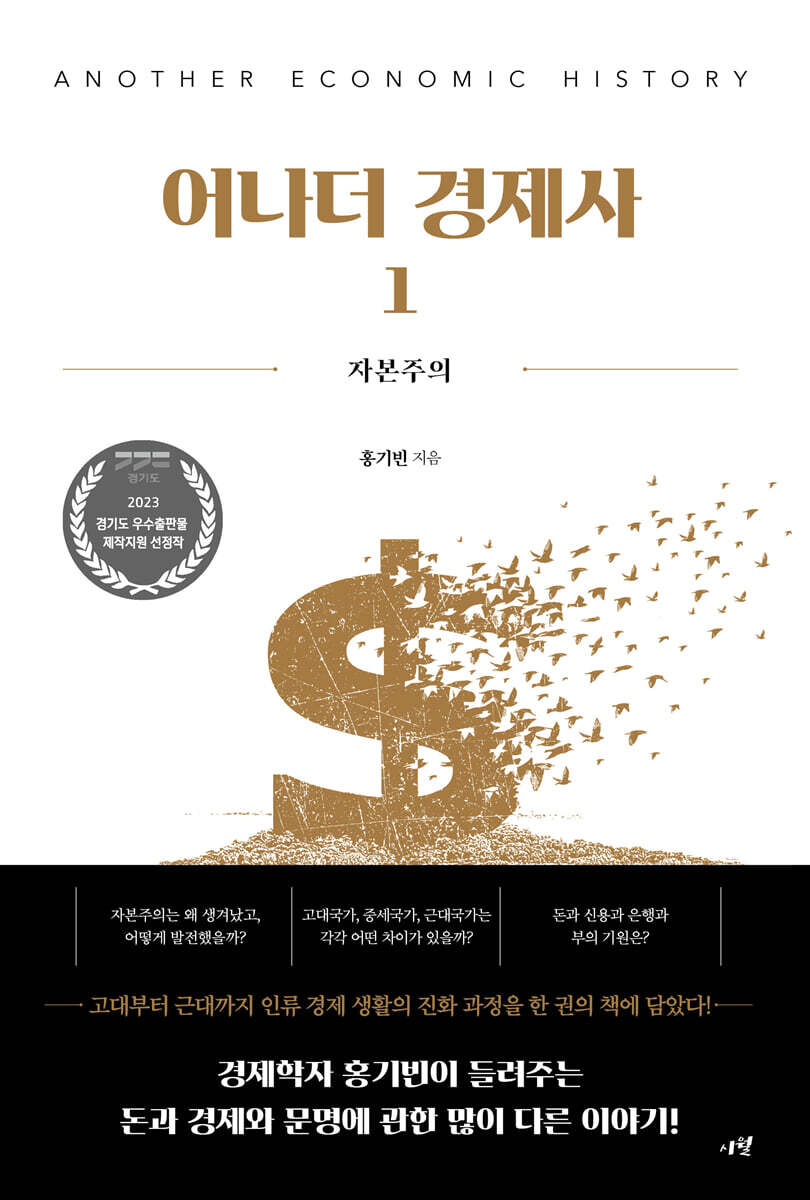
Another Economic History 1
 |
Description
Book Introduction
What is capitalism? Why did it arise, and how did it develop?
Economist Hong Ki-bin tells a very different story about money, economy, and civilization!
We today know all too well that it is 'capitalism' that governs our lives and dominates our economic system.
Even when we curse and curse the world we live in, we talk about capitalism, and even when we praise and exalt it, we talk about capitalism.
But no one can define the exact meaning of 'capitalism'.
What exactly is capitalism, how did it arise, and how did it develop? "Another Economic History 1" explores the vast and expansive history of humankind, spanning 50,000 years, from the diets of Paleolithic peoples to the economies of the Middle Ages and modern times, the Black Death in 14th-century Western Europe, the invention of double-entry bookkeeping, the origins of currency, the development of banking and credit, and the combination of war and state power.
Economist Hong Ki-bin tells a very different story about money, economy, and civilization!
We today know all too well that it is 'capitalism' that governs our lives and dominates our economic system.
Even when we curse and curse the world we live in, we talk about capitalism, and even when we praise and exalt it, we talk about capitalism.
But no one can define the exact meaning of 'capitalism'.
What exactly is capitalism, how did it arise, and how did it develop? "Another Economic History 1" explores the vast and expansive history of humankind, spanning 50,000 years, from the diets of Paleolithic peoples to the economies of the Middle Ages and modern times, the Black Death in 14th-century Western Europe, the invention of double-entry bookkeeping, the origins of currency, the development of banking and credit, and the combination of war and state power.
- You can preview some of the book's contents.
Preview
index
Starting Another Economic History 4
Another Economic History - Capitalism, Preface 18
PART 1.
Ancient socio-economic life
1. Were Paleolithic people more affluent than we are now? 28
2 Gift-giving practices in ancient societies 37
3 The Origins of Redistribution and the Temple Economy 45
4 The Origins of Exchange and Trade 51
5 What did ancient cities look like? 59
6 Aristotle's Economic Thought 69
PART 2.
The medieval economy and the rise of the bourgeoisie
1 Lord, vassal, fief 82
2 Those who pray, those who fight, those who work 90
3 Economic activities not aimed at profit 94
4 Working Merchants, Money-Making Church 102
5 The Development of Commerce and the Birth of the Bourgeoisie 108
PART 3.
pre-capitalist currency
1 Before entering 120
2 Misconceptions About Currency 130
3 The emergence of a consistent pricing system 143
4 The Concept of Currency of Account 149
5 Coins emerge from the wage labor and mercenary system 153
6 Two Interesting Facts About Coins from Ancient Athens 160
7 Where Alexander passed, coins overflowed 166
The Age of Great Chaos of the 8 Coins 174
9. Resolving the Confusion 184
BRIDGE.
Capitalism through Max Weber
1 Ancient Capitalism and Modern Capitalism 190
2 The Beginning of Rational Capitalism Calvinism 199
PART 4.
Decisive events in European civilization that gave birth to capitalism
1 Before entering 210
2 Where the Black Death Passed 218
3 Faust, the Beginning of a Scientific Revolution 224
4 The story of sheep eating people and the disintegration of the community 232
5 Numbers Change Many Things 242
PART 5.
Formation of a modern state
1 Sovereignty, Territory, and Order 256
2 The Relationship Between War, Taxes, and Finance 265
3 Trade and Mercantilism 271
4. The result of those who have 277 craving sugar
5 Establishment of a National Market and Universal Legal Order 284
6 Understanding the Modern State and Capitalism through Civil Servant Pirates 291
PART 6.
Credit and Banking
1 A pseudo-history of credit 300
2 Credit-driven brewery village 307
3 Ancient Credit 313
4 We Must Know Bills of Exchange 322
5 Banks came out of the bench 330
6 The Ecstatic Story of Making Money Out of Nothing 336
7 The Evolution of Banking, the Birth of Modern Banking 341
PART 7.
Power is money, money is power.
1 The Origin and Development of the Company 351
2 The emergence of joint stock companies 357
3. All in One - The Relationship Between the King, the Nobles, and the Bourgeoisie 363
The Emergence of the Citizen and Adam Smith 369
Another Economic History - Concluding the Capitalism Chapter 378
Another Economic History - Capitalism, Preface 18
PART 1.
Ancient socio-economic life
1. Were Paleolithic people more affluent than we are now? 28
2 Gift-giving practices in ancient societies 37
3 The Origins of Redistribution and the Temple Economy 45
4 The Origins of Exchange and Trade 51
5 What did ancient cities look like? 59
6 Aristotle's Economic Thought 69
PART 2.
The medieval economy and the rise of the bourgeoisie
1 Lord, vassal, fief 82
2 Those who pray, those who fight, those who work 90
3 Economic activities not aimed at profit 94
4 Working Merchants, Money-Making Church 102
5 The Development of Commerce and the Birth of the Bourgeoisie 108
PART 3.
pre-capitalist currency
1 Before entering 120
2 Misconceptions About Currency 130
3 The emergence of a consistent pricing system 143
4 The Concept of Currency of Account 149
5 Coins emerge from the wage labor and mercenary system 153
6 Two Interesting Facts About Coins from Ancient Athens 160
7 Where Alexander passed, coins overflowed 166
The Age of Great Chaos of the 8 Coins 174
9. Resolving the Confusion 184
BRIDGE.
Capitalism through Max Weber
1 Ancient Capitalism and Modern Capitalism 190
2 The Beginning of Rational Capitalism Calvinism 199
PART 4.
Decisive events in European civilization that gave birth to capitalism
1 Before entering 210
2 Where the Black Death Passed 218
3 Faust, the Beginning of a Scientific Revolution 224
4 The story of sheep eating people and the disintegration of the community 232
5 Numbers Change Many Things 242
PART 5.
Formation of a modern state
1 Sovereignty, Territory, and Order 256
2 The Relationship Between War, Taxes, and Finance 265
3 Trade and Mercantilism 271
4. The result of those who have 277 craving sugar
5 Establishment of a National Market and Universal Legal Order 284
6 Understanding the Modern State and Capitalism through Civil Servant Pirates 291
PART 6.
Credit and Banking
1 A pseudo-history of credit 300
2 Credit-driven brewery village 307
3 Ancient Credit 313
4 We Must Know Bills of Exchange 322
5 Banks came out of the bench 330
6 The Ecstatic Story of Making Money Out of Nothing 336
7 The Evolution of Banking, the Birth of Modern Banking 341
PART 7.
Power is money, money is power.
1 The Origin and Development of the Company 351
2 The emergence of joint stock companies 357
3. All in One - The Relationship Between the King, the Nobles, and the Bourgeoisie 363
The Emergence of the Citizen and Adam Smith 369
Another Economic History - Concluding the Capitalism Chapter 378
Detailed image
Into the book
Paleolithic people knew exactly what fruits they could eat in which regions at which times of the year, and what fish they could eat in which lakes at which times, based on the region in which they lived.
For example, there was clear data such as, “In March, you should hunt wild boar in this area,” or “In September, what kind of fish from the sea is good.”
If you think about it, this is no different from the seasonal food we are talking about now.
So, Paleolithic people ate the most delicious fruits, the plumpest carp, and the crabs full of eggs every season.
--- p.33, from “Were Paleolithic people more affluent than we are now?”
To understand Aristotle's economic thought, we must ponder and reflect on the questions he raises.
The question is this:
“Are human desires infinite?”
--- p.71, from “Aristotle’s Economic Thought”
Of course, soon after, with the collapse of the Roman Empire system, these various functions were again separated, and the currency fell into disarray.
This state of confusion lasted for a full thousand years. If we listen closely to these stories to understand what is different from the present and what process led to the establishment of the current monetary system, I think we might be able to see something we've been missing.
Leaving aside such grand goals, the process of human development that has lived with money is both interesting and fascinating.
In a way, you could say that this part is a deep history about money.
--- P.129, from “Money Before Capitalism”
Since when did we start talking about money, money, money, money? Surely there were times when money didn't exist.
In medieval England, there was a clergyman named John Ball who led the Peasants' Rebellion alongside Wat Tyler, and he left behind a very famous saying.
“Where were the nobles when Adam plowed the field and Eve weaved cloth?”
If you think about it, isn't the same thing with money? In the beginning, there was no separate money. As I mentioned earlier, even before currency existed, people managed to procure the goods they needed through various means, including gifts, redistribution, and trade.
--- p.130, from “Misunderstandings about Money”
To explain the background at that time, I would like to start with the word 'Dundok'.
Can someone who's been so wealthy be rational? Probably not.
The very word "hard-headed" implies that one is not in one's right mind.
The saying, “When the stakes are high, nothing can be seen” also comes from that context.
The rise in the price of gold is associated with irrationality.
However, Weber saw the characteristic of modern capitalism as one in which, despite its increased prosperity, it was fulfilled in an extremely rational manner, a new perspective that had never been seen before and an attitude with no precedent in history.
--p.
193, from “Ancient Capitalism and Modern Capitalism”
A meter is one ten-millionth of the length of the meridian between the North Pole and the equator.
To accurately measure the length of this meridian, two expeditions set out from France during the Napoleonic era. The astronomer Delambre and the cartographer Méchand went to Dunkirk in the north and Barcelona in the south, respectively, and used triangulation to measure the length of the meridian.
It may not seem like a difficult process, but it took over six years to calculate the exact number of meters.
After creating the metric system, Napoleon said, “Conquests are fleeting, but achievements are eternal.”
--- p.244, from “Many Things Changed by Numbers”
What the Europeans who destroyed West African civilization and decimated the forests of the West Indies brought back was sugar addiction.
Now, all of humanity is addicted to sugar.
The beginning of this extraordinary story may have stemmed from a truly trivial desire to add a spoonful of sugar to my tea.
For example, there was clear data such as, “In March, you should hunt wild boar in this area,” or “In September, what kind of fish from the sea is good.”
If you think about it, this is no different from the seasonal food we are talking about now.
So, Paleolithic people ate the most delicious fruits, the plumpest carp, and the crabs full of eggs every season.
--- p.33, from “Were Paleolithic people more affluent than we are now?”
To understand Aristotle's economic thought, we must ponder and reflect on the questions he raises.
The question is this:
“Are human desires infinite?”
--- p.71, from “Aristotle’s Economic Thought”
Of course, soon after, with the collapse of the Roman Empire system, these various functions were again separated, and the currency fell into disarray.
This state of confusion lasted for a full thousand years. If we listen closely to these stories to understand what is different from the present and what process led to the establishment of the current monetary system, I think we might be able to see something we've been missing.
Leaving aside such grand goals, the process of human development that has lived with money is both interesting and fascinating.
In a way, you could say that this part is a deep history about money.
--- P.129, from “Money Before Capitalism”
Since when did we start talking about money, money, money, money? Surely there were times when money didn't exist.
In medieval England, there was a clergyman named John Ball who led the Peasants' Rebellion alongside Wat Tyler, and he left behind a very famous saying.
“Where were the nobles when Adam plowed the field and Eve weaved cloth?”
If you think about it, isn't the same thing with money? In the beginning, there was no separate money. As I mentioned earlier, even before currency existed, people managed to procure the goods they needed through various means, including gifts, redistribution, and trade.
--- p.130, from “Misunderstandings about Money”
To explain the background at that time, I would like to start with the word 'Dundok'.
Can someone who's been so wealthy be rational? Probably not.
The very word "hard-headed" implies that one is not in one's right mind.
The saying, “When the stakes are high, nothing can be seen” also comes from that context.
The rise in the price of gold is associated with irrationality.
However, Weber saw the characteristic of modern capitalism as one in which, despite its increased prosperity, it was fulfilled in an extremely rational manner, a new perspective that had never been seen before and an attitude with no precedent in history.
--p.
193, from “Ancient Capitalism and Modern Capitalism”
A meter is one ten-millionth of the length of the meridian between the North Pole and the equator.
To accurately measure the length of this meridian, two expeditions set out from France during the Napoleonic era. The astronomer Delambre and the cartographer Méchand went to Dunkirk in the north and Barcelona in the south, respectively, and used triangulation to measure the length of the meridian.
It may not seem like a difficult process, but it took over six years to calculate the exact number of meters.
After creating the metric system, Napoleon said, “Conquests are fleeting, but achievements are eternal.”
--- p.244, from “Many Things Changed by Numbers”
What the Europeans who destroyed West African civilization and decimated the forests of the West Indies brought back was sugar addiction.
Now, all of humanity is addicted to sugar.
The beginning of this extraordinary story may have stemmed from a truly trivial desire to add a spoonful of sugar to my tea.
--- p.282, from “The Results of the Haves’ Desire for Sugar”
Publisher's Review
From the Paleolithic economy to the origins of currency and the development of banking and credit, this book covers 50,000 years of human economic history.
To see capitalism, you have to look at the whole of human history.
Therefore, “Another Economic History 1” covers all the crucial moments in the evolution of human economic life from ancient times to the modern era.
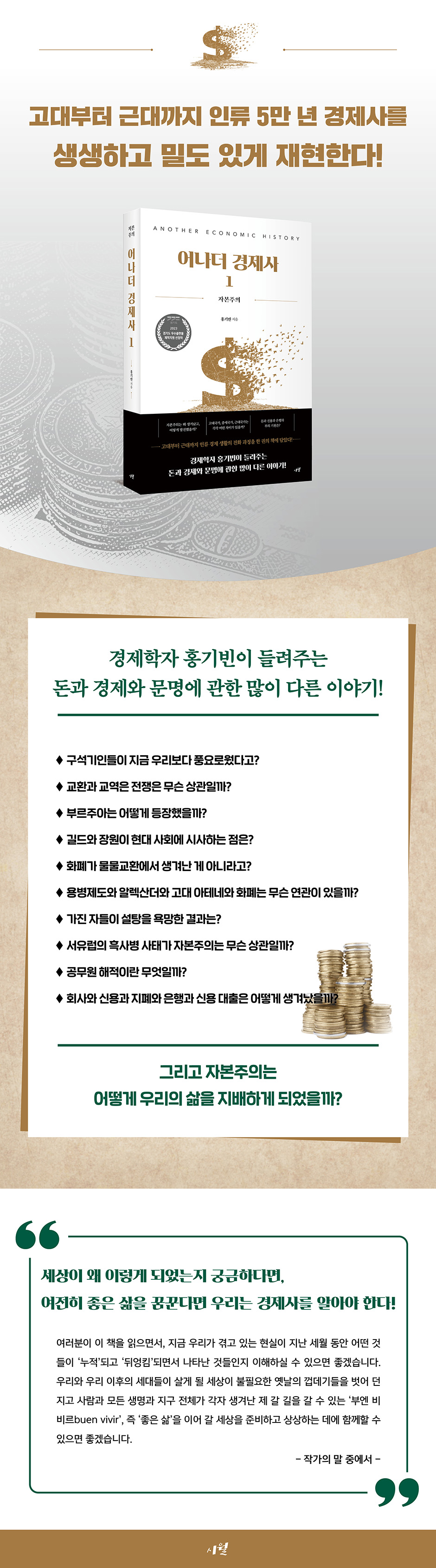
· Paleolithic people were richer than we are now?
· What does exchange and trade have to do with war?
· How did the bourgeoisie emerge?
· What do guilds and manors suggest to modern society?
· Money didn't come from barter?
· What does the mercenary system have to do with Alexander, ancient Athens, and currency?
· What is the result of those who have it craving sugar?
· What does the Black Death in Western Europe have to do with capitalism?
· What is a civil servant pirate?
· How did companies, credit, paper money, banks, and credit loans come into being?
And it moves forward without hesitation toward how these series of processes combined and accumulated to give rise to the massive economic and social lifestyle called capitalism, which forms the basis of our lives today.
Huge and extensive history, but fun!
The main characteristic of the “Another Economic History” series is that it has a narrative structure.
Hong Ki-bin, the author of this book and an economist, fully demonstrates his talent as an excellent storyteller.
It covers a huge and extensive history, but it's easy, exciting, and fun.
At the same time, the book features numerous economists, sociologists, anthropologists, historians, philosophers, politicians, religious figures, and thinkers, from Aristotle to Max Weber, Karl Polanyi, Marshall Sahlins, and Henri Pirene.
The "Another Economic History" series allows one to grasp at a glance the core of the arguments, content, and research of the great scholars who dominated an era.
So, through this book, readers will not only come to understand the 'suspicious order of the world' but will also be able to enjoy an intellectual feast delicately constructed within the larger framework of economics and history.
To see capitalism, you have to look at the whole of human history.
Therefore, “Another Economic History 1” covers all the crucial moments in the evolution of human economic life from ancient times to the modern era.
· Paleolithic people were richer than we are now?
· What does exchange and trade have to do with war?
· How did the bourgeoisie emerge?
· What do guilds and manors suggest to modern society?
· Money didn't come from barter?
· What does the mercenary system have to do with Alexander, ancient Athens, and currency?
· What is the result of those who have it craving sugar?
· What does the Black Death in Western Europe have to do with capitalism?
· What is a civil servant pirate?
· How did companies, credit, paper money, banks, and credit loans come into being?
And it moves forward without hesitation toward how these series of processes combined and accumulated to give rise to the massive economic and social lifestyle called capitalism, which forms the basis of our lives today.
Huge and extensive history, but fun!
The main characteristic of the “Another Economic History” series is that it has a narrative structure.
Hong Ki-bin, the author of this book and an economist, fully demonstrates his talent as an excellent storyteller.
It covers a huge and extensive history, but it's easy, exciting, and fun.
At the same time, the book features numerous economists, sociologists, anthropologists, historians, philosophers, politicians, religious figures, and thinkers, from Aristotle to Max Weber, Karl Polanyi, Marshall Sahlins, and Henri Pirene.
The "Another Economic History" series allows one to grasp at a glance the core of the arguments, content, and research of the great scholars who dominated an era.
So, through this book, readers will not only come to understand the 'suspicious order of the world' but will also be able to enjoy an intellectual feast delicately constructed within the larger framework of economics and history.
GOODS SPECIFICS
- Date of issue: July 1, 2023
- Page count, weight, size: 392 pages | 694g | 152*225*22mm
- ISBN13: 9791191975116
- ISBN10: 1191975118
You may also like
카테고리
korean


korean

![GQ KOREA Mark (Monthly): December [2025]](http://librairie.coreenne.fr/cdn/shop/files/8ef265dbbfbf186523ed75ba7319009d.jpg?v=1765340328&width=3840)


