

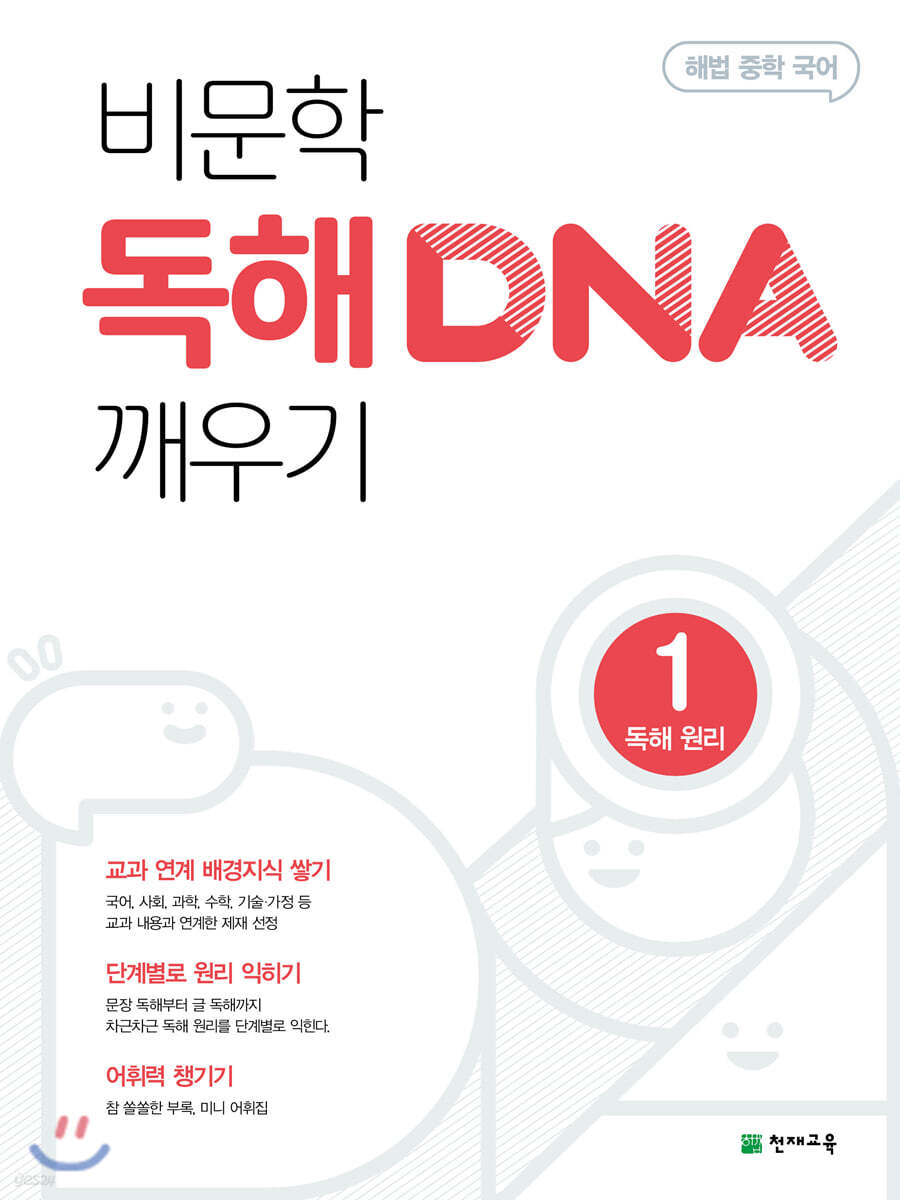
Awakening Non-Fiction Reading DNA 1: Reading Principles
 |
Description
Book Introduction
The [Awakening Non-Fiction Reading DNA] series is a book designed to effectively cultivate the 'text analysis skills' and 'vocabulary' necessary for reading comprehension, and to build 'background knowledge'. The principles, techniques, and types of reading comprehension are explained in a friendly manner with abundant examples, and 'reading practice' is provided to help you develop 'text analysis skills' in a repetitive and step-by-step manner. In particular, Volumes 1 and 2 of 'Reading Practice' selected and included materials related to all subjects of the middle school curriculum, including not only Korean but also mathematics, social studies, science, and history, so that students can naturally build 'background knowledge' appropriate to their learning stage. Volume 3, 'Reading Practice', contains carefully selected passages from the National Academic Achievement Test for first-year high school students, along with new passages on interesting topics, to help you prepare for the actual test. |
- You can preview some of the book's contents.
Preview
index
[Reading Principles]
1.
Principles of content comprehension
① Identifying the main topic
② Identify key information
③ Understanding concepts and principles through specific examples
④ Understanding the core content of opinions and claims
2.
Principles of content inference
① Understanding the relationship between information
② Find hidden content
③ Inferring causes (reasons) and results
3.
Principles of content evaluation
① Understand the writing style
② Compare perspectives
③ Criticize
4.
Principle of content application
① Apply to specific cases (situations)
② Applying to visual materials
[Reading Practice 1]
Humanities 01 _ World History in Cotton
Humanities 02 _ Debate is not a war of words
Society 03 _ For Sustainable Tourism
Society 04 _ The map lies?
Science 05 - Why Hot Air Balloons Rise into the Sky
Science 06 _ How to Mark the Location of Paris
■ Build more vocabulary | Continue the story
Technology 07 _ Driverless Cars That Will Change Our Lives
Technology 08 _ Biomimetic Technology
Art 09 _ Hip-hop, a culture that melts life into itself
Art 10 _ Beautifully Depicted Letters, Calligraphy
Integration 11 _ The Science of Envy
■ Build more vocabulary | Continue the story
■ Critical Thinking Skills Pros vs. Cons _ Is morality the best?
[Reading Practice 2]
Humanities 01 _ Stroop Effect
Humanities 02 - What Do Anthropologists Do?
Society 03 _ Good Soccer Ball and Good Chocolate
Society 04 _ How are electoral districts determined?
Science 05 - How to Find a Boiled Egg
Science 06 _ The Human Heart and the Frog Heart
■ Build more vocabulary | Continue the story
Technology 07 _ Biometric technology that protects me
Technology 08 _ Taiwan's 101 Tower
Art 09 _ Oriental violin, haegeum
Art 10 _ The Secret of the Mona Lisa
Integrated 11 _ The Mathematical Story Hidden in Seokguram Grotto
■ Build more vocabulary | Continue the story
■ Pros vs. Cons of Developing Critical Thinking Skills _ Is it really necessary to organize?
[Reading Practice 3 times]
Humanities 01 _ You don't need money to love the people.
Humanities 02 - Why Did the Pear Fall When the Crow Flies?
Society 03 _ Cultural Meaning of Chopsticks
Society 04 _ Groupthink and Collective Intelligence
Science 05 _ The Secret of a Warm Igloo
Science 06 _ The March of the Troops That Collapsed the Bridge
■ Build more vocabulary | Continue the story
Technology 07 _ Fast and convenient cleaning tool, vacuum cleaner
Technology 08 _ Chromatography is a scientific investigation team
Art 09 _ Beauty is Beauty
Art 10 _ Five Colors Loved by Our Ancestors
Integration 11 _ If I stay still, will the middle go away?
■ Build more vocabulary | Continue the story
■ Pros vs. Cons of Developing Critical Thinking Skills _ Should Custom-Made Babies Be Allowed?
[Reading Practice 4 times]
Humanities 01 _ Dialects that Enrich Our Language
Humanities 02 _ Even a blank piece of paper is better when held up
Society 03 - Why is payday different?
Society 04 _ Citizens participate in the judgment?
Science 05 - Why is species diversity necessary?
Science 06 _ The sun disappeared
■ Build more vocabulary | Continue the story
Technology 07 _ Analog and Digital
Technology 08 _ Smart Concrete
Art 09 _ Staff and Jeongganbo
Art 10 _ Recycling trash becomes art.
Integration 11 _ Technology is competitive?
■ Build more vocabulary | Continue the story
■ Critical Thinking Skills Pros vs. Cons _ Should we stop using plastic?
1.
Principles of content comprehension
① Identifying the main topic
② Identify key information
③ Understanding concepts and principles through specific examples
④ Understanding the core content of opinions and claims
2.
Principles of content inference
① Understanding the relationship between information
② Find hidden content
③ Inferring causes (reasons) and results
3.
Principles of content evaluation
① Understand the writing style
② Compare perspectives
③ Criticize
4.
Principle of content application
① Apply to specific cases (situations)
② Applying to visual materials
[Reading Practice 1]
Humanities 01 _ World History in Cotton
Humanities 02 _ Debate is not a war of words
Society 03 _ For Sustainable Tourism
Society 04 _ The map lies?
Science 05 - Why Hot Air Balloons Rise into the Sky
Science 06 _ How to Mark the Location of Paris
■ Build more vocabulary | Continue the story
Technology 07 _ Driverless Cars That Will Change Our Lives
Technology 08 _ Biomimetic Technology
Art 09 _ Hip-hop, a culture that melts life into itself
Art 10 _ Beautifully Depicted Letters, Calligraphy
Integration 11 _ The Science of Envy
■ Build more vocabulary | Continue the story
■ Critical Thinking Skills Pros vs. Cons _ Is morality the best?
[Reading Practice 2]
Humanities 01 _ Stroop Effect
Humanities 02 - What Do Anthropologists Do?
Society 03 _ Good Soccer Ball and Good Chocolate
Society 04 _ How are electoral districts determined?
Science 05 - How to Find a Boiled Egg
Science 06 _ The Human Heart and the Frog Heart
■ Build more vocabulary | Continue the story
Technology 07 _ Biometric technology that protects me
Technology 08 _ Taiwan's 101 Tower
Art 09 _ Oriental violin, haegeum
Art 10 _ The Secret of the Mona Lisa
Integrated 11 _ The Mathematical Story Hidden in Seokguram Grotto
■ Build more vocabulary | Continue the story
■ Pros vs. Cons of Developing Critical Thinking Skills _ Is it really necessary to organize?
[Reading Practice 3 times]
Humanities 01 _ You don't need money to love the people.
Humanities 02 - Why Did the Pear Fall When the Crow Flies?
Society 03 _ Cultural Meaning of Chopsticks
Society 04 _ Groupthink and Collective Intelligence
Science 05 _ The Secret of a Warm Igloo
Science 06 _ The March of the Troops That Collapsed the Bridge
■ Build more vocabulary | Continue the story
Technology 07 _ Fast and convenient cleaning tool, vacuum cleaner
Technology 08 _ Chromatography is a scientific investigation team
Art 09 _ Beauty is Beauty
Art 10 _ Five Colors Loved by Our Ancestors
Integration 11 _ If I stay still, will the middle go away?
■ Build more vocabulary | Continue the story
■ Pros vs. Cons of Developing Critical Thinking Skills _ Should Custom-Made Babies Be Allowed?
[Reading Practice 4 times]
Humanities 01 _ Dialects that Enrich Our Language
Humanities 02 _ Even a blank piece of paper is better when held up
Society 03 - Why is payday different?
Society 04 _ Citizens participate in the judgment?
Science 05 - Why is species diversity necessary?
Science 06 _ The sun disappeared
■ Build more vocabulary | Continue the story
Technology 07 _ Analog and Digital
Technology 08 _ Smart Concrete
Art 09 _ Staff and Jeongganbo
Art 10 _ Recycling trash becomes art.
Integration 11 _ Technology is competitive?
■ Build more vocabulary | Continue the story
■ Critical Thinking Skills Pros vs. Cons _ Should we stop using plastic?
Detailed image
.jpg)
Publisher's Review
2 fingerprints a day, complete in 30 days!
1.
Through the [Awakening Non-Fiction Reading DNA] series, you can gradually learn “reading principles,” “reading techniques,” and “past question types” to develop solid reading comprehension skills.
- Step 1: Build a solid foundation by learning reading principles based on the curriculum.
- Step 2: Learn the skills of reading step by step, sentence by sentence, paragraph by paragraph, and article by article, and learn how to read complex texts quickly and accurately.
- Step 3: Learn the types of non-literature questions that frequently appear on exams and their solutions, and develop problem-solving skills.
2.
Through practice problems, you can improve your reading comprehension skills and build a variety of background knowledge.
- Stage 1/2: Include at least 50% of texts related to middle school subjects (Korean, math, social studies, history, science, technology/home economics, art, etc.), select texts that stimulate students' interest and curiosity → Build background knowledge for subject learning
- Step 3: Include at least 50% of previous academic ability test questions, and present new questions of similar difficulty → Build background knowledge to prepare for actual exam questions.
3.
Friendly commentary and detailed explanations of incorrect answers allow learners to achieve perfect reading comprehension on their own.
- Detailed explanations of fingerprints, problem-solving methods, and reasons for correct and incorrect answers.
- Presentation of 'explanation' and 'topic' to help understand the text
4.
You can improve your vocabulary by using the appendix mini vocabulary list.
- Vocabulary from the text is collected by chapter and provided in a mini-book format.
- Synonyms, antonyms, Chinese character idioms, and idiomatic expressions related to vocabulary are organized with example sentences to enable extensive vocabulary learning.
1.
Through the [Awakening Non-Fiction Reading DNA] series, you can gradually learn “reading principles,” “reading techniques,” and “past question types” to develop solid reading comprehension skills.
- Step 1: Build a solid foundation by learning reading principles based on the curriculum.
- Step 2: Learn the skills of reading step by step, sentence by sentence, paragraph by paragraph, and article by article, and learn how to read complex texts quickly and accurately.
- Step 3: Learn the types of non-literature questions that frequently appear on exams and their solutions, and develop problem-solving skills.
2.
Through practice problems, you can improve your reading comprehension skills and build a variety of background knowledge.
- Stage 1/2: Include at least 50% of texts related to middle school subjects (Korean, math, social studies, history, science, technology/home economics, art, etc.), select texts that stimulate students' interest and curiosity → Build background knowledge for subject learning
- Step 3: Include at least 50% of previous academic ability test questions, and present new questions of similar difficulty → Build background knowledge to prepare for actual exam questions.
3.
Friendly commentary and detailed explanations of incorrect answers allow learners to achieve perfect reading comprehension on their own.
- Detailed explanations of fingerprints, problem-solving methods, and reasons for correct and incorrect answers.
- Presentation of 'explanation' and 'topic' to help understand the text
4.
You can improve your vocabulary by using the appendix mini vocabulary list.
- Vocabulary from the text is collected by chapter and provided in a mini-book format.
- Synonyms, antonyms, Chinese character idioms, and idiomatic expressions related to vocabulary are organized with example sentences to enable extensive vocabulary learning.
GOODS SPECIFICS
- Date of issue: November 1, 2019
- Page count, weight, size: 248 pages | 492g | 210*280*8mm
- ISBN13: 9791125949787
- ISBN10: 1125949783
- Reference book for use in grades: Common for middle school students
- Reference book usage semester: Common semester
- Reference book difficulty: Medium Reference book difficulty guide
You may also like
카테고리
korean


korean

![ELLE 엘르 스페셜 에디션 A형 : 12월 [2025]](http://librairie.coreenne.fr/cdn/shop/files/b8e27a3de6c9538896439686c6b0e8fb.jpg?v=1766436872&width=3840)


