

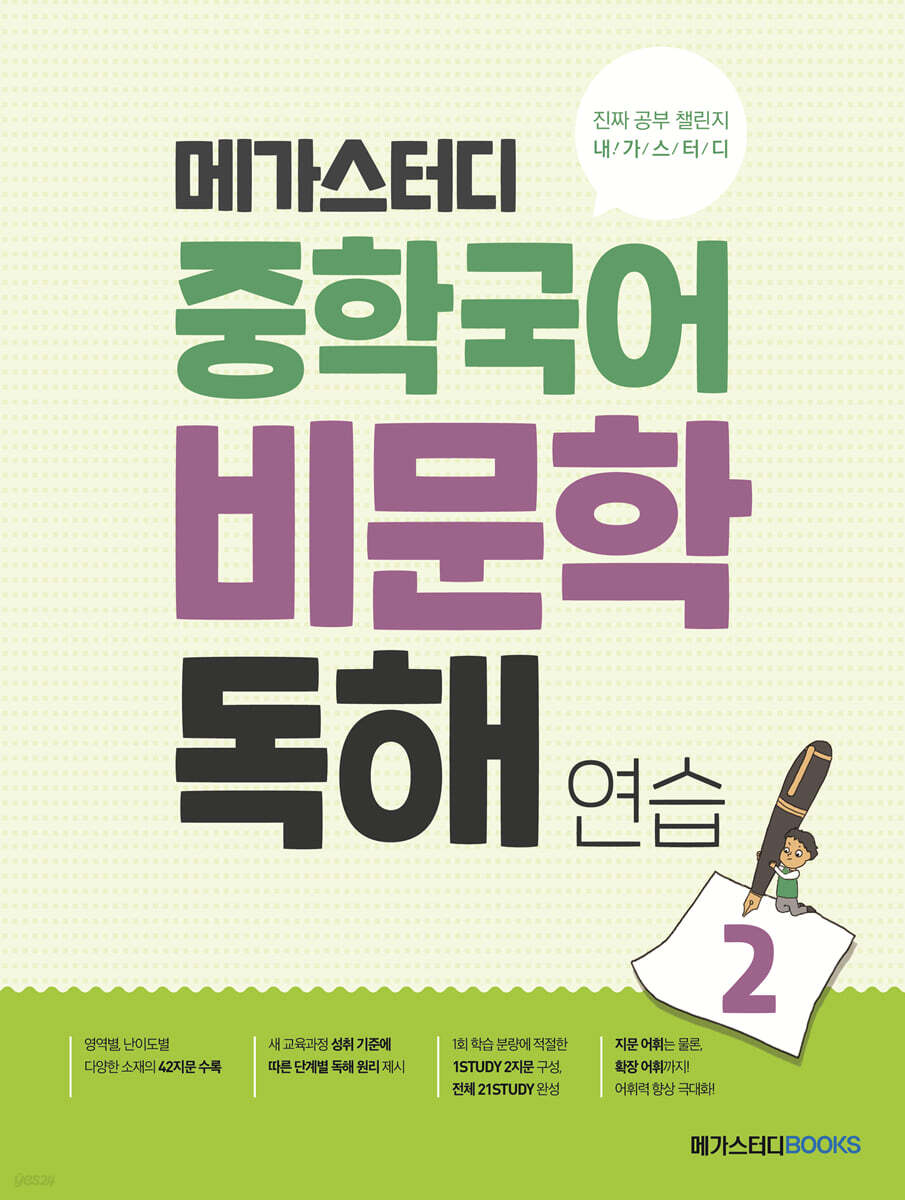
Megastudy Middle School Korean Non-Fiction Reading Practice 2
 |
Description
Book Introduction
"Mega Study Middle School Korean Non-Fiction Reading Practice" is a basic reading book that allows for systematic practice of 42 non-fiction materials carefully selected by subject and difficulty level.
An efficient learning system for non-fiction reading was applied by composing one STUDY with two passages (materials) that are appropriate for middle school students to study at one time, and the reading skills based on the achievement standards for the Korean language reading section of the 2015 revised curriculum that middle school students should know can be identified through problems.
In addition, faithful vocabulary learning is provided for every two fingerprints to maximize vocabulary improvement, and self-study is possible by providing explanations in the form of a text for each fingerprint and detailed explanations of correct and incorrect answers for each question.
An efficient learning system for non-fiction reading was applied by composing one STUDY with two passages (materials) that are appropriate for middle school students to study at one time, and the reading skills based on the achievement standards for the Korean language reading section of the 2015 revised curriculum that middle school students should know can be identified through problems.
In addition, faithful vocabulary learning is provided for every two fingerprints to maximize vocabulary improvement, and self-study is possible by providing explanations in the form of a text for each fingerprint and detailed explanations of correct and incorrect answers for each question.
- You can preview some of the book's contents.
Preview
index
STUDY 01 Understanding the Topic
[Humanities] A Framework for Discerning the World
[Art] Camera Obscura
Summary of STUDY 02 contents
[Society] Reasons for Special Discounts
[Culture] Ownership of the Sea
STUDY 03 Understanding Explanation Methods - Definitions, Examples
[Science] Zero-Energy House
[Technology] Social Robots That Evolve Through Communication
STUDY 04 Understanding Explanatory Methods - Comparison and Contrast, Classification and Distinction
[Humanities] Introduction to Archaeology
[Art] The Beauty of Traditional Patchwork
STUDY 05 Understanding Explanatory Methods - Causality and Analysis
[Society] The Hidden Status Quo Bias in the Subscription Economy
[Culture] The Plastic Revenge
STUDY 06 Practice explaining the core content of a text
[Science] Gut Microbes That Eliminate Fat-Busters
[Technology] Hawkeye, the eagle-eyed video reviewer in sports
STUDY 07 Content Inference
[Humanities] Descartes believed that the mind and body were separate.
[Art] How did Romanticism begin?
STUDY 08 Omitted Content, Inference from Premises and Reasons
[Society] The Political Economics of Rice Planting
[Culture] Hagia Sophia, where two religions coexist
STUDY 09 Point of View and Position Reasoning
[Science] Capillary Phenomenon
[Technology] Transposition and shift ciphers
STUDY 10 Understanding Argumentation Methods - Induction
[Humanities] Who are the enemies of an open society?
[Art] Architecture and Color
STUDY 11 Understanding Argumentation Methods - Deductive
[Society] How to Eat More at a Buffet
[Culture] Elements of a Crime
STUDY 12 Understanding Argumentation Methods - Analogy
[Science] Ultrafine Dust Alert: A Trouble in the Atmosphere
[Technology] Unlocking the Secrets of the Universe: Parker Solar Probe
STUDY 13 Practice Reasoning and Argumentation Methods
[Humanities] The Power of the Mongol Empire: Horses
[Art] Characteristics of Realism and Courbet's Works
STUDY 14 Evaluation through Comparative Viewpoints
[Society] Eastern and Western Perspectives on Space and Time
[Culture] Millennials
STUDY 15 Evaluating the Appropriateness of Criticism and Response
[Science] Why Endocrine Disruptors Are So Scary
[Technology] Wi-Fi and LiFi
STUDY 16 Evaluating the various expression methods and intentions of media
[Humanities] Objectivity and Subjectivity of Beauty
[Art] Korean Folk Dance
STUDY 17: Practice in Evaluating Perspectives and Appropriateness
[Society] Benign interventionism and liberal interventionism
[Culture] Indirect and Virtual Advertising
STUDY 18: Problem Solving and Alternative Exploration
[Science] The Importance of Disinfection
[Technology] Digital Forensics
STUDY 19 Utilizing Reference Materials and Identifying Case Studies
[Humanities] What is true morality?
[Art] Music of the Baroque Era
STUDY 20 Application to Specific Situations or Materials
[Society] Is it beneficial to trade between countries?
[Culture] Attribution Theory in School Learning
STUDY 21 Creative Understanding Application Practice
[Science] Black Hole
[Technology] The amount of work humans can do
[Humanities] A Framework for Discerning the World
[Art] Camera Obscura
Summary of STUDY 02 contents
[Society] Reasons for Special Discounts
[Culture] Ownership of the Sea
STUDY 03 Understanding Explanation Methods - Definitions, Examples
[Science] Zero-Energy House
[Technology] Social Robots That Evolve Through Communication
STUDY 04 Understanding Explanatory Methods - Comparison and Contrast, Classification and Distinction
[Humanities] Introduction to Archaeology
[Art] The Beauty of Traditional Patchwork
STUDY 05 Understanding Explanatory Methods - Causality and Analysis
[Society] The Hidden Status Quo Bias in the Subscription Economy
[Culture] The Plastic Revenge
STUDY 06 Practice explaining the core content of a text
[Science] Gut Microbes That Eliminate Fat-Busters
[Technology] Hawkeye, the eagle-eyed video reviewer in sports
STUDY 07 Content Inference
[Humanities] Descartes believed that the mind and body were separate.
[Art] How did Romanticism begin?
STUDY 08 Omitted Content, Inference from Premises and Reasons
[Society] The Political Economics of Rice Planting
[Culture] Hagia Sophia, where two religions coexist
STUDY 09 Point of View and Position Reasoning
[Science] Capillary Phenomenon
[Technology] Transposition and shift ciphers
STUDY 10 Understanding Argumentation Methods - Induction
[Humanities] Who are the enemies of an open society?
[Art] Architecture and Color
STUDY 11 Understanding Argumentation Methods - Deductive
[Society] How to Eat More at a Buffet
[Culture] Elements of a Crime
STUDY 12 Understanding Argumentation Methods - Analogy
[Science] Ultrafine Dust Alert: A Trouble in the Atmosphere
[Technology] Unlocking the Secrets of the Universe: Parker Solar Probe
STUDY 13 Practice Reasoning and Argumentation Methods
[Humanities] The Power of the Mongol Empire: Horses
[Art] Characteristics of Realism and Courbet's Works
STUDY 14 Evaluation through Comparative Viewpoints
[Society] Eastern and Western Perspectives on Space and Time
[Culture] Millennials
STUDY 15 Evaluating the Appropriateness of Criticism and Response
[Science] Why Endocrine Disruptors Are So Scary
[Technology] Wi-Fi and LiFi
STUDY 16 Evaluating the various expression methods and intentions of media
[Humanities] Objectivity and Subjectivity of Beauty
[Art] Korean Folk Dance
STUDY 17: Practice in Evaluating Perspectives and Appropriateness
[Society] Benign interventionism and liberal interventionism
[Culture] Indirect and Virtual Advertising
STUDY 18: Problem Solving and Alternative Exploration
[Science] The Importance of Disinfection
[Technology] Digital Forensics
STUDY 19 Utilizing Reference Materials and Identifying Case Studies
[Humanities] What is true morality?
[Art] Music of the Baroque Era
STUDY 20 Application to Specific Situations or Materials
[Society] Is it beneficial to trade between countries?
[Culture] Attribution Theory in School Learning
STUDY 21 Creative Understanding Application Practice
[Science] Black Hole
[Technology] The amount of work humans can do
Detailed image
.jpg)
Publisher's Review
Applying efficient learning methods and reflecting interesting material in the text
This textbook is structured so that two passages become one study, and an efficient learning system is applied that presents an appropriate amount of material for students to study at one time according to the achievement criteria.
Each STUDY reflects the 2015 revised curriculum reading area divisions, such as 'Humanities + Arts → Society + Culture → Science + Technology → Humanities + Arts...', and studies two related texts in one STUDY. However, each area is structured in a circular and repetitive manner to ensure learning without getting bored.
Additionally, we have carefully selected and presented in the form of texts interesting for students to read in each area.
Reflecting the 2015 Revised Curriculum Reading Achievement Standards
The STUDY names corresponding to the learning objectives for the two passages in this textbook are organized step by step based on the achievement standards for reading in the 2015 revised curriculum.
For each fingerprint, we have provided 'problems related to the STUDY name' so that you can learn the achievement standard content naturally.
And after studying the two fingerprints, we presented a 'Reading Method Q&A' to help you understand the key concepts related to the STUDY name in the form of questions and answers.
Additionally, after the core concepts are presented, the contents are organized in a separate page called the 'Concept Directory' so that you can review them at a glance.
Reinforce vocabulary learning
This textbook presents a variety of 'Vocabulary Check' questions to help you check your understanding of the key vocabulary presented in the two STUDY passages.
And, although not presented in the text, we have included a 'Vocabulary Special Lecture' to help you improve your vocabulary by learning various vocabulary such as homonyms and polysemy, synonyms and antonyms, and common misspellings that are frequently tested on the exam.
In addition, the problem explanations include a 'vocabulary recharge' that includes the pronunciation and meaning of Chinese characters so that you can learn difficult vocabulary and concept vocabulary that frequently appear on exams that appear in the problems, helping you learn a wide range of vocabulary.
Improving Reading Comprehension Skills through Self-Directed Learning
In the main text of this textbook, a checklist is provided in the 'Learning Checklist' after each of the two passages to enable self-directed learning.
In the 'Fingerprint Structure & Answers & Explanation' section, the text is presented once again and organized in a written format to help students understand the structure of the text and efficiently learn the key contents of the text.
Additionally, in 'Answers and Explanations', we have provided detailed explanations of correct answers and explanations for incorrect answers so that you can thoroughly understand the correct and incorrect answers to the questions.
This textbook is structured so that two passages become one study, and an efficient learning system is applied that presents an appropriate amount of material for students to study at one time according to the achievement criteria.
Each STUDY reflects the 2015 revised curriculum reading area divisions, such as 'Humanities + Arts → Society + Culture → Science + Technology → Humanities + Arts...', and studies two related texts in one STUDY. However, each area is structured in a circular and repetitive manner to ensure learning without getting bored.
Additionally, we have carefully selected and presented in the form of texts interesting for students to read in each area.
Reflecting the 2015 Revised Curriculum Reading Achievement Standards
The STUDY names corresponding to the learning objectives for the two passages in this textbook are organized step by step based on the achievement standards for reading in the 2015 revised curriculum.
For each fingerprint, we have provided 'problems related to the STUDY name' so that you can learn the achievement standard content naturally.
And after studying the two fingerprints, we presented a 'Reading Method Q&A' to help you understand the key concepts related to the STUDY name in the form of questions and answers.
Additionally, after the core concepts are presented, the contents are organized in a separate page called the 'Concept Directory' so that you can review them at a glance.
Reinforce vocabulary learning
This textbook presents a variety of 'Vocabulary Check' questions to help you check your understanding of the key vocabulary presented in the two STUDY passages.
And, although not presented in the text, we have included a 'Vocabulary Special Lecture' to help you improve your vocabulary by learning various vocabulary such as homonyms and polysemy, synonyms and antonyms, and common misspellings that are frequently tested on the exam.
In addition, the problem explanations include a 'vocabulary recharge' that includes the pronunciation and meaning of Chinese characters so that you can learn difficult vocabulary and concept vocabulary that frequently appear on exams that appear in the problems, helping you learn a wide range of vocabulary.
Improving Reading Comprehension Skills through Self-Directed Learning
In the main text of this textbook, a checklist is provided in the 'Learning Checklist' after each of the two passages to enable self-directed learning.
In the 'Fingerprint Structure & Answers & Explanation' section, the text is presented once again and organized in a written format to help students understand the structure of the text and efficiently learn the key contents of the text.
Additionally, in 'Answers and Explanations', we have provided detailed explanations of correct answers and explanations for incorrect answers so that you can thoroughly understand the correct and incorrect answers to the questions.
GOODS SPECIFICS
- Date of issue: September 1, 2019
- Page count, weight, size: 232 pages | 215*285mm
- ISBN13: 9791129704863
- ISBN10: 1129704866
- Reference book for use in grades: Common for middle school students
- Reference book usage semester: Common semester
- Reference book difficulty: Medium Reference book difficulty guide
You may also like
카테고리
korean


korean

![GQ KOREA Mark (Monthly): December [2025]](http://librairie.coreenne.fr/cdn/shop/files/8ef265dbbfbf186523ed75ba7319009d.jpg?v=1765340328&width=3840)


