

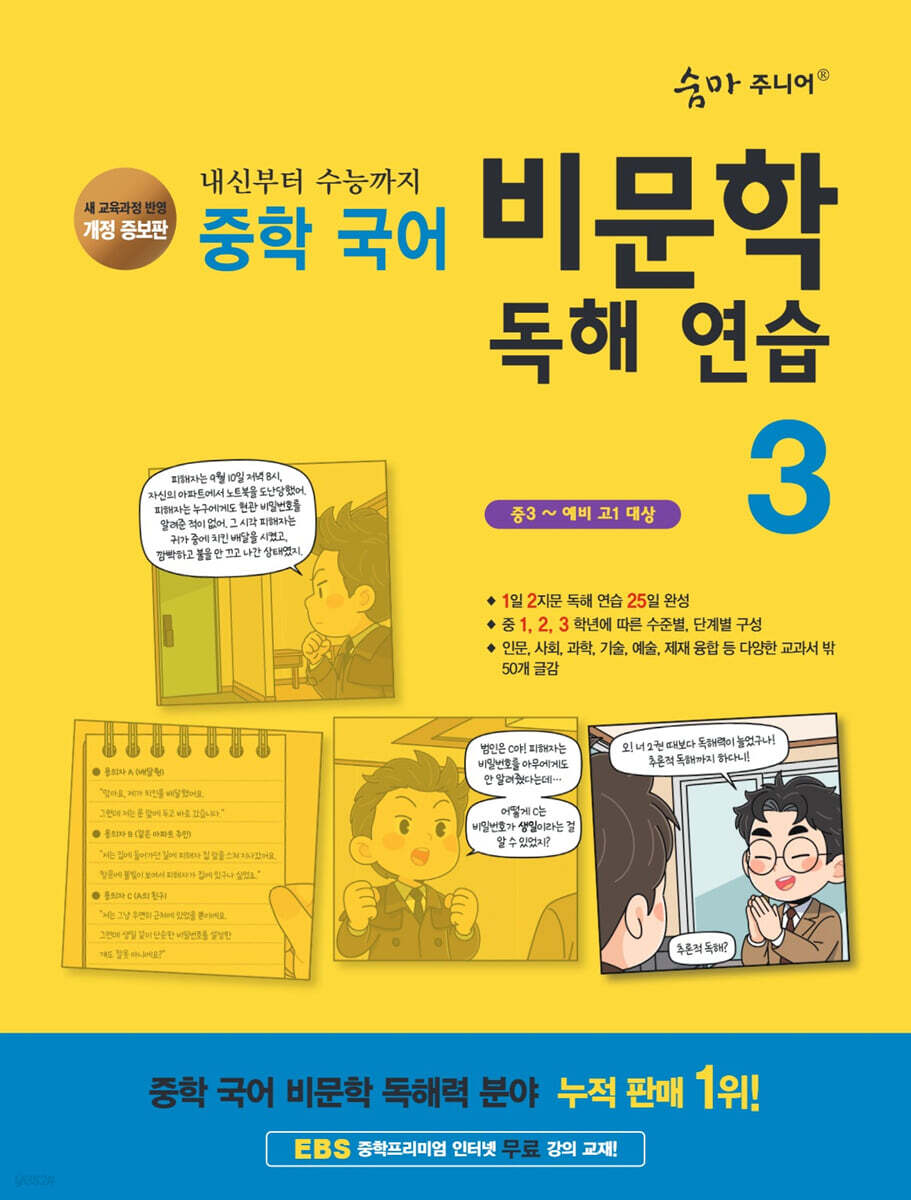
Summa Junior Middle School Korean Non-Fiction Reading Practice 3
 |
Description
Book Introduction
1.
We have carefully selected writing materials from a variety of fields, including humanities, social sciences, science, technology, and art.
We have carefully selected writing materials from a wide range of subjects, including humanities, society, science, technology, and art.
Reading texts can improve your reading skills and enhance your comprehension and thinking skills.
‘Korean’ is the foundation of all studies, but among them, reading comprehension is the most fundamental.
Only by having proper reading skills can we improve our comprehension and expand our thinking.
We hope you will improve your reading comprehension skills through ‘Middle School Korean Non-Fiction Reading Practice.’
2.
We have developed practical problem-solving skills through level-based, step-by-step problems.
Non-fiction reading comprehension is based on problem solving related to factual thinking.
After building a foundation through fundamental questions like fact-checking, identifying key points, and understanding details, you can gradually broaden your thinking by solving questions that require inferential and critical reading, such as graph interpretation, picture application, and perspective-based analysis.
By structuring problems in this way, which progresses from factual to inferential to critical, you can systematically develop the problem-solving skills required for actual exams.
3.
After organizing frequently appearing vocabulary by sanctions, we checked it through a test.
We have selected vocabulary from the previously studied text and included its meaning and examples.
This is a list of vocabulary that is easy to understand once you learn it, but can be an obstacle to getting a high score if you are not familiar with it.
We also provide a simple but diverse range of problems to help you check your vocabulary acquisition.
Vocabulary plays a crucial role in improving Korean reading comprehension skills, so I hope you learn it well.
4.
All texts and problems have been analyzed so that they can be used as self-directed learning and teaching materials.
We have analyzed all the included passages in detail so that you can study them without difficulty even if you are studying on your own, so please make full use of the commentary in this book.
Additionally, it includes detailed explanations of the text, paragraph summary, topic, correct answer, and incorrect answer so that it can be used effectively as a teaching and learning material for parents and teachers.
5.
We have additionally organized reading practice for prospective high school freshmen to prepare for the scholastic ability test.
This textbook includes modified versions of actual academic ability test passages so that prospective high school freshmen can become familiar with the academic ability test passages and question types at the high school level.
· Diverse fields: By including texts from a wide range of fields, including humanities, social sciences, science, technology, and arts, you can simultaneously expand your background knowledge and critical thinking skills in various fields.
?Practical Problem Types: Through content matching and [View] application problems frequently tested on academic ability assessments, you can focus on practicing key elements such as grasping the main idea of a text, inferring clues, and utilizing connective and directive expressions.
?Modified Passage Learning: Rather than simply including the original passage, it is reconstructed to fit the level of a prospective high school freshman. This provides a problem-solving experience similar to the actual exam while adjusting the length and difficulty of the passage.
Expand your thinking skills by reading texts from a variety of fields, solving problems, and more.
This will be the most effective reading practice to get a feel for the actual scholastic ability test.
We have carefully selected writing materials from a variety of fields, including humanities, social sciences, science, technology, and art.
We have carefully selected writing materials from a wide range of subjects, including humanities, society, science, technology, and art.
Reading texts can improve your reading skills and enhance your comprehension and thinking skills.
‘Korean’ is the foundation of all studies, but among them, reading comprehension is the most fundamental.
Only by having proper reading skills can we improve our comprehension and expand our thinking.
We hope you will improve your reading comprehension skills through ‘Middle School Korean Non-Fiction Reading Practice.’
2.
We have developed practical problem-solving skills through level-based, step-by-step problems.
Non-fiction reading comprehension is based on problem solving related to factual thinking.
After building a foundation through fundamental questions like fact-checking, identifying key points, and understanding details, you can gradually broaden your thinking by solving questions that require inferential and critical reading, such as graph interpretation, picture application, and perspective-based analysis.
By structuring problems in this way, which progresses from factual to inferential to critical, you can systematically develop the problem-solving skills required for actual exams.
3.
After organizing frequently appearing vocabulary by sanctions, we checked it through a test.
We have selected vocabulary from the previously studied text and included its meaning and examples.
This is a list of vocabulary that is easy to understand once you learn it, but can be an obstacle to getting a high score if you are not familiar with it.
We also provide a simple but diverse range of problems to help you check your vocabulary acquisition.
Vocabulary plays a crucial role in improving Korean reading comprehension skills, so I hope you learn it well.
4.
All texts and problems have been analyzed so that they can be used as self-directed learning and teaching materials.
We have analyzed all the included passages in detail so that you can study them without difficulty even if you are studying on your own, so please make full use of the commentary in this book.
Additionally, it includes detailed explanations of the text, paragraph summary, topic, correct answer, and incorrect answer so that it can be used effectively as a teaching and learning material for parents and teachers.
5.
We have additionally organized reading practice for prospective high school freshmen to prepare for the scholastic ability test.
This textbook includes modified versions of actual academic ability test passages so that prospective high school freshmen can become familiar with the academic ability test passages and question types at the high school level.
· Diverse fields: By including texts from a wide range of fields, including humanities, social sciences, science, technology, and arts, you can simultaneously expand your background knowledge and critical thinking skills in various fields.
?Practical Problem Types: Through content matching and [View] application problems frequently tested on academic ability assessments, you can focus on practicing key elements such as grasping the main idea of a text, inferring clues, and utilizing connective and directive expressions.
?Modified Passage Learning: Rather than simply including the original passage, it is reconstructed to fit the level of a prospective high school freshman. This provides a problem-solving experience similar to the actual exam while adjusting the length and difficulty of the passage.
Expand your thinking skills by reading texts from a variety of fields, solving problems, and more.
This will be the most effective reading practice to get a feel for the actual scholastic ability test.
- You can preview some of the book's contents.
Preview
index
Ⅰ Humanities
[Humanities 01] 〈Ethics〉 Kant and the Ethics of Duty _ Korean Kant Society
[Humanities 02] 〈Morality〉 How Did People Live in the Joseon Dynasty? _ Korean History Research Association
[Humanities 03] 〈Language〉 Korean Spelling: Examining 'Paste' and 'Put' _ Lim Dong-hoon
[Humanities 04] Psychology: The World of Heuristics: A Shortcut to Quick Decisions _ Han Deok-woong et al.
[Humanities 05] 〈Logic〉: A Bridge to Continue Thought, Analogy _ Robert Root-Bernstein et al.
▶ Reading comprehension skills, vocabulary test
[Humanities 06] 〈Philosophy〉 From the Medieval Worldview to Modern Philosophy: The Influence of Empiricism _ Park Min-young
[Humanities 07] Morality: The Crossroads of Moral Choice: Deontology vs. Teleology_ Jeong Seong-hun et al.
[Humanities 08] 〈Ethics〉 Two Perspectives on Justice: Nozick and Rawls' Social Views _ Duncan
[Humanities 09] Language: Is Language Acquisition Innate or Acquired? _ Kang Ok-mi
[Humanities + Social Sciences 10] 〈Fusion〉 Between Law and Reality: The Two Faces of Joseon's Caste System _ Kim Don et al.
▶ Reading comprehension skills, vocabulary test
Reading practice for scholastic ability tests - Humanities ① Philosophy
②Ethics
③Psychology
Ⅱ Society
[Society 01] 〈Sociology〉 Causes of Deviance _ Kim Seong-kwon et al.
[Society 02] 〈Economy〉 Creating Value Together: The Principles and Operation of Cooperatives _ Lee Dae-jung
[Society 03] 〈Politics〉 Types of Political Culture _ Jin Young-jae
[Society 04] 〈Economy〉 The Value of Money in Numbers: Interest Rates _ Financial Supervisory Service
[Society 05] 〈Media〉 Will Internet News Ever Be Free? _ Wonjae Lee
▶ Reading comprehension skills, vocabulary test
[Society 06] <Law> How Does Law Drive Our Society? _ Ministry of Justice
[Society 07] 〈Social Theory〉 The Electronic Panopticon: The Age of Surveillance Begins _ Hong Seong-wook
[Society 08] 〈Economy〉 The Economics of Interest _ Hwang Hee-young
[Society 09] 〈Society? Culture〉 Multicultural Society, Korea _ Kim Eun-mi et al.
[Social Studies + Math 10] 〈Convergence〉: A Global Trade Created by Comparative Advantage _ Dominique Salvatore
▶ Reading comprehension skills, vocabulary test
Reading practice for scholastic ability assessment - Social Studies ① Economics
② Law
③Society?Culture
Ⅲ Science
[Science 01] 〈Physics〉 Wastewater Treatment in Space Stations _ Choi Wan-seop et al.
[Science 02] 〈Life Science〉 Biophotons, a biosignal that transcends space _ Bang Geon-woong
[Science 03] 〈Earth Science〉 Earth's Magnetic Field _ Korean Earth Science Society
[Science 04] 〈Medicine〉 The Power of Color to Move Humans _ Jonghee Lee
[Science 05] 〈Chemistry〉 Why does water boil longer when powdered soup is added? _ Zoomdal
▶ Reading comprehension skills, vocabulary test
[Science 06] 〈Physics〉 Why Raindrops Feel Stronger When You Run in the Rain _ Choi Sang-il
[Science 07] 〈Earth Science〉 The Reason Why Earth Has Few Craters _ Choi Byeon-gak et al.
[Science 08] 〈Life Science〉 Do you know about autophagy, our body's self-repair mechanism? _ Eunhee Lee et al.
[Science 09] 〈Applied Science〉The Science of Seeing Smells: The World of Olfaction _ Taehyun Park
[Science+Tech 10] 〈Fusion〉 Learning the Basic Principles of Thermodynamics through Energy Exchange _ Baek Seong-hye
▶ Reading comprehension skills, vocabulary test
Reading practice for scholastic ability tests - Science section ① Earth science
②Life Sciences
③Physics
Ⅳ Technology
[Technology 01] 〈Technology General〉 Appropriate Technology
[Technology 02] <Industrial Technology> The Scientific Principles of Washing Machines
[Technology 03] 〈Industrial Technology〉 The Science of Elevators: The Power to Rise to the Sky _ Jaein Lee
[Technology 04] Packet Switching Method _ Jin Hye-jin
[Technology 05] 〈Industrial Technology〉 The Principles of District Heating _ Hong Je-nam
▶ Reading comprehension skills, vocabulary test
[Technology 06] What is the principle of file compression? _ Marshall Brain
[Technology 07] 〈Environmental Technology〉 The Hidden Technology that Protects the Earth: The Secret of CCS _ Jae-chang Kim et al.
[Technology 08] 〈Industrial Technology〉 Reverse Osmosis Water Purifier
[Technology 09] 〈Space Technology〉 Action and Reaction, Dominating Satellites _ Korea Aerospace Research Institute
[Technology + Science 10] 〈Fusion〉 Cutting-edge method for extracting deep-seated shale gas _ Shin Chang-hoon
▶ Reading comprehension skills, vocabulary test
Reading practice for scholastic ability assessment - Technology area ① Fuel cell engineering
②Optical application technology
③Computer processing technology
V Art
[Art 01] 〈Architecture〉 Spatial Characteristics of Hanok _ Lim Seok-jae
[Art 02] 〈Media〉 Screen technology that unites the presenter and background _ Jeong Kyung-hoon
[Art 03] 〈Music〉 The warm sound created by breath, Hoon _ Eunseon Yoo
[Art 04] 〈Photo〉 Shoulder Shot Frame _ Vibration Line
[Art 05] Easy Art Appreciation _ Lee Ju-heon
▶ Reading comprehension skills, vocabulary test
[Art 06] 〈Photo〉 Sound in Film _ Bae Sang-jun
[Art 07] 〈Architecture〉 Dancheong, the Beauty of Architecture Painted with Color _ Lim Young-ju
[Art 08] The Beauty of Traditional Art in Ceramics _ Kim Young-won
[Art 09] The Charm of Percussion Instruments _ Kim Kyung-soo
[Art+Society 10] 〈Fusion〉 New Dance Beyond Tradition and Encounter with the West _ Kim Mal-bok
▶ Reading comprehension skills, vocabulary test
Reading practice for scholastic ability tests - Art section ① Conversation
②Music
③Photo
[Humanities 01] 〈Ethics〉 Kant and the Ethics of Duty _ Korean Kant Society
[Humanities 02] 〈Morality〉 How Did People Live in the Joseon Dynasty? _ Korean History Research Association
[Humanities 03] 〈Language〉 Korean Spelling: Examining 'Paste' and 'Put' _ Lim Dong-hoon
[Humanities 04] Psychology: The World of Heuristics: A Shortcut to Quick Decisions _ Han Deok-woong et al.
[Humanities 05] 〈Logic〉: A Bridge to Continue Thought, Analogy _ Robert Root-Bernstein et al.
▶ Reading comprehension skills, vocabulary test
[Humanities 06] 〈Philosophy〉 From the Medieval Worldview to Modern Philosophy: The Influence of Empiricism _ Park Min-young
[Humanities 07] Morality: The Crossroads of Moral Choice: Deontology vs. Teleology_ Jeong Seong-hun et al.
[Humanities 08] 〈Ethics〉 Two Perspectives on Justice: Nozick and Rawls' Social Views _ Duncan
[Humanities 09] Language: Is Language Acquisition Innate or Acquired? _ Kang Ok-mi
[Humanities + Social Sciences 10] 〈Fusion〉 Between Law and Reality: The Two Faces of Joseon's Caste System _ Kim Don et al.
▶ Reading comprehension skills, vocabulary test
Reading practice for scholastic ability tests - Humanities ① Philosophy
②Ethics
③Psychology
Ⅱ Society
[Society 01] 〈Sociology〉 Causes of Deviance _ Kim Seong-kwon et al.
[Society 02] 〈Economy〉 Creating Value Together: The Principles and Operation of Cooperatives _ Lee Dae-jung
[Society 03] 〈Politics〉 Types of Political Culture _ Jin Young-jae
[Society 04] 〈Economy〉 The Value of Money in Numbers: Interest Rates _ Financial Supervisory Service
[Society 05] 〈Media〉 Will Internet News Ever Be Free? _ Wonjae Lee
▶ Reading comprehension skills, vocabulary test
[Society 06] <Law> How Does Law Drive Our Society? _ Ministry of Justice
[Society 07] 〈Social Theory〉 The Electronic Panopticon: The Age of Surveillance Begins _ Hong Seong-wook
[Society 08] 〈Economy〉 The Economics of Interest _ Hwang Hee-young
[Society 09] 〈Society? Culture〉 Multicultural Society, Korea _ Kim Eun-mi et al.
[Social Studies + Math 10] 〈Convergence〉: A Global Trade Created by Comparative Advantage _ Dominique Salvatore
▶ Reading comprehension skills, vocabulary test
Reading practice for scholastic ability assessment - Social Studies ① Economics
② Law
③Society?Culture
Ⅲ Science
[Science 01] 〈Physics〉 Wastewater Treatment in Space Stations _ Choi Wan-seop et al.
[Science 02] 〈Life Science〉 Biophotons, a biosignal that transcends space _ Bang Geon-woong
[Science 03] 〈Earth Science〉 Earth's Magnetic Field _ Korean Earth Science Society
[Science 04] 〈Medicine〉 The Power of Color to Move Humans _ Jonghee Lee
[Science 05] 〈Chemistry〉 Why does water boil longer when powdered soup is added? _ Zoomdal
▶ Reading comprehension skills, vocabulary test
[Science 06] 〈Physics〉 Why Raindrops Feel Stronger When You Run in the Rain _ Choi Sang-il
[Science 07] 〈Earth Science〉 The Reason Why Earth Has Few Craters _ Choi Byeon-gak et al.
[Science 08] 〈Life Science〉 Do you know about autophagy, our body's self-repair mechanism? _ Eunhee Lee et al.
[Science 09] 〈Applied Science〉The Science of Seeing Smells: The World of Olfaction _ Taehyun Park
[Science+Tech 10] 〈Fusion〉 Learning the Basic Principles of Thermodynamics through Energy Exchange _ Baek Seong-hye
▶ Reading comprehension skills, vocabulary test
Reading practice for scholastic ability tests - Science section ① Earth science
②Life Sciences
③Physics
Ⅳ Technology
[Technology 01] 〈Technology General〉 Appropriate Technology
[Technology 02] <Industrial Technology> The Scientific Principles of Washing Machines
[Technology 03] 〈Industrial Technology〉 The Science of Elevators: The Power to Rise to the Sky _ Jaein Lee
[Technology 04] Packet Switching Method _ Jin Hye-jin
[Technology 05] 〈Industrial Technology〉 The Principles of District Heating _ Hong Je-nam
▶ Reading comprehension skills, vocabulary test
[Technology 06] What is the principle of file compression? _ Marshall Brain
[Technology 07] 〈Environmental Technology〉 The Hidden Technology that Protects the Earth: The Secret of CCS _ Jae-chang Kim et al.
[Technology 08] 〈Industrial Technology〉 Reverse Osmosis Water Purifier
[Technology 09] 〈Space Technology〉 Action and Reaction, Dominating Satellites _ Korea Aerospace Research Institute
[Technology + Science 10] 〈Fusion〉 Cutting-edge method for extracting deep-seated shale gas _ Shin Chang-hoon
▶ Reading comprehension skills, vocabulary test
Reading practice for scholastic ability assessment - Technology area ① Fuel cell engineering
②Optical application technology
③Computer processing technology
V Art
[Art 01] 〈Architecture〉 Spatial Characteristics of Hanok _ Lim Seok-jae
[Art 02] 〈Media〉 Screen technology that unites the presenter and background _ Jeong Kyung-hoon
[Art 03] 〈Music〉 The warm sound created by breath, Hoon _ Eunseon Yoo
[Art 04] 〈Photo〉 Shoulder Shot Frame _ Vibration Line
[Art 05] Easy Art Appreciation _ Lee Ju-heon
▶ Reading comprehension skills, vocabulary test
[Art 06] 〈Photo〉 Sound in Film _ Bae Sang-jun
[Art 07] 〈Architecture〉 Dancheong, the Beauty of Architecture Painted with Color _ Lim Young-ju
[Art 08] The Beauty of Traditional Art in Ceramics _ Kim Young-won
[Art 09] The Charm of Percussion Instruments _ Kim Kyung-soo
[Art+Society 10] 〈Fusion〉 New Dance Beyond Tradition and Encounter with the West _ Kim Mal-bok
▶ Reading comprehension skills, vocabulary test
Reading practice for scholastic ability tests - Art section ① Conversation
②Music
③Photo
GOODS SPECIFICS
- Date of issue: November 10, 2025
- Page count, weight, size: 280 pages | 205*270*20mm
- ISBN13: 9788959905591
- ISBN10: 8959905593
- Reference book for grades: 3rd year middle school students, prospective high school students
You may also like
카테고리
korean


korean

![GQ KOREA Mark (Monthly): December [2025]](http://librairie.coreenne.fr/cdn/shop/files/8ef265dbbfbf186523ed75ba7319009d.jpg?v=1765340328&width=3840)


