

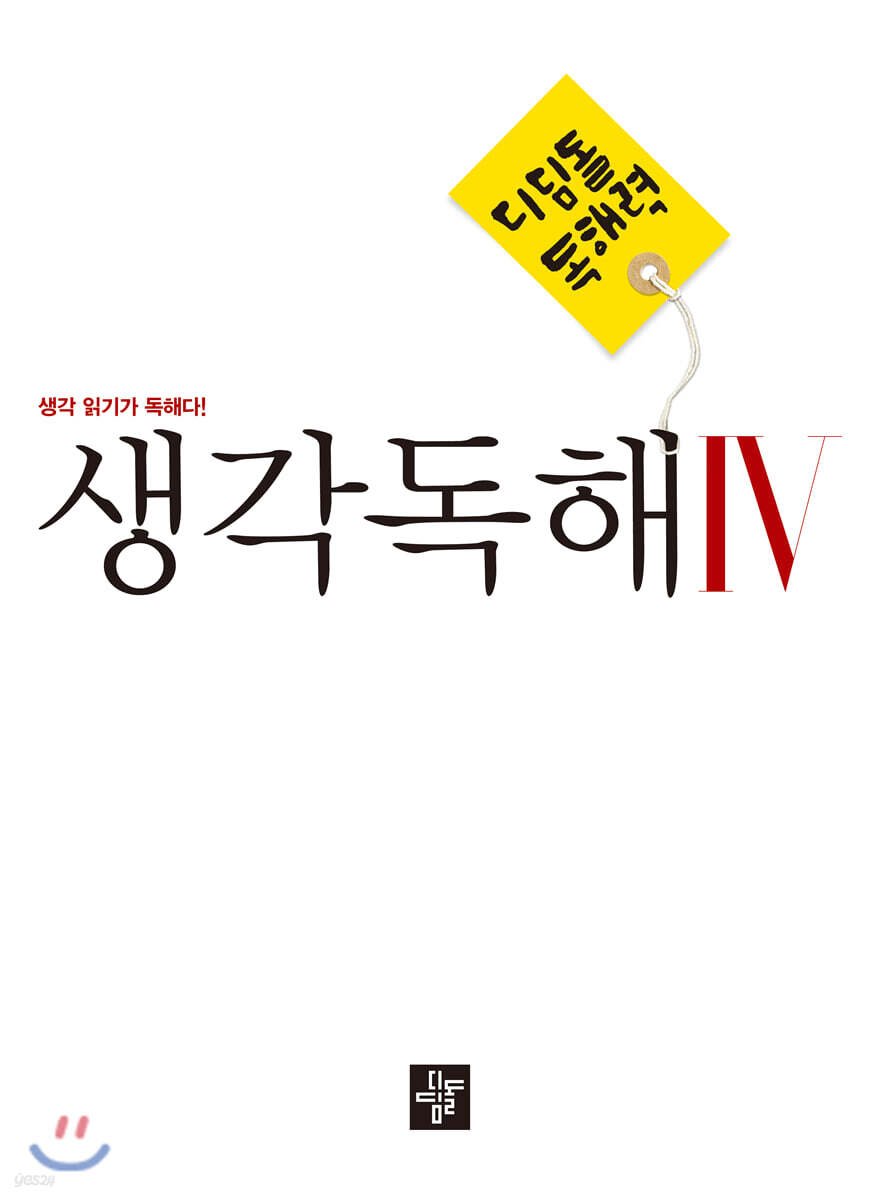
Stepping Stone Middle School Korean Reading Comprehension - Thinking Reading 4
 |
Description
Book Introduction
Reading minds is reading comprehension! We read the same text, so why are our Korean scores different? Being a good reader isn't about who can read faster. Learning how to read and think properly is the core of reading comprehension. Thinking Reading focuses on the process of reading. Starting with the question "why," we select "big ideas" that span a wide range of fields, including humanities, social sciences, science, technology, and the arts, to help you develop the power of thinking beyond simply reading. To reach your destination, the CSAT, let's start with reading comprehension, just like unfolding a map. |
- You can preview some of the book's contents.
Preview
index
Thinking Reading 4
01 Joy
Mind Reading 1 [Philosophy] Is everything that is enjoyable good?
Mind Reading 2 [Life Science] Our bodies also know pleasure.
Mind Reading 3 [Anthropology and Culture] Playful Humans, Homo Ludens
Mind Reading 4 [Psychology] Csikszentmihalyi's Flow Theory
Mind Reading 5 [Advanced Technology] Enjoying Games as if They Were Real
Mindreading is the CSAT. Let's check the criteria for classifying the target.
Mind Reading 6 [Culture and History] Carnival, a noisy and joyful festival
02 Crisis
Mind Reading 1 [Humanities and Social Sciences] Beck and Bauman's Perspective on Modern Society
Mind Reading 2 [Social and Life Sciences] Do superhuman abilities only appear in movies?
Mind Reading 3 [Welfare] Why Social Insurance Is Necessary
Thinking 4 [Industrial Technology] Gas Sensors for Safety
Reading minds is the CSAT. The key to analysis lies in division (÷).
Mind Reading 5 [Industrial Technology] How to Solve Ship Rocking
Mind Reading 6 [Economy] Options for Coping with an Uncertain Future
03 Select
Mind Reading 1 [Ethics/Philosophy] Which Choices Are Morally Justified?
Mind Reading 2 [Economy and Society] Rational Individuals vs. Irrational Societies
Mindreading is the CSAT. Refuting it is "rational nitpicking."
Mind Reading 3 [Photography/Art] The Abstractness of Photography
Mind Reading 4 [Media and Law] Portrait Rights and Media Reporting
Mind Reading 5 [Technology & Society] Should Robot Labor Be Taxed?
Mind Reading 6 [Welfare] Selective Welfare vs. Universal Welfare
04 Efficiency
Reading Thoughts 1 [Thought and Culture] Eastern and Western Perspectives on Efficiency
Reading minds is the CSAT. The key to understanding opinions is applying them to cases.
Mind Reading 2 [Economy/Management] To efficiently allocate resources
Mind Reading 3 [Advanced Technology] Creating a Biocomputer: DNA Computing
Mind Reading 4 [Physics] The Principle of the Lever and the Human Body
Mind Reading 5 [Environment and Society] Septed and Safe Communities
Mind Reading 6 [Science] Thermal Efficiency and the Laws of Thermodynamics
05 Irony
Reading Thoughts 1 [Theater/Literature] What is Irony?
Reading thoughts is the CSAT. When listing, pay attention to the starting point.
Mind Reading 2 [World History] The Results of the French Revolution and the Napoleonic Wars
Mind Reading 3 [Medicine] Are the cells that defend the body attacking the body?
Mind Reading 4 [International/Economy] The Intentions and Results of European Economic Integration
Mind Reading 5 [Technology/Life] This was originally for military use?
Mind Reading 6 [Law/Ethics] What if the person is executed but found not guilty?
06 Coexistence
Mind Reading 1 [International Politics] Will Civilizations Clash or Coexist?
Mind Reading 2 [Economy/Management] Paradox Management: Pursuing Harmony
Mind Reading 3 [Nature/Biology] Ecosystems Seen Through the Principle of Competitive Exclusion
Mindreading is the CSAT. Hidden intentions and context are the clues.
Mind Reading 4 [Advanced Technology] Augmented Reality: Where Reality and Virtuality Coexist
Mind Reading 5 [Medicine and Life Sciences] The War on Infectious Diseases: Vaccines and Antibiotics
Mind Reading 6 [Chemistry and Physics] Coexistence of various phases, 'phase equilibrium'
07 Limits
Mind Reading 1 [Mathematics] Infinity, Beyond the Limits of Numbers
Mind Reading 2 [Logic] The Logical Limitations of Induction
Mindreading is the CSAT. Distinguish between induction and deduction with "arrows."
Mind Reading 3 [Economy] Efficiency in Pricing and Resource Allocation
Mind Reading 4 [Science/Astronomy] The Spatiotemporal Infinity of the Universe
Mind reading is the college entrance exam. If it can't be verified, it's just a hypothesis.
Mind Reading 5 [Crime and Life Sciences] The Birth of DNA Evidence
Mind Reading 6 [Art] Additive Mix vs. Subtractive Mix
01 Joy
Mind Reading 1 [Philosophy] Is everything that is enjoyable good?
Mind Reading 2 [Life Science] Our bodies also know pleasure.
Mind Reading 3 [Anthropology and Culture] Playful Humans, Homo Ludens
Mind Reading 4 [Psychology] Csikszentmihalyi's Flow Theory
Mind Reading 5 [Advanced Technology] Enjoying Games as if They Were Real
Mindreading is the CSAT. Let's check the criteria for classifying the target.
Mind Reading 6 [Culture and History] Carnival, a noisy and joyful festival
02 Crisis
Mind Reading 1 [Humanities and Social Sciences] Beck and Bauman's Perspective on Modern Society
Mind Reading 2 [Social and Life Sciences] Do superhuman abilities only appear in movies?
Mind Reading 3 [Welfare] Why Social Insurance Is Necessary
Thinking 4 [Industrial Technology] Gas Sensors for Safety
Reading minds is the CSAT. The key to analysis lies in division (÷).
Mind Reading 5 [Industrial Technology] How to Solve Ship Rocking
Mind Reading 6 [Economy] Options for Coping with an Uncertain Future
03 Select
Mind Reading 1 [Ethics/Philosophy] Which Choices Are Morally Justified?
Mind Reading 2 [Economy and Society] Rational Individuals vs. Irrational Societies
Mindreading is the CSAT. Refuting it is "rational nitpicking."
Mind Reading 3 [Photography/Art] The Abstractness of Photography
Mind Reading 4 [Media and Law] Portrait Rights and Media Reporting
Mind Reading 5 [Technology & Society] Should Robot Labor Be Taxed?
Mind Reading 6 [Welfare] Selective Welfare vs. Universal Welfare
04 Efficiency
Reading Thoughts 1 [Thought and Culture] Eastern and Western Perspectives on Efficiency
Reading minds is the CSAT. The key to understanding opinions is applying them to cases.
Mind Reading 2 [Economy/Management] To efficiently allocate resources
Mind Reading 3 [Advanced Technology] Creating a Biocomputer: DNA Computing
Mind Reading 4 [Physics] The Principle of the Lever and the Human Body
Mind Reading 5 [Environment and Society] Septed and Safe Communities
Mind Reading 6 [Science] Thermal Efficiency and the Laws of Thermodynamics
05 Irony
Reading Thoughts 1 [Theater/Literature] What is Irony?
Reading thoughts is the CSAT. When listing, pay attention to the starting point.
Mind Reading 2 [World History] The Results of the French Revolution and the Napoleonic Wars
Mind Reading 3 [Medicine] Are the cells that defend the body attacking the body?
Mind Reading 4 [International/Economy] The Intentions and Results of European Economic Integration
Mind Reading 5 [Technology/Life] This was originally for military use?
Mind Reading 6 [Law/Ethics] What if the person is executed but found not guilty?
06 Coexistence
Mind Reading 1 [International Politics] Will Civilizations Clash or Coexist?
Mind Reading 2 [Economy/Management] Paradox Management: Pursuing Harmony
Mind Reading 3 [Nature/Biology] Ecosystems Seen Through the Principle of Competitive Exclusion
Mindreading is the CSAT. Hidden intentions and context are the clues.
Mind Reading 4 [Advanced Technology] Augmented Reality: Where Reality and Virtuality Coexist
Mind Reading 5 [Medicine and Life Sciences] The War on Infectious Diseases: Vaccines and Antibiotics
Mind Reading 6 [Chemistry and Physics] Coexistence of various phases, 'phase equilibrium'
07 Limits
Mind Reading 1 [Mathematics] Infinity, Beyond the Limits of Numbers
Mind Reading 2 [Logic] The Logical Limitations of Induction
Mindreading is the CSAT. Distinguish between induction and deduction with "arrows."
Mind Reading 3 [Economy] Efficiency in Pricing and Resource Allocation
Mind Reading 4 [Science/Astronomy] The Spatiotemporal Infinity of the Universe
Mind reading is the college entrance exam. If it can't be verified, it's just a hypothesis.
Mind Reading 5 [Crime and Life Sciences] The Birth of DNA Evidence
Mind Reading 6 [Art] Additive Mix vs. Subtractive Mix
Detailed image

Publisher's Review
Is reading comprehension complete just by reading the passage and solving the problems?
True reading is when you can read the writer's thoughts!
Reading comprehension refers to the ability to read text and understand its meaning.
The basis of reading comprehension is how accurately you can grasp the content of the text, that is, the information organized according to the writer's thoughts.
So, if I understand all the content of the text, is reading comprehension finished?
There is no writing that does not contain the writer's thoughts.
However, writers often do not express their thoughts directly, but hide them tightly in their writing.
The best strategy for developing reading comprehension is not to simply read the text, but to put yourself in the author's shoes and read the author's hidden thoughts.
True reading is when you can read the writer's thoughts.
One, can you read thoughts from various fields with one idea?
Aren't you curious about what thoughts are circulating across the humanities, society, economics, history, science, technology, art, music, and more, all based on the same idea? Mind Reading presents a panoramic view of diverse fields, all connected by a single, big idea.
Don't be overwhelmed by the uncertainty of what questions will appear on the CSAT. Start by learning how to read your mind!
Read and complete your reading comprehension on a variety of topics with more in-depth insights!
'How should we live?'
『Thinking Reading IV, V Big Idea』 Pleasure, Crisis, Choice, Efficiency, Irony, Coexistence, Limits / Communication, Balance, Change, Riddle, Evolution, System, Future
Starting with the question 'why', we exchange various thoughts related to 'what',
Move on to the stage where you can think about 'how' yourself!
Reading thoughts and completing reading comprehension 『Thought Reading I-V』
The discovery of ideas begins with big ideas.
One idea can be used to read thoughts from various fields such as humanities, society, economics, history, science, technology, and art.
Thinking comprehension is made up of big ideas that allow for expansion and integration of thoughts.
The big idea we're talking about here is a large principle that can bring together ideas from various fields.
Reading various thoughts with one idea
In the six readings, multiple stories unfold on the same topic, each from their own field and perspective.
Second, curious about the principles of reading comprehension? The author's thoughts are the principles of reading comprehension!
As you solve the problems, you might wonder why the author wrote the passage this way, why he or she created this particular problem, and yet feel a sense of resentment. The image tips and thought-reading skills hidden throughout the passages will help you find answers to those questions.
Curious about the author's thoughts? Find out with "Reading Minds is the CSAT"!
You can tell what the writer is thinking just by looking at the paragraph structure?
Practice reading comprehension principles using the 'reading principles' learned in 'Reading Comprehension I, II, III'.
In 『Thinking Reading IV, V』, you will learn the paragraph structure that appears in the actual CSAT,
Shows how to read the writer's thoughts by paragraph structure
Reading comprehension is the CSAT (College Scholastic Ability Test) practice
Third, no more rigid paragraph structures! Structure your thoughts with fun thought puzzles!
If you practice turning the thoughts in each paragraph into a puzzle, like playing a game, before you know it, when you read a piece of writing, your mind will see the writing in a familiar puzzle form!
Fourth, real reading is complete when you can gather your thoughts into one word!
If I just read without organizing my thoughts, like floating dust, the text I read will soon disappear from my mind without a trace.
When I can read a long piece of writing and summarize it in one sentence, or even one word, then that writing becomes truly mine.
In structuring your thoughts, try to integrate various thoughts into paragraphs → sentences → words and make them your own!
True reading is when you can read the writer's thoughts!
Reading comprehension refers to the ability to read text and understand its meaning.
The basis of reading comprehension is how accurately you can grasp the content of the text, that is, the information organized according to the writer's thoughts.
So, if I understand all the content of the text, is reading comprehension finished?
There is no writing that does not contain the writer's thoughts.
However, writers often do not express their thoughts directly, but hide them tightly in their writing.
The best strategy for developing reading comprehension is not to simply read the text, but to put yourself in the author's shoes and read the author's hidden thoughts.
True reading is when you can read the writer's thoughts.
One, can you read thoughts from various fields with one idea?
Aren't you curious about what thoughts are circulating across the humanities, society, economics, history, science, technology, art, music, and more, all based on the same idea? Mind Reading presents a panoramic view of diverse fields, all connected by a single, big idea.
Don't be overwhelmed by the uncertainty of what questions will appear on the CSAT. Start by learning how to read your mind!
Read and complete your reading comprehension on a variety of topics with more in-depth insights!
'How should we live?'
『Thinking Reading IV, V Big Idea』 Pleasure, Crisis, Choice, Efficiency, Irony, Coexistence, Limits / Communication, Balance, Change, Riddle, Evolution, System, Future
Starting with the question 'why', we exchange various thoughts related to 'what',
Move on to the stage where you can think about 'how' yourself!
Reading thoughts and completing reading comprehension 『Thought Reading I-V』
The discovery of ideas begins with big ideas.
One idea can be used to read thoughts from various fields such as humanities, society, economics, history, science, technology, and art.
Thinking comprehension is made up of big ideas that allow for expansion and integration of thoughts.
The big idea we're talking about here is a large principle that can bring together ideas from various fields.
Reading various thoughts with one idea
In the six readings, multiple stories unfold on the same topic, each from their own field and perspective.
Second, curious about the principles of reading comprehension? The author's thoughts are the principles of reading comprehension!
As you solve the problems, you might wonder why the author wrote the passage this way, why he or she created this particular problem, and yet feel a sense of resentment. The image tips and thought-reading skills hidden throughout the passages will help you find answers to those questions.
Curious about the author's thoughts? Find out with "Reading Minds is the CSAT"!
You can tell what the writer is thinking just by looking at the paragraph structure?
Practice reading comprehension principles using the 'reading principles' learned in 'Reading Comprehension I, II, III'.
In 『Thinking Reading IV, V』, you will learn the paragraph structure that appears in the actual CSAT,
Shows how to read the writer's thoughts by paragraph structure
Reading comprehension is the CSAT (College Scholastic Ability Test) practice
Third, no more rigid paragraph structures! Structure your thoughts with fun thought puzzles!
If you practice turning the thoughts in each paragraph into a puzzle, like playing a game, before you know it, when you read a piece of writing, your mind will see the writing in a familiar puzzle form!
Fourth, real reading is complete when you can gather your thoughts into one word!
If I just read without organizing my thoughts, like floating dust, the text I read will soon disappear from my mind without a trace.
When I can read a long piece of writing and summarize it in one sentence, or even one word, then that writing becomes truly mine.
In structuring your thoughts, try to integrate various thoughts into paragraphs → sentences → words and make them your own!
GOODS SPECIFICS
- Publication date: December 15, 2020
- Page count, weight, size: 280 pages | 220*300mm
- ISBN13: 9788926158753
- ISBN10: 8926158756
- Reference book for use in grades: Common for middle school students
- Reference book usage semester: Common semester
- Reference Difficulty: Hard Reference Difficulty Guide
You may also like
카테고리
korean


korean

![GQ KOREA Mark (Monthly): December [2025]](http://librairie.coreenne.fr/cdn/shop/files/8ef265dbbfbf186523ed75ba7319009d.jpg?v=1765340328&width=3840)


