

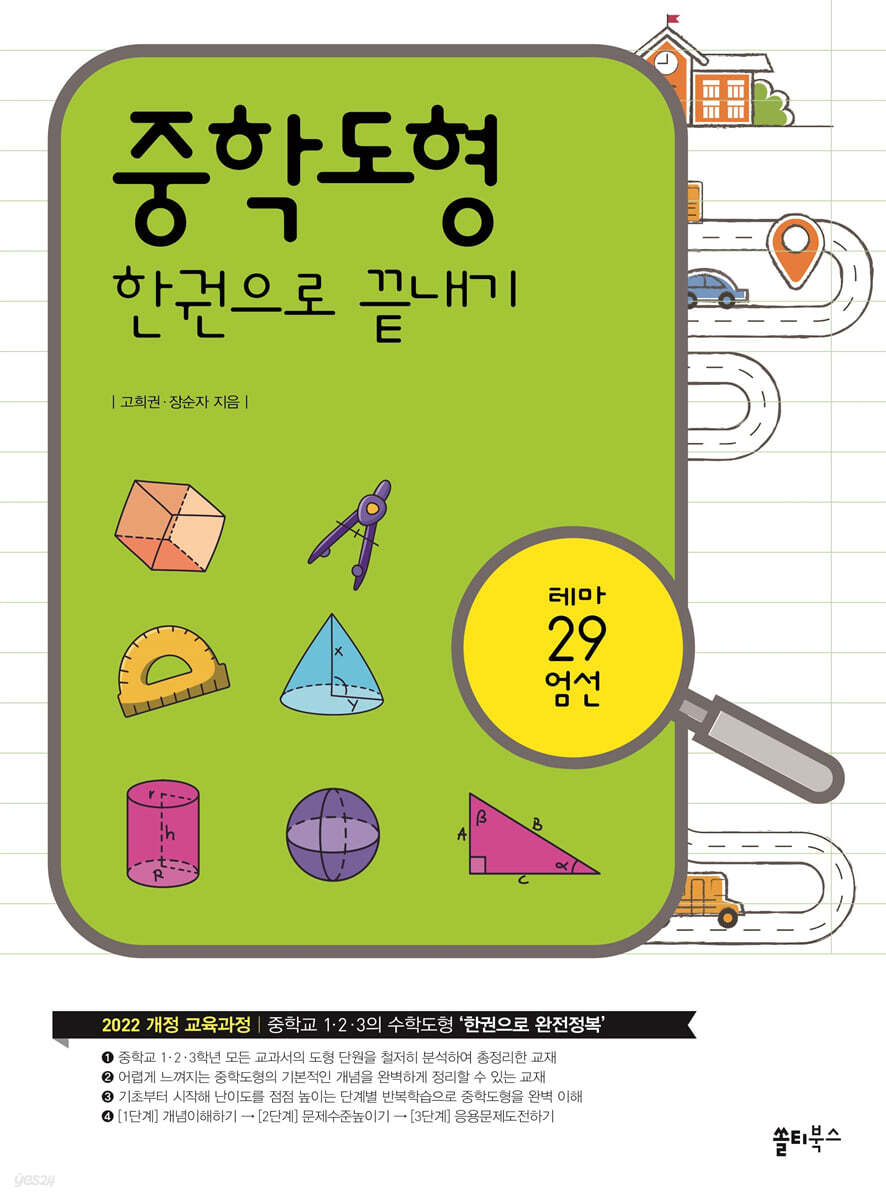
Finishing the middle school version in one volume
 |
Description
Book Introduction
This is a textbook that thoroughly analyzes and summarizes the geometry sections of all textbooks for the first, second, and third grades of middle school.
This is a textbook that can perfectly organize the basic concepts of middle school geometry, which can be perceived as difficult.
You can fully understand middle school geometry through step-by-step, repetitive learning that starts from the basics and gradually increases in difficulty.
It consists of [Step 1] Understanding the concept → [Step 2] Raising the level of the problem → [Step 3] Challenge the application problem.
This is a textbook that can perfectly organize the basic concepts of middle school geometry, which can be perceived as difficult.
You can fully understand middle school geometry through step-by-step, repetitive learning that starts from the basics and gradually increases in difficulty.
It consists of [Step 1] Understanding the concept → [Step 2] Raising the level of the problem → [Step 3] Challenge the application problem.
- You can preview some of the book's contents.
Preview
index
● A complete summary of shapes for first-year middle school students
Theme 01.
Basics of Shapes
Theme 02.
Angles, verticals and perpendiculars
Theme 03.
Positional relationship
Theme 04.
Alternate and alternate angles
Theme 05.
Congruence of triangles
Theme 06.
polygon
Theme 07.
Circles and sectors
Theme 08.
polyhedron
Theme 09.
Rotating body
● A complete summary of shapes for 2nd grade middle school students
Theme 10.
isosceles triangle
Theme 11.
circumcenter of a triangle
Theme 12.
Incenter of a triangle
Theme 13.
parallelogram
Theme 14.
Various squares
Theme 15.
similar shapes
Theme 16.
Angle bisectors, parallel lines and line segments
Theme 17.
Properties of the line segment connecting the midpoints of two sides of a triangle
Theme 18.
Median and centroid of a triangle
Theme 19.
Area and volume of similar shapes
Theme 20.
Pythagorean theorem
Theme 21.
Applications of the Pythagorean theorem
● A complete summary of shapes for 3rd grade middle school students
Theme 22.
Trigonometric ratios
Theme 23.
Values of trigonometric ratios
Theme 24.
Application of trigonometric functions to length
Theme 25.
Application of trigonometric functions to area
Theme 26.
The current of the circle
Theme 27.
Tangent of a circle
Theme 28.
central angle
Theme 29.
Properties of central angles
● [Friendly commentary (book within a book)]
Theme 01.
Basics of Shapes
Theme 02.
Angles, verticals and perpendiculars
Theme 03.
Positional relationship
Theme 04.
Alternate and alternate angles
Theme 05.
Congruence of triangles
Theme 06.
polygon
Theme 07.
Circles and sectors
Theme 08.
polyhedron
Theme 09.
Rotating body
● A complete summary of shapes for 2nd grade middle school students
Theme 10.
isosceles triangle
Theme 11.
circumcenter of a triangle
Theme 12.
Incenter of a triangle
Theme 13.
parallelogram
Theme 14.
Various squares
Theme 15.
similar shapes
Theme 16.
Angle bisectors, parallel lines and line segments
Theme 17.
Properties of the line segment connecting the midpoints of two sides of a triangle
Theme 18.
Median and centroid of a triangle
Theme 19.
Area and volume of similar shapes
Theme 20.
Pythagorean theorem
Theme 21.
Applications of the Pythagorean theorem
● A complete summary of shapes for 3rd grade middle school students
Theme 22.
Trigonometric ratios
Theme 23.
Values of trigonometric ratios
Theme 24.
Application of trigonometric functions to length
Theme 25.
Application of trigonometric functions to area
Theme 26.
The current of the circle
Theme 27.
Tangent of a circle
Theme 28.
central angle
Theme 29.
Properties of central angles
● [Friendly commentary (book within a book)]
Detailed image

Publisher's Review
〉〉Let’s quickly finish the math figures for 1st, 2nd, and 3rd grade middle school students in one book!
Even students who enjoy and study elementary geometry often find middle school geometry very difficult.
This is because, unlike elementary school, the difficulty of the middle school geometry content suddenly increases, as abstract terms and complex formulas appear and you have to prove that certain facts are true.
Moreover, since these geometry units are learned in the second semester when students' motivation to learn is low, this is the reason why many students give up on math.
1.
If you don't pass the middle school exam, you will 100% fail.
In a survey that looked into the reasons for giving up on math, the most common reason was that they were in middle school.
For students who were focused on simple calculation repetition training in elementary school, the difficult middle school math problem becomes a difficult wall to overcome.
The similarity and congruence of shapes, the Pythagorean theorem, and trigonometric functions that we learn in middle school are very important and frequently used in higher mathematics, so you must thoroughly master the concepts of middle school shapes to do well in higher mathematics.
Ultimately, if you don't properly understand middle school geometry, you will have great difficulty in higher level mathematics.
2.
In geometry, too, the basics are more important than solving advanced problems.
Geometry is a core subject in elementary, middle, and high school.
This is because most of the concepts of shapes covered in high school are middle school shapes.
When studying geometry in middle school, it is more important to understand the basic concepts accurately than to be able to solve difficult, advanced problems.
Many students blindly solve advanced problems without even fully understanding the basic concepts, which is no different from building a castle on sand.
For middle school students, focus on studying to accurately understand the basic concepts.
3.
A collection of math figures for 1st, 2nd, and 3rd grade middle school students in one volume.
This book, "Complete Middle School Geometry in One Volume," is an introductory book and training book for middle school students that aims to help them accurately understand the basic concepts of mathematical geometry for 1st, 2nd, and 3rd graders by collecting them into one volume.
In particular, you can accurately understand the basic concepts of shapes through step-by-step repetitive learning.
◆ Structure and Use of This Book
[Step 0] Summary of Essential Concepts
We compared and analyzed all textbooks for the first, second, and third grades of middle school to clearly organize the essential concepts.
Additionally, we added abundant 'editing' throughout to make it easier and faster to understand.
Moreover, 'Yes' is a great help in immediately understanding the concept presented above, 'Caution' is used when caution is needed, and 'Reference' is used when supplementary explanation is needed to understand the content.
[Step 1] Understanding the Concept
We have carefully selected and included basic absolute questions with relatively low difficulty so that you can check for yourself whether you have accurately understood the essential concepts and understand the concepts while solving them.
This concept understanding problem is based on the problem types in the textbook and uses the approach presented in the textbook to ensure accurate understanding of the basic concepts.
If you are having trouble solving a problem, you can refer to the summary of essential concepts to solve it.
[Step 2] Raising the Problem Level
If you have accurately understood the basic concepts through the Level 1 Concept Understanding Problem, you can check the basic concepts again through the Level 1 Problem Raising Problem, which is a bit more difficult, and solve various types of problems to raise the level of understanding of the concepts one step further.
This level-up problem set presents a wide variety of problems, so you should solve them all without missing a single one.
[Step 3] Challenge the application problem
If the Level 1 Concept Understanding and Level 2 Problem Raising are tools that help you check if you understand the concept well or understand the concept while solving it, the Level 3 Application Problem Challenge are carefully selected types that are important enough to appear in school exams or can expand your thinking ability by applying basic concepts.
※ This book is highly recommended for the following students!
〉〉 Middle school 3rd year, high school 1st year: “A student who wants to quickly organize the essential concepts of middle school geometry.”
〉〉 High school freshman, sophomore, and junior: “Students who want to organize only the core concepts of middle school geometry, which are the foundation for high school geometry.”
〉〉 6th grade, 1st and 2nd grade: “Students who want to preview/review the entire middle school curriculum faster than others.”
Even students who enjoy and study elementary geometry often find middle school geometry very difficult.
This is because, unlike elementary school, the difficulty of the middle school geometry content suddenly increases, as abstract terms and complex formulas appear and you have to prove that certain facts are true.
Moreover, since these geometry units are learned in the second semester when students' motivation to learn is low, this is the reason why many students give up on math.
1.
If you don't pass the middle school exam, you will 100% fail.
In a survey that looked into the reasons for giving up on math, the most common reason was that they were in middle school.
For students who were focused on simple calculation repetition training in elementary school, the difficult middle school math problem becomes a difficult wall to overcome.
The similarity and congruence of shapes, the Pythagorean theorem, and trigonometric functions that we learn in middle school are very important and frequently used in higher mathematics, so you must thoroughly master the concepts of middle school shapes to do well in higher mathematics.
Ultimately, if you don't properly understand middle school geometry, you will have great difficulty in higher level mathematics.
2.
In geometry, too, the basics are more important than solving advanced problems.
Geometry is a core subject in elementary, middle, and high school.
This is because most of the concepts of shapes covered in high school are middle school shapes.
When studying geometry in middle school, it is more important to understand the basic concepts accurately than to be able to solve difficult, advanced problems.
Many students blindly solve advanced problems without even fully understanding the basic concepts, which is no different from building a castle on sand.
For middle school students, focus on studying to accurately understand the basic concepts.
3.
A collection of math figures for 1st, 2nd, and 3rd grade middle school students in one volume.
This book, "Complete Middle School Geometry in One Volume," is an introductory book and training book for middle school students that aims to help them accurately understand the basic concepts of mathematical geometry for 1st, 2nd, and 3rd graders by collecting them into one volume.
In particular, you can accurately understand the basic concepts of shapes through step-by-step repetitive learning.
◆ Structure and Use of This Book
[Step 0] Summary of Essential Concepts
We compared and analyzed all textbooks for the first, second, and third grades of middle school to clearly organize the essential concepts.
Additionally, we added abundant 'editing' throughout to make it easier and faster to understand.
Moreover, 'Yes' is a great help in immediately understanding the concept presented above, 'Caution' is used when caution is needed, and 'Reference' is used when supplementary explanation is needed to understand the content.
[Step 1] Understanding the Concept
We have carefully selected and included basic absolute questions with relatively low difficulty so that you can check for yourself whether you have accurately understood the essential concepts and understand the concepts while solving them.
This concept understanding problem is based on the problem types in the textbook and uses the approach presented in the textbook to ensure accurate understanding of the basic concepts.
If you are having trouble solving a problem, you can refer to the summary of essential concepts to solve it.
[Step 2] Raising the Problem Level
If you have accurately understood the basic concepts through the Level 1 Concept Understanding Problem, you can check the basic concepts again through the Level 1 Problem Raising Problem, which is a bit more difficult, and solve various types of problems to raise the level of understanding of the concepts one step further.
This level-up problem set presents a wide variety of problems, so you should solve them all without missing a single one.
[Step 3] Challenge the application problem
If the Level 1 Concept Understanding and Level 2 Problem Raising are tools that help you check if you understand the concept well or understand the concept while solving it, the Level 3 Application Problem Challenge are carefully selected types that are important enough to appear in school exams or can expand your thinking ability by applying basic concepts.
※ This book is highly recommended for the following students!
〉〉 Middle school 3rd year, high school 1st year: “A student who wants to quickly organize the essential concepts of middle school geometry.”
〉〉 High school freshman, sophomore, and junior: “Students who want to organize only the core concepts of middle school geometry, which are the foundation for high school geometry.”
〉〉 6th grade, 1st and 2nd grade: “Students who want to preview/review the entire middle school curriculum faster than others.”
GOODS SPECIFICS
- Date of issue: June 20, 2025
- Page count, weight, size: 268 pages | 617g | 188*257*20mm
- ISBN13: 9791192967288
- ISBN10: 1192967283
You may also like
카테고리
korean


korean

![GQ KOREA Mark (Monthly): December [2025]](http://librairie.coreenne.fr/cdn/shop/files/8ef265dbbfbf186523ed75ba7319009d.jpg?v=1765340328&width=3840)


