

Dadam Middle School Korean Grammar 1200 Questions
 |
Description
Book Introduction
{Reflecting the 2022 revised curriculum}
A workbook that covers all the concepts while solving middle school Korean grammar problems.
Completely master three years' worth of middle school Korean grammar problems and concepts in 28 days, 1 hour a day!
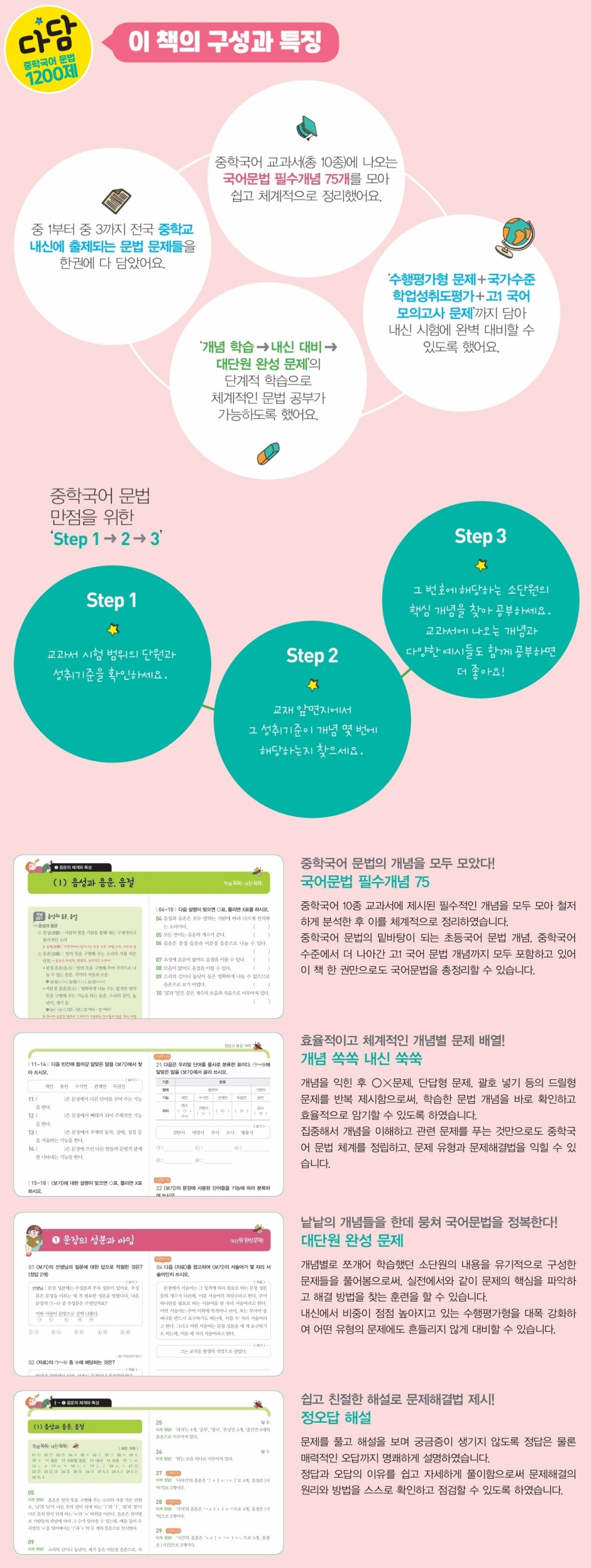
75 essential Korean grammar concepts found in middle school Korean language textbooks are organized in an easy and systematic manner.
This book contains all the grammar problems that appear in middle school grades nationwide, from the first year of middle school to the third year of middle school.
{Concept learning → Internal exam preparation problems → Unit completion problems} Systematic study is possible through step-by-step learning.
You can improve your problem-solving skills through 'performance assessment type problems + national level academic achievement test + high school 1st year Korean language mock test' problems.
〉〉 [Study plan] provided to conquer Korean grammar in 28 days, 1 hour per day
A workbook that covers all the concepts while solving middle school Korean grammar problems.
Completely master three years' worth of middle school Korean grammar problems and concepts in 28 days, 1 hour a day!
75 essential Korean grammar concepts found in middle school Korean language textbooks are organized in an easy and systematic manner.
This book contains all the grammar problems that appear in middle school grades nationwide, from the first year of middle school to the third year of middle school.
{Concept learning → Internal exam preparation problems → Unit completion problems} Systematic study is possible through step-by-step learning.
You can improve your problem-solving skills through 'performance assessment type problems + national level academic achievement test + high school 1st year Korean language mock test' problems.
〉〉 [Study plan] provided to conquer Korean grammar in 28 days, 1 hour per day
- You can preview some of the book's contents.
Preview
index
I.
Phonology
1.
Phonological system and characteristics
(1) Voice, phoneme, and syllable
(2) System of consonants and vowels
〉〉 Grand Finale Completion Problem
2.
Phonological changes
(1) Rules for final sounds of syllables
(2) Consonant assimilation
(3) Palatalization and initial consonant rules
(4) Become a voice
(5) Phonetic contraction
(6) Phoneme omission
(7) Addition of phonemes
〉〉 Grand Finale Completion Problem
II.
Words and parts of speech
1.
Types and characteristics of parts of speech
(1) Concept and classification criteria of parts of speech
(2) Noun
(3) Verbs
(4) Relationship words
(5) Modifiers and independent words
〉〉 Grand Finale Completion Problem
2.
Word formation and vocabulary types
(1) Morpheme
(2) Root and affix
(3) Formation and principles of single and compound words and new words
(4) Significant relationship, antithetical relationship, superior-subordinate relationship
(5) Homonymous relationship, polysemous relationship
(6) System and aspects of vocabulary
〉〉 Grand Finale Completion Problem
3.
Pronunciation and spelling of words
(1) Korean spelling ①
(2) Korean spelling ②
(3) Standard language regulations and standard pronunciation
〉〉 Grand Finale Completion Problem
III.
Sentences and expressions
1.
Sentence components and structure
(1) Sentence components
(2) Sentence structure
〉〉 Grand Finale Completion Problem
2.
Correct sentence expression
(1) Concluding expression
(2) Honorific expressions
(3) Time expression
(4) Passive and causative expressions
(5) Quotation expressions
(6) Negative expression
〉〉 Grand Finale Completion Problem
IV.
Discourse and Hangul
1.
The concept and characteristics of discourse
(1) Concept and characteristics of discourse
〉〉 Grand Finale Completion Problem
2.
The Creation Principles of Hangul and the National Language in the Unified Era
(1) The principles of Hangul’s creation and its excellence
〉〉 Grand Finale Completion Problem
[Answer and Explanation] (Book within a Book)
Phonology
1.
Phonological system and characteristics
(1) Voice, phoneme, and syllable
(2) System of consonants and vowels
〉〉 Grand Finale Completion Problem
2.
Phonological changes
(1) Rules for final sounds of syllables
(2) Consonant assimilation
(3) Palatalization and initial consonant rules
(4) Become a voice
(5) Phonetic contraction
(6) Phoneme omission
(7) Addition of phonemes
〉〉 Grand Finale Completion Problem
II.
Words and parts of speech
1.
Types and characteristics of parts of speech
(1) Concept and classification criteria of parts of speech
(2) Noun
(3) Verbs
(4) Relationship words
(5) Modifiers and independent words
〉〉 Grand Finale Completion Problem
2.
Word formation and vocabulary types
(1) Morpheme
(2) Root and affix
(3) Formation and principles of single and compound words and new words
(4) Significant relationship, antithetical relationship, superior-subordinate relationship
(5) Homonymous relationship, polysemous relationship
(6) System and aspects of vocabulary
〉〉 Grand Finale Completion Problem
3.
Pronunciation and spelling of words
(1) Korean spelling ①
(2) Korean spelling ②
(3) Standard language regulations and standard pronunciation
〉〉 Grand Finale Completion Problem
III.
Sentences and expressions
1.
Sentence components and structure
(1) Sentence components
(2) Sentence structure
〉〉 Grand Finale Completion Problem
2.
Correct sentence expression
(1) Concluding expression
(2) Honorific expressions
(3) Time expression
(4) Passive and causative expressions
(5) Quotation expressions
(6) Negative expression
〉〉 Grand Finale Completion Problem
IV.
Discourse and Hangul
1.
The concept and characteristics of discourse
(1) Concept and characteristics of discourse
〉〉 Grand Finale Completion Problem
2.
The Creation Principles of Hangul and the National Language in the Unified Era
(1) The principles of Hangul’s creation and its excellence
〉〉 Grand Finale Completion Problem
[Answer and Explanation] (Book within a Book)
Detailed image
Publisher's Review
Why is "Dadam Middle School Korean Grammar 1200 Questions" good?
1.
All the concepts of middle school Korean grammar gathered together, 75 essential concepts!
① All concepts presented in 10 middle school Korean language textbooks were collected, analyzed, and organized, and then systematically presented as ‘75 Essential Concepts.’
② By including all elementary school Korean grammar concepts that form the basis of middle school Korean grammar and high school grammar concepts that go beyond middle school Korean, you can cover all elementary, middle, and high school grammar in just this one book.
2.
All the grammar problems that appear on the middle school Korean language exams are included in one book!!
① After learning the concept, by repeatedly presenting drill-type problems such as ○× problems, short answer problems, and parenthesized problems, students can immediately confirm the learned grammar concepts and memorize them efficiently.
② We have significantly strengthened the performance-based assessment type questions, which are increasingly important in internal assessments, and have included a comprehensive range of questions, including the ‘National Academic Achievement Test’ and ‘High School 1st Grade Korean Language Mock Exam Questions,’ to help students fully prepare for the middle school Korean language grammar internal exam and develop problem-solving skills.
3.
Systematic study of Korean grammar through step-by-step learning!!
① Systematic grammar study was made possible through step-by-step learning of ‘concept learning → internal exam preparation → unit completion problems.’
② By organically linking the contents of the sub-units studied by dividing them into concepts and solving problems in the main unit (main unit completion problems), we were able to train students to identify the core of the problem and find a solution as in a real-life situation.
Structure and Features of "Dadam Middle School Korean Grammar 1200 Questions"
1.
A comprehensive compilation of all middle school Korean grammar concepts! - "75 Essential Korean Grammar Concepts"
All essential concepts presented in 10 middle school Korean language textbooks were collected, thoroughly analyzed, and then systematically organized.
This book covers all the concepts of elementary Korean grammar that form the basis of middle school Korean grammar, and even the advanced grammar concepts of high school 1st graders, so you can cover all of Korean grammar in just one book.
2.
Efficient and systematic concept-based problem solving! - "Concepts, concepts, and answers"
After learning the concept, by repeatedly presenting drill-type problems such as ○× problems, short answer problems, and parenthesized problems, students can immediately confirm the learned grammar concepts and memorize them efficiently.
By simply focusing on understanding the concepts and solving related problems, you can establish a middle school Korean grammar system and learn problem types and problem-solving methods.
3.
Master Korean grammar by combining individual concepts! - "Unit Completion Problems"
By solving problems that organically organize the content of the short units learned by breaking them down by concept, you can train yourself to identify the core of the problem and find solutions, just like in real life.
By significantly strengthening the performance-based evaluation system, which is increasingly gaining importance in school records, students can develop skills that will not be shaken by any type of problem.
4.
Easy-to-understand explanations provide problem-solving solutions! - "Correct and Incorrect Answers"
To prevent any questions from arising while solving the problem and looking at the explanation, the correct answers as well as attractive incorrect answers are clearly explained.
By providing easy and detailed explanations of the reasons for correct and incorrect answers, students can confirm and check the principles and methods of problem solving on their own.
1.
All the concepts of middle school Korean grammar gathered together, 75 essential concepts!
① All concepts presented in 10 middle school Korean language textbooks were collected, analyzed, and organized, and then systematically presented as ‘75 Essential Concepts.’
② By including all elementary school Korean grammar concepts that form the basis of middle school Korean grammar and high school grammar concepts that go beyond middle school Korean, you can cover all elementary, middle, and high school grammar in just this one book.
2.
All the grammar problems that appear on the middle school Korean language exams are included in one book!!
① After learning the concept, by repeatedly presenting drill-type problems such as ○× problems, short answer problems, and parenthesized problems, students can immediately confirm the learned grammar concepts and memorize them efficiently.
② We have significantly strengthened the performance-based assessment type questions, which are increasingly important in internal assessments, and have included a comprehensive range of questions, including the ‘National Academic Achievement Test’ and ‘High School 1st Grade Korean Language Mock Exam Questions,’ to help students fully prepare for the middle school Korean language grammar internal exam and develop problem-solving skills.
3.
Systematic study of Korean grammar through step-by-step learning!!
① Systematic grammar study was made possible through step-by-step learning of ‘concept learning → internal exam preparation → unit completion problems.’
② By organically linking the contents of the sub-units studied by dividing them into concepts and solving problems in the main unit (main unit completion problems), we were able to train students to identify the core of the problem and find a solution as in a real-life situation.
Structure and Features of "Dadam Middle School Korean Grammar 1200 Questions"
1.
A comprehensive compilation of all middle school Korean grammar concepts! - "75 Essential Korean Grammar Concepts"
All essential concepts presented in 10 middle school Korean language textbooks were collected, thoroughly analyzed, and then systematically organized.
This book covers all the concepts of elementary Korean grammar that form the basis of middle school Korean grammar, and even the advanced grammar concepts of high school 1st graders, so you can cover all of Korean grammar in just one book.
2.
Efficient and systematic concept-based problem solving! - "Concepts, concepts, and answers"
After learning the concept, by repeatedly presenting drill-type problems such as ○× problems, short answer problems, and parenthesized problems, students can immediately confirm the learned grammar concepts and memorize them efficiently.
By simply focusing on understanding the concepts and solving related problems, you can establish a middle school Korean grammar system and learn problem types and problem-solving methods.
3.
Master Korean grammar by combining individual concepts! - "Unit Completion Problems"
By solving problems that organically organize the content of the short units learned by breaking them down by concept, you can train yourself to identify the core of the problem and find solutions, just like in real life.
By significantly strengthening the performance-based evaluation system, which is increasingly gaining importance in school records, students can develop skills that will not be shaken by any type of problem.
4.
Easy-to-understand explanations provide problem-solving solutions! - "Correct and Incorrect Answers"
To prevent any questions from arising while solving the problem and looking at the explanation, the correct answers as well as attractive incorrect answers are clearly explained.
By providing easy and detailed explanations of the reasons for correct and incorrect answers, students can confirm and check the principles and methods of problem solving on their own.
GOODS SPECIFICS
- Date of issue: September 1, 2025
- Page count, weight, size: 216 pages | 634g | 210*297*20mm
- ISBN13: 9791192967301
- ISBN10: 1192967305
You may also like
카테고리
korean


korean

![GQ KOREA Mark (Monthly): December [2025]](http://librairie.coreenne.fr/cdn/shop/files/8ef265dbbfbf186523ed75ba7319009d.jpg?v=1765340328&width=3840)


