

Zastory Middle School Korean Literature Reading Comprehension + Literature Terminology 2
 |
Description
Book Introduction
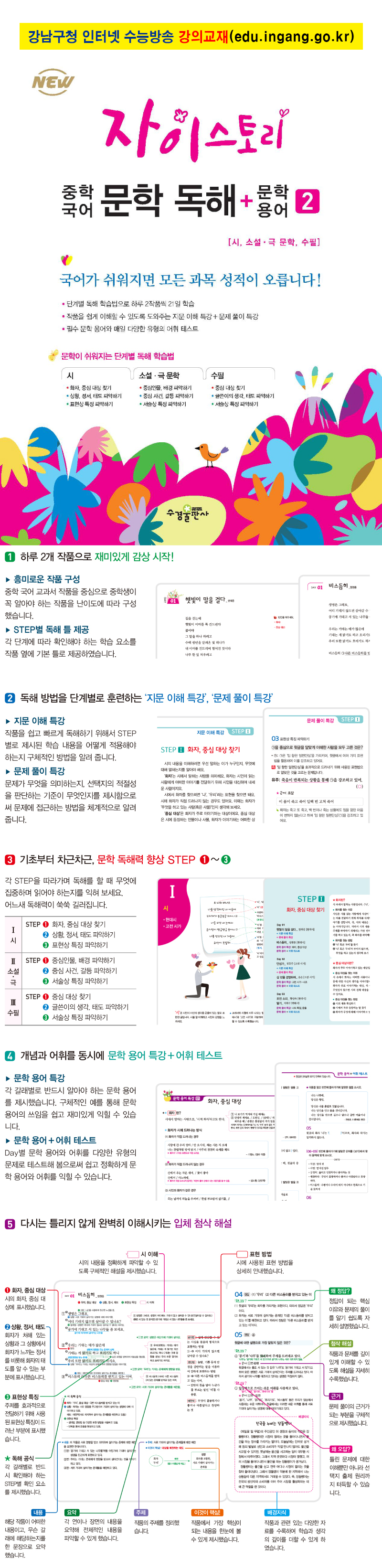
『Zistory Middle School Korean Literature Reading + Literature Terminology』 is designed to teach 42 passages over 21 days, and allows for step-by-step reading training according to each branch's STEP.
You can learn how to read fingerprints in the fingerprint special lecture, and how to approach problems in the problem special lecture.
It includes a special lecture on literary terminology, various types of vocabulary tests, and three-dimensional editing and commentary that supplements concepts to ensure you never make mistakes again.
You can learn how to read fingerprints in the fingerprint special lecture, and how to approach problems in the problem special lecture.
It includes a special lecture on literary terminology, various types of vocabulary tests, and three-dimensional editing and commentary that supplements concepts to ensure you never make mistakes again.
index
Ⅰ City
STEP ? Finding the speaker and the central object
Day 01 Sunlight Speaks (Kwon Dae-woong) 12
Obliquely (Jeong Hyeon-jong) 16
Literary Terms + Vocabulary Test 19
Day 02 Dansimga (Jeong Mong-ju) 20
Managing for Ten Years (Song Soon) 24
Literary Terms + Vocabulary Test 27
Day 03 A Hard Call (Hwang In-sook) 28
Strawberry (Lee Jae-moo) 30
Literary Terms + Vocabulary Test 33
STEP ? Understanding the situation, emotions, and attitudes
Day 04 If We Were Snowflakes (Ando Hyun) 36
Longing (Lee Yong-ak) 40
Literary Terms + Vocabulary Test 43
Day 05: Gasiri (Author Unknown) 44
Toad Biting a Fly (Author Unknown) 48
Literary Terms + Vocabulary Test 51
Day 06 Sura (Baekseok) 52
Seosi (Yun Dong-ju) 54
Literary Terms + Vocabulary Test 57
STEP ? Identifying the characteristics of expression
Day 07 Poison is Beautiful (Ham Min-bok) 60
Long Later (Kim So-wol) 64
Literary Terms + Vocabulary Test 67
Day 08: Why can't you come? (Author unknown) 68
The Long Night of Winter Solstice (Hwang Jini) 72
Literary Terms + Vocabulary Test 75
Day 09 Spring Rain (Lee Dong-soon) 76
Green Grapes (Lee Yuk-sa) 78
Literary Terms + Vocabulary Test 81
Ⅱ Novel and Drama Literature
STEP ? Understanding the central characters and background
Day 10 Two Mules (Choi Il-nam) 84
When Buckwheat Flowers Bloom (Lee Hyo-seok) 88
Literary Terms + Vocabulary Test 92
Day 11: The Tale of Simcheong ① (Author Unknown) 94
Simcheongjeon ② (Author unknown) 98
Literary Terms + Vocabulary Test 101
Day 12 Wildflowers in Memory (Yoon Heung-gil) 102
Stone Bridge (Lee Tae-jun) 104
Literary Terms + Vocabulary Test 107
STEP ? Identifying the central incident and conflict
Day 13 Noise Pollution (Oh Jeong-hee) 110
For My Brother (Hwang Seok-young) 114
Literary Terms + Vocabulary Test 117
Day 14 The Tale of Hong Gildong (Heo Gyun) 118
Chunhyangjeon (author unknown) 122
Literary Terms + Vocabulary Test 125
Day 15: In the Field (Lee Kang-baek) 126
The Bicycle Thief (Park Wan-seo) 128
Literary Terms + Vocabulary Test 131
STEP ? Identifying Descriptive Characteristics
Day 16 Camellia (Kim Yu-jeong) 134
The Sandbar Story (Kim Jeong-han) 138
Literary Terms + Vocabulary Test 141
Day 17 Dae Jang Geum (Kim Young-hyun) 142
History Takes a Side Street - A Day in the Life of Novelist Gubo (Joo In-seok) 146
Literary Terms + Vocabulary Test 149
Day 18 Park's Story (Author Unknown) 150
Yangbanjeon (Author unknown) 152
Literary Terms + Vocabulary Test 156
Ⅲ Essay
STEP ? Finding the center target
Day 19 Like a Tree (Yoon Dae-nyeong) 160
Mistake (Na Hee-deok) 164
Literary Terms + Vocabulary Test 167
STEP ? Understanding the writer's thoughts and attitudes
Day 20 The Old Man Who Carved Bats (Yoon Oh-young) 168
Learning from the Jar (Lee Gyu-bo) 172
Literary Terms + Vocabulary Test 175
STEP ? Identifying Descriptive Characteristics
Day 21 Chamasul (Leegok) 176
A Friend Who Walks the Desert Together (Yang Gui-ja) 180
Literary Terms + Vocabulary Test 183
● Special lecture on literary terminology
Ⅰ City
Speaker, central object 18
Classical Poetry - Sijo 26
? Features of poetry, rhyme 32
?Situation, Emotion 42
?Theme of Classical Poetry, 50 Goryeo Songs
?Attitude, Tone 56
? Various ways of expressing poetry 66
?Expressional Methods in Classical Poetry 74
?Image, Award Development Method 80
Ⅱ Novel and Drama Literature
?Characters, Background 91
?Material, 100 Classic Novels
?The Characteristics and Three Elements of a Novel, Stages of Composition 106
?Incident, Conflict, Foreshadowing 116
?Characteristics of Classical Novels: Biographical Composition 124
? Dramatic Literature, Plays, Screenplays 130
Narrator, Point of View 140
Dialogue, Narration, and Description 148
?Plot, Satire, and Humor 155
Ⅲ Essay
?The Concept and Characteristics of Essays 166
?Various essays - letters, travelogues, diaries 174
?Theory, analogy 182
STEP ? Finding the speaker and the central object
Day 01 Sunlight Speaks (Kwon Dae-woong) 12
Obliquely (Jeong Hyeon-jong) 16
Literary Terms + Vocabulary Test 19
Day 02 Dansimga (Jeong Mong-ju) 20
Managing for Ten Years (Song Soon) 24
Literary Terms + Vocabulary Test 27
Day 03 A Hard Call (Hwang In-sook) 28
Strawberry (Lee Jae-moo) 30
Literary Terms + Vocabulary Test 33
STEP ? Understanding the situation, emotions, and attitudes
Day 04 If We Were Snowflakes (Ando Hyun) 36
Longing (Lee Yong-ak) 40
Literary Terms + Vocabulary Test 43
Day 05: Gasiri (Author Unknown) 44
Toad Biting a Fly (Author Unknown) 48
Literary Terms + Vocabulary Test 51
Day 06 Sura (Baekseok) 52
Seosi (Yun Dong-ju) 54
Literary Terms + Vocabulary Test 57
STEP ? Identifying the characteristics of expression
Day 07 Poison is Beautiful (Ham Min-bok) 60
Long Later (Kim So-wol) 64
Literary Terms + Vocabulary Test 67
Day 08: Why can't you come? (Author unknown) 68
The Long Night of Winter Solstice (Hwang Jini) 72
Literary Terms + Vocabulary Test 75
Day 09 Spring Rain (Lee Dong-soon) 76
Green Grapes (Lee Yuk-sa) 78
Literary Terms + Vocabulary Test 81
Ⅱ Novel and Drama Literature
STEP ? Understanding the central characters and background
Day 10 Two Mules (Choi Il-nam) 84
When Buckwheat Flowers Bloom (Lee Hyo-seok) 88
Literary Terms + Vocabulary Test 92
Day 11: The Tale of Simcheong ① (Author Unknown) 94
Simcheongjeon ② (Author unknown) 98
Literary Terms + Vocabulary Test 101
Day 12 Wildflowers in Memory (Yoon Heung-gil) 102
Stone Bridge (Lee Tae-jun) 104
Literary Terms + Vocabulary Test 107
STEP ? Identifying the central incident and conflict
Day 13 Noise Pollution (Oh Jeong-hee) 110
For My Brother (Hwang Seok-young) 114
Literary Terms + Vocabulary Test 117
Day 14 The Tale of Hong Gildong (Heo Gyun) 118
Chunhyangjeon (author unknown) 122
Literary Terms + Vocabulary Test 125
Day 15: In the Field (Lee Kang-baek) 126
The Bicycle Thief (Park Wan-seo) 128
Literary Terms + Vocabulary Test 131
STEP ? Identifying Descriptive Characteristics
Day 16 Camellia (Kim Yu-jeong) 134
The Sandbar Story (Kim Jeong-han) 138
Literary Terms + Vocabulary Test 141
Day 17 Dae Jang Geum (Kim Young-hyun) 142
History Takes a Side Street - A Day in the Life of Novelist Gubo (Joo In-seok) 146
Literary Terms + Vocabulary Test 149
Day 18 Park's Story (Author Unknown) 150
Yangbanjeon (Author unknown) 152
Literary Terms + Vocabulary Test 156
Ⅲ Essay
STEP ? Finding the center target
Day 19 Like a Tree (Yoon Dae-nyeong) 160
Mistake (Na Hee-deok) 164
Literary Terms + Vocabulary Test 167
STEP ? Understanding the writer's thoughts and attitudes
Day 20 The Old Man Who Carved Bats (Yoon Oh-young) 168
Learning from the Jar (Lee Gyu-bo) 172
Literary Terms + Vocabulary Test 175
STEP ? Identifying Descriptive Characteristics
Day 21 Chamasul (Leegok) 176
A Friend Who Walks the Desert Together (Yang Gui-ja) 180
Literary Terms + Vocabulary Test 183
● Special lecture on literary terminology
Ⅰ City
Speaker, central object 18
Classical Poetry - Sijo 26
? Features of poetry, rhyme 32
?Situation, Emotion 42
?Theme of Classical Poetry, 50 Goryeo Songs
?Attitude, Tone 56
? Various ways of expressing poetry 66
?Expressional Methods in Classical Poetry 74
?Image, Award Development Method 80
Ⅱ Novel and Drama Literature
?Characters, Background 91
?Material, 100 Classic Novels
?The Characteristics and Three Elements of a Novel, Stages of Composition 106
?Incident, Conflict, Foreshadowing 116
?Characteristics of Classical Novels: Biographical Composition 124
? Dramatic Literature, Plays, Screenplays 130
Narrator, Point of View 140
Dialogue, Narration, and Description 148
?Plot, Satire, and Humor 155
Ⅲ Essay
?The Concept and Characteristics of Essays 166
?Various essays - letters, travelogues, diaries 174
?Theory, analogy 182
Detailed image
Publisher's Review
Literature is an art form that expresses human emotions through language, and it refers to poetry, novels, plays, and essays that we are familiar with.
By reading literary works, we come to understand ourselves and other human beings, and by encountering various aspects of the world, we develop into more mature individuals.
So we must read literary works.
To truly understand a literary work, we must be able to read it and accurately appreciate what it conveys to us.
In order to appreciate literary works easily, enjoyably, and accurately, you must study how to read literary works, that is, literary reading comprehension.
[Problem] Features
1.
Start enjoying the fun with two works a day!
▶ Interesting composition of the work
We organized the works that middle school students would find interesting based on middle school Korean language textbooks into categories of difficulty.
▶ Reading framework provided for each step
We have provided a basic framework next to the work, showing the learning elements that need to be checked at each stage.
2.
'Special lectures on understanding texts' and 'Special lectures on solving problems' that train reading comprehension skills step by step.
▶ Special lecture on understanding fingerprints
We provide specific methods for applying the learning content presented step by step to read the work easily and quickly.
▶ Problem-solving special lecture
It systematically explains how to approach a problem by presenting what the problem means and the criteria for judging the appropriateness of the options.
3.
Step by step, from the basics, improving your literary reading comprehension STEP ?~?
Ⅰ City
STEP ? Finding the speaker and the central object
? Understanding the situation, emotions, and attitudes
? Identifying the characteristics of expression
Ⅱ Novel and Drama Literature
STEP ? Understanding the central characters and background
? Identifying the central events and conflicts
? Identifying descriptive features
Ⅲ Essay
STEP ? Identifying the central target
? Understanding the writer's thoughts and attitudes
? Identifying descriptive features
4.
Literary terminology special lecture + vocabulary test that covers both concepts and vocabulary
▶ Special lecture on literary terminology
We have presented literary terms that you must know for each branch.
You can learn the use of literary terms in an easy and fun way through specific examples.
▶ Literary Terms + Vocabulary Test
By testing literary terms and vocabulary by day with various types of problems, you can learn vocabulary easily and accurately.
[Commentary] Features
1.
The commentary includes the entire work and the full text of the question, and the explanations for the multiple choice answers are provided to help you understand at a glance why the answer is correct or incorrect.
2.
We have provided confirmation details for each step according to the characteristics of each branch, allowing you to quickly and accurately understand the content of the work.
3.
The content and theme are presented in a way that allows you to understand the content of the work at a glance by presenting the core.
4.
By asking 'Why is it correct?' and 'Why is it wrong?', we provide the basis for the correct and incorrect answers, thereby increasing understanding of the problem.
5.
'Problem Analysis' allows you to see at a glance what the problem means.
6.
We have included various materials related to the work through background knowledge to help you learn and think more deeply.
If Korean becomes easier, your grades in all subjects will go up!
?42 fingerprints, 21 days of study
Step-by-step reading training according to each branch's STEP
Ⅰ City
STEP ? Finding the speaker and the central object
? Understanding the situation, emotions, and attitudes
? Identifying the characteristics of expression
Ⅱ Novel and Drama Literature
STEP ? Understanding the central characters and background
? Identifying the central events and conflicts
? Identifying descriptive features
Ⅲ Essay
STEP ? Identifying the central target
? Understanding the writer's thoughts and attitudes
? Identifying descriptive features
? Fingerprint Special Lecture: Learning How to Read Fingerprints
?Problem Special Lecture: Learning How to Approach Problems
?Special lecture on literary terminology and various types of vocabulary tests
?3D editing and commentary that supplements concepts to ensure you never make mistakes again
By reading literary works, we come to understand ourselves and other human beings, and by encountering various aspects of the world, we develop into more mature individuals.
So we must read literary works.
To truly understand a literary work, we must be able to read it and accurately appreciate what it conveys to us.
In order to appreciate literary works easily, enjoyably, and accurately, you must study how to read literary works, that is, literary reading comprehension.
[Problem] Features
1.
Start enjoying the fun with two works a day!
▶ Interesting composition of the work
We organized the works that middle school students would find interesting based on middle school Korean language textbooks into categories of difficulty.
▶ Reading framework provided for each step
We have provided a basic framework next to the work, showing the learning elements that need to be checked at each stage.
2.
'Special lectures on understanding texts' and 'Special lectures on solving problems' that train reading comprehension skills step by step.
▶ Special lecture on understanding fingerprints
We provide specific methods for applying the learning content presented step by step to read the work easily and quickly.
▶ Problem-solving special lecture
It systematically explains how to approach a problem by presenting what the problem means and the criteria for judging the appropriateness of the options.
3.
Step by step, from the basics, improving your literary reading comprehension STEP ?~?
Ⅰ City
STEP ? Finding the speaker and the central object
? Understanding the situation, emotions, and attitudes
? Identifying the characteristics of expression
Ⅱ Novel and Drama Literature
STEP ? Understanding the central characters and background
? Identifying the central events and conflicts
? Identifying descriptive features
Ⅲ Essay
STEP ? Identifying the central target
? Understanding the writer's thoughts and attitudes
? Identifying descriptive features
4.
Literary terminology special lecture + vocabulary test that covers both concepts and vocabulary
▶ Special lecture on literary terminology
We have presented literary terms that you must know for each branch.
You can learn the use of literary terms in an easy and fun way through specific examples.
▶ Literary Terms + Vocabulary Test
By testing literary terms and vocabulary by day with various types of problems, you can learn vocabulary easily and accurately.
[Commentary] Features
1.
The commentary includes the entire work and the full text of the question, and the explanations for the multiple choice answers are provided to help you understand at a glance why the answer is correct or incorrect.
2.
We have provided confirmation details for each step according to the characteristics of each branch, allowing you to quickly and accurately understand the content of the work.
3.
The content and theme are presented in a way that allows you to understand the content of the work at a glance by presenting the core.
4.
By asking 'Why is it correct?' and 'Why is it wrong?', we provide the basis for the correct and incorrect answers, thereby increasing understanding of the problem.
5.
'Problem Analysis' allows you to see at a glance what the problem means.
6.
We have included various materials related to the work through background knowledge to help you learn and think more deeply.
If Korean becomes easier, your grades in all subjects will go up!
?42 fingerprints, 21 days of study
Step-by-step reading training according to each branch's STEP
Ⅰ City
STEP ? Finding the speaker and the central object
? Understanding the situation, emotions, and attitudes
? Identifying the characteristics of expression
Ⅱ Novel and Drama Literature
STEP ? Understanding the central characters and background
? Identifying the central events and conflicts
? Identifying descriptive features
Ⅲ Essay
STEP ? Identifying the central target
? Understanding the writer's thoughts and attitudes
? Identifying descriptive features
? Fingerprint Special Lecture: Learning How to Read Fingerprints
?Problem Special Lecture: Learning How to Approach Problems
?Special lecture on literary terminology and various types of vocabulary tests
?3D editing and commentary that supplements concepts to ensure you never make mistakes again
GOODS SPECIFICS
- Date of issue: July 1, 2021
- Page count, weight, size: 280 pages | 215*280*20mm
- ISBN13: 9791162403204
- ISBN10: 1162403209
- KC Certification: Certification Type: Conformity Confirmation
You may also like
카테고리
korean


korean

![GQ KOREA Mark (Monthly): December [2025]](http://librairie.coreenne.fr/cdn/shop/files/8ef265dbbfbf186523ed75ba7319009d.jpg?v=1765340328&width=3840)


