

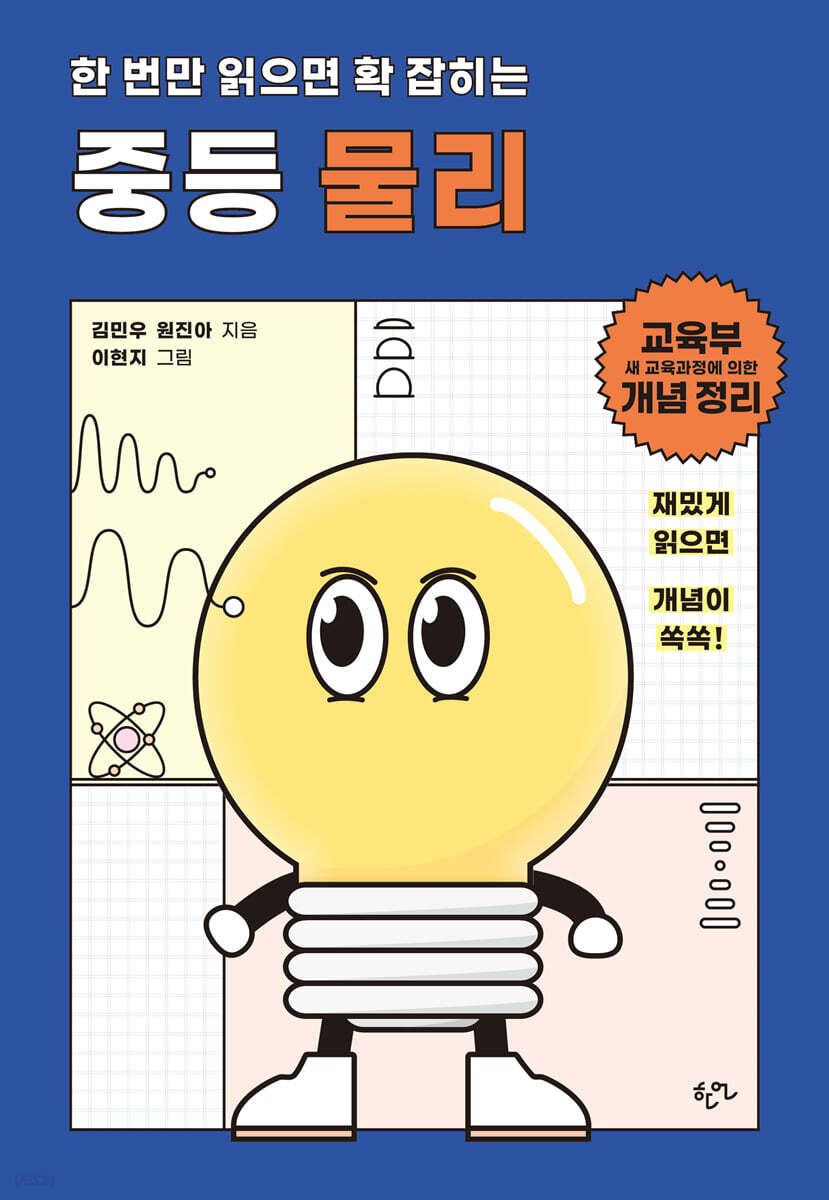
Middle School Physics: A Complete Guide to Reading It Once
 |
Description
Book Introduction
Recommended by Professor Lee Hyun-joo of the Department of Science Education at Ewha Womans University!
Recommended by Seokgwan Middle School's head teacher, Baek Jong-min!
Is science truly a subject of memorization? What if middle school science, which feels unfamiliar at first and then overwhelming as you learn, could be taught as if a teacher were right there with you? "Middle School Physics: A Complete Guide to Mastering in One Reading" is based on the Ministry of Education's latest curriculum, helping prospective middle school students effectively prepare for preparatory learning and providing a comprehensive overview of the three-year curriculum for middle school students.
If you read it smoothly as if you were reading an interesting story, the concepts will soon be ingrained in your head.
Recommended by Seokgwan Middle School's head teacher, Baek Jong-min!
Is science truly a subject of memorization? What if middle school science, which feels unfamiliar at first and then overwhelming as you learn, could be taught as if a teacher were right there with you? "Middle School Physics: A Complete Guide to Mastering in One Reading" is based on the Ministry of Education's latest curriculum, helping prospective middle school students effectively prepare for preparatory learning and providing a comprehensive overview of the three-year curriculum for middle school students.
If you read it smoothly as if you were reading an interesting story, the concepts will soon be ingrained in your head.
- You can preview some of the book's contents.
Preview
index
Part 1.
Various powers
1.
Power in Science: I'll Show You How to Use It Without It
2.
Gravity, the cause of falling things
3.
Elasticity, which increases as it bends or stretches
4.
Friction, a force that opposes motion
5.
Buoyancy, gas and liquid too
Part 2.
Light and waves
1.
Light, can you see it too? What do you see?
2.
What is the difference between looking through a mirror and a lens?
3.
The nature of waves, waves crashing? Waves are coming!
4.
A world filled with sound
Part 3.
Electricity and Magnetism
1.
Friction creates electricity!
2.
Current! Flow of charge!
3.
Learn about voltage and current
4.
Resistance: Is bigger better or smaller?
5.
The amazing power of magnetic fields and electric currents
6.
The power created by electricity and magnetism
Part 4.
Heat and Our Life
1.
Temperature difference? Heat is moving!
2.
Thermal equilibrium, what happens when cold water and warm water meet?
3.
What kind of chopsticks do you use when eating ramen? A story about specific heat and thermal expansion.
Part 5.
Exercise and Energy
1.
Motion in science, position over time
2.
Uniform motion, let's express it with a graph.
3.
Free fall, Earth's gravity is fair
4.
In science, you need energy to do the work.
5.
If only we had potential energy, kinetic energy, height and speed!
Part 6.
Energy Transition and Conservation
1.
Potential energy and kinetic energy are interchangeable.
2.
All energy is transformed and conserved.
3.
Electric energy generation, the meeting of a magnet and a coil
4.
How much power do you consume, how much electrical energy do you use?
Various powers
1.
Power in Science: I'll Show You How to Use It Without It
2.
Gravity, the cause of falling things
3.
Elasticity, which increases as it bends or stretches
4.
Friction, a force that opposes motion
5.
Buoyancy, gas and liquid too
Part 2.
Light and waves
1.
Light, can you see it too? What do you see?
2.
What is the difference between looking through a mirror and a lens?
3.
The nature of waves, waves crashing? Waves are coming!
4.
A world filled with sound
Part 3.
Electricity and Magnetism
1.
Friction creates electricity!
2.
Current! Flow of charge!
3.
Learn about voltage and current
4.
Resistance: Is bigger better or smaller?
5.
The amazing power of magnetic fields and electric currents
6.
The power created by electricity and magnetism
Part 4.
Heat and Our Life
1.
Temperature difference? Heat is moving!
2.
Thermal equilibrium, what happens when cold water and warm water meet?
3.
What kind of chopsticks do you use when eating ramen? A story about specific heat and thermal expansion.
Part 5.
Exercise and Energy
1.
Motion in science, position over time
2.
Uniform motion, let's express it with a graph.
3.
Free fall, Earth's gravity is fair
4.
In science, you need energy to do the work.
5.
If only we had potential energy, kinetic energy, height and speed!
Part 6.
Energy Transition and Conservation
1.
Potential energy and kinetic energy are interchangeable.
2.
All energy is transformed and conserved.
3.
Electric energy generation, the meeting of a magnet and a coil
4.
How much power do you consume, how much electrical energy do you use?
Publisher's Review
Concept organization according to the Ministry of Education's new curriculum!
In line with the new curriculum's basic direction of fostering fundamental scientific literacy by presenting core concepts and principles, we have explained the core concepts of each subject in a way that makes them easy and quick to understand.
Clear learning objectives!
At the beginning of each part, learning objectives are included in a short story format so that you can know the core topic of each part in advance and focus on it.
Detailed explanations that are easy to understand!
It covers the overall content of each subject, so that it can be used as a supplementary textbook, reference book, or homeschooling textbook, while organizing the explanations as easily as possible. It also includes plenty of related figures and photos to help you understand them more clearly.
Organized to help you see key concepts at a glance!
At the end of each unit, we summarize key concepts with “Know This.”
Solve problems considering descriptive evaluation!
We have included actual descriptive questions to help you become familiar with the process assessment and descriptive assessment that are emphasized in recent curricula.
In line with the new curriculum's basic direction of fostering fundamental scientific literacy by presenting core concepts and principles, we have explained the core concepts of each subject in a way that makes them easy and quick to understand.
Clear learning objectives!
At the beginning of each part, learning objectives are included in a short story format so that you can know the core topic of each part in advance and focus on it.
Detailed explanations that are easy to understand!
It covers the overall content of each subject, so that it can be used as a supplementary textbook, reference book, or homeschooling textbook, while organizing the explanations as easily as possible. It also includes plenty of related figures and photos to help you understand them more clearly.
Organized to help you see key concepts at a glance!
At the end of each unit, we summarize key concepts with “Know This.”
Solve problems considering descriptive evaluation!
We have included actual descriptive questions to help you become familiar with the process assessment and descriptive assessment that are emphasized in recent curricula.
GOODS SPECIFICS
- Date of issue: May 3, 2021
- Page count, weight, size: 248 pages | 152*220*20mm
- ISBN13: 9788955969078
- ISBN10: 8955969074
You may also like
카테고리
korean


korean

![GQ KOREA Mark (Monthly): December [2025]](http://librairie.coreenne.fr/cdn/shop/files/8ef265dbbfbf186523ed75ba7319009d.jpg?v=1765340328&width=3840)


