

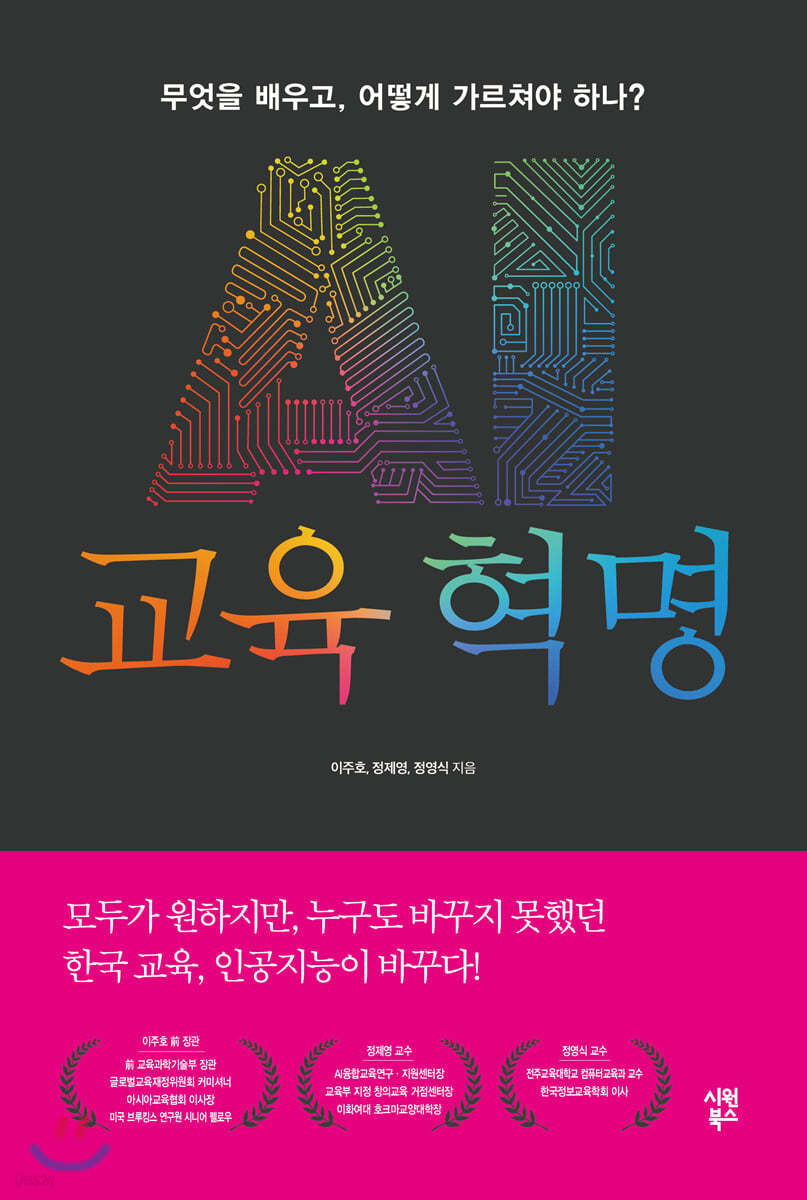
AI Education Revolution
 |
Description
Book Introduction
Is today's education ready to teach tomorrow's students?
Artificial Intelligence (AI) Education for a New Era
Designing the direction of future schools
This book, "AI Education Revolution," is an educational proposal containing practical alternatives and a vision for the role that school education should play in preparing children for a new future.
In the age of artificial intelligence, which is rapidly approaching, education contains specific discussions on what should be taught and how to teach it.
In other words, while fundamentally innovating the content taught to cultivate the capabilities needed for the future, the teaching method also utilizes 'artificial intelligence (AI)' to present an alternative that provides 'individualized education' tailored to the needs of each student.
This means that by leveraging the outstanding technical capabilities of artificial intelligence, we should focus on the essence of education, which values each student's capabilities and achievements rather than competitive learning.
The authors, who have long been dedicated to educational innovation as former and current Ministers of Education, educational policymakers, and professors, reflect on whether today's education is ready to teach tomorrow's students, and suggest that we take practical steps toward even small changes.
Artificial Intelligence (AI) Education for a New Era
Designing the direction of future schools
This book, "AI Education Revolution," is an educational proposal containing practical alternatives and a vision for the role that school education should play in preparing children for a new future.
In the age of artificial intelligence, which is rapidly approaching, education contains specific discussions on what should be taught and how to teach it.
In other words, while fundamentally innovating the content taught to cultivate the capabilities needed for the future, the teaching method also utilizes 'artificial intelligence (AI)' to present an alternative that provides 'individualized education' tailored to the needs of each student.
This means that by leveraging the outstanding technical capabilities of artificial intelligence, we should focus on the essence of education, which values each student's capabilities and achievements rather than competitive learning.
The authors, who have long been dedicated to educational innovation as former and current Ministers of Education, educational policymakers, and professors, reflect on whether today's education is ready to teach tomorrow's students, and suggest that we take practical steps toward even small changes.
- You can preview some of the book's contents.
Preview
index
Chapter 1: New Normal · Education in the New Normal Era
AI-powered classrooms
01 Defining new values and new standards
21st century children studying in a 19th century school
:AI is an irreversible trend
:What we need to learn from a world different from yesterday
COVID-19 Accelerates the Future of Education
:The intersection of AI and education
:In an era where the most 'humane' things become cutting-edge
:The new normal: novelty comes with discomfort.
Designing the direction of future schools
02 Learning to Work with Artificial Intelligence
What AI is different from and what humans are better at
:The capabilities of future talent according to the OECD
The '6C' Core Competencies Required in the AI Era
Human Work vs. Artificial Intelligence Work
The First Step to Understanding Artificial Intelligence _ AI Understanding Education
AI education begins with curiosity.
:What you need to know to become a master of artificial intelligence
How will artificial intelligence change our lives?
AI at Your Side Supporting Lifelong Learning _ AI-Powered Education
:Beyond information retrieval, into a tutoring system
:Reducing dropouts and increasing adaptability
:Level-based learning made possible by AI
:Supporting out-of-school students
: Supporting lifelong education for adults
Learning by Creating Your Own AI _ AI Development Training
"Good" AI for Everyone: AI Ethics Education
:AI must guarantee basic human rights.
:Artificial intelligence should not harm humans.
:AI must be practically fair.
03 AI Education: What's Different and How?
Your own AI tutor that supports personalized learning
Personalized learning becomes possible anytime, anywhere.
:AI content that becomes more sophisticated the more you use it
:Ask the chatbot for simple consultations.
AI to help better collaboration and communication
:Watch, Intervene, Assist _AI & Collaborative Learning
Connecting Differences for a Better Way _AI & Project Learning
Connecting people across time and space
Artificial intelligence that helps foster human connections between students and teachers
Artificial intelligence that overcomes geographical and linguistic barriers
:Into a multidimensional education that transcends the virtual and the real.
Adding AI to the public education curriculum to transform instruction.
Objective Insights from AI
Artificial intelligence as an assistant that brings out the expertise of teachers
Artificial intelligence contributes to student diversity
AI that evaluates alongside teachers as an assistant
:Even descriptive assessments and assignment assessments are now done with artificial intelligence.
Designing high-quality, personalized feedback with AI.
From long-term data analysis to visualization, artificial intelligence is at your fingertips.
Chapter 2: New Rules and New Roles
What kind of people should we become?
04 Rethinking the Role of Teachers in the Age of Artificial Intelligence
'Learning Designer' who designs and advises learning
The future classroom where AI and human teachers collaborate
05 Asking about the qualities of talent that will open the future era.
The path to finding your dream is to explore yourself.
Self-directed learning is the best competitive edge
06 Questioning the Changing Role of Parents in a New Era
Parent mentors who support and encourage their children
Understanding the changing times
07 Asking the Government for Direction for Future Schools
A digital ecosystem creator that breaks down barriers
The future school created through K-Edu
Chapter 3: Narrowing the Gap
Beyond standardization, towards individuality
08 Breaking Down Barriers to Educational Innovation
The barrier of schools creating standardization
:Sleeping Classroom, Sleeping Education
:Each subject is separate and the knowledge is separate
The core of the future curriculum is the high school credit system.
The Path to Future Schools Opened by Artificial Intelligence
09 Let's create a digital world where no one is left behind.
Inequality Created by the Future Technology Gap
Artificial intelligence goes to school
The possibilities for AI tutors are endless.
Let's use the COVID-19 experience as an opportunity to innovate in education.
AI-powered classrooms
01 Defining new values and new standards
21st century children studying in a 19th century school
:AI is an irreversible trend
:What we need to learn from a world different from yesterday
COVID-19 Accelerates the Future of Education
:The intersection of AI and education
:In an era where the most 'humane' things become cutting-edge
:The new normal: novelty comes with discomfort.
Designing the direction of future schools
02 Learning to Work with Artificial Intelligence
What AI is different from and what humans are better at
:The capabilities of future talent according to the OECD
The '6C' Core Competencies Required in the AI Era
Human Work vs. Artificial Intelligence Work
The First Step to Understanding Artificial Intelligence _ AI Understanding Education
AI education begins with curiosity.
:What you need to know to become a master of artificial intelligence
How will artificial intelligence change our lives?
AI at Your Side Supporting Lifelong Learning _ AI-Powered Education
:Beyond information retrieval, into a tutoring system
:Reducing dropouts and increasing adaptability
:Level-based learning made possible by AI
:Supporting out-of-school students
: Supporting lifelong education for adults
Learning by Creating Your Own AI _ AI Development Training
"Good" AI for Everyone: AI Ethics Education
:AI must guarantee basic human rights.
:Artificial intelligence should not harm humans.
:AI must be practically fair.
03 AI Education: What's Different and How?
Your own AI tutor that supports personalized learning
Personalized learning becomes possible anytime, anywhere.
:AI content that becomes more sophisticated the more you use it
:Ask the chatbot for simple consultations.
AI to help better collaboration and communication
:Watch, Intervene, Assist _AI & Collaborative Learning
Connecting Differences for a Better Way _AI & Project Learning
Connecting people across time and space
Artificial intelligence that helps foster human connections between students and teachers
Artificial intelligence that overcomes geographical and linguistic barriers
:Into a multidimensional education that transcends the virtual and the real.
Adding AI to the public education curriculum to transform instruction.
Objective Insights from AI
Artificial intelligence as an assistant that brings out the expertise of teachers
Artificial intelligence contributes to student diversity
AI that evaluates alongside teachers as an assistant
:Even descriptive assessments and assignment assessments are now done with artificial intelligence.
Designing high-quality, personalized feedback with AI.
From long-term data analysis to visualization, artificial intelligence is at your fingertips.
Chapter 2: New Rules and New Roles
What kind of people should we become?
04 Rethinking the Role of Teachers in the Age of Artificial Intelligence
'Learning Designer' who designs and advises learning
The future classroom where AI and human teachers collaborate
05 Asking about the qualities of talent that will open the future era.
The path to finding your dream is to explore yourself.
Self-directed learning is the best competitive edge
06 Questioning the Changing Role of Parents in a New Era
Parent mentors who support and encourage their children
Understanding the changing times
07 Asking the Government for Direction for Future Schools
A digital ecosystem creator that breaks down barriers
The future school created through K-Edu
Chapter 3: Narrowing the Gap
Beyond standardization, towards individuality
08 Breaking Down Barriers to Educational Innovation
The barrier of schools creating standardization
:Sleeping Classroom, Sleeping Education
:Each subject is separate and the knowledge is separate
The core of the future curriculum is the high school credit system.
The Path to Future Schools Opened by Artificial Intelligence
09 Let's create a digital world where no one is left behind.
Inequality Created by the Future Technology Gap
Artificial intelligence goes to school
The possibilities for AI tutors are endless.
Let's use the COVID-19 experience as an opportunity to innovate in education.
Detailed image

Into the book
He points out that our country's biggest problem is that, although it is good at creating products based on blueprints developed and designed by others in any industry, it lacks the ability to design not only new products but also new industries and platforms.
This means that while the execution capabilities to manufacture products are excellent, the conceptual design capabilities to creatively create new things are lacking.
This problem is directly related to the entrance exam-oriented education that forces students to solve multiple-choice questions and fails to foster the ability to think for themselves.
--- p.27
High-stakes exams like the CSAT, which place enormous pressure on test takers to the point where a single test can determine their entire lives, will gradually disappear with the introduction of AI tutors. This is because AI tutors will diagnose each student's learning status dozens of times a day using big data and learning analytics.
Moreover, e-portfolios will provide information that analyzes each student's learning history and the growth of their knowledge system in a much more sophisticated way than any high-stakes test.
Students will be able to use their e-portfolios to choose the colleges and careers that best suit them.
--- p.35
Artificial intelligence and automation technologies aren't just taking over existing jobs.
Historically, while past technologies have led to job losses in certain sectors, overall they have had a positive impact, creating new jobs and increasing workers' incomes.
Artificial intelligence and automation technologies will replace some jobs, but they will also create new jobs to complement them.
As a result, AI is more likely to create new jobs than replace existing ones.
Therefore, AI education should prioritize developing capabilities to understand and prepare for new jobs.
--- p.73
Since September 2020, the Ministry of Education has been providing an artificial intelligence-based elementary school mathematics class support system (Smart Math Exploration Team, www.toctocmath.kr) to all elementary schools nationwide.
Additionally, the curriculum was partially revised to allow high schools to elect the subjects 'Artificial Intelligence Fundamentals' and 'Artificial Intelligence Mathematics' starting in the second semester of 2021.
In the future, AI education is expected to have a significant impact on the curriculum, as it will be applied not only to specific subjects but also to teaching activities that integrate multiple subjects.
--- p.121
According to a 2018 survey by global consulting firm McKinsey, 72 percent of companies worldwide will utilize artificial intelligence by 2030, which is expected to lead to an additional $13 trillion in global GDP growth.
He also said that by 2030, many people will have to become accustomed to working alongside artificial intelligence in their daily work.
What is clear is that the way we work is changing dramatically, and our children will be the generation that works alongside artificial intelligence.
In the era of the Fourth Industrial Revolution, schools must go beyond simply memorizing and understanding knowledge and foster students' self-directed capabilities so they can discover what they want as lifelong learners.
--- p.184
The desire to teach children to memorize even one more English word from a young age to give them a slight edge over the competition is a taboo that must be avoided in the future era of artificial intelligence.
In this rapidly changing era, we need to be open to learning. However, parents' greed for success in the college entrance exam competition makes learning boring for their children and prevents them from experiencing the joy of learning.
Unfortunately, one of the biggest reasons why children in our country fail to become proactive lifelong learners is parents' excessive desire and obsession with their children's grades.
As the well-known Finnish educational philosophy goes, “Teach less, learn more,” parents should intervene less in their children’s learning and not burden them.
The more parents can ease the burden they currently place on their children, the better parents they become.
--- p.185
As distance learning becomes fully implemented in the wake of COVID-19, the edutech industry is also growing.
In particular, as distance education is helping prevent the spread of the disease and providing successful public education compared to many countries around the world, interest in not only K-quarantine but also 'K-edutech' (hereinafter referred to as K-edu) is growing.
AI education is a key area of the edtech industry.
For K-Edu, including AI education, to continue to develop, edutech must be developed from a perspective that encompasses public policy.
--- p.196
As many scholars and experts predict, in the future, abilities that can be easily measured by tests will be easily replaced by artificial intelligence.
High-stakes tests fail to assess competencies that cannot be replaced by artificial intelligence.
The existing high-stakes college entrance exam system will eventually be replaced by AI-powered, continuous, personalized assessments and teachers' human connections to assess students' social and cognitive abilities.
In this way, artificial intelligence will play an increasingly significant role in changing the outdated college entrance examination system.
AI education will also significantly change universities.
In the past, universities were not places where anyone could easily enter and learn.
Getting a college education is expensive, time-consuming, and requires a lot of coursework.
However, universities that adopt AI education will become much cheaper, more accessible, and more convenient to learn.
Of course, this kind of transformation of universities is not easy.
In this process, the hierarchy may be destroyed, with existing prestigious universities being eliminated.
This means that while the execution capabilities to manufacture products are excellent, the conceptual design capabilities to creatively create new things are lacking.
This problem is directly related to the entrance exam-oriented education that forces students to solve multiple-choice questions and fails to foster the ability to think for themselves.
--- p.27
High-stakes exams like the CSAT, which place enormous pressure on test takers to the point where a single test can determine their entire lives, will gradually disappear with the introduction of AI tutors. This is because AI tutors will diagnose each student's learning status dozens of times a day using big data and learning analytics.
Moreover, e-portfolios will provide information that analyzes each student's learning history and the growth of their knowledge system in a much more sophisticated way than any high-stakes test.
Students will be able to use their e-portfolios to choose the colleges and careers that best suit them.
--- p.35
Artificial intelligence and automation technologies aren't just taking over existing jobs.
Historically, while past technologies have led to job losses in certain sectors, overall they have had a positive impact, creating new jobs and increasing workers' incomes.
Artificial intelligence and automation technologies will replace some jobs, but they will also create new jobs to complement them.
As a result, AI is more likely to create new jobs than replace existing ones.
Therefore, AI education should prioritize developing capabilities to understand and prepare for new jobs.
--- p.73
Since September 2020, the Ministry of Education has been providing an artificial intelligence-based elementary school mathematics class support system (Smart Math Exploration Team, www.toctocmath.kr) to all elementary schools nationwide.
Additionally, the curriculum was partially revised to allow high schools to elect the subjects 'Artificial Intelligence Fundamentals' and 'Artificial Intelligence Mathematics' starting in the second semester of 2021.
In the future, AI education is expected to have a significant impact on the curriculum, as it will be applied not only to specific subjects but also to teaching activities that integrate multiple subjects.
--- p.121
According to a 2018 survey by global consulting firm McKinsey, 72 percent of companies worldwide will utilize artificial intelligence by 2030, which is expected to lead to an additional $13 trillion in global GDP growth.
He also said that by 2030, many people will have to become accustomed to working alongside artificial intelligence in their daily work.
What is clear is that the way we work is changing dramatically, and our children will be the generation that works alongside artificial intelligence.
In the era of the Fourth Industrial Revolution, schools must go beyond simply memorizing and understanding knowledge and foster students' self-directed capabilities so they can discover what they want as lifelong learners.
--- p.184
The desire to teach children to memorize even one more English word from a young age to give them a slight edge over the competition is a taboo that must be avoided in the future era of artificial intelligence.
In this rapidly changing era, we need to be open to learning. However, parents' greed for success in the college entrance exam competition makes learning boring for their children and prevents them from experiencing the joy of learning.
Unfortunately, one of the biggest reasons why children in our country fail to become proactive lifelong learners is parents' excessive desire and obsession with their children's grades.
As the well-known Finnish educational philosophy goes, “Teach less, learn more,” parents should intervene less in their children’s learning and not burden them.
The more parents can ease the burden they currently place on their children, the better parents they become.
--- p.185
As distance learning becomes fully implemented in the wake of COVID-19, the edutech industry is also growing.
In particular, as distance education is helping prevent the spread of the disease and providing successful public education compared to many countries around the world, interest in not only K-quarantine but also 'K-edutech' (hereinafter referred to as K-edu) is growing.
AI education is a key area of the edtech industry.
For K-Edu, including AI education, to continue to develop, edutech must be developed from a perspective that encompasses public policy.
--- p.196
As many scholars and experts predict, in the future, abilities that can be easily measured by tests will be easily replaced by artificial intelligence.
High-stakes tests fail to assess competencies that cannot be replaced by artificial intelligence.
The existing high-stakes college entrance exam system will eventually be replaced by AI-powered, continuous, personalized assessments and teachers' human connections to assess students' social and cognitive abilities.
In this way, artificial intelligence will play an increasingly significant role in changing the outdated college entrance examination system.
AI education will also significantly change universities.
In the past, universities were not places where anyone could easily enter and learn.
Getting a college education is expensive, time-consuming, and requires a lot of coursework.
However, universities that adopt AI education will become much cheaper, more accessible, and more convenient to learn.
Of course, this kind of transformation of universities is not easy.
In this process, the hierarchy may be destroyed, with existing prestigious universities being eliminated.
--- p.220
Publisher's Review
What should humans learn in the age of artificial intelligence?
What kind of person should I become?
Discovering humanity through artificial intelligence
EdTech is a 21st century education that aims for 'individualized education'.
It is no exaggeration to say that our country's education system is one that prepares students for high-stakes tests, such as the CSAT, that can significantly influence their future lives.
Because the university you enter based on your test scores has a lifelong impact on your socioeconomic status, a structure has been formed where all learning from a young age is geared towards entrance exams.
However, the hierarchical education system and entrance exam-oriented learning that forces students to solve multiple-choice questions are difficult to adapt to the rapidly changing future.
Because artificial intelligence is best at memorizing and calculating.
In a future where humans and machines must become accustomed to working together, the direction of education must change so that we can develop the abilities that only humans possess and cannot be replaced by machines.
In addition, one of the common concerns in the educational field is the inability to provide 'individualized, customized education' to students of various levels.
For teachers who must follow a set curriculum, customized education is a difficult task to even imagine.
However, various edu-tech systems utilizing artificial intelligence can open up the possibility of personalized education for teachers.
As online and remote classes have become increasingly common due to the COVID-19 pandemic, edutech has become an indispensable part of the educational landscape.
Chapters 1 and 2 explain the necessity of education utilizing artificial intelligence, which is emerging as a central element of edutech, and examine the changing roles of teachers, parents, and students in this new era.
Chapter 3 explores the multifaceted efforts in education to ensure that all students have the opportunity to succeed in their studies without being excluded from the educational system.
In the age of artificial intelligence, humanity is the key to competitiveness and the alternative.
In this high-tech era, high-touch is essential.
Let's close the education gap with high-touch, high-tech education.
The Fourth Industrial Revolution aims for 'high tech' based on five core technologies: artificial intelligence (AI), the Internet of Things (IoT), software, big data, and cloud.
Experts from all walks of life say that children who will live in the future must have high-tech capabilities based on these technologies to remain competitive.
However, the authors say that a technology-centric era like the Fourth Industrial Revolution will require a deeper understanding of humanity and will be an era in which we discover ourselves through technology.
As technology advances, ‘humanity’ becomes more important.
This concept is called 'high touch'.
As cutting-edge technology advances, there is a growing need to connect the hearts of people, and human emotions and empathy must be further developed.
In other words, when high-tech technologies such as artificial intelligence education are applied to schools, the high-touch concept that emphasizes human interaction in the individualized learning process must be introduced.
Combining high-touch with high-tech means figuring out how to divide roles between human teachers and AI tutors.
The authors explain that AI can help teachers transition their roles and handle tasks, and most importantly, it can help children who are lagging behind in their studies.
Going forward, high-touch, high-tech learning in public education will help reduce the number of students who fall behind, thus narrowing the educational gap.
AI can help learners learn, help teachers teach, and connect the two to enable more effective learning.
In this way, the future direction of education proposed by this book will provide readers with diverse perspectives on educational innovation.
What kind of person should I become?
Discovering humanity through artificial intelligence
EdTech is a 21st century education that aims for 'individualized education'.
It is no exaggeration to say that our country's education system is one that prepares students for high-stakes tests, such as the CSAT, that can significantly influence their future lives.
Because the university you enter based on your test scores has a lifelong impact on your socioeconomic status, a structure has been formed where all learning from a young age is geared towards entrance exams.
However, the hierarchical education system and entrance exam-oriented learning that forces students to solve multiple-choice questions are difficult to adapt to the rapidly changing future.
Because artificial intelligence is best at memorizing and calculating.
In a future where humans and machines must become accustomed to working together, the direction of education must change so that we can develop the abilities that only humans possess and cannot be replaced by machines.
In addition, one of the common concerns in the educational field is the inability to provide 'individualized, customized education' to students of various levels.
For teachers who must follow a set curriculum, customized education is a difficult task to even imagine.
However, various edu-tech systems utilizing artificial intelligence can open up the possibility of personalized education for teachers.
As online and remote classes have become increasingly common due to the COVID-19 pandemic, edutech has become an indispensable part of the educational landscape.
Chapters 1 and 2 explain the necessity of education utilizing artificial intelligence, which is emerging as a central element of edutech, and examine the changing roles of teachers, parents, and students in this new era.
Chapter 3 explores the multifaceted efforts in education to ensure that all students have the opportunity to succeed in their studies without being excluded from the educational system.
In the age of artificial intelligence, humanity is the key to competitiveness and the alternative.
In this high-tech era, high-touch is essential.
Let's close the education gap with high-touch, high-tech education.
The Fourth Industrial Revolution aims for 'high tech' based on five core technologies: artificial intelligence (AI), the Internet of Things (IoT), software, big data, and cloud.
Experts from all walks of life say that children who will live in the future must have high-tech capabilities based on these technologies to remain competitive.
However, the authors say that a technology-centric era like the Fourth Industrial Revolution will require a deeper understanding of humanity and will be an era in which we discover ourselves through technology.
As technology advances, ‘humanity’ becomes more important.
This concept is called 'high touch'.
As cutting-edge technology advances, there is a growing need to connect the hearts of people, and human emotions and empathy must be further developed.
In other words, when high-tech technologies such as artificial intelligence education are applied to schools, the high-touch concept that emphasizes human interaction in the individualized learning process must be introduced.
Combining high-touch with high-tech means figuring out how to divide roles between human teachers and AI tutors.
The authors explain that AI can help teachers transition their roles and handle tasks, and most importantly, it can help children who are lagging behind in their studies.
Going forward, high-touch, high-tech learning in public education will help reduce the number of students who fall behind, thus narrowing the educational gap.
AI can help learners learn, help teachers teach, and connect the two to enable more effective learning.
In this way, the future direction of education proposed by this book will provide readers with diverse perspectives on educational innovation.
GOODS SPECIFICS
- Date of issue: January 15, 2021
- Page count, weight, size: 248 pages | 446g | 152*224*15mm
- ISBN13: 9791161504414
- ISBN10: 1161504419
You may also like
카테고리
korean


korean

![ELLE 엘르 스페셜 에디션 A형 : 12월 [2025]](http://librairie.coreenne.fr/cdn/shop/files/b8e27a3de6c9538896439686c6b0e8fb.jpg?v=1766436872&width=3840)


