

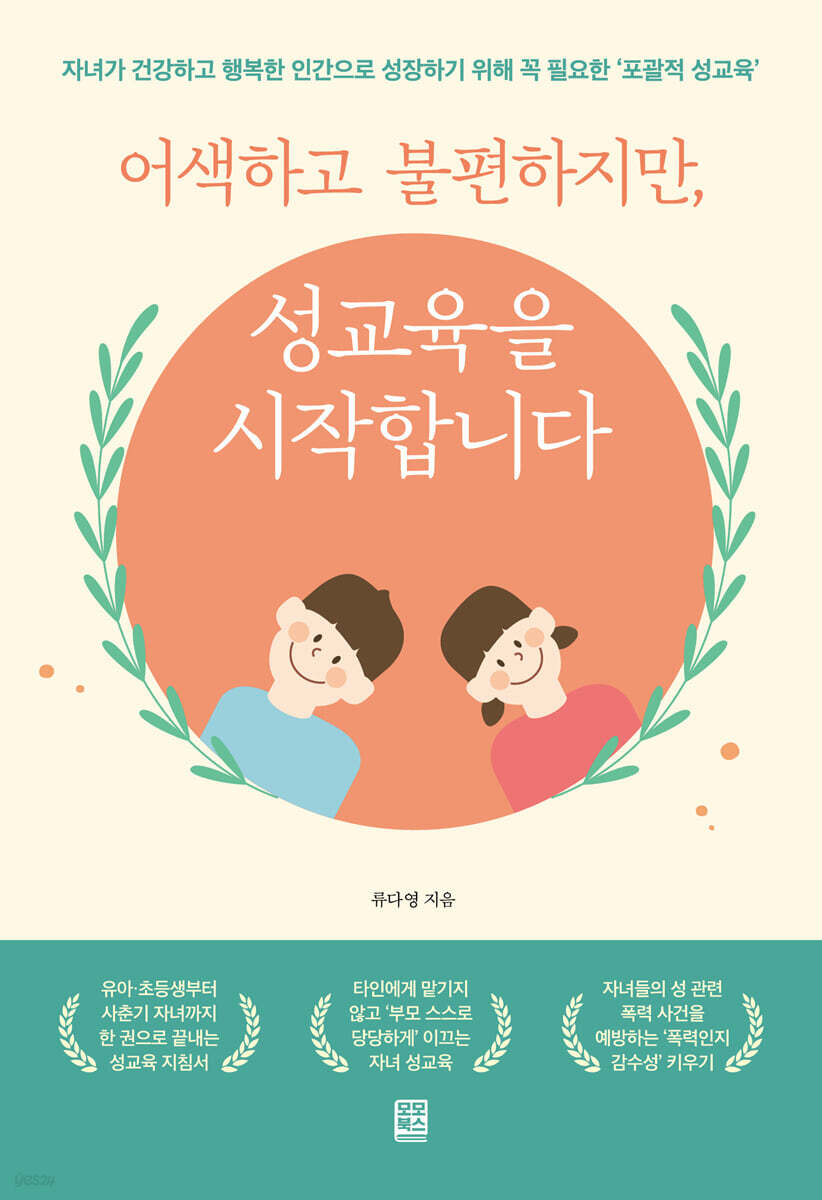
It's awkward and uncomfortable, but sex education begins.
 |
Description
Book Introduction
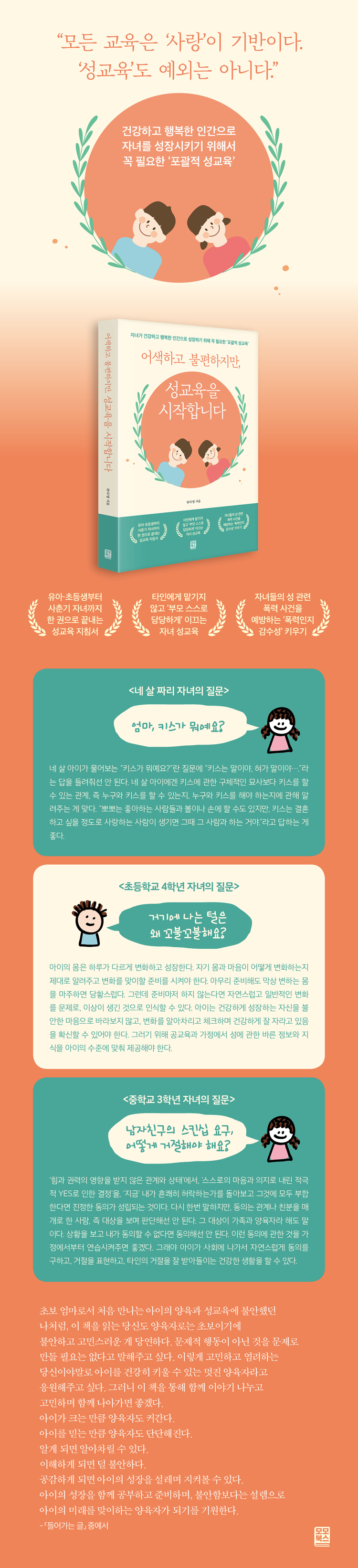
“All education is based on ‘love.’
“Sex education” is no exception.”
Comprehensive sex education is essential for children to grow into healthy, happy individuals.
For parents raising children in their growing years, the biggest concern is education.
But not everything going your way is also education.
This is especially true in the case of ‘sex education.’
"It's Awkward and Uncomfortable, But Let's Start Sex Education" is a "sex education guide" by Ryu Da-young, the director of the Korea Youth Research Institute and a parenting expert with 20 years of experience.
It contains 'comprehensive sex education' that covers everything from infants and elementary school children to adolescents in one volume.
Above all, we focus on having parents confidently lead their children's sex education themselves, rather than leaving it to others.
Through various cases, experiences, and in-depth research, it presents clear solutions to sex education.
Sex education is difficult, then and now.
However, if we leave it to the schools or others because it is difficult, it cannot be called true education.
Through education, not only children grow, but parents also grow together.
I hope that this book will be of some help to both parents and children in achieving their goals of growing and living happy lives.
“Sex education” is no exception.”
Comprehensive sex education is essential for children to grow into healthy, happy individuals.
For parents raising children in their growing years, the biggest concern is education.
But not everything going your way is also education.
This is especially true in the case of ‘sex education.’
"It's Awkward and Uncomfortable, But Let's Start Sex Education" is a "sex education guide" by Ryu Da-young, the director of the Korea Youth Research Institute and a parenting expert with 20 years of experience.
It contains 'comprehensive sex education' that covers everything from infants and elementary school children to adolescents in one volume.
Above all, we focus on having parents confidently lead their children's sex education themselves, rather than leaving it to others.
Through various cases, experiences, and in-depth research, it presents clear solutions to sex education.
Sex education is difficult, then and now.
However, if we leave it to the schools or others because it is difficult, it cannot be called true education.
Through education, not only children grow, but parents also grow together.
I hope that this book will be of some help to both parents and children in achieving their goals of growing and living happy lives.
- You can preview some of the book's contents.
Preview
index
Introduction 4
Chapter 1: Sex Education for Children
1. Should we start sex education? 19
Is it okay to have skinship when you're young? 25
Is it okay for toddlers to masturbate?
4 Bathing: How long can we stay together? 37
5 Is it better for fathers to provide sex education to boys? 42
6 When and how much should I disclose? 48
Should I answer every child's question immediately? 54
Chapter 2: Puberty, the Flower of Growth
1. Does second-year middle school syndrome really exist? 62
2 My body feels weird. Is this normal? 68
Our Attitude to Menstruation 74
4. Different Dreams About Erection and Nocturnal Dreams 82
5. Sense in dealing with masturbation, consideration without pretending to know 92
6 Children Who Don't Need Sex Education 98
Chapter 3: The World Youth Live In
1 I'm special and different, but I don't want to stand out. 108
2 The words 'no' and 'nothing' are not negations. 114
3 You could ask what the average penis length is 120
4 It's easier to talk on social media 125
5 Online, you can do whatever you want in the game 131
6. A person who is good to me is a good person, a close friend. 137
7. Is "Jeojjeoltibi" a derogatory term? "Jeojjeoltibi" 143
Chapter 4: A Child's Love, A Child's Romance
1. Attitude toward love and romance in children 153
2. Checking Your Child's Love Values 160
3 Rights and Responsibilities 167
4 There are things I like but don't like 173
5. Gaslighting: The Secretly Infiltrating Violence 178
6 Preparing for a Child's Love Together 185
Chapter 5: Is My Child the Perpetrator or the Victim?
1 Violent words that seep in without me knowing 197
2 Raising Violence Awareness 204
3 Yes is Yes! Silence is Not Consent 211
4 If a child has committed a crime 217
5 COVID-19 and the Nth Room: Digital Sex Crimes Becoming Commonplace 224
6 Standards for Apology and Forgiveness 231
Chapter 6: How should sex education be conducted?
1 Adults Talking About Comprehensive Sex Education 240
2 Adults who first examine their own sexual values 246
3 Adults Who Know How to Deal with Sexual Crime Victims 253
4 Adults Developing Sensitivity Together 263
5 Adults Who Foster Body Positivity and Self-Affirmation 270
277 Adults who naturally share sex in everyday conversation
7 An adult you can trust anytime, anywhere, in any situation 283
Closing remarks 290
Appendix - National Youth Sexual Culture Center 296
Chapter 1: Sex Education for Children
1. Should we start sex education? 19
Is it okay to have skinship when you're young? 25
Is it okay for toddlers to masturbate?
4 Bathing: How long can we stay together? 37
5 Is it better for fathers to provide sex education to boys? 42
6 When and how much should I disclose? 48
Should I answer every child's question immediately? 54
Chapter 2: Puberty, the Flower of Growth
1. Does second-year middle school syndrome really exist? 62
2 My body feels weird. Is this normal? 68
Our Attitude to Menstruation 74
4. Different Dreams About Erection and Nocturnal Dreams 82
5. Sense in dealing with masturbation, consideration without pretending to know 92
6 Children Who Don't Need Sex Education 98
Chapter 3: The World Youth Live In
1 I'm special and different, but I don't want to stand out. 108
2 The words 'no' and 'nothing' are not negations. 114
3 You could ask what the average penis length is 120
4 It's easier to talk on social media 125
5 Online, you can do whatever you want in the game 131
6. A person who is good to me is a good person, a close friend. 137
7. Is "Jeojjeoltibi" a derogatory term? "Jeojjeoltibi" 143
Chapter 4: A Child's Love, A Child's Romance
1. Attitude toward love and romance in children 153
2. Checking Your Child's Love Values 160
3 Rights and Responsibilities 167
4 There are things I like but don't like 173
5. Gaslighting: The Secretly Infiltrating Violence 178
6 Preparing for a Child's Love Together 185
Chapter 5: Is My Child the Perpetrator or the Victim?
1 Violent words that seep in without me knowing 197
2 Raising Violence Awareness 204
3 Yes is Yes! Silence is Not Consent 211
4 If a child has committed a crime 217
5 COVID-19 and the Nth Room: Digital Sex Crimes Becoming Commonplace 224
6 Standards for Apology and Forgiveness 231
Chapter 6: How should sex education be conducted?
1 Adults Talking About Comprehensive Sex Education 240
2 Adults who first examine their own sexual values 246
3 Adults Who Know How to Deal with Sexual Crime Victims 253
4 Adults Developing Sensitivity Together 263
5 Adults Who Foster Body Positivity and Self-Affirmation 270
277 Adults who naturally share sex in everyday conversation
7 An adult you can trust anytime, anywhere, in any situation 283
Closing remarks 290
Appendix - National Youth Sexual Culture Center 296
Detailed image
Into the book
The education a child needs to develop healthy relationships with others varies depending on the child's developmental stage.
When a four-year-old asks, “What is a kiss?”, you should not answer, “A kiss is a tongue, a tongue...”
For a four-year-old, it's better to teach them about the types of relationships that can lead to kissing—who they can kiss and who they should kiss—rather than providing specific descriptions of kissing.
---p.23
There is puberty.
It is the name of a period of rapid growth during the growth process.
There is no second-year syndrome.
As a child grows and builds his or her own life, the words and actions that change may appear somewhat unstable.
So let's not use the word 'disease' to describe it as something wrong or dismissive.
Let's not make a very healthy growing child into a patient.
Rather than enduring and enduring while watching your child grow with annoyed eyes, I recommend that you carefully observe your child and preserve the precious time and emotions that will never come again as memories.
---p.67
Elementary school students' love life prioritizes 'dating experience'.
It doesn't matter which child you interact with and how you interact with them.
Children are divided into those who have dated, those who have not, and those who have never dated.
If you are the only one in the group you hang out with who has never dated, it means you are choosing to date not because you have feelings for someone, but to escape from loneliness.
If my child chooses to date or interact with the opposite sex for these reasons, I need to examine my child's values in dating.
---p.165
If your child has harmed someone, I hope you and your child will take the opportunity to correct their mistake.
I hope that we can acknowledge our mistakes and slowly and repeatedly educate ourselves so that we do not repeat them again.
And one more thing.
I hope you don't see one mistake your child makes as a reflection of the whole picture of the child.
When a child commits a mistake and becomes a perpetrator, we constantly frame and confine them for fear that they will make the same mistake again.
They brand them as ‘that kind of kid’ or ‘that kid could do that again.’
The moment a child is branded, there is no chance for him or her.
---p.222
If the sexual assault perpetrator is in the home, victims of sexual assault can receive protection at a shelter.
Provides protection and food and lodging to the victim or the victim's family members.
To protect the victims, the location of the shelter is kept confidential.
If sexual assault occurs, you must contact 112 or the Sunflower Center without washing your body to collect evidence.
You should contact someone who can support and help you, and seek refuge in a safe place.
If you have bruises or wounds on your body, take pictures of them, and keep any evidence, such as conversations with the perpetrator, without deleting them.
When a four-year-old asks, “What is a kiss?”, you should not answer, “A kiss is a tongue, a tongue...”
For a four-year-old, it's better to teach them about the types of relationships that can lead to kissing—who they can kiss and who they should kiss—rather than providing specific descriptions of kissing.
---p.23
There is puberty.
It is the name of a period of rapid growth during the growth process.
There is no second-year syndrome.
As a child grows and builds his or her own life, the words and actions that change may appear somewhat unstable.
So let's not use the word 'disease' to describe it as something wrong or dismissive.
Let's not make a very healthy growing child into a patient.
Rather than enduring and enduring while watching your child grow with annoyed eyes, I recommend that you carefully observe your child and preserve the precious time and emotions that will never come again as memories.
---p.67
Elementary school students' love life prioritizes 'dating experience'.
It doesn't matter which child you interact with and how you interact with them.
Children are divided into those who have dated, those who have not, and those who have never dated.
If you are the only one in the group you hang out with who has never dated, it means you are choosing to date not because you have feelings for someone, but to escape from loneliness.
If my child chooses to date or interact with the opposite sex for these reasons, I need to examine my child's values in dating.
---p.165
If your child has harmed someone, I hope you and your child will take the opportunity to correct their mistake.
I hope that we can acknowledge our mistakes and slowly and repeatedly educate ourselves so that we do not repeat them again.
And one more thing.
I hope you don't see one mistake your child makes as a reflection of the whole picture of the child.
When a child commits a mistake and becomes a perpetrator, we constantly frame and confine them for fear that they will make the same mistake again.
They brand them as ‘that kind of kid’ or ‘that kid could do that again.’
The moment a child is branded, there is no chance for him or her.
---p.222
If the sexual assault perpetrator is in the home, victims of sexual assault can receive protection at a shelter.
Provides protection and food and lodging to the victim or the victim's family members.
To protect the victims, the location of the shelter is kept confidential.
If sexual assault occurs, you must contact 112 or the Sunflower Center without washing your body to collect evidence.
You should contact someone who can support and help you, and seek refuge in a safe place.
If you have bruises or wounds on your body, take pictures of them, and keep any evidence, such as conversations with the perpetrator, without deleting them.
---p.257
GOODS SPECIFICS
- Publication date: November 28, 2023
- Page count, weight, size: 298 pages | 137*200*20mm
- ISBN13: 9791190408462
- ISBN10: 1190408465
You may also like
카테고리
korean


korean

![GQ KOREA Mark (Monthly): December [2025]](http://librairie.coreenne.fr/cdn/shop/files/8ef265dbbfbf186523ed75ba7319009d.jpg?v=1765340328&width=3840)


