

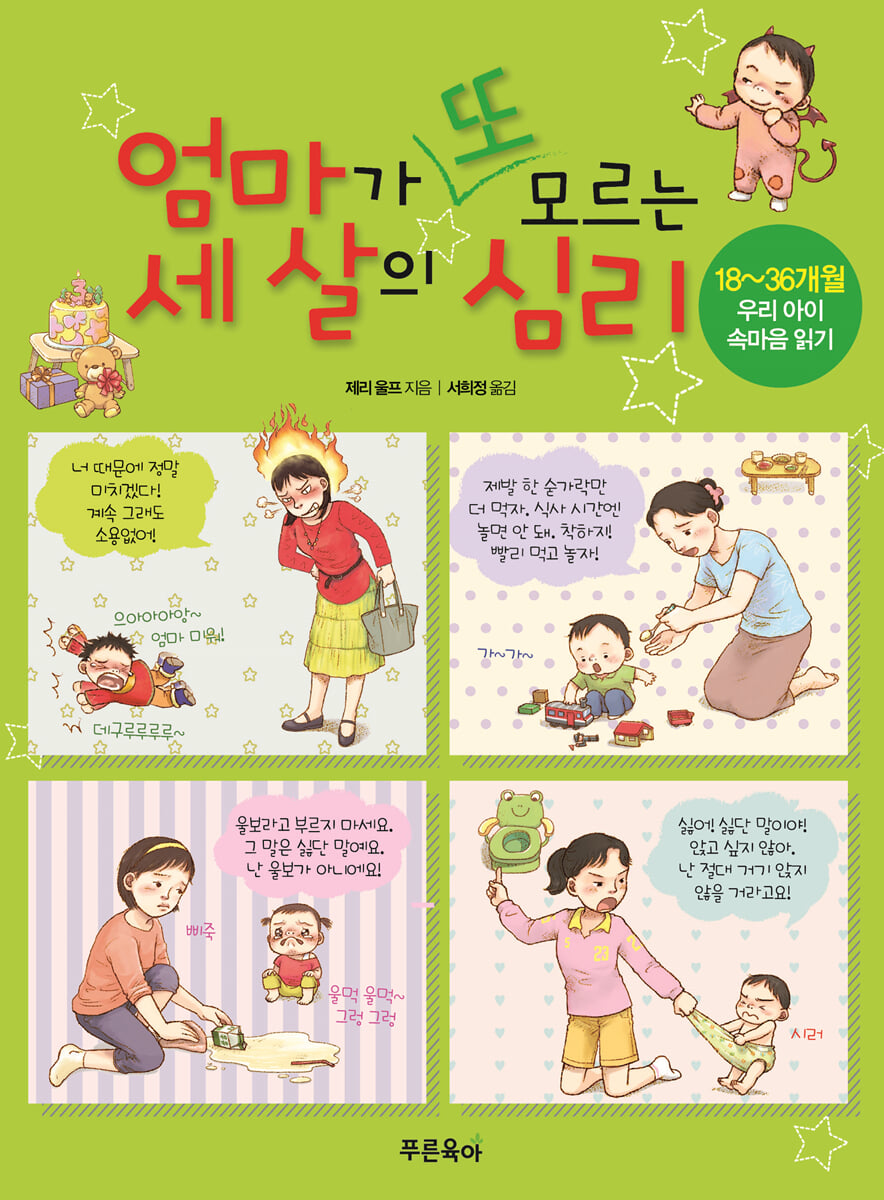
The psychology of a three-year-old that mothers don't know
 |
Description
Book Introduction
I can't take care of it like a newborn baby,
But I'm still anxious about leaving it alone as it is.
My three-year-old child is a troublemaker!
Even a moment's glance away can quickly lead to a precarious situation. Children who don't know how to do much properly yet insist on doing it themselves! We try to stop them by saying, "No!" out of concern that they might get hurt or make a mistake, but at some point, they start saying, "No!" all the time. This is the story of children aged 18 to 36 months.
But I'm still anxious about leaving it alone as it is.
My three-year-old child is a troublemaker!
Even a moment's glance away can quickly lead to a precarious situation. Children who don't know how to do much properly yet insist on doing it themselves! We try to stop them by saying, "No!" out of concern that they might get hurt or make a mistake, but at some point, they start saying, "No!" all the time. This is the story of children aged 18 to 36 months.
- You can preview some of the book's contents.
Preview
index
PART 01 I'm growing differently every day
- It contains the rebellion of three-year-olds who are growing out of their cradles, and the assertion that 'I am not a baby anymore!'
If you wait a little bit, I can do it by myself 22
Please give me a chance to choose too 29
I can't stay still anymore 35
I often find myself in danger without even knowing it. 41
Learning to speak is hard, but it's also fun 47
I'm learning how to say what I want nicely 51
We're learning how to play together 56
Give yourself time to adjust to your new bed 60
PART 02 Understand the unique world of a three-year-old.
- It tells us about the unique habits of three-year-olds, such as living with the word “no” in their mouths and finding stability in the same repetitive daily routine.
I like the word 'no' 66
Why? Why? Why? 71
I started adding imagination to the play 76
Please don't disturb my peaceful routine 80
Mom, please put a band on me 89
I'm so curious about every nook and cranny of my body 89
PART 03 Why can't I just do whatever I want?
- It contains the complaints of three-year-olds who want to do so many things, but are frustrated by the many obstacles that block them.
Why do I have to nap? 96
Can't we have everything we want? 101
Why can't I say "fuck"? 105
I just want to watch TV all day long 109
Why on earth do I have to take bitter medicine? 113
PART 04 There are many things that are difficult for a three-year-old to handle.
-They say he's not a baby anymore, but they're talking about things that are too difficult for a three-year-old to handle.
I don't want to be separated from Mom and Dad. 120
Mealtimes are so miserable 127
You want me to share this with him? 132
I don't want to be forced to hang out with others 140
A day full of change is really hard 147
It's too hard for me to play while organizing things. 152
I prefer a cake I like to eat rather than a grand party. 156
PART 05 Sometimes You Become a Baby Again
-It deals with the growing pains of three-year-olds who, while growing up, sometimes wish they could go back to being babies.
What should I do when tears just start to pour out? 162
I like running around naked 168
There are still times when diapers are more comfortable 172
Sometimes I miss being a baby 176
PART 06 Three years old is a sensitive age for both body and mind.
-It informs us about the sensitive physical and mental states of three-year-olds that adults can easily overlook.
I really, really hate washing my hair 184
I like things that feel familiar, like home. 188
I guess my skin is really sensitive 192
This brushing thing is really weird and I hate it 198
PART 07 Mom is only my mom
-It contains the story of three-year-olds who are still reckless and want to monopolize their mother, who they love the most in the world.
I love my mom the most in the world 204
Playing with mom is the most fun 208
Why do you need another baby besides me? 212
I hate baby! Give me back 216
This guy is making my life a mess 223
I like it when my brother gets scolded 227
PART 08 I didn't do it on purpose to make Mom angry.
- It introduces the chaotic daily lives of three-year-olds who are troublemakers and cause accidents without even realizing it.
I can't stand it when I get really angry 234
Does getting angry make you a bad kid? 241
That's not really me 246
If you whine, you'll get what you want. 250
Please don't leave me alone in the room 254
Can I hit someone too? 258
- It contains the rebellion of three-year-olds who are growing out of their cradles, and the assertion that 'I am not a baby anymore!'
If you wait a little bit, I can do it by myself 22
Please give me a chance to choose too 29
I can't stay still anymore 35
I often find myself in danger without even knowing it. 41
Learning to speak is hard, but it's also fun 47
I'm learning how to say what I want nicely 51
We're learning how to play together 56
Give yourself time to adjust to your new bed 60
PART 02 Understand the unique world of a three-year-old.
- It tells us about the unique habits of three-year-olds, such as living with the word “no” in their mouths and finding stability in the same repetitive daily routine.
I like the word 'no' 66
Why? Why? Why? 71
I started adding imagination to the play 76
Please don't disturb my peaceful routine 80
Mom, please put a band on me 89
I'm so curious about every nook and cranny of my body 89
PART 03 Why can't I just do whatever I want?
- It contains the complaints of three-year-olds who want to do so many things, but are frustrated by the many obstacles that block them.
Why do I have to nap? 96
Can't we have everything we want? 101
Why can't I say "fuck"? 105
I just want to watch TV all day long 109
Why on earth do I have to take bitter medicine? 113
PART 04 There are many things that are difficult for a three-year-old to handle.
-They say he's not a baby anymore, but they're talking about things that are too difficult for a three-year-old to handle.
I don't want to be separated from Mom and Dad. 120
Mealtimes are so miserable 127
You want me to share this with him? 132
I don't want to be forced to hang out with others 140
A day full of change is really hard 147
It's too hard for me to play while organizing things. 152
I prefer a cake I like to eat rather than a grand party. 156
PART 05 Sometimes You Become a Baby Again
-It deals with the growing pains of three-year-olds who, while growing up, sometimes wish they could go back to being babies.
What should I do when tears just start to pour out? 162
I like running around naked 168
There are still times when diapers are more comfortable 172
Sometimes I miss being a baby 176
PART 06 Three years old is a sensitive age for both body and mind.
-It informs us about the sensitive physical and mental states of three-year-olds that adults can easily overlook.
I really, really hate washing my hair 184
I like things that feel familiar, like home. 188
I guess my skin is really sensitive 192
This brushing thing is really weird and I hate it 198
PART 07 Mom is only my mom
-It contains the story of three-year-olds who are still reckless and want to monopolize their mother, who they love the most in the world.
I love my mom the most in the world 204
Playing with mom is the most fun 208
Why do you need another baby besides me? 212
I hate baby! Give me back 216
This guy is making my life a mess 223
I like it when my brother gets scolded 227
PART 08 I didn't do it on purpose to make Mom angry.
- It introduces the chaotic daily lives of three-year-olds who are troublemakers and cause accidents without even realizing it.
I can't stand it when I get really angry 234
Does getting angry make you a bad kid? 241
That's not really me 246
If you whine, you'll get what you want. 250
Please don't leave me alone in the room 254
Can I hit someone too? 258
Detailed image

Publisher's Review
A child who was so lovely, pretty, and kind that you wouldn't mind putting her in your eye starts to change one day.
The child who used to blindly follow his mother's words starts shouting out emotional words like "No!", "I don't want to!", "I want to do it!", and "It's mine!"
What's inside our three-year-old's heart? If only we could understand his inner thoughts, if only we could understand his enigmatic behavior, if only we could love him for who he is, even from now on, could we return to our happy relationship?
All children are unique, each with their own temperament and overflowing personality.
Among them, especially two- and three-year-olds who act out unexpectedly several times a day cannot be at ease even for a moment.
I try to stop him out of concern that something might go wrong with him, but the answer I always get is, “No!”
Many mothers become hysterical and yell at their children when they hear them say “No!”
But as parents, you absolutely must know this.
The word 'I don't like it' is the earliest form of a child's self-assertion.
As children begin to communicate with the world through words and develop their own tastes, they begin to develop their inner selves and try to become independent. It is at this point that the word "I don't like it" appears.
At this age, you should avoid causing conflict with your child by responding too emotionally when they say no.
Rather, we should naturally accept the child's attitude of saying "no!" because at this age, "no!" is a part of the developmental process.
Also, three-year-olds are in the process of developing an inner sense of self.
You have just entered the world of verbal communication, and it is a time of explosive activity that makes it difficult to stay still for even a moment.
Besides, he is still just a little child who wants to monopolize his mother's arms.
Understanding the developmental process and psychology of a three-year-old will help you understand their behavior, which can be confusing and frustrating, and will significantly reduce parenting stress.
This book approaches what it means to be three years old from a child's perspective, starting around the time they turn two.
Two- and three-year-old children are telling us why they act the way they do, how they feel and think, and what they want and need from their parents.
It is written in a way that makes it seem as if a three-year-old is talking directly to his mother. It carefully considers the child's level of development and expresses thoughts that children of the same age cannot express in words, allowing us to read the thoughts of three-year-olds in detail.
The author's extensive research and experience have allowed him to accurately identify and pinpoint the universal developmental characteristics of three-year-old children.
For example, asking a child to teach them how they are feeling, asking them to satisfy their possessions, or asking them to be patient until they can express their needs more sophisticatedly because their whining is an expression of their needs are important guidelines that parents can apply to their child-rearing practices and bring about surprising changes.
The more you understand about children, the more strategies you can use to address the challenges you encounter while living with them.
This book emphasizes the importance of parents first understanding the developmental level of their three-year-old child rather than blindly trying to correct their child's behavior.
Rather than looking at right and wrong behavior from an adult's perspective, we need to look at it from a perspective that is appropriate for the child's developmental level.
By understanding a child's developmental level through these efforts, parents can more easily predict their child's behavior, which can help prevent or minimize many conflicts.
This book will help you understand the developmental level and behavior of two- to three-year-olds, and you will learn how to deal with the various problems we face as parents every day.
It will also serve as a guide for happier parenting, along with a message of hope for parents who are constantly struggling with the frustration, anger, and discipline issues that come with parenting.
The child who used to blindly follow his mother's words starts shouting out emotional words like "No!", "I don't want to!", "I want to do it!", and "It's mine!"
What's inside our three-year-old's heart? If only we could understand his inner thoughts, if only we could understand his enigmatic behavior, if only we could love him for who he is, even from now on, could we return to our happy relationship?
All children are unique, each with their own temperament and overflowing personality.
Among them, especially two- and three-year-olds who act out unexpectedly several times a day cannot be at ease even for a moment.
I try to stop him out of concern that something might go wrong with him, but the answer I always get is, “No!”
Many mothers become hysterical and yell at their children when they hear them say “No!”
But as parents, you absolutely must know this.
The word 'I don't like it' is the earliest form of a child's self-assertion.
As children begin to communicate with the world through words and develop their own tastes, they begin to develop their inner selves and try to become independent. It is at this point that the word "I don't like it" appears.
At this age, you should avoid causing conflict with your child by responding too emotionally when they say no.
Rather, we should naturally accept the child's attitude of saying "no!" because at this age, "no!" is a part of the developmental process.
Also, three-year-olds are in the process of developing an inner sense of self.
You have just entered the world of verbal communication, and it is a time of explosive activity that makes it difficult to stay still for even a moment.
Besides, he is still just a little child who wants to monopolize his mother's arms.
Understanding the developmental process and psychology of a three-year-old will help you understand their behavior, which can be confusing and frustrating, and will significantly reduce parenting stress.
This book approaches what it means to be three years old from a child's perspective, starting around the time they turn two.
Two- and three-year-old children are telling us why they act the way they do, how they feel and think, and what they want and need from their parents.
It is written in a way that makes it seem as if a three-year-old is talking directly to his mother. It carefully considers the child's level of development and expresses thoughts that children of the same age cannot express in words, allowing us to read the thoughts of three-year-olds in detail.
The author's extensive research and experience have allowed him to accurately identify and pinpoint the universal developmental characteristics of three-year-old children.
For example, asking a child to teach them how they are feeling, asking them to satisfy their possessions, or asking them to be patient until they can express their needs more sophisticatedly because their whining is an expression of their needs are important guidelines that parents can apply to their child-rearing practices and bring about surprising changes.
The more you understand about children, the more strategies you can use to address the challenges you encounter while living with them.
This book emphasizes the importance of parents first understanding the developmental level of their three-year-old child rather than blindly trying to correct their child's behavior.
Rather than looking at right and wrong behavior from an adult's perspective, we need to look at it from a perspective that is appropriate for the child's developmental level.
By understanding a child's developmental level through these efforts, parents can more easily predict their child's behavior, which can help prevent or minimize many conflicts.
This book will help you understand the developmental level and behavior of two- to three-year-olds, and you will learn how to deal with the various problems we face as parents every day.
It will also serve as a guide for happier parenting, along with a message of hope for parents who are constantly struggling with the frustration, anger, and discipline issues that come with parenting.
GOODS SPECIFICS
- Publication date: July 27, 2022
- Page count, weight, size: 264 pages | 462g | 153*224*15mm
- ISBN13: 9788992963756
- ISBN10: 8992963750
You may also like
카테고리
korean


korean

![GQ KOREA Mark (Monthly): December [2025]](http://librairie.coreenne.fr/cdn/shop/files/8ef265dbbfbf186523ed75ba7319009d.jpg?v=1765340328&width=3840)


