

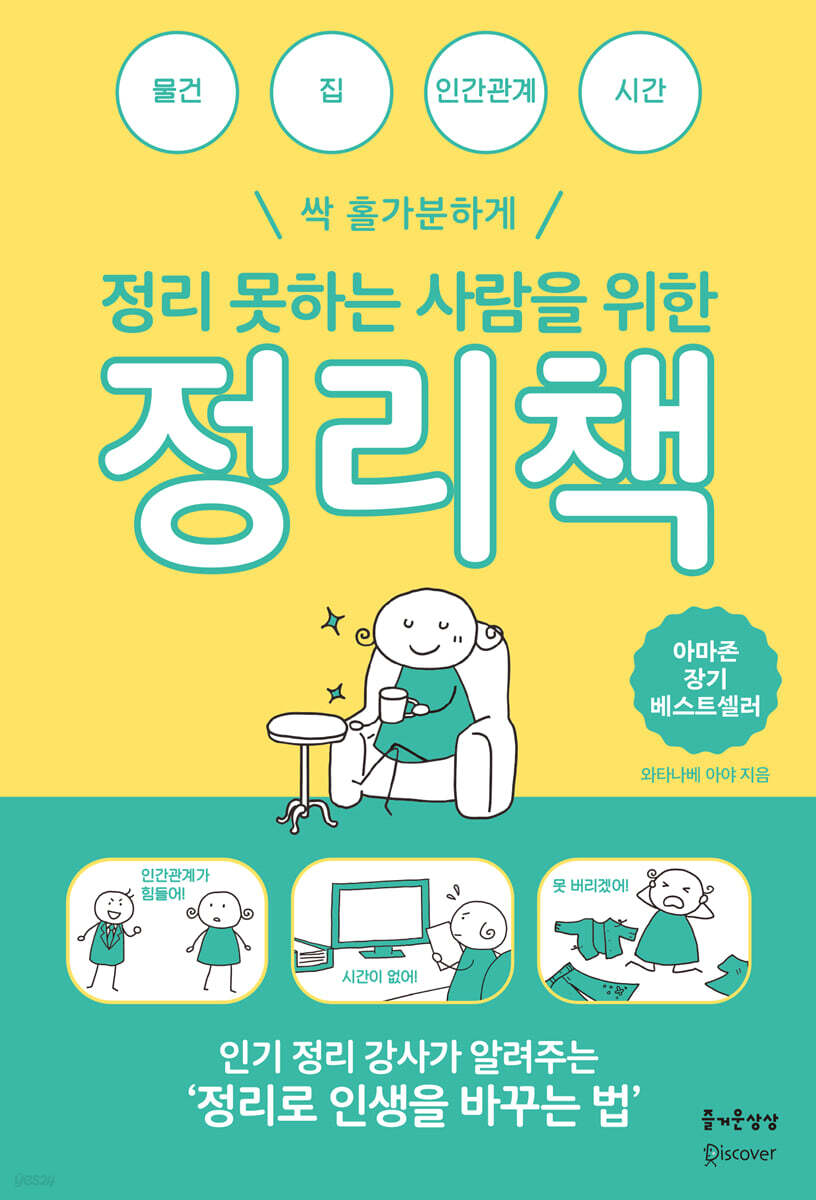
A organizing book for people who can't organize
 |
Description
Book Introduction
Why can't I organize?
There are many organizing methods, but they are too difficult for people who are not good at organizing.
Solve your worries with 'Organizing Methods for People Who Can't Organize'.
As you become better at organizing your things, you will become more adept at managing your relationships and time, making your entire life lighter.
There are many organizing methods, but they are too difficult for people who are not good at organizing.
Solve your worries with 'Organizing Methods for People Who Can't Organize'.
As you become better at organizing your things, you will become more adept at managing your relationships and time, making your entire life lighter.
- You can preview some of the book's contents.
Preview
index
To begin with
The point of this book
Organizing Habit Diagnostic Test ①
Organizing Habit Diagnostic Test ②
Chapter 1: Understanding the true meaning of organization
TIPS 7: Know the true meaning of organization
1. Aim for a space that makes me feel good.
2 What is the first thing you should throw away?
3. Improve your self-esteem by cultivating your five senses.
4. Cleanliness is a barometer of health
5 What does it mean to value 'things'?
6 What does it mean to value 'time'?
7 What does it mean to value ‘human relationships’?
COLUMN
Don't feel inferior even if you're not good at organizing.
Chapter 2: Change your mindset to succeed in organizing
TIPS 10: Change Your Mindset to Successful Organization
8 Gain confidence through small successes and create a virtuous cycle of organization.
9 Escape the status quo with a bingo game
10 Necessary? Unnecessary? Temporary storage '3 rule' makes organizing easy
11 From 'theorems requiring willpower' to 'conditioned reflex' theorems
12. The Deep Psychology of Organization - Confronting Your True Self
13 Do not blame yourself and do not envy others.
14 Stop making excuses and start speaking positively
15 We talk a lot about organizing
16. Don't be trapped by sunk costs.
17 If it's a seriously messy room, reset it boldly.
COLUMN
Control yourself positively
Chapter 3: The Secret to Maintaining a Carefree Feeling
TIPS 7: The Secret to Staying Relaxed
18 Divide your to-do list into 'daily tasks' and 'regular tasks'.
19 Create a routine that doesn't overwork you
20 Efficiently plan your household chores for the year ahead
21 Create a system that makes organizing a habit easy.
22 Set a quantity for the item and dispose of any excess.
23. Preventing Excessive Organizing and Classification with "Border Operation"
24 Preventing the yo-yo effect through regular external pressure
COLUMN
Men and women have different ways of owning things.
Chapter 4: Feeling Free from Things
TIPS 9: Become free from things
25 When you reduce your clothes, your taste begins to show.
26 Books are categorized in the order you want to read them.
27 Documents? Paperwork is being drastically reduced.
28 It is better to eat food as it is being prepared rather than storing it in the refrigerator.
29. Create a 'home where you can heal' by focusing on the route you take after returning home.
30 Your own space is an investment in your future self.
31 Surprisingly Difficult Tips for Choosing and Organizing a Bag
32 Valuables? Take photos of important items and keep them safe.
33 Organizing your parents' house is filial piety + inheritance measures
COLUMN 5 Ways to Stop Excessive Supermarket Shopping
Chapter 5: Freedom from Time and Human Relationships
TIPS 6: Become free from time and relationships
34 Create free time with a organized mindset
Create a day with space by organizing 35 hours
Buy something that increases your assets by 36 hours
37. Work worries are also sorted out easily.
38 Don't worry too much about your friendships
39 The truth is that the most difficult thing is 'relationships with family'.
Organizing communication with COLUMN partners
Chapter 6: Organizing is Self-Development
TIPS 4: Organizing is Self-Development
40. Organizing is self-care
41 I do what I love thoroughly.
42 Create a space where you can do whatever you want
43 I refine the resources given to me.
If you don't have time to organize your columns, we recommend "Night Organizing."
supplement
▶Organizing & Cleaning Techniques
▶Let's start by getting rid of items that are easy to throw away.
▶How to dispose of bulky waste
▶How to request a organizing and storage service
Finally
The point of this book
Organizing Habit Diagnostic Test ①
Organizing Habit Diagnostic Test ②
Chapter 1: Understanding the true meaning of organization
TIPS 7: Know the true meaning of organization
1. Aim for a space that makes me feel good.
2 What is the first thing you should throw away?
3. Improve your self-esteem by cultivating your five senses.
4. Cleanliness is a barometer of health
5 What does it mean to value 'things'?
6 What does it mean to value 'time'?
7 What does it mean to value ‘human relationships’?
COLUMN
Don't feel inferior even if you're not good at organizing.
Chapter 2: Change your mindset to succeed in organizing
TIPS 10: Change Your Mindset to Successful Organization
8 Gain confidence through small successes and create a virtuous cycle of organization.
9 Escape the status quo with a bingo game
10 Necessary? Unnecessary? Temporary storage '3 rule' makes organizing easy
11 From 'theorems requiring willpower' to 'conditioned reflex' theorems
12. The Deep Psychology of Organization - Confronting Your True Self
13 Do not blame yourself and do not envy others.
14 Stop making excuses and start speaking positively
15 We talk a lot about organizing
16. Don't be trapped by sunk costs.
17 If it's a seriously messy room, reset it boldly.
COLUMN
Control yourself positively
Chapter 3: The Secret to Maintaining a Carefree Feeling
TIPS 7: The Secret to Staying Relaxed
18 Divide your to-do list into 'daily tasks' and 'regular tasks'.
19 Create a routine that doesn't overwork you
20 Efficiently plan your household chores for the year ahead
21 Create a system that makes organizing a habit easy.
22 Set a quantity for the item and dispose of any excess.
23. Preventing Excessive Organizing and Classification with "Border Operation"
24 Preventing the yo-yo effect through regular external pressure
COLUMN
Men and women have different ways of owning things.
Chapter 4: Feeling Free from Things
TIPS 9: Become free from things
25 When you reduce your clothes, your taste begins to show.
26 Books are categorized in the order you want to read them.
27 Documents? Paperwork is being drastically reduced.
28 It is better to eat food as it is being prepared rather than storing it in the refrigerator.
29. Create a 'home where you can heal' by focusing on the route you take after returning home.
30 Your own space is an investment in your future self.
31 Surprisingly Difficult Tips for Choosing and Organizing a Bag
32 Valuables? Take photos of important items and keep them safe.
33 Organizing your parents' house is filial piety + inheritance measures
COLUMN 5 Ways to Stop Excessive Supermarket Shopping
Chapter 5: Freedom from Time and Human Relationships
TIPS 6: Become free from time and relationships
34 Create free time with a organized mindset
Create a day with space by organizing 35 hours
Buy something that increases your assets by 36 hours
37. Work worries are also sorted out easily.
38 Don't worry too much about your friendships
39 The truth is that the most difficult thing is 'relationships with family'.
Organizing communication with COLUMN partners
Chapter 6: Organizing is Self-Development
TIPS 4: Organizing is Self-Development
40. Organizing is self-care
41 I do what I love thoroughly.
42 Create a space where you can do whatever you want
43 I refine the resources given to me.
If you don't have time to organize your columns, we recommend "Night Organizing."
supplement
▶Organizing & Cleaning Techniques
▶Let's start by getting rid of items that are easy to throw away.
▶How to dispose of bulky waste
▶How to request a organizing and storage service
Finally
Detailed image
Publisher's Review
01_ Reading and Reading Advice for Those Who Don't Know How to Organize
There are countless organizing methods in the world.
There's a plethora of information about organizing in books, on the internet, on television, and on YouTube.
However, people who worry about organizing tend to collect information diligently but are unable to put it into action.
Why is that? Most organizing tips are presented by people who are good at organizing.
When looking at examples of organizing, there are many cases where people give up and say, 'I can't do this.'
《The Organizing Book for People Who Can't Organize》 provides methods suitable for 'people who are bad at organizing.'
Aya Watanabe, a popular organizing expert, emphasizes that organizing is not simply about organizing or storing items, but rather "a skill that makes life better."
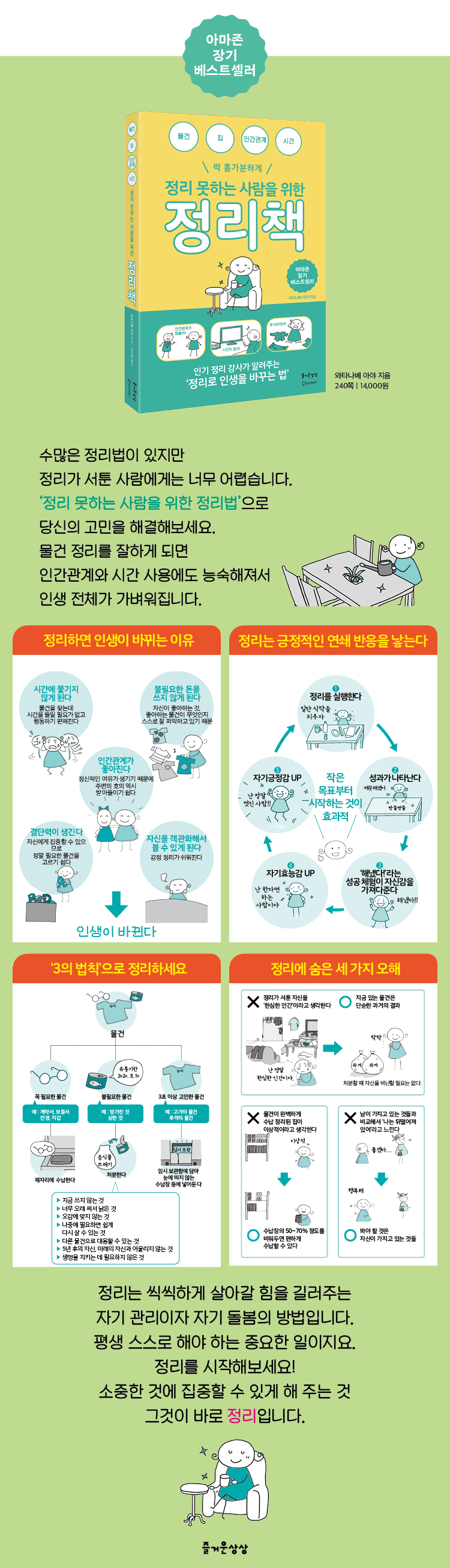
If you organize your things, you can also organize your time and relationships.
Organizing solves many problems and brings more leisure to life.
Have you ever given up on organizing because you thought you weren't good at it? Reassuring yourself that anyone can do it will give you the motivation to try again.
Meet this book that doesn't spare encouragement, saying that it's natural to be unable to do something because you've never learned how to organize.
Your daily life becomes more relaxed.
02_ When you understand the meaning of organization, your mind changes.
The author first explains the meaning of organization step by step.
Tidying up is 'creating a space where you feel good.'
I organize it for my own enjoyment, not to show it to anyone.
Letting go of things is really hard, but I want to emphasize that the first thing you need to let go of is guilt.
Organizing saves time by making it easier to find things.
You also learn to figure out what you like, which reduces unnecessary waste.
Spaciousness leads to mental freedom, which improves interpersonal relationships.
Because you can see yourself objectively, it becomes easier to manage your emotions.
"The Organizing Book for People Who Can't Organize" helps you develop an organizing mindset through various checklists and provides practical organizing know-how in detail with cute illustrations.
Organizing helps you live the life you want, and it becomes a barometer of your health! Get started now.
03_ You can successfully organize your work if you have a positive mindset.
《The Organizing Book for People Who Can't Organize》 is full of useful organizing approaches.
Don't blame yourself or envy others.
Talk a lot about organizing, and don't get caught up in sunk costs that can't be recovered.
It talks about the importance of a good mindset, such as making quick judgments based on the 'necessary, unnecessary, and temporary storage' rules, looking into your own mind to see if you are buying things out of other stress, and never overdoing it.
Are you holding onto things you don't use, unable to throw them away because you feel bad about spending money on them? The author advises that throwing them away doesn't prove you're a failure.
We will teach you step by step that controlling yourself positively is the secret to successful organizing.
04_ If you organize your things well, it becomes easier to manage time and relationships.
If you want to live a carefree life, proper allocation of time and management of interpersonal relationships are essential.
The author says that you can control your time by organizing your things.
It's about developing the habit of cutting out unnecessary tasks and prioritizing what's important.
The key is to create space for both time and organizing things!
The same goes for human relationships.
Don't worry too much about your friendships! If you don't feel at ease, you won't be able to build good relationships with your friends.
The first thing to do is to distinguish between a 'friend' and a 'person you associate with because of their role'.
Typical relationships that arise through roles such as a child's friend's mother or a coworker.
It contains useful tips such as it is taboo to vent to someone you are dating for a role, and when you do talk to someone, it should be in a constructive form such as 'reporting' or 'counseling'.
Human relationships are a lifelong homework for everyone.
But there's some advice that stands out that can help you lighten things up a little.
05_ Organizing is self-development and self-care.
The author explains organization in a way that deeply connects it to life.
By organizing, you can grow, learn to like yourself, and discover what you like, so you can live your life as yourself.
When your space is organized, you have more time, and you are surrounded by good relationships, you can deal with negativity more easily.
Having organizational skills will help you navigate your daily life smoothly, even in the event of an emergency.
Tidying up is a method of self-care that fosters the strength to live courageously.
It's a very important thing that you have to do on your own throughout your life.
Decluttering your surroundings is the first step toward focusing on what matters most to you.
There are countless organizing methods in the world.
There's a plethora of information about organizing in books, on the internet, on television, and on YouTube.
However, people who worry about organizing tend to collect information diligently but are unable to put it into action.
Why is that? Most organizing tips are presented by people who are good at organizing.
When looking at examples of organizing, there are many cases where people give up and say, 'I can't do this.'
《The Organizing Book for People Who Can't Organize》 provides methods suitable for 'people who are bad at organizing.'
Aya Watanabe, a popular organizing expert, emphasizes that organizing is not simply about organizing or storing items, but rather "a skill that makes life better."
If you organize your things, you can also organize your time and relationships.
Organizing solves many problems and brings more leisure to life.
Have you ever given up on organizing because you thought you weren't good at it? Reassuring yourself that anyone can do it will give you the motivation to try again.
Meet this book that doesn't spare encouragement, saying that it's natural to be unable to do something because you've never learned how to organize.
Your daily life becomes more relaxed.
02_ When you understand the meaning of organization, your mind changes.
The author first explains the meaning of organization step by step.
Tidying up is 'creating a space where you feel good.'
I organize it for my own enjoyment, not to show it to anyone.
Letting go of things is really hard, but I want to emphasize that the first thing you need to let go of is guilt.
Organizing saves time by making it easier to find things.
You also learn to figure out what you like, which reduces unnecessary waste.
Spaciousness leads to mental freedom, which improves interpersonal relationships.
Because you can see yourself objectively, it becomes easier to manage your emotions.
"The Organizing Book for People Who Can't Organize" helps you develop an organizing mindset through various checklists and provides practical organizing know-how in detail with cute illustrations.
Organizing helps you live the life you want, and it becomes a barometer of your health! Get started now.
03_ You can successfully organize your work if you have a positive mindset.
《The Organizing Book for People Who Can't Organize》 is full of useful organizing approaches.
Don't blame yourself or envy others.
Talk a lot about organizing, and don't get caught up in sunk costs that can't be recovered.
It talks about the importance of a good mindset, such as making quick judgments based on the 'necessary, unnecessary, and temporary storage' rules, looking into your own mind to see if you are buying things out of other stress, and never overdoing it.
Are you holding onto things you don't use, unable to throw them away because you feel bad about spending money on them? The author advises that throwing them away doesn't prove you're a failure.
We will teach you step by step that controlling yourself positively is the secret to successful organizing.
04_ If you organize your things well, it becomes easier to manage time and relationships.
If you want to live a carefree life, proper allocation of time and management of interpersonal relationships are essential.
The author says that you can control your time by organizing your things.
It's about developing the habit of cutting out unnecessary tasks and prioritizing what's important.
The key is to create space for both time and organizing things!
The same goes for human relationships.
Don't worry too much about your friendships! If you don't feel at ease, you won't be able to build good relationships with your friends.
The first thing to do is to distinguish between a 'friend' and a 'person you associate with because of their role'.
Typical relationships that arise through roles such as a child's friend's mother or a coworker.
It contains useful tips such as it is taboo to vent to someone you are dating for a role, and when you do talk to someone, it should be in a constructive form such as 'reporting' or 'counseling'.
Human relationships are a lifelong homework for everyone.
But there's some advice that stands out that can help you lighten things up a little.
05_ Organizing is self-development and self-care.
The author explains organization in a way that deeply connects it to life.
By organizing, you can grow, learn to like yourself, and discover what you like, so you can live your life as yourself.
When your space is organized, you have more time, and you are surrounded by good relationships, you can deal with negativity more easily.
Having organizational skills will help you navigate your daily life smoothly, even in the event of an emergency.
Tidying up is a method of self-care that fosters the strength to live courageously.
It's a very important thing that you have to do on your own throughout your life.
Decluttering your surroundings is the first step toward focusing on what matters most to you.
GOODS SPECIFICS
- Date of issue: May 25, 2021
- Page count, weight, size: 240 pages | 278g | 130*188*16mm
- ISBN13: 9791155361627
- ISBN10: 1155361628
You may also like
카테고리
korean


korean

![ELLE 엘르 스페셜 에디션 A형 : 12월 [2025]](http://librairie.coreenne.fr/cdn/shop/files/b8e27a3de6c9538896439686c6b0e8fb.jpg?v=1766436872&width=3840)


