

The Miracle of Picture Book Play Classes
 |
Description
Book Introduction
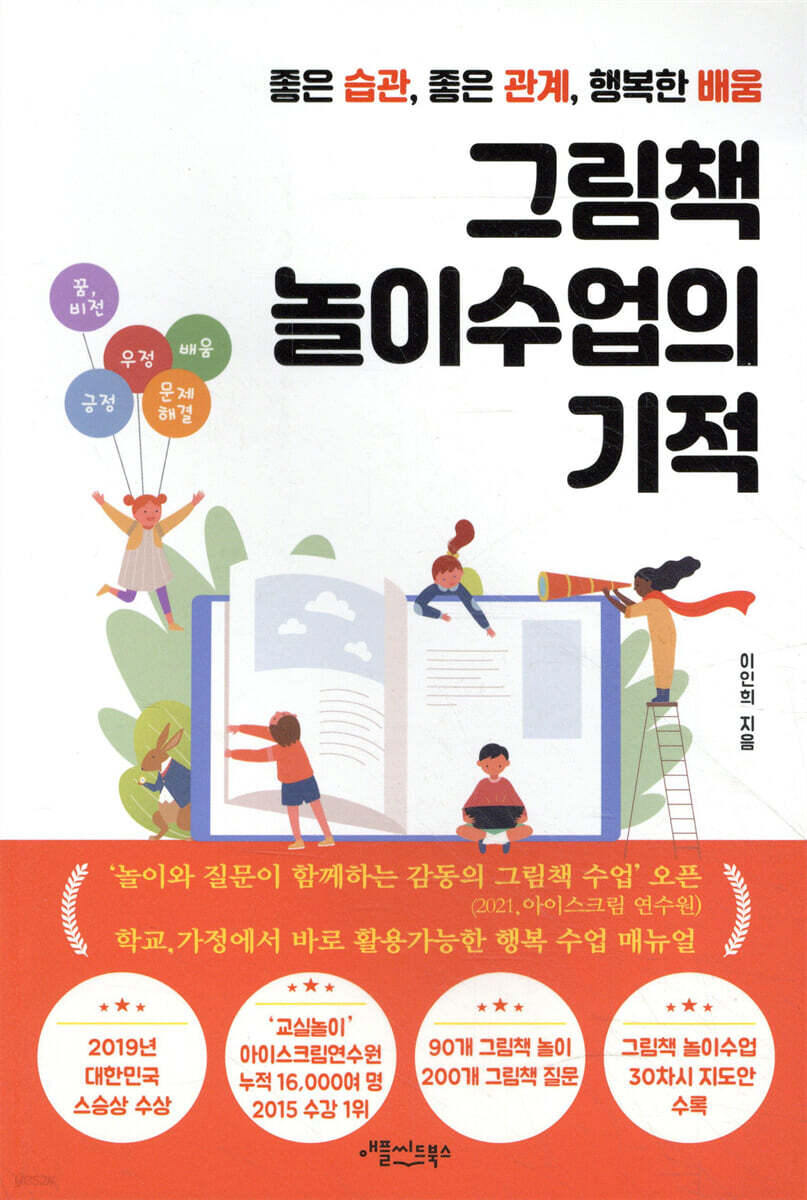
A manual for the field of Miracle Class, explained through questions, play, and picture books.
Author Lee In-hee, a senior elementary school teacher who teaches happiness classes that combine play, learning, and life, presents “The Miracle of Picture Book Play Classes,” which contains the miraculous lessons she created through questions, play, and picture books.
This is a lesson manual that can be used immediately at school or at home to develop good habits, good relationships, and happy learning.
This book is a true testament to the know-how gained from winning the 2019 Korea Teacher Award and running the popular course “Classroom Play, Adding Happiness to Classes” at the Ice Cream Remote Training Center.
It contains 90 picture book activities and 200 picture book questions corresponding to the 30-lesson lesson plan for picture book play classes.
If you dream of a happy encounter with children through picture books, start a picture book play class right now!
Author Lee In-hee, a senior elementary school teacher who teaches happiness classes that combine play, learning, and life, presents “The Miracle of Picture Book Play Classes,” which contains the miraculous lessons she created through questions, play, and picture books.
This is a lesson manual that can be used immediately at school or at home to develop good habits, good relationships, and happy learning.
This book is a true testament to the know-how gained from winning the 2019 Korea Teacher Award and running the popular course “Classroom Play, Adding Happiness to Classes” at the Ice Cream Remote Training Center.
It contains 90 picture book activities and 200 picture book questions corresponding to the 30-lesson lesson plan for picture book play classes.
If you dream of a happy encounter with children through picture books, start a picture book play class right now!
- You can preview some of the book's contents.
Preview
index
Recommendation
prolog
1.
Have a positive attitude
Is it okay to be wrong? [It's okay to be wrong] | How should I treat a friend who thinks differently from me? [Is it half-full or half-empty?] | What do you want to say to yourself when you wake up in the morning? [I like myself] | What makes you happy about something you do every day? [Words that don't get stronger when you say them]
2.
Creating a Dream Vision
Did Puppy Poop Make His Dreams Come True? [Puppy Poop] | What's My Dream Map? [The Dream Map I Met] | Why Do I Exist in This World? [The Big Question] | What Should I Collect as a Student? [Frederick] | What's the Spell That Makes Dreams Come True? [The Magic Bed] | How to Catch the Fox That's Wrecking the Classroom? [Dentist Dr. DeSoto]
3.
Troubleshooting
What habits should I break? [The Land of Monsters] | Why do we say hello? [Why do we say hello?] | What if a friend misuses my stuff? [What should I do when I'm angry?] | What is my role? [The Pig Book] | What happens when we accept differences? [The Black Lamb] | What should I understand and forgive? [Mr. Gumpy's Boating] | Should I follow the rules? [The Lion Goes to the Library]
4.
Sharing friendship and love
How to make friends? [How to lose all your friends] | What can I share? [Rainbow Fish] | What do you do when your friends are having a hard time? [We are friends] | Who do you lean on when times are tough? [Mom, the crow] | What is love? [I will always love you] | How do I treat friends who are different from me? [Crow Boy] | Who gave me strength? [Thank you, teacher]
5.
Deepen your learning
What remains constant over time? [As time passes] | What should I strive for? [The Study of Joseon's Most Foolish Man] | How should I converse when others ask me questions? [Why] | How should I read a book? [Beautiful Books] | What results will come from reading and collaborating? [The Book-Reading Toad] | What efforts should I make to read books? [The Book-Reading Ghost, Kunigi]
Epilogue
References
prolog
1.
Have a positive attitude
Is it okay to be wrong? [It's okay to be wrong] | How should I treat a friend who thinks differently from me? [Is it half-full or half-empty?] | What do you want to say to yourself when you wake up in the morning? [I like myself] | What makes you happy about something you do every day? [Words that don't get stronger when you say them]
2.
Creating a Dream Vision
Did Puppy Poop Make His Dreams Come True? [Puppy Poop] | What's My Dream Map? [The Dream Map I Met] | Why Do I Exist in This World? [The Big Question] | What Should I Collect as a Student? [Frederick] | What's the Spell That Makes Dreams Come True? [The Magic Bed] | How to Catch the Fox That's Wrecking the Classroom? [Dentist Dr. DeSoto]
3.
Troubleshooting
What habits should I break? [The Land of Monsters] | Why do we say hello? [Why do we say hello?] | What if a friend misuses my stuff? [What should I do when I'm angry?] | What is my role? [The Pig Book] | What happens when we accept differences? [The Black Lamb] | What should I understand and forgive? [Mr. Gumpy's Boating] | Should I follow the rules? [The Lion Goes to the Library]
4.
Sharing friendship and love
How to make friends? [How to lose all your friends] | What can I share? [Rainbow Fish] | What do you do when your friends are having a hard time? [We are friends] | Who do you lean on when times are tough? [Mom, the crow] | What is love? [I will always love you] | How do I treat friends who are different from me? [Crow Boy] | Who gave me strength? [Thank you, teacher]
5.
Deepen your learning
What remains constant over time? [As time passes] | What should I strive for? [The Study of Joseon's Most Foolish Man] | How should I converse when others ask me questions? [Why] | How should I read a book? [Beautiful Books] | What results will come from reading and collaborating? [The Book-Reading Toad] | What efforts should I make to read books? [The Book-Reading Ghost, Kunigi]
Epilogue
References
Detailed image
.jpg)
Into the book
“Why does the clock work so diligently?”
Boram is a child in the help group who doesn't usually speak out.
Friends are amazed by the small miracles that play creates.
Boram must have been scared to raise her hand and ask questions like the child in the picture book.
It warms my heart to see the rewards of overcoming fear and asking questions.
I put down the question I was thinking about and focused on Boram's question.
“Boram asked a good question.
“Why does the clock work so diligently?”
“It’s because of the battery power.
“A clock moves for a year when it eats a meal.”
“When we sleep, the clock sleeps too, right?” he said, and they continued working.
When asked, "Why do you think they keep working?", he said that the clock works without stopping, so the time is correct in the morning.
The child who heard that refutes it.
“Sometimes the clock stops.
“When the batteries run out or break down.”
“How does it feel when the clock stops?”
“It’s annoying.”
“It’s annoying.”
Complaints are coming from all over the place.
When I was taking a break from studying, I asked my parents how they would feel if they told me to study.
The children say they are upset.
Now we're back to talking about watches.
“How would a clock that stopped running after working for a year because it ran out of medicine feel if it heard your story?”
“I think it would be disappointing.
“I’m sorry I got annoyed with the clock earlier.”
“I used to not care if the clock stopped, but now I can be grateful.”
I asked how I could express my gratitude.
The saying goes, “You worked hard, so take a break.”
It's cute that the kids are putting in batteries after letting them rest.
--- p.20~21
The animals are playing and fall out of the boat into the water.
This scene was presented as an educational play.
I made a makeshift boat by attaching eight cushions together.
“Now you will board the ship.
Who will be Mr. Geompy?”
Yewon, who volunteered for Mr. Geompy, was the first to be picked up.
I read a picture book scene called 'Neighborhood Kids, Can We Ride Too?'
Two people who want to play the role of neighborhood kids board a makeshift boat.
“The rabbit rode.
“The cat got on.”
As the number of animals increases, the children's voices become louder.
“Pull forward quickly, grab just one space.
“And go sideways too.”
“There are 16 of us and there are only eight seats.
“Two people should stand on each cushion.”
Mathematical concepts also appear in children's conversations.
It's precarious to be stuck together.
All 16 students were seated on 8 cushions.
“How are you now?”
“It’s uncomfortable because my stomach is narrow.
“I think I got more excited and played around because the space was small.”
Children feel the situation more realistically through the indirect experience of riding on a boat.
“Now let’s play a prank.”
Let's play pranks and you'll end up with a kid falling off the boat.
There was even a situation where the cushion fell and a hole was made in the stomach.
“You all fell into the water.
"All the animals and children on Mr. Geompy's boat could swim, right? They escaped by swimming."
The children lie face down on the classroom floor and swim to the end of the classroom.
We split into two teams and played a story-changing game.
“Let me change the subject.
“No one can swim except Mr. Gumpy, so Mr. Gumpy has to build the stepping stones.”
The cushion that had become a boat has now become a stepping stone.
One of the students became Mr. Geompy and laid the stepping stones.
--- p.162~163
Kim Deuk-shin shared with his children the story of the epitaph he wrote on his own grave.
“Don’t limit yourself just because you’re not as talented as others.
There are few people as foolish as me, but I finally achieved my goal.
They say it all depends on how hard you try.
“Let’s talk about what it means to say that everything depends on effort.”
“It’s about working hard at something without giving up until the end.
For example, let's talk about how teacher Kim Deuk-shin never gave up and studied until the end.
So I passed the civil service examination at the age of 59.”
They say that 59 years old in the Joseon Dynasty is equivalent to 100 years old in today's age. 'Wow.
The response is 'daebak'.
The children also say they want to learn from Mr. Kim Deuk-shin's unwavering tenacity and sincerity.
With the sincerity of Mr. Kim Deuk-shin, we discussed among ourselves what we should do.
“Our group decided to read a book every day and write two lines.”
“I think you have to believe in yourself and not give up.”
“I used to stop reading a book once, but I decided to read it over and over again.”
I listened to the children's stories and gave them positive words.
“They say that if you challenge yourself with confidence, what you want will come true.
“If you don’t give up, your sports, studies, and friendships will improve.”
I expressed my sincerity by imagining children who, after failing a hundred times, would try a hundred and one times.
I want to live as a teacher who supports children with loving words and believes in them.
Boram is a child in the help group who doesn't usually speak out.
Friends are amazed by the small miracles that play creates.
Boram must have been scared to raise her hand and ask questions like the child in the picture book.
It warms my heart to see the rewards of overcoming fear and asking questions.
I put down the question I was thinking about and focused on Boram's question.
“Boram asked a good question.
“Why does the clock work so diligently?”
“It’s because of the battery power.
“A clock moves for a year when it eats a meal.”
“When we sleep, the clock sleeps too, right?” he said, and they continued working.
When asked, "Why do you think they keep working?", he said that the clock works without stopping, so the time is correct in the morning.
The child who heard that refutes it.
“Sometimes the clock stops.
“When the batteries run out or break down.”
“How does it feel when the clock stops?”
“It’s annoying.”
“It’s annoying.”
Complaints are coming from all over the place.
When I was taking a break from studying, I asked my parents how they would feel if they told me to study.
The children say they are upset.
Now we're back to talking about watches.
“How would a clock that stopped running after working for a year because it ran out of medicine feel if it heard your story?”
“I think it would be disappointing.
“I’m sorry I got annoyed with the clock earlier.”
“I used to not care if the clock stopped, but now I can be grateful.”
I asked how I could express my gratitude.
The saying goes, “You worked hard, so take a break.”
It's cute that the kids are putting in batteries after letting them rest.
--- p.20~21
The animals are playing and fall out of the boat into the water.
This scene was presented as an educational play.
I made a makeshift boat by attaching eight cushions together.
“Now you will board the ship.
Who will be Mr. Geompy?”
Yewon, who volunteered for Mr. Geompy, was the first to be picked up.
I read a picture book scene called 'Neighborhood Kids, Can We Ride Too?'
Two people who want to play the role of neighborhood kids board a makeshift boat.
“The rabbit rode.
“The cat got on.”
As the number of animals increases, the children's voices become louder.
“Pull forward quickly, grab just one space.
“And go sideways too.”
“There are 16 of us and there are only eight seats.
“Two people should stand on each cushion.”
Mathematical concepts also appear in children's conversations.
It's precarious to be stuck together.
All 16 students were seated on 8 cushions.
“How are you now?”
“It’s uncomfortable because my stomach is narrow.
“I think I got more excited and played around because the space was small.”
Children feel the situation more realistically through the indirect experience of riding on a boat.
“Now let’s play a prank.”
Let's play pranks and you'll end up with a kid falling off the boat.
There was even a situation where the cushion fell and a hole was made in the stomach.
“You all fell into the water.
"All the animals and children on Mr. Geompy's boat could swim, right? They escaped by swimming."
The children lie face down on the classroom floor and swim to the end of the classroom.
We split into two teams and played a story-changing game.
“Let me change the subject.
“No one can swim except Mr. Gumpy, so Mr. Gumpy has to build the stepping stones.”
The cushion that had become a boat has now become a stepping stone.
One of the students became Mr. Geompy and laid the stepping stones.
--- p.162~163
Kim Deuk-shin shared with his children the story of the epitaph he wrote on his own grave.
“Don’t limit yourself just because you’re not as talented as others.
There are few people as foolish as me, but I finally achieved my goal.
They say it all depends on how hard you try.
“Let’s talk about what it means to say that everything depends on effort.”
“It’s about working hard at something without giving up until the end.
For example, let's talk about how teacher Kim Deuk-shin never gave up and studied until the end.
So I passed the civil service examination at the age of 59.”
They say that 59 years old in the Joseon Dynasty is equivalent to 100 years old in today's age. 'Wow.
The response is 'daebak'.
The children also say they want to learn from Mr. Kim Deuk-shin's unwavering tenacity and sincerity.
With the sincerity of Mr. Kim Deuk-shin, we discussed among ourselves what we should do.
“Our group decided to read a book every day and write two lines.”
“I think you have to believe in yourself and not give up.”
“I used to stop reading a book once, but I decided to read it over and over again.”
I listened to the children's stories and gave them positive words.
“They say that if you challenge yourself with confidence, what you want will come true.
“If you don’t give up, your sports, studies, and friendships will improve.”
I expressed my sincerity by imagining children who, after failing a hundred times, would try a hundred and one times.
I want to live as a teacher who supports children with loving words and believes in them.
--- p.256~257
Publisher's Review
Picture book play classes, the beginning of joy
“Now that I think about it, the beginning of my joy was the picture book play class.
Through picture book play classes, children became interested in books.
On school days, the children cheered.
I asked when classes would resume.
“The first graders also insisted on having classes until the 6th period.”
Author Lee In-hee, a senior elementary school teacher who teaches happiness classes that combine play, learning, and life, presents “The Miracle of Picture Book Play Classes,” which contains the miraculous lessons she created through questions, play, and picture books.
This is a lesson manual that can be used immediately at school or at home to develop good habits, good relationships, and happy learning.
This book is a true testament to the know-how gained from winning the 2019 Korea Teacher Award and running the popular course “Classroom Play, Adding Happiness to Classes” at the Ice Cream Remote Training Center.
It contains 90 picture book activities and 200 picture book questions corresponding to the 30-lesson lesson plan for picture book play classes.
If you follow the picture book play classes created with the vision of raising children into happy leaders, you will meet children who eagerly await the day of class.
Let's meet the picture book play class, the beginning of joy.
Picture book play class method
The picture book play class proceeds in the following order.
* Choose a picture book and read it with the children.
(Example: 『Magic Bed』)
[Introduction]
1.
Check the learning problem.
(Example: Let's find a spell that will make my dreams come true.)
2.
Ask the whole question.
(Example: What is the five-letter spell that allows travel in a magic bed?)
4.
Play the first letter quiz game.
[deployment]
1.
Ask the whole question.
(Example: How do we express gratitude?)
2.
Ask questions to each other.
(Example: Where do you want to go?)
3.
Play a four-beat game.
(Example: After playing, say where you want to go in the conversation square.)
4.
Ask group questions.
(Example: What spell will make our class happy?)
5.
Role-playing magic spells.
6.
Play magic chairs.
7.
Ask the whole question.
(Example: What spell will make my dreams come true?)
[finish]
1.
Play a game of guessing.
(Example: Should I present what I have learned through a game of guessing?)
(Holding hands) Algunggeunjeok Bonkejeok! (Example: Saying what you saw, realized, or will put into practice in class.)
"The Magic Bed" is a story about a child who discovers a magic spell and travels to an imaginary world every night in a magic bed.
It starts with a game of finding a magic spell like the main character, and makes you think of a spell that will make your dreams come true.
Of course, it is not simply about asking and answering questions, but rather about having children cooperate and share opinions through various games.
In this class, the kids also said things like “I love you, you can do it” as a mantra to help me dream.
The secret to making children's faces bright and the classroom warm is not simply giving them the right answer, but because the class is a combination of play, learning, and life.
Learn how to resolve conflicts through play.
“I asked questions like a rainbow fish about what I wanted to share.
Pocket money, knowledge, and conversation come out.
"What does it mean to share knowledge?" Yeonju raises her hand and announces.
“I have experience explaining math that a friend didn’t understand in an easy-to-understand way.”
"Rainbow Fish" is a story about how sharing what you have wisely brings happiness to yourself and those around you.
After learning about 'role models' through role-playing, children talk about them together.
And through the rainbow fish, we learn the meaning and joy of sharing.
In this way, children learn how to resolve conflicts through questions, picture books, and play.
In the end, it was a warm class where we expressed our gratitude to our friends who practiced sharing.
How to educate children in the era of contactless communication due to the pandemic is an urgent issue.
What has been paradoxically revealed through non-face-to-face and online classes is that schools are not simply places for learning knowledge, but also places where social skills are fostered.
This is the precious lesson that picture book play classes can teach our children.
Proven training methods
“It is rare to find a book that teaches through play using picture books.
Fun games open children's minds, and they ask to come to class again.
This book introduces a new picture book class.
Read it.
It will be fun and warm.” - Kwon Il-han, bookworm teacher, author of “The Teacher’s Hide and Seek” and many other books
“It provides children with the foundation of character, fosters dreams and hopes, and gives them the perspective to reflect on themselves and view the world.
“Teacher Lee In-hee’s writing has the power to convey hope to children.” - Children’s author Kim Dae-jo, author of “The Spy in Our Class” and many other books
“If you want to kill two birds with one stone by enjoying the properties of books and play, you will enjoy reading this.
Do the children know that they are lucky to be taking Mr. Lee In-hee's class?
You know, right? The strictest people in class are the kids.” - Kim Won-ah, children's author, author of "I am Caterpillar No. 7, Class 2, Grade 3."
“Play makes children children, and good questions expand their thinking.
So what happens when questions, play, and picture books come together? Teacher Lee In-hee beautifully weaves these three together to guide children into a world of fun.” Choi Won-il, author of Elementary Reading Methods
"Through the precious book of Inhee, who shares the vision of 'play is class,' we move from 'play' to 'self-leadership,' and even 'play classes using questions and picture books'... It is full of play with detailed instructional plans and practical activities!" Heo Seung-hwan, CEO of the Honey Jam Education Research Institute and teacher at Seoul Gangil Elementary School
The author appeared on KBS's documentary series [Passionate Teacher, Happy School] and lectured on play and leadership at Doosan Group, Ulaanbaatar University in Mongolia, 3P Self-Management Research Institute, and over 25 educational training centers and education offices.
Judging from the wealth of field experience and recommendations from those around me, picture book play classes are definitely a proven educational method.
“The Miracle of Picture Book Play Class” was born from the process of thinking about “How can we help children become familiar with books?”
It is a happy journey with children to find the author's own answers about positivity, vision, career path, time, problem-solving, reading, study, friendship, and love.
If you dream of a happy encounter with children through picture books, start a picture book play class right now!
“Now that I think about it, the beginning of my joy was the picture book play class.
Through picture book play classes, children became interested in books.
On school days, the children cheered.
I asked when classes would resume.
“The first graders also insisted on having classes until the 6th period.”
Author Lee In-hee, a senior elementary school teacher who teaches happiness classes that combine play, learning, and life, presents “The Miracle of Picture Book Play Classes,” which contains the miraculous lessons she created through questions, play, and picture books.
This is a lesson manual that can be used immediately at school or at home to develop good habits, good relationships, and happy learning.
This book is a true testament to the know-how gained from winning the 2019 Korea Teacher Award and running the popular course “Classroom Play, Adding Happiness to Classes” at the Ice Cream Remote Training Center.
It contains 90 picture book activities and 200 picture book questions corresponding to the 30-lesson lesson plan for picture book play classes.
If you follow the picture book play classes created with the vision of raising children into happy leaders, you will meet children who eagerly await the day of class.
Let's meet the picture book play class, the beginning of joy.
Picture book play class method
The picture book play class proceeds in the following order.
* Choose a picture book and read it with the children.
(Example: 『Magic Bed』)
[Introduction]
1.
Check the learning problem.
(Example: Let's find a spell that will make my dreams come true.)
2.
Ask the whole question.
(Example: What is the five-letter spell that allows travel in a magic bed?)
4.
Play the first letter quiz game.
[deployment]
1.
Ask the whole question.
(Example: How do we express gratitude?)
2.
Ask questions to each other.
(Example: Where do you want to go?)
3.
Play a four-beat game.
(Example: After playing, say where you want to go in the conversation square.)
4.
Ask group questions.
(Example: What spell will make our class happy?)
5.
Role-playing magic spells.
6.
Play magic chairs.
7.
Ask the whole question.
(Example: What spell will make my dreams come true?)
[finish]
1.
Play a game of guessing.
(Example: Should I present what I have learned through a game of guessing?)
(Holding hands) Algunggeunjeok Bonkejeok! (Example: Saying what you saw, realized, or will put into practice in class.)
"The Magic Bed" is a story about a child who discovers a magic spell and travels to an imaginary world every night in a magic bed.
It starts with a game of finding a magic spell like the main character, and makes you think of a spell that will make your dreams come true.
Of course, it is not simply about asking and answering questions, but rather about having children cooperate and share opinions through various games.
In this class, the kids also said things like “I love you, you can do it” as a mantra to help me dream.
The secret to making children's faces bright and the classroom warm is not simply giving them the right answer, but because the class is a combination of play, learning, and life.
Learn how to resolve conflicts through play.
“I asked questions like a rainbow fish about what I wanted to share.
Pocket money, knowledge, and conversation come out.
"What does it mean to share knowledge?" Yeonju raises her hand and announces.
“I have experience explaining math that a friend didn’t understand in an easy-to-understand way.”
"Rainbow Fish" is a story about how sharing what you have wisely brings happiness to yourself and those around you.
After learning about 'role models' through role-playing, children talk about them together.
And through the rainbow fish, we learn the meaning and joy of sharing.
In this way, children learn how to resolve conflicts through questions, picture books, and play.
In the end, it was a warm class where we expressed our gratitude to our friends who practiced sharing.
How to educate children in the era of contactless communication due to the pandemic is an urgent issue.
What has been paradoxically revealed through non-face-to-face and online classes is that schools are not simply places for learning knowledge, but also places where social skills are fostered.
This is the precious lesson that picture book play classes can teach our children.
Proven training methods
“It is rare to find a book that teaches through play using picture books.
Fun games open children's minds, and they ask to come to class again.
This book introduces a new picture book class.
Read it.
It will be fun and warm.” - Kwon Il-han, bookworm teacher, author of “The Teacher’s Hide and Seek” and many other books
“It provides children with the foundation of character, fosters dreams and hopes, and gives them the perspective to reflect on themselves and view the world.
“Teacher Lee In-hee’s writing has the power to convey hope to children.” - Children’s author Kim Dae-jo, author of “The Spy in Our Class” and many other books
“If you want to kill two birds with one stone by enjoying the properties of books and play, you will enjoy reading this.
Do the children know that they are lucky to be taking Mr. Lee In-hee's class?
You know, right? The strictest people in class are the kids.” - Kim Won-ah, children's author, author of "I am Caterpillar No. 7, Class 2, Grade 3."
“Play makes children children, and good questions expand their thinking.
So what happens when questions, play, and picture books come together? Teacher Lee In-hee beautifully weaves these three together to guide children into a world of fun.” Choi Won-il, author of Elementary Reading Methods
"Through the precious book of Inhee, who shares the vision of 'play is class,' we move from 'play' to 'self-leadership,' and even 'play classes using questions and picture books'... It is full of play with detailed instructional plans and practical activities!" Heo Seung-hwan, CEO of the Honey Jam Education Research Institute and teacher at Seoul Gangil Elementary School
The author appeared on KBS's documentary series [Passionate Teacher, Happy School] and lectured on play and leadership at Doosan Group, Ulaanbaatar University in Mongolia, 3P Self-Management Research Institute, and over 25 educational training centers and education offices.
Judging from the wealth of field experience and recommendations from those around me, picture book play classes are definitely a proven educational method.
“The Miracle of Picture Book Play Class” was born from the process of thinking about “How can we help children become familiar with books?”
It is a happy journey with children to find the author's own answers about positivity, vision, career path, time, problem-solving, reading, study, friendship, and love.
If you dream of a happy encounter with children through picture books, start a picture book play class right now!
GOODS SPECIFICS
- Publication date: October 30, 2020
- Page count, weight, size: 304 pages | 518g | 150*220*19mm
- ISBN13: 9791196921545
- ISBN10: 1196921547
You may also like
카테고리
korean


korean

![ELLE 엘르 스페셜 에디션 A형 : 12월 [2025]](http://librairie.coreenne.fr/cdn/shop/files/b8e27a3de6c9538896439686c6b0e8fb.jpg?v=1766436872&width=3840)


