

The perfect way to score on elementary school math: Start with calculations.
 |
Description
Book Introduction
In this era of liberal arts and science integration, elementary school math ultimately determines college acceptance!
This book is a revised edition of [Don't Let Math Hold Your Child Back].
Elementary mathematics focuses on numerical operations.
In this book, Jo An-ho, a math study method expert, explains the seven most important areas of elementary math, which can be considered the foundation of middle school and high school math, in an easy and fun way.
How should we approach elementary mathematics in this era of integrated liberal arts and science? The author emphasizes that the first step is to thoroughly master the following seven areas.
① Operations and speed of natural numbers ② Operation symbols ③ Operations and expansion of fractions ④ Area ⑤ Movement ⑥ Probability ⑦ Word problems
The number of children giving up on math increases rapidly when they reach fifth grade.
Then, when they get to middle school and high school, more than 90% of them give up on math.
If your child is in elementary school, it's not too late.
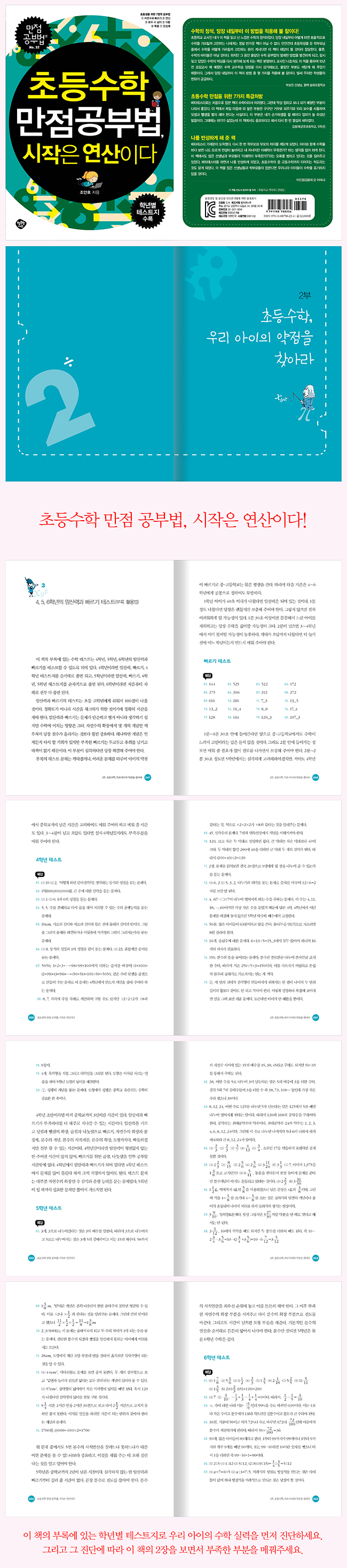
Let's first diagnose which areas our child is lacking in using the 'Grade-specific Test Sheet' included in the appendix of this book.
Then, you can look at this book to learn what and how to teach.
Parents will find practical [tips] that can be utilized through the link between the main text and the appendix test paper.
This book is a revised edition of [Don't Let Math Hold Your Child Back].
Elementary mathematics focuses on numerical operations.
In this book, Jo An-ho, a math study method expert, explains the seven most important areas of elementary math, which can be considered the foundation of middle school and high school math, in an easy and fun way.
How should we approach elementary mathematics in this era of integrated liberal arts and science? The author emphasizes that the first step is to thoroughly master the following seven areas.
① Operations and speed of natural numbers ② Operation symbols ③ Operations and expansion of fractions ④ Area ⑤ Movement ⑥ Probability ⑦ Word problems
The number of children giving up on math increases rapidly when they reach fifth grade.
Then, when they get to middle school and high school, more than 90% of them give up on math.
If your child is in elementary school, it's not too late.
Let's first diagnose which areas our child is lacking in using the 'Grade-specific Test Sheet' included in the appendix of this book.
Then, you can look at this book to learn what and how to teach.
Parents will find practical [tips] that can be utilized through the link between the main text and the appendix test paper.
- You can preview some of the book's contents.
Preview
index
|Prologue| In the era of integrated arts and science, math is essential.
Chapter 1: Don't Let Math Hold Your Child Back
1.
Why should I study math? For a good college?!
2.
What should I do with my child who does finger counting?
3.
Are playful math and storytelling the perfect way to learn math?
4.
19. You don't need to memorize to be good at math.
5.
How to approach a child who hates math?
6.
Math, if you're smart, will you be good at it later?
7.
If you tell someone to think, will their thinking ability develop?
Chapter 2: Elementary Math: Find Your Child's Weaknesses!
1.
Adapt to the characteristics of mathematics, not the characteristics of the child.
2.
Elementary Math: What Do We Need Right Now?
3.
Mental Calculation and Speed Test for Grades 4, 5, and 6 (How to Use the Appendix)
4.
After testing your weaknesses, fill in the missing parts.
5.
Weaknesses that prevent you from achieving a perfect score in elementary school math
6.
80 points, a precarious and dangerous score
7.
Dangerous Habits of Teachers
8.
Pre-learning, academies, and study guides are a shortcut to crisis.
9.
Organize your worksheets step by step
Chapter 3: 9 Strategies for a Perfect Score in Elementary Math
0.
A Three-Step Approach to Elementary Math Study Methods
1_①.
Natural number operations - only speed remains
1_②.
Speed: Complete 20 questions in 1 minute and 20 seconds.
2.
Operation Symbols - The Beginning of Thinking
3_①.
Fraction Operations_ Do it until you develop intuition.
3_②.
Expansion of fractions_ ratios and rates, proportions, fuel efficiency, proportional distribution, probability
4.
Area_ Memorizing only the formula is poisonous.
5.
Movement_ The most difficult is flipping (symmetrical movement)
6.
Probability_ Don't miss the number of cases
7.
Word Problems_ The ultimate collection of mathematical skills!
[Elementary Math Perfect Score Challenge]
.
Sujin's mental arithmetic skills: 3 years of investment
.
Junyoung missed the opportunity but overcame it with effort.
.
A child with a dream
.
Wonil, who lacks calculation skills, finds a weakness.
.
Catch up with Jeonghoon's strengths
.
Seonghyeon's Complete Conquest of Shapes
.
If elementary school is a fraction, middle school is a function.
.
The law of multiplication and the law of addition
.
Conquering Kyungpyo's word problems using only numbers
|Epilogue| Before your child gives up on math, now is the best chance.
|Appendix| 4th, 5th, and 6th Grade Tests
Chapter 1: Don't Let Math Hold Your Child Back
1.
Why should I study math? For a good college?!
2.
What should I do with my child who does finger counting?
3.
Are playful math and storytelling the perfect way to learn math?
4.
19. You don't need to memorize to be good at math.
5.
How to approach a child who hates math?
6.
Math, if you're smart, will you be good at it later?
7.
If you tell someone to think, will their thinking ability develop?
Chapter 2: Elementary Math: Find Your Child's Weaknesses!
1.
Adapt to the characteristics of mathematics, not the characteristics of the child.
2.
Elementary Math: What Do We Need Right Now?
3.
Mental Calculation and Speed Test for Grades 4, 5, and 6 (How to Use the Appendix)
4.
After testing your weaknesses, fill in the missing parts.
5.
Weaknesses that prevent you from achieving a perfect score in elementary school math
6.
80 points, a precarious and dangerous score
7.
Dangerous Habits of Teachers
8.
Pre-learning, academies, and study guides are a shortcut to crisis.
9.
Organize your worksheets step by step
Chapter 3: 9 Strategies for a Perfect Score in Elementary Math
0.
A Three-Step Approach to Elementary Math Study Methods
1_①.
Natural number operations - only speed remains
1_②.
Speed: Complete 20 questions in 1 minute and 20 seconds.
2.
Operation Symbols - The Beginning of Thinking
3_①.
Fraction Operations_ Do it until you develop intuition.
3_②.
Expansion of fractions_ ratios and rates, proportions, fuel efficiency, proportional distribution, probability
4.
Area_ Memorizing only the formula is poisonous.
5.
Movement_ The most difficult is flipping (symmetrical movement)
6.
Probability_ Don't miss the number of cases
7.
Word Problems_ The ultimate collection of mathematical skills!
[Elementary Math Perfect Score Challenge]
.
Sujin's mental arithmetic skills: 3 years of investment
.
Junyoung missed the opportunity but overcame it with effort.
.
A child with a dream
.
Wonil, who lacks calculation skills, finds a weakness.
.
Catch up with Jeonghoon's strengths
.
Seonghyeon's Complete Conquest of Shapes
.
If elementary school is a fraction, middle school is a function.
.
The law of multiplication and the law of addition
.
Conquering Kyungpyo's word problems using only numbers
|Epilogue| Before your child gives up on math, now is the best chance.
|Appendix| 4th, 5th, and 6th Grade Tests
Detailed image
Into the book
“Realistically, there is no way to get into a good university without being good at math.
The idea is not to foster a sense of crisis, but to face things as they are.
However, until now, children who have difficulty with math have given up on their dreams of going into science and engineering and gone to liberal arts departments, and through competition with other children who are not good at math, they have been able to get good grades and go to good universities.
But for current elementary school students, that is a long way off.
When current elementary school students advance to college, the path to escape will be completely blocked, as if they were to run away to the liberal arts if they were not good at math, due to the integration of liberal arts and science.
Policymakers say they're reducing the amount of math and making it easier, but I think they're going in the wrong direction and the perceived difficulty for children will actually increase."
---From the author's note
It has been the case up to now, but it is clear that if a child is not good at math in the future, all of their other strengths will be buried, and they will be relegated to the role of raising the grades of children who are good at math.
--- p.4∼5
The best way is to strike before the question, "What can I use this for?" arises.
Until this question arose, the child desperately wanted to avoid math because it was difficult.
I haven't decided to give up on math yet, but I already hate it.
It's best if these questions don't come up, but if that's not possible, the need for mathematics should be communicated in advance on a regular basis.
--- p.15
In my opinion, the reason children struggle with math is not because the problems themselves are difficult, but because they lack a good understanding of the areas where they struggle and a lack of long-term solutions.
Children will have to study for at least 12 years before taking the college entrance exam, so we need to build a solid foundation so that it won't be shaken no matter how much the system changes.
--- p.27
If you are in 4th or 5th grade, it is already too late to go through all the math courses in order.
Solving any workbook will reduce efficiency and tire out the child by providing too much useless work.
Since parents cannot solve problems with existing workbooks or study materials, it is recommended that they edit and use them separately to fill in each gap.
The idea is not to foster a sense of crisis, but to face things as they are.
However, until now, children who have difficulty with math have given up on their dreams of going into science and engineering and gone to liberal arts departments, and through competition with other children who are not good at math, they have been able to get good grades and go to good universities.
But for current elementary school students, that is a long way off.
When current elementary school students advance to college, the path to escape will be completely blocked, as if they were to run away to the liberal arts if they were not good at math, due to the integration of liberal arts and science.
Policymakers say they're reducing the amount of math and making it easier, but I think they're going in the wrong direction and the perceived difficulty for children will actually increase."
---From the author's note
It has been the case up to now, but it is clear that if a child is not good at math in the future, all of their other strengths will be buried, and they will be relegated to the role of raising the grades of children who are good at math.
--- p.4∼5
The best way is to strike before the question, "What can I use this for?" arises.
Until this question arose, the child desperately wanted to avoid math because it was difficult.
I haven't decided to give up on math yet, but I already hate it.
It's best if these questions don't come up, but if that's not possible, the need for mathematics should be communicated in advance on a regular basis.
--- p.15
In my opinion, the reason children struggle with math is not because the problems themselves are difficult, but because they lack a good understanding of the areas where they struggle and a lack of long-term solutions.
Children will have to study for at least 12 years before taking the college entrance exam, so we need to build a solid foundation so that it won't be shaken no matter how much the system changes.
--- p.27
If you are in 4th or 5th grade, it is already too late to go through all the math courses in order.
Solving any workbook will reduce efficiency and tire out the child by providing too much useless work.
Since parents cannot solve problems with existing workbooks or study materials, it is recommended that they edit and use them separately to fill in each gap.
--- p.81
Publisher's Review
Math for College Decisions: A Must-Read for Elementary School Parents!
This book is for parents and teachers of elementary school students.
Everyone knows that in mathematics, the teacher is more important than any other subject, and that the time when that happens is elementary school.
The author of this book, Mr. Jo An-ho, says that incorrect teaching is the biggest reason why children give up on math.
The mistake parents and teachers make when teaching elementary school math is to focus on extensions rather than the basics, which is why children end up hating math.
This book will serve as a guide for teachers on how to avoid mistakes.
It contains the know-how on what the most important concepts in elementary mathematics are, how to teach them, why mental calculation and speed are important, and how to train them to come up with them intuitively.
It also includes specific tips on how to utilize commercially available workbooks and how to support academies and pre-learning, providing clear answers to parents who wonder, "How on earth should I teach math?"
This book is for parents and teachers of elementary school students.
Everyone knows that in mathematics, the teacher is more important than any other subject, and that the time when that happens is elementary school.
The author of this book, Mr. Jo An-ho, says that incorrect teaching is the biggest reason why children give up on math.
The mistake parents and teachers make when teaching elementary school math is to focus on extensions rather than the basics, which is why children end up hating math.
This book will serve as a guide for teachers on how to avoid mistakes.
It contains the know-how on what the most important concepts in elementary mathematics are, how to teach them, why mental calculation and speed are important, and how to train them to come up with them intuitively.
It also includes specific tips on how to utilize commercially available workbooks and how to support academies and pre-learning, providing clear answers to parents who wonder, "How on earth should I teach math?"
GOODS SPECIFICS
- Date of issue: August 15, 2020
- Page count, weight, size: 232 pages | 348g | 170*225*14mm
- ISBN13: 9791188758234
- ISBN10: 1188758233
You may also like
카테고리
korean


korean

![GQ KOREA Mark (Monthly): December [2025]](http://librairie.coreenne.fr/cdn/shop/files/8ef265dbbfbf186523ed75ba7319009d.jpg?v=1765340328&width=3840)


