

Shin Ui-jin's Encyclopedia of Child Psychology: Ages 0-2 (Newly Expanded Edition to Commemorate 300,000 Copies)
 |
Description
Book Introduction
Korea's leading child education expert, who has counseled 600,000 parents and children for 25 years.
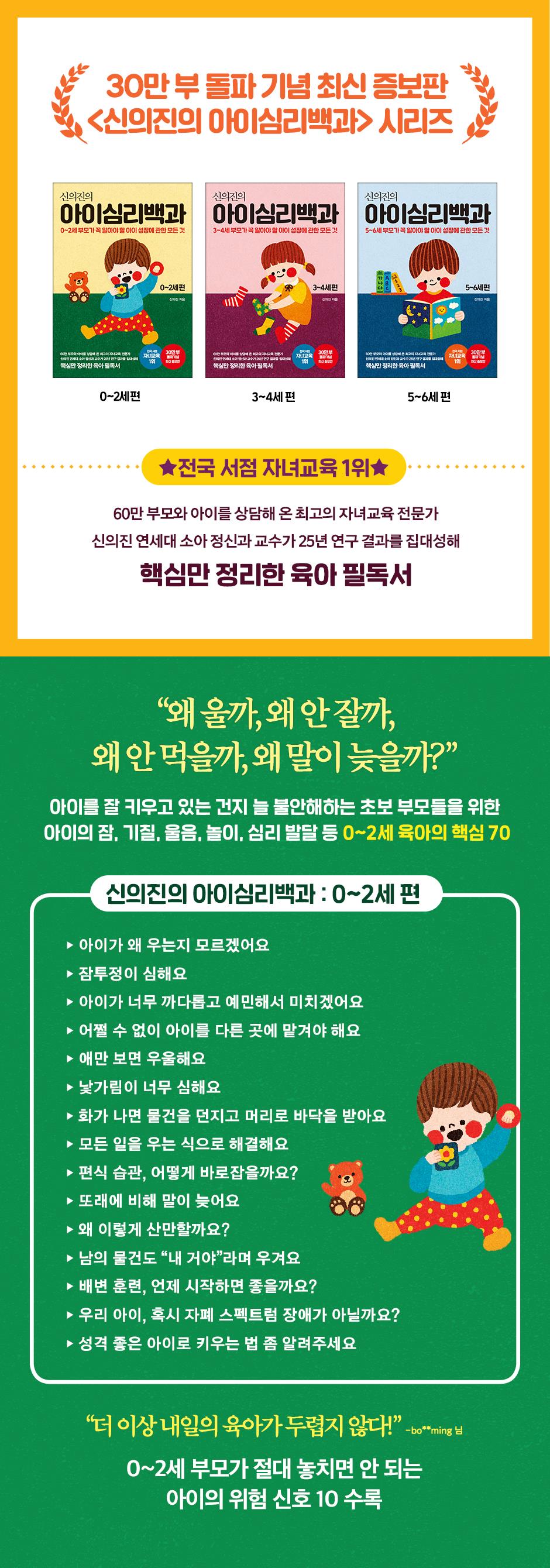
Everything you need to know about the growth of children aged 0-2, compiled by Professor Shin Eui-jin of the Department of Child Psychiatry at Yonsei University. Professor Shin Eui-jin, Korea's leading expert on child education, has summarized 70 key points of childcare for children aged 0-2, focusing on keywords such as sleep, temperament, crying, play, and psychological development. I don't know why my child cries, he/she has a hard time sleeping, he/she is very shy, how can I fix his/her picky eating habits, he/she is late in speaking compared to his/her peers, please tell me how to raise him/her to be a good-natured child… … . Based on 25 years of clinical experience, proven developmental theories, and my experience as a mother of two troubled children, I provide accurate information and useful solutions to the questions that new parents are most curious about. Parents who want to raise their children well but are struggling because they don't know how to do so will be able to look at this book and find help whenever they encounter problems. In particular, the latest expanded edition published to commemorate the sale of over 300,000 copies includes '10 warning signs that parents of children aged 0-2 should never miss', allowing them to self-diagnose their child's developmental status. |
- You can preview some of the book's contents.
Preview
index
Publishing a 300,000 copy commemorative edition
Prologue | For parents of children in their first or second year
Top 20 Questions Parents of Children Ages 0-2 Ask
1.
Is there really a temperamental compatibility between mother and child?
2.
What should I do when my child cries and falls asleep?
3.
Is it always better for the mother to stay at home until the child is two years old?
4.
A child who is slow and has difficulty walking has a problem with emotional development.
5.
Is there any way to avoid postpartum depression?
6.
My child doesn't imitate, is there a problem?
7.
Do newborns have the ability to learn?
8.
My child keeps waking up at night and crying.
9.
The child hugs anyone without discrimination.
10.
I want to know about secure and insecure attachment
11.
I have to leave my child with me when he is 5 months old because of work. Which is better: a babysitter or a daycare center?
12.
The child likes his grandmother more than his mother.
13.
Showing your child their smartphone will stop the tantrum.
14.
Is it better to let the child sleep separately?
15.
My child is able to walk, but he still demands to be held. Is this a problem?
16.
What is the most important thing to keep in mind when raising a sick child?
17.
He starts speaking later than other children his age.
18.
I left my child with my mother, but we keep fighting over the child.
19.
The parents-in-law's interference with the child is too severe.
20.
Are there any special stress management tips for mothers who balance work and childcare?
Part 1.
1 year old (0-12 months)
What Parents Need to Know About Their 1-Year-Old: Physical Development Means Psychological Development
Chapter 1.
baby crying
If you keep hugging a crying child, will it become a bad habit?
If your child cries so hard that he or she can't breathe
I cry every night
I don't know why my child is crying.
Chapter 2.
sleep problems
When can I start sleeping separately?
I wake up at least once in the middle of the night
The sleepiness is too bad
How to Deal with Sleep Problems by Month
Chapter 3.
Shyness & Separation Anxiety
I can't move because of the child.
I'm really shy, will that be okay?
It's a problem if your child doesn't show any shyness at all.
I'm extremely afraid of unfamiliar things.
The child rejects his father.
Chapter 4.
habit
The child cries whenever he can't see the teddy bear.
If you just take off the diaper, you can touch the pepper.
When I get angry, I throw things and hit the floor with my head.
Don't worry if your child sucks his or her thumb.
Chapter 5.
Personality & Temperament
Don't just accept it as an innate trait.
My child is so picky and sensitive, it's driving me crazy.
If your child is particularly irritable
If you don't change your child's diaper often, will their personality get worse?
I became more sensitive while I was sick.
Even children get stressed before they turn one.
Chapter 6.
Parenting attitude & environment
I get depressed just looking at the child.
I have no choice but to leave my child somewhere else.
Chapter 7.
Growth & Development
Is my child growing well?
Is my development slow or am I being impatient?
Part 2.
2 years old (13-24 months)
What Parents Must Know About Their 2-Year-Old: They'll Learn That They Have Their Own Identity, Different from Their Mom
Chapter 1.
Parents' attitude
I feel sorry and worried because I don't have much time to spend with my child.
I keep getting angry at my child.
My husband and I had a fight in front of the child.
I ended up hitting the child in a fit of anger.
Chapter 2.
Growth & Development
They say you have to form attachments well, but I don't know how.
Don't force yourself to wean from breast milk or bottles.
Toilet training: how do I get started?
Trying to foster independence can ruin your child.
The child can't even say 'mom' or 'dad'
Chapter 3.
habit
How to correct picky eating habits?
We fight every day like a habit
I hate playing with friends
I solve everything by crying
Chapter 4.
self-consciousness
They threaten to take other people's things, saying, "It's mine."
I live with the word "no" on my lips
I become a rascal only when I go to public places.
Could my child have autism spectrum disorder?
Chapter 5.
personality
Please tell me how to raise a good-natured child.
I'm timid and unmotivated in everything.
Why is my child so distracted?
A child who is very fearful may have emotional development problems.
Chapter 6.
Play & Learn
They say play is good for children, but why is that?
How can I raise a smart child?
5 Warning Signs Parents of Children Aged 0-2 Should Never Ignore
0~1 years old
1.
My child doesn't hate or cry when he sees strangers.
2.
My child doesn't respond well to peek-a-boo.
3.
My child has no interest in social skills play.
4.
The face is generally stiff, without any variety of facial expressions.
5.
Severe postpartum depression in the mother may be the biggest problem.
1~2 years old
1.
My child rarely expresses whether he likes or dislikes something.
2.
Overall, it's not very well controlled.
3.
If a child is separated from his mother, he cannot sleep.
4.
My child is obsessed with certain senses and certain types of play.
5.
You are very assertive and stubborn.
Prologue | For parents of children in their first or second year
Top 20 Questions Parents of Children Ages 0-2 Ask
1.
Is there really a temperamental compatibility between mother and child?
2.
What should I do when my child cries and falls asleep?
3.
Is it always better for the mother to stay at home until the child is two years old?
4.
A child who is slow and has difficulty walking has a problem with emotional development.
5.
Is there any way to avoid postpartum depression?
6.
My child doesn't imitate, is there a problem?
7.
Do newborns have the ability to learn?
8.
My child keeps waking up at night and crying.
9.
The child hugs anyone without discrimination.
10.
I want to know about secure and insecure attachment
11.
I have to leave my child with me when he is 5 months old because of work. Which is better: a babysitter or a daycare center?
12.
The child likes his grandmother more than his mother.
13.
Showing your child their smartphone will stop the tantrum.
14.
Is it better to let the child sleep separately?
15.
My child is able to walk, but he still demands to be held. Is this a problem?
16.
What is the most important thing to keep in mind when raising a sick child?
17.
He starts speaking later than other children his age.
18.
I left my child with my mother, but we keep fighting over the child.
19.
The parents-in-law's interference with the child is too severe.
20.
Are there any special stress management tips for mothers who balance work and childcare?
Part 1.
1 year old (0-12 months)
What Parents Need to Know About Their 1-Year-Old: Physical Development Means Psychological Development
Chapter 1.
baby crying
If you keep hugging a crying child, will it become a bad habit?
If your child cries so hard that he or she can't breathe
I cry every night
I don't know why my child is crying.
Chapter 2.
sleep problems
When can I start sleeping separately?
I wake up at least once in the middle of the night
The sleepiness is too bad
How to Deal with Sleep Problems by Month
Chapter 3.
Shyness & Separation Anxiety
I can't move because of the child.
I'm really shy, will that be okay?
It's a problem if your child doesn't show any shyness at all.
I'm extremely afraid of unfamiliar things.
The child rejects his father.
Chapter 4.
habit
The child cries whenever he can't see the teddy bear.
If you just take off the diaper, you can touch the pepper.
When I get angry, I throw things and hit the floor with my head.
Don't worry if your child sucks his or her thumb.
Chapter 5.
Personality & Temperament
Don't just accept it as an innate trait.
My child is so picky and sensitive, it's driving me crazy.
If your child is particularly irritable
If you don't change your child's diaper often, will their personality get worse?
I became more sensitive while I was sick.
Even children get stressed before they turn one.
Chapter 6.
Parenting attitude & environment
I get depressed just looking at the child.
I have no choice but to leave my child somewhere else.
Chapter 7.
Growth & Development
Is my child growing well?
Is my development slow or am I being impatient?
Part 2.
2 years old (13-24 months)
What Parents Must Know About Their 2-Year-Old: They'll Learn That They Have Their Own Identity, Different from Their Mom
Chapter 1.
Parents' attitude
I feel sorry and worried because I don't have much time to spend with my child.
I keep getting angry at my child.
My husband and I had a fight in front of the child.
I ended up hitting the child in a fit of anger.
Chapter 2.
Growth & Development
They say you have to form attachments well, but I don't know how.
Don't force yourself to wean from breast milk or bottles.
Toilet training: how do I get started?
Trying to foster independence can ruin your child.
The child can't even say 'mom' or 'dad'
Chapter 3.
habit
How to correct picky eating habits?
We fight every day like a habit
I hate playing with friends
I solve everything by crying
Chapter 4.
self-consciousness
They threaten to take other people's things, saying, "It's mine."
I live with the word "no" on my lips
I become a rascal only when I go to public places.
Could my child have autism spectrum disorder?
Chapter 5.
personality
Please tell me how to raise a good-natured child.
I'm timid and unmotivated in everything.
Why is my child so distracted?
A child who is very fearful may have emotional development problems.
Chapter 6.
Play & Learn
They say play is good for children, but why is that?
How can I raise a smart child?
5 Warning Signs Parents of Children Aged 0-2 Should Never Ignore
0~1 years old
1.
My child doesn't hate or cry when he sees strangers.
2.
My child doesn't respond well to peek-a-boo.
3.
My child has no interest in social skills play.
4.
The face is generally stiff, without any variety of facial expressions.
5.
Severe postpartum depression in the mother may be the biggest problem.
1~2 years old
1.
My child rarely expresses whether he likes or dislikes something.
2.
Overall, it's not very well controlled.
3.
If a child is separated from his mother, he cannot sleep.
4.
My child is obsessed with certain senses and certain types of play.
5.
You are very assertive and stubborn.
Detailed image
Into the book
The most frustrating thing for new parents is not knowing why their child is crying or what the crying means.
Although each child is different, I have summarized the types of crying based on my experience and the stories of mothers I have met, so I hope you find it helpful.
① Crying with eyes closed and opened
This is a type of crying that is mainly seen when falling asleep.
Cry in a dry, medium-toned voice without any change in facial expression or tears.
When a child cries like this, you must first create an environment where the child can fall asleep.
Make the surroundings quiet and cozy, then pat the back to soothe them.
② Crying with eyes open and mouth open
It's a common cry of hunger.
At this time, if you put your hand near the child's mouth, the child will immediately turn his head and look at your hand or pretend to suck it.
First, check the previous feeding time.
If 2-3 hours have passed since your baby last fed, you should feed him again.
③ Sudden crying
When a child cries because he or she is sleepy or hungry, there are signs that he or she does not play well or behaves quietly before that.
If your child is laughing and playing actively and then suddenly starts crying, check his diaper.
Even if I'm having fun, if I feel something unpleasant in my lower body, I start crying right away.
④ Crying loudly but without tears
When a baby cries for its mother, the sound is usually loud.
There are no tears and the facial expression does not change much.
If your child cries loudly without tears, it's likely not because they're hungry or have a wet diaper, but rather because they're saying, "Please hold me more" or "I want to play."
---From "I don't know why the child is crying"
There are many reasons for infiltration.
First of all, children do not know that after they sleep, today passes and tomorrow comes.
When sleep comes, the senses become dull and the child cannot see or feel the mother well, and the child thinks that this means being separated from the mother.
It can't be helped because the concept of 'tomorrow' hasn't been established yet and the mother doesn't feel it.
Because falling asleep causes great anxiety to the child, the child struggles to stay awake.
If you force your child to sleep at this time or get annoyed, the child will think, 'Is Mom really trying to tear me away?' or 'Is Mom hating me?'
In times like these, you must first reassure the child.
In the old days, grandmothers would sing lullabies in soft voices to their young grandchildren when putting them to sleep.
Again, without getting angry or annoyed, I patted the child on the back and waited patiently for the child to fall asleep.
Please hug and comfort your child so that he or she can feel that his or her mother is with him or her while thinking about that image.
---From "The infiltration is too severe"
Everyone wants their child to have a gentle temperament.
But on average, one in ten children is born with a difficult temperament.
Children with difficult temperaments are difficult to soothe and do not sleep deeply, causing trouble for their parents from the time they are newborns.
However, if parents take these temperaments into consideration and treat their children with care, their children can grow up to have stable personalities.
No matter how difficult it may be to deal with your child's difficult temperament, you should not blame him or her.
Would you want to be born with a difficult temperament? The person who suffers the most from a difficult temperament is the child themselves.
I can't easily overcome even small stimuli, I can't eat well, and I can't sleep well either.
If parents, who should be protecting and loving their children, scold and get angry at them, the child will inevitably be hurt.
To prevent a child's sensitive temperament from manifesting as protrusive behavior, the child should not be exposed to too many unfamiliar stimuli.
Even children with a sensitive temperament will begin to adapt to the world through tricks as their brains grow and their intelligence and cognitive abilities improve over time.
So, until then, we must protect the child and wait.
This means that you should pursue change, but give your child time to adapt.
This can be very difficult for parents with impatient temperaments, but when raising a difficult child, remember that there is no better way than patience.
---From "My child is so picky and sensitive, I'm going crazy"
When a child is around 7 to 9 months old, he or she begins to notice other people's facial expressions and begin to recognize emotions such as happiness or sadness and imitate their actions.
The representative games of this period are ‘Dori Dori’, ‘Jjak Jjak Kkung’, and ‘Jam Jam’.
For example, if a mother repeatedly shows her child the 'dori dori' movement, the baby will soon imitate the movement.
Regarding this, Harvard University professor Felix Warneken emphasized the importance of imitation, saying, “Humans are not born with all the abilities necessary for survival, so they try to learn social learning such as imitation.”
In other words, children's imitation is a human instinct to learn and acquire things for survival.
Therefore, if your child does not respond much when playing peek-a-boo, or if he or she only plays briefly without making eye contact and then quickly stops, there is a problem.
It is necessary to suspect social development problems such as autism spectrum disorder, emotional development problems such as attachment disorder, and anxiety disorder.
In such cases, try playing peek-a-boo with your child by covering their eyes with a towel and then taking it off, and practice exchanging emotions through eye contact.
If there is still no response, this can be considered a warning sign.
Although each child is different, I have summarized the types of crying based on my experience and the stories of mothers I have met, so I hope you find it helpful.
① Crying with eyes closed and opened
This is a type of crying that is mainly seen when falling asleep.
Cry in a dry, medium-toned voice without any change in facial expression or tears.
When a child cries like this, you must first create an environment where the child can fall asleep.
Make the surroundings quiet and cozy, then pat the back to soothe them.
② Crying with eyes open and mouth open
It's a common cry of hunger.
At this time, if you put your hand near the child's mouth, the child will immediately turn his head and look at your hand or pretend to suck it.
First, check the previous feeding time.
If 2-3 hours have passed since your baby last fed, you should feed him again.
③ Sudden crying
When a child cries because he or she is sleepy or hungry, there are signs that he or she does not play well or behaves quietly before that.
If your child is laughing and playing actively and then suddenly starts crying, check his diaper.
Even if I'm having fun, if I feel something unpleasant in my lower body, I start crying right away.
④ Crying loudly but without tears
When a baby cries for its mother, the sound is usually loud.
There are no tears and the facial expression does not change much.
If your child cries loudly without tears, it's likely not because they're hungry or have a wet diaper, but rather because they're saying, "Please hold me more" or "I want to play."
---From "I don't know why the child is crying"
There are many reasons for infiltration.
First of all, children do not know that after they sleep, today passes and tomorrow comes.
When sleep comes, the senses become dull and the child cannot see or feel the mother well, and the child thinks that this means being separated from the mother.
It can't be helped because the concept of 'tomorrow' hasn't been established yet and the mother doesn't feel it.
Because falling asleep causes great anxiety to the child, the child struggles to stay awake.
If you force your child to sleep at this time or get annoyed, the child will think, 'Is Mom really trying to tear me away?' or 'Is Mom hating me?'
In times like these, you must first reassure the child.
In the old days, grandmothers would sing lullabies in soft voices to their young grandchildren when putting them to sleep.
Again, without getting angry or annoyed, I patted the child on the back and waited patiently for the child to fall asleep.
Please hug and comfort your child so that he or she can feel that his or her mother is with him or her while thinking about that image.
---From "The infiltration is too severe"
Everyone wants their child to have a gentle temperament.
But on average, one in ten children is born with a difficult temperament.
Children with difficult temperaments are difficult to soothe and do not sleep deeply, causing trouble for their parents from the time they are newborns.
However, if parents take these temperaments into consideration and treat their children with care, their children can grow up to have stable personalities.
No matter how difficult it may be to deal with your child's difficult temperament, you should not blame him or her.
Would you want to be born with a difficult temperament? The person who suffers the most from a difficult temperament is the child themselves.
I can't easily overcome even small stimuli, I can't eat well, and I can't sleep well either.
If parents, who should be protecting and loving their children, scold and get angry at them, the child will inevitably be hurt.
To prevent a child's sensitive temperament from manifesting as protrusive behavior, the child should not be exposed to too many unfamiliar stimuli.
Even children with a sensitive temperament will begin to adapt to the world through tricks as their brains grow and their intelligence and cognitive abilities improve over time.
So, until then, we must protect the child and wait.
This means that you should pursue change, but give your child time to adapt.
This can be very difficult for parents with impatient temperaments, but when raising a difficult child, remember that there is no better way than patience.
---From "My child is so picky and sensitive, I'm going crazy"
When a child is around 7 to 9 months old, he or she begins to notice other people's facial expressions and begin to recognize emotions such as happiness or sadness and imitate their actions.
The representative games of this period are ‘Dori Dori’, ‘Jjak Jjak Kkung’, and ‘Jam Jam’.
For example, if a mother repeatedly shows her child the 'dori dori' movement, the baby will soon imitate the movement.
Regarding this, Harvard University professor Felix Warneken emphasized the importance of imitation, saying, “Humans are not born with all the abilities necessary for survival, so they try to learn social learning such as imitation.”
In other words, children's imitation is a human instinct to learn and acquire things for survival.
Therefore, if your child does not respond much when playing peek-a-boo, or if he or she only plays briefly without making eye contact and then quickly stops, there is a problem.
It is necessary to suspect social development problems such as autism spectrum disorder, emotional development problems such as attachment disorder, and anxiety disorder.
In such cases, try playing peek-a-boo with your child by covering their eyes with a towel and then taking it off, and practice exchanging emotions through eye contact.
If there is still no response, this can be considered a warning sign.
---From "My child doesn't respond much to 'peek-a-boo'"
Publisher's Review
The #1 children's education book in bookstores nationwide, the latest expanded edition celebrating sales of over 300,000 copies!
For new parents who are always anxious about whether they are raising their children well.
70 Key Points for Parenting Children Ages 0-2: Sleep, Temperament, Crying, Play, and Psychological Development
I don't know why my child cries, my child has trouble sleeping, my child is so fussy and sensitive, I'm going crazy, I get depressed just looking at my child, my child is very shy, when he gets angry, he throws things and hits the floor with his head, my child is slower to speak than his peers, why is he so distracted?, when should I start potty training? does my child have autism spectrum disorder?… … .
Professor Shin Eui-jin, Korea's leading expert on child education, has compiled 70 key childcare tips for parents of children aged 0-2, focusing on keywords such as crying, sleeping habits, temperament and personality, play, and learning.
For first-time parents, everything about parenting is unfamiliar and difficult.
There's a ton of parenting information on various websites, but there's no way to know for sure whether it's accurate or the right approach for your child.
For new parents who are just entering the world of parenting and feel lost and at a loss, Professor Shin Ui-jin has compiled her clinical records from counseling 600,000 people over 25 years, proven developmental theories, and her own experiences and parenting know-how as a mother who raised two troubled sons. She has selected accurate information and useful solutions to the questions parents are most curious about and included them in this book.
In particular, the latest expanded edition, compiled to commemorate the 300,000th copy sold, includes '10 warning signs that parents of children aged 0-2 should never miss,' allowing them to self-diagnose their child's developmental status.
Parents who want to raise their children well but struggle because they don't know how to do so will be able to look at this book and find help whenever they encounter problems.
“Why do I cry? Why don’t I sleep? Why don’t I eat? Why am I late to talk?”
A book that provides an easy-to-understand overview of a child's psychological development, which can be easily overlooked when focusing solely on visible growth.
Professor Shin Ui-jin says that there is only one reason why parenting is difficult.
This is because parents do not know their child's developmental process and psychological state.
Especially from birth to two years of age, it is a time when you must respond positively to your child's behavior, smile, hug, comfort, and try not to break their will even if they are a bit stubborn.
In this way, the child can take steps forward into the world based on a positive self-image and attachment to his or her parents.
If parents are unaware of these developmental characteristics of their child and focus only on mechanical development and habits such as “You must do this by 00 months,” the child may lose greater abilities that are essential for living in the future, such as self-esteem and a positive and happy feeling about the world.
This book covers all aspects of a child's psychological development, which can be easily overlooked when focusing only on visible growth.
When a child cries uncontrollably, insists on everything being “mine,” acts overly aggressively, or struggles to break a bad habit like thumb sucking, this book provides solutions to the thorny parenting issues that parents face every day, detailing how they should wait and when and how they should intervene.
This book contains methods for raising children properly without hurting their feelings.
“I’m no longer afraid of tomorrow’s parenting!”
Professor Shin Ui-jin's realistic and clear parenting mentoring will help you escape the daily stress of parenting.
Even if parents are well-informed about their child's development, day-to-day parenting is never easy.
Parenting problems are not solved with one effort.
Consistent effort is essential.
Moreover, when the mother's postpartum depression and the guilt of being a dual-income household are added, the rewards and joys of parenting become someone else's business.
Professor Shin Ui-jin, who is also a mother of two troubled children, knows well how difficult and demanding parenting can be.
Maybe that's why.
Professor Shin Ui-jin 'warns' against trying too hard to be a good parent.
If you are feeling too emotionally drained, I offer some generous advice: get some rest outside and then come home, actively seek help from people around you, and don't feel bad about spending all the money you earn on child support until your child turns three.
There are rules for parenting, but if they are rules that are suffocating parents and children, then we must boldly throw them away and bravely choose a possible solution.
This book is full of practical parenting solutions drawn from Professor Shin Ui-jin's personal experience.
It provides a clue to help parents, who must adapt to the ever-changing childcare environment in their own way, find new ways to do so.
For new parents who are always anxious about whether they are raising their children well.
70 Key Points for Parenting Children Ages 0-2: Sleep, Temperament, Crying, Play, and Psychological Development
I don't know why my child cries, my child has trouble sleeping, my child is so fussy and sensitive, I'm going crazy, I get depressed just looking at my child, my child is very shy, when he gets angry, he throws things and hits the floor with his head, my child is slower to speak than his peers, why is he so distracted?, when should I start potty training? does my child have autism spectrum disorder?… … .
Professor Shin Eui-jin, Korea's leading expert on child education, has compiled 70 key childcare tips for parents of children aged 0-2, focusing on keywords such as crying, sleeping habits, temperament and personality, play, and learning.
For first-time parents, everything about parenting is unfamiliar and difficult.
There's a ton of parenting information on various websites, but there's no way to know for sure whether it's accurate or the right approach for your child.
For new parents who are just entering the world of parenting and feel lost and at a loss, Professor Shin Ui-jin has compiled her clinical records from counseling 600,000 people over 25 years, proven developmental theories, and her own experiences and parenting know-how as a mother who raised two troubled sons. She has selected accurate information and useful solutions to the questions parents are most curious about and included them in this book.
In particular, the latest expanded edition, compiled to commemorate the 300,000th copy sold, includes '10 warning signs that parents of children aged 0-2 should never miss,' allowing them to self-diagnose their child's developmental status.
Parents who want to raise their children well but struggle because they don't know how to do so will be able to look at this book and find help whenever they encounter problems.
“Why do I cry? Why don’t I sleep? Why don’t I eat? Why am I late to talk?”
A book that provides an easy-to-understand overview of a child's psychological development, which can be easily overlooked when focusing solely on visible growth.
Professor Shin Ui-jin says that there is only one reason why parenting is difficult.
This is because parents do not know their child's developmental process and psychological state.
Especially from birth to two years of age, it is a time when you must respond positively to your child's behavior, smile, hug, comfort, and try not to break their will even if they are a bit stubborn.
In this way, the child can take steps forward into the world based on a positive self-image and attachment to his or her parents.
If parents are unaware of these developmental characteristics of their child and focus only on mechanical development and habits such as “You must do this by 00 months,” the child may lose greater abilities that are essential for living in the future, such as self-esteem and a positive and happy feeling about the world.
This book covers all aspects of a child's psychological development, which can be easily overlooked when focusing only on visible growth.
When a child cries uncontrollably, insists on everything being “mine,” acts overly aggressively, or struggles to break a bad habit like thumb sucking, this book provides solutions to the thorny parenting issues that parents face every day, detailing how they should wait and when and how they should intervene.
This book contains methods for raising children properly without hurting their feelings.
“I’m no longer afraid of tomorrow’s parenting!”
Professor Shin Ui-jin's realistic and clear parenting mentoring will help you escape the daily stress of parenting.
Even if parents are well-informed about their child's development, day-to-day parenting is never easy.
Parenting problems are not solved with one effort.
Consistent effort is essential.
Moreover, when the mother's postpartum depression and the guilt of being a dual-income household are added, the rewards and joys of parenting become someone else's business.
Professor Shin Ui-jin, who is also a mother of two troubled children, knows well how difficult and demanding parenting can be.
Maybe that's why.
Professor Shin Ui-jin 'warns' against trying too hard to be a good parent.
If you are feeling too emotionally drained, I offer some generous advice: get some rest outside and then come home, actively seek help from people around you, and don't feel bad about spending all the money you earn on child support until your child turns three.
There are rules for parenting, but if they are rules that are suffocating parents and children, then we must boldly throw them away and bravely choose a possible solution.
This book is full of practical parenting solutions drawn from Professor Shin Ui-jin's personal experience.
It provides a clue to help parents, who must adapt to the ever-changing childcare environment in their own way, find new ways to do so.
GOODS SPECIFICS
- Date of issue: June 8, 2020
- Page count, weight, size: 368 pages | 506g | 150*210*24mm
- ISBN13: 9791190538060
- ISBN10: 1190538067
You may also like
카테고리
korean


korean

![ELLE 엘르 스페셜 에디션 A형 : 12월 [2025]](http://librairie.coreenne.fr/cdn/shop/files/b8e27a3de6c9538896439686c6b0e8fb.jpg?v=1766436872&width=3840)


