

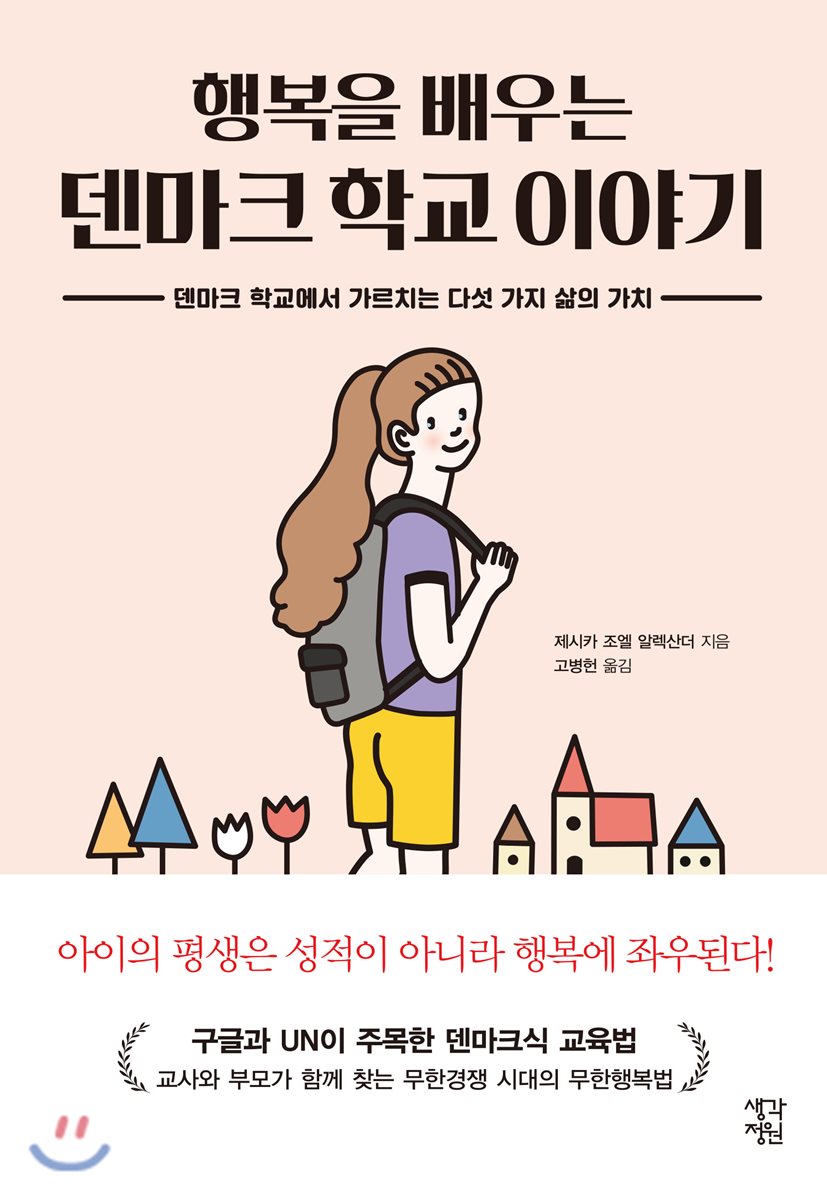
The story of a Danish school that teaches happiness
 |
Description
Book Introduction
The Danish happiness method that has caught the attention of even Google and the UN.
The ultimate Danish childcare experience, brimming with leisure, positivity, laughter, and wisdom!
- Instead of saying “No!”, help children solve problems on their own!
- Praise children when they act kindly and empathize with others.
- Use incorrect assignments or mistakes as good examples in class.
- Develop the courage to transform from bystander to knight.
The truth about Danish child education through the eyes of an American journalist.
The author grew up in a competitive American educational culture, similar to Korean education, married a Danish man, and raised two children in Denmark.
Through communicating with teachers and parents, and even observing classes at each grade level, the author came to the conclusion that happiness is not something you 'feel' but something you 'learn and master.'
This book focuses on the author's real-life experiences from raising children in Denmark for 14 years, and covers the key themes of happiness: trust, empathy, sincerity, courage, and hygge.
Through emotional reading and contact classes, the children learn to trust each other, discuss how to persevere through failure and not be bystanders to bullying of friends, and talk about the importance of trusting and believing in others and building strong friendships, because happiness is not just about individuals but about society.
In addition, it contains the process of developing one's own thoughts more deeply while honestly learning about important topics in life such as sex and death.
Finally, the tips section contains useful information for parents and teachers, as it contains various ways to easily learn happiness with children.
The Danish happiness method, which is attracting attention from Google and the UN, offers various hints on how to change your daily life!
The ultimate Danish childcare experience, brimming with leisure, positivity, laughter, and wisdom!
- Instead of saying “No!”, help children solve problems on their own!
- Praise children when they act kindly and empathize with others.
- Use incorrect assignments or mistakes as good examples in class.
- Develop the courage to transform from bystander to knight.
The truth about Danish child education through the eyes of an American journalist.
The author grew up in a competitive American educational culture, similar to Korean education, married a Danish man, and raised two children in Denmark.
Through communicating with teachers and parents, and even observing classes at each grade level, the author came to the conclusion that happiness is not something you 'feel' but something you 'learn and master.'
This book focuses on the author's real-life experiences from raising children in Denmark for 14 years, and covers the key themes of happiness: trust, empathy, sincerity, courage, and hygge.
Through emotional reading and contact classes, the children learn to trust each other, discuss how to persevere through failure and not be bystanders to bullying of friends, and talk about the importance of trusting and believing in others and building strong friendships, because happiness is not just about individuals but about society.
In addition, it contains the process of developing one's own thoughts more deeply while honestly learning about important topics in life such as sex and death.
Finally, the tips section contains useful information for parents and teachers, as it contains various ways to easily learn happiness with children.
The Danish happiness method, which is attracting attention from Google and the UN, offers various hints on how to change your daily life!
- You can preview some of the book's contents.
Preview
index
Entering
Knowing how to be happy is also a skill.
A country that has had a 'monopoly' on happiness for 40 years?
The Secret of Danish Happiness
Children withering in competition
Danes take the 'Good Life Test' every year.
The main culprit that kills children's creativity
The power to find the extraordinary in the ordinary
A 'New Way' for Our Children
Chapter 1: Trust: Children who believe in themselves are not easily shaken.
A place where there are no “no,” “don’t,” or “stop.”
Parental overprotection hinders children from becoming independent.
The big difference between self-esteem and confidence
The power of 'playing freely'
We grow more when we face risks.
Dealing with fear through curiosity
Only when you make your own decisions do you become happy.
It's okay if you're clumsy! Try doing it yourself!
Teachers and students learn together
The question that will change children's lives: 'Why?'
Contact Classes: Educational Activities to Build Trust and Consideration
No one is there to tease and harass you.
Scientific Evidence for Contact Education
Faith to comfort each other's pain
Children's pats on the back for their Syrian refugee friends
TIP: The Danish Way to Build Trust
Chapter 2 Empathy: The Power to Put Yourself in Your Place
Why We Teach Empathy in Schools
The idea that empathy is innate
Four Characteristics of Empathy
You must know the boundaries between you and me.
There are no self-centered children in Denmark.
If you feel good, you study well.
Reading Emotions: A Special Way to Connect Children with the World
The Language of Empathy Learned in School
The feelings of friends who meet through cooperation
Drawing the happiness curve over a year in the classroom
'I'm Alone Bench' for Lonely Friends
Friendship is more important than grades
Happiness is a state of mind rather than an accomplishment.
Why Parents Are Important for School Life
Children from democratic homes are closer to their parents.
Cake sharing time at school
Empathy improves quality of life
TIP: The Danish Way to Develop Empathy
Chapter 3: Honesty: Talking about sex without pretense or shame
A castle for the boundary between 'you' and 'me'
Approaching the human body honestly
Expressing genitals without euphemisms
Current status of sex education in Denmark
Sex Education: Building a Positive Relationship with Your Body
What will we learn in sex education class?
Time to get to know my body
Distinguishing between reality and fantasy on social media
Honest answers beat distortion.
Parents must first be body positive.
Children have the right to know about sex.
What if we taught sex without shame?
Sex education prevents child abuse
Knowledge is power
Learning about children's rights online
Sex education for adolescents
Become a parent your child can rely on when they have questions about sex.
Protecting Children Through Dialogue, Not Control
How Teenagers Understand Each Other
Children seek answers about sex and love
What is the right age to have sex?
Instead of banning smartphones, communicate your boundaries through conversation.
A new environment for our children to live in
TIP: The Danish Method for Honest Sex Education
Chapter 4: Honesty - Death: The Abundant Life We Encounter When We Know the Limits of Life
Why watch animal carcasses decompose?
Life's tragedies are ageless.
Children who grow through wounds
Take a walk through the cemetery
Action Plan for Coping with Death and Grief
Grief is also shared at school.
Let's not forget to remember
The meaningful happiness learned from death
Learning about sadness through The Little Mermaid
Talk more about death
There are no good or bad emotions, only a variety of emotions.
People eventually die someday.
Chapter 5: Courage: The Courage to Fail and the Power of Wrong Answers
The more you fail, the smarter you become.
It's dangerous to praise perfection.
The chance to fail that overprotection stole
We must help children have adventures.
A teacher who encourages mistakes
Adventure Playground, Don't Be Afraid of Making Mistakes
There are no valedictorians or honor rolls.
How can parents help their children embrace failure?
It is important for parents to change their mindset.
TIP: The Danish Way to Learn the Courage to Fail
Chapter 6: Bravery: The Decisiveness That Brings Bullying and Violence to Their Knees
Look at the group, not the 'perpetrator' or 'victim.'
The problem isn't the individual, it's group dynamics.
Violence-Free Schools Program
School violence is a child's problem, not an adult's responsibility.
Let's understand the hierarchy in the classroom.
Examining Hierarchy Among Children Using Happiness Surveys and Sociograms
Why Maria, a former outcast, became happy
The solution to bullying discovered by children
The courage to transform from bystander to knight
Tolerance is about widening the path to allow more people in.
It's okay to be different from others
Strengthening Teamwork More Effectively Than “Don’t Bully”
“I was just teasing you”, somewhere between fun and hurt
Preventing Bullying Through Teamwork Activities
Belonging is key
TIP: The Danish Way to Create a Bully-Free School
Chapter 7: Whig: Special Habits for Leaving a Legacy of Happiness
The power of habits learned from childhood
The hygge craze that swept the world
The fullness of what we become
A space in the heart to rest
It's not about mindfulness, it's about being together.
Kids who do chores instead of doing homework
Focus on life!
Why Togetherness is Necessary for a Cozy Life
The solid happiness created by friendship
School-wide assembly time to sing together
A Hygge Practice That's More Powerful Than Homework
TIP: The Danish Way to Enjoy Hygge
Acknowledgements
Translator's Note: To put into practice Danish-style happiness education
TIP Denmark's unique education system
Knowing how to be happy is also a skill.
A country that has had a 'monopoly' on happiness for 40 years?
The Secret of Danish Happiness
Children withering in competition
Danes take the 'Good Life Test' every year.
The main culprit that kills children's creativity
The power to find the extraordinary in the ordinary
A 'New Way' for Our Children
Chapter 1: Trust: Children who believe in themselves are not easily shaken.
A place where there are no “no,” “don’t,” or “stop.”
Parental overprotection hinders children from becoming independent.
The big difference between self-esteem and confidence
The power of 'playing freely'
We grow more when we face risks.
Dealing with fear through curiosity
Only when you make your own decisions do you become happy.
It's okay if you're clumsy! Try doing it yourself!
Teachers and students learn together
The question that will change children's lives: 'Why?'
Contact Classes: Educational Activities to Build Trust and Consideration
No one is there to tease and harass you.
Scientific Evidence for Contact Education
Faith to comfort each other's pain
Children's pats on the back for their Syrian refugee friends
TIP: The Danish Way to Build Trust
Chapter 2 Empathy: The Power to Put Yourself in Your Place
Why We Teach Empathy in Schools
The idea that empathy is innate
Four Characteristics of Empathy
You must know the boundaries between you and me.
There are no self-centered children in Denmark.
If you feel good, you study well.
Reading Emotions: A Special Way to Connect Children with the World
The Language of Empathy Learned in School
The feelings of friends who meet through cooperation
Drawing the happiness curve over a year in the classroom
'I'm Alone Bench' for Lonely Friends
Friendship is more important than grades
Happiness is a state of mind rather than an accomplishment.
Why Parents Are Important for School Life
Children from democratic homes are closer to their parents.
Cake sharing time at school
Empathy improves quality of life
TIP: The Danish Way to Develop Empathy
Chapter 3: Honesty: Talking about sex without pretense or shame
A castle for the boundary between 'you' and 'me'
Approaching the human body honestly
Expressing genitals without euphemisms
Current status of sex education in Denmark
Sex Education: Building a Positive Relationship with Your Body
What will we learn in sex education class?
Time to get to know my body
Distinguishing between reality and fantasy on social media
Honest answers beat distortion.
Parents must first be body positive.
Children have the right to know about sex.
What if we taught sex without shame?
Sex education prevents child abuse
Knowledge is power
Learning about children's rights online
Sex education for adolescents
Become a parent your child can rely on when they have questions about sex.
Protecting Children Through Dialogue, Not Control
How Teenagers Understand Each Other
Children seek answers about sex and love
What is the right age to have sex?
Instead of banning smartphones, communicate your boundaries through conversation.
A new environment for our children to live in
TIP: The Danish Method for Honest Sex Education
Chapter 4: Honesty - Death: The Abundant Life We Encounter When We Know the Limits of Life
Why watch animal carcasses decompose?
Life's tragedies are ageless.
Children who grow through wounds
Take a walk through the cemetery
Action Plan for Coping with Death and Grief
Grief is also shared at school.
Let's not forget to remember
The meaningful happiness learned from death
Learning about sadness through The Little Mermaid
Talk more about death
There are no good or bad emotions, only a variety of emotions.
People eventually die someday.
Chapter 5: Courage: The Courage to Fail and the Power of Wrong Answers
The more you fail, the smarter you become.
It's dangerous to praise perfection.
The chance to fail that overprotection stole
We must help children have adventures.
A teacher who encourages mistakes
Adventure Playground, Don't Be Afraid of Making Mistakes
There are no valedictorians or honor rolls.
How can parents help their children embrace failure?
It is important for parents to change their mindset.
TIP: The Danish Way to Learn the Courage to Fail
Chapter 6: Bravery: The Decisiveness That Brings Bullying and Violence to Their Knees
Look at the group, not the 'perpetrator' or 'victim.'
The problem isn't the individual, it's group dynamics.
Violence-Free Schools Program
School violence is a child's problem, not an adult's responsibility.
Let's understand the hierarchy in the classroom.
Examining Hierarchy Among Children Using Happiness Surveys and Sociograms
Why Maria, a former outcast, became happy
The solution to bullying discovered by children
The courage to transform from bystander to knight
Tolerance is about widening the path to allow more people in.
It's okay to be different from others
Strengthening Teamwork More Effectively Than “Don’t Bully”
“I was just teasing you”, somewhere between fun and hurt
Preventing Bullying Through Teamwork Activities
Belonging is key
TIP: The Danish Way to Create a Bully-Free School
Chapter 7: Whig: Special Habits for Leaving a Legacy of Happiness
The power of habits learned from childhood
The hygge craze that swept the world
The fullness of what we become
A space in the heart to rest
It's not about mindfulness, it's about being together.
Kids who do chores instead of doing homework
Focus on life!
Why Togetherness is Necessary for a Cozy Life
The solid happiness created by friendship
School-wide assembly time to sing together
A Hygge Practice That's More Powerful Than Homework
TIP: The Danish Way to Enjoy Hygge
Acknowledgements
Translator's Note: To put into practice Danish-style happiness education
TIP Denmark's unique education system
Into the book
Danish children have contact classes as a set routine from a very young age.
Since contact teaching has been proven to improve children's happiness in the classroom, many Danish classes use this activity at least once a week.
The contact class activities were surprising in terms of both freshness and effectiveness.
The positive impact of contact came as a cultural shock to me.
Danes often say, “No one teases you by patting you.”
Touching, touching, and stroking promote the release of oxytocin, a hormone that increases trust and suppresses aggression, improving the well-being of children in the classroom.
It may seem like a simple principle, but it is incredibly effective.
--- p.69 From “Chapter 1: Trust: Children who believe in themselves are not easily shaken”
In Denmark, the ability to read people's emotions is developed in several ways.
For younger students, show them pictures and have them describe and discuss what emotions they perceive.
It also makes you think about why you feel that way.
In this way, children develop the 'language of empathy' and the ability to read the emotions of others.
For older students, we show pictures and videos of children in various situations, such as being bullied on the playground, playing soccer, or being teased.
Have several people carefully 'read' the facial expression and discuss what emotions they read and why they read it that way.
--- p.101 From “Chapter 2 Empathy: The Power to Stand in ‘Your’ Position”
Accepting your body as it is and being kind to yourself and others.
This is the most important lesson to impart to children.
A happy and joyful life begins with a healthy relationship with your body.
If you find it too difficult to change your feelings about yourself, why not at least change the words you use? Even just changing your words can make a difference.
Do you want to make a significant difference to your children? Remember, all you have to do is look in the mirror, change the way you look at yourself, and the words you say to yourself.
--- p.169 From “Chapter 3 Honesty-Sex: Talking about sex without ‘pretense’ and ‘shame’”
If children perceive that adults do not want to talk about death, grief, or sorrow, they will hide their feelings about such topics out of consideration for the adults.
Children, like adults, experience sadness and longing, and have feelings about serious illness, death, and deep emotional wounds.
You may also feel guilty.
But if children are unable to express those feelings verbally, they will eventually explode in inappropriate and unhealthy ways.
Death is obviously a part of life.
That's why Danes consider death a very important educational topic.
--- p.216 From “Chapter 4 Honesty-Death: The Abundant Life We Encounter When We Know the Limits of Life”
Amalie was a studious student who studied hard in school to avoid making mistakes.
The homeroom teacher told Amalie not to try so hard not to make mistakes.
Because Amalie seemed to be weighed down by the worry of getting everything right.
“Amalie needs to be less perfect to have a good life,” the teacher said, and included being less perfect in Amalie’s learning goals.
Can you imagine telling your child in school to be less perfect and make more mistakes? In fact, there's a Danish proverb that says, "People learn the most from their mistakes."
The Danes believe this and apply it to their daily lives and school education.
Since contact teaching has been proven to improve children's happiness in the classroom, many Danish classes use this activity at least once a week.
The contact class activities were surprising in terms of both freshness and effectiveness.
The positive impact of contact came as a cultural shock to me.
Danes often say, “No one teases you by patting you.”
Touching, touching, and stroking promote the release of oxytocin, a hormone that increases trust and suppresses aggression, improving the well-being of children in the classroom.
It may seem like a simple principle, but it is incredibly effective.
--- p.69 From “Chapter 1: Trust: Children who believe in themselves are not easily shaken”
In Denmark, the ability to read people's emotions is developed in several ways.
For younger students, show them pictures and have them describe and discuss what emotions they perceive.
It also makes you think about why you feel that way.
In this way, children develop the 'language of empathy' and the ability to read the emotions of others.
For older students, we show pictures and videos of children in various situations, such as being bullied on the playground, playing soccer, or being teased.
Have several people carefully 'read' the facial expression and discuss what emotions they read and why they read it that way.
--- p.101 From “Chapter 2 Empathy: The Power to Stand in ‘Your’ Position”
Accepting your body as it is and being kind to yourself and others.
This is the most important lesson to impart to children.
A happy and joyful life begins with a healthy relationship with your body.
If you find it too difficult to change your feelings about yourself, why not at least change the words you use? Even just changing your words can make a difference.
Do you want to make a significant difference to your children? Remember, all you have to do is look in the mirror, change the way you look at yourself, and the words you say to yourself.
--- p.169 From “Chapter 3 Honesty-Sex: Talking about sex without ‘pretense’ and ‘shame’”
If children perceive that adults do not want to talk about death, grief, or sorrow, they will hide their feelings about such topics out of consideration for the adults.
Children, like adults, experience sadness and longing, and have feelings about serious illness, death, and deep emotional wounds.
You may also feel guilty.
But if children are unable to express those feelings verbally, they will eventually explode in inappropriate and unhealthy ways.
Death is obviously a part of life.
That's why Danes consider death a very important educational topic.
--- p.216 From “Chapter 4 Honesty-Death: The Abundant Life We Encounter When We Know the Limits of Life”
Amalie was a studious student who studied hard in school to avoid making mistakes.
The homeroom teacher told Amalie not to try so hard not to make mistakes.
Because Amalie seemed to be weighed down by the worry of getting everything right.
“Amalie needs to be less perfect to have a good life,” the teacher said, and included being less perfect in Amalie’s learning goals.
Can you imagine telling your child in school to be less perfect and make more mistakes? In fact, there's a Danish proverb that says, "People learn the most from their mistakes."
The Danes believe this and apply it to their daily lives and school education.
--- p.250 From “Chapter 5 Courage: The Courage to Fail and the Power of Wrong Answers”
Publisher's Review
Why We Are Not Happy
- For the Danes, happiness is not something you 'feel', but something you 'learn and master'!
In April 2019, the results of a survey on the happiness of Koreans conducted by the Seoul National University Happiness Research Center were announced.
It was the largest happiness survey ever conducted, analyzing 2.27 million data points from 1.04 million people.
This survey showed that even Koreans' happiness levels are polarized.
While about 20% of people rated their happiness as 8 or higher, 23% rated it as below 4, which is considered unhappiness.
When assessing the happiness levels of countries around the world, the United Nations World Happiness Report is a must.
According to the '2019 World Happiness Report' published by the United Nations, Korea's happiness index was 5.895 out of 10, ranking 54th out of 156 countries.
It rose three places from last year's 57th place, but has been hovering around the 50th place for the past five years.
What on earth could be the problem?
Meanwhile, there is a country that has never fallen below the third place in happiness rankings for a full 40 years.
As is well known, it is Denmark.
What is the secret to Danes leading some of the happiest lives in the world?
What factors contribute to the Danish people's consistent happiness?
The author of this book, "The Danish School of Learning Happiness," is Jessica Joel Alexander, who grew up in the United States, graduated from college, and became a journalist.
She honestly shares her experience of 'happiness' while married to a Dane and raising children in Denmark for 14 years.
Above all, the author's insights are very profound as they were gained through raising two children in Denmark, communicating with teachers and other parents, and even observing classes at each grade level.
Is there a word more fitting for the meaning of poverty amidst abundance than happiness? Everyone wants to be happy, but happiness sounds so cliché.
What exactly is happiness? Danes have such high happiness indices. What's the secret? Let's put aside the prejudice that Denmark is a welfare state or has a different culture.
The author asserts that the reason Danes are happy is none other than 'school'.
She also proves through her own experience that the happiness that Danes experience is not something they sense, but something they learn and master at school.
So how do we teach and learn happiness in Denmark?
Parents and teachers worry about their children's happiness scores.
- Happiness in Denmark begins at school!
Even the title, “Happiness is learned at school,” may sound unfamiliar to us.
Is happiness something we must learn? We often interpret happiness as a personal fulfillment we must each find, or as the comfort we find after overcoming a moment of crisis.
For example, in the term 'small but certain happiness', which became widely known in Korea after Haruki Murakami mentioned it in his work, there is a tendency to limit happiness to an individual's internal problems (contrary to the author's intention).
Children who spent their school years solving problems at their desks often consider happiness as a problem they must solve alone as adults.
But in Denmark, the new school year has a peculiar spectacle.
Denmark records students' happiness scores in the first semester of each year, and conducts interviews with students, parents, and homeroom teachers to increase happiness scores throughout the year.
You might worry that your children might not be able to study because they are too focused on happiness, but Danes don't give up on the belief that children "study well when they are in a good mood."
In Denmark, happiness, not grades, determines a child's life.
Instead of grading, Danish schools teach trust and empathy, encourage students to grapple with failure, and discuss bullying with their peers so they don't become bystanders.
What kind of place would school be if we felt confident that our classmates were not enemies but warm, understanding people? What if we taught children important life lessons from a young age? What if we fostered a culture where children had the courage to fail and didn't cowardly turn a blind eye to bullying, what would these children become as they grew up?
This book is filled with happiness-boosting strategies that parents and teachers can implement themselves for their children.
This book was also translated by Professor Koh Byeong-heon of the Department of Liberal Arts at Sungkonghoe University, who is Korea's top Danish education expert and has been thinking about the path that teachers and parents should take to make children happy. This book shows us how Danish schools are actually run and explains in detail how it can be applied in Korea.
Let's take a look at the reality of Danish education through this book to see what we can do to ensure children's happiness and to maintain that happiness!
Happiness is not something that belongs to you alone!
Thinking of a world where we can be together through trust and empathy
- The 1st principle of happiness taught and learned by the Danes: 'Contact classes' and 'Emotional Reading classes'
The author's story, born and educated in the United States, resembles Korean education.
The United States is known to have a more liberal educational environment than Korea, but even in the American public education system, students must take at least 112 tests and achieve good scores to enter a prestigious university.
Of course, Korea's entrance exam education is more.
What surprised the author was that in Denmark, apart from the secondary school graduation exam, there are no tests during childhood, and there is not even any homework.
He talks about happiness all the time in the book.
But what the author focuses on is the Danish people's priorities for happiness.
They first talk about the importance of ‘social happiness’.
In Denmark, happiness is different from self-satisfaction or fulfillment.
For Danes, happiness cannot be something that is just for themselves.
No one can be happy alone while seeing his friends unhappy and his neighbors grieving.
The happiness of the Danes can only be found through sharing with their neighbors, and furthermore, it can only be shared when society is stable.
In other words, for Danes, happiness is both an individual pursuit and a community issue.
I believe that Danes cannot be happy alone and that always thinking about the happiness of the community is not only a natural way of life, but also a duty to others.
The author closely observes what is taught in Danish schools to create our own happiness, not just his own.
What caught the author's attention were the teachers who taught trust and empathy and the children who discussed how to learn them.
Trust is the first virtue taught in Danish schools.
But they don't teach us to 'trust others' in words.
Uniquely, Danes see trust as a matter of the body.
In Danish schools, every class has a 'contact lesson' for about 10 minutes.
Pat your friends on the shoulders and rub their backs in time with the video the teacher shows.
No child ever resorts to violence just because they're playing.
Above all, the tension that a friend might hit you in contact class is not visible in the classroom.
Contact classes, which take place daily across Denmark, have not only transformed Danish classrooms.
In Denmark, contact classes for children with behavioral disorders were implemented, and aggression was reduced and social adaptability greatly improved.
Countries around the world develop various learning programs to teach children to read and write.
However, in Denmark, instead of reading books, they conduct classes on 'reading the emotions' of friends.
Read your friend's facial expressions and share with each other what they are feeling and why they feel that way.
In this process, children listen to and share their friends' feelings, and they have endless conversations to understand their friends' feelings and realize that each other's thoughts may be different.
Children who can read emotions and be considerate of their friends' feelings will again develop relationships of trust and reliance on each other.
Don't hide 'sex' and 'death'!
The more transparent it is, the clearer the distinction between reality and fantasy becomes.
The 2 principles of happiness taught and learned by the Danes: 'Sex education' and 'Death education'
The author presents three unique examples of Danish education.
The first was sex education and death education that were taught so honestly that they felt naked; the second was an academic atmosphere that encouraged children to fail; and the third was Denmark's unique system for dealing with school violence and bullying, which are problems worldwide.
Korea has effectively blocked children from learning about sex by adopting abstinence-oriented sex education.
Even when it comes to genitals, we often use euphemisms to refer to children rather than using anatomical terms.
For Danes, 'sex' is a very important topic in human life.
Danes believe that if something is important to learn in life, it should be taught in school from a very young age.
The author tells us to face the present we belong to.
Images that have been edited and polished on social media are spread around the world.
Images processed through Photoshop are being indiscriminately distributed to children who do not yet have standards for their bodies.
Denmark conducts a large-scale sex education program every second week of February.
Denmark's sex education is bold enough to seem radical.
Have younger children discuss how to distinguish between reality and fantasy on social media, and have older children have a relay race to see who can put on a condom the fastest in each class.
You will learn how to find the best answer by presenting various performance-related dilemmas.
For the Danes, sexual issues are not something to be hidden in the shadows.
Ultimately, sex is about finding the boundary between me and what is not me.
Denmark's sex education is proven effective by having one of the lowest teenage pregnancy rates in the world.
Perhaps because of this remarkable effect, Denmark's 'radical' sex education is becoming a benchmark for many other countries.
In Danish schools, we learn not only about a 'happy life' but also about the 'sadness of death'.
The 'sorrow of death' is like the other side of a coin that cannot be separated from a happy life.
There can't be only happy endings in life.
As we live, someone close to us dies, we are separated from others, and children experience sadness and grief in various ways.
The death of an acquaintance is something that many children experience.
All schools in Denmark teach 'Action Plans for Coping with Grief and Grief'.
When you find an animal carcass, place it in a mortar and record the process of its decomposition.
We also learn with our friends at school how to mourn someone who has passed away, starting with a walk through a cemetery.
Sex education and death education are processes of learning about life from its creation to its demise.
Just as there is no good or bad color in the color wheel, and the more colors you have, the richer your view of the world becomes, Danes believe that learning about a variety of emotions allows you to see life in a three-dimensional way.
Happiness does not remain in pleasure or satisfaction.
When we encounter the limit of life called death, we can learn meaningful happiness.
'Fail more and make more mistakes!'
Learning possibility through failure
The 3 principles of happiness taught and learned by the Danes: 'Creative Education'
In Denmark, we teach two types of courage.
For them, courage is the courage to face failure and try new things, while also being firm in dealing with school violence and bullying.
In Korea and the United States, there is a 'model answer' for every question.
A 'model answer' does not allow for side branches and presents only one direction to solve the problem.
However, in Denmark, rather than looking at model answers, students look at a friend's notebook with incorrect answers and incorrect solutions and find the answers together.
Never tease or ignore a friend for being wrong.
Explore the path your friend took to approach the problem.
In this process, children learn more.
Because they are not labeled as failures for getting things wrong, children actively share and discuss wrong answers with their friends.
The two scientists who devised a system to select NASA's most creative employees also tracked children to study how creativity fades.
When they were young, 98 percent of children were creative, but in a system that focuses on correct answers, children limit their diverse thinking to only say the right answer.
As a result, 98 percent of creative children end up with only 2 percent as adults.
In one Danish school, students who struggle to make mistakes are given the learning goal of "fail more, make more mistakes."
Because creative thinking emerges when the possibility of being wrong is given.
Interestingly, according to the European Commission, Denmark is ranked as one of the most innovative countries in Europe.
In schools where children are encouraged to fail more, they do not remain silent for fear of being seen as foolish.
Grow up while confidently expressing your own opinions.
Be a strength to your friends, not a coward!
Children can create a violence-free school.
The 4th Principle of Happiness Taught and Learned by the Danes: Bullying Prevention Education
Even the seemingly perfect Danish schools were not without their problems.
It is said that many children in Denmark are unhappy due to school violence and group bullying, which are now receiving attention as global problems.
But Denmark also tackles school violence and bullying head-on in its own way.
Denmark's unique program to create violence-free schools is more about prevention than post-event prescription.
Denmark does not view bullying as a problem caused by bad children.
Rather, it focuses on the internal dynamics of peer groups.
In every class, there are popular friends and unpopular friends.
Friends in the middle are anxious that if they play with unpopular friends, popular friends will not play with them.
In Denmark, they distribute happiness surveys and create sociograms to show how children's popularity is skewed.
The teacher helps children work together in groups by looking at the results of the happiness questionnaire and sociogram.
It is adjusted so that no one child becomes popular and no one is left out.
The problem of bullying should be addressed directly by children.
Have the children discuss how to respond to friends who call them to talk about bullying.
In the process, children do not ignore their friends' problems but think about how to help them.
Children hate being cowardly.
When everyone thinks they can stop being cowards, they can become knights of justice who protect their friends rather than bystanders to bullying.
Whigee, time to learn happiness!
Creating happiness for everyone
- 5 Principles of Happiness Taught and Learned by the Danes: Hygge Time
At one time, there was a worldwide craze for whiqe.
It was even listed in the Collins English Dictionary.
People think of whigge as the act of eating delicious food in a good atmosphere.
The author corrects our misconceptions about hygge.
Whipping is the act of leaving complaints and grievances behind and spending time with loved ones.
Everyone feels comfortable and at peace when they are together.
Although he is at peace when he is alone, Whiggie emphasizes the comfort of being together.
The author says that Whigee is the time when one can learn happiness.
Danish children don't do homework.
Instead of doing homework, I spend quality time with my family.
Spending time together every day allows me to put aside my individual self and experience the fulfillment of being one with my family.
Spending time at home isn't the only thing you can do.
Even at school, children spend time together in a quiet time called 'class time'.
During the whig time, we write down the good deeds our friends have done on a piece of paper and share them with everyone.
If bullying or harassment occurs, we discuss together how to resolve it.
The 'class cake' shared during class time is a core part of Danish hygge culture.
The author, who spreads Danish happiness education around the world, introduced this class time to a school in New Jersey, USA.
It is said that in the United States, like Denmark, only one hour per week is allocated.
The change that one hour brought about was incredible.
A classroom where most children reported being unhappy in a happiness survey transformed into a harmonious culture within a few months.
The classroom atmosphere, which had been tense with tension between each other, softened, and the children said that school was a place they wanted to come to.
For children, school is a place where they spend a very long time.
What if school, where children grow emotionally and intellectually, became a place they wanted to go instead of a place they didn't want to go, a place where children learned and played with their friends?
The Danish happiness method that has caught the attention of even Google and the UN.
We must learn to be happy!
The first thing that people consider when judging their lives is ‘happiness’ and ‘unhappiness.’
Because the criteria for dividing happiness and unhappiness are subjective and must also take into account social aspects, the discussion on 'happiness' has become one of humanity's oldest philosophical debates.
But the Danes demonstrate in their daily lives at home and at school what the material and intellectual foundations for a happy life are.
The daily life is filled with very small practices.
Instead of telling children to do something, adults should show them through their own actions, teach them to be positive about their bodies, believe in their potential and wait for them, and teach them the joy of being together as well as the joy of achieving something alone.
Parents and teachers also learn by actively communicating with their children.
The Danish culture of teaching and learning happiness in school is attracting attention from even Google and the UN.
The Danish principles of happiness are now universal and spreading worldwide.
When we close this book, we realize that we have never learned happiness.
And we can also see that in order to spread happiness, we must change ourselves before the social system.
Efforts to learn happiness are included as tips at the end of each chapter of this book.
- Instead of saying “No!”, help children solve problems on their own!
- Praise children when they act kindly and empathize with others.
- Discuss the rights of children related to sexuality, which should be respected both online and offline.
- Adults are the role models for children.
- Use film-like visuals that address topics that are difficult to discuss openly, including death.
- Use incorrect assignments or mistakes as good examples in class.
- Develop the courage to transform from bystander to knight.
This book, which contains the happiness taught and learned by Danes, will provide a comfortable happiness in the competitive Korean society and will serve as a good guide not only for children, but also for teachers and parents.
- For the Danes, happiness is not something you 'feel', but something you 'learn and master'!
In April 2019, the results of a survey on the happiness of Koreans conducted by the Seoul National University Happiness Research Center were announced.
It was the largest happiness survey ever conducted, analyzing 2.27 million data points from 1.04 million people.
This survey showed that even Koreans' happiness levels are polarized.
While about 20% of people rated their happiness as 8 or higher, 23% rated it as below 4, which is considered unhappiness.
When assessing the happiness levels of countries around the world, the United Nations World Happiness Report is a must.
According to the '2019 World Happiness Report' published by the United Nations, Korea's happiness index was 5.895 out of 10, ranking 54th out of 156 countries.
It rose three places from last year's 57th place, but has been hovering around the 50th place for the past five years.
What on earth could be the problem?
Meanwhile, there is a country that has never fallen below the third place in happiness rankings for a full 40 years.
As is well known, it is Denmark.
What is the secret to Danes leading some of the happiest lives in the world?
What factors contribute to the Danish people's consistent happiness?
The author of this book, "The Danish School of Learning Happiness," is Jessica Joel Alexander, who grew up in the United States, graduated from college, and became a journalist.
She honestly shares her experience of 'happiness' while married to a Dane and raising children in Denmark for 14 years.
Above all, the author's insights are very profound as they were gained through raising two children in Denmark, communicating with teachers and other parents, and even observing classes at each grade level.
Is there a word more fitting for the meaning of poverty amidst abundance than happiness? Everyone wants to be happy, but happiness sounds so cliché.
What exactly is happiness? Danes have such high happiness indices. What's the secret? Let's put aside the prejudice that Denmark is a welfare state or has a different culture.
The author asserts that the reason Danes are happy is none other than 'school'.
She also proves through her own experience that the happiness that Danes experience is not something they sense, but something they learn and master at school.
So how do we teach and learn happiness in Denmark?
Parents and teachers worry about their children's happiness scores.
- Happiness in Denmark begins at school!
Even the title, “Happiness is learned at school,” may sound unfamiliar to us.
Is happiness something we must learn? We often interpret happiness as a personal fulfillment we must each find, or as the comfort we find after overcoming a moment of crisis.
For example, in the term 'small but certain happiness', which became widely known in Korea after Haruki Murakami mentioned it in his work, there is a tendency to limit happiness to an individual's internal problems (contrary to the author's intention).
Children who spent their school years solving problems at their desks often consider happiness as a problem they must solve alone as adults.
But in Denmark, the new school year has a peculiar spectacle.
Denmark records students' happiness scores in the first semester of each year, and conducts interviews with students, parents, and homeroom teachers to increase happiness scores throughout the year.
You might worry that your children might not be able to study because they are too focused on happiness, but Danes don't give up on the belief that children "study well when they are in a good mood."
In Denmark, happiness, not grades, determines a child's life.
Instead of grading, Danish schools teach trust and empathy, encourage students to grapple with failure, and discuss bullying with their peers so they don't become bystanders.
What kind of place would school be if we felt confident that our classmates were not enemies but warm, understanding people? What if we taught children important life lessons from a young age? What if we fostered a culture where children had the courage to fail and didn't cowardly turn a blind eye to bullying, what would these children become as they grew up?
This book is filled with happiness-boosting strategies that parents and teachers can implement themselves for their children.
This book was also translated by Professor Koh Byeong-heon of the Department of Liberal Arts at Sungkonghoe University, who is Korea's top Danish education expert and has been thinking about the path that teachers and parents should take to make children happy. This book shows us how Danish schools are actually run and explains in detail how it can be applied in Korea.
Let's take a look at the reality of Danish education through this book to see what we can do to ensure children's happiness and to maintain that happiness!
Happiness is not something that belongs to you alone!
Thinking of a world where we can be together through trust and empathy
- The 1st principle of happiness taught and learned by the Danes: 'Contact classes' and 'Emotional Reading classes'
The author's story, born and educated in the United States, resembles Korean education.
The United States is known to have a more liberal educational environment than Korea, but even in the American public education system, students must take at least 112 tests and achieve good scores to enter a prestigious university.
Of course, Korea's entrance exam education is more.
What surprised the author was that in Denmark, apart from the secondary school graduation exam, there are no tests during childhood, and there is not even any homework.
He talks about happiness all the time in the book.
But what the author focuses on is the Danish people's priorities for happiness.
They first talk about the importance of ‘social happiness’.
In Denmark, happiness is different from self-satisfaction or fulfillment.
For Danes, happiness cannot be something that is just for themselves.
No one can be happy alone while seeing his friends unhappy and his neighbors grieving.
The happiness of the Danes can only be found through sharing with their neighbors, and furthermore, it can only be shared when society is stable.
In other words, for Danes, happiness is both an individual pursuit and a community issue.
I believe that Danes cannot be happy alone and that always thinking about the happiness of the community is not only a natural way of life, but also a duty to others.
The author closely observes what is taught in Danish schools to create our own happiness, not just his own.
What caught the author's attention were the teachers who taught trust and empathy and the children who discussed how to learn them.
Trust is the first virtue taught in Danish schools.
But they don't teach us to 'trust others' in words.
Uniquely, Danes see trust as a matter of the body.
In Danish schools, every class has a 'contact lesson' for about 10 minutes.
Pat your friends on the shoulders and rub their backs in time with the video the teacher shows.
No child ever resorts to violence just because they're playing.
Above all, the tension that a friend might hit you in contact class is not visible in the classroom.
Contact classes, which take place daily across Denmark, have not only transformed Danish classrooms.
In Denmark, contact classes for children with behavioral disorders were implemented, and aggression was reduced and social adaptability greatly improved.
Countries around the world develop various learning programs to teach children to read and write.
However, in Denmark, instead of reading books, they conduct classes on 'reading the emotions' of friends.
Read your friend's facial expressions and share with each other what they are feeling and why they feel that way.
In this process, children listen to and share their friends' feelings, and they have endless conversations to understand their friends' feelings and realize that each other's thoughts may be different.
Children who can read emotions and be considerate of their friends' feelings will again develop relationships of trust and reliance on each other.
Don't hide 'sex' and 'death'!
The more transparent it is, the clearer the distinction between reality and fantasy becomes.
The 2 principles of happiness taught and learned by the Danes: 'Sex education' and 'Death education'
The author presents three unique examples of Danish education.
The first was sex education and death education that were taught so honestly that they felt naked; the second was an academic atmosphere that encouraged children to fail; and the third was Denmark's unique system for dealing with school violence and bullying, which are problems worldwide.
Korea has effectively blocked children from learning about sex by adopting abstinence-oriented sex education.
Even when it comes to genitals, we often use euphemisms to refer to children rather than using anatomical terms.
For Danes, 'sex' is a very important topic in human life.
Danes believe that if something is important to learn in life, it should be taught in school from a very young age.
The author tells us to face the present we belong to.
Images that have been edited and polished on social media are spread around the world.
Images processed through Photoshop are being indiscriminately distributed to children who do not yet have standards for their bodies.
Denmark conducts a large-scale sex education program every second week of February.
Denmark's sex education is bold enough to seem radical.
Have younger children discuss how to distinguish between reality and fantasy on social media, and have older children have a relay race to see who can put on a condom the fastest in each class.
You will learn how to find the best answer by presenting various performance-related dilemmas.
For the Danes, sexual issues are not something to be hidden in the shadows.
Ultimately, sex is about finding the boundary between me and what is not me.
Denmark's sex education is proven effective by having one of the lowest teenage pregnancy rates in the world.
Perhaps because of this remarkable effect, Denmark's 'radical' sex education is becoming a benchmark for many other countries.
In Danish schools, we learn not only about a 'happy life' but also about the 'sadness of death'.
The 'sorrow of death' is like the other side of a coin that cannot be separated from a happy life.
There can't be only happy endings in life.
As we live, someone close to us dies, we are separated from others, and children experience sadness and grief in various ways.
The death of an acquaintance is something that many children experience.
All schools in Denmark teach 'Action Plans for Coping with Grief and Grief'.
When you find an animal carcass, place it in a mortar and record the process of its decomposition.
We also learn with our friends at school how to mourn someone who has passed away, starting with a walk through a cemetery.
Sex education and death education are processes of learning about life from its creation to its demise.
Just as there is no good or bad color in the color wheel, and the more colors you have, the richer your view of the world becomes, Danes believe that learning about a variety of emotions allows you to see life in a three-dimensional way.
Happiness does not remain in pleasure or satisfaction.
When we encounter the limit of life called death, we can learn meaningful happiness.
'Fail more and make more mistakes!'
Learning possibility through failure
The 3 principles of happiness taught and learned by the Danes: 'Creative Education'
In Denmark, we teach two types of courage.
For them, courage is the courage to face failure and try new things, while also being firm in dealing with school violence and bullying.
In Korea and the United States, there is a 'model answer' for every question.
A 'model answer' does not allow for side branches and presents only one direction to solve the problem.
However, in Denmark, rather than looking at model answers, students look at a friend's notebook with incorrect answers and incorrect solutions and find the answers together.
Never tease or ignore a friend for being wrong.
Explore the path your friend took to approach the problem.
In this process, children learn more.
Because they are not labeled as failures for getting things wrong, children actively share and discuss wrong answers with their friends.
The two scientists who devised a system to select NASA's most creative employees also tracked children to study how creativity fades.
When they were young, 98 percent of children were creative, but in a system that focuses on correct answers, children limit their diverse thinking to only say the right answer.
As a result, 98 percent of creative children end up with only 2 percent as adults.
In one Danish school, students who struggle to make mistakes are given the learning goal of "fail more, make more mistakes."
Because creative thinking emerges when the possibility of being wrong is given.
Interestingly, according to the European Commission, Denmark is ranked as one of the most innovative countries in Europe.
In schools where children are encouraged to fail more, they do not remain silent for fear of being seen as foolish.
Grow up while confidently expressing your own opinions.
Be a strength to your friends, not a coward!
Children can create a violence-free school.
The 4th Principle of Happiness Taught and Learned by the Danes: Bullying Prevention Education
Even the seemingly perfect Danish schools were not without their problems.
It is said that many children in Denmark are unhappy due to school violence and group bullying, which are now receiving attention as global problems.
But Denmark also tackles school violence and bullying head-on in its own way.
Denmark's unique program to create violence-free schools is more about prevention than post-event prescription.
Denmark does not view bullying as a problem caused by bad children.
Rather, it focuses on the internal dynamics of peer groups.
In every class, there are popular friends and unpopular friends.
Friends in the middle are anxious that if they play with unpopular friends, popular friends will not play with them.
In Denmark, they distribute happiness surveys and create sociograms to show how children's popularity is skewed.
The teacher helps children work together in groups by looking at the results of the happiness questionnaire and sociogram.
It is adjusted so that no one child becomes popular and no one is left out.
The problem of bullying should be addressed directly by children.
Have the children discuss how to respond to friends who call them to talk about bullying.
In the process, children do not ignore their friends' problems but think about how to help them.
Children hate being cowardly.
When everyone thinks they can stop being cowards, they can become knights of justice who protect their friends rather than bystanders to bullying.
Whigee, time to learn happiness!
Creating happiness for everyone
- 5 Principles of Happiness Taught and Learned by the Danes: Hygge Time
At one time, there was a worldwide craze for whiqe.
It was even listed in the Collins English Dictionary.
People think of whigge as the act of eating delicious food in a good atmosphere.
The author corrects our misconceptions about hygge.
Whipping is the act of leaving complaints and grievances behind and spending time with loved ones.
Everyone feels comfortable and at peace when they are together.
Although he is at peace when he is alone, Whiggie emphasizes the comfort of being together.
The author says that Whigee is the time when one can learn happiness.
Danish children don't do homework.
Instead of doing homework, I spend quality time with my family.
Spending time together every day allows me to put aside my individual self and experience the fulfillment of being one with my family.
Spending time at home isn't the only thing you can do.
Even at school, children spend time together in a quiet time called 'class time'.
During the whig time, we write down the good deeds our friends have done on a piece of paper and share them with everyone.
If bullying or harassment occurs, we discuss together how to resolve it.
The 'class cake' shared during class time is a core part of Danish hygge culture.
The author, who spreads Danish happiness education around the world, introduced this class time to a school in New Jersey, USA.
It is said that in the United States, like Denmark, only one hour per week is allocated.
The change that one hour brought about was incredible.
A classroom where most children reported being unhappy in a happiness survey transformed into a harmonious culture within a few months.
The classroom atmosphere, which had been tense with tension between each other, softened, and the children said that school was a place they wanted to come to.
For children, school is a place where they spend a very long time.
What if school, where children grow emotionally and intellectually, became a place they wanted to go instead of a place they didn't want to go, a place where children learned and played with their friends?
The Danish happiness method that has caught the attention of even Google and the UN.
We must learn to be happy!
The first thing that people consider when judging their lives is ‘happiness’ and ‘unhappiness.’
Because the criteria for dividing happiness and unhappiness are subjective and must also take into account social aspects, the discussion on 'happiness' has become one of humanity's oldest philosophical debates.
But the Danes demonstrate in their daily lives at home and at school what the material and intellectual foundations for a happy life are.
The daily life is filled with very small practices.
Instead of telling children to do something, adults should show them through their own actions, teach them to be positive about their bodies, believe in their potential and wait for them, and teach them the joy of being together as well as the joy of achieving something alone.
Parents and teachers also learn by actively communicating with their children.
The Danish culture of teaching and learning happiness in school is attracting attention from even Google and the UN.
The Danish principles of happiness are now universal and spreading worldwide.
When we close this book, we realize that we have never learned happiness.
And we can also see that in order to spread happiness, we must change ourselves before the social system.
Efforts to learn happiness are included as tips at the end of each chapter of this book.
- Instead of saying “No!”, help children solve problems on their own!
- Praise children when they act kindly and empathize with others.
- Discuss the rights of children related to sexuality, which should be respected both online and offline.
- Adults are the role models for children.
- Use film-like visuals that address topics that are difficult to discuss openly, including death.
- Use incorrect assignments or mistakes as good examples in class.
- Develop the courage to transform from bystander to knight.
This book, which contains the happiness taught and learned by Danes, will provide a comfortable happiness in the competitive Korean society and will serve as a good guide not only for children, but also for teachers and parents.
GOODS SPECIFICS
- Date of issue: April 22, 2019
- Page count, weight, size: 368 pages | 574g | 148*210*30mm
- ISBN13: 9791188388806
- ISBN10: 1188388800
You may also like
카테고리
korean


korean

![GQ KOREA Mark (Monthly): December [2025]](http://librairie.coreenne.fr/cdn/shop/files/8ef265dbbfbf186523ed75ba7319009d.jpg?v=1765340328&width=3840)


