

ABA Therapy Program at Home 2
 |
Description
Book Introduction
“My child said ‘Mom’!”
5 Steps to Raising a Child Who Speaks and Communicates Spontaneously
The second book, "ABA Therapy Program at Home," has been published.
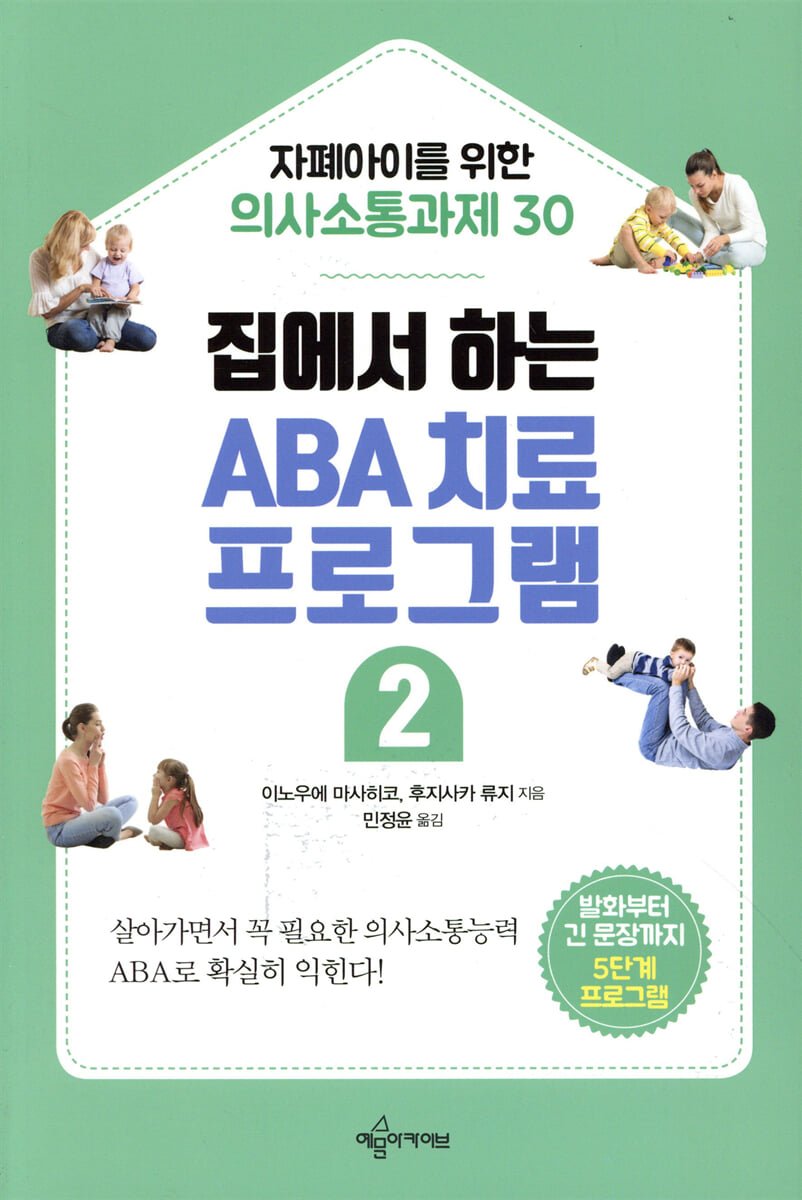
This is the second installment of a practical introduction to Applied Behavior Analysis (ABA), which is easy to understand and can be taught at home by parents of children with autism. It introduces 30 different tasks related to 'communication', from speaking to sentence use, divided into five levels of difficulty.
For children who cannot yet speak, all communication skills can now be taught at home, from speaking to using words, simple sentences to more complex sentences.
This book provides detailed information on how to start with the basics of communication for children with autism, gradually expanding the ability to speak and speaking words into sentences.
The 5-step communication program fundamentally utilizes "discrete trial training" (DTT), along with the "small step" method, which breaks down tasks into smaller pieces to increase a sense of accomplishment. DTT involves giving a child a directive, then providing a prompt or hint to elicit a desired response. Then, reinforcers like treats or toys are provided to continue encouraging positive responses.
Through the DTT process of 'instruction → prompting → response → reinforcement', children can acquire tasks like playing and naturally learn to speak and communicate.
On the other hand, since it is not easy to elicit spontaneous communication from a child, questions may arise during the process.
Accordingly, the author has selected 16 frequently asked questions from parents before starting a full-scale program and is providing advice.
5 Steps to Raising a Child Who Speaks and Communicates Spontaneously
The second book, "ABA Therapy Program at Home," has been published.
This is the second installment of a practical introduction to Applied Behavior Analysis (ABA), which is easy to understand and can be taught at home by parents of children with autism. It introduces 30 different tasks related to 'communication', from speaking to sentence use, divided into five levels of difficulty.
For children who cannot yet speak, all communication skills can now be taught at home, from speaking to using words, simple sentences to more complex sentences.
This book provides detailed information on how to start with the basics of communication for children with autism, gradually expanding the ability to speak and speaking words into sentences.
The 5-step communication program fundamentally utilizes "discrete trial training" (DTT), along with the "small step" method, which breaks down tasks into smaller pieces to increase a sense of accomplishment. DTT involves giving a child a directive, then providing a prompt or hint to elicit a desired response. Then, reinforcers like treats or toys are provided to continue encouraging positive responses.
Through the DTT process of 'instruction → prompting → response → reinforcement', children can acquire tasks like playing and naturally learn to speak and communicate.
On the other hand, since it is not easy to elicit spontaneous communication from a child, questions may arise during the process.
Accordingly, the author has selected 16 frequently asked questions from parents before starting a full-scale program and is providing advice.
- You can preview some of the book's contents.
Preview
index
Parents' recommendations after reading first
Beginning with Writing_Raising Children to Express Their Thoughts Through Words
Chapter 1: Learning Communication
_Autism and Communication
Developmental Differences Between Autistic and Typically Developing Children/Language Development in Autistic Children
_Promoting communication development
Principles of ABA Therapy / What is Communication? / Features of this Program / How to Use this Program
_ABA Basic Knowledge
Learning the Basics of ABA / How to Proceed with Home Therapy / Before Starting Home Therapy
_Before starting ABA
Q&A 16 for successfully completing assignments
Chapter 2: Communication Program I
_Step 1: Laying the foundations of communication
01_Introducing the task / 02_Matching / 03_Imitating movements / 04_Following verbal directions / 05_Making eye contact and pointing / 06_Eliciting communication in play situations
_Step 2 Acquiring a horse
01_Voice Imitation / 02_Name Objects / 03_Expressing Needs with Words / 04_Expanding the World of First Language / 05_Communicating Using Picture Cards
·After practicing ABA ①: From imitating mouth shapes to imitating sounds using a mirror
·After practicing ABA ②: Parents and children learn to express needs while playing together
_Step 3 Forming sentences and concepts
01_Understanding Complex Instructions / 02_Social Responses / 03_Properties of Objects / 04_2nd and 3rd Language / 05_Expressing Facial Expressions and Emotions
·After practicing ABA ③: Teaching basic social conversation skills
·After practicing ABA ④: Teaching by experiencing 'hot' and 'cold'
[Column] Teaching Methods Using Visual Prompts
Chapter 3: Communication Program II
_Step 4 The Basics of Conversation
01_Characteristics and functions of objects / 02_Affirmative and negative / 03_Tense and particles / 04_Distinguishing questions / 05_Spontaneous questions / 06_Reading and writing / 07_Recalling the past / 08_Information exchange conversation
·After practicing ABA, ⑤: Encouraging spontaneous questions accompanied by emotions
·After practicing ABA, ⑥: Able to write letters by imitating movements
[Column] Two Strengthenings: What to Watch Out for When Strengthening
_Step 5 Advanced Communication
01_Peer Learning and Shadow Techniques / 02_Empathy and the Perspective of Others / 03_The Concepts of "Giving" and "Receiving" / 04_Developing Conversation / 05_Expanding the World of Language / 06_Remaining Tasks
·After practicing ABA, ⑦ Peer learning that both my daughter and her friends can enjoy together
·After practicing ABA, I was able to continuously practice developing conversations.
·After practicing ABA, I hope to make true friends.
[Column] Aiming for Self-Management
In closing, ABA is one way to help children enjoy a happy life.
Translator's Note_To develop overall language skills and become a child who can communicate happily.
Major ABA therapy support groups and organizations
Beginning with Writing_Raising Children to Express Their Thoughts Through Words
Chapter 1: Learning Communication
_Autism and Communication
Developmental Differences Between Autistic and Typically Developing Children/Language Development in Autistic Children
_Promoting communication development
Principles of ABA Therapy / What is Communication? / Features of this Program / How to Use this Program
_ABA Basic Knowledge
Learning the Basics of ABA / How to Proceed with Home Therapy / Before Starting Home Therapy
_Before starting ABA
Q&A 16 for successfully completing assignments
Chapter 2: Communication Program I
_Step 1: Laying the foundations of communication
01_Introducing the task / 02_Matching / 03_Imitating movements / 04_Following verbal directions / 05_Making eye contact and pointing / 06_Eliciting communication in play situations
_Step 2 Acquiring a horse
01_Voice Imitation / 02_Name Objects / 03_Expressing Needs with Words / 04_Expanding the World of First Language / 05_Communicating Using Picture Cards
·After practicing ABA ①: From imitating mouth shapes to imitating sounds using a mirror
·After practicing ABA ②: Parents and children learn to express needs while playing together
_Step 3 Forming sentences and concepts
01_Understanding Complex Instructions / 02_Social Responses / 03_Properties of Objects / 04_2nd and 3rd Language / 05_Expressing Facial Expressions and Emotions
·After practicing ABA ③: Teaching basic social conversation skills
·After practicing ABA ④: Teaching by experiencing 'hot' and 'cold'
[Column] Teaching Methods Using Visual Prompts
Chapter 3: Communication Program II
_Step 4 The Basics of Conversation
01_Characteristics and functions of objects / 02_Affirmative and negative / 03_Tense and particles / 04_Distinguishing questions / 05_Spontaneous questions / 06_Reading and writing / 07_Recalling the past / 08_Information exchange conversation
·After practicing ABA, ⑤: Encouraging spontaneous questions accompanied by emotions
·After practicing ABA, ⑥: Able to write letters by imitating movements
[Column] Two Strengthenings: What to Watch Out for When Strengthening
_Step 5 Advanced Communication
01_Peer Learning and Shadow Techniques / 02_Empathy and the Perspective of Others / 03_The Concepts of "Giving" and "Receiving" / 04_Developing Conversation / 05_Expanding the World of Language / 06_Remaining Tasks
·After practicing ABA, ⑦ Peer learning that both my daughter and her friends can enjoy together
·After practicing ABA, I was able to continuously practice developing conversations.
·After practicing ABA, I hope to make true friends.
[Column] Aiming for Self-Management
In closing, ABA is one way to help children enjoy a happy life.
Translator's Note_To develop overall language skills and become a child who can communicate happily.
Major ABA therapy support groups and organizations
Into the book
Regardless of your child's condition, we recommend implementing the program presented in this book from the beginning.
You may find that something you thought you could do without any problems turns out to be surprisingly difficult.
If the foundation is not solid, the progress of the program will be slow.
Let's make sure we can successfully complete the basic tasks before moving on to the next step.
---From "Promoting Communication Development"
In ABA therapy, the environment is adjusted so that the child performs a desired behavior, such as asking for it verbally or pointing, and an adult provides assistance (prompting) to elicit the behavior, and then reinforces the behavior by providing the child with something that serves as a reinforcer immediately after the behavior.
At this time, the choice of reinforcing agent greatly affects the outcome of the treatment.
Therefore, it is helpful to make a list in advance of things or activities that can serve as reinforcers for your child.
---From "ABA Basic Knowledge"
Now let's actually teach the child.
First, to create a good learning environment for your child, start with tasks that require simple hand movements while sitting in a chair.
The task at hand should be simple and easy to accomplish.
And when your child succeeds, praise him/her a lot.
This is because if children are given difficult tasks from the beginning and experience many failures, they will come to dislike learning.
Once your child is able to sit down and do homework, we begin teaching them the fundamental tasks of communication learning.
---From "Step 1: Laying the Foundations of Communication"
Once you can understand colors, shapes, and basic adjectives, try to apply them little by little to your daily life.
For example, taking a bath is a great way to practice saying "hot" and "cold."
During snack time, you can prepare jellies or candies of various colors and practice expressing requests using colors by asking, “What color do you want next?”
---From "Step 3 03 Object Properties"
There are two ways to answer the question: positive and negative.
In this step, we teach you how to answer questions in this way.
There are also two types of questions of this type:
'Yes/no in expression of intent', which answers 'yes' or 'no' to questions asking the other person's intention, such as "Do you want some strawberries?" or "Can I come in?", and 'yes/no in fact', which answers 'yes' or 'no' to questions asking the truth of a fact, such as "Is this a banana?"
---From "Step 4: The Basics of Conversation"
The problem here is that the instructor fails to recognize that the child's response is being reinforced by the removal of an aversive stimulus. Instead, they assume, "Since I'm giving the reinforcer, it must be reinforced by the reinforcer." In many task-based learning situations, not just ABA, the presentation of reinforcers and the removal of aversives are intertwined.
That is, appropriate response behavior is reinforced by presenting a reinforcer for appropriate response behavior and an aversive agent for no response or incorrect response.
However, no matter how much reinforcement is presented, if the reinforcing power of the aversive stimulus is greater than the effect of the reinforcer, the behavior will become established for the child by the removal of the aversive stimulus.
You may find that something you thought you could do without any problems turns out to be surprisingly difficult.
If the foundation is not solid, the progress of the program will be slow.
Let's make sure we can successfully complete the basic tasks before moving on to the next step.
---From "Promoting Communication Development"
In ABA therapy, the environment is adjusted so that the child performs a desired behavior, such as asking for it verbally or pointing, and an adult provides assistance (prompting) to elicit the behavior, and then reinforces the behavior by providing the child with something that serves as a reinforcer immediately after the behavior.
At this time, the choice of reinforcing agent greatly affects the outcome of the treatment.
Therefore, it is helpful to make a list in advance of things or activities that can serve as reinforcers for your child.
---From "ABA Basic Knowledge"
Now let's actually teach the child.
First, to create a good learning environment for your child, start with tasks that require simple hand movements while sitting in a chair.
The task at hand should be simple and easy to accomplish.
And when your child succeeds, praise him/her a lot.
This is because if children are given difficult tasks from the beginning and experience many failures, they will come to dislike learning.
Once your child is able to sit down and do homework, we begin teaching them the fundamental tasks of communication learning.
---From "Step 1: Laying the Foundations of Communication"
Once you can understand colors, shapes, and basic adjectives, try to apply them little by little to your daily life.
For example, taking a bath is a great way to practice saying "hot" and "cold."
During snack time, you can prepare jellies or candies of various colors and practice expressing requests using colors by asking, “What color do you want next?”
---From "Step 3 03 Object Properties"
There are two ways to answer the question: positive and negative.
In this step, we teach you how to answer questions in this way.
There are also two types of questions of this type:
'Yes/no in expression of intent', which answers 'yes' or 'no' to questions asking the other person's intention, such as "Do you want some strawberries?" or "Can I come in?", and 'yes/no in fact', which answers 'yes' or 'no' to questions asking the truth of a fact, such as "Is this a banana?"
---From "Step 4: The Basics of Conversation"
The problem here is that the instructor fails to recognize that the child's response is being reinforced by the removal of an aversive stimulus. Instead, they assume, "Since I'm giving the reinforcer, it must be reinforced by the reinforcer." In many task-based learning situations, not just ABA, the presentation of reinforcers and the removal of aversives are intertwined.
That is, appropriate response behavior is reinforced by presenting a reinforcer for appropriate response behavior and an aversive agent for no response or incorrect response.
However, no matter how much reinforcement is presented, if the reinforcing power of the aversive stimulus is greater than the effect of the reinforcer, the behavior will become established for the child by the removal of the aversive stimulus.
---From "Column - Two Strengthenings"
Publisher's Review
Communication skills essential for life
Learn step by step with small steps and DTT!
―A customized program based on developmental status, starting from the basics
If you are a parent raising a child with autism, you may have heard of Applied Behavior Analysis (ABA) and are interested in treatment.
However, in reality, treatment facilities are severely lacking and the costs are not insignificant.
There are many cases where parents want to learn and treat their children themselves, but they are worried because they do not know the detailed method.
This book, "ABA Therapy Program at Home," is a practical guide to ABA that teaches the basic principles, methods, and programs of ABA to parents who want to teach their children right away.
The second book in the series, "Home ABA Therapy Program 2: 30 Communication Tasks for Children with Autism," presents a step-by-step program to improve children's communication skills and interactions with parents and friends.
We provide detailed information on how to create an environment, teach in a way, and provide reinforcement when providing home treatment to develop communication skills.
It is a concise guide to the content needed for home treatment, so even non-expert parents can help develop their children's communication skills, speech, and overall language behavior.
―Task 30: Developing Communication Skills
Communication can be broadly divided into verbal communication and nonverbal communication. This book focuses on language, especially spoken language, as its focus.
Above all, we have compressed the tasks that need to be learned into 30, focusing on understanding and expressing language, and presented them in 5 stages.
It is recommended to start a communication program from the age of 2 to 3, when children begin to babble and learn to speak.
This is because you can elicit 'speech' by doing tasks such as imitating lip shapes and voices.
Advanced communication courses from Step 4 and above are intended for children up to the lower grades of elementary school.
Teaching advanced communication skills often presents challenges for both parents and children, so programs must be tailored to the child.
Professor Masahiko Inoue, the author of this book, advises, “Depending on the differences in a child’s development or characteristics, there are times when you need to take a detour or find a way forward.”
Meanwhile, this book recommends that everyone start from Step 1 to check whether their child's language development is fast or slow.
There may be times when you think you can do this much, but you don't, and there may be times when you think you can speak fluently, but your communication isn't spontaneous.
―20 years of expertise from Japan's largest ABA parents' group, Tsumikikai
Ryuji Fujisaka, who wrote the communication program section of this book, is a guardian of a child with autism and an expert in ABA therapy.
After his two-year-old daughter was diagnosed with a suspected autism spectrum disorder, he tried to teach her to speak by giving her home treatment through trial and error, and with great success.
Afterwards, they formed a group called 'Tsumikikai' where parents could help each other, and now, 20 years later, the group is producing its own guidebook and training therapists.
He said, “Don’t give up on your child’s language skills too early,” adding that recent research has shown that even if a child is nonverbal, if they are properly guided with ABA, the rate at which they can use language increases.
He encourages us that anyone can successfully implement ABA therapy at home, as he himself was an ordinary parent.
From making eye contact to understanding and communicating on one's own
Chapter 1 introduces the basic knowledge of ABA necessary to guide the language development and communication of children with autism, as well as how to use the program in this book.
Additionally, we learn about the principles of reinforcement and extinction, which are core concepts of ABA, and explain what to prepare and how to proceed when conducting ABA at home.
Chapter 2 covers Steps 1 to 3 of the communication program.
Step 1 begins with tasks that develop the observation and concentration skills necessary for communication, such as matching, imitating movements, and making eye contact, which are initial communication tasks.
In Step 2, the goal is to be able to make sounds and speak, and students learn to imitate sounds, name objects, and communicate using picture cards.
In Step 3, you will learn how to combine the words you have learned to make sentences, and you will do tasks to understand and distinguish the properties of objects.
Chapter 3 is comprised of Steps 4 and 5, and covers the advanced communication program.
Step 4 focuses on learning how to talk to other people.
Respond appropriately when others speak to you or ask you questions, and enable them to ask simple questions themselves.
Step 5 teaches communication skills learned at home so that they can be applied in kindergarten and school.
Learn conversation skills that take others into consideration, such as empathizing with their emotions and guessing their feelings and thoughts.
Experts answer parents' most common questions and concerns.
“How do I get my child to do homework because he is very distracted and restless?”
“I can’t find a reinforcer that my child likes.
“He doesn’t eat sweets and he’s not interested in toys.”
“How many times does it take for a child to perform a task before you can tell if he or she understands it?”
“Please tell me the appropriate time to do the homework and break time.”
In this book, experts answer 16 of the most common questions parents have before starting ABA therapy or when undertaking the task.
It provides specific methods, including points to keep in mind when treating at home, how to find the right reinforcer for your child, and how to transition from sweets to other reinforcers.
Learn step by step with small steps and DTT!
―A customized program based on developmental status, starting from the basics
If you are a parent raising a child with autism, you may have heard of Applied Behavior Analysis (ABA) and are interested in treatment.
However, in reality, treatment facilities are severely lacking and the costs are not insignificant.
There are many cases where parents want to learn and treat their children themselves, but they are worried because they do not know the detailed method.
This book, "ABA Therapy Program at Home," is a practical guide to ABA that teaches the basic principles, methods, and programs of ABA to parents who want to teach their children right away.
The second book in the series, "Home ABA Therapy Program 2: 30 Communication Tasks for Children with Autism," presents a step-by-step program to improve children's communication skills and interactions with parents and friends.
We provide detailed information on how to create an environment, teach in a way, and provide reinforcement when providing home treatment to develop communication skills.
It is a concise guide to the content needed for home treatment, so even non-expert parents can help develop their children's communication skills, speech, and overall language behavior.
―Task 30: Developing Communication Skills
Communication can be broadly divided into verbal communication and nonverbal communication. This book focuses on language, especially spoken language, as its focus.
Above all, we have compressed the tasks that need to be learned into 30, focusing on understanding and expressing language, and presented them in 5 stages.
It is recommended to start a communication program from the age of 2 to 3, when children begin to babble and learn to speak.
This is because you can elicit 'speech' by doing tasks such as imitating lip shapes and voices.
Advanced communication courses from Step 4 and above are intended for children up to the lower grades of elementary school.
Teaching advanced communication skills often presents challenges for both parents and children, so programs must be tailored to the child.
Professor Masahiko Inoue, the author of this book, advises, “Depending on the differences in a child’s development or characteristics, there are times when you need to take a detour or find a way forward.”
Meanwhile, this book recommends that everyone start from Step 1 to check whether their child's language development is fast or slow.
There may be times when you think you can do this much, but you don't, and there may be times when you think you can speak fluently, but your communication isn't spontaneous.
―20 years of expertise from Japan's largest ABA parents' group, Tsumikikai
Ryuji Fujisaka, who wrote the communication program section of this book, is a guardian of a child with autism and an expert in ABA therapy.
After his two-year-old daughter was diagnosed with a suspected autism spectrum disorder, he tried to teach her to speak by giving her home treatment through trial and error, and with great success.
Afterwards, they formed a group called 'Tsumikikai' where parents could help each other, and now, 20 years later, the group is producing its own guidebook and training therapists.
He said, “Don’t give up on your child’s language skills too early,” adding that recent research has shown that even if a child is nonverbal, if they are properly guided with ABA, the rate at which they can use language increases.
He encourages us that anyone can successfully implement ABA therapy at home, as he himself was an ordinary parent.
From making eye contact to understanding and communicating on one's own
Chapter 1 introduces the basic knowledge of ABA necessary to guide the language development and communication of children with autism, as well as how to use the program in this book.
Additionally, we learn about the principles of reinforcement and extinction, which are core concepts of ABA, and explain what to prepare and how to proceed when conducting ABA at home.
Chapter 2 covers Steps 1 to 3 of the communication program.
Step 1 begins with tasks that develop the observation and concentration skills necessary for communication, such as matching, imitating movements, and making eye contact, which are initial communication tasks.
In Step 2, the goal is to be able to make sounds and speak, and students learn to imitate sounds, name objects, and communicate using picture cards.
In Step 3, you will learn how to combine the words you have learned to make sentences, and you will do tasks to understand and distinguish the properties of objects.
Chapter 3 is comprised of Steps 4 and 5, and covers the advanced communication program.
Step 4 focuses on learning how to talk to other people.
Respond appropriately when others speak to you or ask you questions, and enable them to ask simple questions themselves.
Step 5 teaches communication skills learned at home so that they can be applied in kindergarten and school.
Learn conversation skills that take others into consideration, such as empathizing with their emotions and guessing their feelings and thoughts.
Experts answer parents' most common questions and concerns.
“How do I get my child to do homework because he is very distracted and restless?”
“I can’t find a reinforcer that my child likes.
“He doesn’t eat sweets and he’s not interested in toys.”
“How many times does it take for a child to perform a task before you can tell if he or she understands it?”
“Please tell me the appropriate time to do the homework and break time.”
In this book, experts answer 16 of the most common questions parents have before starting ABA therapy or when undertaking the task.
It provides specific methods, including points to keep in mind when treating at home, how to find the right reinforcer for your child, and how to transition from sweets to other reinforcers.
GOODS SPECIFICS
- Publication date: December 15, 2018
- Page count, weight, size: 304 pages | 470g | 153*225*20mm
- ISBN13: 9791163860099
- ISBN10: 1163860093
You may also like
카테고리
korean


korean

![GQ KOREA Mark (Monthly): December [2025]](http://librairie.coreenne.fr/cdn/shop/files/8ef265dbbfbf186523ed75ba7319009d.jpg?v=1765340328&width=3840)


