

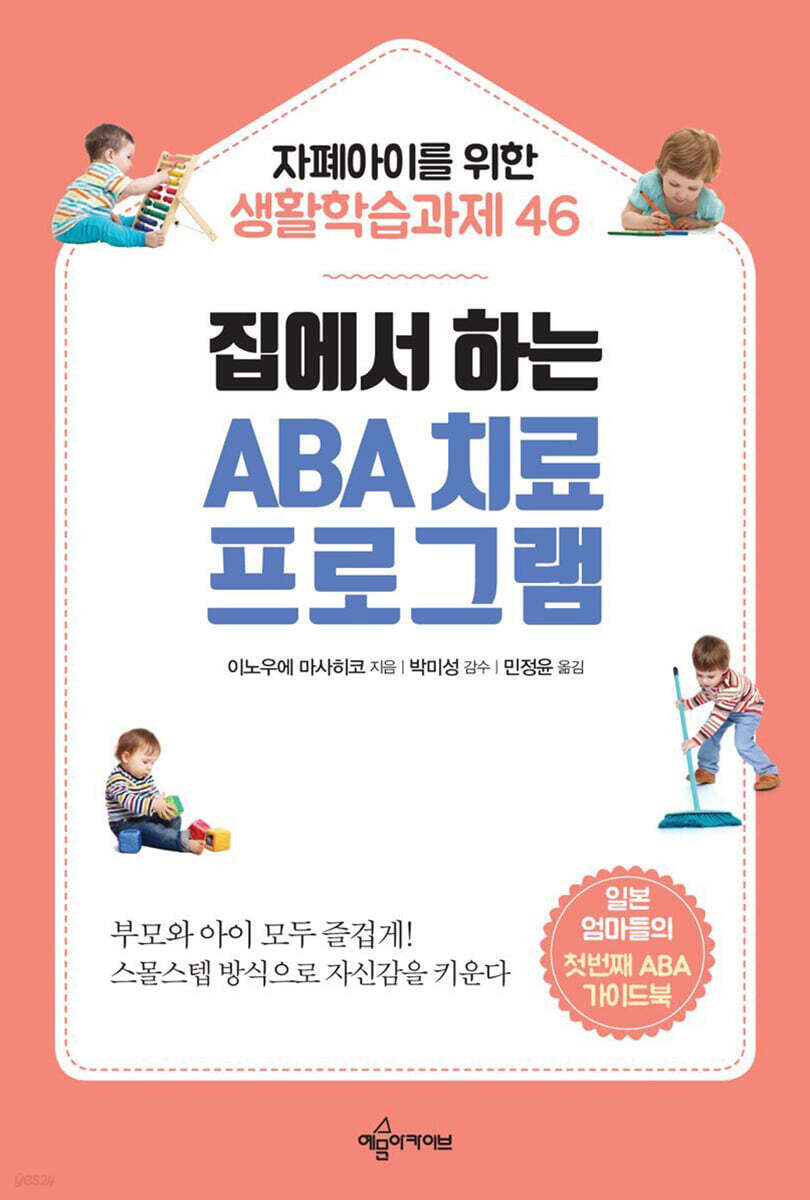
ABA therapy program at home
 |
Description
Book Introduction
"Children transform with ABA, a playful way of teaching."
Step-by-step 'small steps' from the ABA's top authority
A practical introduction to Applied Behavior Analysis (ABA) for parents of children with autism. ABA is recognized as the most effective theory in the field of educating children with autism.
We are achieving great results in training social self-help skills, personal independence, and communication skills for children with autism and intellectual disabilities.
However, teaching autistic children specific behaviors requires intensive training and time, and it was difficult for non-expert parents to learn the theory and training methods and provide treatment.
This book introduces a program designed to help parents who spend a lot of time with their children achieve good results by utilizing ABA methods at home, based on target behaviors.
The author, translator, and editor are all experts with extensive theoretical and practical experience, providing guidance that pinpoints the areas that parents actually need.
This book introduces 46 tasks in the areas of 'interpersonal relationships, life, communication, sociality, exercise, cognition and learning' that children must learn while living their daily lives and forming social relationships, divided into small steps and trained using the 'Small Step' method.
Using this method can give your child a sense of accomplishment and help them achieve the target behavior on their own.
It gives parents confidence in parenting and the joy of communicating with their children.
Step-by-step 'small steps' from the ABA's top authority
A practical introduction to Applied Behavior Analysis (ABA) for parents of children with autism. ABA is recognized as the most effective theory in the field of educating children with autism.
We are achieving great results in training social self-help skills, personal independence, and communication skills for children with autism and intellectual disabilities.
However, teaching autistic children specific behaviors requires intensive training and time, and it was difficult for non-expert parents to learn the theory and training methods and provide treatment.
This book introduces a program designed to help parents who spend a lot of time with their children achieve good results by utilizing ABA methods at home, based on target behaviors.
The author, translator, and editor are all experts with extensive theoretical and practical experience, providing guidance that pinpoints the areas that parents actually need.
This book introduces 46 tasks in the areas of 'interpersonal relationships, life, communication, sociality, exercise, cognition and learning' that children must learn while living their daily lives and forming social relationships, divided into small steps and trained using the 'Small Step' method.
Using this method can give your child a sense of accomplishment and help them achieve the target behavior on their own.
It gives parents confidence in parenting and the joy of communicating with their children.
- You can preview some of the book's contents.
Preview
index
A reviewer's note: When the environment changes, so do the children.
As I begin writing _ I hope you enjoy the process of getting to know your child through ABA.
PART 1.
What You Need to Know Before Starting ABA
Learn about ABA
- What is ABA?
Understanding the Core of ABA
- Understanding ABA principles
- Praise your child well
- To provide effective guidance
Dealing with Problem Behavior
- If you don't want to do the homework
- Responding to irritation or problem behavior
PART 2.
ABA programs at home
interpersonal behavior
01_Physical play
02_Exchanging items
life
03_Toilet training
04_Change clothes
05_Washing your hands
06_Washing your face
07_Brushing teeth
08_Taking a bath
09_Eating
10_Using chopsticks
11_Organizing and cleaning
12_Cooking
13_Buying things
14_Running errands
15_Money Management
16_Management of allowance account entries
After practicing ABA, ① the difficulty of eating became pleasure
Communication
17_Imitation
18_Request for selection of real objects
19_Request with a picture card
20_Saying the names of family members or friends
21_Demands and Reports through Learning
22_Answer yes or no
23_Answering questions
24_Reporting and putting into action the memo
25_Understanding and Expressing Emotions
② Reaching out to your child's emotions with photo and picture cards
Sociality
26_Understanding the rules through games
27_Understanding Rock, Paper, Scissors and Winning and Losing
28_Dice Game
29_School Play
work out
30_Jump, Balance Board
31_Circular Learning Exercise
32_Catch Ball
33_Jump rope
34_Cutting with scissors
After practicing ABA, ③ overcoming the perception that it is difficult with small steps
Cognition and Learning
35_Classification
36_Category Classification
37_Matching
38_Relative concept
39_Doodle
40_Overwrite
41_Write along
42_Anagram
43_Reading Words and Korean
44_Speaking and counting numbers
45_Extraction of numbers, counting methods, ordinal numbers
46_Counting Money
After practicing ABA, I was able to steadily gain strength step by step.
After practicing ABA, I found that ⑤ guidance tailored to the child's understanding is important.
In conclusion _ Advice for successfully conducting treatment at home
Translator's Note _ What's important is the parents' mindset, and for both parents and children to have fun
References
Major ABA therapy support groups and organizations
As I begin writing _ I hope you enjoy the process of getting to know your child through ABA.
PART 1.
What You Need to Know Before Starting ABA
Learn about ABA
- What is ABA?
Understanding the Core of ABA
- Understanding ABA principles
- Praise your child well
- To provide effective guidance
Dealing with Problem Behavior
- If you don't want to do the homework
- Responding to irritation or problem behavior
PART 2.
ABA programs at home
interpersonal behavior
01_Physical play
02_Exchanging items
life
03_Toilet training
04_Change clothes
05_Washing your hands
06_Washing your face
07_Brushing teeth
08_Taking a bath
09_Eating
10_Using chopsticks
11_Organizing and cleaning
12_Cooking
13_Buying things
14_Running errands
15_Money Management
16_Management of allowance account entries
After practicing ABA, ① the difficulty of eating became pleasure
Communication
17_Imitation
18_Request for selection of real objects
19_Request with a picture card
20_Saying the names of family members or friends
21_Demands and Reports through Learning
22_Answer yes or no
23_Answering questions
24_Reporting and putting into action the memo
25_Understanding and Expressing Emotions
② Reaching out to your child's emotions with photo and picture cards
Sociality
26_Understanding the rules through games
27_Understanding Rock, Paper, Scissors and Winning and Losing
28_Dice Game
29_School Play
work out
30_Jump, Balance Board
31_Circular Learning Exercise
32_Catch Ball
33_Jump rope
34_Cutting with scissors
After practicing ABA, ③ overcoming the perception that it is difficult with small steps
Cognition and Learning
35_Classification
36_Category Classification
37_Matching
38_Relative concept
39_Doodle
40_Overwrite
41_Write along
42_Anagram
43_Reading Words and Korean
44_Speaking and counting numbers
45_Extraction of numbers, counting methods, ordinal numbers
46_Counting Money
After practicing ABA, I was able to steadily gain strength step by step.
After practicing ABA, I found that ⑤ guidance tailored to the child's understanding is important.
In conclusion _ Advice for successfully conducting treatment at home
Translator's Note _ What's important is the parents' mindset, and for both parents and children to have fun
References
Major ABA therapy support groups and organizations
Into the book
Home treatment is like jogging every day.
No one competes by timing themselves when jogging.
It's important to keep doing it, even if it's just a little bit every day.
I hope that parents can enjoy getting to know their children and the process at their own pace, rather than focusing on whether or not they can achieve the desired behavior within a positive relationship with their children.
--- p.13 From “Starting Writing”
ABA programs do not discriminate based on the type or presence of a disability.
The same principles apply to behavioral analysis techniques.
However, when coaching, we provide a program tailored to each individual. ABA views "individual behavior" as the unit of analysis.
Therefore, we create and provide a ‘program for ○○’ rather than a ‘program for children with ○○ disabilities.’
Additionally, you can share your leadership skills with other leaders by recording and analyzing vague assessments of a specific leader's capabilities or the compatibility between a child and the leader, using specific methods such as setting up the environment, presenting problems, and praising.
--- p.27 From “What is ABA”
One of the reasons it's difficult to frequently praise children is because we have high standards for praising them.
Let's take for example the case of guiding a child who only makes a mess of his toys and never cleans them up.
Instead of having the child clean up on their own from the beginning, prepare a large box first and set up the environment so that the child hands the messy toys to the parent or teacher, and the teacher then puts them in the box.
Make this your first goal and give yourself lots of praise when you succeed.
Setting goals step by step like this is called small steps.
--- pp.37-38 From “How to Praise Your Child Well”
It is difficult to respond to each problem by simply trying to suppress it.
When thinking about what desirable behavior to change, think about behaviors that are easy for the child to achieve first.
Also, when the child does something desirable instead of the problem behavior, praise him or meet his or her requests to reinforce the good behavior, and do not respond to inappropriate behavior.
Consistent parental attitude is very important in the process of changing behavior.
--- p.74 From “Responding to Irritation or Problem Behavior”
Various life skills such as eating, dressing, toileting, bathing, shopping, and cooking are acquired as children grow and are used throughout their lives.
Let's learn it little by little with a long-term perspective.
No matter how you guide, prepare the environment in advance to encourage appropriate behavior, and set the target behavior and method of encouraging it in small steps.
This is the basic method of guidance, and the method does not change even if the task changes.
Rather than trying to achieve success right from the start, set a level that suits your child and let them start with what they can do.
--- pp.93-94 From “Life Skills”
To guide the use of photo and picture cards in everyday life, a calendar was introduced into the learning process.
I had my son choose a card with a fun activity, and then we went to the calendar area with him and compared the contents of the card to the calendar.
I was able to slowly increase the time starting with a daily schedule, then a weekly schedule, and then a monthly schedule.
By introducing a common language of photos and picture cards, mothers have gained more peace of mind and have been able to connect with their sons' emotions.
No one competes by timing themselves when jogging.
It's important to keep doing it, even if it's just a little bit every day.
I hope that parents can enjoy getting to know their children and the process at their own pace, rather than focusing on whether or not they can achieve the desired behavior within a positive relationship with their children.
--- p.13 From “Starting Writing”
ABA programs do not discriminate based on the type or presence of a disability.
The same principles apply to behavioral analysis techniques.
However, when coaching, we provide a program tailored to each individual. ABA views "individual behavior" as the unit of analysis.
Therefore, we create and provide a ‘program for ○○’ rather than a ‘program for children with ○○ disabilities.’
Additionally, you can share your leadership skills with other leaders by recording and analyzing vague assessments of a specific leader's capabilities or the compatibility between a child and the leader, using specific methods such as setting up the environment, presenting problems, and praising.
--- p.27 From “What is ABA”
One of the reasons it's difficult to frequently praise children is because we have high standards for praising them.
Let's take for example the case of guiding a child who only makes a mess of his toys and never cleans them up.
Instead of having the child clean up on their own from the beginning, prepare a large box first and set up the environment so that the child hands the messy toys to the parent or teacher, and the teacher then puts them in the box.
Make this your first goal and give yourself lots of praise when you succeed.
Setting goals step by step like this is called small steps.
--- pp.37-38 From “How to Praise Your Child Well”
It is difficult to respond to each problem by simply trying to suppress it.
When thinking about what desirable behavior to change, think about behaviors that are easy for the child to achieve first.
Also, when the child does something desirable instead of the problem behavior, praise him or meet his or her requests to reinforce the good behavior, and do not respond to inappropriate behavior.
Consistent parental attitude is very important in the process of changing behavior.
--- p.74 From “Responding to Irritation or Problem Behavior”
Various life skills such as eating, dressing, toileting, bathing, shopping, and cooking are acquired as children grow and are used throughout their lives.
Let's learn it little by little with a long-term perspective.
No matter how you guide, prepare the environment in advance to encourage appropriate behavior, and set the target behavior and method of encouraging it in small steps.
This is the basic method of guidance, and the method does not change even if the task changes.
Rather than trying to achieve success right from the start, set a level that suits your child and let them start with what they can do.
--- pp.93-94 From “Life Skills”
To guide the use of photo and picture cards in everyday life, a calendar was introduced into the learning process.
I had my son choose a card with a fun activity, and then we went to the calendar area with him and compared the contents of the card to the calendar.
I was able to slowly increase the time starting with a daily schedule, then a weekly schedule, and then a monthly schedule.
By introducing a common language of photos and picture cards, mothers have gained more peace of mind and have been able to connect with their sons' emotions.
--- pp.192-193 From "After Putting ABA into Practice ②"
Publisher's Review
Build your child's confidence with "I did it!" and "I did it!"
Easy and fun at home
ABA therapy programs available
―Parents who know their children best are the best therapists.
The number of children with autism spectrum disorder and other developmental disabilities is increasing every year.
However, the reality is that educational facilities for children with autism are woefully inadequate compared to the demand.
Most treatment centers are located in large cities and metropolitan areas, and the costs are substantial. For a child to experience change through ABA, consistent treatment is necessary not only at home but also in everyday life, including outdoor activities and social interactions. Parents' interest and role are crucial in this process.
However, there are many cases where parents want to teach and train their children directly but are at a loss as to how to do so.
This book, "ABA Therapy Program at Home," is a practical book that even non-expert parents can easily understand the basic theories of ABA and immediately apply them to practice.
It aims to help parents treat their children at home using the ABA method, and introduces 46 important life and learning tasks with illustrations.
―Start with the basics! Even parents can do it with confidence!
Parents need books that teach them how to do ABA in practice, rather than just theories or explanations.
Even when reading a theory-oriented book, the question “So what do you want me to do?” comes to mind.
《ABA Therapy Program at Home》 is a friendly guidebook that answers those questions.
It covers basic life habits that children need to learn at a young age, such as toilet training, hand washing, and using the toilet, as well as personal independence skills such as managing allowances, running errands, and purchasing things, and even basic communication skills, all of which are skills that children need to acquire before or after starting school.
It is suitable for a wide range of age groups, as it starts with the tasks that the child needs most and can be learned step by step.
It can be used for a long period of time, from the age of 3 until after entering school.
Generalization is when a child can perform a target behavior not only at home but also with other people and in other places. To achieve this, consistent efforts by parents are important.
Author Masahiko Inoue emphasizes, "Home therapy is like jogging, so it's important to continue doing it every day, even if it's just a little bit." Even if ABA therapy is effective, your child won't change overnight.
If you keep in sync with your child as if you were jogging together and keep a positive mindset, both the child and the parent will soon find themselves growing together.
A guideline created jointly by Korean and Japanese experts
Professor Masahiko Inoue, who has been treating and educating people with autism and developmental disabilities for decades, is Japan's leading expert in applied behavior analysis.
After experiencing the difficulties faced by parents through numerous consultations, I realized the need for a book tailored to the level of parents, and wrote this book.
I hope this book will be of practical help in easily teaching children at home, as I expressed regret that parents often fail to teach their children with autism because they “set their goals too high or teach in a way that is not suitable for the child.”
Min Jeong-yoon, who was in charge of the translation, is an expert who studied in Japan and returned to treat children and parents at the [Happy ABA Child Development Research Institute].
In a domestic situation worse than Japan, I was looking for a book that would directly help parents, and I ended up introducing this book, "ABA Therapy Program at Home," which consists of tasks that children absolutely need.
This book, which introduces ABA teaching methods in an easy-to-understand manner, was reviewed by Professor Mi-seong Park, an international behavior analysis expert who has been teaching ABA in the field for over 10 years, and was recommended by Professor I-re Hong, an international behavior analysis expert and professor at the University of Tsukuba in Japan, and Sang-min Kim, the representative of the Korean ABA Parents Association.
Meanwhile, the terms used in the book are based on actual use in domestic treatment settings, minimizing confusion when combining home and center treatment.
―Basic knowledge and practical guide
Part 1 covers the basic theories necessary to begin ABA therapy. It provides a brief introduction to the field of ABA, covering the principles and teaching methods used in ABA therapy, as well as various methods for addressing children's behavioral challenges. Part 2 presents 46 life and learning tasks, setting goals for each task so they can be implemented immediately at home, and explains the Small Steps method to encourage behavior.
We provide guidance on how to increase or decrease steps to suit the child's disability characteristics and level.
The experiences of parents who have practiced ABA directly in Japan are introduced, and through their vivid voices, you can learn about the trials and errors and tips for practicing ABA at home.
―The most frequently asked questions from ABA professionals
Q: What is ABA?
A: ABA is a branch of behavior analysis.
We are achieving great results in social skills training, self-reliance, and communication guidance for children with disabilities such as intellectual disabilities and autism.
ABA is a very effective method for children with autism to acquire and improve skills necessary for daily life, and to improve and promote maladaptive behaviors.
The TEACCH program, which is well known in Japan, also integrates support methods including ABA to promote more effective practice.
Q: Is teaching ABA difficult?
A: By learning the basic principles of ABA, you can understand the causes of your child's behavior, improve their environment, and guide them through small steps to build successful experiences that help them grow without overdoing it.
Q: Can my child change with ABA?
A: In ABA, we create an environment tailored to each child's disability characteristics and developmental level to enable them to exhibit desirable behaviors, and we teach in stages to avoid failure.
This will reduce the number of failures and increase the opportunities for praise, which will help your child build confidence.
A mother's recommendation after reading this book first
Reading this book reminds me of when my child was first diagnosed with autism and I visited an ABA center without even knowing what ABA was.
I thought I would understand if the therapist showed me how to do it at the center, but when I actually came home and tried it, it didn't work out well, so it was difficult.
This book is well explained so that parents can easily access it, and it is about everyday life_ Kim Hye-young
I knew that ABA was something that needed to be done not only by the therapist but also by the parents who spend a lot of time with the child, but when I actually started, it felt difficult and overwhelming.
This book is easier to read and contains more practical content than other books on the market, so you can immediately understand how to put it into practice.
If you incorporate ABA into your child's daily life and repeat it every day while staying at home with them, the skills will be acquired naturally.
This is good content that is helpful not only for children with autism but also for children without autism.
_ Joo Yu-jin
Parents raising children with autism are likely to have encountered a behavioral therapy technique called ABA at least once.
However, it is not easy to apply ABA at home or in institutions other than in therapy rooms led by experts, and there are limits to how parents can apply and practice it based on theory.
However, through this practice book, I was able to receive a lot of help in terms of methodologies for self-help skills and cognitive learning that can be applied to children's lives.
If you know the theory but are stuck in practice, this is a book I would definitely recommend.
_ Goyura
Easy and fun at home
ABA therapy programs available
―Parents who know their children best are the best therapists.
The number of children with autism spectrum disorder and other developmental disabilities is increasing every year.
However, the reality is that educational facilities for children with autism are woefully inadequate compared to the demand.
Most treatment centers are located in large cities and metropolitan areas, and the costs are substantial. For a child to experience change through ABA, consistent treatment is necessary not only at home but also in everyday life, including outdoor activities and social interactions. Parents' interest and role are crucial in this process.
However, there are many cases where parents want to teach and train their children directly but are at a loss as to how to do so.
This book, "ABA Therapy Program at Home," is a practical book that even non-expert parents can easily understand the basic theories of ABA and immediately apply them to practice.
It aims to help parents treat their children at home using the ABA method, and introduces 46 important life and learning tasks with illustrations.
―Start with the basics! Even parents can do it with confidence!
Parents need books that teach them how to do ABA in practice, rather than just theories or explanations.
Even when reading a theory-oriented book, the question “So what do you want me to do?” comes to mind.
《ABA Therapy Program at Home》 is a friendly guidebook that answers those questions.
It covers basic life habits that children need to learn at a young age, such as toilet training, hand washing, and using the toilet, as well as personal independence skills such as managing allowances, running errands, and purchasing things, and even basic communication skills, all of which are skills that children need to acquire before or after starting school.
It is suitable for a wide range of age groups, as it starts with the tasks that the child needs most and can be learned step by step.
It can be used for a long period of time, from the age of 3 until after entering school.
Generalization is when a child can perform a target behavior not only at home but also with other people and in other places. To achieve this, consistent efforts by parents are important.
Author Masahiko Inoue emphasizes, "Home therapy is like jogging, so it's important to continue doing it every day, even if it's just a little bit." Even if ABA therapy is effective, your child won't change overnight.
If you keep in sync with your child as if you were jogging together and keep a positive mindset, both the child and the parent will soon find themselves growing together.
A guideline created jointly by Korean and Japanese experts
Professor Masahiko Inoue, who has been treating and educating people with autism and developmental disabilities for decades, is Japan's leading expert in applied behavior analysis.
After experiencing the difficulties faced by parents through numerous consultations, I realized the need for a book tailored to the level of parents, and wrote this book.
I hope this book will be of practical help in easily teaching children at home, as I expressed regret that parents often fail to teach their children with autism because they “set their goals too high or teach in a way that is not suitable for the child.”
Min Jeong-yoon, who was in charge of the translation, is an expert who studied in Japan and returned to treat children and parents at the [Happy ABA Child Development Research Institute].
In a domestic situation worse than Japan, I was looking for a book that would directly help parents, and I ended up introducing this book, "ABA Therapy Program at Home," which consists of tasks that children absolutely need.
This book, which introduces ABA teaching methods in an easy-to-understand manner, was reviewed by Professor Mi-seong Park, an international behavior analysis expert who has been teaching ABA in the field for over 10 years, and was recommended by Professor I-re Hong, an international behavior analysis expert and professor at the University of Tsukuba in Japan, and Sang-min Kim, the representative of the Korean ABA Parents Association.
Meanwhile, the terms used in the book are based on actual use in domestic treatment settings, minimizing confusion when combining home and center treatment.
―Basic knowledge and practical guide
Part 1 covers the basic theories necessary to begin ABA therapy. It provides a brief introduction to the field of ABA, covering the principles and teaching methods used in ABA therapy, as well as various methods for addressing children's behavioral challenges. Part 2 presents 46 life and learning tasks, setting goals for each task so they can be implemented immediately at home, and explains the Small Steps method to encourage behavior.
We provide guidance on how to increase or decrease steps to suit the child's disability characteristics and level.
The experiences of parents who have practiced ABA directly in Japan are introduced, and through their vivid voices, you can learn about the trials and errors and tips for practicing ABA at home.
―The most frequently asked questions from ABA professionals
Q: What is ABA?
A: ABA is a branch of behavior analysis.
We are achieving great results in social skills training, self-reliance, and communication guidance for children with disabilities such as intellectual disabilities and autism.
ABA is a very effective method for children with autism to acquire and improve skills necessary for daily life, and to improve and promote maladaptive behaviors.
The TEACCH program, which is well known in Japan, also integrates support methods including ABA to promote more effective practice.
Q: Is teaching ABA difficult?
A: By learning the basic principles of ABA, you can understand the causes of your child's behavior, improve their environment, and guide them through small steps to build successful experiences that help them grow without overdoing it.
Q: Can my child change with ABA?
A: In ABA, we create an environment tailored to each child's disability characteristics and developmental level to enable them to exhibit desirable behaviors, and we teach in stages to avoid failure.
This will reduce the number of failures and increase the opportunities for praise, which will help your child build confidence.
A mother's recommendation after reading this book first
Reading this book reminds me of when my child was first diagnosed with autism and I visited an ABA center without even knowing what ABA was.
I thought I would understand if the therapist showed me how to do it at the center, but when I actually came home and tried it, it didn't work out well, so it was difficult.
This book is well explained so that parents can easily access it, and it is about everyday life_ Kim Hye-young
I knew that ABA was something that needed to be done not only by the therapist but also by the parents who spend a lot of time with the child, but when I actually started, it felt difficult and overwhelming.
This book is easier to read and contains more practical content than other books on the market, so you can immediately understand how to put it into practice.
If you incorporate ABA into your child's daily life and repeat it every day while staying at home with them, the skills will be acquired naturally.
This is good content that is helpful not only for children with autism but also for children without autism.
_ Joo Yu-jin
Parents raising children with autism are likely to have encountered a behavioral therapy technique called ABA at least once.
However, it is not easy to apply ABA at home or in institutions other than in therapy rooms led by experts, and there are limits to how parents can apply and practice it based on theory.
However, through this practice book, I was able to receive a lot of help in terms of methodologies for self-help skills and cognitive learning that can be applied to children's lives.
If you know the theory but are stuck in practice, this is a book I would definitely recommend.
_ Goyura
GOODS SPECIFICS
- Date of issue: May 15, 2018
- Page count, weight, size: 312 pages | 484g | 152*215*18mm
- ISBN13: 9791187749769
- ISBN10: 1187749761
You may also like
카테고리
korean


korean

![ELLE 엘르 스페셜 에디션 A형 : 12월 [2025]](http://librairie.coreenne.fr/cdn/shop/files/b8e27a3de6c9538896439686c6b0e8fb.jpg?v=1766436872&width=3840)


