

How do competent elementary school teachers teach their children?
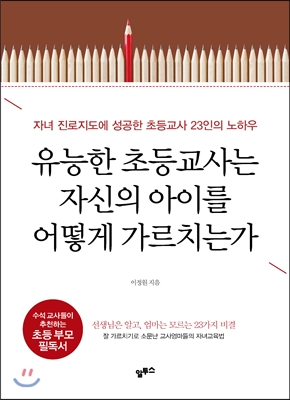 |
Description
Book Introduction
How do renowned teachers raise their children to become top-tier students?
This book contains the know-how of 23 elementary school teachers who have successfully guided children's career paths.
Based on the experience accumulated over a teaching career spanning from 20 to 40 years, you can hear vivid advice from teachers who have successfully raised their children.
The author of this book focused on hearing the experiences and unique know-how of senior teachers to reduce trial and error, from his days as a beginner teacher to his tenth year as a teacher.
As my worries as a teacher gradually diminished, I suddenly began to wonder, 'How did these capable teachers, who raised their children with such envy, teach their own children?'
Above all, I felt it was a shame that their know-how in child education and their teaching experience would be forgotten with their retirement, so I hastily wrote this book.
The advice from the experiences of 23 teachers, from head teachers to principals, can be called '500 years of know-how in elementary education.'
They say a child's life is decided in elementary school.
This is because most of the conditions for 'happy growth', including learning attitudes, character, lifestyle habits, and sociality, are acquired at this time.
Teacher parents also realize the importance of elementary education more than anyone else, and have been working hard to find the best educational and career guidance methods for their children.
This book details the self-directed learning methods they discovered and how to find opportunities for growth.
Additionally, as a teacher, I have generously included advice that accurately reflects the reality of the educational field, including the extremes that I would strongly recommend to parents and the extremes that I would absolutely discourage.
This book contains the know-how of 23 elementary school teachers who have successfully guided children's career paths.
Based on the experience accumulated over a teaching career spanning from 20 to 40 years, you can hear vivid advice from teachers who have successfully raised their children.
The author of this book focused on hearing the experiences and unique know-how of senior teachers to reduce trial and error, from his days as a beginner teacher to his tenth year as a teacher.
As my worries as a teacher gradually diminished, I suddenly began to wonder, 'How did these capable teachers, who raised their children with such envy, teach their own children?'
Above all, I felt it was a shame that their know-how in child education and their teaching experience would be forgotten with their retirement, so I hastily wrote this book.
The advice from the experiences of 23 teachers, from head teachers to principals, can be called '500 years of know-how in elementary education.'
They say a child's life is decided in elementary school.
This is because most of the conditions for 'happy growth', including learning attitudes, character, lifestyle habits, and sociality, are acquired at this time.
Teacher parents also realize the importance of elementary education more than anyone else, and have been working hard to find the best educational and career guidance methods for their children.
This book details the self-directed learning methods they discovered and how to find opportunities for growth.
Additionally, as a teacher, I have generously included advice that accurately reflects the reality of the educational field, including the extremes that I would strongly recommend to parents and the extremes that I would absolutely discourage.
- You can preview some of the book's contents.
Preview
index
A competent teacher and the best parent
500 Years of Elementary Education Know-How from Them_Prologue
Chapter 1: How Experienced Teachers Teach Their Children
First Button: Teacher Moms Don't Start Their Children's Education at the Beginner Level
Self-Direction: How Teachers Can Raise Their Children to Be Self-Directed
Focus, look at the eyes to see if there is focus or not.
You can tell what kind of person they are by looking at their handwriting and note-taking.
Exercise Strategy: The Brains of Young Elementary School Students Develop Through Exercise
English Strategies, English, How to Get Further Even If You Start a Little Late
Korean language strategy, lower elementary school grades, why studying Korean is the most important
Math Strategies: How to Stop Letting Math Hold Your Child Back
Chapter 2: What kind of mother raises a child who is both good at studying and socially adept?
A mother's attitude: a mother who shows everything through actions, not words.
How to Praise: A Mom Who Starts with Strengths and Fixes Flaws Last
A mother who believes in me, who waits for me and trusts me even though she knows I don't
Living next door to the library, my mom goes to the library more often than the supermarket.
A mother who cheats by comparing without words and learning the secrets of a successful home.
How to Use Private Education: Moms Who Don't Make It a Habit
The Dad Effect: Moms Building a Bridge to Bring Fathers and Children Closer
A mother who knows that the power of words and that child education begins with words
A chance to dream: A mother who gives her child the chance to dream first.
Chapter 3: How a Mother's Pre-Learning Determines a Child's Life
Learn the benefits of play and how to play with your child.
The purpose of travel is to make travel "reading on the go."
Mom's Preparation: There are things moms need to prepare before their children enter elementary school.
What are the essential prerequisites that teachers consider essential before admission?
Smartphone and Game Addiction: Consider Whether Your Child Really Needs a Smartphone
Bullying: What to Do if Your Child Is Being Bullied
Teachers with 30 Years of Experience: "If I Had to Raise a Child Again" - Epilogue
500 Years of Elementary Education Know-How from Them_Prologue
Chapter 1: How Experienced Teachers Teach Their Children
First Button: Teacher Moms Don't Start Their Children's Education at the Beginner Level
Self-Direction: How Teachers Can Raise Their Children to Be Self-Directed
Focus, look at the eyes to see if there is focus or not.
You can tell what kind of person they are by looking at their handwriting and note-taking.
Exercise Strategy: The Brains of Young Elementary School Students Develop Through Exercise
English Strategies, English, How to Get Further Even If You Start a Little Late
Korean language strategy, lower elementary school grades, why studying Korean is the most important
Math Strategies: How to Stop Letting Math Hold Your Child Back
Chapter 2: What kind of mother raises a child who is both good at studying and socially adept?
A mother's attitude: a mother who shows everything through actions, not words.
How to Praise: A Mom Who Starts with Strengths and Fixes Flaws Last
A mother who believes in me, who waits for me and trusts me even though she knows I don't
Living next door to the library, my mom goes to the library more often than the supermarket.
A mother who cheats by comparing without words and learning the secrets of a successful home.
How to Use Private Education: Moms Who Don't Make It a Habit
The Dad Effect: Moms Building a Bridge to Bring Fathers and Children Closer
A mother who knows that the power of words and that child education begins with words
A chance to dream: A mother who gives her child the chance to dream first.
Chapter 3: How a Mother's Pre-Learning Determines a Child's Life
Learn the benefits of play and how to play with your child.
The purpose of travel is to make travel "reading on the go."
Mom's Preparation: There are things moms need to prepare before their children enter elementary school.
What are the essential prerequisites that teachers consider essential before admission?
Smartphone and Game Addiction: Consider Whether Your Child Really Needs a Smartphone
Bullying: What to Do if Your Child Is Being Bullied
Teachers with 30 Years of Experience: "If I Had to Raise a Child Again" - Epilogue
Detailed image

Into the book
From them, who were already the best parents before they became competent teachers, I was able to receive more valuable and wise advice than I had learned in four years of teacher training or any educational book.
Among the seniors who helped me grow at that time, some have already retired, and some will retire in a few years.
Suddenly, I felt a pity that their know-how in raising children and their experience as teachers were being buried with their retirement, and so I hastily wrote this book.
--- p.7
If you are a mother who laments, “It would be great if my child could just take care of his own work, putting aside studying…”, I hope you will first give your child the opportunity to think for himself, the opportunity to judge, the opportunity to decide, the opportunity to act, and the opportunity to fail, and then wait.
That way, the child can do it on his own.
It may seem clumsy, slow, and frustrating to parents, but it is through these experiences that the foundation for living a self-directed life is laid.
--- p.29
“Being good at handwriting doesn’t necessarily mean you’ll get good grades.
However, most students who excel in their studies have their own note-taking techniques.
In order to take notes systematically, you have to listen intently during class so as not to miss a single word the teacher says.
In fact, among the children I met during my teaching career, those with excellent grades and promising futures generally had a habit of taking notes, and even had their own know-how.”
--- p.43-44
In the early elementary school years, the prefrontal cortex, which controls cognitive learning, is not fully developed.
Because the prefrontal cortex only develops around the age of 13 or 14, it is more efficient to develop the 'social brain' rather than trying to overdevelop the brain that controls learning during the early elementary school years.
The development of the 'social brain' is also possible through physical play with parents that involves a lot of skin contact.
--- p.59
“As an English teacher and a mother of two, I have thought a lot about English education methods and tried out various methods.
But the conclusion was that there was nothing better than reading English books.
In my daughter's case, I saw the full effect of it.”…… In addition to reading English storybooks, Mr. Hwang also emphasized ‘reading practice.’
He cited his daughter's example, saying that it is important to do it consistently every day, even if it is just 10 or 15 minutes before going to school.
--- p.63-64
“These days, it is rare to find children who do not study math in advance.
But do all children who have done pre-learning achieve good grades? No.
The scope of pre-learning that is prevalent in academies goes beyond learning things for the next school year.
This kind of pre-learning can only be superficial problem solving.
… … Children do not know ‘exactly’ what they are learning now, and they only ‘roughly’ understand what they will learn next year.
There is a clear difference between 'understanding' and 'knowing'.
“Only when you have the ability to know what you know exactly and what you don’t know well, that is, when you have ‘metacognition,’ do you truly ‘know.’”
--- p.78-79
I have also experienced many times that when I praised my child's strengths and helped develop those strengths, their weaknesses naturally disappeared.
When I was a new teacher, I didn't know much about it because I lacked a pedagogical background, but later, while reading a book, I found out that it was 'applied behavior analysis.'
Applied behavior analysis is a branch of behaviorist psychology that is an educational strategy that increases desirable behaviors and decreases undesirable behaviors.
Simply put, it can be interpreted as magnifying a child's strengths through praise and eroding their weaknesses.
Among the seniors who helped me grow at that time, some have already retired, and some will retire in a few years.
Suddenly, I felt a pity that their know-how in raising children and their experience as teachers were being buried with their retirement, and so I hastily wrote this book.
--- p.7
If you are a mother who laments, “It would be great if my child could just take care of his own work, putting aside studying…”, I hope you will first give your child the opportunity to think for himself, the opportunity to judge, the opportunity to decide, the opportunity to act, and the opportunity to fail, and then wait.
That way, the child can do it on his own.
It may seem clumsy, slow, and frustrating to parents, but it is through these experiences that the foundation for living a self-directed life is laid.
--- p.29
“Being good at handwriting doesn’t necessarily mean you’ll get good grades.
However, most students who excel in their studies have their own note-taking techniques.
In order to take notes systematically, you have to listen intently during class so as not to miss a single word the teacher says.
In fact, among the children I met during my teaching career, those with excellent grades and promising futures generally had a habit of taking notes, and even had their own know-how.”
--- p.43-44
In the early elementary school years, the prefrontal cortex, which controls cognitive learning, is not fully developed.
Because the prefrontal cortex only develops around the age of 13 or 14, it is more efficient to develop the 'social brain' rather than trying to overdevelop the brain that controls learning during the early elementary school years.
The development of the 'social brain' is also possible through physical play with parents that involves a lot of skin contact.
--- p.59
“As an English teacher and a mother of two, I have thought a lot about English education methods and tried out various methods.
But the conclusion was that there was nothing better than reading English books.
In my daughter's case, I saw the full effect of it.”…… In addition to reading English storybooks, Mr. Hwang also emphasized ‘reading practice.’
He cited his daughter's example, saying that it is important to do it consistently every day, even if it is just 10 or 15 minutes before going to school.
--- p.63-64
“These days, it is rare to find children who do not study math in advance.
But do all children who have done pre-learning achieve good grades? No.
The scope of pre-learning that is prevalent in academies goes beyond learning things for the next school year.
This kind of pre-learning can only be superficial problem solving.
… … Children do not know ‘exactly’ what they are learning now, and they only ‘roughly’ understand what they will learn next year.
There is a clear difference between 'understanding' and 'knowing'.
“Only when you have the ability to know what you know exactly and what you don’t know well, that is, when you have ‘metacognition,’ do you truly ‘know.’”
--- p.78-79
I have also experienced many times that when I praised my child's strengths and helped develop those strengths, their weaknesses naturally disappeared.
When I was a new teacher, I didn't know much about it because I lacked a pedagogical background, but later, while reading a book, I found out that it was 'applied behavior analysis.'
Applied behavior analysis is a branch of behaviorist psychology that is an educational strategy that increases desirable behaviors and decreases undesirable behaviors.
Simply put, it can be interpreted as magnifying a child's strengths through praise and eroding their weaknesses.
--- p.101
Publisher's Review
The six years of elementary education that determine my child's 'first impression of life'
How should we teach and what should we value?
The first six years of elementary school are the moment when the 'first button' of education is fastened, and it is an important period in which the 'first impression' of a child's life is created.
Above all, it is also a time when parents' educational views are established.
So, it is important to determine the direction and goals of education and lay the foundation for learning during this period.
Additionally, self-directed lifestyle habits, positive language habits, and considerate relationships with peers are formed during this period, which later influence the child's first impression.
This book contains information on what to focus on and how to teach during this crucial educational period.
Let's hear from 23 parents and respected teachers who have raised their children successfully, sharing their strategies for Korean, English, and math, how to utilize private tutoring, and their know-how in character education through play, travel, and reading.
Elementary school head teachers and teaching experts with 30 years of experience
Polarity that I would definitely recommend vs. Polarity that I would absolutely advise against
The teachers interviewed for this book include many senior teachers and renowned teachers known for their teaching prowess.
They have taught their own children based on their own teaching know-how accumulated over nearly 30 years of teaching experience, commonalities of excellent students, and the teaching methods of their parents.
Based on their experiences, teachers said there are some extremes they would definitely recommend to parents and some extremes they would absolutely discourage.
An English teacher who has completed a government-funded teacher-supported study abroad program suggested "3 tips for going further in English even if you start late" based on the study methods of children who have achieved excellent English skills through mother-style English and their own experience with English education.
A teacher who is an expert in math and self-directed learning tells us what is most important in studying math, saying, "Mathematics prerequisites without metacognition are a shortcut to making my child a math dropout (a child who gives up on elementary school math)."
The teacher, who usually emphasizes to his junior teachers, "Move to a place near the library rather than a place with a good school district," is explaining through real-life examples why the god of reading cannot help but become the god of studying.
This book also provides advice on the areas that elementary school parents worry about most, outside of academics.
Among them, the most practical and vivid advice is based on experiences at schools, such as essential prerequisites for mothers and children before entering elementary school, smartphone game addiction, and how to prevent and deal with bullying.
Teachers who raised their children without envy
If I were to raise my child again, this is what I would definitely do!
While writing this book, the author asked all the teachers he met, "If you were to raise your own child again, what kind of parent would you want to be?"
Even teachers who raise their children without envy have regrets as parents.
Surprisingly, the most common regret was 'affectionate conversation'.
This is because I know that one thing that positive and confident children have in common is affectionate conversations with their parents. When I look at my adult children, I realize that the thing I regret most is putting off conversations with them when they were younger, saying, "Let's talk about it later."
In addition, he advised that the sixth year of elementary school should not be missed as it is the optimal time to build memories with family through travel, have many conversations, and fully develop curiosity and intellectual inquiry through reading.
Many teachers cited 'memories and conversations through travel' as one of the reasons why their children successfully navigated adolescence.
The first six years of elementary school are more important than any other period, as they determine the first impression of your child's life and are the first step in choosing a career path.
This book, which reveals 500 years of know-how in elementary education, contains tips for getting the first button right.
How should we teach and what should we value?
The first six years of elementary school are the moment when the 'first button' of education is fastened, and it is an important period in which the 'first impression' of a child's life is created.
Above all, it is also a time when parents' educational views are established.
So, it is important to determine the direction and goals of education and lay the foundation for learning during this period.
Additionally, self-directed lifestyle habits, positive language habits, and considerate relationships with peers are formed during this period, which later influence the child's first impression.
This book contains information on what to focus on and how to teach during this crucial educational period.
Let's hear from 23 parents and respected teachers who have raised their children successfully, sharing their strategies for Korean, English, and math, how to utilize private tutoring, and their know-how in character education through play, travel, and reading.
Elementary school head teachers and teaching experts with 30 years of experience
Polarity that I would definitely recommend vs. Polarity that I would absolutely advise against
The teachers interviewed for this book include many senior teachers and renowned teachers known for their teaching prowess.
They have taught their own children based on their own teaching know-how accumulated over nearly 30 years of teaching experience, commonalities of excellent students, and the teaching methods of their parents.
Based on their experiences, teachers said there are some extremes they would definitely recommend to parents and some extremes they would absolutely discourage.
An English teacher who has completed a government-funded teacher-supported study abroad program suggested "3 tips for going further in English even if you start late" based on the study methods of children who have achieved excellent English skills through mother-style English and their own experience with English education.
A teacher who is an expert in math and self-directed learning tells us what is most important in studying math, saying, "Mathematics prerequisites without metacognition are a shortcut to making my child a math dropout (a child who gives up on elementary school math)."
The teacher, who usually emphasizes to his junior teachers, "Move to a place near the library rather than a place with a good school district," is explaining through real-life examples why the god of reading cannot help but become the god of studying.
This book also provides advice on the areas that elementary school parents worry about most, outside of academics.
Among them, the most practical and vivid advice is based on experiences at schools, such as essential prerequisites for mothers and children before entering elementary school, smartphone game addiction, and how to prevent and deal with bullying.
Teachers who raised their children without envy
If I were to raise my child again, this is what I would definitely do!
While writing this book, the author asked all the teachers he met, "If you were to raise your own child again, what kind of parent would you want to be?"
Even teachers who raise their children without envy have regrets as parents.
Surprisingly, the most common regret was 'affectionate conversation'.
This is because I know that one thing that positive and confident children have in common is affectionate conversations with their parents. When I look at my adult children, I realize that the thing I regret most is putting off conversations with them when they were younger, saying, "Let's talk about it later."
In addition, he advised that the sixth year of elementary school should not be missed as it is the optimal time to build memories with family through travel, have many conversations, and fully develop curiosity and intellectual inquiry through reading.
Many teachers cited 'memories and conversations through travel' as one of the reasons why their children successfully navigated adolescence.
The first six years of elementary school are more important than any other period, as they determine the first impression of your child's life and are the first step in choosing a career path.
This book, which reveals 500 years of know-how in elementary education, contains tips for getting the first button right.
GOODS SPECIFICS
- Date of issue: July 6, 2015
- Page count, weight, size: 240 pages | 426g | 152*210*14mm
- ISBN13: 9791186116050
- ISBN10: 1186116056
You may also like
카테고리
korean


korean

![GQ KOREA Mark (Monthly): December [2025]](http://librairie.coreenne.fr/cdn/shop/files/8ef265dbbfbf186523ed75ba7319009d.jpg?v=1765340328&width=3840)


