

Why are you crying?
 |
Description
Book Introduction
It is a child education book in the form of a picture book, and is composed entirely of what the mother says.
This book says that the mother's careless words, "No!" and "Don't do that!" are like a prison without bars for a child.
Rather than giving advice or instructions like conventional parenting books, this book simply shows the everyday life surrounding me and my child as it is, and beyond the ‘writing’ made up of only the mother’s words, the child’s voice, which clearly exists but cannot be heard anywhere, creates a stark contrast, conveying the message of this book.
Rather than telling a story, this book contains only commands and encouraging questions, such as “Put on your coat!”, “Go and find your boots!”, and so on.
The mother keeps asking questions and giving orders, but the child doesn't really listen to her.
Mom's last resort is, "I'll tell Dad everything!"
Like countless parents, this mother finds herself at a loss as to how to cope with her child.
The two authors, who have continuously studied the relationship between text and pictures, have made us reflect on the tone in which we speak to children through the medium of expression called 'picture books'.
This book says that the mother's careless words, "No!" and "Don't do that!" are like a prison without bars for a child.
Rather than giving advice or instructions like conventional parenting books, this book simply shows the everyday life surrounding me and my child as it is, and beyond the ‘writing’ made up of only the mother’s words, the child’s voice, which clearly exists but cannot be heard anywhere, creates a stark contrast, conveying the message of this book.
Rather than telling a story, this book contains only commands and encouraging questions, such as “Put on your coat!”, “Go and find your boots!”, and so on.
The mother keeps asking questions and giving orders, but the child doesn't really listen to her.
Mom's last resort is, "I'll tell Dad everything!"
Like countless parents, this mother finds herself at a loss as to how to cope with her child.
The two authors, who have continuously studied the relationship between text and pictures, have made us reflect on the tone in which we speak to children through the medium of expression called 'picture books'.
- You can preview some of the book's contents.
Preview
Into the book
What kind of mother are you?
Children's psychology is weak to "Why are you like that?"
Even if it's the same thing, try saying it in a positive sentence rather than a negative one.
Instead of saying, “You can’t go out and play until you put your toys away,” it’s better to say, “After you put your toys away, you can go out and play.”
It is much more effective to say that good behavior will be rewarded than to say that bad behavior will be punished.
I'm not saying you should never scold someone.
When something is wrong, you need to point out that it is wrong, but you also need to point out the wrongdoing itself.
When you should be saying, “I can’t stand what you’ve done,” you should consider whether you’re saying, “I can’t stand you anymore.”
I also need to assess myself to see if I am getting too excited or if I am losing objectivity by getting caught up in my emotions.
You need to be clear-headed and ask yourself if you are speaking more aggressively because you are angry.
Children raised by parents who know how to regulate their emotions can grow into confident and happy individuals.
Take a moment to reflect on how you are speaking to your child right now.
After all, which parent would want their child to grow up with low self-esteem and apathy? Yet, parents often fail to recognize the harm their words inflict on their children and the impact they will have on their future development.
I think the words I'm saying aren't that harsh.
Words that may seem like nothing to an adult can become arrows that fly and pierce a child at any moment.
This book is like a mirror that makes mothers look back at the words they say without thinking.
Listen again to what you just said to your child.
Keep it next to you as if you were looking in a mirror to see if you were yelling at your child or if all you said to your child was negative or imperative sentences.
What kind of mother are you?
Children's psychology is weak to "Why are you like that?"
Even if it's the same thing, try saying it in a positive sentence rather than a negative one.
Instead of saying, “You can’t go out and play until you put your toys away,” it’s better to say, “After you put your toys away, you can go out and play.”
It is much more effective to say that good behavior will be rewarded than to say that bad behavior will be punished.
I'm not saying you should never scold someone.
When something is wrong, you need to point out that it is wrong, but you also need to point out the wrongdoing itself.
When you should be saying, “I can’t stand what you’ve done,” you should consider whether you’re saying, “I can’t stand you anymore.”
I also need to assess myself to see if I am getting too excited or if I am losing objectivity by getting caught up in my emotions.
You need to be clear-headed and ask yourself if you are speaking more aggressively because you are angry.
Children raised by parents who know how to regulate their emotions can grow into confident and happy individuals.
Take a moment to reflect on how you are speaking to your child right now.
After all, which parent would want their child to grow up with low self-esteem and apathy? Yet, parents often fail to recognize the harm their words inflict on their children and the impact they will have on their future development.
I think the words I'm saying aren't that harsh.
Words that may seem like nothing to an adult can become arrows that fly and pierce a child at any moment.
This book is like a mirror that makes mothers look back at the words they say without thinking.
Listen again to what you just said to your child.
Keep it next to you as if you were looking in a mirror to see if you were yelling at your child or if all you said to your child was negative or imperative sentences.
What kind of mother are you?
--- From 'Helpful Articles'
Publisher's Review
A prison without bars, “No!” and “Don’t!”
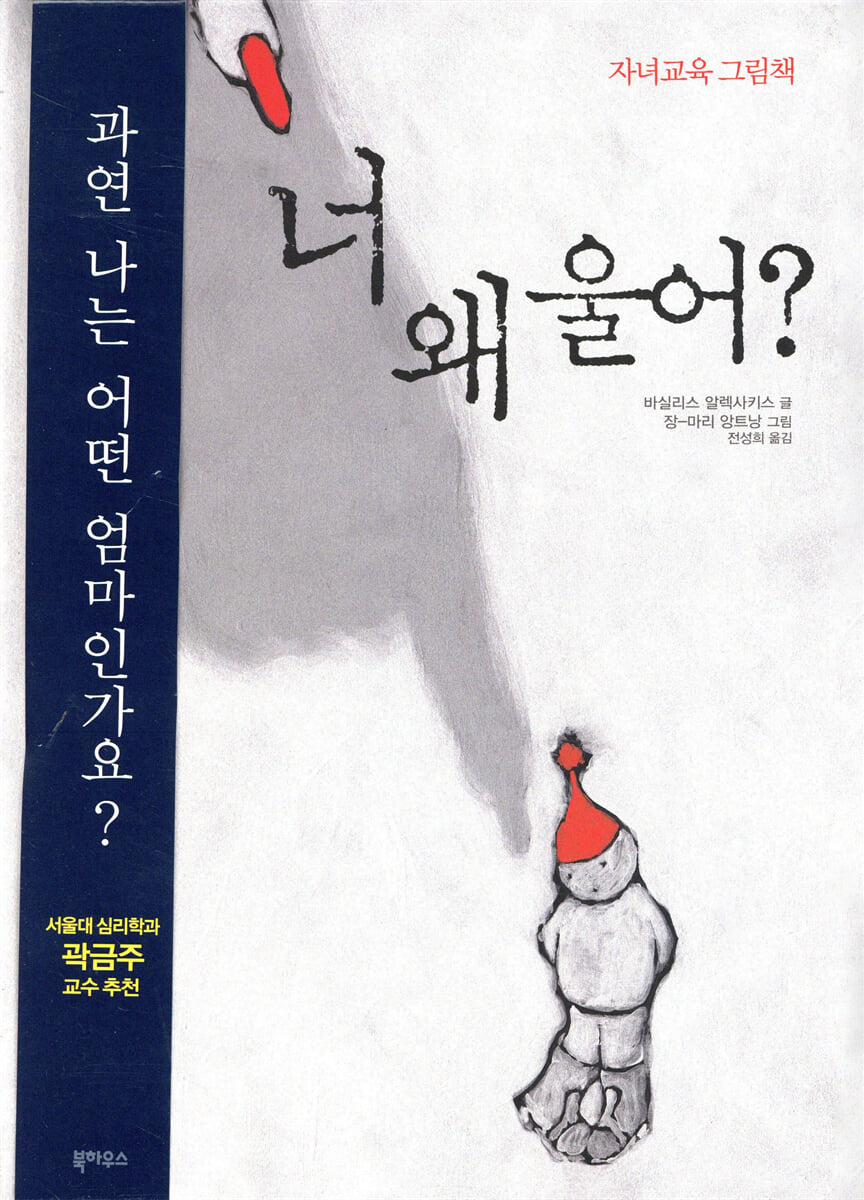
The child on the cover is shrunken, much smaller than the accusing finger pointed at her mother.
“Why are you crying?” asks mom.
What on earth did the child do wrong? The book features a mother and child who frequently clash.
Like these two characters, writing and drawing also clash with each other.
In fact, the text is entirely composed of the mother's words, while the pictures only feature the child.
There is no plot structure, no setting, no tension in the story.
The book simply contains the exact words a mother pours out to her child.
Almost everything my mother says ends with a commanding exclamation or a demanding question mark.
“Put on your coat!” “Go and find your boots!” “So, did you find them?” Mom keeps asking questions and giving commands, but the child doesn’t really listen to her.
Mom's last resort is, "I'll tell Dad everything!"
Like countless parents, this mother finds herself at a loss as to how to cope with her child.
What kind of mother am I?
『Why Are You Crying?』, subtitled ‘Children’s Education Picture Book,’ is far from the typical picture books.
It is a children's education book in the form of a picture book.
However, unlike existing parenting books, it does not provide advice or instructions, but simply shows the everyday life surrounding me and my child as it is.
But the sight of that commonplace everyday life is shocking.
The book engages in a subtle psychological battle with its parent readers.
Behind the 'text' consisting only of the mother's words, the child's voice, which clearly exists in the 'picture' but is nowhere to be heard, forms a stark contrast.
Moreover, the child is often depicted as being trapped in a square, and in the final scene, he is trapped inside the skirt worn by his mother.
A mother is a prison that confines her child with forbidden words.
These two authors, who have continuously studied the relationship between text and image, are making excellent use of the expressive medium called 'picture book'.
Stories can help parents reflect on their feelings more effectively than any instructions or advice.
How am I speaking to my child now?
The child on the cover is shrunken, much smaller than the accusing finger pointed at her mother.
“Why are you crying?” asks mom.
What on earth did the child do wrong? The book features a mother and child who frequently clash.
Like these two characters, writing and drawing also clash with each other.
In fact, the text is entirely composed of the mother's words, while the pictures only feature the child.
There is no plot structure, no setting, no tension in the story.
The book simply contains the exact words a mother pours out to her child.
Almost everything my mother says ends with a commanding exclamation or a demanding question mark.
“Put on your coat!” “Go and find your boots!” “So, did you find them?” Mom keeps asking questions and giving commands, but the child doesn’t really listen to her.
Mom's last resort is, "I'll tell Dad everything!"
Like countless parents, this mother finds herself at a loss as to how to cope with her child.
What kind of mother am I?
『Why Are You Crying?』, subtitled ‘Children’s Education Picture Book,’ is far from the typical picture books.
It is a children's education book in the form of a picture book.
However, unlike existing parenting books, it does not provide advice or instructions, but simply shows the everyday life surrounding me and my child as it is.
But the sight of that commonplace everyday life is shocking.
The book engages in a subtle psychological battle with its parent readers.
Behind the 'text' consisting only of the mother's words, the child's voice, which clearly exists in the 'picture' but is nowhere to be heard, forms a stark contrast.
Moreover, the child is often depicted as being trapped in a square, and in the final scene, he is trapped inside the skirt worn by his mother.
A mother is a prison that confines her child with forbidden words.
These two authors, who have continuously studied the relationship between text and image, are making excellent use of the expressive medium called 'picture book'.
Stories can help parents reflect on their feelings more effectively than any instructions or advice.
How am I speaking to my child now?
GOODS SPECIFICS
- Date of issue: October 26, 2009
- Format: Hardcover book binding method guide
- Page count, weight, size: 44 pages | 318g | 172*240*15mm
- ISBN13: 9788956053820
- ISBN10: 8956053820
You may also like
카테고리
korean


korean

![GQ KOREA Mark (Monthly): December [2025]](http://librairie.coreenne.fr/cdn/shop/files/8ef265dbbfbf186523ed75ba7319009d.jpg?v=1765340328&width=3840)


