

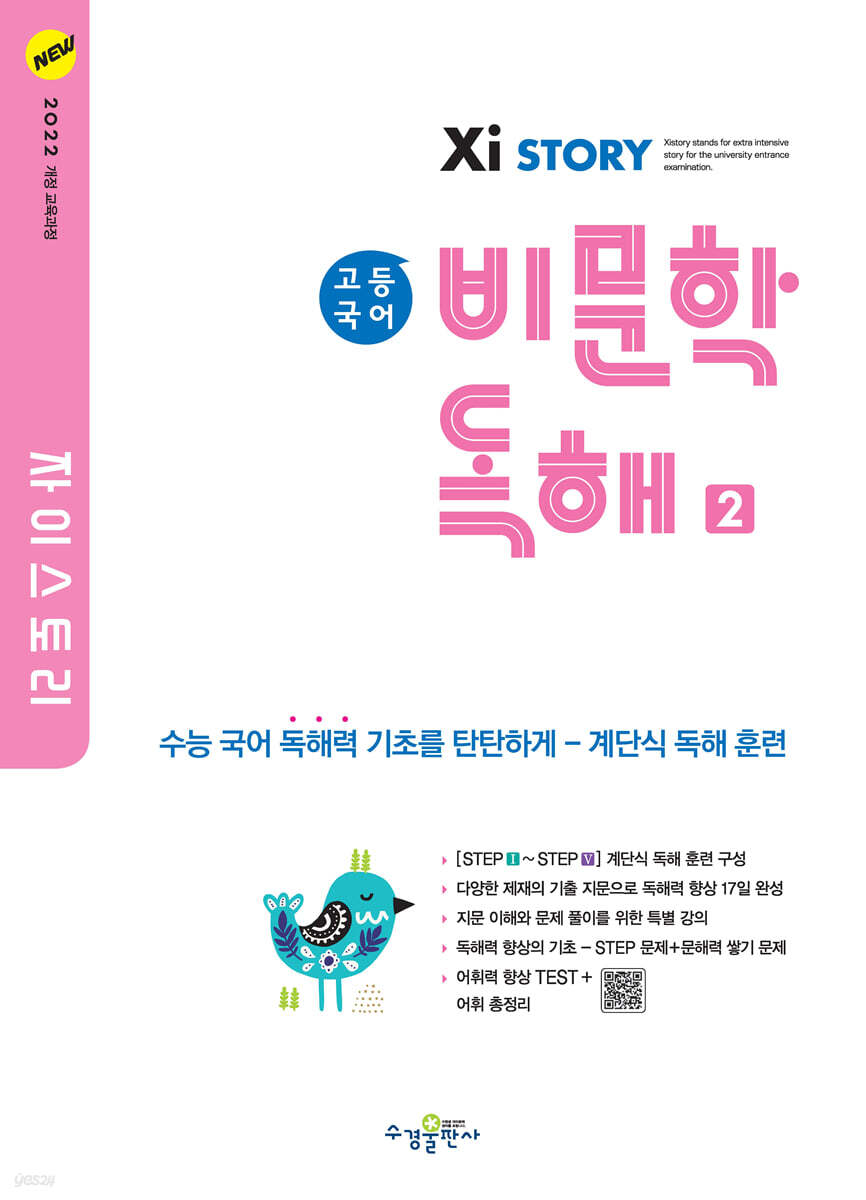
Zaistory High School Korean Non-Fiction Reading 2 (2026)
 |
Description
Book Introduction
The questions from the National Academic Achievement Test for the second year of high school are arranged according to difficulty.
To help you take your skills to the next level, STEP V also includes questions from the National Federation of High School Examinations and the Evaluation Institute.
To help you take your skills to the next level, STEP V also includes questions from the National Federation of High School Examinations and the Evaluation Institute.
- You can preview some of the book's contents.
Preview
index
STEP Ⅰ: Finding Key Words and Central Sentences (2 days)
DAY 01 Frege's Theory of Proper Names [Humanities] 10
+ Fingerprint Analysis Special Lecture 13
+ Problem Solving Special Lecture 13
Plant Variety Protection Act and Establishment of Variety Protection Rights [Society] 15
DAY 02 Principles of Capacitive Touch Screen Panels [Technology] 18
Levinas's Other-Centered Philosophy [Humanities] 21
STEP Ⅱ: Summarizing Paragraphs and Understanding Relationships Between Paragraphs (3 Days)
DAY 03 Nietzsche's Philosophy on Life [Humanities] 28
+ Fingerprint Analysis Special Lecture 31
+ Problem Solving Special Lecture 31
The Structure of the Eye and the Role of Aqueous Humor [Science] 33
DAY 04 Plotinus's Theory of Beauty [Humanities] 36
STR Analysis [Science] 41
DAY 05 Memory and Forgetting in Western Philosophy [Humanities] 44
Characteristics and Functions of the Certified Mail System [Society] 47
STEP Ⅲ: Understanding the Structure of the Text and Finding the Topic (4 days)
DAY 06 mRNA Vaccines and Lipid Nanoparticles [Science] 54
+ Fingerprint Analysis Special Lecture 57
+Problem Solving Special Lecture 57
Chemical Precipitation Method Among Water Purification Technologies [Science] 59
DAY 07 Second-Best Theory and Social Indifference Curves [Society] 62
Characteristics of Fertility Ethics [Humanities] 65
DAY 08 (A) Classical Philosophy of Technology with a Focus on Technology in General [Humanities]
Philosophers Who Criticized Classical Philosophy of Technology [Humanities] 68
+ Fingerprint Analysis Special Lecture 73
+Problem Solving Special Lecture 74
(a) The profit-seeking process of a monopoly [Society]
(I) Understanding the Fair Trade Act [Society] 76
DAY 09 Frankl's Psychology and Psychotherapy [Humanities] 80
(a) Access to and use of media [Society]
(I) A means of redress for individuals harmed by the media [Society] 83
STEP Ⅳ Skill Test (3 days)
DAY 10 Combustion Instability in Liquid Propellant Rockets [Technology] 90
Dispute Settlement Mechanism under the United Nations Convention on the Law of the Sea [Society] 92
(a) Husserl's philosophy on the meaning of the object [Humanities]
(I) Merleau-Ponty's View on Body Perception [Humanities] 95
DAY 11: Poison in Living Things [Science] 98
Extradition System [Society] 100
Types and Principles of Automatic Repeat Request Methods [Technology] 103
DAY 12: The Coexistence of the Human Immune System and Foreign Substances [Science] 106
Administrative Agencies and the Trust Protection Principle [Society] 109
(A) Plato and Deleuze's view of art [Humanities + Arts]
(I) Baudrillard's Interpretation of Art [Humanities + Arts] 111
STEP Ⅴ Mock Test for the Strongest Skills (5 days)
DAY 13 Virus Infection Methods and Types [Science] 118
Citizen Participation Trials and Juries [Society] 120
(a) Saussure's Linguistics [Humanities]
(I) Wittgenstein's Theory of the Use of Meaning [Humanities] 122
DAY 14 Sartre's Existentialism [Humanities] 126
Understanding and Significance of Dimensional Analysis [Science] 128
(a) Concept and characteristics of the Constitution [Society]
(I) Various Perspectives on the Constitution [Society] 131
DAY 15 Crystallization Process [Technology] 134
Rational Choices of Enterprises Regarding Production [Society] 136
(a) Philosophers' Views on Reason and Object [Humanities]
Goodman's Argument About the Version and the World [Humanities] 139
DAY 16: Olfactory Stimulus Signal Transmission Process [Science] 142
Digital Camera Data Generation Method [Technology] 144
(a) Psychological Philosophers' Perspectives on Consciousness [Humanities]
(I) Different Perspectives on Perception [Humanities] 145
DAY 17: The Operating Principles and Applications of Ultra-Precision Scales [Technology] 148
Perspectives on Rational Behavior and Policy Decision-Making Models [Society] 149
(a) Mirror neurons and human imitative behavior [Humanities]
Memes and Imitation [Humanities] 152
DAY 01 Frege's Theory of Proper Names [Humanities] 10
+ Fingerprint Analysis Special Lecture 13
+ Problem Solving Special Lecture 13
Plant Variety Protection Act and Establishment of Variety Protection Rights [Society] 15
DAY 02 Principles of Capacitive Touch Screen Panels [Technology] 18
Levinas's Other-Centered Philosophy [Humanities] 21
STEP Ⅱ: Summarizing Paragraphs and Understanding Relationships Between Paragraphs (3 Days)
DAY 03 Nietzsche's Philosophy on Life [Humanities] 28
+ Fingerprint Analysis Special Lecture 31
+ Problem Solving Special Lecture 31
The Structure of the Eye and the Role of Aqueous Humor [Science] 33
DAY 04 Plotinus's Theory of Beauty [Humanities] 36
STR Analysis [Science] 41
DAY 05 Memory and Forgetting in Western Philosophy [Humanities] 44
Characteristics and Functions of the Certified Mail System [Society] 47
STEP Ⅲ: Understanding the Structure of the Text and Finding the Topic (4 days)
DAY 06 mRNA Vaccines and Lipid Nanoparticles [Science] 54
+ Fingerprint Analysis Special Lecture 57
+Problem Solving Special Lecture 57
Chemical Precipitation Method Among Water Purification Technologies [Science] 59
DAY 07 Second-Best Theory and Social Indifference Curves [Society] 62
Characteristics of Fertility Ethics [Humanities] 65
DAY 08 (A) Classical Philosophy of Technology with a Focus on Technology in General [Humanities]
Philosophers Who Criticized Classical Philosophy of Technology [Humanities] 68
+ Fingerprint Analysis Special Lecture 73
+Problem Solving Special Lecture 74
(a) The profit-seeking process of a monopoly [Society]
(I) Understanding the Fair Trade Act [Society] 76
DAY 09 Frankl's Psychology and Psychotherapy [Humanities] 80
(a) Access to and use of media [Society]
(I) A means of redress for individuals harmed by the media [Society] 83
STEP Ⅳ Skill Test (3 days)
DAY 10 Combustion Instability in Liquid Propellant Rockets [Technology] 90
Dispute Settlement Mechanism under the United Nations Convention on the Law of the Sea [Society] 92
(a) Husserl's philosophy on the meaning of the object [Humanities]
(I) Merleau-Ponty's View on Body Perception [Humanities] 95
DAY 11: Poison in Living Things [Science] 98
Extradition System [Society] 100
Types and Principles of Automatic Repeat Request Methods [Technology] 103
DAY 12: The Coexistence of the Human Immune System and Foreign Substances [Science] 106
Administrative Agencies and the Trust Protection Principle [Society] 109
(A) Plato and Deleuze's view of art [Humanities + Arts]
(I) Baudrillard's Interpretation of Art [Humanities + Arts] 111
STEP Ⅴ Mock Test for the Strongest Skills (5 days)
DAY 13 Virus Infection Methods and Types [Science] 118
Citizen Participation Trials and Juries [Society] 120
(a) Saussure's Linguistics [Humanities]
(I) Wittgenstein's Theory of the Use of Meaning [Humanities] 122
DAY 14 Sartre's Existentialism [Humanities] 126
Understanding and Significance of Dimensional Analysis [Science] 128
(a) Concept and characteristics of the Constitution [Society]
(I) Various Perspectives on the Constitution [Society] 131
DAY 15 Crystallization Process [Technology] 134
Rational Choices of Enterprises Regarding Production [Society] 136
(a) Philosophers' Views on Reason and Object [Humanities]
Goodman's Argument About the Version and the World [Humanities] 139
DAY 16: Olfactory Stimulus Signal Transmission Process [Science] 142
Digital Camera Data Generation Method [Technology] 144
(a) Psychological Philosophers' Perspectives on Consciousness [Humanities]
(I) Different Perspectives on Perception [Humanities] 145
DAY 17: The Operating Principles and Applications of Ultra-Precision Scales [Technology] 148
Perspectives on Rational Behavior and Policy Decision-Making Models [Society] 149
(a) Mirror neurons and human imitative behavior [Humanities]
Memes and Imitation [Humanities] 152
Detailed image

Publisher's Review
[Problem] Features
1.
Step-by-step reading comprehension improvement learning method
Learn what to focus on and read by following each step.
Before you know it, your reading comprehension skills for the CSAT will improve rapidly.
·STEP (1) - Finding keywords and central sentences
·STEP (2) - Summarizing paragraphs and understanding relationships between paragraphs
·STEP (3) - Understanding the structure of the text and finding the topic
·STEP (4) - Skill Test
·STEP (5) - The ultimate mock exam
2.
Special problem structure to develop reading comprehension skills in a fun way
· Literacy building problem
- You can understand the meaning of directives, conjunctions, sentences, and passages.
- By solving literacy building problems, you can summarize the main points of the text.
· Step-by-step reading comprehension questions
- If you train with the STEP-by-STEP reading comprehension improvement learning method, you will be able to easily understand the text.
- You can quickly improve your reading comprehension by practicing the learning elements step by step.
· National Federation of University Examinations Past Questions
- The questions from the National Academic Achievement Test for the second year of high school are arranged according to difficulty.
- To help you take your skills to the next level, STEP V also includes questions from the National Federation of High School Examinations and the Evaluation Institute.
3.
My Private Tutor - "Special Lecture on Fingerprint Analysis" and "Special Lecture on Problem Solving"
· Special lecture on fingerprint analysis
It helps you practice quickly and accurately understanding the content of a text.
· Special lecture on problem solving
It teaches you how to solve problems and why choices are right or wrong.
4.
Vocabulary Enhancement Test + Background Knowledge
· Vocabulary Improvement Test
You can solidify your vocabulary by solving various types of problems using the vocabulary in the text and problems.
· Vocabulary summary
- We have compiled essential vocabulary for each day.
- In the case of Chinese characters, the pronunciation and meaning of the Chinese characters are also presented.
[Commentary] Features
1.
The entire text is included in the commentary, and the text, questions, and choice options are explained in detail so that you can understand at a glance why the answer is correct or incorrect.
2.
We summarize the content of each paragraph and display the keywords and central sentences of the entire text to help you quickly understand the content of the text.
3.
The relationship between topics and paragraphs and the structure of the text are presented to help readers fully understand the content of the text.
4.
By asking 'Why is it correct?' and 'Why is it wrong?', we provide the basis for the correct and incorrect answers, thereby increasing understanding of the problem.
5.
High-difficulty problems are classified as ‘1st grade problems’ and special explanations are provided.
Building a Solid Foundation for the College Scholastic Ability Test's Korean Reading Comprehension Skills - Step-by-Step Reading Training
· [STEP Ⅰ~ STEP Ⅴ] Step-by-step reading training structure
· Improve your reading comprehension with past exam questions on various subjects. Complete in 17 days.
· Special lectures for understanding fingerprints and solving problems
· The foundation for improving reading comprehension - step problems + literacy building problems
· Vocabulary Improvement Test + Vocabulary Summary
1.
Step-by-step reading comprehension improvement learning method
Learn what to focus on and read by following each step.
Before you know it, your reading comprehension skills for the CSAT will improve rapidly.
·STEP (1) - Finding keywords and central sentences
·STEP (2) - Summarizing paragraphs and understanding relationships between paragraphs
·STEP (3) - Understanding the structure of the text and finding the topic
·STEP (4) - Skill Test
·STEP (5) - The ultimate mock exam
2.
Special problem structure to develop reading comprehension skills in a fun way
· Literacy building problem
- You can understand the meaning of directives, conjunctions, sentences, and passages.
- By solving literacy building problems, you can summarize the main points of the text.
· Step-by-step reading comprehension questions
- If you train with the STEP-by-STEP reading comprehension improvement learning method, you will be able to easily understand the text.
- You can quickly improve your reading comprehension by practicing the learning elements step by step.
· National Federation of University Examinations Past Questions
- The questions from the National Academic Achievement Test for the second year of high school are arranged according to difficulty.
- To help you take your skills to the next level, STEP V also includes questions from the National Federation of High School Examinations and the Evaluation Institute.
3.
My Private Tutor - "Special Lecture on Fingerprint Analysis" and "Special Lecture on Problem Solving"
· Special lecture on fingerprint analysis
It helps you practice quickly and accurately understanding the content of a text.
· Special lecture on problem solving
It teaches you how to solve problems and why choices are right or wrong.
4.
Vocabulary Enhancement Test + Background Knowledge
· Vocabulary Improvement Test
You can solidify your vocabulary by solving various types of problems using the vocabulary in the text and problems.
· Vocabulary summary
- We have compiled essential vocabulary for each day.
- In the case of Chinese characters, the pronunciation and meaning of the Chinese characters are also presented.
[Commentary] Features
1.
The entire text is included in the commentary, and the text, questions, and choice options are explained in detail so that you can understand at a glance why the answer is correct or incorrect.
2.
We summarize the content of each paragraph and display the keywords and central sentences of the entire text to help you quickly understand the content of the text.
3.
The relationship between topics and paragraphs and the structure of the text are presented to help readers fully understand the content of the text.
4.
By asking 'Why is it correct?' and 'Why is it wrong?', we provide the basis for the correct and incorrect answers, thereby increasing understanding of the problem.
5.
High-difficulty problems are classified as ‘1st grade problems’ and special explanations are provided.
Building a Solid Foundation for the College Scholastic Ability Test's Korean Reading Comprehension Skills - Step-by-Step Reading Training
· [STEP Ⅰ~ STEP Ⅴ] Step-by-step reading training structure
· Improve your reading comprehension with past exam questions on various subjects. Complete in 17 days.
· Special lectures for understanding fingerprints and solving problems
· The foundation for improving reading comprehension - step problems + literacy building problems
· Vocabulary Improvement Test + Vocabulary Summary
GOODS SPECIFICS
- Date of issue: August 20, 2024
- Page count, weight, size: 336 pages | 215*297*30mm
- ISBN13: 9791162406014
- ISBN10: 1162406011
You may also like
카테고리
korean


korean

![GQ KOREA Mark (Monthly): December [2025]](http://librairie.coreenne.fr/cdn/shop/files/8ef265dbbfbf186523ed75ba7319009d.jpg?v=1765340328&width=3840)


