

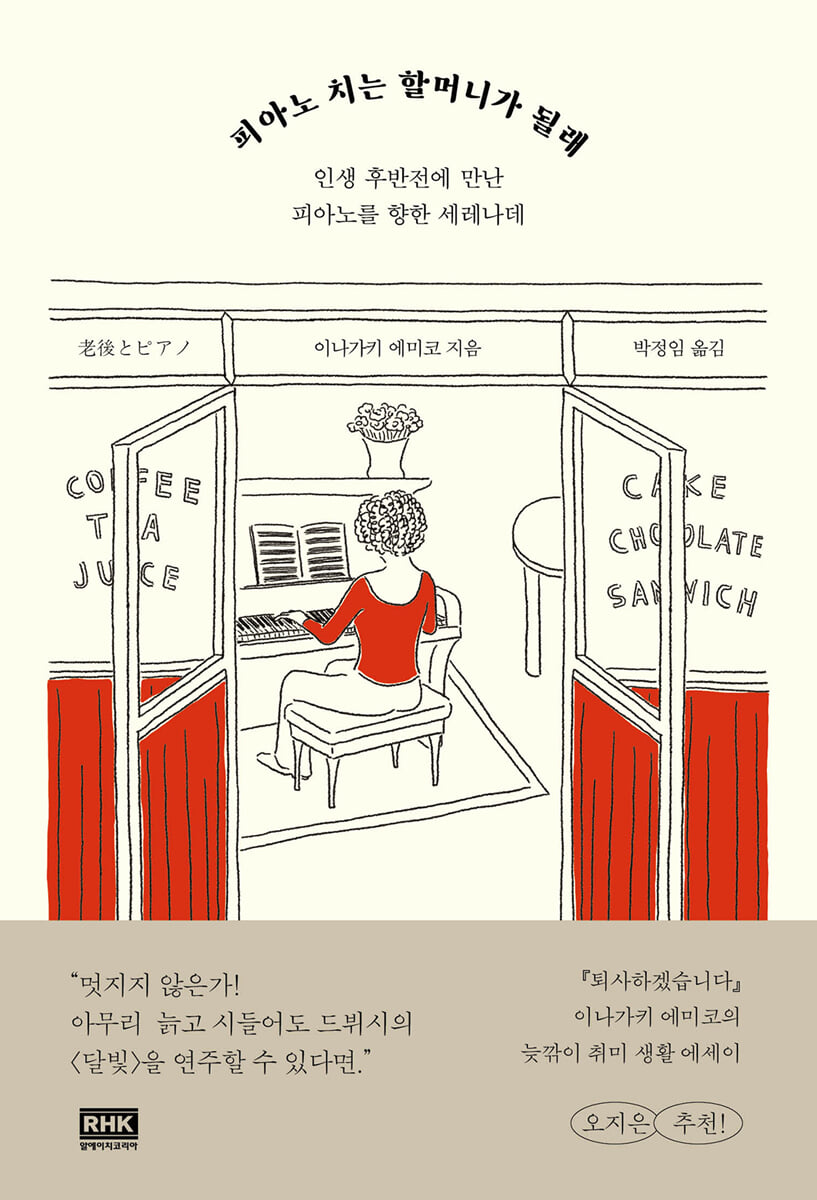
I want to be a grandma who plays the piano
 |
Description
Book Introduction
“I am 53 years old and I am learning the piano again after 40 years.
“I am willing to give up the rest of my life!”
Emiko Inagaki from SBS Special 'I Quit My Job'
A middle-aged man's journey to mastering the piano, dreaming of a happy second half of life.
Will my life be fun when I'm older? Even as I'm busy living today, when this question suddenly pops into my head, it's hard to shake.
By then, your body will be stiffer, you won't be as strong as you are now, and your motivation will gradually decline.
(Because what you can't do will be more visible than what you can do) Here, there is someone in his 50s who is so absorbed in 'this' that he learned it again that he is dedicating the rest of his life to it.
Emiko Inagaki is a Japanese essayist who became known for her essay of the same name as the SBS special "I Will Quit My Job," which sparked a craze for quitting jobs in Korea.
He returned with a piano essay, “I Want to Become a Grandma Who Plays the Piano,” which contains the joys and sorrows of middle age.
After leaving his job, at the age of 53, the author started learning the piano again, which he had given up as a child, and became completely absorbed in it.
Of course, there are countless obstacles ahead.
His body and mind don't keep up with his desires, and he faces the limitations of his abilities every day... As he keeps track of his daily records, you can fully feel and empathize with the frustration and sadness he feels.
Nevertheless, he continues to preach the joy and delight that learning brings.
Sometimes I feel proud of my teacher's praise and enjoy the joy of playing the song of my dreams.
The author's writing reveals insights into life gained through piano and his firm determination to live the second half of his life, prompting readers to reflect on their own attitudes toward life.
And, by dedicating a separate page, he teaches "How to Start Playing the 'Adult Piano'" to help those who, like him, are learning piano late in life.
If you can't see an interesting future for yourself, if you're shaking your head thinking, "It's too late to learn anything," I highly recommend reading this.
“I am willing to give up the rest of my life!”
Emiko Inagaki from SBS Special 'I Quit My Job'
A middle-aged man's journey to mastering the piano, dreaming of a happy second half of life.
Will my life be fun when I'm older? Even as I'm busy living today, when this question suddenly pops into my head, it's hard to shake.
By then, your body will be stiffer, you won't be as strong as you are now, and your motivation will gradually decline.
(Because what you can't do will be more visible than what you can do) Here, there is someone in his 50s who is so absorbed in 'this' that he learned it again that he is dedicating the rest of his life to it.
Emiko Inagaki is a Japanese essayist who became known for her essay of the same name as the SBS special "I Will Quit My Job," which sparked a craze for quitting jobs in Korea.
He returned with a piano essay, “I Want to Become a Grandma Who Plays the Piano,” which contains the joys and sorrows of middle age.
After leaving his job, at the age of 53, the author started learning the piano again, which he had given up as a child, and became completely absorbed in it.
Of course, there are countless obstacles ahead.
His body and mind don't keep up with his desires, and he faces the limitations of his abilities every day... As he keeps track of his daily records, you can fully feel and empathize with the frustration and sadness he feels.
Nevertheless, he continues to preach the joy and delight that learning brings.
Sometimes I feel proud of my teacher's praise and enjoy the joy of playing the song of my dreams.
The author's writing reveals insights into life gained through piano and his firm determination to live the second half of his life, prompting readers to reflect on their own attitudes toward life.
And, by dedicating a separate page, he teaches "How to Start Playing the 'Adult Piano'" to help those who, like him, are learning piano late in life.
If you can't see an interesting future for yourself, if you're shaking your head thinking, "It's too late to learn anything," I highly recommend reading this.
- You can preview some of the book's contents.
Preview
index
Preface for Korean Readers
prolog
1st movement.
Piano after 40 years
Tip 1: How to Start Playing Piano for Adults
2nd movement.
Play the dream song
Tip 2: How to Start Playing Piano for Adults
3rd movement.
Stiff body, straight head
Tip 3: How to Start Playing Piano as an Adult
4th movement.
Finally the presentation
tip my secret ambition
5th movement.
I want to be a grandma who plays the piano
Epilogue
Appendix 1.
List of songs challenged
Appendix 2.
11 Favorite Albums
prolog
1st movement.
Piano after 40 years
Tip 1: How to Start Playing Piano for Adults
2nd movement.
Play the dream song
Tip 2: How to Start Playing Piano for Adults
3rd movement.
Stiff body, straight head
Tip 3: How to Start Playing Piano as an Adult
4th movement.
Finally the presentation
tip my secret ambition
5th movement.
I want to be a grandma who plays the piano
Epilogue
Appendix 1.
List of songs challenged
Appendix 2.
11 Favorite Albums
Detailed image
.jpg)
Into the book
The people I mostly encountered in society were ‘people’.
People really don't move the way my heart does.
(…) Compared to that, isn’t playing the piano a piece of cake? Then, it’s all up to me.
To play the piano or not to play it.
To try or not to try.
--- p.26
Dodosolsollalasol… .
It was quite a shock.
Far from being simple, isn't this a total undertaking!
First of all, I was truly surprised at how heavy the keyboard was.
--- p.30
It's the very finger number I hated so much when I was little.
To me at that time, finger numbers were just annoying rules that hindered my free playing.
But I am different now than I was then.
I believe that rules have meaning and contain the wisdom of our ancestors.
--- p.31
Have you ever heard a piece by Chopin whose rhythm is as regular as a metronome? I have! Yes, that's the Chopin I play.
How pathetic this is.
No, what the hell am I doing? I have a ton of other things to do besides playing the piano… .
--- p.54
Each variation is a bloody record of each pianist's struggle with the score.
--- p.111
I thought that the weapon of an adult was knowing that 'effort never betrays'.
Clearly, children's potential is limitless, but unfortunately, it is difficult for them to work hard with sincerity.
But adults can do it.
Even rusty possibilities can be polished with effort.
That's why I'm facing the piano at this age.
--- p.138
Adults have their own piano, their own kind of piano.
The joy of playing the piano for adults lies in something other than trivial matters like skill level.
--- p.148
People who are going to get dementia will get it.
However, they say that even with severe dementia, you can still play the piano.
Wouldn't it be wonderful! No matter how old and withered you become, you can still play Debussy's "Moonlight" with such brilliance.
--- p.204
I've always thought that since I started learning the piano, I should eventually be able to play it 'proficiently'.
So I was afraid of my age and of getting older in the future.
But isn't what's truly important not playing skillfully, but maintaining a fresh love for the song?
If it's more important whether or not you can continue to hold on to that love no matter how old you get...
--- p.260
The best part is that no matter how old you get and how much your physical and mental abilities decline, you won't have to worry about feeling frustrated or frustrated because your skills haven't improved at all or even have decreased.
People really don't move the way my heart does.
(…) Compared to that, isn’t playing the piano a piece of cake? Then, it’s all up to me.
To play the piano or not to play it.
To try or not to try.
--- p.26
Dodosolsollalasol… .
It was quite a shock.
Far from being simple, isn't this a total undertaking!
First of all, I was truly surprised at how heavy the keyboard was.
--- p.30
It's the very finger number I hated so much when I was little.
To me at that time, finger numbers were just annoying rules that hindered my free playing.
But I am different now than I was then.
I believe that rules have meaning and contain the wisdom of our ancestors.
--- p.31
Have you ever heard a piece by Chopin whose rhythm is as regular as a metronome? I have! Yes, that's the Chopin I play.
How pathetic this is.
No, what the hell am I doing? I have a ton of other things to do besides playing the piano… .
--- p.54
Each variation is a bloody record of each pianist's struggle with the score.
--- p.111
I thought that the weapon of an adult was knowing that 'effort never betrays'.
Clearly, children's potential is limitless, but unfortunately, it is difficult for them to work hard with sincerity.
But adults can do it.
Even rusty possibilities can be polished with effort.
That's why I'm facing the piano at this age.
--- p.138
Adults have their own piano, their own kind of piano.
The joy of playing the piano for adults lies in something other than trivial matters like skill level.
--- p.148
People who are going to get dementia will get it.
However, they say that even with severe dementia, you can still play the piano.
Wouldn't it be wonderful! No matter how old and withered you become, you can still play Debussy's "Moonlight" with such brilliance.
--- p.204
I've always thought that since I started learning the piano, I should eventually be able to play it 'proficiently'.
So I was afraid of my age and of getting older in the future.
But isn't what's truly important not playing skillfully, but maintaining a fresh love for the song?
If it's more important whether or not you can continue to hold on to that love no matter how old you get...
--- p.260
The best part is that no matter how old you get and how much your physical and mental abilities decline, you won't have to worry about feeling frustrated or frustrated because your skills haven't improved at all or even have decreased.
--- p.268
Publisher's Review
“Adults have their own pianos, their own unique pianos.”
The joys of growing older and loving myself, learned from the piano
For Korean millennials, piano academies were a familiar place during their childhood.
At the time, the piano was a symbol of economic prosperity, and even in Japan, which had achieved economic growth a decade earlier, the piano was a required course for children.
It seems that not only the phenomenon was similar, but even the mindset of children learning piano in Korea and Japan was similar.
“When I played the piano with a stutter, the young teacher’s beautiful face instantly turned into a ferocious ghostly expression.
How loud was the ghost's sigh, as if telling us to listen?
(…) So, it is difficult to find any happy memories related to the piano.” (p.22)
Reading the author's vivid accounts of his experiences, I can't help but picture children locked in their rooms, bored, playing Bayer or Czerny, or coloring two or three empty apples after one practice session.
Like many others, author Emiko Inagaki did not have a long relationship with the piano as a child.
Then, after retiring from my job at the age of 50, a desire to play the piano suddenly arose from deep within my heart.
So, after 40 years, I started playing the piano again.
The author personally experiences the difficulties of learning piano as one gets older.
The author's vivid writing style captures these hilarious incidents: being surprised by the weight of the keyboard, desperately pressing the keys while reading the finger numbers that he had ignored as a child, and having to double-size and copy sheet music due to presbyopia.
This is a story of laughter and tears, about tasting a sparkling moment of growth when you feel like it's too late, and then facing another crisis just as you're intoxicated by that taste.
Through repeated trial and error, the author realizes:
The pleasures to be enjoyed in the second half of life are quite different from those before.
Even if you don't achieve perfect results in the eyes of others, the attitude of giving your all in every moment that seems fleeting will make your life enjoyable.
“I always thought that since I was learning the piano, I would eventually be able to play it ‘proficiently.’
So I was afraid of my age and of getting older in the future.
But isn't what's truly important not playing skillfully, but maintaining a fresh love for the song?
“If it’s more important whether or not you can continue to hold on to that love no matter how old you get…” (p.260)
The author, who was frustrated by words like 'old age' and 'old age', confesses that he was finally able to grow old happily after meeting the piano.
So, the author sits down in front of the piano that makes him laugh and cry, and presses the keys again today.
Waiting for someone else to embark on the same adventure as you.
The joys of growing older and loving myself, learned from the piano
For Korean millennials, piano academies were a familiar place during their childhood.
At the time, the piano was a symbol of economic prosperity, and even in Japan, which had achieved economic growth a decade earlier, the piano was a required course for children.
It seems that not only the phenomenon was similar, but even the mindset of children learning piano in Korea and Japan was similar.
“When I played the piano with a stutter, the young teacher’s beautiful face instantly turned into a ferocious ghostly expression.
How loud was the ghost's sigh, as if telling us to listen?
(…) So, it is difficult to find any happy memories related to the piano.” (p.22)
Reading the author's vivid accounts of his experiences, I can't help but picture children locked in their rooms, bored, playing Bayer or Czerny, or coloring two or three empty apples after one practice session.
Like many others, author Emiko Inagaki did not have a long relationship with the piano as a child.
Then, after retiring from my job at the age of 50, a desire to play the piano suddenly arose from deep within my heart.
So, after 40 years, I started playing the piano again.
The author personally experiences the difficulties of learning piano as one gets older.
The author's vivid writing style captures these hilarious incidents: being surprised by the weight of the keyboard, desperately pressing the keys while reading the finger numbers that he had ignored as a child, and having to double-size and copy sheet music due to presbyopia.
This is a story of laughter and tears, about tasting a sparkling moment of growth when you feel like it's too late, and then facing another crisis just as you're intoxicated by that taste.
Through repeated trial and error, the author realizes:
The pleasures to be enjoyed in the second half of life are quite different from those before.
Even if you don't achieve perfect results in the eyes of others, the attitude of giving your all in every moment that seems fleeting will make your life enjoyable.
“I always thought that since I was learning the piano, I would eventually be able to play it ‘proficiently.’
So I was afraid of my age and of getting older in the future.
But isn't what's truly important not playing skillfully, but maintaining a fresh love for the song?
“If it’s more important whether or not you can continue to hold on to that love no matter how old you get…” (p.260)
The author, who was frustrated by words like 'old age' and 'old age', confesses that he was finally able to grow old happily after meeting the piano.
So, the author sits down in front of the piano that makes him laugh and cry, and presses the keys again today.
Waiting for someone else to embark on the same adventure as you.
GOODS SPECIFICS
- Publication date: November 10, 2022
- Page count, weight, size: 288 pages | 316g | 128*188*20mm
- ISBN13: 9788925577302
- ISBN10: 8925577305
You may also like
카테고리
korean


korean

![GQ KOREA Mark (Monthly): December [2025]](http://librairie.coreenne.fr/cdn/shop/files/8ef265dbbfbf186523ed75ba7319009d.jpg?v=1765340328&width=3840)


