

case
 |
Description
Book Introduction
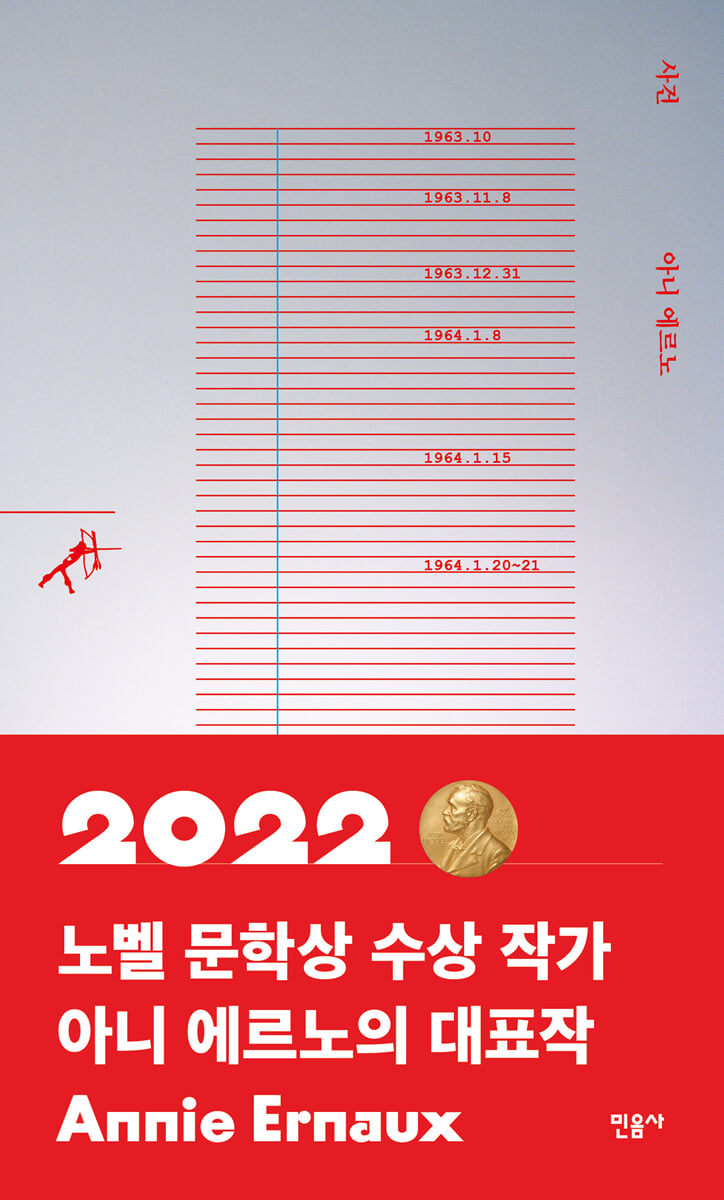
A master of modern French literature, A courageous confession from Annie Ernaux, author of "Writing Like a Knife." Annie Ernaux, who reigns as one of the most important writers in French literature with her unique writing style that clearly reveals her true self in detail, combining autobiographical research and social scientific methodology, has published her courageous confessional book, "The Incident," in the Minumsa Thornsal Library. The name of Annie Ernaux, who has received no small amount of shock from the literary world by revealing intense sexual experiences and indiscriminate desires without filtering, such as 『Simple Passion』 and 『Indulgence』, as well as 『A Man's Place』 and 『A Woman』, which coolly look back on the lives and deaths of her father and mother, 『Shame』, which vividly depicts her fate born into a proletarian family and her shameful inner struggle to escape from it, and 『Years』, which has already been recorded as a literary event rather than just a single work, is not unfamiliar to our readers. She was nominated for not only major French literary awards but also a finalist for the 2019 Man Booker International Prize. Annie Ernaux, who has been constantly confessing herself since appearing in the literary world, confessed that it was especially painful to talk about 『The Incident』. This is because it was deemed impossible to thoroughly confess the experience of abortion, which could be called the ‘event’ of ‘Incident’, without any exaggeration or error. So the author had to wait until abortion, which was prohibited by law and branded a crime, became a 'woman's choice.' And then, after a long time, at the very moment when I was just getting a routine STD test, suddenly, like a bolt from the blue, I suddenly remembered myself in my twenties, pregnant and forced to have an abortion. Eventually, Ernaux revisits her past diary, and as she fiercely encounters the places she wandered to and the music that flowed indifferently, she is roughly swept into a desperate time when she desperately longed for “her period to start.” Even though everyone knows about this (abortion), they never say anything about it. Even for the same sex and same pregnancy, there is a double standard that separates men and women, and the law inevitably drives women who have to have abortions to death and brands them as depraved women. Finally, Annie Ernaux realizes that 'pregnancy' and 'abortion', which are not protected by the system, are clear symbols of social decline and academic failure, and she puts her life on the line and inserts a knitting needle and the probe of an illegal practitioner into her vagina. “As has always been the case, it is impossible to determine whether abortion is banned because it is bad, or whether it is bad because it is banned. As the author accuses, “We judged in light of the law, not the law,” “The Incident” raises a current issue in our country, where “abortion” remains a legal issue. |
- You can preview some of the book's contents.
Preview
index
text
Detailed image
.jpg)
Into the book
In October 1963, in Rouen, I waited for more than a week for my period to start.
It was a clear and mild day.
I kept hoping I could see the blood on her panties.
Every evening, I started writing 'nothing' in my notebook and underlining it.
Even when I woke up at night, I immediately realized that there was 'nothing'.
I realized that my period would not start.
There was no path to follow, no signs to follow.
Many novels have mentioned abortion, but they don't go into detail about exactly how it happens.
The time between the moment a woman discovers she is pregnant and the moment she is no longer pregnant is omitted.
It was a clear and mild day.
I kept hoping I could see the blood on her panties.
Every evening, I started writing 'nothing' in my notebook and underlining it.
Even when I woke up at night, I immediately realized that there was 'nothing'.
I realized that my period would not start.
There was no path to follow, no signs to follow.
Many novels have mentioned abortion, but they don't go into detail about exactly how it happens.
The time between the moment a woman discovers she is pregnant and the moment she is no longer pregnant is omitted.
--- From the text
Publisher's Review
A master of modern French literature,
A courageous confession from Annie Ernaux, author of "Writing Like a Knife."
Annie Ernaux, who reigns as one of the most important writers in French literature with her unique writing style that clearly reveals her true self in detail, combining autobiographical research and social scientific methodology, has published her courageous confessional book, "The Incident," in the Minumsa Thornsal Library.
The name of Annie Ernaux, who has received no small amount of shock from the literary world by revealing intense sexual experiences and indiscriminate desires without filtering, such as 『Simple Passion』 and 『Indulgence』, as well as 『A Man's Place』 and 『A Woman』, which coolly look back on the lives and deaths of her father and mother, 『Shame』, which vividly depicts her fate born into a proletarian family and her shameful inner struggle to escape from it, and 『Years』, which has already been recorded as a literary event rather than just a single work, is not unfamiliar to our readers. She was nominated for not only major French literary awards but also a finalist for the 2019 Man Booker International Prize.
Annie Ernaux, who has been constantly confessing herself since appearing in the literary world, confessed that it was especially painful to talk about 『The Incident』.
This is because it was deemed impossible to thoroughly confess the experience of abortion, which could be called the ‘event’ of ‘Incident’, without any exaggeration or error.
So the author had to wait until abortion, which was prohibited by law and branded a crime, became a 'woman's choice.'
And then, after a long time, at the very moment when I was just getting a routine STD test, suddenly, like a bolt from the blue, I suddenly remembered myself in my twenties, pregnant and forced to have an abortion.
Eventually, Ernaux revisits her past diary, and as she fiercely encounters the places she wandered to and the music that flowed indifferently, she is roughly swept into a desperate time when she desperately longed for “her period to start.”
Sex was a shared responsibility for both herself and the Bordeaux boys, but pregnancy, which came as an unexpected accident, was a burden only for women.
The author recalls that while she felt no different from a man during sex, it was only after she became pregnant that she became acutely aware of the fact that she was “a woman.”
Unable to confide in her conservative and religious parents, the narrator desperately seeks out friends who support free love and are sensitive to women's rights.
However, even they secretly look down on 'abortion', treating it as an exceptional case.
Even a man who asked for help sexually harassed her, treating her as a woman who "didn't have to worry about getting pregnant anyway" (since she was already pregnant).
Even though everyone knows about this (abortion), they never say anything about it.
Even for the same sex and same pregnancy, there is a double standard that separates men and women, and the law inevitably drives women who have to have abortions to death and brands them as depraved women.
Finally, Annie Ernaux realizes that 'pregnancy' and 'abortion', which are not protected by the system, are clear symbols of social decline and academic failure, and she puts her life on the line and inserts a knitting needle and the probe of an illegal practitioner into her vagina.
“As has always been the case, it is impossible to determine whether abortion is banned because it is bad, or whether it is bad because it is banned.
As the author accuses, “We judged in light of the law, not the law,” “The Incident” raises a current issue in our country, where “abortion” remains a legal issue.
Look at this piece!
A Brave New World of Women's Literature Discovered at the Sossal Library
The world women face,
Experiences recorded by women,
The fate that women struggled for,
Discovering new horizons in literature
Since the publication of the first book of 'Ssongsal Munko' in commemoration of the 50th anniversary of the founding of Minumsa in July 2016, the total number of books in the 'Women's Literature Collection' has exceeded 50 with the publication of this 'Women's Literature Collection' (excluding special editions such as 'Neighborhood Bookstore Edition' and 'Waterproof Book'). Under the banner of implementing a new publishing platform, 'Ssongsal Munko' has continued to take on various challenges from selection of works, editing, and design, while renewing the framework of past 'paperback' books, and has finally returned to readers in 2019 with 'Women's Literature of the East and the West, Past and Present'.
This "Women's Literature Collection," which has been meticulously planned over the past three years, is, like the "Masters' Collection in the World Literature Collection" published between 2016 and 2017 and the "Jun'ichirō Tanizaki Anthology" published last year, a "small universe within a library," and plans to consistently present a unique curation.
Using these six books, released in November 2019 as the first installment of the "Women's Literature Collection," as a stepping stone, we will gradually unfold the "brave new world" of women's literature, a field that deserves the attention and recognition of our publishing community.
From Virginia Woolf's A Room of One's Own, published as the first volume of the "Masters of World Literature Collection" in 2016, to Chimamanda Ngozi Adichie's 21st-century feminist literature leading the way with her hit "Mother is a Feminist" in 2017, to Marguerite Duras's "Writing" in 2018, which demonstrated the essence of "feminine writing (écriture feminine)", women's literature, which has drawn a large trajectory every year in the "Ssonsal Library," is expected to be reborn as a huge constellation through this "Women's Literature Collection."
Why 'Women's Literature' Now?
Literature is at once a personal record of the author, an accumulation of all the space-time that crosses the author's body and mind, and a piece of evidence of the times chosen by readers and history.
Each work that has survived the ages has its own value, and we call them "classics," rereading and remembering them anew every moment.
I find it puzzling that, despite the prominence of women writers, female readers, and the cultural and industrial influence of women surrounding books, there is a dearth of works that can be called "women's classics."
If half the world is made up of women, I couldn't help but think that there are a lot of 'classics' around us, and that we need them more.
To expand the horizons of our world and commemorate the fierce struggles of women's literature, we have decided to publish the "Women's Literature Collection" to celebrate the "women's literature" that has survived through fierce struggles, including intimate experiences surrounding women's bodies, stories of women's growth and self-realization, narratives of the suffering endured in the history of women's oppression, and the "own voice" that women can express as women.
Beginning with Annie Ernaux's "The Incident," which courageously describes the experience of an abortion "forbidden by law" in an extremely refined style, the book also brings together in one place the literary talent and life-observing perspective of Tove Jansson, author of the "Moomin series" and who has left a great mark on modern Nordic culture and art, "A Summer Book" and "A Light Journey with Two Hands," as well as the works of Kang Kyung-ae, a giant in the Korean literary world and a defining figure in modern Korean women's literature, such as "Salt," Park Wan-seo's "Farewell at Gimpo Airport," and Kang Shin-jae's "The Road to Haebangchon."
We plan to continue publishing important female writers and women's literature from around the world, including Virginia Woolf, Marguerite Duras, Ichiyo Higuchi, Katherine Mansfield, and Gertrude Stein.
Additionally, the cover design of the “Women’s Literature Collection” cannot be left out.
Domestic female designers, including designers Jeong-eun Choi, Ji-eun Choi, and Jin-ah Yoo, who have been active at Minumsa, as well as designers Lin Kim and Yeon-mi Park, each took charge of the cover.
As the first readers of the "Women's Literature Collection" by the publishing house "Son-Sal Munko," let's take a look at the remarkable achievements of these designers who deeply connected with each and every work.
A courageous confession from Annie Ernaux, author of "Writing Like a Knife."
Annie Ernaux, who reigns as one of the most important writers in French literature with her unique writing style that clearly reveals her true self in detail, combining autobiographical research and social scientific methodology, has published her courageous confessional book, "The Incident," in the Minumsa Thornsal Library.
The name of Annie Ernaux, who has received no small amount of shock from the literary world by revealing intense sexual experiences and indiscriminate desires without filtering, such as 『Simple Passion』 and 『Indulgence』, as well as 『A Man's Place』 and 『A Woman』, which coolly look back on the lives and deaths of her father and mother, 『Shame』, which vividly depicts her fate born into a proletarian family and her shameful inner struggle to escape from it, and 『Years』, which has already been recorded as a literary event rather than just a single work, is not unfamiliar to our readers. She was nominated for not only major French literary awards but also a finalist for the 2019 Man Booker International Prize.
Annie Ernaux, who has been constantly confessing herself since appearing in the literary world, confessed that it was especially painful to talk about 『The Incident』.
This is because it was deemed impossible to thoroughly confess the experience of abortion, which could be called the ‘event’ of ‘Incident’, without any exaggeration or error.
So the author had to wait until abortion, which was prohibited by law and branded a crime, became a 'woman's choice.'
And then, after a long time, at the very moment when I was just getting a routine STD test, suddenly, like a bolt from the blue, I suddenly remembered myself in my twenties, pregnant and forced to have an abortion.
Eventually, Ernaux revisits her past diary, and as she fiercely encounters the places she wandered to and the music that flowed indifferently, she is roughly swept into a desperate time when she desperately longed for “her period to start.”
Sex was a shared responsibility for both herself and the Bordeaux boys, but pregnancy, which came as an unexpected accident, was a burden only for women.
The author recalls that while she felt no different from a man during sex, it was only after she became pregnant that she became acutely aware of the fact that she was “a woman.”
Unable to confide in her conservative and religious parents, the narrator desperately seeks out friends who support free love and are sensitive to women's rights.
However, even they secretly look down on 'abortion', treating it as an exceptional case.
Even a man who asked for help sexually harassed her, treating her as a woman who "didn't have to worry about getting pregnant anyway" (since she was already pregnant).
Even though everyone knows about this (abortion), they never say anything about it.
Even for the same sex and same pregnancy, there is a double standard that separates men and women, and the law inevitably drives women who have to have abortions to death and brands them as depraved women.
Finally, Annie Ernaux realizes that 'pregnancy' and 'abortion', which are not protected by the system, are clear symbols of social decline and academic failure, and she puts her life on the line and inserts a knitting needle and the probe of an illegal practitioner into her vagina.
“As has always been the case, it is impossible to determine whether abortion is banned because it is bad, or whether it is bad because it is banned.
As the author accuses, “We judged in light of the law, not the law,” “The Incident” raises a current issue in our country, where “abortion” remains a legal issue.
Look at this piece!
A Brave New World of Women's Literature Discovered at the Sossal Library
The world women face,
Experiences recorded by women,
The fate that women struggled for,
Discovering new horizons in literature
Since the publication of the first book of 'Ssongsal Munko' in commemoration of the 50th anniversary of the founding of Minumsa in July 2016, the total number of books in the 'Women's Literature Collection' has exceeded 50 with the publication of this 'Women's Literature Collection' (excluding special editions such as 'Neighborhood Bookstore Edition' and 'Waterproof Book'). Under the banner of implementing a new publishing platform, 'Ssongsal Munko' has continued to take on various challenges from selection of works, editing, and design, while renewing the framework of past 'paperback' books, and has finally returned to readers in 2019 with 'Women's Literature of the East and the West, Past and Present'.
This "Women's Literature Collection," which has been meticulously planned over the past three years, is, like the "Masters' Collection in the World Literature Collection" published between 2016 and 2017 and the "Jun'ichirō Tanizaki Anthology" published last year, a "small universe within a library," and plans to consistently present a unique curation.
Using these six books, released in November 2019 as the first installment of the "Women's Literature Collection," as a stepping stone, we will gradually unfold the "brave new world" of women's literature, a field that deserves the attention and recognition of our publishing community.
From Virginia Woolf's A Room of One's Own, published as the first volume of the "Masters of World Literature Collection" in 2016, to Chimamanda Ngozi Adichie's 21st-century feminist literature leading the way with her hit "Mother is a Feminist" in 2017, to Marguerite Duras's "Writing" in 2018, which demonstrated the essence of "feminine writing (écriture feminine)", women's literature, which has drawn a large trajectory every year in the "Ssonsal Library," is expected to be reborn as a huge constellation through this "Women's Literature Collection."
Why 'Women's Literature' Now?
Literature is at once a personal record of the author, an accumulation of all the space-time that crosses the author's body and mind, and a piece of evidence of the times chosen by readers and history.
Each work that has survived the ages has its own value, and we call them "classics," rereading and remembering them anew every moment.
I find it puzzling that, despite the prominence of women writers, female readers, and the cultural and industrial influence of women surrounding books, there is a dearth of works that can be called "women's classics."
If half the world is made up of women, I couldn't help but think that there are a lot of 'classics' around us, and that we need them more.
To expand the horizons of our world and commemorate the fierce struggles of women's literature, we have decided to publish the "Women's Literature Collection" to celebrate the "women's literature" that has survived through fierce struggles, including intimate experiences surrounding women's bodies, stories of women's growth and self-realization, narratives of the suffering endured in the history of women's oppression, and the "own voice" that women can express as women.
Beginning with Annie Ernaux's "The Incident," which courageously describes the experience of an abortion "forbidden by law" in an extremely refined style, the book also brings together in one place the literary talent and life-observing perspective of Tove Jansson, author of the "Moomin series" and who has left a great mark on modern Nordic culture and art, "A Summer Book" and "A Light Journey with Two Hands," as well as the works of Kang Kyung-ae, a giant in the Korean literary world and a defining figure in modern Korean women's literature, such as "Salt," Park Wan-seo's "Farewell at Gimpo Airport," and Kang Shin-jae's "The Road to Haebangchon."
We plan to continue publishing important female writers and women's literature from around the world, including Virginia Woolf, Marguerite Duras, Ichiyo Higuchi, Katherine Mansfield, and Gertrude Stein.
Additionally, the cover design of the “Women’s Literature Collection” cannot be left out.
Domestic female designers, including designers Jeong-eun Choi, Ji-eun Choi, and Jin-ah Yoo, who have been active at Minumsa, as well as designers Lin Kim and Yeon-mi Park, each took charge of the cover.
As the first readers of the "Women's Literature Collection" by the publishing house "Son-Sal Munko," let's take a look at the remarkable achievements of these designers who deeply connected with each and every work.
GOODS SPECIFICS
- Date of issue: November 1, 2019
- Format: Paperback book binding method guide
- Page count, weight, size: 84 pages | 92g | 113*188*6mm
- ISBN13: 9788937429583
- ISBN10: 8937429586
You may also like
카테고리
korean


korean

![GQ KOREA Mark (Monthly): December [2025]](http://librairie.coreenne.fr/cdn/shop/files/8ef265dbbfbf186523ed75ba7319009d.jpg?v=1765340328&width=3840)


