

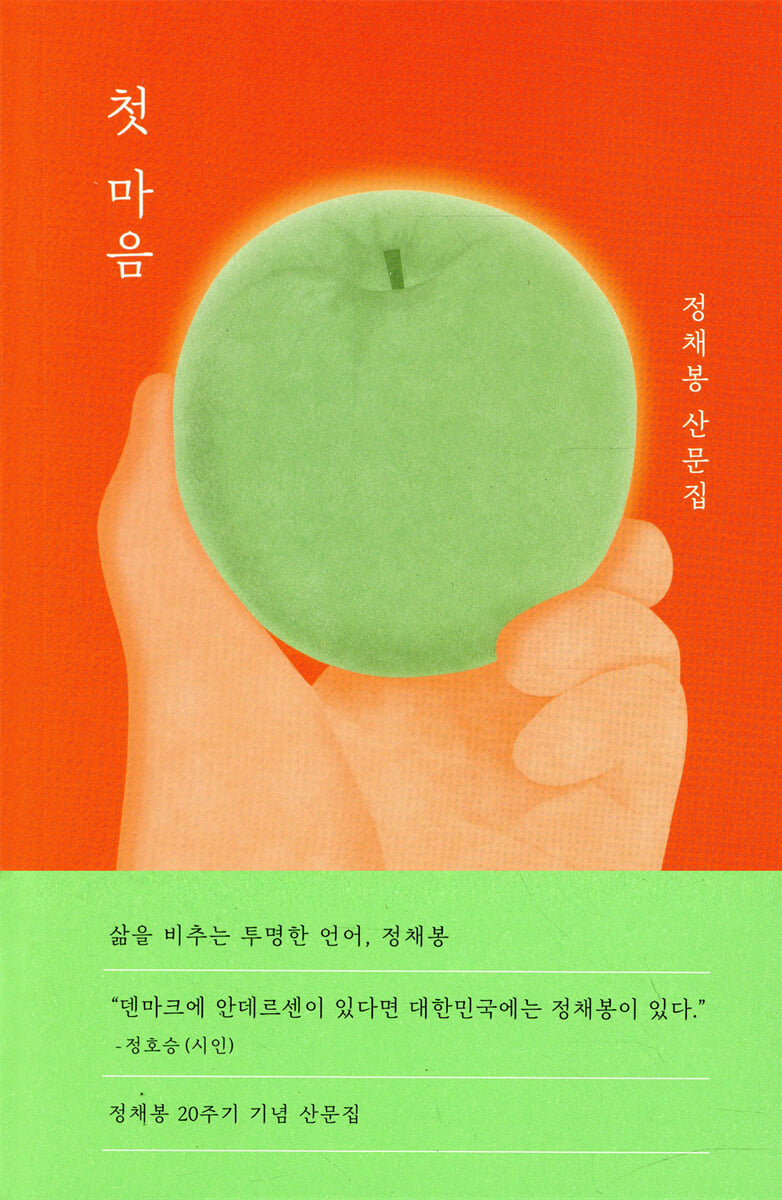
First heart
 |
Description
Book Introduction
Anthology of essays commemorating the 20th anniversary of Jeong Chae-bong's death
Jeong Chae-bong, a transparent language that illuminates life
Reconnect with the writings and heart of the beloved Jeong Chae-bong.
“He will exist forever as long as there are readers who read and love his fairy tales.
“If Denmark has Andersen, South Korea has Jeong Chae-bong.” - Jeong Ho-seung (poet)
2021 marks the 20th anniversary of the passing of author Jeong Chae-bong.
Jeong Chae-bong, who lived his entire life with a boyish heart and never lost his innocence, suddenly left us on January 9, 2001.
To commemorate the 20th anniversary of Jeong Chae-bong's death, Samteo Publishing published "First Heart," a collection of his still-beautiful essays from four volumes ("Your Back View," "Twenty-Year-Old Mother," "The Road Seen with Eyes Closed," and "A Good Premonition").
He left a deep mark on the history of Korean literature by establishing a new literary term called 'adult fairy tales', and he went beyond the genre framework of fairy tales to produce a variety of works including novels, poetry, and essays with remarkable creative passion.
Through this collection of essays, we aim to shed new light on his world of work, which was not only excellent as a fairy tale writer but also as an essayist.
Novelist Jo Jeong-rae called Jeong Chae-bong "an outstanding writer who writes works that no one else can match" and his sentences "a jewel that shines like a morning star beyond beauty."
In addition, he interacted with many literary figures of the time, including monk Beopjeong, nun Hae-in Lee, professor Yeong-hee Jang, essayist Cheon-deuk Pi, and poet Ho-seung Jeong.
Jeong Chae-bong, who touched the hearts of countless readers with his warm perspective on humanity, insight into the world, and simple, concise language.
He always spoke of the purity of life he had discovered, and his self-deprecating gait and speech revealed a humbleness that lowered him.
It was perhaps only natural that he was loved and respected by many.
In moments when our hearts feel heavy and suffocated, we may find the wisdom and comfort we need in his writings.
“When no one can tell you what is right, when there are no answers, no exits, no paths in sight, then you have to go back.
betimes.
“With the original intention.”
Jeong Chae-bong, a transparent language that illuminates life
Reconnect with the writings and heart of the beloved Jeong Chae-bong.
“He will exist forever as long as there are readers who read and love his fairy tales.
“If Denmark has Andersen, South Korea has Jeong Chae-bong.” - Jeong Ho-seung (poet)
2021 marks the 20th anniversary of the passing of author Jeong Chae-bong.
Jeong Chae-bong, who lived his entire life with a boyish heart and never lost his innocence, suddenly left us on January 9, 2001.
To commemorate the 20th anniversary of Jeong Chae-bong's death, Samteo Publishing published "First Heart," a collection of his still-beautiful essays from four volumes ("Your Back View," "Twenty-Year-Old Mother," "The Road Seen with Eyes Closed," and "A Good Premonition").
He left a deep mark on the history of Korean literature by establishing a new literary term called 'adult fairy tales', and he went beyond the genre framework of fairy tales to produce a variety of works including novels, poetry, and essays with remarkable creative passion.
Through this collection of essays, we aim to shed new light on his world of work, which was not only excellent as a fairy tale writer but also as an essayist.
Novelist Jo Jeong-rae called Jeong Chae-bong "an outstanding writer who writes works that no one else can match" and his sentences "a jewel that shines like a morning star beyond beauty."
In addition, he interacted with many literary figures of the time, including monk Beopjeong, nun Hae-in Lee, professor Yeong-hee Jang, essayist Cheon-deuk Pi, and poet Ho-seung Jeong.
Jeong Chae-bong, who touched the hearts of countless readers with his warm perspective on humanity, insight into the world, and simple, concise language.
He always spoke of the purity of life he had discovered, and his self-deprecating gait and speech revealed a humbleness that lowered him.
It was perhaps only natural that he was loved and respected by many.
In moments when our hearts feel heavy and suffocated, we may find the wisdom and comfort we need in his writings.
“When no one can tell you what is right, when there are no answers, no exits, no paths in sight, then you have to go back.
betimes.
“With the original intention.”
- You can preview some of the book's contents.
Preview
index
Just as there is no heart without sorrow
Landscapes of the Field of the Heart 15
'I' to 'me' 18
Open the window 20
Open the door of your heart 26
Sorry Time 32
Evening bell 36
A single green tree on a sandy ridge 40
See Matter as Dust 44
Period and First Thought 52
If I could live by the starlight
A Drop of Rain 59
The Road to See with Your Eyes Closed 63
New age one year old 68
Thinking of the Sea 71
A Life of Desperation 74
There is no one without heartache 77
Life 82
Five Postcards 85
Bullet 91 called 'Moment'
Your stop 94
I look at you like I'm looking at a white cloud
99 Things I Love
The Unfading Fragrance 102
Grandma 105
Sleeping on a Stone 111
The soil is really good 114
Rusting of the Body 121
It's so clear 124
Love from Small Things 129
A Fragrance More Beautiful Than Flowers 134
One Star's Comfort 139
I want to stand in the middle of the green
Autumn Rain 145
Thinking of Water 149
Flowers and Silence 153
The Longing Scent of Wild Grass 156
Looking at the fallen leaves 159
Dawn Letter 162
Looking at Chae Song-hwa 164
Wildflower 167
The ground looks like a seventeen-year-old girl's face just after washing her face. 171
Watercolor of an Autumn Day 176
Open the eye within the eye 189
Landscapes of the Field of the Heart 15
'I' to 'me' 18
Open the window 20
Open the door of your heart 26
Sorry Time 32
Evening bell 36
A single green tree on a sandy ridge 40
See Matter as Dust 44
Period and First Thought 52
If I could live by the starlight
A Drop of Rain 59
The Road to See with Your Eyes Closed 63
New age one year old 68
Thinking of the Sea 71
A Life of Desperation 74
There is no one without heartache 77
Life 82
Five Postcards 85
Bullet 91 called 'Moment'
Your stop 94
I look at you like I'm looking at a white cloud
99 Things I Love
The Unfading Fragrance 102
Grandma 105
Sleeping on a Stone 111
The soil is really good 114
Rusting of the Body 121
It's so clear 124
Love from Small Things 129
A Fragrance More Beautiful Than Flowers 134
One Star's Comfort 139
I want to stand in the middle of the green
Autumn Rain 145
Thinking of Water 149
Flowers and Silence 153
The Longing Scent of Wild Grass 156
Looking at the fallen leaves 159
Dawn Letter 162
Looking at Chae Song-hwa 164
Wildflower 167
The ground looks like a seventeen-year-old girl's face just after washing her face. 171
Watercolor of an Autumn Day 176
Open the eye within the eye 189
Detailed image
.jpg)
Into the book
Something that cannot be seen but is clearly there.
If I had to name one, I would choose 'heart'.
Do you not think with your heart, sin with your heart, and cry with your heart?
--- p.15
But as I left the embrace of the sea, the simplicity of my mind, like a sandy ridge, changed into a complexity like a swamp of weeds.
My pockets, which had been satisfied with just a couple of seashells, now felt empty even with a bundle of bills. I could throw away the sand castles I had worked so hard to build without looking back, but in the city, I couldn't throw away even the smallest thing, and I was impatient.
The sea does not rebuke me today either.
He just looks at me with a pitiful expression.
I cannot help but pay my respects to the sea.
--- p.75
Just as a rock island standing in the middle of the sea cannot be free of wave marks, is there anyone among us living in this world without even a single slash?
I hope to live like that rock, standing there blankly, washing my wounds in salt water so they don't get worse.
--- p.81
We create death with our thoughts and hell with our thoughts.
We break up because of our thoughts and cry, and we struggle in the swamp of misunderstanding because of our thoughts.
The pain of this pure white night, when sleep was driven away by these troubles, was worse than the pain of the flesh.
That is why people say that they have hidden their heart, the house of their thoughts, or that their heart has been stolen, or that they have lost their heart.
--- p.81
When I say noise, I don't mean just loud sounds.
The busyness that makes me unable to feel myself, the worries that suffocate me when I open my eyes, no, the bonds that do not know how to leave even when I close my eyes, all seething like a scream, what else could it be but noise?
--- p.92
I love the color of the grass on the embankment that grows another layer after the rain.
I love the dewdrops hiding inside the leaves of the taro tree.
I love the echoes that spread across the remote, remote spring.
I love the dawn moonlight that sometimes comes down to the upper room.
I love mugwort flowers, persimmon flowers, cotton flowers, and sesame flowers more than flowers.
I love the pure white frost falling on the thatched roof.
I love the bright yellow shoots of radish dug out of the radish pit.
I love the bamboo shoots from Damyang that grow through the asphalt.
I love the healthy fishermen who come back home with mud on their shins at sunset.
--- p.99
This summer too, I will go to a quiet waterside.
I'll sit with my feet in the flowing water and listen to the sounds of water birds.
I will watch the sunset and meditate on the language of the fish that cannot speak.
That those who leave make this shore ripple, and that the water I scoop up in my palm is the same water now and then, but that it is new every moment.
I want to quietly look into that secret thread.
--- p.152
The sun is setting.
I wonder where the last ray of light from the setting sun is disappearing.
The windswept windows of a nursing home, the gun barrels ahead, the chimneys of an industrial complex, the lightning rods on top of high-rise buildings, the back of a woman's hand picking chestnuts at the entrance to an underground passage.
If you lift the curtain of the food stall, you might find yourself standing at the half-full mark of a soju bottle.
--- p.186
Under the sky where the stars are sparkling as if they are about to pour down.
A grassy field and sandy field where you can walk barefoot without worrying about getting hurt by shards of glass, and at the bottom of a hill where you can faintly hear the singing of sea squirts and the flapping of barnacle wings.
There, dung beetles will be running like in our childhood dreams.
In that place where there is no electricity, we light a candle and look back at the candle and our shadows shaking when the wind blows… … .
Wouldn't the soot from our city finally be lifted in the silence of brewing a cup of tea alone?
If I had to name one, I would choose 'heart'.
Do you not think with your heart, sin with your heart, and cry with your heart?
--- p.15
But as I left the embrace of the sea, the simplicity of my mind, like a sandy ridge, changed into a complexity like a swamp of weeds.
My pockets, which had been satisfied with just a couple of seashells, now felt empty even with a bundle of bills. I could throw away the sand castles I had worked so hard to build without looking back, but in the city, I couldn't throw away even the smallest thing, and I was impatient.
The sea does not rebuke me today either.
He just looks at me with a pitiful expression.
I cannot help but pay my respects to the sea.
--- p.75
Just as a rock island standing in the middle of the sea cannot be free of wave marks, is there anyone among us living in this world without even a single slash?
I hope to live like that rock, standing there blankly, washing my wounds in salt water so they don't get worse.
--- p.81
We create death with our thoughts and hell with our thoughts.
We break up because of our thoughts and cry, and we struggle in the swamp of misunderstanding because of our thoughts.
The pain of this pure white night, when sleep was driven away by these troubles, was worse than the pain of the flesh.
That is why people say that they have hidden their heart, the house of their thoughts, or that their heart has been stolen, or that they have lost their heart.
--- p.81
When I say noise, I don't mean just loud sounds.
The busyness that makes me unable to feel myself, the worries that suffocate me when I open my eyes, no, the bonds that do not know how to leave even when I close my eyes, all seething like a scream, what else could it be but noise?
--- p.92
I love the color of the grass on the embankment that grows another layer after the rain.
I love the dewdrops hiding inside the leaves of the taro tree.
I love the echoes that spread across the remote, remote spring.
I love the dawn moonlight that sometimes comes down to the upper room.
I love mugwort flowers, persimmon flowers, cotton flowers, and sesame flowers more than flowers.
I love the pure white frost falling on the thatched roof.
I love the bright yellow shoots of radish dug out of the radish pit.
I love the bamboo shoots from Damyang that grow through the asphalt.
I love the healthy fishermen who come back home with mud on their shins at sunset.
--- p.99
This summer too, I will go to a quiet waterside.
I'll sit with my feet in the flowing water and listen to the sounds of water birds.
I will watch the sunset and meditate on the language of the fish that cannot speak.
That those who leave make this shore ripple, and that the water I scoop up in my palm is the same water now and then, but that it is new every moment.
I want to quietly look into that secret thread.
--- p.152
The sun is setting.
I wonder where the last ray of light from the setting sun is disappearing.
The windswept windows of a nursing home, the gun barrels ahead, the chimneys of an industrial complex, the lightning rods on top of high-rise buildings, the back of a woman's hand picking chestnuts at the entrance to an underground passage.
If you lift the curtain of the food stall, you might find yourself standing at the half-full mark of a soju bottle.
--- p.186
Under the sky where the stars are sparkling as if they are about to pour down.
A grassy field and sandy field where you can walk barefoot without worrying about getting hurt by shards of glass, and at the bottom of a hill where you can faintly hear the singing of sea squirts and the flapping of barnacle wings.
There, dung beetles will be running like in our childhood dreams.
In that place where there is no electricity, we light a candle and look back at the candle and our shadows shaking when the wind blows… … .
Wouldn't the soot from our city finally be lifted in the silence of brewing a cup of tea alone?
--- p.192
Publisher's Review
A book containing the essence of Jeong Chae-bong's prose, "First Heart"
He never lost his original heart until the last moment of his life.
Jeong Chae-bong's clear moment
Jeong Chae-bong believed that in the harsh and difficult reality, many people lose their original heart and purity and become obsessed with worldly desires, falling into suffering.
He wanted to comfort and console the hearts of those who were burned by life through his writing.
I hoped to bring back some of what we have lost into simple sentences, so that they would naturally seep into the hearts of readers without preaching or enlightening them.
Sister Lee Hae-in said, “Innocence is the mother of prayer, directly connected to purity, chastity, and truthfulness that transcends mere naivety and childishness,” and so “it is a value of longing that we long to regain even as adults.”
It is not unrelated that Jeong Chae-bong's will to delve into the world of innocence led to the literary achievement of 'adult fairy tales'.
In the 20th anniversary commemorative prose collection “First Heart,” we aim to shed light on his world of work across a wider spectrum, not limited to fairy tales.
We selected four themes that run through his literature: heart ('As there is no one without sorrow'), will to live ('If I could live relying on starlight'), people ('Looking at you as if looking at white clouds'), and nature ('I want to stand in full green'), and selected clear writings that do not fade with the passage of time, writings that anyone can relate to and find comfort in.
The first chapter, "No One Without Sorrow," talks about cherishing the emotional scars we experience in life and cultivating a strong yet humble heart.
In the second chapter, 'If I Could Live by the Starlight', you can see the self-reflective side of the author, who reveals his will to live even after being diagnosed with liver cancer and reflects on life in a clear handwriting even while on his sickbed.
The third chapter, 'Looking at You as if Looking at a White Cloud', delicately captures the wisdom of life gained from interacting with contemporary giants such as Cardinal Kim Su-hwan, Monk Beopjeong, Sister Lee Hae-in, and essayist Pi Cheon-deuk.
The film also contains the human heart of Jeong Chae-bong, who is moved by the ordinary moments of people around him, such as his grandmother who protected him during his childhood, Mr. Gombo, and the people of Nongbawitgol in Mungyeong.
The last chapter, 'I want to stand in the green,' contains his attitude of pursuing humility and a natural life as a mere human being before nature.
Readers will feel a warmth deep within their hearts, filled with Jeong Chae-bong's refined writing style and unique sensibility, no matter which page they turn to in this book.
In clear and transparent language
Swallowing a piece of solid sadness
“At sunset, I climbed up an apricot tree and looked at the sunset. I felt sad for some reason, and tears welled up in my eyes as I looked out at the alleyway.
“I can say that the alleyways of my hometown were the first fields where I sowed the seeds of waiting, of longing, of farawayness in my empty heart.” (p. 16)
If there is an emotion that runs consistently through his work, it would be 'sorrow'.
He lost his mother at an early age, and lost contact with his father, so he was raised by his grandmother.
A quiet, introverted personality and the deprivations of his childhood allowed him to gradually carve out his own literary world.
“The lonely environment actually allowed me to think a lot on my own, and instead of being able to hang out with friends, I was able to observe nature and make friends, which helped me become emotionally richer.
“In fact, much of what I write is indebted to fragments of childhood memories.” (From the text of “The Childlike Heart Returning to Mother’s Arms”) The keywords mother, sea, and hometown, which frequently appear in the 40 or so works he left behind, were like the roots of his creations that his language ultimately reached.
“In the womb, I heard the waves and the songs of seagulls through my mother’s ears, I breathed in the scent of the sea through my mother’s nose, and I saw the sea with the rising and setting sun, the sea with rain, and the sea with snow through my mother’s eyes.
“And so, from the moment I left my mother’s room, where there were no tears, and entered the world of tears, the real sea followed me, knowingly or unknowingly.” (p. 74)
“When I lived in a seaside village, I never knew what was lacking like the sea.
It didn't even overflow.
The sadness of that day ended that day, and the joy of that day ended that day.
“My heart was always filled with a song like the sound of waves, and even if sadness came, it would quickly disappear with a trivial laugh, like ants fighting each other.” (p. 75)
How about taking a moment to rest in the author's language, which whispers the simple truths of life in comforting words at every difficult moment in life that everyone experiences?
The simple heart of Jeong Chae-bong, who admired the simplicity of the sea, saying, “The sadness of that day ends with the sadness of that day, and the joy also ends with that day,” will resonate deeply with readers.
He never lost his original heart until the last moment of his life.
Jeong Chae-bong's clear moment
Jeong Chae-bong believed that in the harsh and difficult reality, many people lose their original heart and purity and become obsessed with worldly desires, falling into suffering.
He wanted to comfort and console the hearts of those who were burned by life through his writing.
I hoped to bring back some of what we have lost into simple sentences, so that they would naturally seep into the hearts of readers without preaching or enlightening them.
Sister Lee Hae-in said, “Innocence is the mother of prayer, directly connected to purity, chastity, and truthfulness that transcends mere naivety and childishness,” and so “it is a value of longing that we long to regain even as adults.”
It is not unrelated that Jeong Chae-bong's will to delve into the world of innocence led to the literary achievement of 'adult fairy tales'.
In the 20th anniversary commemorative prose collection “First Heart,” we aim to shed light on his world of work across a wider spectrum, not limited to fairy tales.
We selected four themes that run through his literature: heart ('As there is no one without sorrow'), will to live ('If I could live relying on starlight'), people ('Looking at you as if looking at white clouds'), and nature ('I want to stand in full green'), and selected clear writings that do not fade with the passage of time, writings that anyone can relate to and find comfort in.
The first chapter, "No One Without Sorrow," talks about cherishing the emotional scars we experience in life and cultivating a strong yet humble heart.
In the second chapter, 'If I Could Live by the Starlight', you can see the self-reflective side of the author, who reveals his will to live even after being diagnosed with liver cancer and reflects on life in a clear handwriting even while on his sickbed.
The third chapter, 'Looking at You as if Looking at a White Cloud', delicately captures the wisdom of life gained from interacting with contemporary giants such as Cardinal Kim Su-hwan, Monk Beopjeong, Sister Lee Hae-in, and essayist Pi Cheon-deuk.
The film also contains the human heart of Jeong Chae-bong, who is moved by the ordinary moments of people around him, such as his grandmother who protected him during his childhood, Mr. Gombo, and the people of Nongbawitgol in Mungyeong.
The last chapter, 'I want to stand in the green,' contains his attitude of pursuing humility and a natural life as a mere human being before nature.
Readers will feel a warmth deep within their hearts, filled with Jeong Chae-bong's refined writing style and unique sensibility, no matter which page they turn to in this book.
In clear and transparent language
Swallowing a piece of solid sadness
“At sunset, I climbed up an apricot tree and looked at the sunset. I felt sad for some reason, and tears welled up in my eyes as I looked out at the alleyway.
“I can say that the alleyways of my hometown were the first fields where I sowed the seeds of waiting, of longing, of farawayness in my empty heart.” (p. 16)
If there is an emotion that runs consistently through his work, it would be 'sorrow'.
He lost his mother at an early age, and lost contact with his father, so he was raised by his grandmother.
A quiet, introverted personality and the deprivations of his childhood allowed him to gradually carve out his own literary world.
“The lonely environment actually allowed me to think a lot on my own, and instead of being able to hang out with friends, I was able to observe nature and make friends, which helped me become emotionally richer.
“In fact, much of what I write is indebted to fragments of childhood memories.” (From the text of “The Childlike Heart Returning to Mother’s Arms”) The keywords mother, sea, and hometown, which frequently appear in the 40 or so works he left behind, were like the roots of his creations that his language ultimately reached.
“In the womb, I heard the waves and the songs of seagulls through my mother’s ears, I breathed in the scent of the sea through my mother’s nose, and I saw the sea with the rising and setting sun, the sea with rain, and the sea with snow through my mother’s eyes.
“And so, from the moment I left my mother’s room, where there were no tears, and entered the world of tears, the real sea followed me, knowingly or unknowingly.” (p. 74)
“When I lived in a seaside village, I never knew what was lacking like the sea.
It didn't even overflow.
The sadness of that day ended that day, and the joy of that day ended that day.
“My heart was always filled with a song like the sound of waves, and even if sadness came, it would quickly disappear with a trivial laugh, like ants fighting each other.” (p. 75)
How about taking a moment to rest in the author's language, which whispers the simple truths of life in comforting words at every difficult moment in life that everyone experiences?
The simple heart of Jeong Chae-bong, who admired the simplicity of the sea, saying, “The sadness of that day ends with the sadness of that day, and the joy also ends with that day,” will resonate deeply with readers.
GOODS SPECIFICS
- Publication date: December 23, 2020
- Page count, weight, size: 196 pages | 296g | 132*200*12mm
- ISBN13: 9788946421714
- ISBN10: 8946421711
You may also like
카테고리
korean


korean

![GQ KOREA Mark (Monthly): December [2025]](http://librairie.coreenne.fr/cdn/shop/files/8ef265dbbfbf186523ed75ba7319009d.jpg?v=1765340328&width=3840)


