

Yesterday's World
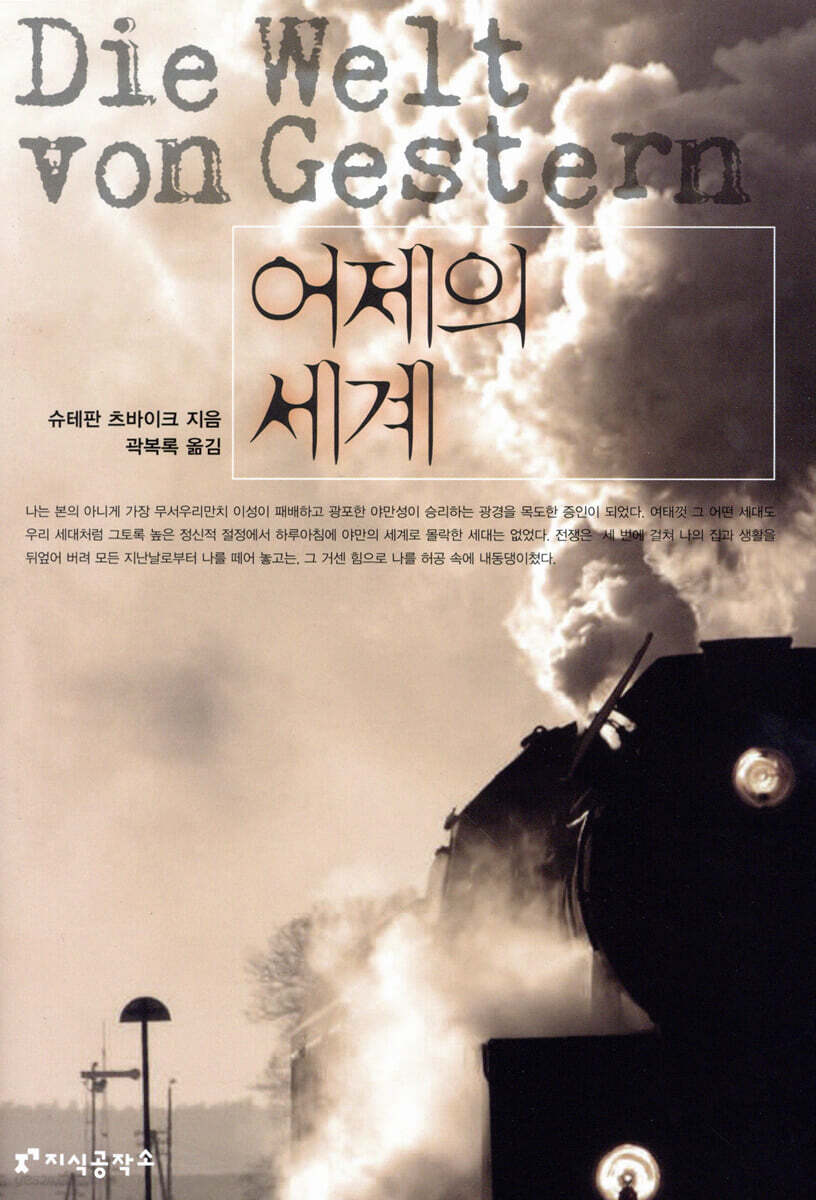 |
Description
Book Introduction
Stefan Zweig was born in Vienna, Austria in 1881 to a businessman father and a Jewish mother.
One of the greatest humanists of 20th century Europe, he testified in detail in his memoir, "Yesterday's World," how the improbable war broke out in Europe in 1914.
This book is a revised edition published to correct some translation errors to mark the 100th anniversary of the outbreak of World War I.
Zweig deepened his spiritual world by forming friendships with various artists and scholars, including writer Romain Rolland, poet Rainer Maria Rilke, psychoanalyst Sigmund Freud, and conductor Bruno Walter.
In this memoir, he describes in detail the moments of his encounters with these world-class giants and paints a picture of the times.
One of the greatest humanists of 20th century Europe, he testified in detail in his memoir, "Yesterday's World," how the improbable war broke out in Europe in 1914.
This book is a revised edition published to correct some translation errors to mark the 100th anniversary of the outbreak of World War I.
Zweig deepened his spiritual world by forming friendships with various artists and scholars, including writer Romain Rolland, poet Rainer Maria Rilke, psychoanalyst Sigmund Freud, and conductor Bruno Walter.
In this memoir, he describes in detail the moments of his encounters with these world-class giants and paints a picture of the times.
- You can preview some of the book's contents.
Preview
index
history
preface
01 A world of stability
School of the 2nd century
03 Puberty
04 Life University
05 Paris, the city of eternal youth
06 A detour on the way to yourself
07 Beyond Europe
08 Light and Shadow Covering Europe
091914 During the first period of the war
10 The struggle for spiritual brotherhood
11 In the heart of Europe
12 Return to Austria
13 Back to the world
Sunset on the 14th
15 Hitler, start here
16 The Last Words of Peace
Translator's Note
preface
01 A world of stability
School of the 2nd century
03 Puberty
04 Life University
05 Paris, the city of eternal youth
06 A detour on the way to yourself
07 Beyond Europe
08 Light and Shadow Covering Europe
091914 During the first period of the war
10 The struggle for spiritual brotherhood
11 In the heart of Europe
12 Return to Austria
13 Back to the world
Sunset on the 14th
15 Hitler, start here
16 The Last Words of Peace
Translator's Note
Publisher's Review
In 2014, why are academics and the media paying renewed attention to Stefan Zweig's "The World of Yesterday" (Die Welt von Gestern)? It's because, a century after the outbreak of World War I, the dark madness of that war still lingers ominously around East Asia.
Stefan Zweig was born in Vienna, Austria in 1881 to a businessman father and a Jewish mother.
One of the greatest humanists of 20th century Europe, he testified in detail in his memoir, "Yesterday's World," how the improbable war broke out in Europe in 1914.
He says, “I can’t find a single reason, a single motive that makes sense.”
When viewed through the eyes of reason, World War I was a war that could not and should not have happened.
This book is a revised edition published to correct some translation errors to commemorate the 100th anniversary of the outbreak of World War I.
[Yesterday's World], first published in German in 1942, was translated and published in France after German reunification (1990) and became a bestseller.
And today, on the 100th anniversary of the outbreak of World War I, it is once again attracting the attention of intellectuals around the world.
Stefan Zweig debuted in the literary world at the age of 20 with his poetry collection [Silver Strings], and was a famous writer with millions of readers across Europe during the 1920s and 1930s.
Vienna, Austria, where he worked, served as a melting pot of culture and art along with Paris, France from 1900 until around this time.
Zweig deepened his spiritual world by forming friendships with various artists and scholars, including writer Romain Rolland, poet Rainer Maria Rilke, psychoanalyst Sigmund Freud, and conductor Bruno Walter.
In this memoir, he describes in detail the moments of his encounters with these world-class giants and paints a picture of the times.
Unfortunately, Zweig was a thoroughgoing liberal and pacifist.
Unable to withstand Hitler's oppression, he left Vienna in 1934 and settled in Brazil via London and the United States.
How could he have left behind this epoch-making testimony in a distant foreign land, relying solely on memory and no other sources? In the words of his fellow writer and friend, Hermann Kesten, "His goal was to pass on even a shred of truth to future generations," we glimpse Zweig's earnestness and greatness.
136 Giants Met by Stefan Zweig
Auguste Rodin
He had forgotten that he had taken me to the atelier.
Rodin spoke to me with embarrassment.
“I’m sorry.” Then I saw the secret of all great art, of all earthly achievement.
In that moment I learned something that would change my entire life.
Romain Rolland
He was even more heartbroken by the destruction caused by war.
“Art can comfort us as individuals.
But in reality, we are helpless.”
Rainer Maria Rilke
The next moment I was startled.
Rilke, it was Rainer Maria Rilke in military uniform! "I've always hated this uniform," Rilke said to me in a low voice.
“I want to go abroad.
If only I could go.
“War is always like a prison.”
Maxim Gorky
“You don’t know how different it is from us.
Our generation was either timid or very intense.
But I never had any confidence in myself.” All through the night of his exile in Sorrento, his eyes were shining.
And after some time, Gorky returned to Russia again.
Walter Rathenau
Just before he was assassinated, he said to me:
“You are a free human being.
Take advantage of your freedom! Literature is a wonderful thing.
Because rushing is unnecessary in that profession.
“It doesn’t matter if it takes more or less than a year for a really good book.”
Sigmund Freud
He was a passionate seeker of truth, but at the same time he was acutely aware of the limitations of all truth.
Freud said.
“Just as there is no such thing as 100% alcohol, there is no such thing as 100% truth.”
Benedetto Croce
He just laughed it off and said.
“It is resistance itself that makes people young.
There is nothing so harmful to the mental man as a lack of resistance.
“When you become lonely and there are no young people around you, you can’t help but become younger.”
… and 129 other people
Stefan Zweig testifies to them in this book.
Stefan Zweig was born in Vienna, Austria in 1881 to a businessman father and a Jewish mother.
One of the greatest humanists of 20th century Europe, he testified in detail in his memoir, "Yesterday's World," how the improbable war broke out in Europe in 1914.
He says, “I can’t find a single reason, a single motive that makes sense.”
When viewed through the eyes of reason, World War I was a war that could not and should not have happened.
This book is a revised edition published to correct some translation errors to commemorate the 100th anniversary of the outbreak of World War I.
[Yesterday's World], first published in German in 1942, was translated and published in France after German reunification (1990) and became a bestseller.
And today, on the 100th anniversary of the outbreak of World War I, it is once again attracting the attention of intellectuals around the world.
Stefan Zweig debuted in the literary world at the age of 20 with his poetry collection [Silver Strings], and was a famous writer with millions of readers across Europe during the 1920s and 1930s.
Vienna, Austria, where he worked, served as a melting pot of culture and art along with Paris, France from 1900 until around this time.
Zweig deepened his spiritual world by forming friendships with various artists and scholars, including writer Romain Rolland, poet Rainer Maria Rilke, psychoanalyst Sigmund Freud, and conductor Bruno Walter.
In this memoir, he describes in detail the moments of his encounters with these world-class giants and paints a picture of the times.
Unfortunately, Zweig was a thoroughgoing liberal and pacifist.
Unable to withstand Hitler's oppression, he left Vienna in 1934 and settled in Brazil via London and the United States.
How could he have left behind this epoch-making testimony in a distant foreign land, relying solely on memory and no other sources? In the words of his fellow writer and friend, Hermann Kesten, "His goal was to pass on even a shred of truth to future generations," we glimpse Zweig's earnestness and greatness.
136 Giants Met by Stefan Zweig
Auguste Rodin
He had forgotten that he had taken me to the atelier.
Rodin spoke to me with embarrassment.
“I’m sorry.” Then I saw the secret of all great art, of all earthly achievement.
In that moment I learned something that would change my entire life.
Romain Rolland
He was even more heartbroken by the destruction caused by war.
“Art can comfort us as individuals.
But in reality, we are helpless.”
Rainer Maria Rilke
The next moment I was startled.
Rilke, it was Rainer Maria Rilke in military uniform! "I've always hated this uniform," Rilke said to me in a low voice.
“I want to go abroad.
If only I could go.
“War is always like a prison.”
Maxim Gorky
“You don’t know how different it is from us.
Our generation was either timid or very intense.
But I never had any confidence in myself.” All through the night of his exile in Sorrento, his eyes were shining.
And after some time, Gorky returned to Russia again.
Walter Rathenau
Just before he was assassinated, he said to me:
“You are a free human being.
Take advantage of your freedom! Literature is a wonderful thing.
Because rushing is unnecessary in that profession.
“It doesn’t matter if it takes more or less than a year for a really good book.”
Sigmund Freud
He was a passionate seeker of truth, but at the same time he was acutely aware of the limitations of all truth.
Freud said.
“Just as there is no such thing as 100% alcohol, there is no such thing as 100% truth.”
Benedetto Croce
He just laughed it off and said.
“It is resistance itself that makes people young.
There is nothing so harmful to the mental man as a lack of resistance.
“When you become lonely and there are no young people around you, you can’t help but become younger.”
… and 129 other people
Stefan Zweig testifies to them in this book.
GOODS SPECIFICS
- Date of issue: February 5, 2014
- Page count, weight, size: 596 pages | 154*225*35mm
- ISBN13: 9791130425054
- ISBN10: 1130425053
You may also like
카테고리
korean


korean

![GQ KOREA Mark (Monthly): December [2025]](http://librairie.coreenne.fr/cdn/shop/files/8ef265dbbfbf186523ed75ba7319009d.jpg?v=1765340328&width=3840)


