

Before the lights turn on
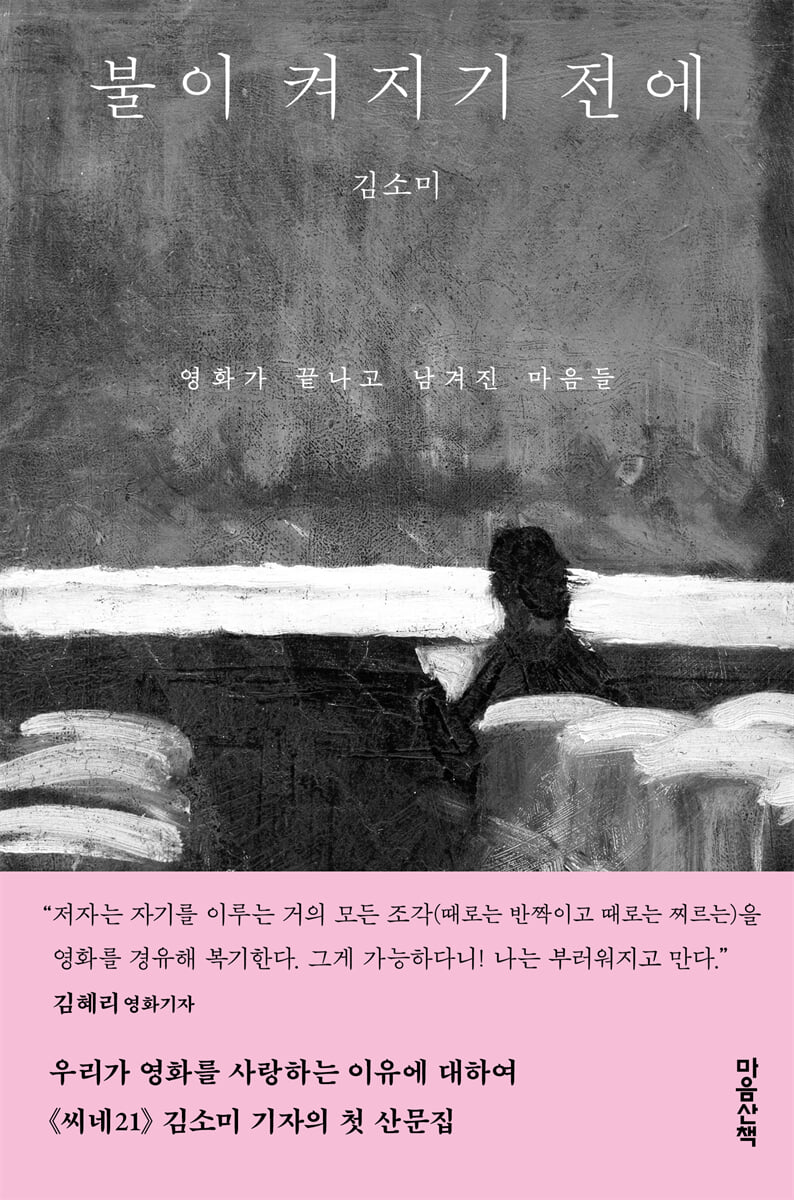 |
Description
Book Introduction
The feelings left behind after the movie ends
On Why We Love Movies
Cine21 reporter Kim So-mi's first collection of essays, "Before the Lights Turn On," has been published by Maumsanchaek.
Kim So-mi is a film journalist with nine years of experience, mediating between films and audiences through writing, speech, critique, and conversation.
With precise sentences and thoughtful progression, “trusted by both filmmakers and viewers” (reporter Kim Hye-ri), in this book, he tells the story of the allure of movies that keeps viewers glued to their seats until the lights come on, and the life of a film reporter that begins after the film ends.
Starting from his childhood when he first fell in love with movies while watching the horror film “Ju-on,” to his college days when he dreamed of becoming a film director, to his current status as the head of the Cine21 reporting team, his journey captures the expansion of a “viewer” into a person who “sees, listens, writes, and speaks.”
As a film journalist, watching films, listening to interviewees, meeting deadlines every week, and meeting audiences through GV create fleeting beauty even amidst the pressure and fatigue.
This book captures a love for cinema that persists despite the fact that watching movies has become a daily routine. In an era where the rise of OTT platforms and the rise of short-form video have raised concerns about the potential demise of movie theaters, following reporter Kim So-mi's memories and thoughts about film offers a hopeful glimpse into the future of cinema.
Before the theater lights come on, time passes even though the movie is over.
According to this book, for Kim So-mi, that time is not much different from the sum total of her life.
From the time he was a little boy, covering his sorrow with the chilling blanket of "Ju-on," to the present day, when he is a journalist trusted by both filmmakers and viewers, the author revisits almost every piece of himself—sometimes sparkling, sometimes poignant—through films.
I can't believe that's possible! I'm so jealous.
- Kim Hye-ri, film reporter
On Why We Love Movies
Cine21 reporter Kim So-mi's first collection of essays, "Before the Lights Turn On," has been published by Maumsanchaek.
Kim So-mi is a film journalist with nine years of experience, mediating between films and audiences through writing, speech, critique, and conversation.
With precise sentences and thoughtful progression, “trusted by both filmmakers and viewers” (reporter Kim Hye-ri), in this book, he tells the story of the allure of movies that keeps viewers glued to their seats until the lights come on, and the life of a film reporter that begins after the film ends.
Starting from his childhood when he first fell in love with movies while watching the horror film “Ju-on,” to his college days when he dreamed of becoming a film director, to his current status as the head of the Cine21 reporting team, his journey captures the expansion of a “viewer” into a person who “sees, listens, writes, and speaks.”
As a film journalist, watching films, listening to interviewees, meeting deadlines every week, and meeting audiences through GV create fleeting beauty even amidst the pressure and fatigue.
This book captures a love for cinema that persists despite the fact that watching movies has become a daily routine. In an era where the rise of OTT platforms and the rise of short-form video have raised concerns about the potential demise of movie theaters, following reporter Kim So-mi's memories and thoughts about film offers a hopeful glimpse into the future of cinema.
Before the theater lights come on, time passes even though the movie is over.
According to this book, for Kim So-mi, that time is not much different from the sum total of her life.
From the time he was a little boy, covering his sorrow with the chilling blanket of "Ju-on," to the present day, when he is a journalist trusted by both filmmakers and viewers, the author revisits almost every piece of himself—sometimes sparkling, sometimes poignant—through films.
I can't believe that's possible! I'm so jealous.
- Kim Hye-ri, film reporter
- You can preview some of the book's contents.
Preview
index
introduction
The first light I encountered
If we can come from
Respond to the movie while shaking
Independence-Connection-Sadness
Second best job
Standing at the edge of the movie
One of many people who make one book
Who needs you?
Seeing movies in a different way
The film In Praise of the Wandering
When the interviewer climbs the stairs
Far away but close
Look straight ahead
In case you have to use it
Surviving the Darkness
Favorite thing
To the point of failure
Beginner's Stopover - Cannes Film Festival Report Part 1
Embarrassing mistakes of living people
Bake and cool
A lonely and brave gathering
Sloppily and meticulously
People Waiting for Darkness
I'll go get some fresh air.
Random support for the story
The need for a totem
Sleeping movies
Double-printing of front and back
Countries That Don't Require a Passport - Cannes Film Festival Report Part 2
A place for hiding
The Chimera Effect - Cannes Film Festival Report Part 3
The first light I encountered
If we can come from
Respond to the movie while shaking
Independence-Connection-Sadness
Second best job
Standing at the edge of the movie
One of many people who make one book
Who needs you?
Seeing movies in a different way
The film In Praise of the Wandering
When the interviewer climbs the stairs
Far away but close
Look straight ahead
In case you have to use it
Surviving the Darkness
Favorite thing
To the point of failure
Beginner's Stopover - Cannes Film Festival Report Part 1
Embarrassing mistakes of living people
Bake and cool
A lonely and brave gathering
Sloppily and meticulously
People Waiting for Darkness
I'll go get some fresh air.
Random support for the story
The need for a totem
Sleeping movies
Double-printing of front and back
Countries That Don't Require a Passport - Cannes Film Festival Report Part 2
A place for hiding
The Chimera Effect - Cannes Film Festival Report Part 3
Detailed image
.png)
Into the book
In a place where the blessed beings called spectators resonate with one another, everyone becomes less immersed.
--- p.19
After watching a good movie, you want to hear other people's stories about it.
There are times when just that excitement is enough for a few hours or even days.
The film's running time of just over two hours often extends its life through the various reactions of those who responded to it (not limited to criticism or reviews, but countless pieces of reaction from online communities).
--- p.29
We often call the overwhelming feeling we get after watching a great movie "emotion," but in some cases it's closer to an impulse.
For the first time, I felt the urge to live with a better heart because of the movie, the feeling that my life would unfold more properly in the future.
--- p.30
As far as I know, every audience member lives a 'life after the movie' for a while.
Could we call that 'being alive'?
We are alive when we feel a surge of desire for adventure, a yearning to fall in love, a vitality that drives us to live our lives more intensely, and a destructive desire to become more free or debauched.
--- pp.31-32
But the light of the movie begins right then.
The audience's eyes are the last physical device through which the film awakens.
In a theater, in someone's small room, the life of this medium is dramatically extended.
The fact that countless viewers remember the potential images formed on their retinas while watching a film gives the act of watching a movie a secret fascination.
--- p.32
If we love something, we are willing to go to the periphery.
And then you realize that that's actually the center.
--- pp.54-55
Watching a movie is also about getting used to the ending credits.
The end credits, a black-and-white image for those who are not the main characters but the owners, are a time preserved to convey the fact that more people than expected were involved in the completion of something.
--- p.63
The audience is always a space for freedom rather than constraint.
--- p.80
Some people go into the cinema to cry.
I am no exception someday.
The theater is one of the few social spaces that naturally tolerates adult tears.
--- pp.107-108
But now I must step back from the position of short-sightedness and admiration and write.
It must be written properly.
Because you became my knight.
--- p.112
In cases where we must use it, the object helps us.
It comes in the form of affection that grows stronger the more you know it, as a pleasure that makes you forget about what you have to do for a moment, as someone's low, affectionate voice and a few words in a letter.
--- p.117
All films are made to be enjoyed, and the one who most faithfully protects the reason for the existence of films is always the audience.
--- p.169
People who invent their own mise-en-scène in life do not easily become old.
--- p.194
In a modern sense, the theater can become a world of voluntary pause.
The audience that hopes to arrive here is one that seeks solace in a world that relentlessly impels us, and one that is willing to endure stagnation.
Cinemas are now more than just spaces for entertainment and art; they are places for active disengagement from the conveyor belt.
This is precisely the utility of theater that must be reexamined in this time of theater crisis.
--- p.19
After watching a good movie, you want to hear other people's stories about it.
There are times when just that excitement is enough for a few hours or even days.
The film's running time of just over two hours often extends its life through the various reactions of those who responded to it (not limited to criticism or reviews, but countless pieces of reaction from online communities).
--- p.29
We often call the overwhelming feeling we get after watching a great movie "emotion," but in some cases it's closer to an impulse.
For the first time, I felt the urge to live with a better heart because of the movie, the feeling that my life would unfold more properly in the future.
--- p.30
As far as I know, every audience member lives a 'life after the movie' for a while.
Could we call that 'being alive'?
We are alive when we feel a surge of desire for adventure, a yearning to fall in love, a vitality that drives us to live our lives more intensely, and a destructive desire to become more free or debauched.
--- pp.31-32
But the light of the movie begins right then.
The audience's eyes are the last physical device through which the film awakens.
In a theater, in someone's small room, the life of this medium is dramatically extended.
The fact that countless viewers remember the potential images formed on their retinas while watching a film gives the act of watching a movie a secret fascination.
--- p.32
If we love something, we are willing to go to the periphery.
And then you realize that that's actually the center.
--- pp.54-55
Watching a movie is also about getting used to the ending credits.
The end credits, a black-and-white image for those who are not the main characters but the owners, are a time preserved to convey the fact that more people than expected were involved in the completion of something.
--- p.63
The audience is always a space for freedom rather than constraint.
--- p.80
Some people go into the cinema to cry.
I am no exception someday.
The theater is one of the few social spaces that naturally tolerates adult tears.
--- pp.107-108
But now I must step back from the position of short-sightedness and admiration and write.
It must be written properly.
Because you became my knight.
--- p.112
In cases where we must use it, the object helps us.
It comes in the form of affection that grows stronger the more you know it, as a pleasure that makes you forget about what you have to do for a moment, as someone's low, affectionate voice and a few words in a letter.
--- p.117
All films are made to be enjoyed, and the one who most faithfully protects the reason for the existence of films is always the audience.
--- p.169
People who invent their own mise-en-scène in life do not easily become old.
--- p.194
In a modern sense, the theater can become a world of voluntary pause.
The audience that hopes to arrive here is one that seeks solace in a world that relentlessly impels us, and one that is willing to endure stagnation.
Cinemas are now more than just spaces for entertainment and art; they are places for active disengagement from the conveyor belt.
This is precisely the utility of theater that must be reexamined in this time of theater crisis.
--- p.225
Publisher's Review
Respect for the ending credits
Collaboration between 'us' to complete 'my' work
Kim So-mi, a journalist who studied film in college to become a film director, took part in the inaugural issue of the film magazine "anno." as an editor in 2013, and decided to make a career out of standing on the edge of film and adding the language of criticism rather than making films herself.
As I create a magazine with colleagues I meet outside the school walls and sell it through Unlimited Edition, my focus, which had been focused on myself, gradually expands to include others.
After becoming a reporter for Cine21, the author repeatedly realizes that deadlines are achieved through the collaboration of colleagues.
After much deliberation, you submit the final manuscript, which is then polished by a proofreader and editor before it is published.
The word 'colleague' encompasses not only those who work together to create a magazine, but also those who are the subjects of interviews or reports.
When writing the obituary of the late actor Song Jae-ho, who passed away in 2020, I look into his filmography and consider the messages left by those who worked with him, including director Bong Joon-ho.
For the author, writing an article is an act of listening to the voices of others.
'Colleagues' also tolerate mistakes.
The author accidentally leaves out half of the poems written by poet Jin Eun-young, which he received at her request on the 10th anniversary of the Sewol ferry disaster, but Jin Eun-young consoles him, saying that anyone can do that because she is faced with “something that is difficult to endure even after 10 years.”
The feeling of watching the end credits of a movie all the way to the end, the gaze that follows the pages listing the names of those who participated in the creation of a magazine, is love.
The author confirms his love by standing next to the film and watching it.
Watching a movie is also about getting used to the ending credits.
The end credits, a black-and-white image for those who are not the main characters but the owners, are a time preserved to convey the fact that more people than expected were involved in the completion of something.
- In the text
Citizens of a country where 'passport-free' movies are allowed
Each of us, lost in solitude, completes our own film.
Watching a movie is often perceived as an act of immersing oneself in solitude and encountering the film in a darkened space.
In this book, reporter Kim So-mi tells us, through her personal experience as a "viewer" and the landscapes she encountered as a film reporter, that the reason we love movies is because watching them is a communal experience shared with others.
The author's chronicle as an audience member begins with watching the movie "Ju-on" recommended by the owner of "Dooly Video" in Daegu.
The author, who used to soothe the sadness of his childhood by escaping into the eeriness of horror films, approaches film more deeply by looking at the works of those who intertwine life and film, such as Krzysztof Kieślowski and Agnes Varda.
From this point on, after watching a movie, I searched online, read articles in movie magazines, and exchanged opinions with people around me, making the experience of watching a movie a shared one.
Film is a medium that, more than any other art form, evokes a strong desire to “project one’s own feelings into the collective experience.”
As a film journalist, standing between the screen and the audience, commenting on films, the author directly encounters the audience and witnesses the potential of a community formed through the medium of film.
At 1 a.m., after returning home from the GV of the movie “Cleo’s World” with writer Jihye Yoo, who wrote “Friendship Thief,” the alarm in the open chat room where over 100 people still remained rings.
One night, while everyone was asleep, an audience member knocked on the door to share more stories related to the movie.
The audience's knock is a friendly reply, a one-line link that carries the music.
Film festivals, which are events where people who love movies gather and enjoy themselves together, also provide this kind of experience.
The author, who went to the Cannes Film Festival for reporting, left his passport on the plane just before leaving for Cannes, and ended up without it for the entire time he was in Cannes.
Ironically, thanks to this, the author realizes that while he was in Cannes, he was in a country called the “passport-free” cinema.
To the person who stands with his back to the screen and facing the audience, the audience begins to hear a voice that has become close to his heart.
Despite the seemingly minor side effects of the overflowing film festival, true feelings sometimes remain as a gift.
I'd like to be optimistic that theaters will survive as long as there are people who ask for help at dawn and people who respond to strangers gathered for a single film.
And I walk from my closed room to the open room, to the sound of people tapping on their phones, wanting to continue what they were saying in the theater.
- In the text
When asked by the author why we love the experience of watching movies in theaters, director Hirokazu Koreeda scratches his head and replies that it is because we are “behind the times.”
In this age where efficiency is paramount, going to the theater and sitting there for two hours watching a movie would be a waste of time.
Nevertheless, for those who are 'behind the times' and still go to the theater to see movies, 'Before the Lights Come On' will be a deep conversation piece.
Collaboration between 'us' to complete 'my' work
Kim So-mi, a journalist who studied film in college to become a film director, took part in the inaugural issue of the film magazine "anno." as an editor in 2013, and decided to make a career out of standing on the edge of film and adding the language of criticism rather than making films herself.
As I create a magazine with colleagues I meet outside the school walls and sell it through Unlimited Edition, my focus, which had been focused on myself, gradually expands to include others.
After becoming a reporter for Cine21, the author repeatedly realizes that deadlines are achieved through the collaboration of colleagues.
After much deliberation, you submit the final manuscript, which is then polished by a proofreader and editor before it is published.
The word 'colleague' encompasses not only those who work together to create a magazine, but also those who are the subjects of interviews or reports.
When writing the obituary of the late actor Song Jae-ho, who passed away in 2020, I look into his filmography and consider the messages left by those who worked with him, including director Bong Joon-ho.
For the author, writing an article is an act of listening to the voices of others.
'Colleagues' also tolerate mistakes.
The author accidentally leaves out half of the poems written by poet Jin Eun-young, which he received at her request on the 10th anniversary of the Sewol ferry disaster, but Jin Eun-young consoles him, saying that anyone can do that because she is faced with “something that is difficult to endure even after 10 years.”
The feeling of watching the end credits of a movie all the way to the end, the gaze that follows the pages listing the names of those who participated in the creation of a magazine, is love.
The author confirms his love by standing next to the film and watching it.
Watching a movie is also about getting used to the ending credits.
The end credits, a black-and-white image for those who are not the main characters but the owners, are a time preserved to convey the fact that more people than expected were involved in the completion of something.
- In the text
Citizens of a country where 'passport-free' movies are allowed
Each of us, lost in solitude, completes our own film.
Watching a movie is often perceived as an act of immersing oneself in solitude and encountering the film in a darkened space.
In this book, reporter Kim So-mi tells us, through her personal experience as a "viewer" and the landscapes she encountered as a film reporter, that the reason we love movies is because watching them is a communal experience shared with others.
The author's chronicle as an audience member begins with watching the movie "Ju-on" recommended by the owner of "Dooly Video" in Daegu.
The author, who used to soothe the sadness of his childhood by escaping into the eeriness of horror films, approaches film more deeply by looking at the works of those who intertwine life and film, such as Krzysztof Kieślowski and Agnes Varda.
From this point on, after watching a movie, I searched online, read articles in movie magazines, and exchanged opinions with people around me, making the experience of watching a movie a shared one.
Film is a medium that, more than any other art form, evokes a strong desire to “project one’s own feelings into the collective experience.”
As a film journalist, standing between the screen and the audience, commenting on films, the author directly encounters the audience and witnesses the potential of a community formed through the medium of film.
At 1 a.m., after returning home from the GV of the movie “Cleo’s World” with writer Jihye Yoo, who wrote “Friendship Thief,” the alarm in the open chat room where over 100 people still remained rings.
One night, while everyone was asleep, an audience member knocked on the door to share more stories related to the movie.
The audience's knock is a friendly reply, a one-line link that carries the music.
Film festivals, which are events where people who love movies gather and enjoy themselves together, also provide this kind of experience.
The author, who went to the Cannes Film Festival for reporting, left his passport on the plane just before leaving for Cannes, and ended up without it for the entire time he was in Cannes.
Ironically, thanks to this, the author realizes that while he was in Cannes, he was in a country called the “passport-free” cinema.
To the person who stands with his back to the screen and facing the audience, the audience begins to hear a voice that has become close to his heart.
Despite the seemingly minor side effects of the overflowing film festival, true feelings sometimes remain as a gift.
I'd like to be optimistic that theaters will survive as long as there are people who ask for help at dawn and people who respond to strangers gathered for a single film.
And I walk from my closed room to the open room, to the sound of people tapping on their phones, wanting to continue what they were saying in the theater.
- In the text
When asked by the author why we love the experience of watching movies in theaters, director Hirokazu Koreeda scratches his head and replies that it is because we are “behind the times.”
In this age where efficiency is paramount, going to the theater and sitting there for two hours watching a movie would be a waste of time.
Nevertheless, for those who are 'behind the times' and still go to the theater to see movies, 'Before the Lights Come On' will be a deep conversation piece.
GOODS SPECIFICS
- Date of issue: September 10, 2025
- Page count, weight, size: 236 pages | 344g | 133*201*14mm
- ISBN13: 9788960909526
You may also like
카테고리
korean


korean

![GQ KOREA Mark (Monthly): December [2025]](http://librairie.coreenne.fr/cdn/shop/files/8ef265dbbfbf186523ed75ba7319009d.jpg?v=1765340328&width=3840)


