

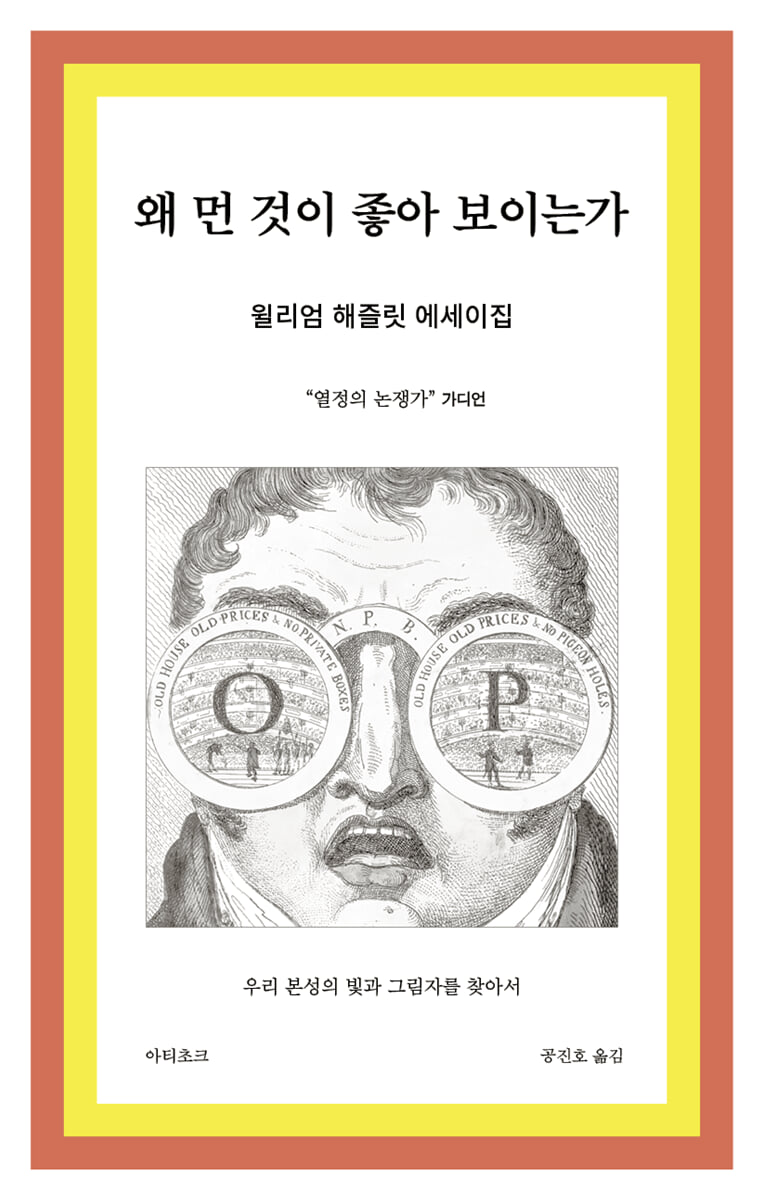
Why do distant things look good?
 |
Description
Book Introduction
"Why Distant Things Look Good" is William Hazlitt's second collection of humanities essays, following "On the Pleasure of Disgust," which was first published in Korea by Artichoke.
Along with George Orwell, Hazlitt is considered one of the greatest essayists in British history, a radical idealist who longed for a sovereign republic of the people. He delves into the unchanging nature and behavior of human beings, revealing their light and shadow to us today.
Subtitled “In Search of the Light and Shadow of Our Nature,” this anthology contrasts the lives of the wealthy and powerful Royal Academy members with the lives of the vast majority of artists who fear poverty more than death. It also poses the provocative question of why so few tyrants take their own lives, and why the most despicable slaves are the most ideal flatterers. The essays, which shine with Hazlitt’s signature insight and writing, explore human nature and behavior.
Hazlitt's timeless appeal, profound relevance, and sharp writing will once again confirm why he is considered Britain's "greatest prose writer" and "a passionate polemicist."
Along with George Orwell, Hazlitt is considered one of the greatest essayists in British history, a radical idealist who longed for a sovereign republic of the people. He delves into the unchanging nature and behavior of human beings, revealing their light and shadow to us today.
Subtitled “In Search of the Light and Shadow of Our Nature,” this anthology contrasts the lives of the wealthy and powerful Royal Academy members with the lives of the vast majority of artists who fear poverty more than death. It also poses the provocative question of why so few tyrants take their own lives, and why the most despicable slaves are the most ideal flatterers. The essays, which shine with Hazlitt’s signature insight and writing, explore human nature and behavior.
Hazlitt's timeless appeal, profound relevance, and sharp writing will once again confirm why he is considered Britain's "greatest prose writer" and "a passionate polemicist."
- You can preview some of the book's contents.
Preview
index
William Hazlitt's epitaph
On the artist's old age
Why do distant things look good?
To love life is
About Fashion
On the Conditions of Success
On Flatterers and Tyrants
About the death penalty
Translator's Note: London's Solitude & Liber Amoris
Chronology of William Hazlitt
On the artist's old age
Why do distant things look good?
To love life is
About Fashion
On the Conditions of Success
On Flatterers and Tyrants
About the death penalty
Translator's Note: London's Solitude & Liber Amoris
Chronology of William Hazlitt
Into the book
Art Academy members are definitely different.
He is an “unbreakable immortal” who cannot be defeated by creditors, critics, or patrons.
To embarrass your jealous detractors, all you have to do is draw a picture (just as the sun needs to shine).
[Omitted] Most artists fear poverty more than death.
Having started their lives in poverty, they are haunted by the thought that they will end up in poverty, that they will die to avoid being prosecuted for debt.
--- From "On the Old Age of Artists"
“The fabric of life is a mixture of good and bad threads.
“Virtue would be proud without the scourge of vice, and sin would despair without the care of virtue.” These are true and excellent words from long ago, spoken by a man who knew well the strengths and weaknesses of human nature.
The philosophers who take pride in classifying schools, parties, and people by nicknames have not yet grasped its meaning!
--- From "Why Do Distant Things Look Good?"
“Why are there so few tyrants who take their own lives?” First of all, tyrants are never satisfied with the evil they have committed.
So even after all the feelings of pleasure have disappeared, one cannot let go of power.
Moreover, they absurdly view happiness not as an end but as a means within their power.
[Omitted] Kings are the fools of life.
They are fools who easily fall for the dazzling illusions surrounding them and hold on to their absurd opinions.
--- From "Loving Life"
In fact, true virtue, beauty, or understanding are the same regardless of 'high or low' status.
The attitudes and charm that come from the false superiority of the upper classes can be easily and successfully imitated by even the lower classes if they put their minds to it.
[Omitted] Nobility and vulgarity are very, very close.
The gap can be said to be the difference of a blank sheet of paper.
You can be sure that where there is much pretense of nobility, there is twice as much vulgarity.
--- From "On Fashion"
“Being fast does not necessarily mean winning a race, and being strong does not necessarily mean winning a fight.” [Omitted] Success is a matter of acquiring rather than qualifying for.
Setting your standards for improving your own qualities too high or expecting the public's expectations too highly are obstacles to success.
The question is not what we should do, but what we can do to achieve the best possible outcome.
--- From "On the Conditions of Success"
The principle of all idolatry is the same.
It is a psychological function that seeks to fill the lack of something to worship.
I don't know what the deficiency is or why.
It's like loving an effect without a cause.
It is an act of voluntary offering that does not damage our pretense.
And it is an act of establishing something in the world that makes us feel superior to other people.
In other words, it is a work of our own creation.
He is an “unbreakable immortal” who cannot be defeated by creditors, critics, or patrons.
To embarrass your jealous detractors, all you have to do is draw a picture (just as the sun needs to shine).
[Omitted] Most artists fear poverty more than death.
Having started their lives in poverty, they are haunted by the thought that they will end up in poverty, that they will die to avoid being prosecuted for debt.
--- From "On the Old Age of Artists"
“The fabric of life is a mixture of good and bad threads.
“Virtue would be proud without the scourge of vice, and sin would despair without the care of virtue.” These are true and excellent words from long ago, spoken by a man who knew well the strengths and weaknesses of human nature.
The philosophers who take pride in classifying schools, parties, and people by nicknames have not yet grasped its meaning!
--- From "Why Do Distant Things Look Good?"
“Why are there so few tyrants who take their own lives?” First of all, tyrants are never satisfied with the evil they have committed.
So even after all the feelings of pleasure have disappeared, one cannot let go of power.
Moreover, they absurdly view happiness not as an end but as a means within their power.
[Omitted] Kings are the fools of life.
They are fools who easily fall for the dazzling illusions surrounding them and hold on to their absurd opinions.
--- From "Loving Life"
In fact, true virtue, beauty, or understanding are the same regardless of 'high or low' status.
The attitudes and charm that come from the false superiority of the upper classes can be easily and successfully imitated by even the lower classes if they put their minds to it.
[Omitted] Nobility and vulgarity are very, very close.
The gap can be said to be the difference of a blank sheet of paper.
You can be sure that where there is much pretense of nobility, there is twice as much vulgarity.
--- From "On Fashion"
“Being fast does not necessarily mean winning a race, and being strong does not necessarily mean winning a fight.” [Omitted] Success is a matter of acquiring rather than qualifying for.
Setting your standards for improving your own qualities too high or expecting the public's expectations too highly are obstacles to success.
The question is not what we should do, but what we can do to achieve the best possible outcome.
--- From "On the Conditions of Success"
The principle of all idolatry is the same.
It is a psychological function that seeks to fill the lack of something to worship.
I don't know what the deficiency is or why.
It's like loving an effect without a cause.
It is an act of voluntary offering that does not damage our pretense.
And it is an act of establishing something in the world that makes us feel superior to other people.
In other words, it is a work of our own creation.
--- From "On Flatterers and Tyrants"
Publisher's Review
★ British Guardian “A passionate polemicist and radical romantic.
“Master of English Essays”
★ Virginia Woolf: "The strongest and most fearless writer of her time."
Britain's greatest prose writer and passionate debater
Discover the essence of William Hazlitt's essays!
"Why Distant Things Look Good" is William Hazlitt's second collection of essays, following "On the Pleasure of Disgust."
Along with George Orwell, Hazlitt is considered one of the greatest essayists in British history, a radical idealist who longed for a sovereign republic of the people. He delves into the unchanging nature and behavior of human beings, revealing their light and shadow to us today.
Subtitled “In Search of the Light and Shadow of Our Nature,” this anthology contains a selection of essays that shine with Hazlitt’s unique insight and writing skills on human nature and behavior.
As Virginia Woolf lauded, Hazlitt delighted in exploring the strange depths of human psychology and discovering the logic of worldly affairs, and he excelled above all others in discovering the obscure causes hidden behind commonplace words or emotions.
He also never compromised with authority and never abandoned or changed his own uniqueness and concepts under the pretext of respecting public opinion.
“His essays are undeniably Hazlitt himself.”
Why do artists fear poverty more than death?
Why so few tyrants take their own lives?
Why the most despicable slaves are the most ideal flatterers
Opening with "On the Artist's Old Age," "Why Distant Things Look Good" contains essays that resonate with our times, including the title piece, and are uniquely thoughtful and insightful, drawing from Hazlitt's vast oeuvre.
Hazlitt contrasts the lives of the wealthy and prestigious Royal Academy members with the lives of the majority of artists who fear poverty more than death, delves into the roots of human behavior that turns people into monsters or ghosts through mere ignorance, and repeatedly poses provocative questions about why so few tyrants take their own lives and why writers tend to turn to “empty praise or a salty reward.”
In particular, “On Flatterers and Tyrants” fully shows Hazlitt’s republican side, who “never compromises with authority.”
Hazlitt analyzes the unchanging nature of power and the principle of idolatry, citing examples from shackled slaves to writers of why they worship idols and love kings, and asserts that “the meanest slaves are the most ideal flatterers.”
According to him, all other idol-mongers seem insignificant compared to the creators and reformers of the idols called 'divine right of kings' or 'orthodoxy', who exploit the weak points of the servile mentality and prickly egoism of flatterers.
“A true republican is one who sees the morning star falling over a poor man’s hut and connects it with the human desire for happiness.”
Unlike his friends who surrendered to the government, Hazlitt remained a lifelong minority, passionately defending truth, liberty, and humanity, and striving to live the life of a “true republican.”
The seven essays in "Why Distant Things Look Good," which are being introduced for the first time in Korea, are, as inscribed on his tombstone, the very essence of Hazlitt: a man who loved the poor and oppressed, despised the arrogance and power of the few, and possessed true moral courage.
The timeless appeal, profound relevance, and sharp writing will once again confirm why Hazlitt is “the greatest writer” and “a passionate debater.”
“Master of English Essays”
★ Virginia Woolf: "The strongest and most fearless writer of her time."
Britain's greatest prose writer and passionate debater
Discover the essence of William Hazlitt's essays!
"Why Distant Things Look Good" is William Hazlitt's second collection of essays, following "On the Pleasure of Disgust."
Along with George Orwell, Hazlitt is considered one of the greatest essayists in British history, a radical idealist who longed for a sovereign republic of the people. He delves into the unchanging nature and behavior of human beings, revealing their light and shadow to us today.
Subtitled “In Search of the Light and Shadow of Our Nature,” this anthology contains a selection of essays that shine with Hazlitt’s unique insight and writing skills on human nature and behavior.
As Virginia Woolf lauded, Hazlitt delighted in exploring the strange depths of human psychology and discovering the logic of worldly affairs, and he excelled above all others in discovering the obscure causes hidden behind commonplace words or emotions.
He also never compromised with authority and never abandoned or changed his own uniqueness and concepts under the pretext of respecting public opinion.
“His essays are undeniably Hazlitt himself.”
Why do artists fear poverty more than death?
Why so few tyrants take their own lives?
Why the most despicable slaves are the most ideal flatterers
Opening with "On the Artist's Old Age," "Why Distant Things Look Good" contains essays that resonate with our times, including the title piece, and are uniquely thoughtful and insightful, drawing from Hazlitt's vast oeuvre.
Hazlitt contrasts the lives of the wealthy and prestigious Royal Academy members with the lives of the majority of artists who fear poverty more than death, delves into the roots of human behavior that turns people into monsters or ghosts through mere ignorance, and repeatedly poses provocative questions about why so few tyrants take their own lives and why writers tend to turn to “empty praise or a salty reward.”
In particular, “On Flatterers and Tyrants” fully shows Hazlitt’s republican side, who “never compromises with authority.”
Hazlitt analyzes the unchanging nature of power and the principle of idolatry, citing examples from shackled slaves to writers of why they worship idols and love kings, and asserts that “the meanest slaves are the most ideal flatterers.”
According to him, all other idol-mongers seem insignificant compared to the creators and reformers of the idols called 'divine right of kings' or 'orthodoxy', who exploit the weak points of the servile mentality and prickly egoism of flatterers.
“A true republican is one who sees the morning star falling over a poor man’s hut and connects it with the human desire for happiness.”
Unlike his friends who surrendered to the government, Hazlitt remained a lifelong minority, passionately defending truth, liberty, and humanity, and striving to live the life of a “true republican.”
The seven essays in "Why Distant Things Look Good," which are being introduced for the first time in Korea, are, as inscribed on his tombstone, the very essence of Hazlitt: a man who loved the poor and oppressed, despised the arrogance and power of the few, and possessed true moral courage.
The timeless appeal, profound relevance, and sharp writing will once again confirm why Hazlitt is “the greatest writer” and “a passionate debater.”
GOODS SPECIFICS
- Date of issue: February 7, 2025
- Page count, weight, size: 200 pages | 284g | 140*220*14mm
- ISBN13: 9791186643211
- ISBN10: 1186643218
You may also like
카테고리
korean


korean

![GQ KOREA Mark (Monthly): December [2025]](http://librairie.coreenne.fr/cdn/shop/files/8ef265dbbfbf186523ed75ba7319009d.jpg?v=1765340328&width=3840)


