

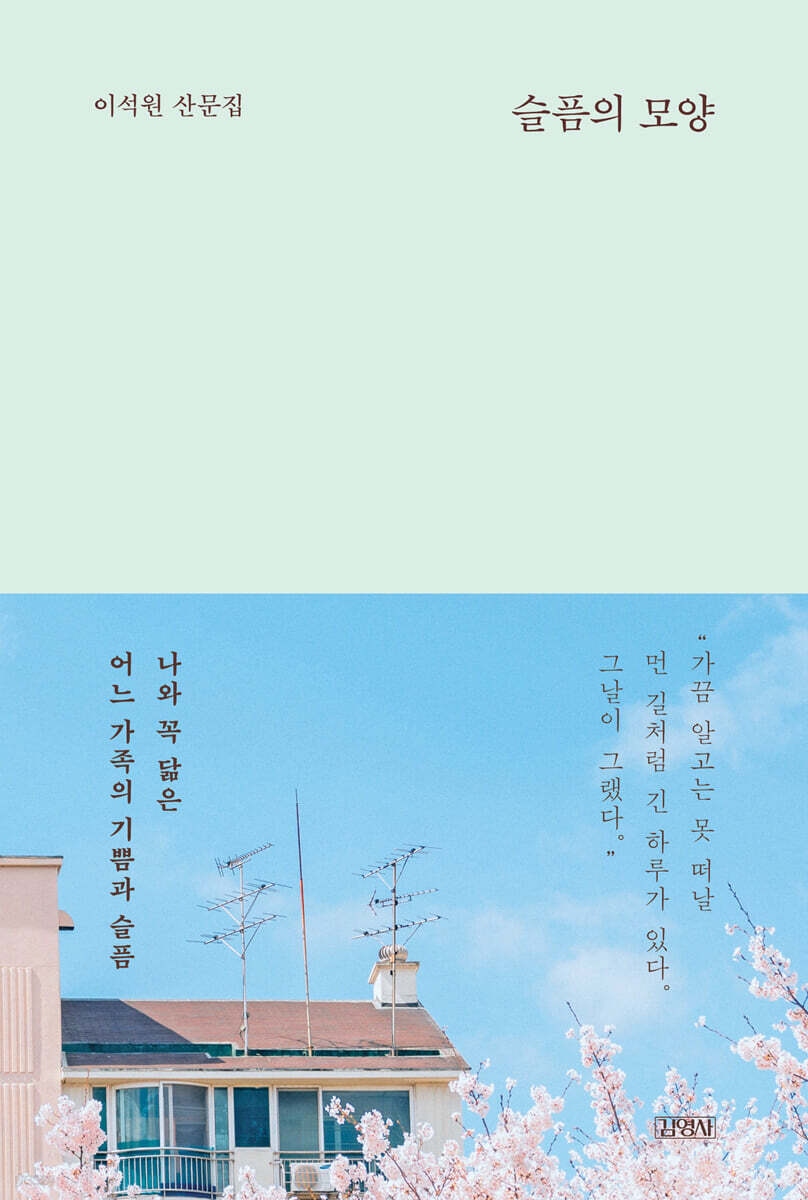
The shape of sadness
 |
Description
Book Introduction
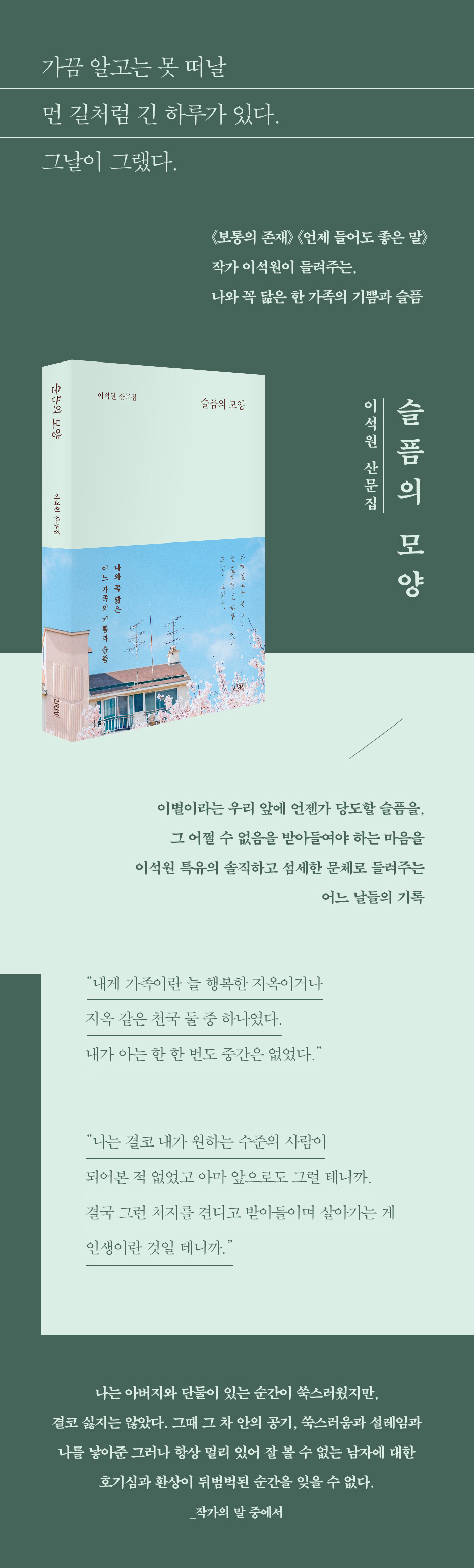
“For me, family is either a happy hell or
It was one of two hells and one heaven.
As far as I know, there has never been a middle ground.”
Lee Seok-won, author of 『Ordinary Existence』 and 『Words Good to Hear Anytime』, conveys,
The joys and sorrows of a family that looks just like me
On the day my father suddenly collapsed, time began to flow differently for each member of the family.
Seok-won, the son who lives a completely different life, visits his parents' apartment every night and looks up at the empty room with the lights off.
"The Shape of Sorrow" is a collection of essays that captures the author Lee Seok-won's characteristically honest and delicate perspective on the long period of nursing a patient, when one cannot know when or how it will end, the gradually growing sensitivity of family members, and the time when one will one day be left alone.
When I get close to someone, I get angry and sometimes sad, so I want to keep my distance, but even so, family is a group of beings who share an indescribable, vast, and complex fate.
In this article, which makes us think about this fact again, the author vividly shows the various faces of a family that we cannot hate, but that feels like our own family.
"The Shape of Sorrow" is a powerful and captivating piece by Lee Seok-won that speaks of the sadness that will one day come upon us in the form of parting, the heart that must accept its inevitability, the moments of everyday life that are tragic when seen from afar but comedic when seen up close, and the preciousness of each and every moment.
It was one of two hells and one heaven.
As far as I know, there has never been a middle ground.”
Lee Seok-won, author of 『Ordinary Existence』 and 『Words Good to Hear Anytime』, conveys,
The joys and sorrows of a family that looks just like me
On the day my father suddenly collapsed, time began to flow differently for each member of the family.
Seok-won, the son who lives a completely different life, visits his parents' apartment every night and looks up at the empty room with the lights off.
"The Shape of Sorrow" is a collection of essays that captures the author Lee Seok-won's characteristically honest and delicate perspective on the long period of nursing a patient, when one cannot know when or how it will end, the gradually growing sensitivity of family members, and the time when one will one day be left alone.
When I get close to someone, I get angry and sometimes sad, so I want to keep my distance, but even so, family is a group of beings who share an indescribable, vast, and complex fate.
In this article, which makes us think about this fact again, the author vividly shows the various faces of a family that we cannot hate, but that feels like our own family.
"The Shape of Sorrow" is a powerful and captivating piece by Lee Seok-won that speaks of the sadness that will one day come upon us in the form of parting, the heart that must accept its inevitability, the moments of everyday life that are tragic when seen from afar but comedic when seen up close, and the preciousness of each and every moment.
- You can preview some of the book's contents.
Preview
index
Part 1: The Trap
Part 2 Villain
Part 3: The Road to Father
Part 4: Why is my heart like this?
Part 5: What Matters Most Was Daily Life
Part 6 Have mercy on us
Part 7: Return
Part 8 PT (Presentation)
Part 9: The Maze with No Exit
Part 10: A Campfire in Spring
Part 11 Paper Dolls
Part 12 Memories
Author's Note
Part 2 Villain
Part 3: The Road to Father
Part 4: Why is my heart like this?
Part 5: What Matters Most Was Daily Life
Part 6 Have mercy on us
Part 7: Return
Part 8 PT (Presentation)
Part 9: The Maze with No Exit
Part 10: A Campfire in Spring
Part 11 Paper Dolls
Part 12 Memories
Author's Note
Detailed image
Into the book
Looking at the light in that room that never went out, day or night, I thought that my parents, now in their mid-eighties, were still alive and that they were sleeping comfortably there or having a comfortable time watching TV. I felt grateful and relieved for everything, and even my small worries were alleviated.
Seeing the lights in the room that had never been turned off like this, and especially the living room where my mother was with the lights on, made me feel so sad and lonely.
I ended up just crying out loud on the side of the road.
---p.28
But why didn't I still know?
Life is much more complicated than I thought, and there are always reasons why other people make decisions and act differently from me.
---p.44
It was obviously a distortion of the photograph, but even knowing that, I felt sad.
Because I believed that we would never get together like this again.
Even then, did I want to know if these feelings were real or if I was simply shedding tears in the face of the situation? Because they were disrupting my peace of mind and seriously disrupting my life? Probably not.
Because we are family.
Family is not people who feel sadness because they deserve to be sad, nor people who love because they deserve to be loved, but people who are capable of everything simply because they are family.
---p.120
The day the nursing home was decided.
My older sister, who was so happy that she was out of breath and drenched in sweat in the middle of winter after visiting more than five hospitals in one day and finding a good place… As the eldest daughter in the family and as her father’s child, she could have easily shown that kind of dedicated effort and responsibility for her parents, but instead, my older sister was completely lacking in communicating with the people she was supposed to be responsible for, namely her parents.
---p.173
Parents always teach us lessons in two ways.
I have to live like that.
I shouldn't live like that.
---p.188
I wanted to remember my father in a good way.
For me and no one else.
Of course, you can't say that it wasn't for the father.
Seeing the lights in the room that had never been turned off like this, and especially the living room where my mother was with the lights on, made me feel so sad and lonely.
I ended up just crying out loud on the side of the road.
---p.28
But why didn't I still know?
Life is much more complicated than I thought, and there are always reasons why other people make decisions and act differently from me.
---p.44
It was obviously a distortion of the photograph, but even knowing that, I felt sad.
Because I believed that we would never get together like this again.
Even then, did I want to know if these feelings were real or if I was simply shedding tears in the face of the situation? Because they were disrupting my peace of mind and seriously disrupting my life? Probably not.
Because we are family.
Family is not people who feel sadness because they deserve to be sad, nor people who love because they deserve to be loved, but people who are capable of everything simply because they are family.
---p.120
The day the nursing home was decided.
My older sister, who was so happy that she was out of breath and drenched in sweat in the middle of winter after visiting more than five hospitals in one day and finding a good place… As the eldest daughter in the family and as her father’s child, she could have easily shown that kind of dedicated effort and responsibility for her parents, but instead, my older sister was completely lacking in communicating with the people she was supposed to be responsible for, namely her parents.
---p.173
Parents always teach us lessons in two ways.
I have to live like that.
I shouldn't live like that.
---p.188
I wanted to remember my father in a good way.
For me and no one else.
Of course, you can't say that it wasn't for the father.
---p.280
Publisher's Review
“Sometimes there are days that are as long as a long journey that you know you can’t leave.
That was the day.”
About the mind that takes things for granted
Time is fair to everyone.
The moment of youth that shines brightly like Yunseul withers like autumn leaves, and the time of parting comes.
We love and hate passionately, as if we were born to part, but in the end we all part.
There is no other reason.
When the absence of our parents, who we believed would always be by our side, becomes a reality, we feel bewilderment rather than sadness at the suddenness of their absence, and when the bewilderment reaches its peak, sadness bursts into tears.
Lee Seok-won, a writer who is much loved for his honest and unique writing style.
He looks at the process of preparing for separation in the face of his father's sudden illness with a gaze that is sometimes cynical, but also does not try to hide his emotions and is filled with longing.
My father, who had been like a distant mountain for a long time, had given me a lot of trauma.
And the mother, who was once the person who had the greatest influence on the author, for better or worse, but is now an irreplaceable person, and the two older sisters, who each have a clear division of roles in the face of a crisis. Although no one in the family is easy, the author's story of learning that having them by his side and each day is precious through his father's work is read like a warm family movie, although full of twists and turns.
“For some reason, my parents never turned off the lights even when they were asleep, so whenever I saw the lights always on in the bedroom where my father was and the living room where my mother lived, I would feel a strange sense of relief and a warm feeling in my heart.
Then, with that charged warmth, I could live for a while longer.
It is no exaggeration to say that I have survived to this day thanks to that.” - pages 27-28
“I wanted to remember my father in a good way.
“For me, and no one else.”
A heart that cherishes precious things
A person who would give his last penny for his family, a person who makes you wonder why he would do such a thing for his parents.
Reading his writing, I find myself seriously asking myself what family means to him.
Sometimes, the author gets frustrated and annoyed by the situation, and gets angry at the elderly parents who don't listen to their children, but even then, he says that it's for his own good, but even in those moments, the author's eyes are fixed on his family.
Although nursing a sick person is not an easy task because there is no filial son in a long illness, he does not ask why he has to do it.
Because we are family.
Family is a complex group of emotions that cannot be expressed in words alone.
So, in "The Shape of Sorrow," author Lee Seok-won completely captured the feelings that cannot be measured by material things, the feelings that can even be felt as desperation, and his desire to protect even the small, fragile light that remains next to his family.
“I have spent my entire life, especially in your later years, putting my father on the court of my mind and judging him every day, but I suspect he never once in his life rated me, or any of us, as his children.” - Page 290
Human, all too human
The story of a family that looks exactly like ours
That's usually how it was back then.
Fathers who worked were indifferent to their children and wanted to be treated well at home, while mothers who stayed home and did housework were very interested in their children's education.
And as time goes by, the father, who has grown older, still tries to manipulate his family as before.
It wasn't so much my personality as it was the times.
Because we lived in a patriarchal era where the line was passed down from father to eldest son to son.
Children sometimes feel disillusioned with such a father, but the sadness that slowly creeps in overshadows any hatred or resentment.
A family like that also appears in “The Shape of Sorrow.”
A father who compares his children to other families' children without a second thought.
And the father who doesn't even know why that comparison is wrong.
The author, through his unique wit and metaphors, portrays even this extremely human father as an object of affection, not something one can simply hate.
The author says that seeing his father acting like a child makes him feel like a parent himself.
But I can't help but sigh in deep sympathy at his words.
“At that time, maybe we really were our father’s father.
“Because the worry about my children never left my mind and the nagging never stopped.” - Page 179
Could there be a more appropriate saying between aging children and their parents?
The author says he still doesn't know what to call the bond between being born as a child and becoming a parent, but concludes that what's more important is the memories and love of this moment.
“What kind of fate brought us together as parents and children and led us through this life?
I'd like to end this book by making a confession that I've never made before.
“I loved my father and I hated him, but I will always love him and I will never forget him.” - Page 297
That was the day.”
About the mind that takes things for granted
Time is fair to everyone.
The moment of youth that shines brightly like Yunseul withers like autumn leaves, and the time of parting comes.
We love and hate passionately, as if we were born to part, but in the end we all part.
There is no other reason.
When the absence of our parents, who we believed would always be by our side, becomes a reality, we feel bewilderment rather than sadness at the suddenness of their absence, and when the bewilderment reaches its peak, sadness bursts into tears.
Lee Seok-won, a writer who is much loved for his honest and unique writing style.
He looks at the process of preparing for separation in the face of his father's sudden illness with a gaze that is sometimes cynical, but also does not try to hide his emotions and is filled with longing.
My father, who had been like a distant mountain for a long time, had given me a lot of trauma.
And the mother, who was once the person who had the greatest influence on the author, for better or worse, but is now an irreplaceable person, and the two older sisters, who each have a clear division of roles in the face of a crisis. Although no one in the family is easy, the author's story of learning that having them by his side and each day is precious through his father's work is read like a warm family movie, although full of twists and turns.
“For some reason, my parents never turned off the lights even when they were asleep, so whenever I saw the lights always on in the bedroom where my father was and the living room where my mother lived, I would feel a strange sense of relief and a warm feeling in my heart.
Then, with that charged warmth, I could live for a while longer.
It is no exaggeration to say that I have survived to this day thanks to that.” - pages 27-28
“I wanted to remember my father in a good way.
“For me, and no one else.”
A heart that cherishes precious things
A person who would give his last penny for his family, a person who makes you wonder why he would do such a thing for his parents.
Reading his writing, I find myself seriously asking myself what family means to him.
Sometimes, the author gets frustrated and annoyed by the situation, and gets angry at the elderly parents who don't listen to their children, but even then, he says that it's for his own good, but even in those moments, the author's eyes are fixed on his family.
Although nursing a sick person is not an easy task because there is no filial son in a long illness, he does not ask why he has to do it.
Because we are family.
Family is a complex group of emotions that cannot be expressed in words alone.
So, in "The Shape of Sorrow," author Lee Seok-won completely captured the feelings that cannot be measured by material things, the feelings that can even be felt as desperation, and his desire to protect even the small, fragile light that remains next to his family.
“I have spent my entire life, especially in your later years, putting my father on the court of my mind and judging him every day, but I suspect he never once in his life rated me, or any of us, as his children.” - Page 290
Human, all too human
The story of a family that looks exactly like ours
That's usually how it was back then.
Fathers who worked were indifferent to their children and wanted to be treated well at home, while mothers who stayed home and did housework were very interested in their children's education.
And as time goes by, the father, who has grown older, still tries to manipulate his family as before.
It wasn't so much my personality as it was the times.
Because we lived in a patriarchal era where the line was passed down from father to eldest son to son.
Children sometimes feel disillusioned with such a father, but the sadness that slowly creeps in overshadows any hatred or resentment.
A family like that also appears in “The Shape of Sorrow.”
A father who compares his children to other families' children without a second thought.
And the father who doesn't even know why that comparison is wrong.
The author, through his unique wit and metaphors, portrays even this extremely human father as an object of affection, not something one can simply hate.
The author says that seeing his father acting like a child makes him feel like a parent himself.
But I can't help but sigh in deep sympathy at his words.
“At that time, maybe we really were our father’s father.
“Because the worry about my children never left my mind and the nagging never stopped.” - Page 179
Could there be a more appropriate saying between aging children and their parents?
The author says he still doesn't know what to call the bond between being born as a child and becoming a parent, but concludes that what's more important is the memories and love of this moment.
“What kind of fate brought us together as parents and children and led us through this life?
I'd like to end this book by making a confession that I've never made before.
“I loved my father and I hated him, but I will always love him and I will never forget him.” - Page 297
GOODS SPECIFICS
- Date of issue: November 30, 2024
- Page count, weight, size: 300 pages | 378g | 128*190*18mm
- ISBN13: 9791194330813
- ISBN10: 1194330819
You may also like
카테고리
korean


korean

![GQ KOREA Mark (Monthly): December [2025]](http://librairie.coreenne.fr/cdn/shop/files/8ef265dbbfbf186523ed75ba7319009d.jpg?v=1765340328&width=3840)


