

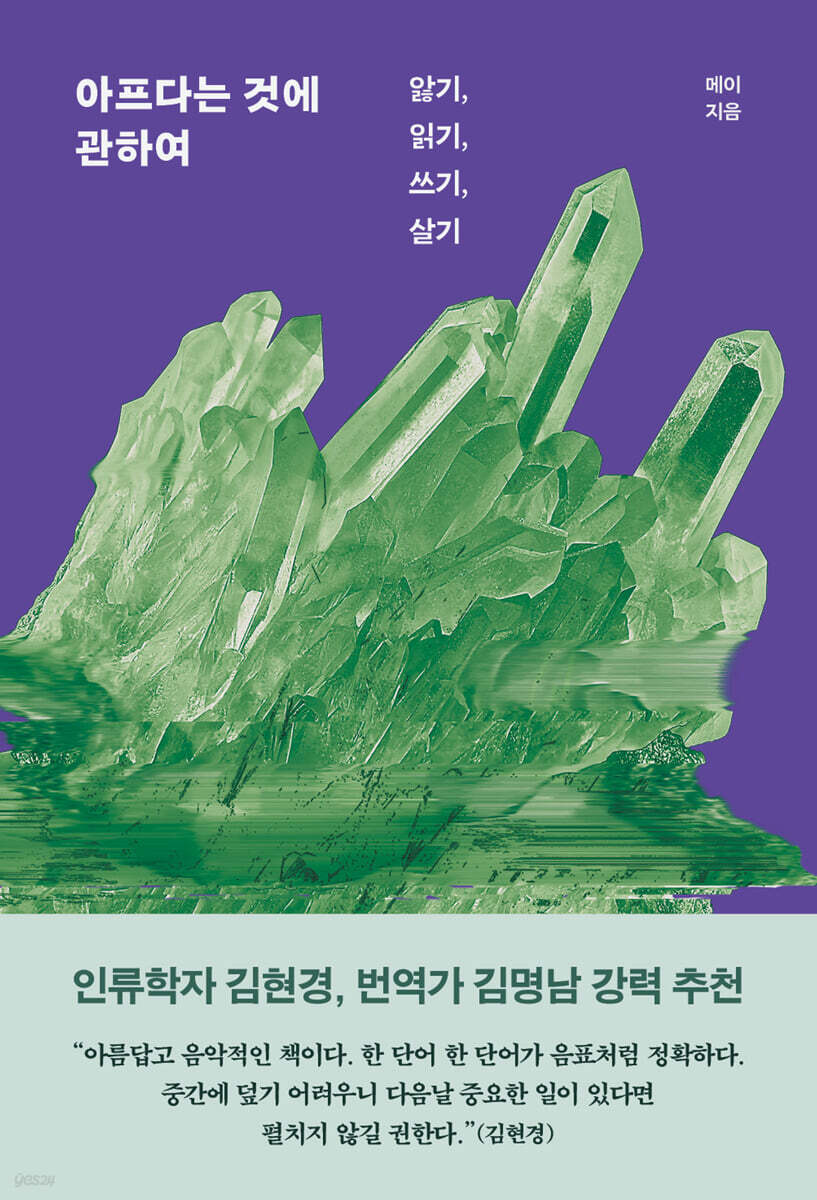
About being sick
 |
Description
Book Introduction
“It is a beautiful and musical book.
“Every single word is as precise as a musical note.” _Kim Hyun-kyung (anthropologist, author of People, Place, Hospitality)
"Surprisingly, this book will have many moments that will make you laugh." _Kim Myeong-nam (translator)
A story about pain is a story about everything, about humanity.
: An essay with delicate and profound insights into 'living with a sick body'
This book is the first solo essay by author May, who has deeply explored the meaning of suffering from illness through her translations of works such as “Living with a Sick Body” and “The Suffering Body.” It contains the author’s unique answers to the fundamental and complex questions raised by physical pain and illness.
A 'sick person' who has suffered from chronic pain for a long time, a painful but difficult to cure disease with an unknown cause - this book contains the life and thoughts of a writer, but it is far from a traditional struggle with illness or a drama of human triumph.
From the long history of sick-writer narratives, such as the Book of Job, that describe the hardships and suffering caused by pain, to the writings of writers like Alphonse Daudet, Virginia Woolf, and Susan Sontag about their own illnesses, this is a unique and elegant humanities essay that explores with beautiful reasoning and prose, ultimately reaching the fundamental question of what it means to be a "human being with a body."
This book is not a memoir of a struggle in the traditional sense.
This means that this is not a book detailing personal experiences of illness, following a narrative of diagnosis, treatment, and recovery.
It is not a practical book providing information and advice about hospitals, doctors, and treatments.
It is not a memoir that details the difficulties and the process of overcoming them.
This is not a record of all the waves I've encountered.
Rather, this book is about what I learned and thought while living within a specific condition/situation/limit condition in my life when the condition became a condition.
This is a book about 'reading and writing about being sick.'
It's a book about words and pain.
This is a book about the education of pain.
This is a book about gravity, the force that pulls us down to the ground.
This is a book about living in a body that is monstrous, painful, and miraculous.
_Main text, pages 19-20, "Beginning the Story"
“Every single word is as precise as a musical note.” _Kim Hyun-kyung (anthropologist, author of People, Place, Hospitality)
"Surprisingly, this book will have many moments that will make you laugh." _Kim Myeong-nam (translator)
A story about pain is a story about everything, about humanity.
: An essay with delicate and profound insights into 'living with a sick body'
This book is the first solo essay by author May, who has deeply explored the meaning of suffering from illness through her translations of works such as “Living with a Sick Body” and “The Suffering Body.” It contains the author’s unique answers to the fundamental and complex questions raised by physical pain and illness.
A 'sick person' who has suffered from chronic pain for a long time, a painful but difficult to cure disease with an unknown cause - this book contains the life and thoughts of a writer, but it is far from a traditional struggle with illness or a drama of human triumph.
From the long history of sick-writer narratives, such as the Book of Job, that describe the hardships and suffering caused by pain, to the writings of writers like Alphonse Daudet, Virginia Woolf, and Susan Sontag about their own illnesses, this is a unique and elegant humanities essay that explores with beautiful reasoning and prose, ultimately reaching the fundamental question of what it means to be a "human being with a body."
This book is not a memoir of a struggle in the traditional sense.
This means that this is not a book detailing personal experiences of illness, following a narrative of diagnosis, treatment, and recovery.
It is not a practical book providing information and advice about hospitals, doctors, and treatments.
It is not a memoir that details the difficulties and the process of overcoming them.
This is not a record of all the waves I've encountered.
Rather, this book is about what I learned and thought while living within a specific condition/situation/limit condition in my life when the condition became a condition.
This is a book about 'reading and writing about being sick.'
It's a book about words and pain.
This is a book about the education of pain.
This is a book about gravity, the force that pulls us down to the ground.
This is a book about living in a body that is monstrous, painful, and miraculous.
_Main text, pages 19-20, "Beginning the Story"
- You can preview some of the book's contents.
Preview
index
Prologue: Return
Starting the story
Body: Tomb, Sign, Place of Salvation
genesis
The Art of Suffering and the Art of Writing
So small that it's almost invisible
Painting of Pain
For the successful interpersonal relationships of the sick
The Story of Pie
Writing the History of Pain: Alphonse Daudet's "La Doulue"
What the bottle gave
Coming from nothing
Virginia Woolf, Portrait of a Writer, a Woman, and a Sick Person
Books and phrases for young patients
gravitation
We shed our leaves like trees
Epilogue: Sea of Notes
main
Recommendation
Acknowledgements
Starting the story
Body: Tomb, Sign, Place of Salvation
genesis
The Art of Suffering and the Art of Writing
So small that it's almost invisible
Painting of Pain
For the successful interpersonal relationships of the sick
The Story of Pie
Writing the History of Pain: Alphonse Daudet's "La Doulue"
What the bottle gave
Coming from nothing
Virginia Woolf, Portrait of a Writer, a Woman, and a Sick Person
Books and phrases for young patients
gravitation
We shed our leaves like trees
Epilogue: Sea of Notes
main
Recommendation
Acknowledgements
Into the book
The arrow of doubt also points outward.
Then the sick person becomes a revolutionary rather than a religious person.
The cause of the disease lies outside, in society, in the country, in the system.
The most frequently cited concerns include unhealthy food, toxic living conditions, unsafe work environments, long working hours, corporate greed, and poverty.
At a more fundamental level, neoliberal capitalism, racism, and sexism all threaten health.
--- p.29
The Greek word 'hamartia', which is translated as 'sin' in the Bible, is said to have originally meant 'to miss the target'.
That was something that wasn't there in my previous life.
Target, point, gist, core, center.
All I did was wander around anxiously, distracted, and in that sense, I was a sinner.
--- p.31
The self-consciousness of a writer who conveys his pain as a sick person but does not endlessly complain, the skill to convey what cannot be said through the words that can be said, the composure that does not succumb to easy victory or easy despair, the self-respect that does not use pain as an excuse for trivial writing, the ethics that do not hide the darkness that one sees but also do not adorn oneself with it, the self-discipline that one works hard at every day for a long time, the balance that recognizes that one's pain is unique and absolute but at the same time the countless sufferings that exist in the world, the amazing leap that turns isolating pain into an opportunity to broaden one's horizons.
--- pp.46~47
Without words and stories that serve as mirrors, we cannot see what we have experienced from outside the scope of that experience.
We know ourselves by reflecting on the similarities as well as the differences.
--- p.67
A sick person is an open wound.
Touch him.
There will be an outpouring of crying and complaints.
Talking to a sick person is like walking through a minefield.
He will shake a fine sieve of accusations, filtering every word you use, and sometimes the relationship itself.
--- p.92
Language emerges only when we distance ourselves from the sick body.
If there were a piece of writing that conveyed pain in its entirety, and thus was written without a single bit of distortion, there would be no one who could read it.
--- p.112
For those who aren't sick, the truth is simpler.
For them, happiness comes (only) from health.
The experience of being sick is negative in all dimensions and aspects, both personally and socially.
Sick time is a waste of life and a time of falling behind.
A sick person experiences only loss.
--- p.137
fun.
Fun is precious to a sick person.
It might be better to create happy moments between hardships and gradually increase the number of such moments.
Getting better isn't just about getting rid of the pain.
If you can enjoy pain, it's better (this is not just my opinion, but what pain researchers consistently say).
--- p.162
“When you are sick, think of how vast the kingdom of the sick is.
Think of all of us here.” Think of all of us here.
I did that.
A friend of mine once said—a living, real friend—that Wolff was the patron saint of sick women, and for me, that was true.
Virginia Woolf was my absent friend, my fellow invalid, my patron saint who, in her absence, could be everywhere.
--- pp.165~166
There is nothing beautiful in pain, weakness, or suffering.
The passivity of being subjected to and tormented by things that happen regardless of my will is simply miserable and disgusting.
If there is beauty in suffering (and beauty is a word we must use), it lies in our response to and adaptation to suffering.
The 'beauty' I find in the sick Virginia Woolf, and in all other stories of the sick, is nothing other than that kind of activity.
--- pp.201~202
Context is always important in speech, but this is especially true for people in pain.
Depending on who speaks, in what situation, and how the words are conveyed, the same words can become a knife or a lifeline.
Additionally, a sick person who is overwhelmed by their own misfortune is not a good conversationalist in the first place.
I get angry even if someone says they know about this pain (what do you know) and I get angry even if they say they don't know (how can you not know this).
I get sick and tired of being told what to eat or not to eat, and what is good for my health (Is there anything I haven't tried?).
--- p.209
I am now belatedly re-evaluating the time of survival that I thought was a time of miracles.
Maybe I've just been living all those years like a racing dog, chasing after a fake bait.
Because ‘that place’ was always right in front of my eyes.
And at the end of this painful journey, the words I never wanted to hear, these are all there is to it.
Has there ever been a dog that realized the rules of the game while running and stopped and whined?
Do you know what wakes me up?
Anything.
Then the sick person becomes a revolutionary rather than a religious person.
The cause of the disease lies outside, in society, in the country, in the system.
The most frequently cited concerns include unhealthy food, toxic living conditions, unsafe work environments, long working hours, corporate greed, and poverty.
At a more fundamental level, neoliberal capitalism, racism, and sexism all threaten health.
--- p.29
The Greek word 'hamartia', which is translated as 'sin' in the Bible, is said to have originally meant 'to miss the target'.
That was something that wasn't there in my previous life.
Target, point, gist, core, center.
All I did was wander around anxiously, distracted, and in that sense, I was a sinner.
--- p.31
The self-consciousness of a writer who conveys his pain as a sick person but does not endlessly complain, the skill to convey what cannot be said through the words that can be said, the composure that does not succumb to easy victory or easy despair, the self-respect that does not use pain as an excuse for trivial writing, the ethics that do not hide the darkness that one sees but also do not adorn oneself with it, the self-discipline that one works hard at every day for a long time, the balance that recognizes that one's pain is unique and absolute but at the same time the countless sufferings that exist in the world, the amazing leap that turns isolating pain into an opportunity to broaden one's horizons.
--- pp.46~47
Without words and stories that serve as mirrors, we cannot see what we have experienced from outside the scope of that experience.
We know ourselves by reflecting on the similarities as well as the differences.
--- p.67
A sick person is an open wound.
Touch him.
There will be an outpouring of crying and complaints.
Talking to a sick person is like walking through a minefield.
He will shake a fine sieve of accusations, filtering every word you use, and sometimes the relationship itself.
--- p.92
Language emerges only when we distance ourselves from the sick body.
If there were a piece of writing that conveyed pain in its entirety, and thus was written without a single bit of distortion, there would be no one who could read it.
--- p.112
For those who aren't sick, the truth is simpler.
For them, happiness comes (only) from health.
The experience of being sick is negative in all dimensions and aspects, both personally and socially.
Sick time is a waste of life and a time of falling behind.
A sick person experiences only loss.
--- p.137
fun.
Fun is precious to a sick person.
It might be better to create happy moments between hardships and gradually increase the number of such moments.
Getting better isn't just about getting rid of the pain.
If you can enjoy pain, it's better (this is not just my opinion, but what pain researchers consistently say).
--- p.162
“When you are sick, think of how vast the kingdom of the sick is.
Think of all of us here.” Think of all of us here.
I did that.
A friend of mine once said—a living, real friend—that Wolff was the patron saint of sick women, and for me, that was true.
Virginia Woolf was my absent friend, my fellow invalid, my patron saint who, in her absence, could be everywhere.
--- pp.165~166
There is nothing beautiful in pain, weakness, or suffering.
The passivity of being subjected to and tormented by things that happen regardless of my will is simply miserable and disgusting.
If there is beauty in suffering (and beauty is a word we must use), it lies in our response to and adaptation to suffering.
The 'beauty' I find in the sick Virginia Woolf, and in all other stories of the sick, is nothing other than that kind of activity.
--- pp.201~202
Context is always important in speech, but this is especially true for people in pain.
Depending on who speaks, in what situation, and how the words are conveyed, the same words can become a knife or a lifeline.
Additionally, a sick person who is overwhelmed by their own misfortune is not a good conversationalist in the first place.
I get angry even if someone says they know about this pain (what do you know) and I get angry even if they say they don't know (how can you not know this).
I get sick and tired of being told what to eat or not to eat, and what is good for my health (Is there anything I haven't tried?).
--- p.209
I am now belatedly re-evaluating the time of survival that I thought was a time of miracles.
Maybe I've just been living all those years like a racing dog, chasing after a fake bait.
Because ‘that place’ was always right in front of my eyes.
And at the end of this painful journey, the words I never wanted to hear, these are all there is to it.
Has there ever been a dog that realized the rules of the game while running and stopped and whined?
Do you know what wakes me up?
Anything.
--- p.225
Publisher's Review
As much as we empathize with the suffering of others,
It's not easy to fully convey your pain to others.
Even if they don't experience mental or physical illness themselves, people listen to the stories of the sick and their pain.
This may be the reason why works of art with the theme of pain have continued from ancient times to the present.
This is because the very feeling of pain is an undeniable condition of life that all humans cannot avoid.
From the stories of these sick writers, we can either feel fortunate for our own stable and 'normal' lives, or we can experience indirectly the hardships of being human.
But more than anything, I find comfort and solace in their stories and art, confirming that the pain they seem to be experiencing is universal.
"I'm not the only one who's weird, am I? I'm not the only one who doesn't have an answer, am I?" (pp. 36-37)
However, it is nearly impossible to convey to others and have them fully understand the absolute pain that occurs only within one's own skin.
Not only is it difficult to reproduce suffering, but it also demands active compassion and solidarity from others who must accept it, beyond a sense of duty.
If you want to sort out your current relationships, I recommend getting sick.
You will learn about various techniques that people use to change the subject when they confess that they are having a hard time.
You will learn about the feeling of not being able to answer calls and begging.
You will come to know the words that are spoken as you close the door, sometimes coldly, sometimes shyly.
You're not the only one having a hard time.
I don't like talking like that.
How about facing it with a little more composure?
Why are you crying on the phone?
_Main text, pages 87-88, "For the Sick's Successful Interpersonal Relationships"
“How lucky I am.
“I must always live with gratitude.”
: How to Represent Pain Without Objectifying It
In "Life of Pi," which contains reflections on the suffering and survival of the protagonist in the movie [Life of Pi], the author talks about the problem of alienation of the suffering subject that is inevitably caused by the superficial representation of pain, and the desire to convey the truth gained from painful experiences to others.
Those who have suffered pain unknown to anyone hope that their listeners will be moved by the secret wisdom about life and death they have gained from it.
However, the expectations and reactions of the listeners are usually limited to catharsis through testimonies sharing miraculous experiences or shocking true stories.
So how can we have a 'good' story about suffering?
How can we perceive the truth that the world of ordinary normality ignores and misses?
How should we write 'Pi's Story' as a story that "breaks down the barriers between you and me" (p. 107) and as a story in which the sufferer is the author of the story?
But amidst all the cheers, applause, and praise, the boy sensed that something contrary to his intentions was happening.
I wanted to tell my truth.
I wanted to say something that shook my whole life.
But my truth doesn't matter to you.
My real life doesn't matter either.
All that matters is that he is a boy who survived a terrible experience.
I am the misfortune, the accidental victim of fate, everything you wish to avoid, the other who solidifies your normality and makes you appreciate it.
_Main text, pages 102-103, "The Story of Pi"
The art of suffering and the art of writing,
Portrait of Virginia Woolf, the Writer, the Woman, and the Sick
The highlight of this book, "Virginia Woolf: Portrait of a Writer-Woman-Sick Person," discusses Virginia Woolf as a sick person and the long-standing clichés that repeatedly conjure up Virginia Woolf as a frail, sickly, and disadvantaged female writer.
The melancholic Virginia Woolf, constantly plagued by the urge to die in the film [The Hours], or the Virginia Woolf portrayed as a pale woman in profile, are unsurprisingly typical derogations of female intellectuals.
In this essay, the author meticulously unfolds Virginia Woolf's life and work, connecting them to her chronic illness, quietly and cheerfully overturning the simplistic and often violent perspectives on the sick, women, and intellectuals.
The persistent attempt to pinpoint Virginia Woolf with the keywords of childhood misfortune, lifelong suffering from manic depression, and suicide obscures Woolf's outstanding abilities and struggles as a writer, her cool intellect and chatty humor, and her tenacious sincerity as a publisher—all aspects of her as a leading intellectual.
But regardless of the long history of misogyny evoked by vulnerable and insecure female intellectuals, Virginia Woolf, the writer-woman-sick woman, stands outside the closed circuits of thought that dichotomize her fortunes and misfortunes, as “the patron saint of sick women” (p. 204).
Living in pain is the opposite of happiness, a sick life is synonymous with suffering, a sick life is a lesser life and has nothing to do with words like desire, achievement, success, pleasure, and joy… … In this notion, which abandons the dynamism, contradictions, and multifacetedness of human life, the sick Virginia Woolf cannot but be an unhappy person because she is sick.
There is no space to think about the seemingly conflicting yet coexisting truths, like days that are both painful and happy, or lives that are full of hardships.
_Main text, pages 190-200
It's not easy to fully convey your pain to others.
Even if they don't experience mental or physical illness themselves, people listen to the stories of the sick and their pain.
This may be the reason why works of art with the theme of pain have continued from ancient times to the present.
This is because the very feeling of pain is an undeniable condition of life that all humans cannot avoid.
From the stories of these sick writers, we can either feel fortunate for our own stable and 'normal' lives, or we can experience indirectly the hardships of being human.
But more than anything, I find comfort and solace in their stories and art, confirming that the pain they seem to be experiencing is universal.
"I'm not the only one who's weird, am I? I'm not the only one who doesn't have an answer, am I?" (pp. 36-37)
However, it is nearly impossible to convey to others and have them fully understand the absolute pain that occurs only within one's own skin.
Not only is it difficult to reproduce suffering, but it also demands active compassion and solidarity from others who must accept it, beyond a sense of duty.
If you want to sort out your current relationships, I recommend getting sick.
You will learn about various techniques that people use to change the subject when they confess that they are having a hard time.
You will learn about the feeling of not being able to answer calls and begging.
You will come to know the words that are spoken as you close the door, sometimes coldly, sometimes shyly.
You're not the only one having a hard time.
I don't like talking like that.
How about facing it with a little more composure?
Why are you crying on the phone?
_Main text, pages 87-88, "For the Sick's Successful Interpersonal Relationships"
“How lucky I am.
“I must always live with gratitude.”
: How to Represent Pain Without Objectifying It
In "Life of Pi," which contains reflections on the suffering and survival of the protagonist in the movie [Life of Pi], the author talks about the problem of alienation of the suffering subject that is inevitably caused by the superficial representation of pain, and the desire to convey the truth gained from painful experiences to others.
Those who have suffered pain unknown to anyone hope that their listeners will be moved by the secret wisdom about life and death they have gained from it.
However, the expectations and reactions of the listeners are usually limited to catharsis through testimonies sharing miraculous experiences or shocking true stories.
So how can we have a 'good' story about suffering?
How can we perceive the truth that the world of ordinary normality ignores and misses?
How should we write 'Pi's Story' as a story that "breaks down the barriers between you and me" (p. 107) and as a story in which the sufferer is the author of the story?
But amidst all the cheers, applause, and praise, the boy sensed that something contrary to his intentions was happening.
I wanted to tell my truth.
I wanted to say something that shook my whole life.
But my truth doesn't matter to you.
My real life doesn't matter either.
All that matters is that he is a boy who survived a terrible experience.
I am the misfortune, the accidental victim of fate, everything you wish to avoid, the other who solidifies your normality and makes you appreciate it.
_Main text, pages 102-103, "The Story of Pi"
The art of suffering and the art of writing,
Portrait of Virginia Woolf, the Writer, the Woman, and the Sick
The highlight of this book, "Virginia Woolf: Portrait of a Writer-Woman-Sick Person," discusses Virginia Woolf as a sick person and the long-standing clichés that repeatedly conjure up Virginia Woolf as a frail, sickly, and disadvantaged female writer.
The melancholic Virginia Woolf, constantly plagued by the urge to die in the film [The Hours], or the Virginia Woolf portrayed as a pale woman in profile, are unsurprisingly typical derogations of female intellectuals.
In this essay, the author meticulously unfolds Virginia Woolf's life and work, connecting them to her chronic illness, quietly and cheerfully overturning the simplistic and often violent perspectives on the sick, women, and intellectuals.
The persistent attempt to pinpoint Virginia Woolf with the keywords of childhood misfortune, lifelong suffering from manic depression, and suicide obscures Woolf's outstanding abilities and struggles as a writer, her cool intellect and chatty humor, and her tenacious sincerity as a publisher—all aspects of her as a leading intellectual.
But regardless of the long history of misogyny evoked by vulnerable and insecure female intellectuals, Virginia Woolf, the writer-woman-sick woman, stands outside the closed circuits of thought that dichotomize her fortunes and misfortunes, as “the patron saint of sick women” (p. 204).
Living in pain is the opposite of happiness, a sick life is synonymous with suffering, a sick life is a lesser life and has nothing to do with words like desire, achievement, success, pleasure, and joy… … In this notion, which abandons the dynamism, contradictions, and multifacetedness of human life, the sick Virginia Woolf cannot but be an unhappy person because she is sick.
There is no space to think about the seemingly conflicting yet coexisting truths, like days that are both painful and happy, or lives that are full of hardships.
_Main text, pages 190-200
GOODS SPECIFICS
- Date of issue: November 15, 2024
- Page count, weight, size: 256 pages | 320g | 128*188*16mm
- ISBN13: 9791191114683
- ISBN10: 1191114686
You may also like
카테고리
korean


korean

![GQ KOREA Mark (Monthly): December [2025]](http://librairie.coreenne.fr/cdn/shop/files/8ef265dbbfbf186523ed75ba7319009d.jpg?v=1765340328&width=3840)


