

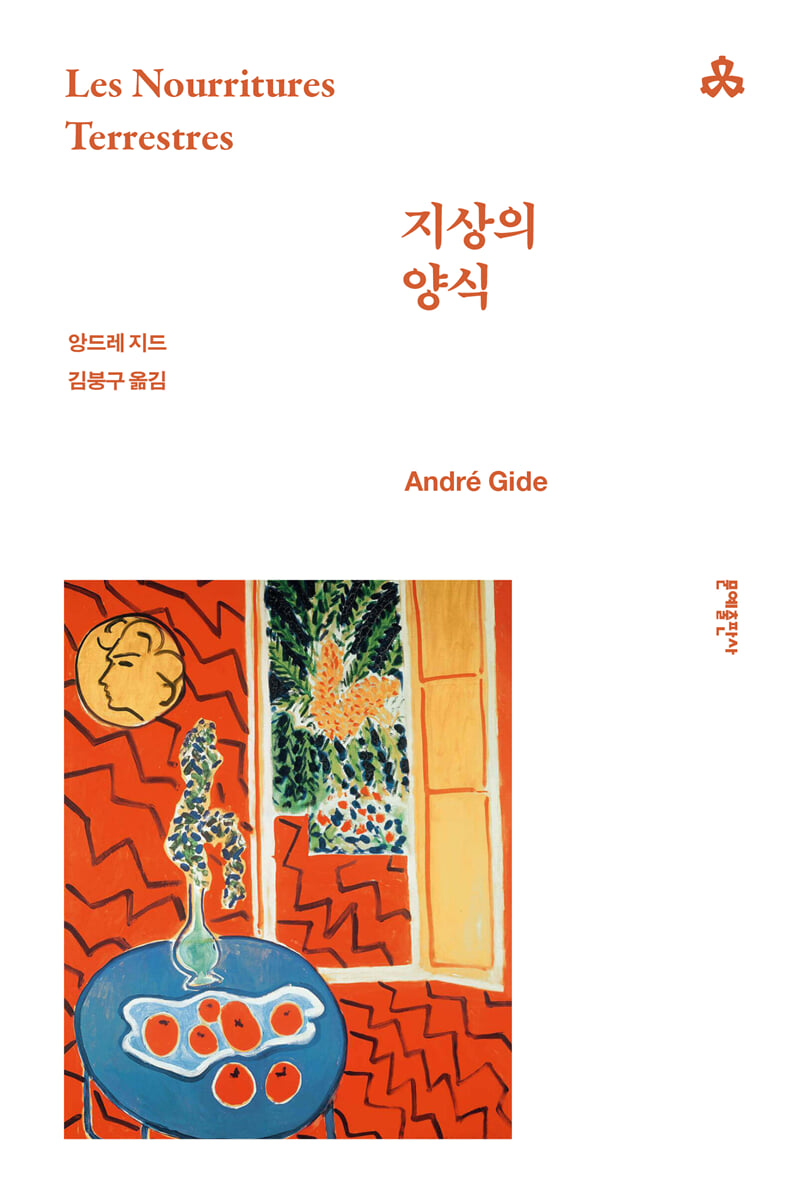
Food on Earth
 |
Description
Book Introduction
“Nathaniel, what is within you
“Burn all the books.”
From Martin du Gard to Camus and Sartre
A work that has shaken the souls of almost every generation since Gide
Gide, a young man who suffered from a nervous breakdown due to strict religious upbringing.
His journey to Africa led him to the realization that the way to live was to break free from all restraints and enjoy intense vitality.
The work that Gide wrote during this period is “The Food of the Earth.”
The characteristic of Gide's literature, which seeks to fully enjoy the joys life offers, began with this book.
Gide's appeal to break free from everything that was attached to him had an explosive response in the post-war generation.
Although "The Bread of the Earth" sold only about 500 copies in the ten years after its publication, it was later rediscovered by the public and became one of Gide's most beloved works.
Gide's powerful defense of ontological 'nakedness' still evokes something in the hearts of young people who are still bound by something, and is read across time.
Nobel Prize-winning author
Recommended Readings from Seoul National University and Yonsei University
1001 Books You Must Read Before You Die, by Peter Boxall
“Burn all the books.”
From Martin du Gard to Camus and Sartre
A work that has shaken the souls of almost every generation since Gide
Gide, a young man who suffered from a nervous breakdown due to strict religious upbringing.
His journey to Africa led him to the realization that the way to live was to break free from all restraints and enjoy intense vitality.
The work that Gide wrote during this period is “The Food of the Earth.”
The characteristic of Gide's literature, which seeks to fully enjoy the joys life offers, began with this book.
Gide's appeal to break free from everything that was attached to him had an explosive response in the post-war generation.
Although "The Bread of the Earth" sold only about 500 copies in the ten years after its publication, it was later rediscovered by the public and became one of Gide's most beloved works.
Gide's powerful defense of ontological 'nakedness' still evokes something in the hearts of young people who are still bound by something, and is read across time.
Nobel Prize-winning author
Recommended Readings from Seoul National University and Yonsei University
1001 Books You Must Read Before You Die, by Peter Boxall
- You can preview some of the book's contents.
Preview
index
Author's Preface to the 1927 Edition
introduction
Chapter 1
Chapter 2
Chapter 3
Chapter 4
Chapter 5
Chapter 6
Chapter 7
Chapter 8
Commentary on the work
André Gide Chronology
introduction
Chapter 1
Chapter 2
Chapter 3
Chapter 4
Chapter 5
Chapter 6
Chapter 7
Chapter 8
Commentary on the work
André Gide Chronology
Detailed image

Into the book
After you read my story, throw this book away—and go outside.
I hope this book will inspire you to go out—to escape from your city, your home, your room, your thoughts, wherever that may be.
--- p.14
While others were publishing their works or working, I spent three years traveling, forgetting everything I had learned in my head.
The task of unlearning what I had learned was slow and difficult.
But it was more beneficial to me than all the knowledge that was forced upon people, and was truly the beginning of education.
--- pp.17~18
'Importance' should be in your eyes, not in things.
--- p.20
When you open and close books, seeking more revelations than you have ever received, and are still unsatisfied and waiting for something, when you cannot help feeling empty at night and your passion is about to turn to sadness, I want to be by your side.
--- p.22
Nathanael, burn all the books within you.
--- p.33
It is not enough to just read in a book that the sand on the beach is soft.
My bare feet want to feel it.
Any knowledge that is not preceded by the senses is of no use to me.
--- p.35
Nathanael, do not stay beside anything that resembles you.
Never 'stay'.
Nathaniel, when your surroundings become like you, or when you become like your surroundings, there is nothing there that will benefit you.
I have to leave there.
There is nothing more dangerous to you than 'your' house, 'your' room, 'your' past.
--- p.52
Pleasure! I want to repeat this word over and over again.
I wish this word were synonymous with 'blessed life'.
No, I just wish I could say it's life.
--- p.59
Through all my open senses I welcomed the presence of the outside world.
Everything was being accepted within me.
--- p.82
It pains me that your worship is fixed.
I wish your worship had spread more widely.
--- p.87
Desire! Desire! What do you want? What do you desire? Don't you know how to be weary?
--- p.110
You cannot imagine, Nathaniel, what will become of this indulgence in light and the sensual ecstasy brought about by this ceaseless heat.
I hope this book will inspire you to go out—to escape from your city, your home, your room, your thoughts, wherever that may be.
--- p.14
While others were publishing their works or working, I spent three years traveling, forgetting everything I had learned in my head.
The task of unlearning what I had learned was slow and difficult.
But it was more beneficial to me than all the knowledge that was forced upon people, and was truly the beginning of education.
--- pp.17~18
'Importance' should be in your eyes, not in things.
--- p.20
When you open and close books, seeking more revelations than you have ever received, and are still unsatisfied and waiting for something, when you cannot help feeling empty at night and your passion is about to turn to sadness, I want to be by your side.
--- p.22
Nathanael, burn all the books within you.
--- p.33
It is not enough to just read in a book that the sand on the beach is soft.
My bare feet want to feel it.
Any knowledge that is not preceded by the senses is of no use to me.
--- p.35
Nathanael, do not stay beside anything that resembles you.
Never 'stay'.
Nathaniel, when your surroundings become like you, or when you become like your surroundings, there is nothing there that will benefit you.
I have to leave there.
There is nothing more dangerous to you than 'your' house, 'your' room, 'your' past.
--- p.52
Pleasure! I want to repeat this word over and over again.
I wish this word were synonymous with 'blessed life'.
No, I just wish I could say it's life.
--- p.59
Through all my open senses I welcomed the presence of the outside world.
Everything was being accepted within me.
--- p.82
It pains me that your worship is fixed.
I wish your worship had spread more widely.
--- p.87
Desire! Desire! What do you want? What do you desire? Don't you know how to be weary?
--- p.110
You cannot imagine, Nathaniel, what will become of this indulgence in light and the sensual ecstasy brought about by this ceaseless heat.
--- p.168
Publisher's Review
“Nathaniel, what is within you
“Burn all the books.”
From Martin du Gard to Camus and Sartre
A work that has shaken the souls of almost every generation since Gide
★Nobel Prize in Literature winner
★Recommended books from Yonsei University and Seoul National University
★1001 Books You Must Read Before You Die, selected by Peter Boxall
《The Food of the Earth》 is the masterpiece of André Gide, a Nobel Prize winner who had a great influence on later French literary figures, including Sartre and Camus.
This work, which contains the sense of liberation he felt after visiting North Africa in his youth despite receiving an oppressive Puritan education, is an artistic collection of prose, including diaries, letters, poems, travelogues, and fictional dialogues.
Zid keeps shouting about disconnection from everything.
We already have God within us.
But the comfort of our homes, our fixed past and future, our established books and learning, confine our most precious parts.
So Gide urges us to “escape from your city, from your home, from your room, from your thoughts” and move into a state of “nakedness.”
All of this is because it prevents 'I' from experiencing and sensing things as 'I' myself.
Gide advises us to abandon all established authority and experience life directly and enjoy it.
“It is not enough to just read in a book that the sand on the beach is soft.
“My bare feet want to feel it.”
“After you read my story, throw this book away.”
“Nathaniel, burn all the books that are in your possession.”
What do we gain by breaking away from everything that binds us? Desire, pleasure, a sense of unbridled life, sensual ecstasy.
Gide repeatedly urges us to banish the empathy that suppresses the 'self' in our hearts, and to return to the 'self' and go through the process of recreating an unknown life.
A 'blessed life' can only be obtained after that.
Gide tasted a sense of liberation just before he was suffocated by the authoritarian atmosphere in which he had grown up, and he saw “a generation rising, a generation going down” in the rise of sensations, feelings, pleasures, and desires that originate within oneself and do not belong to anyone else.
Zide was a pioneer at the forefront of the new generation.
A strong defense of ontological 'nakedness'
A work that transcends time and offers a sense of liberation to young people who are bound by something!
The reason why Gide, after assuming a hypothetical listener named Nathanael, earnestly appeals in poetic language that he hopes that the listener will also feel what he has seen and felt is because he wanted to gift the 'defense of nakedness' to his contemporaries who are in a similar situation to him.
It is 'nakedness' from everything that oppresses us.
The characteristic of Gide's literature, which seeks to fully enjoy the joys that life offers, began with "Bread of the Earth."
Gide's appeal to break free from everything that was attached to him had an explosive response in the post-war generation.
Although "The Bread of the Earth" sold only about 500 copies in the ten years after its publication, it was later rediscovered by the public and became one of Gide's most beloved works.
Gide's powerful defense of ontological 'nakedness' still evokes something in the hearts of young people who are still bound by something, and is read across time.
“Burn all the books.”
From Martin du Gard to Camus and Sartre
A work that has shaken the souls of almost every generation since Gide
★Nobel Prize in Literature winner
★Recommended books from Yonsei University and Seoul National University
★1001 Books You Must Read Before You Die, selected by Peter Boxall
《The Food of the Earth》 is the masterpiece of André Gide, a Nobel Prize winner who had a great influence on later French literary figures, including Sartre and Camus.
This work, which contains the sense of liberation he felt after visiting North Africa in his youth despite receiving an oppressive Puritan education, is an artistic collection of prose, including diaries, letters, poems, travelogues, and fictional dialogues.
Zid keeps shouting about disconnection from everything.
We already have God within us.
But the comfort of our homes, our fixed past and future, our established books and learning, confine our most precious parts.
So Gide urges us to “escape from your city, from your home, from your room, from your thoughts” and move into a state of “nakedness.”
All of this is because it prevents 'I' from experiencing and sensing things as 'I' myself.
Gide advises us to abandon all established authority and experience life directly and enjoy it.
“It is not enough to just read in a book that the sand on the beach is soft.
“My bare feet want to feel it.”
“After you read my story, throw this book away.”
“Nathaniel, burn all the books that are in your possession.”
What do we gain by breaking away from everything that binds us? Desire, pleasure, a sense of unbridled life, sensual ecstasy.
Gide repeatedly urges us to banish the empathy that suppresses the 'self' in our hearts, and to return to the 'self' and go through the process of recreating an unknown life.
A 'blessed life' can only be obtained after that.
Gide tasted a sense of liberation just before he was suffocated by the authoritarian atmosphere in which he had grown up, and he saw “a generation rising, a generation going down” in the rise of sensations, feelings, pleasures, and desires that originate within oneself and do not belong to anyone else.
Zide was a pioneer at the forefront of the new generation.
A strong defense of ontological 'nakedness'
A work that transcends time and offers a sense of liberation to young people who are bound by something!
The reason why Gide, after assuming a hypothetical listener named Nathanael, earnestly appeals in poetic language that he hopes that the listener will also feel what he has seen and felt is because he wanted to gift the 'defense of nakedness' to his contemporaries who are in a similar situation to him.
It is 'nakedness' from everything that oppresses us.
The characteristic of Gide's literature, which seeks to fully enjoy the joys that life offers, began with "Bread of the Earth."
Gide's appeal to break free from everything that was attached to him had an explosive response in the post-war generation.
Although "The Bread of the Earth" sold only about 500 copies in the ten years after its publication, it was later rediscovered by the public and became one of Gide's most beloved works.
Gide's powerful defense of ontological 'nakedness' still evokes something in the hearts of young people who are still bound by something, and is read across time.
GOODS SPECIFICS
- Date of issue: September 10, 2024
- Page count, weight, size: 208 pages | 152*223*20mm
- ISBN13: 9788931023732
- ISBN10: 8931023731
You may also like
카테고리
korean


korean

![GQ KOREA Mark (Monthly): December [2025]](http://librairie.coreenne.fr/cdn/shop/files/8ef265dbbfbf186523ed75ba7319009d.jpg?v=1765340328&width=3840)


