

A light confession
 |
Description
Book Introduction
What is a reflective drip that reveals the truth of life? "Light Confession" contains 365 short essays selected from sentences written by Professor Kim Young-min over a period of 17 years, from 2007 to 2024. You can encounter the essence of Kim Young-min's wit, a sharp yet warm reflection that examines the imperfections of life, and a digging into the world's banality and revealing its hidden side. The crisp, clean sentences reach the reader's heart 'like a butterfly, like a bee.' It is difficult to contain the history of humanity and the world in a few sentences, but this book has accomplished it. This book is divided into three parts: “Where the Heart Stays,” “Where the Head Stays,” and “Where the Senses Stay,” and tells a variety of stories based on each theme. In the "Preface," he expresses some of his aphorisms as "drips," saying, "Life is often an ambiguous phenomenon that contains absurdity and wonder, so sometimes we must contain life as if we were catching clouds in a glass," and defining "drips as that glass made of language." It encourages readers to savor the truth of life that can only be expressed through such drips, and to live without losing their composure in the face of many hardships. |
- You can preview some of the book's contents.
Preview
index
Welcome to the world of reflective drip.
Part 1: Where the Heart Stays
Part 2: Where the Head Stays
Part 3: Where the Senses Stay
Part 1: Where the Heart Stays
Part 2: Where the Head Stays
Part 3: Where the Senses Stay
Detailed image

Into the book
Vulnerability is a human characteristic that makes us human.
To discover humanity is to discover human vulnerability.
Humans are vulnerable, so they need a place where they can cry.
That place is called the sanctuary.
--- p.21
Who can say everything that is on their mind?
Words that are not spoken rot away in the intestines and eventually become relics.
--- p.45
Yes, that's right, you're angry because you're sensitive to the imperfections of life.
There is no sin in that anger.
--- p.72
A graduate who is not yet forty and has a six-year-old daughter called.
A student who was bright and stood out in class and read the commencement speech at graduation.
A student who keeps in touch every time a new chapter in life begins.
The cancer has metastasized to the brain and he is now given at most two to three months to live.
I'm going to try this new drug one last time, even if it doesn't have clinical results.
I called to say goodbye.
Looking back, my college days were so much fun and great.
I'm going to tell my young daughter the truth about my situation.
I'm not good at comforting people.
I just hope that listening will be a comfort.
--- p.87
As you read, you will encounter various metaphors that refer to the mind.
The mind is sometimes a mirror that reflects something, sometimes a field that needs to be plowed, and sometimes flowing water.
If you ask me today for a metaphor for the mind, I would answer, “landfill.”
As time passes, much that is buried will rot.
It will have no form.
If it still shines, I will return it to you.
--- p.100
“I was a debaucher when I was young.” It seems like most people go through this process before realizing the emptiness of life… .
Isn't that the first hurdle too difficult?
--- p.108
There is a difference between being critical and being cynical.
You can love life critically as much as you want.
There is no need to love life as a slave loves his chains.
--- p.116
There may be no such thing as a beginner's mind.
But there are often times when you have to say your original intentions.
Just as a country founded without deep reflection sometimes has to speak of its founding spirit.
Please tell me you had a beginner's mind.
It's just that I don't remember now.
--- p.133
Memento mori at the Museum of Arts and Crafts in Hamburg.
I saw the Allegory of the Fall, Death and Resurrection (Allegorie von Sundenfall, Tod und Auferstehung), which depicts a human being wrestling with death.
And I named it 'The Cross of Life and Death'.
But before death comes, aren't we usually already doing a reverse cross with ourselves?
Death comes and speaks like a wrestler in a tag match.
“It’s my turn now.”
--- p.208
Life of Pi (2012) is a story about God, but it is also a story about how to survive that long period of drifting.
The reason I was able to survive was because I was on a raft with a tiger.
The tiger made him uneasy, and that tension made him strong, and that strength allowed him to cross the ocean.
If you are currently adrift, who is your tiger?
--- p.211
Just as a true journey lies in the anticipation before the trip and the memories after the trip, a true life lies in the dreams before living and the memories after living.
That's why Marcel Proust wrote his masterpiece, In Search of Lost Time.
To discover humanity is to discover human vulnerability.
Humans are vulnerable, so they need a place where they can cry.
That place is called the sanctuary.
--- p.21
Who can say everything that is on their mind?
Words that are not spoken rot away in the intestines and eventually become relics.
--- p.45
Yes, that's right, you're angry because you're sensitive to the imperfections of life.
There is no sin in that anger.
--- p.72
A graduate who is not yet forty and has a six-year-old daughter called.
A student who was bright and stood out in class and read the commencement speech at graduation.
A student who keeps in touch every time a new chapter in life begins.
The cancer has metastasized to the brain and he is now given at most two to three months to live.
I'm going to try this new drug one last time, even if it doesn't have clinical results.
I called to say goodbye.
Looking back, my college days were so much fun and great.
I'm going to tell my young daughter the truth about my situation.
I'm not good at comforting people.
I just hope that listening will be a comfort.
--- p.87
As you read, you will encounter various metaphors that refer to the mind.
The mind is sometimes a mirror that reflects something, sometimes a field that needs to be plowed, and sometimes flowing water.
If you ask me today for a metaphor for the mind, I would answer, “landfill.”
As time passes, much that is buried will rot.
It will have no form.
If it still shines, I will return it to you.
--- p.100
“I was a debaucher when I was young.” It seems like most people go through this process before realizing the emptiness of life… .
Isn't that the first hurdle too difficult?
--- p.108
There is a difference between being critical and being cynical.
You can love life critically as much as you want.
There is no need to love life as a slave loves his chains.
--- p.116
There may be no such thing as a beginner's mind.
But there are often times when you have to say your original intentions.
Just as a country founded without deep reflection sometimes has to speak of its founding spirit.
Please tell me you had a beginner's mind.
It's just that I don't remember now.
--- p.133
Memento mori at the Museum of Arts and Crafts in Hamburg.
I saw the Allegory of the Fall, Death and Resurrection (Allegorie von Sundenfall, Tod und Auferstehung), which depicts a human being wrestling with death.
And I named it 'The Cross of Life and Death'.
But before death comes, aren't we usually already doing a reverse cross with ourselves?
Death comes and speaks like a wrestler in a tag match.
“It’s my turn now.”
--- p.208
Life of Pi (2012) is a story about God, but it is also a story about how to survive that long period of drifting.
The reason I was able to survive was because I was on a raft with a tiger.
The tiger made him uneasy, and that tension made him strong, and that strength allowed him to cross the ocean.
If you are currently adrift, who is your tiger?
--- p.211
Just as a true journey lies in the anticipation before the trip and the memories after the trip, a true life lies in the dreams before living and the memories after living.
That's why Marcel Proust wrote his masterpiece, In Search of Lost Time.
--- p.219
Publisher's Review
What is a reflective drip that reveals the truth of life?
"Light Confession" is a collection of short essays by Professor Kim Young-min, who has made everything in the world a subject of study and thought, condensing his reflections on not only the world around him but also his own life.
This book is a compilation of 365 carefully selected short essays written over 17 years since 2007, filled with thoughts that “jumped out like a goral.”
Why does our society pay attention to Kim Young-min's writing?
Why do readers rave about Kim Young-min's writing?
If you are curious, I dare to recommend reading this book.
In the preface to “Light Confession,” Professor Kim Young-min breaks away from the preface that outlines the text and presents his own theory of “reflective drip.”
He poses the question, “Why do we have to endure this hardship? How many people can logically define the entirety of this life, which is so uncertain?” and asserts that “we need a drip to avoid succumbing to all the language that surrounds us, from the “language of condemnation” to the language of favor.
What is a reflective drip?
It is different from proverbs, sermons, lies, abusive language, exaggeration, boasting, boasting, empty words, and nonsense.
It is different from the language of peripheral and stimulating pleasure.
It is different from language that preaches a plausible meaning of life or the direction of humanity.
It is a language that allows readers to think about aspects of life that conventional language fails to capture, and it gives readers “a pleasant sense of not being completely dominated by a messy world.”
He expresses some of his short stories as reflective drips, and since there is “the truth of life that can only be expressed through drips” and drips are “small changes, minor revolutions, and serious performance art” in the helpless daily life, he suggests, “Like Baruch Spinoza, who said he would plant an apple tree even if the Earth were to end tomorrow, let’s take care of our physical and mental health and drip together.”
“Life is no joke.
Everyone gets hurt when they fall, bleeds when their skin is torn, and gets hungry at some point.
So humans seriously plan for the future, hunt for food, and try to control birth, aging, illness, and death.
When it comes to survival, humans are as serious as a millstone.
But humans cannot be only serious.” His insight, gleaned from such a difficult and dreary life, adjusts its weight so that sorrow can be carefully observed and accepted, rather than left as a spectacle or something to be avoided.
Thus, this book ultimately provides comfort and laughter that affirms life to all who “want to live with burdens but without pain.”
What are the reflective mind, head, and senses?
The short essay, divided into three parts, is independent yet connected, ranging from a theory of the mind that looks at reality as a vulnerable “beneficiary, victim, and witness” of life, a theory of the head that prevents self-abandonment as a “student,” and a theory of sensation acquired as an art and travel enthusiast.
In Part 1, “Where the Heart Stays,” Professor Kim Young-min observes the situations and limitations of life while also discovering overlooked gaps.
What is a human being and how should a human being live?
He answers that weighty question by saying that “the human characteristic that makes humans human” is “vulnerability,” that humans are “mortal,” and that “the goal of life is not victory, but graceful defeat.”
He compares humans to spit, feces, and urine, and insists that “scatological imagination is effective in awakening us to the arrogance of civilization,” which inevitably leads to laughter.
From the everyday wit of “I eat well and do planks, so the fat that used to go to my stomach seems to have lost its way and is wandering all over my body” to the thought that penetrates the essence of “Action is not following the chain of cause and effect, but breaking the chain of cause and effect”, it colorfully expresses the unpredictable irony of life while sharing simple but earnest encouragement to love life because that is what it is.
In Part 2, “Where the Head Stays,” readers can encounter Professor Kim Young-min, who has lived a life of reading, writing, speaking, and pondering.
“If you see life as a ditch, the most appropriate occupation is one that explores and studies,” he began, and “Where else can there be revolution?
He talks about the reasons, attitude, and direction of studying for life, ending with the phrase, “Even nagging changes the world.”
As a scholar, he does not hesitate to speak about academia; as a teacher, he shows his care and concern for his students without being solemn; and as a scholar of the history of ideas, he expresses his political views with a sharp yet elegant tone.
In particular, anecdotes with students make us question what true learning and teaching are, and anecdotes with colleagues make us ponder what scholarship and academia are.
Growth is “a process of refining oneself, which is filled with empty boasts, baseless hopes, and falsehoods,” and to grow, one must make the effort to “go as far as one can go, go as far as one can go, and go further” without compromising.
I hope that we will never stop learning, with “a desire for the ‘truth’ and humility,” so as not to be trapped in the shackles of “incompetence and corruption.”
Part 3, “Where the Senses Dwell,” offers a glimpse into Professor Kim Young-min’s art collection, which encompasses a wide range of fields, including film, fine art, comics, and literature.
Why art?
Because it is just as important to develop “mental lung capacity” as “physical lung capacity.”
This is because “humans are cultural amphibians” and “when they get tired of culture, they dream of the wild, but they cannot survive in the wild for long”, so they must “immerse themselves in the body of culture.”
As you follow his writings, from his thoughts on the comics "Slam Dunk" and "Pluto" to the movies "Paterson" and "Life of Pi", to his thoughts on artists such as Salvador Dali, Caravaggio, Marcel Proust, and Atsuko Suga, you will feel your sixth sense awakening.
At the root of this author's aesthetic insight lies the pursuit of "a selfless affection that is endangered" and "a love for the peace that comes with waiting."
He mutters, “How much comfort do humans need,” while looking at Meiji Shrine in Tokyo, and, reminiscing about the touching memories of interacting with the audience at a book talk, he hopes to live a life of simple but precious moments.
“The cold wave warning just went off, and I’ve never learned anything I didn’t know through a warning.
What surprises me is not the content of the alert, but the alert itself.
Instead of ringing the bell, just pet it gently.
“So that you can be amazed by its affection.”
What kind of reflective short essays are needed in our times?
What is a reflective essay?
To borrow Professor Kim Young-min's words, it is a short sentence that "price[s] the empty space of the mind."
It is a sentence that leads one to observe, question, wonder, explore, and ask one's own questions.
Reflective short essays expand his world by sharing insights that allow readers to break free from the confines of their own ego and ask questions of their own.
It twists and questions forced language in a refreshing way, moves beyond the “list of dry facts” to reveal the essence and correct falsehoods and confusion.
It questions the world of lies, despises prejudices that distort reality, and pokes fun at those who talk nonsense.
It explores the inner workings of things that are “brain-damaging” and things that make life sick, makes us ask ourselves what we are like, and imparts wisdom to stay away from them.
Reflective short sentences are different from “right words, beautiful words, and strict” words.
It is different from commands, advice, or counsel.
It differs from the language of inspection and surveillance that solidifies conventional wisdom in that it contains insights that break conventional wisdom.
Rather than tense your neck and emphasize the vowel sound to make you take a deep breath, relax your neck and break the vowel sound to make you breathe freely and deeply.
Although it is often “more suitable as a weapon of the resisters than of the powerful,” it would be effective if used as a tool to awaken the powerful to their own inaction and ignorance.
Professor Kim Young-min's collection of short essays is a literary work that appropriately possesses all of these attributes, and will likely play a role in shedding new light on "short essays," a genre that has not been properly addressed in our literary world.
It may also become a avant-garde weapon that breaks the lethargy of human history and worldly affairs.
This is why our times require reading Kim Young-min's short stories, and why his short stories must exist.
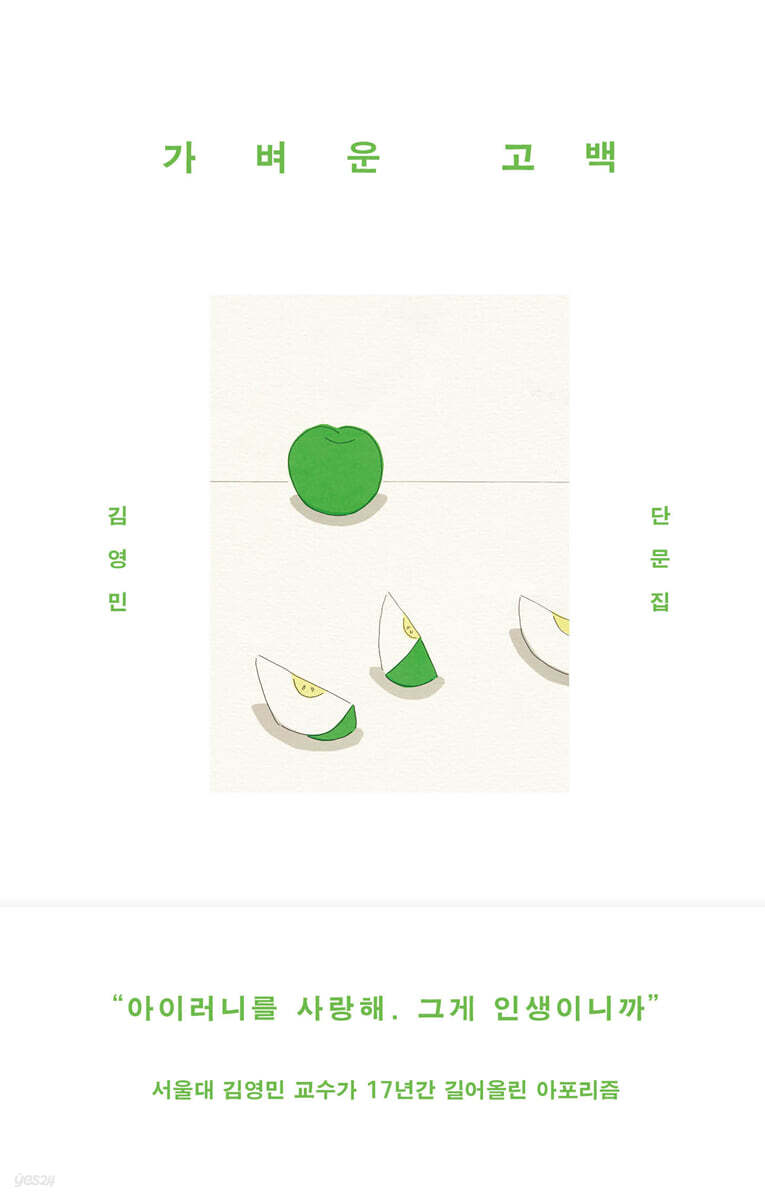
The cover art for the book is “Green Apples,” a work by Mizumaru Anzai, who illustrated Haruki Murakami’s books.
I hope that as you read 『Light Confession』, you will fill your mind with refreshing language, not the language of ripe admonition or the “language of propaganda” that has become stale.
"Light Confession" is a collection of short essays by Professor Kim Young-min, who has made everything in the world a subject of study and thought, condensing his reflections on not only the world around him but also his own life.
This book is a compilation of 365 carefully selected short essays written over 17 years since 2007, filled with thoughts that “jumped out like a goral.”
Why does our society pay attention to Kim Young-min's writing?
Why do readers rave about Kim Young-min's writing?
If you are curious, I dare to recommend reading this book.
In the preface to “Light Confession,” Professor Kim Young-min breaks away from the preface that outlines the text and presents his own theory of “reflective drip.”
He poses the question, “Why do we have to endure this hardship? How many people can logically define the entirety of this life, which is so uncertain?” and asserts that “we need a drip to avoid succumbing to all the language that surrounds us, from the “language of condemnation” to the language of favor.
What is a reflective drip?
It is different from proverbs, sermons, lies, abusive language, exaggeration, boasting, boasting, empty words, and nonsense.
It is different from the language of peripheral and stimulating pleasure.
It is different from language that preaches a plausible meaning of life or the direction of humanity.
It is a language that allows readers to think about aspects of life that conventional language fails to capture, and it gives readers “a pleasant sense of not being completely dominated by a messy world.”
He expresses some of his short stories as reflective drips, and since there is “the truth of life that can only be expressed through drips” and drips are “small changes, minor revolutions, and serious performance art” in the helpless daily life, he suggests, “Like Baruch Spinoza, who said he would plant an apple tree even if the Earth were to end tomorrow, let’s take care of our physical and mental health and drip together.”
“Life is no joke.
Everyone gets hurt when they fall, bleeds when their skin is torn, and gets hungry at some point.
So humans seriously plan for the future, hunt for food, and try to control birth, aging, illness, and death.
When it comes to survival, humans are as serious as a millstone.
But humans cannot be only serious.” His insight, gleaned from such a difficult and dreary life, adjusts its weight so that sorrow can be carefully observed and accepted, rather than left as a spectacle or something to be avoided.
Thus, this book ultimately provides comfort and laughter that affirms life to all who “want to live with burdens but without pain.”
What are the reflective mind, head, and senses?
The short essay, divided into three parts, is independent yet connected, ranging from a theory of the mind that looks at reality as a vulnerable “beneficiary, victim, and witness” of life, a theory of the head that prevents self-abandonment as a “student,” and a theory of sensation acquired as an art and travel enthusiast.
In Part 1, “Where the Heart Stays,” Professor Kim Young-min observes the situations and limitations of life while also discovering overlooked gaps.
What is a human being and how should a human being live?
He answers that weighty question by saying that “the human characteristic that makes humans human” is “vulnerability,” that humans are “mortal,” and that “the goal of life is not victory, but graceful defeat.”
He compares humans to spit, feces, and urine, and insists that “scatological imagination is effective in awakening us to the arrogance of civilization,” which inevitably leads to laughter.
From the everyday wit of “I eat well and do planks, so the fat that used to go to my stomach seems to have lost its way and is wandering all over my body” to the thought that penetrates the essence of “Action is not following the chain of cause and effect, but breaking the chain of cause and effect”, it colorfully expresses the unpredictable irony of life while sharing simple but earnest encouragement to love life because that is what it is.
In Part 2, “Where the Head Stays,” readers can encounter Professor Kim Young-min, who has lived a life of reading, writing, speaking, and pondering.
“If you see life as a ditch, the most appropriate occupation is one that explores and studies,” he began, and “Where else can there be revolution?
He talks about the reasons, attitude, and direction of studying for life, ending with the phrase, “Even nagging changes the world.”
As a scholar, he does not hesitate to speak about academia; as a teacher, he shows his care and concern for his students without being solemn; and as a scholar of the history of ideas, he expresses his political views with a sharp yet elegant tone.
In particular, anecdotes with students make us question what true learning and teaching are, and anecdotes with colleagues make us ponder what scholarship and academia are.
Growth is “a process of refining oneself, which is filled with empty boasts, baseless hopes, and falsehoods,” and to grow, one must make the effort to “go as far as one can go, go as far as one can go, and go further” without compromising.
I hope that we will never stop learning, with “a desire for the ‘truth’ and humility,” so as not to be trapped in the shackles of “incompetence and corruption.”
Part 3, “Where the Senses Dwell,” offers a glimpse into Professor Kim Young-min’s art collection, which encompasses a wide range of fields, including film, fine art, comics, and literature.
Why art?
Because it is just as important to develop “mental lung capacity” as “physical lung capacity.”
This is because “humans are cultural amphibians” and “when they get tired of culture, they dream of the wild, but they cannot survive in the wild for long”, so they must “immerse themselves in the body of culture.”
As you follow his writings, from his thoughts on the comics "Slam Dunk" and "Pluto" to the movies "Paterson" and "Life of Pi", to his thoughts on artists such as Salvador Dali, Caravaggio, Marcel Proust, and Atsuko Suga, you will feel your sixth sense awakening.
At the root of this author's aesthetic insight lies the pursuit of "a selfless affection that is endangered" and "a love for the peace that comes with waiting."
He mutters, “How much comfort do humans need,” while looking at Meiji Shrine in Tokyo, and, reminiscing about the touching memories of interacting with the audience at a book talk, he hopes to live a life of simple but precious moments.
“The cold wave warning just went off, and I’ve never learned anything I didn’t know through a warning.
What surprises me is not the content of the alert, but the alert itself.
Instead of ringing the bell, just pet it gently.
“So that you can be amazed by its affection.”
What kind of reflective short essays are needed in our times?
What is a reflective essay?
To borrow Professor Kim Young-min's words, it is a short sentence that "price[s] the empty space of the mind."
It is a sentence that leads one to observe, question, wonder, explore, and ask one's own questions.
Reflective short essays expand his world by sharing insights that allow readers to break free from the confines of their own ego and ask questions of their own.
It twists and questions forced language in a refreshing way, moves beyond the “list of dry facts” to reveal the essence and correct falsehoods and confusion.
It questions the world of lies, despises prejudices that distort reality, and pokes fun at those who talk nonsense.
It explores the inner workings of things that are “brain-damaging” and things that make life sick, makes us ask ourselves what we are like, and imparts wisdom to stay away from them.
Reflective short sentences are different from “right words, beautiful words, and strict” words.
It is different from commands, advice, or counsel.
It differs from the language of inspection and surveillance that solidifies conventional wisdom in that it contains insights that break conventional wisdom.
Rather than tense your neck and emphasize the vowel sound to make you take a deep breath, relax your neck and break the vowel sound to make you breathe freely and deeply.
Although it is often “more suitable as a weapon of the resisters than of the powerful,” it would be effective if used as a tool to awaken the powerful to their own inaction and ignorance.
Professor Kim Young-min's collection of short essays is a literary work that appropriately possesses all of these attributes, and will likely play a role in shedding new light on "short essays," a genre that has not been properly addressed in our literary world.
It may also become a avant-garde weapon that breaks the lethargy of human history and worldly affairs.
This is why our times require reading Kim Young-min's short stories, and why his short stories must exist.
The cover art for the book is “Green Apples,” a work by Mizumaru Anzai, who illustrated Haruki Murakami’s books.
I hope that as you read 『Light Confession』, you will fill your mind with refreshing language, not the language of ripe admonition or the “language of propaganda” that has become stale.
GOODS SPECIFICS
- Date of issue: July 10, 2024
- Format: Hardcover book binding method guide
- Page count, weight, size: 256 pages | 388g | 120*190*18mm
- ISBN13: 9788934920892
- ISBN10: 8934920890
You may also like
카테고리
korean


korean

![GQ KOREA Mark (Monthly): December [2025]](http://librairie.coreenne.fr/cdn/shop/files/8ef265dbbfbf186523ed75ba7319009d.jpg?v=1765340328&width=3840)


