

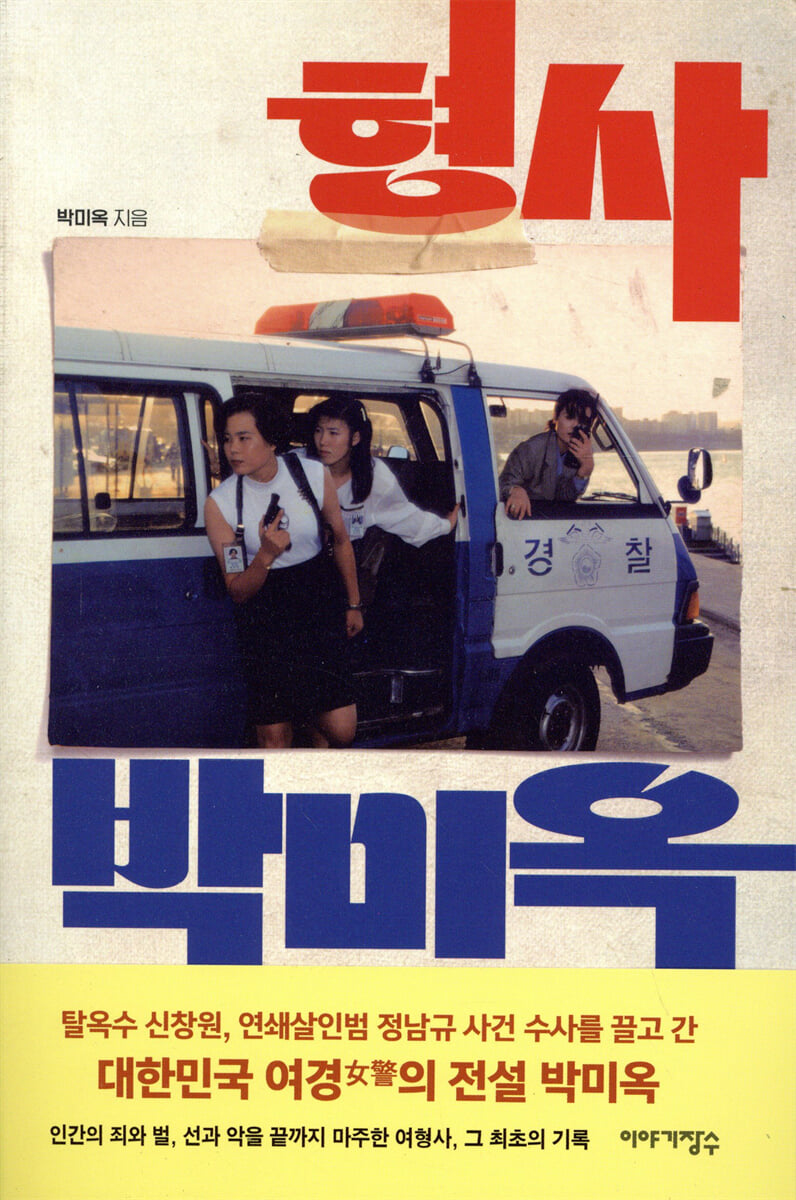
Detective Park Mi-ok
 |
Description
Book Introduction
- A word from MD
-
Records of a female detective who loved peopleThe first book by Park Mi-ok, the first female police chief.
He has handled numerous cases, including those of Shin Chang-won and Jeong Nam-gyu, and he is the subject of many plays. He says that the first records he set were thanks to his love for people.
His words about wanting to meet people before they become criminals show his love for people more important than catching criminals.
May 16, 2023. Essay PD Lee Na-young
The first female detective and first female head of the violent crimes unit in Korean police history.
The first female head of the narcotics investigation team in Yangcheon, the first female head of the violent crimes unit in Gangnam…
Breaking the 'first' records he had set himself
Detective Park Mi-ok, who wrote a new history for female detectives
There is a legendary female detective who stood up from her seat and greeted escaped prisoner Shin Chang-won after he was arrested.
In 1991, the year the first 'Female Mobile Detective Unit' in the history of the Korean police was established, Park Mi-ok became the first female detective in the violent crimes unit.
When he first stepped into the world of detectives, having been a traffic officer who gave powerful signals on the street, he had no idea.
What kind of hellish incidents and people will she encounter as she lives as a female detective in the violent crimes unit for the next 30 years?
In the meantime, he meets people who make him believe in the goodness of humanity, and how far he will go to protect that goodness and resolve the injustice.
A book written by detective Park Mi-ok, who handled cases that shook South Korea, such as the case of escaped convict Shin Chang-won, the case of serial killer Jeong Nam-gyu, the murder of a pregnant doctor's wife, the murder of a middle school girl along the Han River, and the fire investigation of the Sungnyemun arson case, has been published.
She is called the 'Legend of Female Police Officers' for her rapid promotion from a police officer to a superintendent in just 9 years (normally, a police officer-turned-superintendent has 20 years of service experience) and for constantly breaking her own records as a woman within the police organization.
He is now living in Jeju after retiring with honors as the chief of the detective division at Seogwipo Police Station.
On one side of his yard is a study and bookstore filled with books about good and evil and the human heart.
People who visit this place often burst into tears.
As you listen to the stories of people and incidents experienced by Detective Park Mi-ok, you are struck by the injustice, anger, despair, and hope that each person has faced in their lives.
People come to detective Park Mi-ok's house to read, cry, and rest.
Due to several recent incidents, the 'uselessness of female police officers' theory has become a trend in the world.
Detective Park Mi-ok was unable to say anything.
Here is a female police officer who has solved countless cases that have shocked the Republic of Korea by roaming around violent crime scenes since the 1990s, when not only male detectives but also the public found the existence of female detectives strange and unfamiliar.
No other words were added to the book title.
There was no need to add anything.
It's not 'Detective Park Mi-ok', it's 'Detective Park Mi-ok'.
Detective Park Mi-ok says that being a detective is a job that involves 'emotions' that allow you to understand and love people.
The surprising anecdotes and realizations about sin and punishment, good and evil that women face as humans unfold in “Detective Park Mi-ok.”
The first female head of the narcotics investigation team in Yangcheon, the first female head of the violent crimes unit in Gangnam…
Breaking the 'first' records he had set himself
Detective Park Mi-ok, who wrote a new history for female detectives
There is a legendary female detective who stood up from her seat and greeted escaped prisoner Shin Chang-won after he was arrested.
In 1991, the year the first 'Female Mobile Detective Unit' in the history of the Korean police was established, Park Mi-ok became the first female detective in the violent crimes unit.
When he first stepped into the world of detectives, having been a traffic officer who gave powerful signals on the street, he had no idea.
What kind of hellish incidents and people will she encounter as she lives as a female detective in the violent crimes unit for the next 30 years?
In the meantime, he meets people who make him believe in the goodness of humanity, and how far he will go to protect that goodness and resolve the injustice.
A book written by detective Park Mi-ok, who handled cases that shook South Korea, such as the case of escaped convict Shin Chang-won, the case of serial killer Jeong Nam-gyu, the murder of a pregnant doctor's wife, the murder of a middle school girl along the Han River, and the fire investigation of the Sungnyemun arson case, has been published.
She is called the 'Legend of Female Police Officers' for her rapid promotion from a police officer to a superintendent in just 9 years (normally, a police officer-turned-superintendent has 20 years of service experience) and for constantly breaking her own records as a woman within the police organization.
He is now living in Jeju after retiring with honors as the chief of the detective division at Seogwipo Police Station.
On one side of his yard is a study and bookstore filled with books about good and evil and the human heart.
People who visit this place often burst into tears.
As you listen to the stories of people and incidents experienced by Detective Park Mi-ok, you are struck by the injustice, anger, despair, and hope that each person has faced in their lives.
People come to detective Park Mi-ok's house to read, cry, and rest.
Due to several recent incidents, the 'uselessness of female police officers' theory has become a trend in the world.
Detective Park Mi-ok was unable to say anything.
Here is a female police officer who has solved countless cases that have shocked the Republic of Korea by roaming around violent crime scenes since the 1990s, when not only male detectives but also the public found the existence of female detectives strange and unfamiliar.
No other words were added to the book title.
There was no need to add anything.
It's not 'Detective Park Mi-ok', it's 'Detective Park Mi-ok'.
Detective Park Mi-ok says that being a detective is a job that involves 'emotions' that allow you to understand and love people.
The surprising anecdotes and realizations about sin and punishment, good and evil that women face as humans unfold in “Detective Park Mi-ok.”
index
Part 1_ Detective, with emotion
Becoming a founding member of Korea's first female mobile detective unit _10
Faces that come to mind in the face of the uselessness of female police officers and the abuse of police officers _17
My voice… … do you remember _25
You were right _32
The fugitive knew, but we didn't _38
I will take this as a misogynistic remark _49
Detective, I did it with emotion _55
Why are you staring at me _61
What's More Important Than Negotiation in a Hostage Situation _67
About the style of a girl detective who doesn't even get married _75
Organizational Time _79
By any chance, are you Detective Park Mi-ok? _87
Part 2: Women I Met at the Crime Scene
Going to the Red-light District _94
There was no reason for her to disappear _100
To you, who couldn't rest a single day while investigating the doctor's room _105
Detective, you may not know, but _111
The Eyeless Man and the Stony Cat _118
To the actress who must survive the detective _123
Scammers Prey on the Desire for Comfort _133
She Saved Me _141
Even a rhinoceros' horn stops before a person _146
Waiting for you _153
Part 3: Walking on the Prison Wall
My shoulder moved for a moment _160
Man Walking on Prison Wall _166
A detective's job is to make sure even a runaway report turns into a flower basket. _175
I saw fear in your eyes _182
Every scene was scary _190
There is no such thing as just one drug _197
Looking at the criminal's torn hand _203
Father's last name is in the genes _210
Where do you live and what do you become? _217
I Can't Lose to the Criminal _223
Part 4_ The small bookstore of a person who was a detective in a past life
The Detective Who Wants to Leave Home _230
What's the big deal about money _237
You can't be free from that moment _243
Qualifications of a Detective _249
Everyone has a sense of pride they want to protect to the end _255
I killed my daughter _261
Did we live like radish? _269
Please take control of the situation _276
It's Time to Change Your Life Tools _283
The Bookstore of Women Who Were Detectives in Their Past Lives _289
Becoming a founding member of Korea's first female mobile detective unit _10
Faces that come to mind in the face of the uselessness of female police officers and the abuse of police officers _17
My voice… … do you remember _25
You were right _32
The fugitive knew, but we didn't _38
I will take this as a misogynistic remark _49
Detective, I did it with emotion _55
Why are you staring at me _61
What's More Important Than Negotiation in a Hostage Situation _67
About the style of a girl detective who doesn't even get married _75
Organizational Time _79
By any chance, are you Detective Park Mi-ok? _87
Part 2: Women I Met at the Crime Scene
Going to the Red-light District _94
There was no reason for her to disappear _100
To you, who couldn't rest a single day while investigating the doctor's room _105
Detective, you may not know, but _111
The Eyeless Man and the Stony Cat _118
To the actress who must survive the detective _123
Scammers Prey on the Desire for Comfort _133
She Saved Me _141
Even a rhinoceros' horn stops before a person _146
Waiting for you _153
Part 3: Walking on the Prison Wall
My shoulder moved for a moment _160
Man Walking on Prison Wall _166
A detective's job is to make sure even a runaway report turns into a flower basket. _175
I saw fear in your eyes _182
Every scene was scary _190
There is no such thing as just one drug _197
Looking at the criminal's torn hand _203
Father's last name is in the genes _210
Where do you live and what do you become? _217
I Can't Lose to the Criminal _223
Part 4_ The small bookstore of a person who was a detective in a past life
The Detective Who Wants to Leave Home _230
What's the big deal about money _237
You can't be free from that moment _243
Qualifications of a Detective _249
Everyone has a sense of pride they want to protect to the end _255
I killed my daughter _261
Did we live like radish? _269
Please take control of the situation _276
It's Time to Change Your Life Tools _283
The Bookstore of Women Who Were Detectives in Their Past Lives _289
Detailed image
Into the book
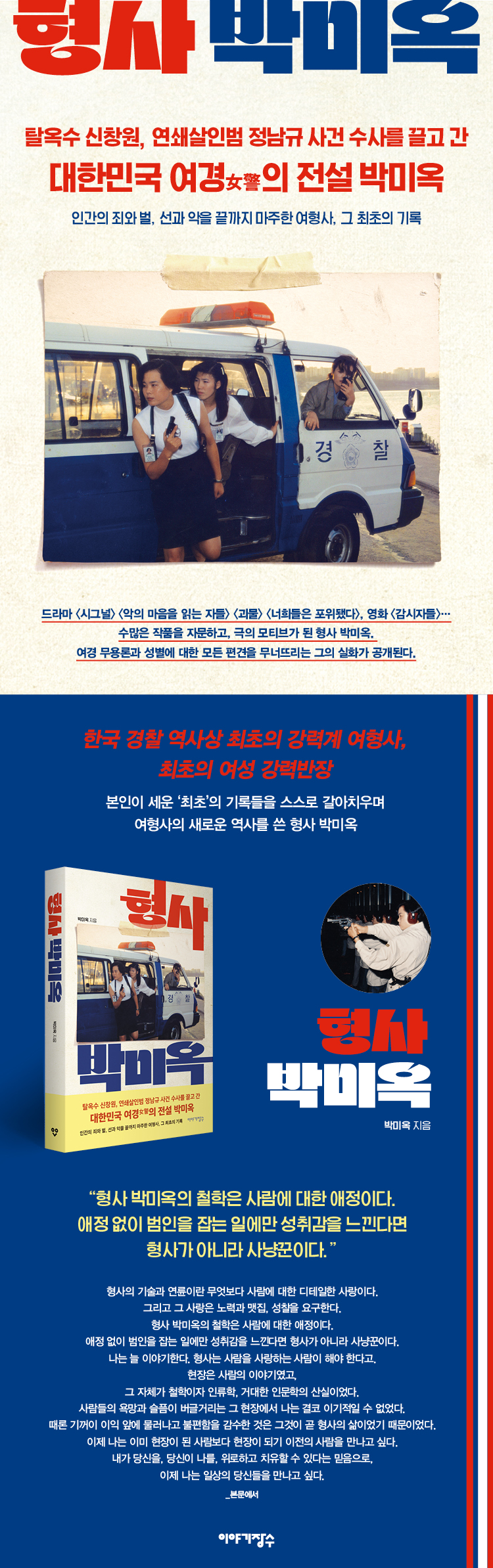
A detective's skills and experience are, above all, a detailed love for people.
And that love requires effort, grit, and reflection.
Detective Park Mi-ok's philosophy is love for people.
If you only find fulfillment in catching criminals without any affection, you are a hunter, not a detective.
I always say.
A detective is someone who loves people.
The scene was a human story, and in itself it was a cradle of philosophy, anthropology, and the great humanities.
In that place where people's desires and sorrows were boiling, I could never be selfish.
Sometimes, I was willing to step down and endure discomfort in the face of profit because that was the life of a detective.
Now I want to meet the person before he became the scene rather than the person who has already become the scene.
With the belief that I can comfort and heal you, and you can comfort and heal me, I now want to meet you in your daily lives.
And that love requires effort, grit, and reflection.
Detective Park Mi-ok's philosophy is love for people.
If you only find fulfillment in catching criminals without any affection, you are a hunter, not a detective.
I always say.
A detective is someone who loves people.
The scene was a human story, and in itself it was a cradle of philosophy, anthropology, and the great humanities.
In that place where people's desires and sorrows were boiling, I could never be selfish.
Sometimes, I was willing to step down and endure discomfort in the face of profit because that was the life of a detective.
Now I want to meet the person before he became the scene rather than the person who has already become the scene.
With the belief that I can comfort and heal you, and you can comfort and heal me, I now want to meet you in your daily lives.
--- From the text
Publisher's Review
Dramas “Signal,” “Those Who Read Evil Minds,” “The Host,” “You’re All Surrounded,” and the movie “The Guardians”…
Detective Park Mi-ok, who has advised on numerous works and served as the motif for the play.
His true story, which shatters all prejudices about the uselessness of female police officers and gender, is revealed.
When he first became a detective in the violent crimes unit, female detectives were an unfamiliar and strange presence not only to the public but also to existing male detectives.
Female detectives were often relegated to copy jobs or auxiliary work, and when female detectives were assigned to a unit, rumors would spread that they were "practicing driving in the mobile detective squad car."
There were cases where the female detectives had almost solved the case, but at the last minute, the credit had to be given entirely to the male detectives because it was "too dangerous for the female detectives to arrest the criminals themselves."
These female detectives had to fight not only against cases but also against public prejudice.
Even when detective Park Mi-ok, who had been building up a record of top-notch arrests, was appointed as the first female chief of the Gangnam Police Station's violent crimes division, she had to face this question at an official event.
Reporters flocked to the powerful investigation team's office.
All kinds of questions poured in.
At that moment, a reporter comes to his senses.
“Is this a lipstick policy?”
"What does this mean to someone who doesn't even wear lipstick?" the reporter asked.
“What does the term ‘lipstick policy’ mean?”
“What I mean is, can the corruption scandal be solved by putting a female head of the violent crimes unit in charge of the investigation?”
The reporter's rant told me exactly what I needed to do.
The aggression I had developed over my long career as a detective was immediately activated, and I responded without hesitation.
“Reporter, if I have no experience with violent crimes, have never been the head of the violent crimes unit, or have only a sloppy track record in investigating cases, and therefore am not competent enough to take charge of Gangnam, then I will listen carefully to what you have to say today.
However, if I am someone who has a long career in the violent crimes unit, has decent experience as a violent crimes unit chief, and is recognized for my abilities, and is considered to be in the top group, I will understand what the reporter said today as a comment degrading women.
I think the reporter still needs time to judge me, so I'll check the information and meet you again.
("I will take this as a misogynistic remark," pp. 50-51)
When he was assigned to the special task force to arrest escaped convict Shin Chang-won, he was met with harsh remarks such as, "What kind of 'pot' (a sexually derogatory term for women) is this?" However, he responded, "The kettle will stay still," and immediately focused on the scene.
After all, incidents on the scene are always resolved through close teamwork, not through a showdown between male and female police officers.
A dangerous and precarious scene where police officers are injured or even killed while trying to arrest criminals.
He comforts and consoles the lives and deaths of his colleagues who were with him at this site with poignant sentences.
On the day the two detectives who had sadly passed away were buried in the national cemetery, I read a requiem poem there to bid farewell to them.
At that moment, the souls of myself and all the detectives I knew cried out loud inside me.
It was the detective's long-suppressed cry.
As a police officer, I wear a uniform and a badge on my chest, and live with the police spirit of protecting the lives and property of the people day and night, but in reality, I am destined to be stabbed or shot at any time.
Before the police officers, we were just people who were afraid of weapons and didn't want to be killed by strangers. It was a hot tear that only our colleagues could share.
Anyone who has been on the scene knows.
That we all, regardless of gender, have anxiety and fear.
Sometimes, my anxiety makes me want to lean on someone.
The world of police is not divided into female and male police officers.
With one mind, with our breathing and effort together, the energy that can stop an approaching knife and bring a criminal into our hands is only found in teamwork.
("Faces That Come to Mind in the Face of the Uselessness of Female Police Officers and the Insults Against Police," pp. 22-23)
Meanwhile, the book records the full story of numerous incidents he has uncovered, including the Sungnyemun arson incident, in which the scene of Korea's National Treasure No. 1 being reduced to ashes was broadcast live to the entire nation, and the time he gritted his teeth and analyzed the diary of fugitive Shin Chang-won, who caused a syndrome among the people as if he were a thief.
While the major incidents and heinous criminals known to all South Koreans are usually the ones that brought him promotions and awards and made his name known to the public, what he particularly painstakingly documents in this book are his battles with pickpockets, stalkers, and car thieves that never made the news.
Pickpockets must be caught at the scene, but their stealing hands are so fast that they are not caught by his eyes.
Detective Park Mi-ok sneaks into a crowded subway car and quietly leans her shoulder against the back of a person she suspects to be a pickpocket.
And then he captures the fleeting moment when the criminal's shoulder blade moves.
With a keener sense than his eyes, he finally catches a gang of pickpockets at the scene.
Detectives often get the spotlight when they're involved in sensational cases or heinous crimes, but it's precisely moments like these that give them a sense of pride in their work.
When you catch a criminal at the very moment he moves and prevent him from being a victim of a crime, when you prevent something that would make ordinary people beat their chests, even if it's a small incident that wouldn't even make it to the news.
When I needed something to make myself proud, I caught a pickpocket boss and a technician.
It seems like we often need to be rewarded for our work and achievements.
Only then can you move on to the next step and build up the energy to endure even the hardships.
The strength to overcome the pain of work, the motivation to heal the wounds incurred from work and move forward again, all lie in the joys and sorrows of work.
("The Shoulder Moved in an Instant," pp. 165-166)
“Detective Park Mi-ok’s philosophy is love for people.
“If you only find fulfillment in catching criminals without any affection, you are a hunter, not a detective.”
He is a master of interrogation and a technician who can change the minds of criminals.
Rather than looking at the criminal's colorful criminal record, the investigator reads the expression on the back of the criminal's hand, which is covered in dirt and grime, to comfort the criminal's heart, who has nowhere to lean on. Rather than pressuring for a confession and interrogating him, the investigator asks questions and talks to get the inside story out.
Even in the midst of a dangerous hostage situation, he saves both the perpetrator and the hostage by shouting, “I am the one who will listen to you and help you right now.”
He studied profiling and worked as the head of the profiling team at the Seoul Scientific Investigation Team to ask the criminal more precisely, "Why did you do that? Why did you have to do that?" Now, he is trying to meet people through another tool in life.
When he suddenly announced his departure from the police force, rumors spread that he had a terminal illness, and his future as a police officer was so secure that he was assured of a stable future. But now he confesses that he wants to meet and talk to 'people before they became the field'.
He wants to hear about the complex and wounded hearts of those of us who are both perpetrators and victims in life, and who live between good and evil depending on the situation.
During his 30 years as a detective, he solved cases by listening and observing, and he instilled in his body and mind the rule of not judging or treating anyone lightly, whether they were a woman, a man, a criminal, or a person with a criminal record.
Detective Park Mi-ok, who witnessed the extremes of good and evil at violent crime scenes where extreme human behavior frequently erupts, is a message of greeting to Korean society and its people suffering from unresolved wounds and unknown pain.
He says.
Let's not endlessly regret and mourn in a place where old wounds and resentments burst forth and flow as blood and tears, but let's live in everyday life, understanding and resolving each other.
We can finally do that.
Now, I've opened a space in Jeju where books, people, and hearts can linger, and I'm using it as a place for friends who have been busy and pushed themselves on the mainland to rest.
Many people come here to cry, laugh, pour out their hearts, read books, and rest.
But more than anything, the person I meet most often in this study is myself.
In this space, I hope to be able to objectively face myself, so I filled it with books that allow me to look into my heart and explore myself.
The first thing I did in this space was to write about myself.
I wanted to record the evidence of my attitude and perspective in life, the people I saw at the crime scene, the hopes I held onto, and the times I lived with the support and encouragement of those who lived with that hope, while also completely pushing aside the internal wounds that had built up over the past 30 years and taking the time to recover.
Now, in this space, I want to meet people who have not yet become a scene, rather than people who have already become a scene.
With the belief that I can comfort and heal you, and you can comfort me, and with the hope that perhaps space can be a source of comfort to people, I now want to meet you in your daily lives.
(The Bookstore of Women Who Were Detectives in Their Past Lives, pp. 294-295)
Detective Park Mi-ok, who has advised on numerous works and served as the motif for the play.
His true story, which shatters all prejudices about the uselessness of female police officers and gender, is revealed.
When he first became a detective in the violent crimes unit, female detectives were an unfamiliar and strange presence not only to the public but also to existing male detectives.
Female detectives were often relegated to copy jobs or auxiliary work, and when female detectives were assigned to a unit, rumors would spread that they were "practicing driving in the mobile detective squad car."
There were cases where the female detectives had almost solved the case, but at the last minute, the credit had to be given entirely to the male detectives because it was "too dangerous for the female detectives to arrest the criminals themselves."
These female detectives had to fight not only against cases but also against public prejudice.
Even when detective Park Mi-ok, who had been building up a record of top-notch arrests, was appointed as the first female chief of the Gangnam Police Station's violent crimes division, she had to face this question at an official event.
Reporters flocked to the powerful investigation team's office.
All kinds of questions poured in.
At that moment, a reporter comes to his senses.
“Is this a lipstick policy?”
"What does this mean to someone who doesn't even wear lipstick?" the reporter asked.
“What does the term ‘lipstick policy’ mean?”
“What I mean is, can the corruption scandal be solved by putting a female head of the violent crimes unit in charge of the investigation?”
The reporter's rant told me exactly what I needed to do.
The aggression I had developed over my long career as a detective was immediately activated, and I responded without hesitation.
“Reporter, if I have no experience with violent crimes, have never been the head of the violent crimes unit, or have only a sloppy track record in investigating cases, and therefore am not competent enough to take charge of Gangnam, then I will listen carefully to what you have to say today.
However, if I am someone who has a long career in the violent crimes unit, has decent experience as a violent crimes unit chief, and is recognized for my abilities, and is considered to be in the top group, I will understand what the reporter said today as a comment degrading women.
I think the reporter still needs time to judge me, so I'll check the information and meet you again.
("I will take this as a misogynistic remark," pp. 50-51)
When he was assigned to the special task force to arrest escaped convict Shin Chang-won, he was met with harsh remarks such as, "What kind of 'pot' (a sexually derogatory term for women) is this?" However, he responded, "The kettle will stay still," and immediately focused on the scene.
After all, incidents on the scene are always resolved through close teamwork, not through a showdown between male and female police officers.
A dangerous and precarious scene where police officers are injured or even killed while trying to arrest criminals.
He comforts and consoles the lives and deaths of his colleagues who were with him at this site with poignant sentences.
On the day the two detectives who had sadly passed away were buried in the national cemetery, I read a requiem poem there to bid farewell to them.
At that moment, the souls of myself and all the detectives I knew cried out loud inside me.
It was the detective's long-suppressed cry.
As a police officer, I wear a uniform and a badge on my chest, and live with the police spirit of protecting the lives and property of the people day and night, but in reality, I am destined to be stabbed or shot at any time.
Before the police officers, we were just people who were afraid of weapons and didn't want to be killed by strangers. It was a hot tear that only our colleagues could share.
Anyone who has been on the scene knows.
That we all, regardless of gender, have anxiety and fear.
Sometimes, my anxiety makes me want to lean on someone.
The world of police is not divided into female and male police officers.
With one mind, with our breathing and effort together, the energy that can stop an approaching knife and bring a criminal into our hands is only found in teamwork.
("Faces That Come to Mind in the Face of the Uselessness of Female Police Officers and the Insults Against Police," pp. 22-23)
Meanwhile, the book records the full story of numerous incidents he has uncovered, including the Sungnyemun arson incident, in which the scene of Korea's National Treasure No. 1 being reduced to ashes was broadcast live to the entire nation, and the time he gritted his teeth and analyzed the diary of fugitive Shin Chang-won, who caused a syndrome among the people as if he were a thief.
While the major incidents and heinous criminals known to all South Koreans are usually the ones that brought him promotions and awards and made his name known to the public, what he particularly painstakingly documents in this book are his battles with pickpockets, stalkers, and car thieves that never made the news.
Pickpockets must be caught at the scene, but their stealing hands are so fast that they are not caught by his eyes.
Detective Park Mi-ok sneaks into a crowded subway car and quietly leans her shoulder against the back of a person she suspects to be a pickpocket.
And then he captures the fleeting moment when the criminal's shoulder blade moves.
With a keener sense than his eyes, he finally catches a gang of pickpockets at the scene.
Detectives often get the spotlight when they're involved in sensational cases or heinous crimes, but it's precisely moments like these that give them a sense of pride in their work.
When you catch a criminal at the very moment he moves and prevent him from being a victim of a crime, when you prevent something that would make ordinary people beat their chests, even if it's a small incident that wouldn't even make it to the news.
When I needed something to make myself proud, I caught a pickpocket boss and a technician.
It seems like we often need to be rewarded for our work and achievements.
Only then can you move on to the next step and build up the energy to endure even the hardships.
The strength to overcome the pain of work, the motivation to heal the wounds incurred from work and move forward again, all lie in the joys and sorrows of work.
("The Shoulder Moved in an Instant," pp. 165-166)
“Detective Park Mi-ok’s philosophy is love for people.
“If you only find fulfillment in catching criminals without any affection, you are a hunter, not a detective.”
He is a master of interrogation and a technician who can change the minds of criminals.
Rather than looking at the criminal's colorful criminal record, the investigator reads the expression on the back of the criminal's hand, which is covered in dirt and grime, to comfort the criminal's heart, who has nowhere to lean on. Rather than pressuring for a confession and interrogating him, the investigator asks questions and talks to get the inside story out.
Even in the midst of a dangerous hostage situation, he saves both the perpetrator and the hostage by shouting, “I am the one who will listen to you and help you right now.”
He studied profiling and worked as the head of the profiling team at the Seoul Scientific Investigation Team to ask the criminal more precisely, "Why did you do that? Why did you have to do that?" Now, he is trying to meet people through another tool in life.
When he suddenly announced his departure from the police force, rumors spread that he had a terminal illness, and his future as a police officer was so secure that he was assured of a stable future. But now he confesses that he wants to meet and talk to 'people before they became the field'.
He wants to hear about the complex and wounded hearts of those of us who are both perpetrators and victims in life, and who live between good and evil depending on the situation.
During his 30 years as a detective, he solved cases by listening and observing, and he instilled in his body and mind the rule of not judging or treating anyone lightly, whether they were a woman, a man, a criminal, or a person with a criminal record.
Detective Park Mi-ok, who witnessed the extremes of good and evil at violent crime scenes where extreme human behavior frequently erupts, is a message of greeting to Korean society and its people suffering from unresolved wounds and unknown pain.
He says.
Let's not endlessly regret and mourn in a place where old wounds and resentments burst forth and flow as blood and tears, but let's live in everyday life, understanding and resolving each other.
We can finally do that.
Now, I've opened a space in Jeju where books, people, and hearts can linger, and I'm using it as a place for friends who have been busy and pushed themselves on the mainland to rest.
Many people come here to cry, laugh, pour out their hearts, read books, and rest.
But more than anything, the person I meet most often in this study is myself.
In this space, I hope to be able to objectively face myself, so I filled it with books that allow me to look into my heart and explore myself.
The first thing I did in this space was to write about myself.
I wanted to record the evidence of my attitude and perspective in life, the people I saw at the crime scene, the hopes I held onto, and the times I lived with the support and encouragement of those who lived with that hope, while also completely pushing aside the internal wounds that had built up over the past 30 years and taking the time to recover.
Now, in this space, I want to meet people who have not yet become a scene, rather than people who have already become a scene.
With the belief that I can comfort and heal you, and you can comfort me, and with the hope that perhaps space can be a source of comfort to people, I now want to meet you in your daily lives.
(The Bookstore of Women Who Were Detectives in Their Past Lives, pp. 294-295)
GOODS SPECIFICS
- Date of issue: May 3, 2024
- Page count, weight, size: 300 pages | 465g | 135*200*26mm
- ISBN13: 9791198744425
- ISBN10: 1198744421
You may also like
카테고리
korean


korean

![GQ KOREA Mark (Monthly): December [2025]](http://librairie.coreenne.fr/cdn/shop/files/8ef265dbbfbf186523ed75ba7319009d.jpg?v=1765340328&width=3840)


