

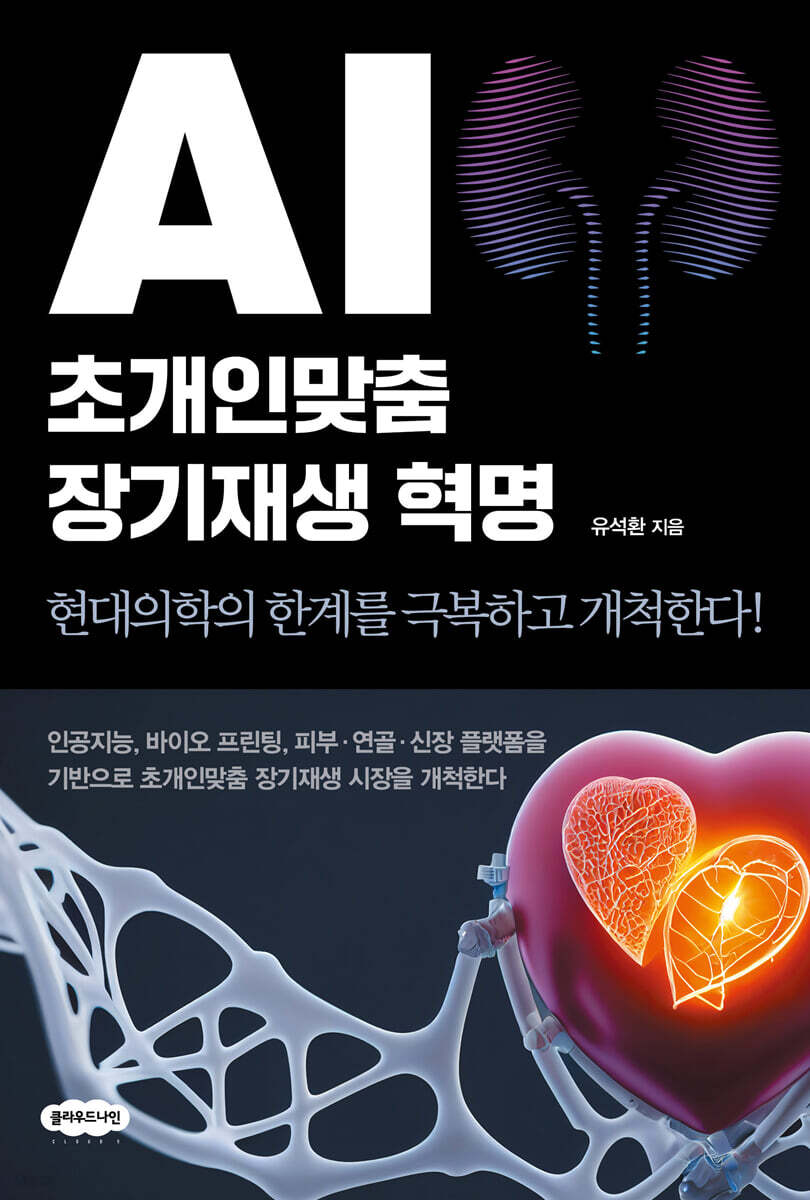
AI's hyper-personalized organ regeneration revolution
 |
Description
Book Introduction
Beyond the Limits of Modern Medicine
The AI-based hyper-personalized organ regeneration revolution has begun!
This book contains all the latest achievements of the next-generation medical innovations by startup Rocket Healthcare, combining cutting-edge technologies such as artificial intelligence, 3D bioprinting, and genome analysis.
This study sharply analyzes the problems of the existing medical system, such as the surge in medical expenses due to the aging population, the limitations of chronic diseases, and the inefficient structure of the pharmaceutical industry, and suggests the possibility of a hyper-personalized organ regeneration platform as an alternative.
Beyond simply explaining the technology, it proposes reasons why Korean society must transition to a hyper-personalized economy and strategies for implementing it.
It will provide valuable insights to medical and biotech industry professionals, policymakers, and general readers interested in the future of healthcare.
The author, Seok-Hwan Yoo, CEO of Rocket Healthcare, is a first mover who has developed long-term regenerative treatments for skin, cartilage, kidneys, and other organs for over 10 years since 2012, achieving clinical trials and global commercialization.
Using artificial intelligence bioprinting technology, we have successfully commercialized a treatment that regenerates diabetic feet, restores cartilage, and revives kidneys with a single procedure.
These treatments have fewer side effects, higher cure rates, and can dramatically reduce costs by up to 80% compared to existing treatments.
The AI-based hyper-personalized organ regeneration revolution has begun!
This book contains all the latest achievements of the next-generation medical innovations by startup Rocket Healthcare, combining cutting-edge technologies such as artificial intelligence, 3D bioprinting, and genome analysis.
This study sharply analyzes the problems of the existing medical system, such as the surge in medical expenses due to the aging population, the limitations of chronic diseases, and the inefficient structure of the pharmaceutical industry, and suggests the possibility of a hyper-personalized organ regeneration platform as an alternative.
Beyond simply explaining the technology, it proposes reasons why Korean society must transition to a hyper-personalized economy and strategies for implementing it.
It will provide valuable insights to medical and biotech industry professionals, policymakers, and general readers interested in the future of healthcare.
The author, Seok-Hwan Yoo, CEO of Rocket Healthcare, is a first mover who has developed long-term regenerative treatments for skin, cartilage, kidneys, and other organs for over 10 years since 2012, achieving clinical trials and global commercialization.
Using artificial intelligence bioprinting technology, we have successfully commercialized a treatment that regenerates diabetic feet, restores cartilage, and revives kidneys with a single procedure.
These treatments have fewer side effects, higher cure rates, and can dramatically reduce costs by up to 80% compared to existing treatments.
- You can preview some of the book's contents.
Preview
index
Prologue: The AI-powered, hyper-personalized organ regeneration revolution has already arrived.
Chapter 1: The Era of Artificial Intelligence-Powered Hyper-Personalized Organ Regeneration is Coming
1.
An AI-powered, hyper-personalized organ regeneration platform has emerged.
A fundamental belief in modern medicine has been shattered. / Solving the problem of medical costs in an aging society. / Personalized treatment dramatically increases cure rates.
2.
Becoming a game changer that turns the healthcare system upside down
AI-powered hyper-personalized organ regeneration is the big solution / AI-powered hyper-personalized regeneration will become the standard treatment.
3.
We need a healthcare revolution.
The problem of medical expenses will become more serious due to the aging population. / Pharmaceutical companies are withdrawing from treating complex chronic diseases. / The gap in health and life expectancy will become more severe depending on the wealth.
4.
Creating personalized organs with regenerative medicine
Promoting personalized precision medicine projects / Regenerative medicine tailors its approach to individual patient characteristics / Regenerative medicine solves the challenges of modern medicine / Understanding the fundamental principles of life allows for application / Exploring the secrets of life's survival through the eyes of an engineer / Life possesses complex optimization, homeostasis, and self-regeneration systems
5.
Solving the problems of modern medicine
Creating an extracellular matrix field to plant stem cell seeds / Cells need networks and an extracellular matrix to survive / Regeneration niche enables organ regeneration / Stem cell treatments are either ineffective or have many side effects / Focusing on regenerative medicine utilizing the extracellular matrix / Revolutionizing regenerative treatments through extracellular matrix / Complex chronic diseases meet hyper-personalized organ regeneration / Hyper-personalized regenerative medicine meets digital healthcare
Chapter 2: Artificial Intelligence-Powered Hyper-Personalized Organ Regeneration Is a Reality
1.
Curing diabetic feet and regenerating skin
The world's first successful clinical trial for diabetic foot / Expanding the potential of skin regeneration to skin cancer and burns / Beginning a global journey of skin regeneration / Seizing another opportunity in Brazil and Latin America / Sparks of life bloom in South America / Waves of life regeneration spread to South America, Europe, and the United States / One in ten diabetic foot patients require amputation / Why conventional treatments fail to cure the condition
2.
Say goodbye to knee pain by regenerating cartilage
Why Doctors Give Up on Arthritis Treatment / Challenging the Impossible Cartilage Regeneration Treatment / Preclinical Success at Harvard Medical School / Praise from the World Orthopedic Association
3.
Restoring Kidney Health Using Autologous Tissue
Are transplants and dialysis the only options? / Reducing immune rejection is key. / Confirming Omentum's remarkable kidney regeneration effects. / The world's first human kidney regeneration trial becomes a reality. / Efforts are being made to develop organ transplant technology after kidney donation.
Chapter 3: Innovative Technologies Leading the Era of Long-Term Regeneration
1.
Medical AI prescribes and diagnoses through modeling.
The potential for advancements in medical AI is limitless. / AI and 3D bioprinters are converging. / When medical AI is integrated, a new world will unfold.
2.
Medical 3D bioprinting prints human organs
What we saw in the movie "The Fifth Element" is becoming reality / All surgeries can be performed with three pushes of a button in 30 minutes / "Doctor Invivo" delivered to the US FDA / When will we be able to print organs for transplant?
3.
Repairing my body with autologous tissue created with bioink
Bioink must have four characteristics: / The extracellular matrix is the soil that supports cell growth / Bioink is made from autologous, not foreign, extracellular matrix
4.
Creating new organs from donated organs through decellularization and recellularization.
Why organ transplantation is so close yet so distant / Enabling organ transplantation through decellularization and recellularization / Cutting-edge technologies are lowering the hurdles to organ transplantation.
5.
Understanding the core principles of long-term regeneration in the era of hyper-personalization
Disease is a disruption of the body's homeostasis. / What is the basic strategy for diabetic foot skin regeneration?
Chapter 4: Becoming a True First Mover with Blitz & Simple
1.
The principle of action is Blitz and Simple.
Founded to create jobs for young people / Rocket's leadership is based on the 5Es / Rocket Psyche guides organizational culture / Blitz and Simplicity are the two principles of innovation / Successfully presenting clinical results
2.
Rocket Psyche is the compass that guides Rocket on his journey.
Every journey has been a series of challenges and innovations / Every process has been a challenge to break taboos / Work with a missionary spirit / Dr. Invivo is the result of pursuing the best / Excellent operations create innovation / Developing NMN and Fisetin / Think big with customer value / Develop a customer-centered innovation strategy by working backwards / Developing a diabetic foot regeneration treatment platform by working backwards / Preparing for the future with two principles
Epilogue: Overcoming the Limitations of Modern Medicine and Pioneering It
Chapter 1: The Era of Artificial Intelligence-Powered Hyper-Personalized Organ Regeneration is Coming
1.
An AI-powered, hyper-personalized organ regeneration platform has emerged.
A fundamental belief in modern medicine has been shattered. / Solving the problem of medical costs in an aging society. / Personalized treatment dramatically increases cure rates.
2.
Becoming a game changer that turns the healthcare system upside down
AI-powered hyper-personalized organ regeneration is the big solution / AI-powered hyper-personalized regeneration will become the standard treatment.
3.
We need a healthcare revolution.
The problem of medical expenses will become more serious due to the aging population. / Pharmaceutical companies are withdrawing from treating complex chronic diseases. / The gap in health and life expectancy will become more severe depending on the wealth.
4.
Creating personalized organs with regenerative medicine
Promoting personalized precision medicine projects / Regenerative medicine tailors its approach to individual patient characteristics / Regenerative medicine solves the challenges of modern medicine / Understanding the fundamental principles of life allows for application / Exploring the secrets of life's survival through the eyes of an engineer / Life possesses complex optimization, homeostasis, and self-regeneration systems
5.
Solving the problems of modern medicine
Creating an extracellular matrix field to plant stem cell seeds / Cells need networks and an extracellular matrix to survive / Regeneration niche enables organ regeneration / Stem cell treatments are either ineffective or have many side effects / Focusing on regenerative medicine utilizing the extracellular matrix / Revolutionizing regenerative treatments through extracellular matrix / Complex chronic diseases meet hyper-personalized organ regeneration / Hyper-personalized regenerative medicine meets digital healthcare
Chapter 2: Artificial Intelligence-Powered Hyper-Personalized Organ Regeneration Is a Reality
1.
Curing diabetic feet and regenerating skin
The world's first successful clinical trial for diabetic foot / Expanding the potential of skin regeneration to skin cancer and burns / Beginning a global journey of skin regeneration / Seizing another opportunity in Brazil and Latin America / Sparks of life bloom in South America / Waves of life regeneration spread to South America, Europe, and the United States / One in ten diabetic foot patients require amputation / Why conventional treatments fail to cure the condition
2.
Say goodbye to knee pain by regenerating cartilage
Why Doctors Give Up on Arthritis Treatment / Challenging the Impossible Cartilage Regeneration Treatment / Preclinical Success at Harvard Medical School / Praise from the World Orthopedic Association
3.
Restoring Kidney Health Using Autologous Tissue
Are transplants and dialysis the only options? / Reducing immune rejection is key. / Confirming Omentum's remarkable kidney regeneration effects. / The world's first human kidney regeneration trial becomes a reality. / Efforts are being made to develop organ transplant technology after kidney donation.
Chapter 3: Innovative Technologies Leading the Era of Long-Term Regeneration
1.
Medical AI prescribes and diagnoses through modeling.
The potential for advancements in medical AI is limitless. / AI and 3D bioprinters are converging. / When medical AI is integrated, a new world will unfold.
2.
Medical 3D bioprinting prints human organs
What we saw in the movie "The Fifth Element" is becoming reality / All surgeries can be performed with three pushes of a button in 30 minutes / "Doctor Invivo" delivered to the US FDA / When will we be able to print organs for transplant?
3.
Repairing my body with autologous tissue created with bioink
Bioink must have four characteristics: / The extracellular matrix is the soil that supports cell growth / Bioink is made from autologous, not foreign, extracellular matrix
4.
Creating new organs from donated organs through decellularization and recellularization.
Why organ transplantation is so close yet so distant / Enabling organ transplantation through decellularization and recellularization / Cutting-edge technologies are lowering the hurdles to organ transplantation.
5.
Understanding the core principles of long-term regeneration in the era of hyper-personalization
Disease is a disruption of the body's homeostasis. / What is the basic strategy for diabetic foot skin regeneration?
Chapter 4: Becoming a True First Mover with Blitz & Simple
1.
The principle of action is Blitz and Simple.
Founded to create jobs for young people / Rocket's leadership is based on the 5Es / Rocket Psyche guides organizational culture / Blitz and Simplicity are the two principles of innovation / Successfully presenting clinical results
2.
Rocket Psyche is the compass that guides Rocket on his journey.
Every journey has been a series of challenges and innovations / Every process has been a challenge to break taboos / Work with a missionary spirit / Dr. Invivo is the result of pursuing the best / Excellent operations create innovation / Developing NMN and Fisetin / Think big with customer value / Develop a customer-centered innovation strategy by working backwards / Developing a diabetic foot regeneration treatment platform by working backwards / Preparing for the future with two principles
Epilogue: Overcoming the Limitations of Modern Medicine and Pioneering It
Detailed image

Into the book
The golden rule for providing products cheaply and quickly in the global online platform market is hyper-personalization.
In reality, hyper-personalized services have already become a trend.
Amazon, Coupang, and American social media platforms are taking the lead in the market with predictive personalized marketing and services utilizing generative artificial intelligence and big data.
There are some concerns that come with it.
On an international level, issues such as monopoly, international taxation, and personal information leaks are becoming increasingly serious.
Hyper-personalization is also having a profound impact on legacy industries.
The semiconductor industry has also rapidly transformed from a mass production system to a customer-tailored semiconductor foundry, with Taiwan's TSMC leaping to the top of the world.
Korean semiconductor companies are struggling to reform their old paradigm of mass production, and this is cited as a cause of sluggish exports.
The electric vehicle revolution is also shifting from a hardware industry of secondary batteries and powertrains to personalized software mobility (SDV, Software Derived Vehicle).
Entertainment tailored to individual tastes and experiences, as well as convenient and useful apps, will shape the future of the mobility industry.
--- p.6
I define living systems as energy architectures that self-assemble, self-heal, self-regenerate, regenerate, and thrive.
In reality, our human body has the ultra-precision information processing ability to process 3 billion genetic information using the four basic bases A, T, C, and G with nano-level sophistication and quantum precision.
Additionally, they replicate and survive in the extracellular environment using various extracellular matrix (ECM) in the body.
Recently, epigenetic changes, which involve the acquisition of traits that regulate gene expression, have also been attracting attention. In addition to DNA and RNA mutations, these changes also involve local optimization, a process of collective intelligence among cells through neural tissue.
In summary, attempting to achieve perfect personalized organ regeneration with only two or three key substances or signals is bound to be fraught with difficulties and errors.
--- p.20
In 2012, I set out to create a new medical platform that would break away from the existing drug-centered treatment system.
For the past 10 years, we have been working to achieve a complete cure for complex chronic diseases by realizing the 'AI hyper-personalized organ regeneration revolution.'
As of 2024, the AI organ regeneration platform has undergone clinical trials in over 10 countries and has received various medical device approvals from around 50 countries, including the European Food and Drug Administration, the U.S. Food and Drug Administration, and the Korea Food and Drug Administration, and is in the process of commercializing exports.
For example, diabetic foot (diabetic foot ulcer) is a complex chronic disease that affects approximately 150 million patients worldwide and approximately 500,000 patients in Korea.
Peripheral blood vessels and nerves are damaged, leading to internal tissue necrosis.
Tissues that have died due to diabetic foot disease are not easy to treat, so up to 40% of cases require amputation of the toes or ankles.
Moreover, once amputation is performed, the patient's five-year mortality rate soars to 50%.
Diabetic foot is one of the chronic, incurable diseases caused by complex circumstances.
Rocket Healthcare has developed a method to regenerate diabetic feet with just one treatment.
This method involves extracting the patient's extracellular matrix (ECM), inserting it into a 3D bioprinter, and then creating a regeneration niche patch to fill the affected area.
The treatment time does not exceed 30 minutes, and it has been confirmed through clinical trials in over 10 countries that the affected area is regenerated by more than 90% after 2 weeks at the earliest and 8 weeks at the latest.
There are already thousands of patients who have achieved complete recovery through clinical trials both domestically and internationally.
This diabetic foot regeneration treatment can be extended to all skin regeneration conditions, including bedsores, burns, wounds, plastic surgery, and skin cancer.
Clinical trials for skin cancer were also conducted with plastic surgeons in Korea and Japan to prove its effectiveness.
--- p.27~28
The most common cause of reduced healthy life expectancy is complex chronic diseases.
It refers to the simultaneous progression of two or more chronic diseases, such as hypertension, arthritis, diabetes, hyperlipidemia, and renal failure.
In Korea, 40% of adults aged 20 or older suffer from at least one chronic disease, and 20% of them suffer from two or more complex chronic diseases.
The prevalence rate increases sharply from age 40 to 70, reaching 35.6% in those aged 45 to 64, 74.2% in those aged 65 and older, and 89.2% in those aged 75 and older.
The problem of chronic illness does not end with mere physical pain.
The economic burden mentioned earlier is another disaster.
The average household medical expenses were 1,326,000 won in 2018, but for households with chronic diseases, the average medical expenses increased to 2,329,000 won.
56% higher.
The social burden of medical expenses for chronic diseases is also significant.
Of the approximately 86.7 trillion won in benefits paid by the National Health Insurance Service in 2020, approximately 36.23 trillion won was spent on 12 chronic diseases alone.
Of the National Health Insurance Corporation's total expenditures, 42% was spent on treating chronic diseases.
This is not just a problem in our country.
In the United States, the proportion of patients with multiple chronic diseases is as high as 30%, and treatment costs account for 85% of total health care spending.
--- p.33
“Most treatments today are designed for the average patient.
However, successful treatment for some patients does not translate equally to others.
Precision medicine will provide personalized treatment options for each individual.”
On January 30, 2015, US President Barack Obama announced the launch of the Hyper-Personalized Precision Medicine Initiative in his State of the Union address at the White House.
The total budget allocated for this project amounted to 215 million dollars (approximately 256 billion won).
On that day, White House Press Secretary Lindsay Holst pointed out the "limits of average treatment" and declared that future medical care must evolve toward precision medicine.
--- p.37
The dictionary definition of 'treatment', which we commonly use, is 'to treat and cure an illness or wound.'
But if you add the word 'law' to this, the content becomes truly vast.
Representative treatments include internal medicine and surgical treatments.
There are also physical therapies that utilize physical methods, such as phototherapy and ultrasound therapy.
However, the ultimate goal of various treatments is generally the same.
It is to restore its form and function.
With the advent of the 4P medical era, the topics being discussed in the medical field are diverse.
The Fourth Industrial Revolution's diverse technologies, including precision medicine, companion diagnostics, targeted therapies, personalized treatments, minimally invasive procedures, and robotic surgery, are impacting the entire healthcare landscape.
Hyper-personalized regenerative medicine is also one of the most active research and clinical fields.
Hyper-personalized regenerative medicine is a cutting-edge medical field that regenerates various organs, tissues, and cells that make up the body, restoring or replacing their original form and function.
Restores tissues or organs that were previously unable to recover by activating the body's own healing mechanisms or replacing damaged tissue.
--- p.40
"Isn't there a law that makes life possible?" "If so, what is it?" After pondering these arrogant questions, I began my own study to find the law.
At the starting point was the hope that an answer could be found based on the principle of simplicity, Occam's Razor.
I expected and wanted to find a 'law of life' that was faithful to the principle of economy or the principle of frugality.
I hoped to discover a universally valid 'operating principle of life' that could be explained with a small amount of logic and without requiring many assumptions.
But the first thing I noticed was the solid wall of 'absence of macroscopic interpretation'.
Previous research into the principles of life has focused on the microscopic. Most studies, including DNA, have been based on reductionism.
There has not been much research or assumptions about the axioms that permeate the entire human body.
In particular, there was no explanation of the principles that make it possible for the human body to 'heal itself' from a systems engineering perspective.
In reality, hyper-personalized services have already become a trend.
Amazon, Coupang, and American social media platforms are taking the lead in the market with predictive personalized marketing and services utilizing generative artificial intelligence and big data.
There are some concerns that come with it.
On an international level, issues such as monopoly, international taxation, and personal information leaks are becoming increasingly serious.
Hyper-personalization is also having a profound impact on legacy industries.
The semiconductor industry has also rapidly transformed from a mass production system to a customer-tailored semiconductor foundry, with Taiwan's TSMC leaping to the top of the world.
Korean semiconductor companies are struggling to reform their old paradigm of mass production, and this is cited as a cause of sluggish exports.
The electric vehicle revolution is also shifting from a hardware industry of secondary batteries and powertrains to personalized software mobility (SDV, Software Derived Vehicle).
Entertainment tailored to individual tastes and experiences, as well as convenient and useful apps, will shape the future of the mobility industry.
--- p.6
I define living systems as energy architectures that self-assemble, self-heal, self-regenerate, regenerate, and thrive.
In reality, our human body has the ultra-precision information processing ability to process 3 billion genetic information using the four basic bases A, T, C, and G with nano-level sophistication and quantum precision.
Additionally, they replicate and survive in the extracellular environment using various extracellular matrix (ECM) in the body.
Recently, epigenetic changes, which involve the acquisition of traits that regulate gene expression, have also been attracting attention. In addition to DNA and RNA mutations, these changes also involve local optimization, a process of collective intelligence among cells through neural tissue.
In summary, attempting to achieve perfect personalized organ regeneration with only two or three key substances or signals is bound to be fraught with difficulties and errors.
--- p.20
In 2012, I set out to create a new medical platform that would break away from the existing drug-centered treatment system.
For the past 10 years, we have been working to achieve a complete cure for complex chronic diseases by realizing the 'AI hyper-personalized organ regeneration revolution.'
As of 2024, the AI organ regeneration platform has undergone clinical trials in over 10 countries and has received various medical device approvals from around 50 countries, including the European Food and Drug Administration, the U.S. Food and Drug Administration, and the Korea Food and Drug Administration, and is in the process of commercializing exports.
For example, diabetic foot (diabetic foot ulcer) is a complex chronic disease that affects approximately 150 million patients worldwide and approximately 500,000 patients in Korea.
Peripheral blood vessels and nerves are damaged, leading to internal tissue necrosis.
Tissues that have died due to diabetic foot disease are not easy to treat, so up to 40% of cases require amputation of the toes or ankles.
Moreover, once amputation is performed, the patient's five-year mortality rate soars to 50%.
Diabetic foot is one of the chronic, incurable diseases caused by complex circumstances.
Rocket Healthcare has developed a method to regenerate diabetic feet with just one treatment.
This method involves extracting the patient's extracellular matrix (ECM), inserting it into a 3D bioprinter, and then creating a regeneration niche patch to fill the affected area.
The treatment time does not exceed 30 minutes, and it has been confirmed through clinical trials in over 10 countries that the affected area is regenerated by more than 90% after 2 weeks at the earliest and 8 weeks at the latest.
There are already thousands of patients who have achieved complete recovery through clinical trials both domestically and internationally.
This diabetic foot regeneration treatment can be extended to all skin regeneration conditions, including bedsores, burns, wounds, plastic surgery, and skin cancer.
Clinical trials for skin cancer were also conducted with plastic surgeons in Korea and Japan to prove its effectiveness.
--- p.27~28
The most common cause of reduced healthy life expectancy is complex chronic diseases.
It refers to the simultaneous progression of two or more chronic diseases, such as hypertension, arthritis, diabetes, hyperlipidemia, and renal failure.
In Korea, 40% of adults aged 20 or older suffer from at least one chronic disease, and 20% of them suffer from two or more complex chronic diseases.
The prevalence rate increases sharply from age 40 to 70, reaching 35.6% in those aged 45 to 64, 74.2% in those aged 65 and older, and 89.2% in those aged 75 and older.
The problem of chronic illness does not end with mere physical pain.
The economic burden mentioned earlier is another disaster.
The average household medical expenses were 1,326,000 won in 2018, but for households with chronic diseases, the average medical expenses increased to 2,329,000 won.
56% higher.
The social burden of medical expenses for chronic diseases is also significant.
Of the approximately 86.7 trillion won in benefits paid by the National Health Insurance Service in 2020, approximately 36.23 trillion won was spent on 12 chronic diseases alone.
Of the National Health Insurance Corporation's total expenditures, 42% was spent on treating chronic diseases.
This is not just a problem in our country.
In the United States, the proportion of patients with multiple chronic diseases is as high as 30%, and treatment costs account for 85% of total health care spending.
--- p.33
“Most treatments today are designed for the average patient.
However, successful treatment for some patients does not translate equally to others.
Precision medicine will provide personalized treatment options for each individual.”
On January 30, 2015, US President Barack Obama announced the launch of the Hyper-Personalized Precision Medicine Initiative in his State of the Union address at the White House.
The total budget allocated for this project amounted to 215 million dollars (approximately 256 billion won).
On that day, White House Press Secretary Lindsay Holst pointed out the "limits of average treatment" and declared that future medical care must evolve toward precision medicine.
--- p.37
The dictionary definition of 'treatment', which we commonly use, is 'to treat and cure an illness or wound.'
But if you add the word 'law' to this, the content becomes truly vast.
Representative treatments include internal medicine and surgical treatments.
There are also physical therapies that utilize physical methods, such as phototherapy and ultrasound therapy.
However, the ultimate goal of various treatments is generally the same.
It is to restore its form and function.
With the advent of the 4P medical era, the topics being discussed in the medical field are diverse.
The Fourth Industrial Revolution's diverse technologies, including precision medicine, companion diagnostics, targeted therapies, personalized treatments, minimally invasive procedures, and robotic surgery, are impacting the entire healthcare landscape.
Hyper-personalized regenerative medicine is also one of the most active research and clinical fields.
Hyper-personalized regenerative medicine is a cutting-edge medical field that regenerates various organs, tissues, and cells that make up the body, restoring or replacing their original form and function.
Restores tissues or organs that were previously unable to recover by activating the body's own healing mechanisms or replacing damaged tissue.
--- p.40
"Isn't there a law that makes life possible?" "If so, what is it?" After pondering these arrogant questions, I began my own study to find the law.
At the starting point was the hope that an answer could be found based on the principle of simplicity, Occam's Razor.
I expected and wanted to find a 'law of life' that was faithful to the principle of economy or the principle of frugality.
I hoped to discover a universally valid 'operating principle of life' that could be explained with a small amount of logic and without requiring many assumptions.
But the first thing I noticed was the solid wall of 'absence of macroscopic interpretation'.
Previous research into the principles of life has focused on the microscopic. Most studies, including DNA, have been based on reductionism.
There has not been much research or assumptions about the axioms that permeate the entire human body.
In particular, there was no explanation of the principles that make it possible for the human body to 'heal itself' from a systems engineering perspective.
--- p.47~48
Publisher's Review
From treatment to regeneration through artificial intelligence and bioprinting
Rewriting the future of medicine!
“Why should everyone be treated the same way?” “Which treatment is best for which body type and in which context?”
This is the question the author asks in this book.
Modern medicine is more accustomed to ‘managing’ disease than ‘curing’ it.
Diabetics have had to take medication their entire lives, kidney disease patients have had to endure dialysis, and arthritis patients have had to have joint replacement surgery.
But this method does not fit the reality of an aging society.
The increasing number of patients with chronic diseases, soaring medical costs, and doctor-centered, uniform treatment are not only interfering with the quality of life of patients, but also placing a burden on medical finances.
For the past decade, CEO Seok-Hwan Yoo has been developing treatment methods optimized for each individual's body by integrating artificial intelligence, bioprinting, and genome-based precision medicine technologies.
This book deals with a new medical paradigm that combines artificial intelligence, genetic analysis, 3D bioprinting, and regenerative medicine technologies.
As the founder of Rocket Healthcare, the author presented a 'hyper-personalized organ regeneration platform' as the only solution to overcome the problem of chronic diseases and the burden of medical expenses in the aging society, and was the first in the world to clinically and commercially successfully regenerate skin, cartilage, and kidneys.
As of 2024, through clinical trials in over 10 countries, the company has established a hyper-personalized platform capable of treating intractable chronic diseases such as diabetic foot, arthritis, and chronic renal failure, and has obtained medical device certification in over 50 countries, including the Ministry of Food and Drug Safety in Europe, the United States, and the Republic of Korea.
It demonstrates real-world examples of medical innovation, with cases showing how a single procedure can regenerate skin tissue, restore cartilage, and restore kidney function without dialysis.
In particular, bioink, autologous cell-based 3D printing technology, and AI-based tissue customization technology are opening up a new horizon of 'organ regeneration' beyond 'personalized treatment.'
Presenting a new medical economy that addresses the limitations of the existing medical system.
The organ regeneration revolution is a philosophy, not a technology.
Until now, the pharmaceutical-centered medical system has remained limited to alleviating repetitive symptoms, leading to increased medical costs and deepening the inequality in life caused by the gap between rich and poor.
It is a well-known fact that the average life expectancy of rich and poor people differs by eight years.
This book warns that the current medical system is no longer sustainable, with the prediction that South Korea's medical expenses will reach 30% of the national budget by 2035.
The solution proposed for this is 'AI-based hyper-personalized treatment' that aims for complete regeneration.
Personalized treatment using autologous tissue is attracting attention as the only method that has minimal side effects, is economical, and can significantly reduce national healthcare budgets.
Moreover, this book does not simply list techniques.
It starts from the philosophy that 'all people are different and therefore treatment should be different.'
The philosophy of 'hyper-personalization' is centered on the biological understanding that life is a complex and sophisticated system, and the value of valuing human dignity and quality of life.
Furthermore, CEO Yoo Seok-hwan also proposes a strategic shift at the industry level.
The government must move beyond the mass production system centered on large corporations and foster hyper-personalized small and medium-sized enterprises and venture companies, and transform the medical regulatory system into a self-regulatory system like that of advanced countries.
Building this convergence ecosystem sends a strong message that Korea can lead global medical innovation.
Making diabetic foot skin regeneration, knee cartilage regeneration, and kidney regeneration a reality!
We are building a medical platform called the AI-powered organ regeneration system.
Rocket Healthcare's representative technologies are being applied in three fields.
First, we regenerate diabetic feet, burns, and even skin defects with customized bioprinting treatments.
Hyper-personalized organ regeneration technology is being applied to diabetic feet.
Amputation of toes or entire feet is common due to diabetes.
Rocket Healthcare has achieved amputation-free treatment by bioprinting a customized patch based on autologous tissue and implanting it into the wound.
This technology has been applied to more than 200 patients, with very high recovery rates and satisfaction, and has been certified as a medical device by CE MDR, FDA, and the Ministry of Food and Drug Safety.
The cartilage regeneration platform is a technology that eliminates the need for artificial joints when suffering from arthritis.
Modern orthopedic surgeons manage arthritis patients' pain with painkillers and physical therapy, and eventually recommend artificial joints.
However, artificial joints have a limited lifespan, so the risk of reoperation is high for young patients.
CEO Yoo Seok-hwan raised concerns about this method and developed an autologous tissue-based cartilage regeneration treatment.
This technique involves the following steps:
The extracellular matrix (ECM) is extracted from the patient's adipose tissue, concentrated, purified into bioink, and a customized patch is created for the damaged area using an artificial intelligence-based 3D bioprinter.
It induces self-regeneration by transplanting to a local area without surgery.
This process takes about 30 minutes, and in one procedure, the cartilage is regenerated into hyaline cartilage.
It is also effective for patients with insufficient or impaired chondrocyte function, and has a lower risk of infection and cost than existing stem cell treatment or autologous cartilage transplantation.
The kidney regeneration platform is a technology that breaks the common belief that kidneys do not regenerate.
Chronic kidney disease is a disease for which there is no alternative other than dialysis and transplantation.
CEO Yoo Seok-hwan broke the conventional medical belief that “kidneys do not regenerate” and developed the ‘Omentum Patch’ technology for kidney regeneration.
A patch that attaches to the kidney is made using extracellular matrix ECM extracted from autologous tissue.
It alleviates renal fibrosis and promotes functional recovery.
The research results were published as a cover paper in the 2022 TERMIS official journal, Tissue Engineering Part C, and the world's first human clinical trial is scheduled to be conducted in 2025.
Additionally, Rocket Healthcare is conducting research to develop future bio-artificial organs through decellularization and recellularization technologies.
This is attracting attention as an innovative technology that can be used 'like my own organ' without immunosuppressants in the future.
Beyond simple surgical techniques, Rocket Healthcare has built a medical platform called the AI-powered organ regeneration system.
Step 1 is automatic AI recognition of individual refunds.
Step 2 is autologous tissue extraction → ECM purification → customized patch design.
Step 3 is bioprinting and treatment.
This all-in-one system has been implemented in 'Doctor Invivo' to be applied in the operating room within 30 minutes, and is already being exported globally and applied in the field.
Rewriting the future of medicine!
“Why should everyone be treated the same way?” “Which treatment is best for which body type and in which context?”
This is the question the author asks in this book.
Modern medicine is more accustomed to ‘managing’ disease than ‘curing’ it.
Diabetics have had to take medication their entire lives, kidney disease patients have had to endure dialysis, and arthritis patients have had to have joint replacement surgery.
But this method does not fit the reality of an aging society.
The increasing number of patients with chronic diseases, soaring medical costs, and doctor-centered, uniform treatment are not only interfering with the quality of life of patients, but also placing a burden on medical finances.
For the past decade, CEO Seok-Hwan Yoo has been developing treatment methods optimized for each individual's body by integrating artificial intelligence, bioprinting, and genome-based precision medicine technologies.
This book deals with a new medical paradigm that combines artificial intelligence, genetic analysis, 3D bioprinting, and regenerative medicine technologies.
As the founder of Rocket Healthcare, the author presented a 'hyper-personalized organ regeneration platform' as the only solution to overcome the problem of chronic diseases and the burden of medical expenses in the aging society, and was the first in the world to clinically and commercially successfully regenerate skin, cartilage, and kidneys.
As of 2024, through clinical trials in over 10 countries, the company has established a hyper-personalized platform capable of treating intractable chronic diseases such as diabetic foot, arthritis, and chronic renal failure, and has obtained medical device certification in over 50 countries, including the Ministry of Food and Drug Safety in Europe, the United States, and the Republic of Korea.
It demonstrates real-world examples of medical innovation, with cases showing how a single procedure can regenerate skin tissue, restore cartilage, and restore kidney function without dialysis.
In particular, bioink, autologous cell-based 3D printing technology, and AI-based tissue customization technology are opening up a new horizon of 'organ regeneration' beyond 'personalized treatment.'
Presenting a new medical economy that addresses the limitations of the existing medical system.
The organ regeneration revolution is a philosophy, not a technology.
Until now, the pharmaceutical-centered medical system has remained limited to alleviating repetitive symptoms, leading to increased medical costs and deepening the inequality in life caused by the gap between rich and poor.
It is a well-known fact that the average life expectancy of rich and poor people differs by eight years.
This book warns that the current medical system is no longer sustainable, with the prediction that South Korea's medical expenses will reach 30% of the national budget by 2035.
The solution proposed for this is 'AI-based hyper-personalized treatment' that aims for complete regeneration.
Personalized treatment using autologous tissue is attracting attention as the only method that has minimal side effects, is economical, and can significantly reduce national healthcare budgets.
Moreover, this book does not simply list techniques.
It starts from the philosophy that 'all people are different and therefore treatment should be different.'
The philosophy of 'hyper-personalization' is centered on the biological understanding that life is a complex and sophisticated system, and the value of valuing human dignity and quality of life.
Furthermore, CEO Yoo Seok-hwan also proposes a strategic shift at the industry level.
The government must move beyond the mass production system centered on large corporations and foster hyper-personalized small and medium-sized enterprises and venture companies, and transform the medical regulatory system into a self-regulatory system like that of advanced countries.
Building this convergence ecosystem sends a strong message that Korea can lead global medical innovation.
Making diabetic foot skin regeneration, knee cartilage regeneration, and kidney regeneration a reality!
We are building a medical platform called the AI-powered organ regeneration system.
Rocket Healthcare's representative technologies are being applied in three fields.
First, we regenerate diabetic feet, burns, and even skin defects with customized bioprinting treatments.
Hyper-personalized organ regeneration technology is being applied to diabetic feet.
Amputation of toes or entire feet is common due to diabetes.
Rocket Healthcare has achieved amputation-free treatment by bioprinting a customized patch based on autologous tissue and implanting it into the wound.
This technology has been applied to more than 200 patients, with very high recovery rates and satisfaction, and has been certified as a medical device by CE MDR, FDA, and the Ministry of Food and Drug Safety.
The cartilage regeneration platform is a technology that eliminates the need for artificial joints when suffering from arthritis.
Modern orthopedic surgeons manage arthritis patients' pain with painkillers and physical therapy, and eventually recommend artificial joints.
However, artificial joints have a limited lifespan, so the risk of reoperation is high for young patients.
CEO Yoo Seok-hwan raised concerns about this method and developed an autologous tissue-based cartilage regeneration treatment.
This technique involves the following steps:
The extracellular matrix (ECM) is extracted from the patient's adipose tissue, concentrated, purified into bioink, and a customized patch is created for the damaged area using an artificial intelligence-based 3D bioprinter.
It induces self-regeneration by transplanting to a local area without surgery.
This process takes about 30 minutes, and in one procedure, the cartilage is regenerated into hyaline cartilage.
It is also effective for patients with insufficient or impaired chondrocyte function, and has a lower risk of infection and cost than existing stem cell treatment or autologous cartilage transplantation.
The kidney regeneration platform is a technology that breaks the common belief that kidneys do not regenerate.
Chronic kidney disease is a disease for which there is no alternative other than dialysis and transplantation.
CEO Yoo Seok-hwan broke the conventional medical belief that “kidneys do not regenerate” and developed the ‘Omentum Patch’ technology for kidney regeneration.
A patch that attaches to the kidney is made using extracellular matrix ECM extracted from autologous tissue.
It alleviates renal fibrosis and promotes functional recovery.
The research results were published as a cover paper in the 2022 TERMIS official journal, Tissue Engineering Part C, and the world's first human clinical trial is scheduled to be conducted in 2025.
Additionally, Rocket Healthcare is conducting research to develop future bio-artificial organs through decellularization and recellularization technologies.
This is attracting attention as an innovative technology that can be used 'like my own organ' without immunosuppressants in the future.
Beyond simple surgical techniques, Rocket Healthcare has built a medical platform called the AI-powered organ regeneration system.
Step 1 is automatic AI recognition of individual refunds.
Step 2 is autologous tissue extraction → ECM purification → customized patch design.
Step 3 is bioprinting and treatment.
This all-in-one system has been implemented in 'Doctor Invivo' to be applied in the operating room within 30 minutes, and is already being exported globally and applied in the field.
GOODS SPECIFICS
- Date of issue: May 14, 2025
- Page count, weight, size: 260 pages | 152*225*20mm
- ISBN13: 9791194534167
- ISBN10: 1194534163
You may also like
카테고리
korean


korean

![GQ KOREA Mark (Monthly): December [2025]](http://librairie.coreenne.fr/cdn/shop/files/8ef265dbbfbf186523ed75ba7319009d.jpg?v=1765340328&width=3840)


