

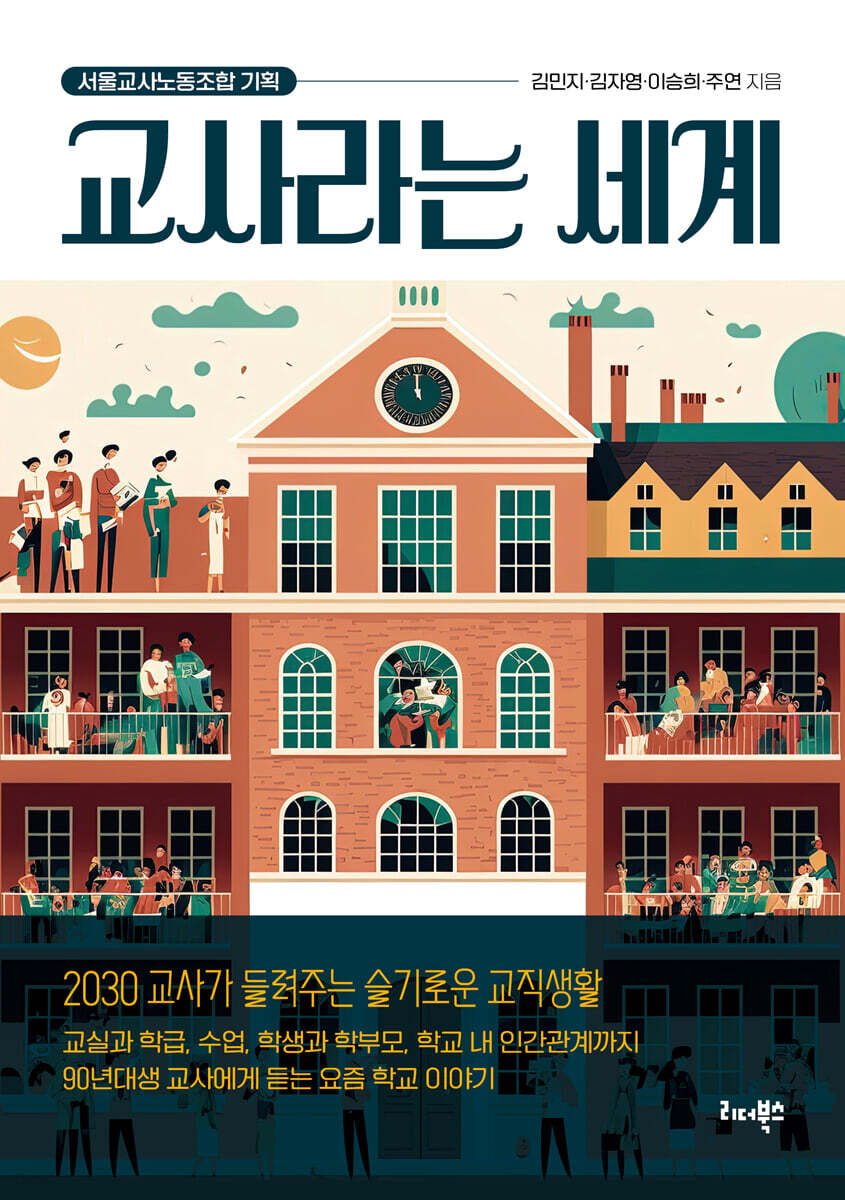
The world of teachers
 |
Description
Book Introduction
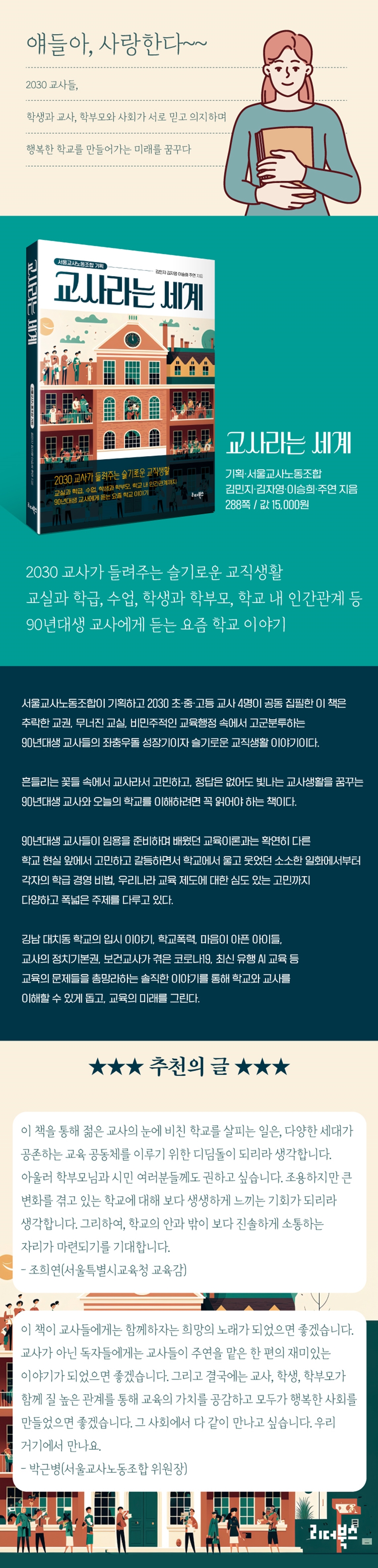
Wise Teaching Life as Told by a 2030 Teacher Classrooms and classes, lessons, students and parents, and even human relationships within the school Stories from today's schools from a teacher born in the 90s This book, planned by the Seoul Teachers' Union and co-written by four elementary, middle, and high school teachers in their 20s and 30s, is a story of the struggles of teachers amidst the decline of their authority, collapsed classrooms, and undemocratic educational administration, as well as their wise teaching lives. This is a must-read for teachers born in the 90s who struggle with the swaying flowers and dream of a bright teaching life even without the right answers, and for those who want to understand today's schools. The book covers a wide range of topics, from the small anecdotes of teachers born in the 90s struggling and crying and laughing at school while facing the reality of schools that was clearly different from the educational theories they learned while preparing for employment, to each teacher's classroom management secrets, and in-depth reflections on the Korean education system. It calmly and honestly captures the process of four new teachers, who faced difficulties and hardships, growing step by step and creating their own worlds. Senior teachers who have personally experienced the changes schools have gone through can also indirectly experience the perspectives of teachers in their 20s and 30s by reading this book. Examining schools through the eyes of young teachers, through the experiences of teachers born in the 1990s, will serve as a stepping stone toward creating an educational community where diverse generations coexist. I hope that this will provide parents with a more vivid understanding of the school, which is quietly undergoing significant changes, and that this will create a space for more honest communication between the inside and outside of the school. I hope that teachers, students, and parents can share the value of education through high-quality relationships and create a happy society for all. |
- You can preview some of the book's contents.
Preview
index
Chapter 1: I'm a Teacher, So I'm Worried: Kim Ja-young
- My dream is to be a psycho teacher.
- Compatibility is important for teachers too
- My child is an expert on me.
- Until all the geniuses in the world disappear
- I'm not that kind of person.
- Teachers grow up in school.
There is no education in a world where teachers' mouths are shut.
- School violence is ongoing.
- I'm still at school now.
Chapter 2: A Shining Teacher's Life Without a Correct Answer: Seunghee Lee
- The mirror effect between teachers and students
- What teachers can and cannot do
- Children are slime
- The most essential ability for teachers
- We are education curators
- Between honesty and lies
- The fate of the classroom depends on the teacher's charisma.
- How to get along well with elementary school students these days
Chapter 3: Among the Swaying Flowers: Kim Min-ji
- It's not that you lack persistence, it's that you have courage.
- I hope it hurts a little
- School nurses encounter COVID-19.
- School nurse Kim Min-ji, homeroom teacher Kim Min-ji
- Kids these days, my precious babies
- A changing world, a changing school
- The profession of a teacher, the stage of school
- The only teacher in Seoul
Chapter 4: The tumultuous growth of a dream teacher: Juyeon
- A girl from Seoul goes to Seoul
- I'm holding on thanks to the teacher.
- Why small schools can thrive
- MZ Teacher's Work Life
- What's important?
- Guys, I love you!
- Become more professional in front of parents
- What matters is an unwavering heart
- My dream is to be a psycho teacher.
- Compatibility is important for teachers too
- My child is an expert on me.
- Until all the geniuses in the world disappear
- I'm not that kind of person.
- Teachers grow up in school.
There is no education in a world where teachers' mouths are shut.
- School violence is ongoing.
- I'm still at school now.
Chapter 2: A Shining Teacher's Life Without a Correct Answer: Seunghee Lee
- The mirror effect between teachers and students
- What teachers can and cannot do
- Children are slime
- The most essential ability for teachers
- We are education curators
- Between honesty and lies
- The fate of the classroom depends on the teacher's charisma.
- How to get along well with elementary school students these days
Chapter 3: Among the Swaying Flowers: Kim Min-ji
- It's not that you lack persistence, it's that you have courage.
- I hope it hurts a little
- School nurses encounter COVID-19.
- School nurse Kim Min-ji, homeroom teacher Kim Min-ji
- Kids these days, my precious babies
- A changing world, a changing school
- The profession of a teacher, the stage of school
- The only teacher in Seoul
Chapter 4: The tumultuous growth of a dream teacher: Juyeon
- A girl from Seoul goes to Seoul
- I'm holding on thanks to the teacher.
- Why small schools can thrive
- MZ Teacher's Work Life
- What's important?
- Guys, I love you!
- Become more professional in front of parents
- What matters is an unwavering heart
Detailed image
Into the book
When I realized that the question wasn't the result of the student's curiosity and concern, but rather a parrot-like repetition of the academy instructor's words, I felt a sense of utter disorientation, as if the ground beneath my feet had given out.
And in the process of explaining the answer while trying to hide my embarrassed expression, I was shocked once again.
I tried to ask a question in return to give the student a chance to think for himself, but the student looked frustrated and said, “Oh, teacher.
Because I said, “Can’t you just give me the answer right away?”
--- p.21
If you look on the Internet, there are countless criticisms of teachers.
Among the many criticisms, the one that takes up the majority is the accusation that “they do their work half-heartedly and take the money.”
This criticism is unfair in many ways because it comes from a lack of understanding of teachers' actual workload, but I think it also illustrates the atmosphere of the teaching profession, where teachers' passion can sometimes be dampened.
As the heart that was full of passion and enthusiasm gradually diminishes due to rejection and dissuasion from colleagues around you, you think, 'Oh, I'll just do it roughly.
'I don't get paid more for doing this, and I only get bad comments for doing unnecessary work.' This makes me think.
And in the end, only self-mockery and sighs remain.
‘Will I fall into mannerism someday?’
--- p.28
A teacher's expertise comes from time.
Children are not robots.
Not all children produce the same output just because the input is the same.
In the same situation, warm comfort may be effective for one child, while firm discipline may be effective for another.
So, teachers have no choice but to sensitively grasp the subtle atmosphere in the classroom and the children's reactions and provide the teachings they believe are best in that situation.
At this time, what determines the 'best' is the judgment of the teacher who has observed and experienced the child for a long time.
So teachers must be by the children's side.
--- p.37
When we see someone who is perfect in everything, we call them a 'unicorn'.
Because it is a being that seems to not exist in reality at all.
I think the image of a teacher that people in our country expect is often like a unicorn.
It seems like everyone has an image of an ideal teacher in their head and is evaluating whether or not they fit that image.
I can be a hard-working teacher.
But I don't know if I can be a good daughter-in-law or a devoted mother.
I don't have the confidence to dress neatly all year round, use polite and correct language, and maintain elegant and dignified behavior.
If someone were to ask me to look like that, I would
I will answer like this.
“I got off work.”
--- p.55
One day, a fellow teacher jokingly said this to me:
“Teachers are celebrities who can’t make money.”
Just like celebrities who get caught up in all kinds of gossip because of a single photo posted on social media or a single expression flashed on camera during a broadcast, teachers also often feel exhausted from excessive attention and false rumors.
A colleague lamented that while celebrities earn a lot of money, teachers' salaries are low, so it's not a good idea to make a profit.
But if you think about it carefully, the nickname 'celebrity who can't make money' isn't necessarily a bad thing.
Celebrities, idols, superstars.
Just hearing the name makes me excited and bright.
As someone who dreamed of becoming a celebrity when I was in elementary school, I find it quite enjoyable to be in the classroom instead of on stage, and to be the center of attention of my students instead of fans.
--- p.77
Of course, it is never easy to accept children as they are.
Slime is fun to play with, so keep playing with it, but keeping children interested requires extreme patience and tolerance, like the asceticism of a monk.
Dozens of times a day, I have to test my patience, process my emotions, and repeat what I've said over and over again.
It's a little better now, but when I was a new teacher, I often cried out of sadness after the kids got home from school.
'Why on earth am I so emotionally drained?
'I wish they'd just leave me alone.' It wasn't easy to understand and embrace those less mature than me with a broad mind.
--- p.102
When I was a new teacher, I didn't know this, so I tried to explain it in detail.
I thought that if I explained it in detail, the children would understand it better.
However, as the speech became longer, the power of communication decreased significantly.
Even though I spoke for 40 minutes without any gaps in class, the children didn't even understand half of it.
As a result, it was a class that was quite inefficient and only wasted my energy.
We just wanted to 'input' a lot of learning material into the children, but we couldn't actually 'teach' them.
To make things easier and simpler, it's best to use only one meaning per sentence.
When a sentence contains multiple meanings, children's brains have difficulty processing it.
Children don't listen to me with intense concentration, word by word, sentence by sentence.
We need to speak in a way that is as easy to understand as possible so that even if we only hear it briefly, it will stick in the children's minds.
--- p.106
If the 'what' refers to what materials to present in class, then the 'how' refers to thinking about what teaching method to apply to each child.
Even in the same class, there is a big difference in immersion depending on 'how' it is applied to the children.
To make learning engaging for children, we need to make sure they feel comfortable expressing their own style in class.
This is why, when I take on the role of homeroom teacher, I first try to understand the children's tendencies.
During break time, observe what the children are doing and playing, and during class time, offer various learning activities and observe the children's reactions.
--- p.116
When I tell my friends, who are not teachers, how many students come to the infirmary, they are very surprised.
They said they don't really remember going to the health center while attending elementary, middle, and high school.
These days, kids are so impatient that they seem to go to the infirmary even when they are slightly sick.
He said that he was faking illness because he didn't want to study.
But whether it's malingering or not, that's not the important thing.
The problem is that there are too many children visiting the health center several times a day.
I want to make these kids different again.
Instead of wandering around the infirmary during recess, lost and without a place to go, let the classrooms, hallways, and playground be filled with laughter.
--- p.157
I also felt a great sense of gratitude for the hard work of those who work silently in places that are not visible.
When I asked him what he would think if another infectious disease crisis came when he became a medical professional, he was filled with a sense of desperation.
A child said that he was moved to tears by the sight of medical workers working at screening clinics wearing layers of protective clothing even in the hot summer, and showing their "bandage fighting spirit" with their noses pressed into masks.
There are even children who want to emulate their parents or family members who have 'corona heroes'.
The will to become a valuable person through work was conveyed, rather than viewing work as just a means of making money.
--- p.178
As a teacher, my love for children is no different.
The homeroom teacher and the school nurse just look at the child according to their own circumstances.
Having experienced and felt both sides, I can say that the very idea that children 'look prettier' is wrong.
When you are a homeroom teacher, there are times when you want to be objective and deal with the child from a distance, like social distancing.
When I am a school nurse, I want to understand even the smallest details surrounding the child and help them.
But you can't kill two birds with one stone.
If you get one, you have to give up the other.
But after being in both situations, I came to understand why the homeroom teacher and the health teacher did that.
In the end, when I became a homeroom teacher, it wasn't the children that looked prettier, but my fellow teachers.
--- p.188
If such a child could have even a little interest in school and attend school every day, wouldn't that be enough to justify the existence of various schools?
If you enjoy going to school and dream of becoming a 'personal trainer, YouTuber, pro gamer, or pet caretaker'.
Our children are moving beyond the MZ generation and into the Alpha generation.
I want to choose a job that I like.
The teacher's approach of pursuing stability is only relevant to the Joseon Dynasty, and education tailored to the individuality of the child is desperately needed.
--- p.198
No matter how individualistic MZ teachers may be, the communal spirit of Koreans is deeply rooted in their DNA.
It may seem like they are asserting their rights confidently without worrying about what others think, but in reality, they are just being careful and mustering up their courage.
All Koreans have the same desire to do as well as others.
Children and adults, old and new, all like praise, recognition, and empathy.
A word of encouragement makes me want to do better and work harder.
--- p.254
Parents are really difficult people.
A close yet distant relationship with students in between.
It's a relationship that's friendly at times, but you never know when or how it might become uncomfortable.
It seems important to keep that appropriate distance.
Fortunately, I have not yet met any of the so-called "true parents".
It's too early to say I'm lucky.
Because we might meet tomorrow.
It's chilling to hear stories of parents who got involved in an out-of-the-ordinary situation and ended up in a lawsuit.
Since there is still more road left to walk than the road I have already walked, I am also afraid of what kind of thorny path I will face in the future.
But as my mom said, worrying won't solve anything.
I just have to take one step at a time.
And in the process of explaining the answer while trying to hide my embarrassed expression, I was shocked once again.
I tried to ask a question in return to give the student a chance to think for himself, but the student looked frustrated and said, “Oh, teacher.
Because I said, “Can’t you just give me the answer right away?”
--- p.21
If you look on the Internet, there are countless criticisms of teachers.
Among the many criticisms, the one that takes up the majority is the accusation that “they do their work half-heartedly and take the money.”
This criticism is unfair in many ways because it comes from a lack of understanding of teachers' actual workload, but I think it also illustrates the atmosphere of the teaching profession, where teachers' passion can sometimes be dampened.
As the heart that was full of passion and enthusiasm gradually diminishes due to rejection and dissuasion from colleagues around you, you think, 'Oh, I'll just do it roughly.
'I don't get paid more for doing this, and I only get bad comments for doing unnecessary work.' This makes me think.
And in the end, only self-mockery and sighs remain.
‘Will I fall into mannerism someday?’
--- p.28
A teacher's expertise comes from time.
Children are not robots.
Not all children produce the same output just because the input is the same.
In the same situation, warm comfort may be effective for one child, while firm discipline may be effective for another.
So, teachers have no choice but to sensitively grasp the subtle atmosphere in the classroom and the children's reactions and provide the teachings they believe are best in that situation.
At this time, what determines the 'best' is the judgment of the teacher who has observed and experienced the child for a long time.
So teachers must be by the children's side.
--- p.37
When we see someone who is perfect in everything, we call them a 'unicorn'.
Because it is a being that seems to not exist in reality at all.
I think the image of a teacher that people in our country expect is often like a unicorn.
It seems like everyone has an image of an ideal teacher in their head and is evaluating whether or not they fit that image.
I can be a hard-working teacher.
But I don't know if I can be a good daughter-in-law or a devoted mother.
I don't have the confidence to dress neatly all year round, use polite and correct language, and maintain elegant and dignified behavior.
If someone were to ask me to look like that, I would
I will answer like this.
“I got off work.”
--- p.55
One day, a fellow teacher jokingly said this to me:
“Teachers are celebrities who can’t make money.”
Just like celebrities who get caught up in all kinds of gossip because of a single photo posted on social media or a single expression flashed on camera during a broadcast, teachers also often feel exhausted from excessive attention and false rumors.
A colleague lamented that while celebrities earn a lot of money, teachers' salaries are low, so it's not a good idea to make a profit.
But if you think about it carefully, the nickname 'celebrity who can't make money' isn't necessarily a bad thing.
Celebrities, idols, superstars.
Just hearing the name makes me excited and bright.
As someone who dreamed of becoming a celebrity when I was in elementary school, I find it quite enjoyable to be in the classroom instead of on stage, and to be the center of attention of my students instead of fans.
--- p.77
Of course, it is never easy to accept children as they are.
Slime is fun to play with, so keep playing with it, but keeping children interested requires extreme patience and tolerance, like the asceticism of a monk.
Dozens of times a day, I have to test my patience, process my emotions, and repeat what I've said over and over again.
It's a little better now, but when I was a new teacher, I often cried out of sadness after the kids got home from school.
'Why on earth am I so emotionally drained?
'I wish they'd just leave me alone.' It wasn't easy to understand and embrace those less mature than me with a broad mind.
--- p.102
When I was a new teacher, I didn't know this, so I tried to explain it in detail.
I thought that if I explained it in detail, the children would understand it better.
However, as the speech became longer, the power of communication decreased significantly.
Even though I spoke for 40 minutes without any gaps in class, the children didn't even understand half of it.
As a result, it was a class that was quite inefficient and only wasted my energy.
We just wanted to 'input' a lot of learning material into the children, but we couldn't actually 'teach' them.
To make things easier and simpler, it's best to use only one meaning per sentence.
When a sentence contains multiple meanings, children's brains have difficulty processing it.
Children don't listen to me with intense concentration, word by word, sentence by sentence.
We need to speak in a way that is as easy to understand as possible so that even if we only hear it briefly, it will stick in the children's minds.
--- p.106
If the 'what' refers to what materials to present in class, then the 'how' refers to thinking about what teaching method to apply to each child.
Even in the same class, there is a big difference in immersion depending on 'how' it is applied to the children.
To make learning engaging for children, we need to make sure they feel comfortable expressing their own style in class.
This is why, when I take on the role of homeroom teacher, I first try to understand the children's tendencies.
During break time, observe what the children are doing and playing, and during class time, offer various learning activities and observe the children's reactions.
--- p.116
When I tell my friends, who are not teachers, how many students come to the infirmary, they are very surprised.
They said they don't really remember going to the health center while attending elementary, middle, and high school.
These days, kids are so impatient that they seem to go to the infirmary even when they are slightly sick.
He said that he was faking illness because he didn't want to study.
But whether it's malingering or not, that's not the important thing.
The problem is that there are too many children visiting the health center several times a day.
I want to make these kids different again.
Instead of wandering around the infirmary during recess, lost and without a place to go, let the classrooms, hallways, and playground be filled with laughter.
--- p.157
I also felt a great sense of gratitude for the hard work of those who work silently in places that are not visible.
When I asked him what he would think if another infectious disease crisis came when he became a medical professional, he was filled with a sense of desperation.
A child said that he was moved to tears by the sight of medical workers working at screening clinics wearing layers of protective clothing even in the hot summer, and showing their "bandage fighting spirit" with their noses pressed into masks.
There are even children who want to emulate their parents or family members who have 'corona heroes'.
The will to become a valuable person through work was conveyed, rather than viewing work as just a means of making money.
--- p.178
As a teacher, my love for children is no different.
The homeroom teacher and the school nurse just look at the child according to their own circumstances.
Having experienced and felt both sides, I can say that the very idea that children 'look prettier' is wrong.
When you are a homeroom teacher, there are times when you want to be objective and deal with the child from a distance, like social distancing.
When I am a school nurse, I want to understand even the smallest details surrounding the child and help them.
But you can't kill two birds with one stone.
If you get one, you have to give up the other.
But after being in both situations, I came to understand why the homeroom teacher and the health teacher did that.
In the end, when I became a homeroom teacher, it wasn't the children that looked prettier, but my fellow teachers.
--- p.188
If such a child could have even a little interest in school and attend school every day, wouldn't that be enough to justify the existence of various schools?
If you enjoy going to school and dream of becoming a 'personal trainer, YouTuber, pro gamer, or pet caretaker'.
Our children are moving beyond the MZ generation and into the Alpha generation.
I want to choose a job that I like.
The teacher's approach of pursuing stability is only relevant to the Joseon Dynasty, and education tailored to the individuality of the child is desperately needed.
--- p.198
No matter how individualistic MZ teachers may be, the communal spirit of Koreans is deeply rooted in their DNA.
It may seem like they are asserting their rights confidently without worrying about what others think, but in reality, they are just being careful and mustering up their courage.
All Koreans have the same desire to do as well as others.
Children and adults, old and new, all like praise, recognition, and empathy.
A word of encouragement makes me want to do better and work harder.
--- p.254
Parents are really difficult people.
A close yet distant relationship with students in between.
It's a relationship that's friendly at times, but you never know when or how it might become uncomfortable.
It seems important to keep that appropriate distance.
Fortunately, I have not yet met any of the so-called "true parents".
It's too early to say I'm lucky.
Because we might meet tomorrow.
It's chilling to hear stories of parents who got involved in an out-of-the-ordinary situation and ended up in a lawsuit.
Since there is still more road left to walk than the road I have already walked, I am also afraid of what kind of thorny path I will face in the future.
But as my mom said, worrying won't solve anything.
I just have to take one step at a time.
--- p.278
Publisher's Review
Classrooms and classes, lessons, students and parents, interpersonal relationships within the school, etc.
Stories from today's schools from a teacher born in the 90s
As of October 1, 2022, the total number of teachers in South Korea is 509,090.
The stories of the four elementary, middle, and high school teachers who co-authored this book are not intended to represent or generalize the stories of the entire group of teachers.
This is because there are as many different stories as there are children in each school grade, subject taught, and number of children in charge.
What the authors felt after entering the teaching profession is that there is no group with as distinct an individuality as teachers.
It's so boring that they're all grouped together under the two words 'teacher,' but if you look at each individual, they're all so different.
I worry as a teacher amidst the swaying flowers.
Dreaming of a shining teaching life even if there is no right answer
The tumultuous growth of teachers in 2030
This book, which faithfully portrays the daily lives of teachers in their 20s and 30s in schools, is filled with stories of empathy between students and teachers that arise during educational activities, as well as various discourses related to education.
It covers a wide range of educational issues, including the Daechi-dong school entrance exam story, school violence, heartbroken children, teachers' basic political rights, the school nurse's experience with COVID-19, and the latest AI education trend. Through honest stories, it helps readers understand schools and envisions the future of education.
Schools are rapidly changing due to various social changes and generational changes in schools.
However, society is stuck in 'unfounded stereotypes' about teachers, and the relationship between society and teachers is becoming increasingly distant.
I hope that this book will provide those outside of school with an opportunity to understand, even if only a little, the "educational activities" of teachers, and that it will provide an opportunity for those inside the school to empathize with the thoughts of teachers among the school members and to support each other.
Seoul Metropolitan Office of Education Superintendent Cho Hee-yeon recommended the book, saying, “This is a must-read to understand today’s schools, which are different from yesterday’s,” and Seoul Teachers’ Union Chairman Park Geun-byeong stated, “Even as times change, the purpose of education to create a better society remains unchanged.”
Stories from today's schools from a teacher born in the 90s
As of October 1, 2022, the total number of teachers in South Korea is 509,090.
The stories of the four elementary, middle, and high school teachers who co-authored this book are not intended to represent or generalize the stories of the entire group of teachers.
This is because there are as many different stories as there are children in each school grade, subject taught, and number of children in charge.
What the authors felt after entering the teaching profession is that there is no group with as distinct an individuality as teachers.
It's so boring that they're all grouped together under the two words 'teacher,' but if you look at each individual, they're all so different.
I worry as a teacher amidst the swaying flowers.
Dreaming of a shining teaching life even if there is no right answer
The tumultuous growth of teachers in 2030
This book, which faithfully portrays the daily lives of teachers in their 20s and 30s in schools, is filled with stories of empathy between students and teachers that arise during educational activities, as well as various discourses related to education.
It covers a wide range of educational issues, including the Daechi-dong school entrance exam story, school violence, heartbroken children, teachers' basic political rights, the school nurse's experience with COVID-19, and the latest AI education trend. Through honest stories, it helps readers understand schools and envisions the future of education.
Schools are rapidly changing due to various social changes and generational changes in schools.
However, society is stuck in 'unfounded stereotypes' about teachers, and the relationship between society and teachers is becoming increasingly distant.
I hope that this book will provide those outside of school with an opportunity to understand, even if only a little, the "educational activities" of teachers, and that it will provide an opportunity for those inside the school to empathize with the thoughts of teachers among the school members and to support each other.
Seoul Metropolitan Office of Education Superintendent Cho Hee-yeon recommended the book, saying, “This is a must-read to understand today’s schools, which are different from yesterday’s,” and Seoul Teachers’ Union Chairman Park Geun-byeong stated, “Even as times change, the purpose of education to create a better society remains unchanged.”
GOODS SPECIFICS
- Date of issue: April 10, 2023
- Page count, weight, size: 288 pages | 454g | 148*210*17mm
- ISBN13: 9791190616911
- ISBN10: 1190616912
You may also like
카테고리
korean


korean

![GQ KOREA Mark (Monthly): December [2025]](http://librairie.coreenne.fr/cdn/shop/files/8ef265dbbfbf186523ed75ba7319009d.jpg?v=1765340328&width=3840)


