

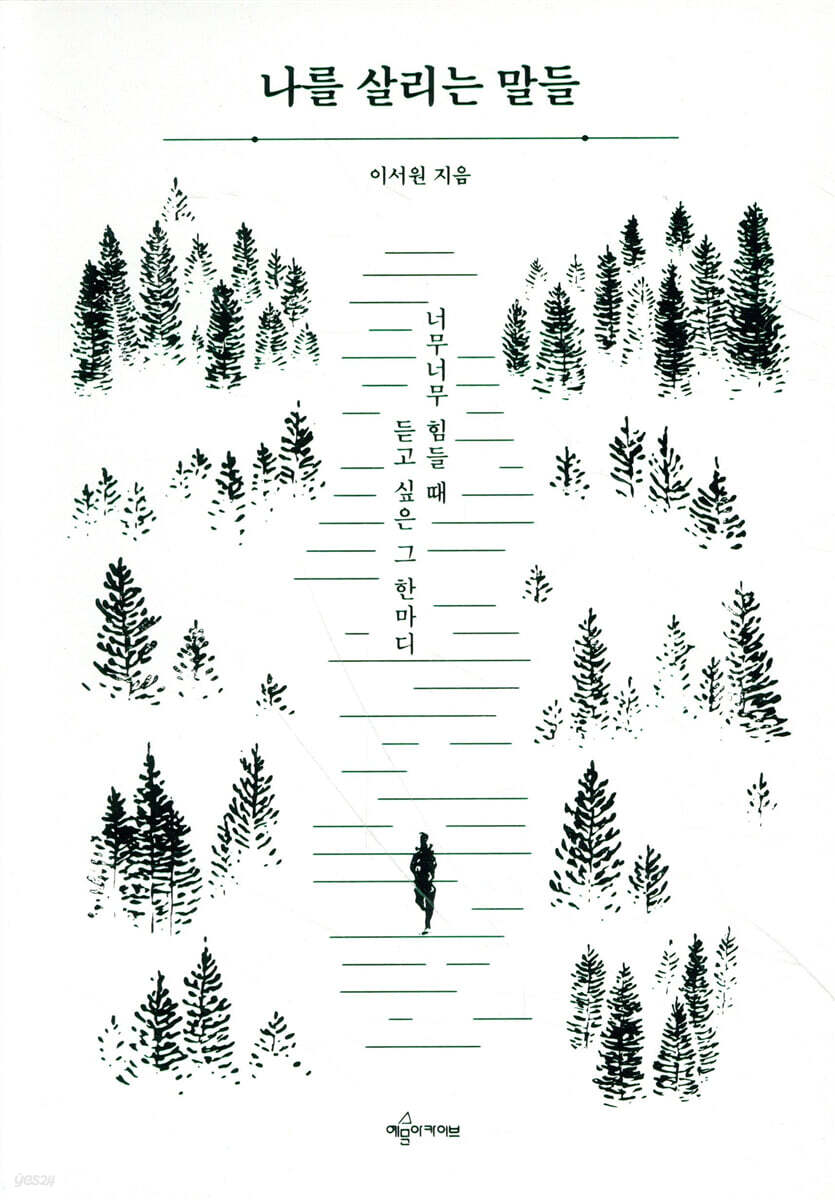
Words that save me
 |
Description
Book Introduction
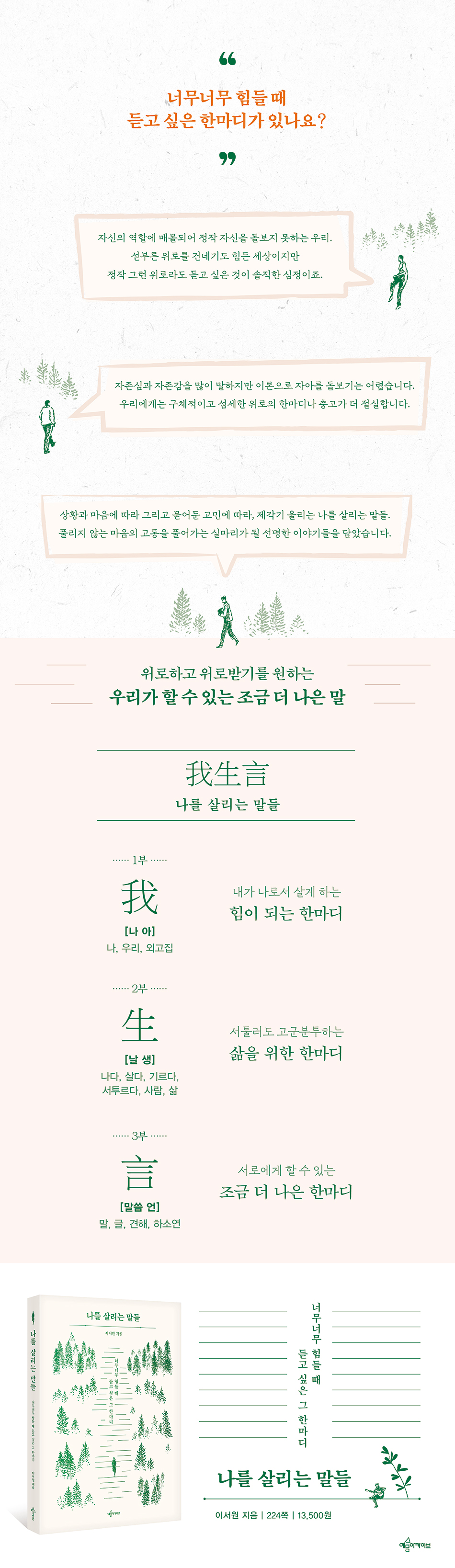
Wanting to comfort and be comforted
A little better words we can say
We are so absorbed in our roles that we fail to take care of ourselves.
It's a world where it's difficult to offer hasty consolation, but honestly, I really want to hear that kind of consolation.
We talk a lot about self-esteem and self-respect, but it's difficult to take care of ourselves in theory.
We are in desperate need of specific and nuanced words of comfort or advice.
Words that save me, each one resonating differently depending on the situation, my feelings, and my buried worries.
Vivid stories that will provide a clue to unraveling the unsettling pain of the heart.
A little better words we can say
We are so absorbed in our roles that we fail to take care of ourselves.
It's a world where it's difficult to offer hasty consolation, but honestly, I really want to hear that kind of consolation.
We talk a lot about self-esteem and self-respect, but it's difficult to take care of ourselves in theory.
We are in desperate need of specific and nuanced words of comfort or advice.
Words that save me, each one resonating differently depending on the situation, my feelings, and my buried worries.
Vivid stories that will provide a clue to unraveling the unsettling pain of the heart.
- You can preview some of the book's contents.
Preview
index
Part 1
me
“Who caught you?”
“What would you like to take out?”
“I feel lonely because I can’t be alone.”
“Am I a parasite?”
“They say that even spring flowers have a certain order in which they bloom.”
“Someone worse than you will leave.”
“I came because I was lonely.”
"why?"
“I can’t even study”
“Or straight or comfortable”
“Are you going to lie again?”
“Isn’t it hard for anyone?”
“I am 100% right.”
“I’m behind you.”
"That's you"
“The results are not mine.”
“They are Iranian twins.”
“What is this mind that arises?”
“I don’t know you when things are going well.”
Part 2
Born
“There was soju.”
“What’s truly scary isn’t the water.”
“It’s good, but why am I nervous?”
“Raise the blue flag, raise the white flag”
“If you wake me up one more time, I’ll kill you.”
“Even after trying 108 methods, it still didn’t work.”
“Don’t starve”
“What are you going to do?”
“Is this real?”
“Binding someone together doesn’t make them a couple.”
“Do you think you’re the only one having a hard time?”
“Oh, good.”
“It’s a tree that needs to be watered with a bucket of water.”
“How can it be this unfair?”
“Where is the person who is good from the beginning?”
“Is this a trip?”
“Yeah, I’m worried.”
“There are four types of people.”
“So that no one is wronged”
Part 3
言
“Still go”
“Don’t do it for me.”
“Are you done?”
“If a nuclear bomb explodes, will you live or die?”
“Am I wrong?”
“That’s what they teach you at home.”
“What difference does it make if I talk?”
“What are you talking about now!”
“So what’s the conclusion?”
“I take responsibility.”
“Why didn’t you catch it when I took the picture?”
“Was it so hard to ask why?”
“Water tastes the best.”
“Please give me a male to adopt.”
“Why did you decide that?”
“You are more important”
“Why don’t you learn to speak with your hands?”
“I don’t watch anything longer than 3 minutes.”
“Do you know what I mean?”
“I like it because you like it.”
“I don’t even know the line”
me
“Who caught you?”
“What would you like to take out?”
“I feel lonely because I can’t be alone.”
“Am I a parasite?”
“They say that even spring flowers have a certain order in which they bloom.”
“Someone worse than you will leave.”
“I came because I was lonely.”
"why?"
“I can’t even study”
“Or straight or comfortable”
“Are you going to lie again?”
“Isn’t it hard for anyone?”
“I am 100% right.”
“I’m behind you.”
"That's you"
“The results are not mine.”
“They are Iranian twins.”
“What is this mind that arises?”
“I don’t know you when things are going well.”
Part 2
Born
“There was soju.”
“What’s truly scary isn’t the water.”
“It’s good, but why am I nervous?”
“Raise the blue flag, raise the white flag”
“If you wake me up one more time, I’ll kill you.”
“Even after trying 108 methods, it still didn’t work.”
“Don’t starve”
“What are you going to do?”
“Is this real?”
“Binding someone together doesn’t make them a couple.”
“Do you think you’re the only one having a hard time?”
“Oh, good.”
“It’s a tree that needs to be watered with a bucket of water.”
“How can it be this unfair?”
“Where is the person who is good from the beginning?”
“Is this a trip?”
“Yeah, I’m worried.”
“There are four types of people.”
“So that no one is wronged”
Part 3
言
“Still go”
“Don’t do it for me.”
“Are you done?”
“If a nuclear bomb explodes, will you live or die?”
“Am I wrong?”
“That’s what they teach you at home.”
“What difference does it make if I talk?”
“What are you talking about now!”
“So what’s the conclusion?”
“I take responsibility.”
“Why didn’t you catch it when I took the picture?”
“Was it so hard to ask why?”
“Water tastes the best.”
“Please give me a male to adopt.”
“Why did you decide that?”
“You are more important”
“Why don’t you learn to speak with your hands?”
“I don’t watch anything longer than 3 minutes.”
“Do you know what I mean?”
“I like it because you like it.”
“I don’t even know the line”
Detailed image
Into the book
“I hope the monk likes it.”
"why?"
“When I’m hungry, I can eat anywhere, when I’m sleepy, I can sleep anywhere, when I want to go here, I can go there, when I want to go there, I can go there.”
The monk looked at me blankly and asked.
“Who caught you?”
The reason why the hermitage life that I was planning to spend two or three months writing my doctoral dissertation ended up lasting five years was because of a single word the monk said that day.
Actually, no one was there to catch me at that time.
There was no one to tell me to hurry up and come down from the hermitage after finishing my thesis and become a professor, and there was no one to tell me to hurry up and get married, have children, and live a good life.
It was just me holding myself back, urging myself, and spending each day under all kinds of stress.
--- From "Who's Caught You?"
The thick law books on the bookshelf on the wall of the counseling room caught my eye.
I asked the mountain man to come forward.
I asked the mountain man who came out hesitantly if he could do 'front-to-back parallel' once.
He said this while placing a volume of the law book on the arms of the monk who was standing in front of him with a puzzled look on his face.
“This is my mother with dementia.”
The mountain man nodded.
He said, adding a second volume.
“These are the two kids who live together now.”
The third law is about a mentally ill son, the fourth is about a son who thinks a lot, and the fifth is about a suspicious wife.
The mountain's two arms began to fall down.
“Is it heavy?” “Yes!” “What do you want to remove?” “There’s nothing to remove.” “Then do you want to keep holding it?” “It’s heavy!”
“What do you want to take out?” “There’s nothing to take out!” “Then just hold on.”
The monk's arm convulsed and the law books all fell to the floor at once.
The mountain also collapsed.
I started crying with a runny nose.
“There’s nothing left to lose,” he wailed.
The room was filled with sighs from those watching.
--- From "What would you like to take out?"
“Lord Oxygen, has there ever been anyone in my life who listened to me when I was having a hard time?”
Lord Oxygen looked up at me and shook his head.
“There wasn’t any.
“There wasn’t a single one.”
When I heard the story of Lord Oxygen, tears came out without me knowing.
I held the Lord of Oxygen's hand and spoke slowly.
“It was there!”
The oxygen lord shook his head again and said that there was no such thing.
“There was soju! Even if all the black-haired beasts turned their backs on me and betrayed me, there was soju.
“Cry with me and understand my feelings.”
At my words, the Lord of Oxygen nodded and his face turned red.
Then I said:
"But isn't that guy a bad guy? I gave him my time, my money, and even my life. Why is he making it so much harder for me?"
--- From "There was soju"
The person who was going to heaven had some free time and asked King Yeomra if he could follow him to hell and take a look.
With the permission of King Yeomra, I went to see hell, and there were beautiful fields full of flowers in bloom.
He came back surprised and asked why it was hell.
Then King Yeomra smiled and said.
“There’s no one to brag about.”
If hell is like that, I wondered how good heaven would be.
When I went to heaven, I saw several kind people sitting there laughing.
He returned and asked King Yeomra again.
Is this all there is to heaven?
Then King Yeomra said.
“I think you’re mistaken. It’s not that there are good people in heaven, but that heaven is within good people.”
--- From "Don't starve"
The father's question of whether he was wrong was a protest asking what was wrong with telling his son the right thing.
I asked my father if he would mind singing me a song.
My father was so shocked that he didn't even feel like listening to music and asked why I was giving advice through singing.
When I told him that I could also give counseling through singing, he reluctantly agreed to give it a try.
So I changed the lyrics to the song 'What I Wanted From You' by Group Noise and started singing it slowly.
“What I asked of you, Dad, wasn’t a difficult request.
Expressing how much you love me.
“So that I can feel it!”
--- From "Am I wrong?"
I was inviting my college classmates and their spouses over for dinner.
A friend who had been oblivious since school said this while eating dinner.
“Ah, the water tastes the best in this house!”
The moment the wife prepared the food, her eyes wavered.
As the atmosphere grew cold, the wife of the friend sitting next to me whispered and pinched me.
“Oh my, I should say the food is delicious!” The friend said again a moment later, as if trying to make up for his previous slip of the tongue.
“Wow, I guess you used good meat.
“The meat is very tasty.”
At those words, my wife's eyes turned cold.
Since that day, my wife has not been attending the alumni couples' reunion.
--- From "Water tastes the best"
During the meal, the detective told a story about an elderly couple he met while traveling in Europe.
I sat with an elderly European couple, and they were both fluent in sign language.
After a long conversation, the old couple asked.
Are there many Koreans who use sign language?
Let's say it's very little, they are said to have said this.
“You study English so hard to communicate with foreigners, but why don’t you learn to use your hands to communicate with deaf people, who are your fellow countrymen?”
"why?"
“When I’m hungry, I can eat anywhere, when I’m sleepy, I can sleep anywhere, when I want to go here, I can go there, when I want to go there, I can go there.”
The monk looked at me blankly and asked.
“Who caught you?”
The reason why the hermitage life that I was planning to spend two or three months writing my doctoral dissertation ended up lasting five years was because of a single word the monk said that day.
Actually, no one was there to catch me at that time.
There was no one to tell me to hurry up and come down from the hermitage after finishing my thesis and become a professor, and there was no one to tell me to hurry up and get married, have children, and live a good life.
It was just me holding myself back, urging myself, and spending each day under all kinds of stress.
--- From "Who's Caught You?"
The thick law books on the bookshelf on the wall of the counseling room caught my eye.
I asked the mountain man to come forward.
I asked the mountain man who came out hesitantly if he could do 'front-to-back parallel' once.
He said this while placing a volume of the law book on the arms of the monk who was standing in front of him with a puzzled look on his face.
“This is my mother with dementia.”
The mountain man nodded.
He said, adding a second volume.
“These are the two kids who live together now.”
The third law is about a mentally ill son, the fourth is about a son who thinks a lot, and the fifth is about a suspicious wife.
The mountain's two arms began to fall down.
“Is it heavy?” “Yes!” “What do you want to remove?” “There’s nothing to remove.” “Then do you want to keep holding it?” “It’s heavy!”
“What do you want to take out?” “There’s nothing to take out!” “Then just hold on.”
The monk's arm convulsed and the law books all fell to the floor at once.
The mountain also collapsed.
I started crying with a runny nose.
“There’s nothing left to lose,” he wailed.
The room was filled with sighs from those watching.
--- From "What would you like to take out?"
“Lord Oxygen, has there ever been anyone in my life who listened to me when I was having a hard time?”
Lord Oxygen looked up at me and shook his head.
“There wasn’t any.
“There wasn’t a single one.”
When I heard the story of Lord Oxygen, tears came out without me knowing.
I held the Lord of Oxygen's hand and spoke slowly.
“It was there!”
The oxygen lord shook his head again and said that there was no such thing.
“There was soju! Even if all the black-haired beasts turned their backs on me and betrayed me, there was soju.
“Cry with me and understand my feelings.”
At my words, the Lord of Oxygen nodded and his face turned red.
Then I said:
"But isn't that guy a bad guy? I gave him my time, my money, and even my life. Why is he making it so much harder for me?"
--- From "There was soju"
The person who was going to heaven had some free time and asked King Yeomra if he could follow him to hell and take a look.
With the permission of King Yeomra, I went to see hell, and there were beautiful fields full of flowers in bloom.
He came back surprised and asked why it was hell.
Then King Yeomra smiled and said.
“There’s no one to brag about.”
If hell is like that, I wondered how good heaven would be.
When I went to heaven, I saw several kind people sitting there laughing.
He returned and asked King Yeomra again.
Is this all there is to heaven?
Then King Yeomra said.
“I think you’re mistaken. It’s not that there are good people in heaven, but that heaven is within good people.”
--- From "Don't starve"
The father's question of whether he was wrong was a protest asking what was wrong with telling his son the right thing.
I asked my father if he would mind singing me a song.
My father was so shocked that he didn't even feel like listening to music and asked why I was giving advice through singing.
When I told him that I could also give counseling through singing, he reluctantly agreed to give it a try.
So I changed the lyrics to the song 'What I Wanted From You' by Group Noise and started singing it slowly.
“What I asked of you, Dad, wasn’t a difficult request.
Expressing how much you love me.
“So that I can feel it!”
--- From "Am I wrong?"
I was inviting my college classmates and their spouses over for dinner.
A friend who had been oblivious since school said this while eating dinner.
“Ah, the water tastes the best in this house!”
The moment the wife prepared the food, her eyes wavered.
As the atmosphere grew cold, the wife of the friend sitting next to me whispered and pinched me.
“Oh my, I should say the food is delicious!” The friend said again a moment later, as if trying to make up for his previous slip of the tongue.
“Wow, I guess you used good meat.
“The meat is very tasty.”
At those words, my wife's eyes turned cold.
Since that day, my wife has not been attending the alumni couples' reunion.
--- From "Water tastes the best"
During the meal, the detective told a story about an elderly couple he met while traveling in Europe.
I sat with an elderly European couple, and they were both fluent in sign language.
After a long conversation, the old couple asked.
Are there many Koreans who use sign language?
Let's say it's very little, they are said to have said this.
“You study English so hard to communicate with foreigners, but why don’t you learn to use your hands to communicate with deaf people, who are your fellow countrymen?”
--- From "Why don't you learn to speak with your hands?"
Publisher's Review
Collected by counseling experts
A word that saves you and me from our hardships
It's a tough world.
I try my best to pull myself together, but one adversity after another follows another.
For family, for dreams, for the future, we muster new strength and overcome another day, but it is even harder when the hope of better days comes and whips us along.
When you get caught up in your role, you often fail to take care of yourself.
I try to find and read books about taking care of my self-esteem and self-worth to feel better, but it's difficult to take care of myself in theory.
So, more than anything, a word of delicate comfort is needed.
But it's not easy to hear such words even from people close to you.
Haste words can actually cause harm.
The most necessary, yet in fact the most difficult words, are words of comfort.
Seo-won Lee, author of “Words that Save Me,” has been working as a counselor for a long time.
I have collected 'words that save me' from my experiences and cases of counseling people who are hurt and those who hurt others, and have included them in this book along with vivid stories.
'Words that save me' are the advice and comfort I can give to myself.
These are words that resonate differently depending on the situation, the mind, and the buried worries.
Stories that provide a clue to solving the unresolved pain in my heart also become the topic of today that saves me.
A word that gives me the strength to live as myself
The book is divided into three parts.
Each section is themed around a character from the Chinese character title of the book, 'Words that Save Me', '我生言(Ah-saeng-eon).
Part 1 deals with me.
It contains words and stories that comfort and help me take care of myself when I am having a hard time.
The author introduces anecdotes related to stories he experienced and heard in counseling settings and unforgettable words from his life.
In particular, anecdotes from the hermitage where he stayed when he began his studies as a counselor are interspersed here and there.
The first story in the book is also a story from that time.
One day, the monk suggested that we go out together, and we drove together for three days without any destination or plan.
I went wherever I wanted to go, ate wherever I was hungry, and slept somewhere suitable when night came.
When the author told the monk that he was jealous, the monk looked at him blankly and asked,
“Who caught you?”
With those words, the life of a hermit who was supposed to write a doctoral dissertation in two or three months turned into five years.
It was because of the realization that everything I had to do was actually decided by me, and that it was I who had caught me.
As a social welfare doctor, professor, and counselor, those words have long been a topic of conversation in my life, and they have become a key to understanding the suffering of those who are immersed in their roles.
The author has been counseling perpetrators at a domestic violence counseling center for over 20 years.
In the process, I was able to encounter scenes of extreme suffering.
Violence and anger often began with a single word between loved ones or family members.
The author says that when you lose something precious, you feel sad, and when it is taken away, you feel angry.
We hurt each other because of the pain of not being able to live fully as ourselves.
The more I think about it, the more I need a single word that gives me the strength to live as myself, and I put those words into a book.
A word for those struggling through life, even if it's awkward.
Part 2 deals with life.
In the process of living a difficult life, we sometimes make mistakes and live with unresolved conflicts.
There are many ways to resolve this, but more than anything, we desperately need a single word that will give us the strength to correct ourselves and live again.
The author tells the story of a man in his 60s who participated in group counseling for domestic violence victims.
As an orphan, he never went a day without drinking soju.
I always had problems because of alcohol.
Everyone told him to quit drinking and criticized him for not being able to do so.
He came to the counseling room drunk and ended up causing an accident, and the author confronted him.
I asked the orphan if there was anyone who had listened to him when he was going through hard times in his life.
He said there wasn't one, but the author, who is a counselor, said there was one.
“There was soju! Even if all the black-haired beasts turned their backs on me and betrayed me, there was soju.
“Cry with me and understand my feelings.”
He said that for the first time in his life, he did not drink alcohol and did not touch it for at least six weeks until the counseling was over.
The door that had been tightly closed was opened to someone who understood alcohol and understood me.
When you acknowledge the target rather than criticize them, you gain the strength to face them.
The author says that since then he has seen 'Soju' in everyone.
I was able to have a deeper consultation after realizing that I had to be positive about soju in order to stop drinking it.
The author always says in the book that saving lives comes first.
In a life where we struggle even if we are clumsy, recognition is more important than encouragement.
The attitude and words that acknowledge each other and accept each other's situation are the words that save us.
I am introducing such cases and some words that come to mind.
A slightly better word we can say to each other
Part 3 deals with speech.
The closer we are to each other, the easier it is to talk.
So, there are many times when I say what I want to say rather than what the other person wants to hear.
It hurts and the relationship starts to go wrong.
They say they're all saying it for your benefit, but they say good things in a hurtful way.
Because the speaker's mind is relieved.
Also, because I believe that speaking painfully will make the other person change.
Square words with sharp angles do not enter round ears.
If you wish for that, it is just a 'square dream' like the song title.
Even if the content is the same, there are 'slightly better things' we can say to each other.
An angry person's words can be calmed down simply by asking back, appropriate words are more effective than correct words, depth is more important than explanation, and when praising, the purpose must be clear to avoid misunderstandings.
For speech to become a conversation, it must first belong to the listener.
A little better word for each other saves us and saves me.
The author wanted to include practical advice in this book that would help you build better relationships.
A word that saves you and me from our hardships
It's a tough world.
I try my best to pull myself together, but one adversity after another follows another.
For family, for dreams, for the future, we muster new strength and overcome another day, but it is even harder when the hope of better days comes and whips us along.
When you get caught up in your role, you often fail to take care of yourself.
I try to find and read books about taking care of my self-esteem and self-worth to feel better, but it's difficult to take care of myself in theory.
So, more than anything, a word of delicate comfort is needed.
But it's not easy to hear such words even from people close to you.
Haste words can actually cause harm.
The most necessary, yet in fact the most difficult words, are words of comfort.
Seo-won Lee, author of “Words that Save Me,” has been working as a counselor for a long time.
I have collected 'words that save me' from my experiences and cases of counseling people who are hurt and those who hurt others, and have included them in this book along with vivid stories.
'Words that save me' are the advice and comfort I can give to myself.
These are words that resonate differently depending on the situation, the mind, and the buried worries.
Stories that provide a clue to solving the unresolved pain in my heart also become the topic of today that saves me.
A word that gives me the strength to live as myself
The book is divided into three parts.
Each section is themed around a character from the Chinese character title of the book, 'Words that Save Me', '我生言(Ah-saeng-eon).
Part 1 deals with me.
It contains words and stories that comfort and help me take care of myself when I am having a hard time.
The author introduces anecdotes related to stories he experienced and heard in counseling settings and unforgettable words from his life.
In particular, anecdotes from the hermitage where he stayed when he began his studies as a counselor are interspersed here and there.
The first story in the book is also a story from that time.
One day, the monk suggested that we go out together, and we drove together for three days without any destination or plan.
I went wherever I wanted to go, ate wherever I was hungry, and slept somewhere suitable when night came.
When the author told the monk that he was jealous, the monk looked at him blankly and asked,
“Who caught you?”
With those words, the life of a hermit who was supposed to write a doctoral dissertation in two or three months turned into five years.
It was because of the realization that everything I had to do was actually decided by me, and that it was I who had caught me.
As a social welfare doctor, professor, and counselor, those words have long been a topic of conversation in my life, and they have become a key to understanding the suffering of those who are immersed in their roles.
The author has been counseling perpetrators at a domestic violence counseling center for over 20 years.
In the process, I was able to encounter scenes of extreme suffering.
Violence and anger often began with a single word between loved ones or family members.
The author says that when you lose something precious, you feel sad, and when it is taken away, you feel angry.
We hurt each other because of the pain of not being able to live fully as ourselves.
The more I think about it, the more I need a single word that gives me the strength to live as myself, and I put those words into a book.
A word for those struggling through life, even if it's awkward.
Part 2 deals with life.
In the process of living a difficult life, we sometimes make mistakes and live with unresolved conflicts.
There are many ways to resolve this, but more than anything, we desperately need a single word that will give us the strength to correct ourselves and live again.
The author tells the story of a man in his 60s who participated in group counseling for domestic violence victims.
As an orphan, he never went a day without drinking soju.
I always had problems because of alcohol.
Everyone told him to quit drinking and criticized him for not being able to do so.
He came to the counseling room drunk and ended up causing an accident, and the author confronted him.
I asked the orphan if there was anyone who had listened to him when he was going through hard times in his life.
He said there wasn't one, but the author, who is a counselor, said there was one.
“There was soju! Even if all the black-haired beasts turned their backs on me and betrayed me, there was soju.
“Cry with me and understand my feelings.”
He said that for the first time in his life, he did not drink alcohol and did not touch it for at least six weeks until the counseling was over.
The door that had been tightly closed was opened to someone who understood alcohol and understood me.
When you acknowledge the target rather than criticize them, you gain the strength to face them.
The author says that since then he has seen 'Soju' in everyone.
I was able to have a deeper consultation after realizing that I had to be positive about soju in order to stop drinking it.
The author always says in the book that saving lives comes first.
In a life where we struggle even if we are clumsy, recognition is more important than encouragement.
The attitude and words that acknowledge each other and accept each other's situation are the words that save us.
I am introducing such cases and some words that come to mind.
A slightly better word we can say to each other
Part 3 deals with speech.
The closer we are to each other, the easier it is to talk.
So, there are many times when I say what I want to say rather than what the other person wants to hear.
It hurts and the relationship starts to go wrong.
They say they're all saying it for your benefit, but they say good things in a hurtful way.
Because the speaker's mind is relieved.
Also, because I believe that speaking painfully will make the other person change.
Square words with sharp angles do not enter round ears.
If you wish for that, it is just a 'square dream' like the song title.
Even if the content is the same, there are 'slightly better things' we can say to each other.
An angry person's words can be calmed down simply by asking back, appropriate words are more effective than correct words, depth is more important than explanation, and when praising, the purpose must be clear to avoid misunderstandings.
For speech to become a conversation, it must first belong to the listener.
A little better word for each other saves us and saves me.
The author wanted to include practical advice in this book that would help you build better relationships.
GOODS SPECIFICS
- Date of issue: December 31, 2020
- Page count, weight, size: 224 pages | 388g | 148*210*15mm
- ISBN13: 9791163860617
- ISBN10: 1163860611
You may also like
카테고리
korean


korean

![GQ KOREA Mark (Monthly): December [2025]](http://librairie.coreenne.fr/cdn/shop/files/8ef265dbbfbf186523ed75ba7319009d.jpg?v=1765340328&width=3840)


