

Life Reading 1 & 2 Box Set
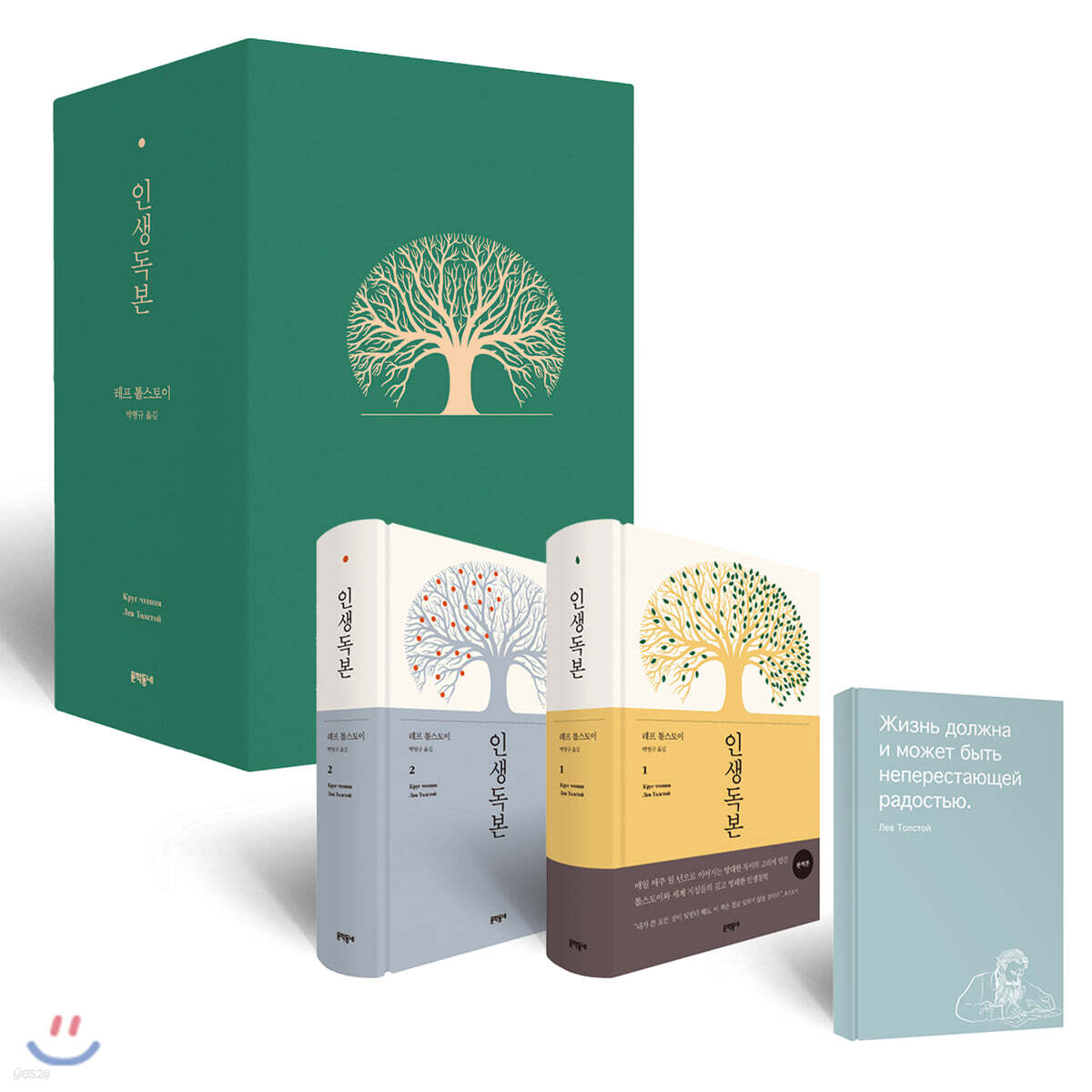 |
Description
Book Introduction
A vast chain of reading that stretches from day to day, week to year.
The profound and clear life philosophies of Tolstoy and the world's intellectuals
Complete translation by Professor Park Hyung-gyu, the leading authority on Tolstoy translation
A monumental anthology in which Tolstoy collected the life philosophies of sages from the East and the West, past and present, over a period of fifteen years from conception to writing.
In the latter years of his life, with a renewed creative passion, Tolstoy compiled the thoughts and insights of nearly 300 thinkers, philosophers, and religious figures, including the world's classics and literary works, as well as the words and writings of the Four Great Saints, Thoreau, Emerson, Pascal, Spinoza, Schopenhauer, Kant, Nietzsche, and Gogol, in the form of a yearly diary, along with his own writings. With this massive work, he achieved his long-held dream of "collecting the wisdom of centuries in one volume" and his final achievement in life.
Tolstoy, who devoted himself to perfecting the book, revising the preface over a hundred times, always kept this book by his side and reread it until he passed away, and he even said, “Even if everything I have written is forgotten, this book will never be forgotten.”
The profound and clear life philosophies of Tolstoy and the world's intellectuals
Complete translation by Professor Park Hyung-gyu, the leading authority on Tolstoy translation
A monumental anthology in which Tolstoy collected the life philosophies of sages from the East and the West, past and present, over a period of fifteen years from conception to writing.
In the latter years of his life, with a renewed creative passion, Tolstoy compiled the thoughts and insights of nearly 300 thinkers, philosophers, and religious figures, including the world's classics and literary works, as well as the words and writings of the Four Great Saints, Thoreau, Emerson, Pascal, Spinoza, Schopenhauer, Kant, Nietzsche, and Gogol, in the form of a yearly diary, along with his own writings. With this massive work, he achieved his long-held dream of "collecting the wisdom of centuries in one volume" and his final achievement in life.
Tolstoy, who devoted himself to perfecting the book, revising the preface over a hundred times, always kept this book by his side and reread it until he passed away, and he even said, “Even if everything I have written is forgotten, this book will never be forgotten.”
- You can preview some of the book's contents.
Preview
index
Volume 1
Preface … 7
January … 9
February … 95
March … 185
April … 299
May … 399
June … 485
July … 623
Volume 2
August … 7
September … 91
October … 229
November … 335
December … 473
Translator's Note | A Book of the Life of a Great Russian Thinker … 603
Introduction of key figures… 615
Leo Tolstoy Chronology … 637
Preface … 7
January … 9
February … 95
March … 185
April … 299
May … 399
June … 485
July … 623
Volume 2
August … 7
September … 91
October … 229
November … 335
December … 473
Translator's Note | A Book of the Life of a Great Russian Thinker … 603
Introduction of key figures… 615
Leo Tolstoy Chronology … 637
Into the book
You should start by reading good books.
Otherwise, you'll never be able to read it.
_Soro (Volume 1, Page 12)
If you don't have the power to burn and shine, don't cover the light.
(Volume 1, page 16)
Without love, not a single child would grow and not a single person would survive.
(Volume 1, page 42)
Why do we criticize others and slander them so harshly and maliciously? Because by criticizing others, we absolve ourselves of responsibility.
(Volume 1, page 69)
It is more important to know what not to think about than what to think about.
(Volume 1, page 111)
Most of the problems we encounter in life are like equations.
In other words, it can be easily solved by changing it to its simplest form.
(Volume 1, page 137)
Honesty is the awareness of one's own human worth.
_Buast (Volume 1, page 138)
The only way to communicate truth is to speak it with love.
People only listen to those they love.
_Soro (Volume 1, page 162)
Life should be, and can be, an unending joy.
(Volume 1, page 307)
Most of the money we spend is spent imitating others.
Emerson (Volume 1, p. 376)
People who want to appear simple are often the least simple.
Conscious simplicity is the most unpleasant artifice.
(Volume 1, page 377)
No misfortune is greater than the fear of it.
_Choke (Volume 1, page 402)
We see people in high positions suddenly collapse and die.
And every day I see people visibly weakening and finally dying.
But people don't pay much attention.
I see things like that, like when I see flowers wither or leaves fall.
They only envy and question who has taken his position.
Labruyère (Volume 1, p. 432)
When a man dies, the candle that illuminated him as he read the book full of anxiety, deception, sorrow, and evil burns brighter than ever, illuminating everything that was previously in darkness, and then finally, with a crackling sound, it goes out forever, fading into darkness.
(Volume 1, page 468)
Hypocrisy is more terrible than outright evil.
(Volume 1, 523)
Competition cannot create beauty, and arrogance cannot create nobility.
Ruskin (Volume 1, p. 628)
The reason people do not believe in God is because they believe in fakes that claim to be God's name.
(Volume 1, page 644)
What you give is yours, but what you hold on to is already lost.
_Oriental Proverbs (Volume 1, Page 661)
What is truly useful, what is truly good, and therefore what is truly great, is always simple.
(Volume 1, page 686)
Compassion for living beings evokes in us emotions similar to physical pain.
But just as we can become numb to physical pain, we can also become numb to the pain of compassion.
(Volume 1, page 688)
There is no future in love.
Love is only present.
A person who does not love now is a person without love.
(Volume 1, page 693)
It is like manure, which gives off a bad smell when it is piled up, but when spread, it enriches the soil.
(Volume 1, page 729)
Humans can get used to even the worst life.
Especially when everyone around you is living that way.
(Volume 2, page 22)
You have to learn a lot to realize that your knowledge is worthless.
Montaigne (Volume 2, p. 231)
Always stay awake.
Work as if you were going to live forever, and treat people as if they were going to die.
(Volume 2, page 234)
There are many people in the world who are less fortunate than me.
This may not give you a roof over your head, but it's enough to keep you out of the rain.
Lichtenberg (Volume 2, p. 311)
That the perfection of the soul is the sole purpose of our lives can be seen simply by observing that all other purposes become meaningless in the face of death.
(Volume 2, page 449)
Humans do not get lost alone.
When you lose your way, you make those around you lose their way too.
Seneca (Volume 2, p. 465)
When we live our best lives, we don't question time.
Emerson (Volume 2, p. 467)
When a man loses his true nature, anything can become his nature, and when he loses his true happiness, anything can become his happiness.
_pascal
Otherwise, you'll never be able to read it.
_Soro (Volume 1, Page 12)
If you don't have the power to burn and shine, don't cover the light.
(Volume 1, page 16)
Without love, not a single child would grow and not a single person would survive.
(Volume 1, page 42)
Why do we criticize others and slander them so harshly and maliciously? Because by criticizing others, we absolve ourselves of responsibility.
(Volume 1, page 69)
It is more important to know what not to think about than what to think about.
(Volume 1, page 111)
Most of the problems we encounter in life are like equations.
In other words, it can be easily solved by changing it to its simplest form.
(Volume 1, page 137)
Honesty is the awareness of one's own human worth.
_Buast (Volume 1, page 138)
The only way to communicate truth is to speak it with love.
People only listen to those they love.
_Soro (Volume 1, page 162)
Life should be, and can be, an unending joy.
(Volume 1, page 307)
Most of the money we spend is spent imitating others.
Emerson (Volume 1, p. 376)
People who want to appear simple are often the least simple.
Conscious simplicity is the most unpleasant artifice.
(Volume 1, page 377)
No misfortune is greater than the fear of it.
_Choke (Volume 1, page 402)
We see people in high positions suddenly collapse and die.
And every day I see people visibly weakening and finally dying.
But people don't pay much attention.
I see things like that, like when I see flowers wither or leaves fall.
They only envy and question who has taken his position.
Labruyère (Volume 1, p. 432)
When a man dies, the candle that illuminated him as he read the book full of anxiety, deception, sorrow, and evil burns brighter than ever, illuminating everything that was previously in darkness, and then finally, with a crackling sound, it goes out forever, fading into darkness.
(Volume 1, page 468)
Hypocrisy is more terrible than outright evil.
(Volume 1, 523)
Competition cannot create beauty, and arrogance cannot create nobility.
Ruskin (Volume 1, p. 628)
The reason people do not believe in God is because they believe in fakes that claim to be God's name.
(Volume 1, page 644)
What you give is yours, but what you hold on to is already lost.
_Oriental Proverbs (Volume 1, Page 661)
What is truly useful, what is truly good, and therefore what is truly great, is always simple.
(Volume 1, page 686)
Compassion for living beings evokes in us emotions similar to physical pain.
But just as we can become numb to physical pain, we can also become numb to the pain of compassion.
(Volume 1, page 688)
There is no future in love.
Love is only present.
A person who does not love now is a person without love.
(Volume 1, page 693)
It is like manure, which gives off a bad smell when it is piled up, but when spread, it enriches the soil.
(Volume 1, page 729)
Humans can get used to even the worst life.
Especially when everyone around you is living that way.
(Volume 2, page 22)
You have to learn a lot to realize that your knowledge is worthless.
Montaigne (Volume 2, p. 231)
Always stay awake.
Work as if you were going to live forever, and treat people as if they were going to die.
(Volume 2, page 234)
There are many people in the world who are less fortunate than me.
This may not give you a roof over your head, but it's enough to keep you out of the rain.
Lichtenberg (Volume 2, p. 311)
That the perfection of the soul is the sole purpose of our lives can be seen simply by observing that all other purposes become meaningless in the face of death.
(Volume 2, page 449)
Humans do not get lost alone.
When you lose your way, you make those around you lose their way too.
Seneca (Volume 2, p. 465)
When we live our best lives, we don't question time.
Emerson (Volume 2, p. 467)
When a man loses his true nature, anything can become his nature, and when he loses his true happiness, anything can become his happiness.
_pascal
(Volume 2, page 524)
Publisher's Review
The great thinker Tolstoy, with his conviction and sense of calling
A book of wisdom completed for the happiness of the people and the world
Tolstoy was a giant of modern world literature, a thinker who led Tolstoyism, which is based on humanism and non-resistance, and a religious figure who criticized the hypocrisy and corruption of formalistic 'state' Christianity and 'church' Christianity, and advocated a return to 'primitive' Christianity, to the point of being excommunicated from the Russian Orthodox Church in 1901, and who continued the asceticism of self-perfection according to the teachings of the Sermon on the Mount in the Gospel of Matthew.
He was also a practical mentor who experienced the Russo-Japanese War, the Russian Revolution, abuse of state power, military reactionary politics that went against the will of the times and the people, deceptive reforms and the decline of the countryside, the resulting spiritual panic, and the rapid collapse of the existing social system and moral values. Sometimes he sought change and improvement through literary works containing deep reflection, and at other times he struggled with direct and sharp criticism of the absurdity of society and reality.
One of Tolstoy's major later works, "The Reader of Life," was born from such search and struggle, and was born from a deep desire to convey moral faith and the ideals of a worthwhile life to the people.
As can be seen from the anecdote that the amount of material he read and collected to write War and Peace would fill a library, Tolstoy also read the Bible, the Quran, the Talmud, the Upanishads, ancient philosophical works, Lao-tzu and Confucius, and countless books and materials by numerous authors to write The Reader of Life, selecting them by topic, and sometimes coloring and editing his own thoughts and opinions with those maxims. He continued this arduous task with a sense of overwhelming mission and joy.
Love, the driving force of a good life and a great power that can change the world
The truth that Tolstoy discovered throughout his life was 'love'.
Tolstoy, who left a great mark on the history of literature with "War and Peace," fell into a state of fear of death and a sense of the futility of life after writing "Anna Karenina." The culmination of his ideological writing activities, which began around that time, is "The Reader of Life."
This writing activity, which was like an inner confession of his ideological conversion period, continued with 『Confessions』 (1882), 『What is My Faith』 (1884), and 『On Life』 (1887), and was completed with 『The 1887 Calendar with Proverbs』 in 1886, 『Thoughts of Wise People to Be Read Every Day』 in 1903, and 『The Reader of Life』 in 1905-1906.
However, the 1908 reprint of 『Life Reader』 was an incomplete edition with many parts deleted due to government censorship, and it did not see the light of day until 1928 when the complete works were published to commemorate the centennial of Tolstoy's birth, finally restoring its original form.
In 『The Reader of Life』, the thoughts of people from various nations and eras that moved Tolstoy the most and gave him the best answers to his questions are colorfully quoted.
Every day, 4 to 15 maxims from Tolstoy and the sages are introduced in a summary, including Socrates' rational reason and global citizenship, Buddha's middle way and peace, Thoreau's justice and freedom, Lao-tzu's humility and emptiness, Hugo and Maupassant's humanism, Dostoevsky's exploration of humanity, Confucius' fairness, Pascal's religious life, Rousseau's sense of freedom and equality, and Henry George's social welfare thoughts. At the end of each week, there is a literary text called 'Reading of the Week', which is a short novel, letter, speech, or other text that encourages deep thought on the topic.
The truth that Tolstoy discovered in his search for answers to the various questions that had preoccupied him during the last fifteen years of his life was 'love.'
It was the source of Christian self-denial and self-sacrifice, the driving force of a good life, and a great power that could change the world.
Based on such a view of life and the world, he wrote this book, which criticizes evil and violence with honest and sharp language, and serves as a guide to a moral and ethical life.
The simple and pious wisdom collected by Tolstoy will be a warm gift that will make us look back on our present 'self' and the world we belong to, and help us realize how to live the best life possible, overflowing with joy.
A book of wisdom completed for the happiness of the people and the world
Tolstoy was a giant of modern world literature, a thinker who led Tolstoyism, which is based on humanism and non-resistance, and a religious figure who criticized the hypocrisy and corruption of formalistic 'state' Christianity and 'church' Christianity, and advocated a return to 'primitive' Christianity, to the point of being excommunicated from the Russian Orthodox Church in 1901, and who continued the asceticism of self-perfection according to the teachings of the Sermon on the Mount in the Gospel of Matthew.
He was also a practical mentor who experienced the Russo-Japanese War, the Russian Revolution, abuse of state power, military reactionary politics that went against the will of the times and the people, deceptive reforms and the decline of the countryside, the resulting spiritual panic, and the rapid collapse of the existing social system and moral values. Sometimes he sought change and improvement through literary works containing deep reflection, and at other times he struggled with direct and sharp criticism of the absurdity of society and reality.
One of Tolstoy's major later works, "The Reader of Life," was born from such search and struggle, and was born from a deep desire to convey moral faith and the ideals of a worthwhile life to the people.
As can be seen from the anecdote that the amount of material he read and collected to write War and Peace would fill a library, Tolstoy also read the Bible, the Quran, the Talmud, the Upanishads, ancient philosophical works, Lao-tzu and Confucius, and countless books and materials by numerous authors to write The Reader of Life, selecting them by topic, and sometimes coloring and editing his own thoughts and opinions with those maxims. He continued this arduous task with a sense of overwhelming mission and joy.
Love, the driving force of a good life and a great power that can change the world
The truth that Tolstoy discovered throughout his life was 'love'.
Tolstoy, who left a great mark on the history of literature with "War and Peace," fell into a state of fear of death and a sense of the futility of life after writing "Anna Karenina." The culmination of his ideological writing activities, which began around that time, is "The Reader of Life."
This writing activity, which was like an inner confession of his ideological conversion period, continued with 『Confessions』 (1882), 『What is My Faith』 (1884), and 『On Life』 (1887), and was completed with 『The 1887 Calendar with Proverbs』 in 1886, 『Thoughts of Wise People to Be Read Every Day』 in 1903, and 『The Reader of Life』 in 1905-1906.
However, the 1908 reprint of 『Life Reader』 was an incomplete edition with many parts deleted due to government censorship, and it did not see the light of day until 1928 when the complete works were published to commemorate the centennial of Tolstoy's birth, finally restoring its original form.
In 『The Reader of Life』, the thoughts of people from various nations and eras that moved Tolstoy the most and gave him the best answers to his questions are colorfully quoted.
Every day, 4 to 15 maxims from Tolstoy and the sages are introduced in a summary, including Socrates' rational reason and global citizenship, Buddha's middle way and peace, Thoreau's justice and freedom, Lao-tzu's humility and emptiness, Hugo and Maupassant's humanism, Dostoevsky's exploration of humanity, Confucius' fairness, Pascal's religious life, Rousseau's sense of freedom and equality, and Henry George's social welfare thoughts. At the end of each week, there is a literary text called 'Reading of the Week', which is a short novel, letter, speech, or other text that encourages deep thought on the topic.
The truth that Tolstoy discovered in his search for answers to the various questions that had preoccupied him during the last fifteen years of his life was 'love.'
It was the source of Christian self-denial and self-sacrifice, the driving force of a good life, and a great power that could change the world.
Based on such a view of life and the world, he wrote this book, which criticizes evil and violence with honest and sharp language, and serves as a guide to a moral and ethical life.
The simple and pious wisdom collected by Tolstoy will be a warm gift that will make us look back on our present 'self' and the world we belong to, and help us realize how to live the best life possible, overflowing with joy.
GOODS SPECIFICS
- Publication date: November 5, 2020
- Format: Hardcover book binding method guide
- Page count, weight, size: 1,380 pages | 2,384g | 157*237*101mm
- ISBN13: 9788954675475
- ISBN10: 8954675476
You may also like
카테고리
korean


korean

![GQ KOREA Mark (Monthly): December [2025]](http://librairie.coreenne.fr/cdn/shop/files/8ef265dbbfbf186523ed75ba7319009d.jpg?v=1765340328&width=3840)


