

road
 |
Description
Book Introduction
In an age where human paths are cut off, comfort and courage are offered to those seeking their way.
"In this age of coronavirus, we must walk the path."
Poet Park No-hae, a wanderer of the Earth Age, has been recording for 20 years.
All the roads on earth, captured in black and white photographs and text.
Following the great journey 'The Human Path' recorded in 14 countries
I hope to go on my own true path.
The third book in the [Park No-hae Photo Essay] series, following 『One Day』 and 『Simply, Firmly, Elegantly』, 『Road』.
In his new book, "Road," poet Park No-hae, who has been a wanderer of the Earth's age for the past 20 years, walking paths not even on maps, guides us to our own "different paths" through 37 black-and-white photographs and stories that capture the landscapes and lives of various paths.
“What we need to establish is not a plan.
It is the destination of my life.
It is a firm principle about 'how I should not live'.
The light of that first heart is shining on me at the final destination of life, and is pointing me to the path I must take.
Let's leave the rest to the 'surprises of the journey' and the 'mystery of fate'.
“For my own different path to walk between the ‘gap of the plan’ and the ‘margin of emptiness.’” (_from p.15)
The high Andes plateau road and the Chamagodo, the first civilization road in human history, the snow-covered eternal snow-capped mountains and endless desert roads, the quaint alleyways and beautiful tree-lined paths, the workers' exciting homecoming and grandmothers' final pilgrimage, the 'school on the road' where children thirsty for learning gather after walking long distances, the land of conflict where even roads have been cut off and the alleyways of the Earth shed tears.
Let's walk along the 'roads of the world' in Park No-hae's photo essay 'Road' and find 'my own path'!
"In this age of coronavirus, we must walk the path."
Poet Park No-hae, a wanderer of the Earth Age, has been recording for 20 years.
All the roads on earth, captured in black and white photographs and text.
Following the great journey 'The Human Path' recorded in 14 countries
I hope to go on my own true path.
The third book in the [Park No-hae Photo Essay] series, following 『One Day』 and 『Simply, Firmly, Elegantly』, 『Road』.
In his new book, "Road," poet Park No-hae, who has been a wanderer of the Earth's age for the past 20 years, walking paths not even on maps, guides us to our own "different paths" through 37 black-and-white photographs and stories that capture the landscapes and lives of various paths.
“What we need to establish is not a plan.
It is the destination of my life.
It is a firm principle about 'how I should not live'.
The light of that first heart is shining on me at the final destination of life, and is pointing me to the path I must take.
Let's leave the rest to the 'surprises of the journey' and the 'mystery of fate'.
“For my own different path to walk between the ‘gap of the plan’ and the ‘margin of emptiness.’” (_from p.15)
The high Andes plateau road and the Chamagodo, the first civilization road in human history, the snow-covered eternal snow-capped mountains and endless desert roads, the quaint alleyways and beautiful tree-lined paths, the workers' exciting homecoming and grandmothers' final pilgrimage, the 'school on the road' where children thirsty for learning gather after walking long distances, the land of conflict where even roads have been cut off and the alleyways of the Earth shed tears.
Let's walk along the 'roads of the world' in Park No-hae's photo essay 'Road' and find 'my own path'!
- You can preview some of the book's contents.
Preview
index
introduction
The path belongs to those who walk it 11
work
Fields that reach to the sky 28
Seokduseong Fortress 32 of Chamagodo
Border River 34
You're behind me 38
40 with a new knife
Seaside Village Chat 44
Dirt Playground 46
Prayer for Travelers 48
The Last Pilgrimage 50
Rivers of the Tibetan Grasslands 54
Farmer 58 of Mount Bromo
Postman 60 of Gosan Village
Miner's Path 62
Apple Orchards in Kashmir 66
Children's 'Wood Rock' 68
72 When rowing across the moon lake
The grandmother who was left alone was 74
A cup of chai for breakfast 78
80 at your own pace
Exciting Homecoming 82
The Tree Child 84
The Weight of Love 88
School on the Road 90
Andean Stone Walls 92
Beyond the eternal snow mountain 94
98 with a coca leaf in his mouth
The Barefoot Three Musketeers 100
The Vast Desert 102
Camel Goes 106
My beloved Baghdad Cafe 108
Isolated Palestine 110
112 in the alleys of the Earth where tears flow
When the wind blows 114
Bedouin Girl 118
A heartbreaking landscape 120
Good Brothers 122
124 between tall trees
Biography 129
Book 134
The path belongs to those who walk it 11
work
Fields that reach to the sky 28
Seokduseong Fortress 32 of Chamagodo
Border River 34
You're behind me 38
40 with a new knife
Seaside Village Chat 44
Dirt Playground 46
Prayer for Travelers 48
The Last Pilgrimage 50
Rivers of the Tibetan Grasslands 54
Farmer 58 of Mount Bromo
Postman 60 of Gosan Village
Miner's Path 62
Apple Orchards in Kashmir 66
Children's 'Wood Rock' 68
72 When rowing across the moon lake
The grandmother who was left alone was 74
A cup of chai for breakfast 78
80 at your own pace
Exciting Homecoming 82
The Tree Child 84
The Weight of Love 88
School on the Road 90
Andean Stone Walls 92
Beyond the eternal snow mountain 94
98 with a coca leaf in his mouth
The Barefoot Three Musketeers 100
The Vast Desert 102
Camel Goes 106
My beloved Baghdad Cafe 108
Isolated Palestine 110
112 in the alleys of the Earth where tears flow
When the wind blows 114
Bedouin Girl 118
A heartbreaking landscape 120
Good Brothers 122
124 between tall trees
Biography 129
Book 134
Detailed image

Into the book
If you lose your way, a path will come to you.
When you walk on the road, the road begins.
The path belongs to those who walk it.
--- p.7
We are all people on the road.
When we were born on this planet, didn't we all have a calling that we must fulfill in this life and come out with a path to our own destiny?
Isn't the 'path of humanity' to find the reason and meaning of my life, which is unique and comes only once in the history of this universe?
--- p.11
Ah, but alas, we lost our way.
We communicate with the world in real time and travel to the ends of the earth, but we have lost our own path.
I have become the most distant person from myself.
I have become the stranger to myself.
(...) So the road became a place where lost people flocked.
When I run ahead of everyone else on the road, the road passes me by.
I pass myself by.
--- pp.11-12
Today, in 2020, the world is said to be in a state of disaster.
The etymology of the word disaster is a combination of the words dis, meaning 'to fall', and astro, meaning 'star', and refers to a 'state of a star falling'.
A situation where there is no way forward and no hope is a disaster.
--- p.12
Now, the world has come to a standstill due to the COVID-19 pandemic, and the "human path" has been cut off.
For the first time in history, all 7.8 billion people on Earth were gripped by fear at the same time.
A view of the end of the world seen in real time.
Days of the 'Untouchable World'.
This is a situation of great disaster where humanity has lost its way at the pinnacle of civilization where all of humanity is closely connected as one.
--- p.13
Nevertheless, we must walk the path in the age of Corona.
We must live vividly, sharing and gathering through deeper encounters and face-to-face interactions.
We must seize the opportunity of this COVID-19 era, which has taken us by surprise at the pinnacle of human civilization, to find a new philosophy and way of life. We must not waste this disaster and leap forward to become "a better version of ourselves."
--- p.14
What we need to establish is not a plan.
The first thing I need to establish is my life's destination.
It is a firm principle about 'how I should not live'.
My first heart, which I must never let go of, the light of that first heart is shining on me at the final destination of my life, and is pointing the way I must take.
Let's leave the rest to the 'surprises of the journey' and the 'mystery of fate'.
For my own different path to walk between the ‘gap of the plan’ and the ‘margin of emptiness.’
--- p.15
The red sunset falls on the river waters of the Luergai grassland, where the Yellow River first turns and flows through nine bends.
While tourists are busy taking pictures of the breathtaking scenery, a Tibetan woman, who has not been able to take in any guests all day, offers evening prayers with a heavy burden on her shoulders.
The horse quietly stays by his side, feeling sorry.
A story told by a winding river.
Life goes on.
Still, I'm going.
Even if the winding road is long and arduous, don't rush and go.
They become each other's path.
--- p.57
You who have come a long way, fear nothing.
You have suffered enough and yet we have come this far.
For those who live good and righteous lives, friends await even at the end of the world.
Walk your path without losing yourself, without losing faith.
When you walk on the road, the road begins.
The path belongs to those who walk it.
--- p.7
We are all people on the road.
When we were born on this planet, didn't we all have a calling that we must fulfill in this life and come out with a path to our own destiny?
Isn't the 'path of humanity' to find the reason and meaning of my life, which is unique and comes only once in the history of this universe?
--- p.11
Ah, but alas, we lost our way.
We communicate with the world in real time and travel to the ends of the earth, but we have lost our own path.
I have become the most distant person from myself.
I have become the stranger to myself.
(...) So the road became a place where lost people flocked.
When I run ahead of everyone else on the road, the road passes me by.
I pass myself by.
--- pp.11-12
Today, in 2020, the world is said to be in a state of disaster.
The etymology of the word disaster is a combination of the words dis, meaning 'to fall', and astro, meaning 'star', and refers to a 'state of a star falling'.
A situation where there is no way forward and no hope is a disaster.
--- p.12
Now, the world has come to a standstill due to the COVID-19 pandemic, and the "human path" has been cut off.
For the first time in history, all 7.8 billion people on Earth were gripped by fear at the same time.
A view of the end of the world seen in real time.
Days of the 'Untouchable World'.
This is a situation of great disaster where humanity has lost its way at the pinnacle of civilization where all of humanity is closely connected as one.
--- p.13
Nevertheless, we must walk the path in the age of Corona.
We must live vividly, sharing and gathering through deeper encounters and face-to-face interactions.
We must seize the opportunity of this COVID-19 era, which has taken us by surprise at the pinnacle of human civilization, to find a new philosophy and way of life. We must not waste this disaster and leap forward to become "a better version of ourselves."
--- p.14
What we need to establish is not a plan.
The first thing I need to establish is my life's destination.
It is a firm principle about 'how I should not live'.
My first heart, which I must never let go of, the light of that first heart is shining on me at the final destination of my life, and is pointing the way I must take.
Let's leave the rest to the 'surprises of the journey' and the 'mystery of fate'.
For my own different path to walk between the ‘gap of the plan’ and the ‘margin of emptiness.’
--- p.15
The red sunset falls on the river waters of the Luergai grassland, where the Yellow River first turns and flows through nine bends.
While tourists are busy taking pictures of the breathtaking scenery, a Tibetan woman, who has not been able to take in any guests all day, offers evening prayers with a heavy burden on her shoulders.
The horse quietly stays by his side, feeling sorry.
A story told by a winding river.
Life goes on.
Still, I'm going.
Even if the winding road is long and arduous, don't rush and go.
They become each other's path.
--- p.57
You who have come a long way, fear nothing.
You have suffered enough and yet we have come this far.
For those who live good and righteous lives, friends await even at the end of the world.
Walk your path without losing yourself, without losing faith.
--- p.77
Publisher's Review
In an age where human paths are cut off, comfort and courage are offered to those seeking their way.
"In this age of coronavirus, we must walk the path."
Poet Park No-hae, a wanderer of the Earth Age, has been recording for 20 years.
All the roads on earth, captured in black and white photographs and text.
The Chamagodo, the first civilization road in the Andes highlands,
From the beautiful tree-lined path to the endless desert road,
The workers' exciting journey home and the grandmother's final pilgrimage,
And to the alleyways of the Earth where tears flow.
Following the great journey of 'The Human Path' recorded in 14 countries
I hope to go on my own true path.
Park No-hae's photo essay "Road": A book that will serve as a star map for those seeking their way.
'road'.
What a thrilling word.
The road, the eternal human topic and the sound calling me from afar.
But now, with the world at a standstill due to the COVID-19 pandemic and humanity's path cut off, we have sadly lost our way at the pinnacle of civilization, where humanity is tightly connected as one.
Still, we must walk the path.
In this unfamiliar world, in this unfamiliar self, at a crossroads where I don't know 'how should I live, where should I go?', Park No-hae's photo essay 'Road' is a book that will serve as a guide to finding my own true path.
This is the third book in the Park No-hae photo essay series, following books 01 『One Day』 and 02 『Simply, Firmly, and Elegantly』, first published in June 2019.
Poet Park No-hae, who has walked the 'road without a road', has recorded black-and-white photos and writings for 20 years.
Park No-hae, a man who has walked the 'road without a road' throughout his life at every moment of history.
In 1984, he published his first poetry collection, “Labor’s Dawn,” and walked the arduous path of being wanted, tortured, and imprisoned for life in order to liberate labor and achieve democracy in this land. In 1997, he published his prison essay, “Only People Are Hope,” and walked the path of diligence, taking up the topic of a new era.
Since his release in 1998, he has been wandering the Earth's most remote, highest, and deepest places for the past 20 years, searching for a "different path."
From the highest Andean highlands to the paths of those living in the lowest places
Park No-hae's photo essay, "Road," tells the story of the diverse landscapes and people the poet encountered on the roads of 14 countries, including India, Pakistan, Sudan, Palestine, and Peru.
The Andean highlands, known as the "fields reaching to the sky," the Chamagodo Trail, the first civilizational road in human history, snow-covered mountains and endless desert roads, quaint alleyways and paths through beautiful tree-lined forests, the workers' exciting journey home and grandmothers' final pilgrimage, the "school on the road" where children thirsty for learning gather after walking long distances, a land of conflict where even roads have been cut off and the alleyways of the Earth shed tears.
37 black-and-white photographs and stories guide us on our own 'different paths'.
As I slowly turn the pages and follow the paths of the characters in the photos, memories of my childhood come flooding back, along the tearful paths of meeting and parting, and along the paths of life I wandered alone and lost, and I find myself shedding tears and feeling my heart being purified.
The title typography "Road" is created in poet Park No-hae's handwriting.
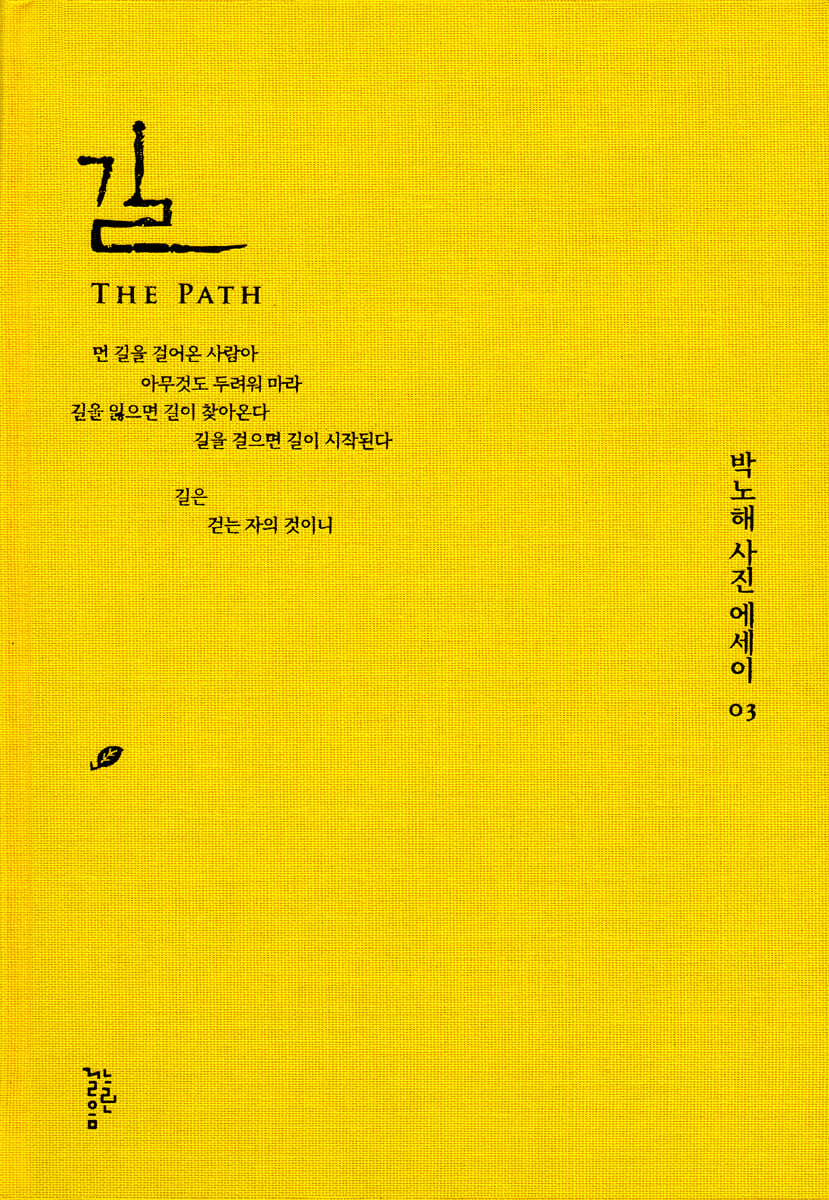
In the photo essay 『Road』, there are two things that stand out: the warm and bright yellow cover and the strong and beautiful title typography.
It was created based on the handwriting of poet Park No-hae, who writes only by hand.
The word 'road', which poet Park No-hae has written hundreds of times, contains in its single letter the plateau, the mountain range, the river, the fields, and even the person walking the road.
The titles of the previous photo essays, “One Day” and “Simply, Firmly, and Elegantly,” were also created in the poet’s handwriting, and many readers, visitors to the exhibition, and artists also praised the handwriting.
Simultaneous English translation of this beautiful book to share it with the world.
There is a part that readers of 『Park No-hae's Photo Essay』 are impressed by.
It is the English version included right next to the Korean version.
Foreigners even ask, “Is this originally written in English?”
The translator, Brother Anthony of Taize (Ahn Seon-jae), is a master of Korean literature translation, having translated over 50 works by representative Korean authors. He translated poet Park No-hae's works, including "Dawn of Labor," "People Are the Only Hope," and "So Don't Disappear."
Professor Ahn Seon-jae said in a recent interview, “Poet Park No-hae is a unique and special being in the world.
“His life has profound historical significance and gives people inspiration and hope,” he said.
Meet the photos in the book through an exhibition of analog prints.
There is also an opportunity to view all the works included in 『Road』 as authentic analog prints.
A photo exhibition with the same title, [Road], will be held at 'La Cafe Gallery' located in Tongui-dong, Jongno-gu, from September 1st.
The accumulated number of visitors to the Park No-hae photo exhibition, which is now in its 10th year, is approximately 280,000.
The comments left by visitors show that Park No-hae's photo exhibition provides deep reflection and a philosophy of life.
“In these days of blocked roads, I feel like I’ve found my way again”, “Poet Park No-hae’s love flows into me”, “The space in black and white, the photos, the text, and even the music are all in harmony”.
This is why 'La Gallery', with its analog black-and-white photographs developed one by one in a darkroom by a craftsman, captions that condense the story into a short story, and world music carefully selected by a poet, is called "the pilgrimage of my soul."
“Fear nothing, for the path belongs to those who walk it.” - Park No-hae
In the preface to his photo essay, “Road,” poet Park No-hae states that the most significant event of our time is that “the road stretches to the ends of the earth, but we have lost the path we are meant to take.”
Furthermore, in today's world, faced with the global pandemic of COVID-19, we speak of the 'path of humanity' in a language that transcends the times.
And I tell you that there is a path of your own that can be found by being willing to lose your way through life.
“You who have come a long way, fear nothing.
If you lose your way, a path will come to you.
When you walk on the road, the road begins.
“The road belongs to those who walk it.” (Park No-hae) Park No-hae’s photo essay, “Road,” will become a friend who walks the “roads of the world” and finds “my own path.”
"In this age of coronavirus, we must walk the path."
Poet Park No-hae, a wanderer of the Earth Age, has been recording for 20 years.
All the roads on earth, captured in black and white photographs and text.
The Chamagodo, the first civilization road in the Andes highlands,
From the beautiful tree-lined path to the endless desert road,
The workers' exciting journey home and the grandmother's final pilgrimage,
And to the alleyways of the Earth where tears flow.
Following the great journey of 'The Human Path' recorded in 14 countries
I hope to go on my own true path.
Park No-hae's photo essay "Road": A book that will serve as a star map for those seeking their way.
'road'.
What a thrilling word.
The road, the eternal human topic and the sound calling me from afar.
But now, with the world at a standstill due to the COVID-19 pandemic and humanity's path cut off, we have sadly lost our way at the pinnacle of civilization, where humanity is tightly connected as one.
Still, we must walk the path.
In this unfamiliar world, in this unfamiliar self, at a crossroads where I don't know 'how should I live, where should I go?', Park No-hae's photo essay 'Road' is a book that will serve as a guide to finding my own true path.
This is the third book in the Park No-hae photo essay series, following books 01 『One Day』 and 02 『Simply, Firmly, and Elegantly』, first published in June 2019.
Poet Park No-hae, who has walked the 'road without a road', has recorded black-and-white photos and writings for 20 years.
Park No-hae, a man who has walked the 'road without a road' throughout his life at every moment of history.
In 1984, he published his first poetry collection, “Labor’s Dawn,” and walked the arduous path of being wanted, tortured, and imprisoned for life in order to liberate labor and achieve democracy in this land. In 1997, he published his prison essay, “Only People Are Hope,” and walked the path of diligence, taking up the topic of a new era.
Since his release in 1998, he has been wandering the Earth's most remote, highest, and deepest places for the past 20 years, searching for a "different path."
From the highest Andean highlands to the paths of those living in the lowest places
Park No-hae's photo essay, "Road," tells the story of the diverse landscapes and people the poet encountered on the roads of 14 countries, including India, Pakistan, Sudan, Palestine, and Peru.
The Andean highlands, known as the "fields reaching to the sky," the Chamagodo Trail, the first civilizational road in human history, snow-covered mountains and endless desert roads, quaint alleyways and paths through beautiful tree-lined forests, the workers' exciting journey home and grandmothers' final pilgrimage, the "school on the road" where children thirsty for learning gather after walking long distances, a land of conflict where even roads have been cut off and the alleyways of the Earth shed tears.
37 black-and-white photographs and stories guide us on our own 'different paths'.
As I slowly turn the pages and follow the paths of the characters in the photos, memories of my childhood come flooding back, along the tearful paths of meeting and parting, and along the paths of life I wandered alone and lost, and I find myself shedding tears and feeling my heart being purified.
The title typography "Road" is created in poet Park No-hae's handwriting.
In the photo essay 『Road』, there are two things that stand out: the warm and bright yellow cover and the strong and beautiful title typography.
It was created based on the handwriting of poet Park No-hae, who writes only by hand.
The word 'road', which poet Park No-hae has written hundreds of times, contains in its single letter the plateau, the mountain range, the river, the fields, and even the person walking the road.
The titles of the previous photo essays, “One Day” and “Simply, Firmly, and Elegantly,” were also created in the poet’s handwriting, and many readers, visitors to the exhibition, and artists also praised the handwriting.
Simultaneous English translation of this beautiful book to share it with the world.
There is a part that readers of 『Park No-hae's Photo Essay』 are impressed by.
It is the English version included right next to the Korean version.
Foreigners even ask, “Is this originally written in English?”
The translator, Brother Anthony of Taize (Ahn Seon-jae), is a master of Korean literature translation, having translated over 50 works by representative Korean authors. He translated poet Park No-hae's works, including "Dawn of Labor," "People Are the Only Hope," and "So Don't Disappear."
Professor Ahn Seon-jae said in a recent interview, “Poet Park No-hae is a unique and special being in the world.
“His life has profound historical significance and gives people inspiration and hope,” he said.
Meet the photos in the book through an exhibition of analog prints.
There is also an opportunity to view all the works included in 『Road』 as authentic analog prints.
A photo exhibition with the same title, [Road], will be held at 'La Cafe Gallery' located in Tongui-dong, Jongno-gu, from September 1st.
The accumulated number of visitors to the Park No-hae photo exhibition, which is now in its 10th year, is approximately 280,000.
The comments left by visitors show that Park No-hae's photo exhibition provides deep reflection and a philosophy of life.
“In these days of blocked roads, I feel like I’ve found my way again”, “Poet Park No-hae’s love flows into me”, “The space in black and white, the photos, the text, and even the music are all in harmony”.
This is why 'La Gallery', with its analog black-and-white photographs developed one by one in a darkroom by a craftsman, captions that condense the story into a short story, and world music carefully selected by a poet, is called "the pilgrimage of my soul."
“Fear nothing, for the path belongs to those who walk it.” - Park No-hae
In the preface to his photo essay, “Road,” poet Park No-hae states that the most significant event of our time is that “the road stretches to the ends of the earth, but we have lost the path we are meant to take.”
Furthermore, in today's world, faced with the global pandemic of COVID-19, we speak of the 'path of humanity' in a language that transcends the times.
And I tell you that there is a path of your own that can be found by being willing to lose your way through life.
“You who have come a long way, fear nothing.
If you lose your way, a path will come to you.
When you walk on the road, the road begins.
“The road belongs to those who walk it.” (Park No-hae) Park No-hae’s photo essay, “Road,” will become a friend who walks the “roads of the world” and finds “my own path.”
GOODS SPECIFICS
- Date of issue: September 1, 2020
- Format: Hardcover book binding method guide
- Page count, weight, size: 136 pages | 380g | 145*210*15mm
- ISBN13: 9788991418295
- ISBN10: 8991418295
You may also like
카테고리
korean


korean

![GQ KOREA Mark (Monthly): December [2025]](http://librairie.coreenne.fr/cdn/shop/files/8ef265dbbfbf186523ed75ba7319009d.jpg?v=1765340328&width=3840)


