

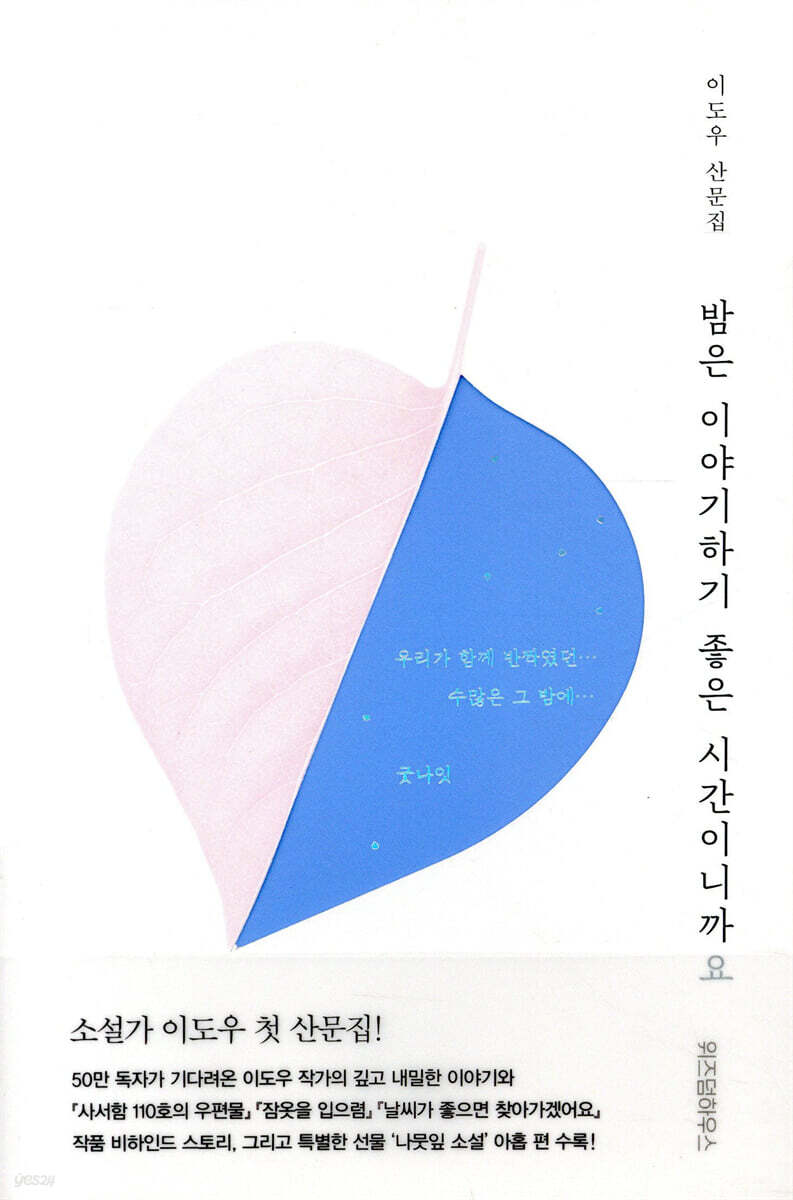
Because night is a good time to talk
 |
Description
Book Introduction
Novelist Lee Do-woo's first prose collection! A story about lonely and beautiful landscapes that will be remembered for a long time. The first collection of essays by novelist Lee Do-woo, who deeply moved 500,000 readers with three novels: "Mail from PO Box 110," "Put on Your Pajamas," and "I'll Visit You When the Weather Is Fine." This book allows readers to experience the essence of author Lee Do-woo's uniquely warm perspective and profound, lyrical writing style. It contains detailed and warm stories about people, words, writing, landscapes, and the feelings of that day that the author has long remembered. Additionally, it includes nine 'leaf novels', providing short but intense fun and emotion to readers eagerly awaiting the new novel by author Lee Do-woo. Author Lee Do-woo, who likes to say 'good night' at night, wrote this book as if he were saying 'good night' to his readers. I hope that the stories written on each leaf will be placed in someone's bookmark and blown away on the wind, and I think of someone who will listen comfortably and enjoyably. So, it would be nice if we could open the bookshelf and say good night to each other. Tomorrow will bring another day of hardship, joy, and sorrow, but for now, it's deep night... and night is a good time for talking. |
- You can preview some of the book's contents.
Preview
index
Preface Goodnight to those countless nights
Chapter 1: Loneliness Must Be Recorded
The Loss of a Dandelion | Loneliness Must Be Recorded | A Day and Night Walk | The Whereabouts of the Moon Tea House | [Leaf Novel] A Spring Day's Landmark | About Things That Are Necessary Whether They Exist or Not | Mr. Sommer at Terminal 157 | Weeping Sand | The Ice Maiden's Ramen | A Broken Clock | A Dictionary of the Language of Flowers | Today's Volume | Where Were Those Days? | A Recipe | [Leaf Novel] Blending for Him
Chapter 2: The Parallelogram-Shaped Sorrow
The Sorrow of a Parallelogram|I Think of It Every Time|The First Alphabet|Under the Big Chestnut Tree|The Window Painter|[Leaf Novel] Happily Ever After|The Embroidered Women and the Back of Embroidery|I Want to Become Yarn|Is It Spring Rain|The Room of Many Singas|If You Are Not Really a Weaver Girl|Will You Recognize Me, Mother?|The Enemy of a Summer Day|Their Piano|Where Are You Going, Emily|[Leaf Novel] Grandmother's Soda Soap
Chapter 3: The Spider's Web Library
Writing in a four-beat rhythm|The Shop Around the Corner|[Leaf Novel] Strange Visitor|Purloined Letter Trick|Pigeon Communication|Rocking Chair Journey|Turning the Story to a Happy Ending|Songs in Novels|[Leaf Novel] Soundtrack That Doesn't Exist|New Interpretation Obsession|Mask Cliché|I Want to Misunderstand|Dickensian House|Please Insert This Word|[Leaf Novel] Beach Lighting Truck
Chapter 4: A Warm Place Without Memories
A warm place without memories|When you want to learn a dead language|A conch shell in your ear|Friday night knitting club|[Leaf novel] January's hashtag #|Late autumn's spider web gossamer|Saying goodbye to a time|To you, it is as it is|Ruins abandoned by the world|Goodnight radio letter|[Leaf novel] A conversation in the dark|Orion in 2060|What the fences say|Beautiful traveler
Chapter 1: Loneliness Must Be Recorded
The Loss of a Dandelion | Loneliness Must Be Recorded | A Day and Night Walk | The Whereabouts of the Moon Tea House | [Leaf Novel] A Spring Day's Landmark | About Things That Are Necessary Whether They Exist or Not | Mr. Sommer at Terminal 157 | Weeping Sand | The Ice Maiden's Ramen | A Broken Clock | A Dictionary of the Language of Flowers | Today's Volume | Where Were Those Days? | A Recipe | [Leaf Novel] Blending for Him
Chapter 2: The Parallelogram-Shaped Sorrow
The Sorrow of a Parallelogram|I Think of It Every Time|The First Alphabet|Under the Big Chestnut Tree|The Window Painter|[Leaf Novel] Happily Ever After|The Embroidered Women and the Back of Embroidery|I Want to Become Yarn|Is It Spring Rain|The Room of Many Singas|If You Are Not Really a Weaver Girl|Will You Recognize Me, Mother?|The Enemy of a Summer Day|Their Piano|Where Are You Going, Emily|[Leaf Novel] Grandmother's Soda Soap
Chapter 3: The Spider's Web Library
Writing in a four-beat rhythm|The Shop Around the Corner|[Leaf Novel] Strange Visitor|Purloined Letter Trick|Pigeon Communication|Rocking Chair Journey|Turning the Story to a Happy Ending|Songs in Novels|[Leaf Novel] Soundtrack That Doesn't Exist|New Interpretation Obsession|Mask Cliché|I Want to Misunderstand|Dickensian House|Please Insert This Word|[Leaf Novel] Beach Lighting Truck
Chapter 4: A Warm Place Without Memories
A warm place without memories|When you want to learn a dead language|A conch shell in your ear|Friday night knitting club|[Leaf novel] January's hashtag #|Late autumn's spider web gossamer|Saying goodbye to a time|To you, it is as it is|Ruins abandoned by the world|Goodnight radio letter|[Leaf novel] A conversation in the dark|Orion in 2060|What the fences say|Beautiful traveler
Into the book
Wouldn't it be okay if the stories written on each leaf were put into someone's bookmark and then blown away by the wind?
Like the bookkeeper who wrote a diary like a radio message to the nameless members of the Goodnight Club, I, too, convey the words of this book to readers somewhere out there.
If there are people who will listen to me comfortably, I could not ask for more.
It's late at night now... and night is a good time for talking.
--- p.9
Now, once or twice a year, I go to bulletin boards that no one visits by myself.
I click on the titles that seem to have been left behind and read them blankly, and only then do I realize it.
Loneliness must be recorded.
There are far more days that are not recorded than days that are recorded, and ironically, many of those days are days that were not lonely.
I decided to remember the empty days I lived through without even having time to feel lonely.
Ordinary days without name tags that were not recorded.
Those days when I was young and innocent, when life was smooth and no one cried except the willow tree, and when I was grateful for the dream next to my pillow.
--- pp.22-23
When something breaks, there are people who fix it quickly and people who leave it alone for a while.
I may be making excuses for my habit of leaving it alone for months or years, but since it's broken, I feel like I should just give it a rest.
When I see a convenience store that's brightly lit 24 hours a day, I sometimes want to close the shutters.
Even once a year, no, even once every three years.
It seems like the heart never rests even once throughout its life, so when you think about it, how sincere and arduous is our 'heart'?
The moment I first rested was the moment when everything was over, so I wanted to put my hand on my left chest and whisper, "Thank you."
--- pp.58-59
I want to tell that girl.
'If I had been born in the Middle Ages, I think I would have been fooled by a sorcerer who claimed to be a panacea rather than by alchemy.
He might have spent his whole life grazing in the fields and working as an assistant.
It's not strange.
Alchemy was a man's magic, and panaceas were a woman's magic.
If you look at the fact that she was burned at the stake as a witch, it seems like making gold was okay, but making medicine was not.
In that case, it would have been better to become the real witches of the wasteland in Macbeth.
right?'
I wish Doolyeong could hear me smile.
And I want to boil all kinds of mysterious things in a big cauldron together to make a magic potion.
--- pp.80-81
His expression as he prepares tea for his fans is affectionate and kind.
With a small microphone pinned to his lapel, he makes witty remarks and makes fans laugh.
The blended tea born today may be nothing more than a transfer of his image floating around the world, but I decide to think that it is not unlike him.
If you look at someone for that long, you might be able to see a piece of their true self.
The blue banner hanging on the tea room wall finally comes into view.
A car for him.
Tea for him and you.
--- pp.86-87
Sometimes I really wonder.
What is it about the eyes that really allows us to see the essence of another person?
It's not even iris recognition that scans in an instant.
But rather than needlessly nitpicking about the unwavering faith that is passed down, I too would like to carefully analyze the unique gaze of those I love.
What elements are contained and shining in the eyes?
--- pp.152-153
Su-an closed her eyes as I told her.
I whispered like a spell.
You just have to make fond memories.
You can erase scary memories.
When I opened my eyes again, my hands were clean and fine.
It doesn't hurt, the child says.
I was truly happy.
I always felt sorry for Su-an.
That we couldn't be together.
But now we are together like this.
Forever.
--- pp.178-179
We are no longer Christopher Robin with a bright future, but Winnie the Pooh, now grown and destined to live in the Hundred Acre Wood with his small, rambunctious friends, but we will tell you this instead.
Good Times Never Saw So Good--- pp.
You don't know that when times are good.
So please know that those were good days, that they are good days now, and that they will be good days in the future.
All we have to do is not forget that the ordinary days that pass by us are good days and recognize them.
--- p.290
So I guess I wanted to say these words to Eunseop, the character in the novel.
“That’s exactly what it says.
“Always to you.”
Haewon, who Eunseop loves, was someone who had been hurt a lot by people.
Haewon goes to the cabin behind the mountain to look for him on a winter night and gets lost. When Eunseop tries to find her and go down the mountain with her, they misunderstand for a moment.
Is it because she doesn't like going to the cabin?
It seems like he doesn't want to let you into his space.
Eunseop says, embracing Haewon.
It's cold in the cabin right now, and that's the only reason.
There is no other meaning to that statement.
I was grateful that Eunseop was a character who could say things like that.
I wanted to write this line so I gave up the potentially romantic setting of the two spending the night together in a cabin in the woods.
Even if we couldn't spend another night together, I wanted to tell Haewon that 'it's exactly as you said.'
--- pp.294-295
In a previous interview at a bookstore, a reporter asked me if I had a "life theme I want to write about for the rest of my life." To be honest, I didn't know what the theme would be, but I simply answered that this life is all about tribute.
I think it will be a life where I constantly mutter that I love the things I like and love… .
Days that are not enough to even confess my affection.
It may seem like a memory hoarding syndrome where I live with a lot of miscellaneous things, but I want to be someone who remembers and writes down a lot of things, like I once thought in Singa's room.
Like the bookkeeper who wrote a diary like a radio message to the nameless members of the Goodnight Club, I, too, convey the words of this book to readers somewhere out there.
If there are people who will listen to me comfortably, I could not ask for more.
It's late at night now... and night is a good time for talking.
--- p.9
Now, once or twice a year, I go to bulletin boards that no one visits by myself.
I click on the titles that seem to have been left behind and read them blankly, and only then do I realize it.
Loneliness must be recorded.
There are far more days that are not recorded than days that are recorded, and ironically, many of those days are days that were not lonely.
I decided to remember the empty days I lived through without even having time to feel lonely.
Ordinary days without name tags that were not recorded.
Those days when I was young and innocent, when life was smooth and no one cried except the willow tree, and when I was grateful for the dream next to my pillow.
--- pp.22-23
When something breaks, there are people who fix it quickly and people who leave it alone for a while.
I may be making excuses for my habit of leaving it alone for months or years, but since it's broken, I feel like I should just give it a rest.
When I see a convenience store that's brightly lit 24 hours a day, I sometimes want to close the shutters.
Even once a year, no, even once every three years.
It seems like the heart never rests even once throughout its life, so when you think about it, how sincere and arduous is our 'heart'?
The moment I first rested was the moment when everything was over, so I wanted to put my hand on my left chest and whisper, "Thank you."
--- pp.58-59
I want to tell that girl.
'If I had been born in the Middle Ages, I think I would have been fooled by a sorcerer who claimed to be a panacea rather than by alchemy.
He might have spent his whole life grazing in the fields and working as an assistant.
It's not strange.
Alchemy was a man's magic, and panaceas were a woman's magic.
If you look at the fact that she was burned at the stake as a witch, it seems like making gold was okay, but making medicine was not.
In that case, it would have been better to become the real witches of the wasteland in Macbeth.
right?'
I wish Doolyeong could hear me smile.
And I want to boil all kinds of mysterious things in a big cauldron together to make a magic potion.
--- pp.80-81
His expression as he prepares tea for his fans is affectionate and kind.
With a small microphone pinned to his lapel, he makes witty remarks and makes fans laugh.
The blended tea born today may be nothing more than a transfer of his image floating around the world, but I decide to think that it is not unlike him.
If you look at someone for that long, you might be able to see a piece of their true self.
The blue banner hanging on the tea room wall finally comes into view.
A car for him.
Tea for him and you.
--- pp.86-87
Sometimes I really wonder.
What is it about the eyes that really allows us to see the essence of another person?
It's not even iris recognition that scans in an instant.
But rather than needlessly nitpicking about the unwavering faith that is passed down, I too would like to carefully analyze the unique gaze of those I love.
What elements are contained and shining in the eyes?
--- pp.152-153
Su-an closed her eyes as I told her.
I whispered like a spell.
You just have to make fond memories.
You can erase scary memories.
When I opened my eyes again, my hands were clean and fine.
It doesn't hurt, the child says.
I was truly happy.
I always felt sorry for Su-an.
That we couldn't be together.
But now we are together like this.
Forever.
--- pp.178-179
We are no longer Christopher Robin with a bright future, but Winnie the Pooh, now grown and destined to live in the Hundred Acre Wood with his small, rambunctious friends, but we will tell you this instead.
Good Times Never Saw So Good--- pp.
You don't know that when times are good.
So please know that those were good days, that they are good days now, and that they will be good days in the future.
All we have to do is not forget that the ordinary days that pass by us are good days and recognize them.
--- p.290
So I guess I wanted to say these words to Eunseop, the character in the novel.
“That’s exactly what it says.
“Always to you.”
Haewon, who Eunseop loves, was someone who had been hurt a lot by people.
Haewon goes to the cabin behind the mountain to look for him on a winter night and gets lost. When Eunseop tries to find her and go down the mountain with her, they misunderstand for a moment.
Is it because she doesn't like going to the cabin?
It seems like he doesn't want to let you into his space.
Eunseop says, embracing Haewon.
It's cold in the cabin right now, and that's the only reason.
There is no other meaning to that statement.
I was grateful that Eunseop was a character who could say things like that.
I wanted to write this line so I gave up the potentially romantic setting of the two spending the night together in a cabin in the woods.
Even if we couldn't spend another night together, I wanted to tell Haewon that 'it's exactly as you said.'
--- pp.294-295
In a previous interview at a bookstore, a reporter asked me if I had a "life theme I want to write about for the rest of my life." To be honest, I didn't know what the theme would be, but I simply answered that this life is all about tribute.
I think it will be a life where I constantly mutter that I love the things I like and love… .
Days that are not enough to even confess my affection.
It may seem like a memory hoarding syndrome where I live with a lot of miscellaneous things, but I want to be someone who remembers and writes down a lot of things, like I once thought in Singa's room.
--- p.325
Publisher's Review
Novelist Lee Do-woo's first prose collection!
A story about lonely and beautiful landscapes that will be remembered for a long time.
Novelist Lee Do-woo, who deeply moved 500,000 readers with three novels, 『Mail from PO Box 110』, 『Put on Your Pajamas』, and 『I'll Visit You When the Weather Is Fine』, has published his first prose collection, 『Because Night is a Good Time to Talk』, by Wisdom House.
"Because Night is a Good Time to Talk," which allows you to experience the essence of author Lee Do-woo's unique warm gaze and deep, lyrical writing style, is a book that, like his other novels, you want to "read slowly, cherishing it for a long time."
Writer Lee Do-woo, who describes himself as having “memory hoarding syndrome,” remembers stories from all the past with surprising clarity.
Was it because one day in 1992, I suddenly realized that “a writer is someone who remembers everything and then uses it in his writing”?
Perhaps it was because I decided to record the lonely days to remember the days I lived without even having time to feel lonely.
Thanks to this, we can now encounter in a single book the detailed and warm stories of people, words, writings, landscapes, and the feelings of that day that author Lee Do-woo has long remembered.
Author Lee Do-woo, who likes to say 'good night' at night, wrote this book as if he were saying 'good night' to his readers.
I hope that the stories written on each leaf will be placed in someone's bookmark and blown away on the wind, and I think of someone who will listen comfortably and enjoyably.
So, it would be nice if we could open the bookshelf and say good night to each other.
Tomorrow will bring another day of hardship, joy, and sorrow, but for now, it's deep night... and night is a good time for talking.
The deep and intimate story of author Lee Do-woo that 500,000 readers have been waiting for
"Mail for PO Box 110" "Put on your pajamas" "I'll come by when the weather's nice"
Behind-the-scenes stories and a special gift: nine "Leaf Novels" included.
While writing “Because Night is a Good Time to Talk,” author Lee Do-woo confessed, “I poured all my life into this book, so I don’t think I’ll be able to write another book like this for at least 10 years.”
This book, which contains the author's honest and intimate stories, is a great gift to readers simply because it is the first collection of essays by author Lee Do-woo, who has never written his own stories outside of novels.
"Because Night is a Good Time to Talk" is composed of four chapters.
In Chapter 1, 'Loneliness Must Be Recorded', the images that have been encountered by chance or fate in the past are recorded.
In 'Chapter 2: Parallelogram-Shaped Sorrow', he confesses that "my memories are overflowing with random moments, and sometimes it's painful" and depicts old times that brought unexpected emotions.
Chapter 3, Spiderweb Library, contains the author's confession as a bookworm, "If I don't read novels, I feel like I'll live one layer of life, but if I do, I'll live many layers." Chapter 4, A Warm Place Without Memories, offers a glimpse into the author's perspective on creating a gentle and soft boundary between the world and others.
In particular, this book provides a glimpse into the various emotions experienced while creating and writing Gong Jin-sol and Lee Geon of 『Mail from Post Office Box 110』, Su-an and Dool-nyeong of 『Put on Your Pajamas』, and Eun-seop and Hae-won of 『I'll Visit You When the Weather Is Fine』, providing time to understand the novel a little more deeply.
Lastly, the book includes nine "leaf novels," a special gift only available in "Because Night is a Good Time to Talk," offering short but intense fun and emotion to readers eagerly awaiting the new novel by author Lee Do-woo.
A story about lonely and beautiful landscapes that will be remembered for a long time.
Novelist Lee Do-woo, who deeply moved 500,000 readers with three novels, 『Mail from PO Box 110』, 『Put on Your Pajamas』, and 『I'll Visit You When the Weather Is Fine』, has published his first prose collection, 『Because Night is a Good Time to Talk』, by Wisdom House.
"Because Night is a Good Time to Talk," which allows you to experience the essence of author Lee Do-woo's unique warm gaze and deep, lyrical writing style, is a book that, like his other novels, you want to "read slowly, cherishing it for a long time."
Writer Lee Do-woo, who describes himself as having “memory hoarding syndrome,” remembers stories from all the past with surprising clarity.
Was it because one day in 1992, I suddenly realized that “a writer is someone who remembers everything and then uses it in his writing”?
Perhaps it was because I decided to record the lonely days to remember the days I lived without even having time to feel lonely.
Thanks to this, we can now encounter in a single book the detailed and warm stories of people, words, writings, landscapes, and the feelings of that day that author Lee Do-woo has long remembered.
Author Lee Do-woo, who likes to say 'good night' at night, wrote this book as if he were saying 'good night' to his readers.
I hope that the stories written on each leaf will be placed in someone's bookmark and blown away on the wind, and I think of someone who will listen comfortably and enjoyably.
So, it would be nice if we could open the bookshelf and say good night to each other.
Tomorrow will bring another day of hardship, joy, and sorrow, but for now, it's deep night... and night is a good time for talking.
The deep and intimate story of author Lee Do-woo that 500,000 readers have been waiting for
"Mail for PO Box 110" "Put on your pajamas" "I'll come by when the weather's nice"
Behind-the-scenes stories and a special gift: nine "Leaf Novels" included.
While writing “Because Night is a Good Time to Talk,” author Lee Do-woo confessed, “I poured all my life into this book, so I don’t think I’ll be able to write another book like this for at least 10 years.”
This book, which contains the author's honest and intimate stories, is a great gift to readers simply because it is the first collection of essays by author Lee Do-woo, who has never written his own stories outside of novels.
"Because Night is a Good Time to Talk" is composed of four chapters.
In Chapter 1, 'Loneliness Must Be Recorded', the images that have been encountered by chance or fate in the past are recorded.
In 'Chapter 2: Parallelogram-Shaped Sorrow', he confesses that "my memories are overflowing with random moments, and sometimes it's painful" and depicts old times that brought unexpected emotions.
Chapter 3, Spiderweb Library, contains the author's confession as a bookworm, "If I don't read novels, I feel like I'll live one layer of life, but if I do, I'll live many layers." Chapter 4, A Warm Place Without Memories, offers a glimpse into the author's perspective on creating a gentle and soft boundary between the world and others.
In particular, this book provides a glimpse into the various emotions experienced while creating and writing Gong Jin-sol and Lee Geon of 『Mail from Post Office Box 110』, Su-an and Dool-nyeong of 『Put on Your Pajamas』, and Eun-seop and Hae-won of 『I'll Visit You When the Weather Is Fine』, providing time to understand the novel a little more deeply.
Lastly, the book includes nine "leaf novels," a special gift only available in "Because Night is a Good Time to Talk," offering short but intense fun and emotion to readers eagerly awaiting the new novel by author Lee Do-woo.
GOODS SPECIFICS
- Date of issue: March 31, 2020
- Page count, weight, size: 328 pages | 346g | 125*190*20mm
- ISBN13: 9791190630955
- ISBN10: 1190630958
You may also like
카테고리
korean


korean

![GQ KOREA Mark (Monthly): December [2025]](http://librairie.coreenne.fr/cdn/shop/files/8ef265dbbfbf186523ed75ba7319009d.jpg?v=1765340328&width=3840)


