

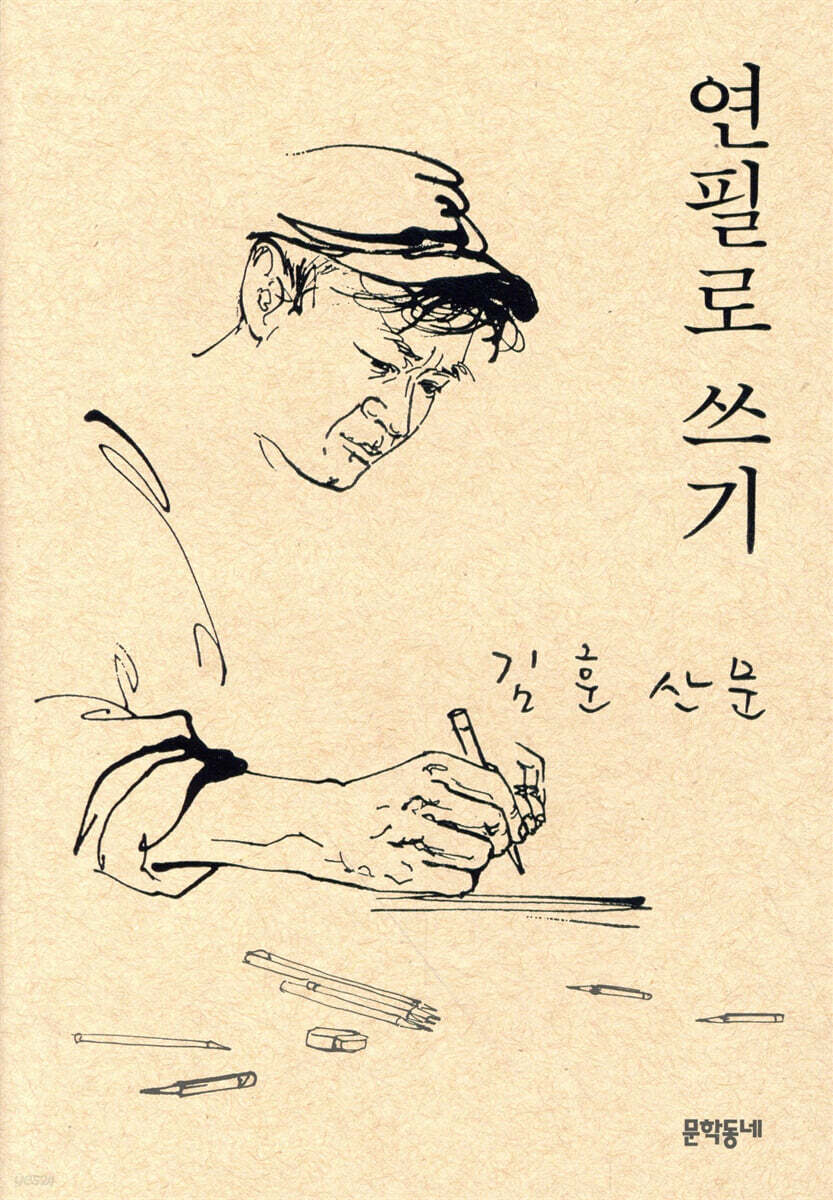
Writing with a pencil
 |
Description
Book Introduction
- A word from MD
-
The true beauty of Kim Hoon's prose, written with a pencilA new essay by novelist Kim Hoon, who still writes manuscripts by hand on manuscript paper.
It's been a while since I've visited readers with a story about the various fragments that make up life, the things that pass by, the trivial and the small things we encounter every day.
It contains sentences written with a pencil, which is his weapon, his instrument, and his way of earning a living.
March 29, 2019. Essay PD Kim Tae-hee
“The pencil is my shovel.
“The eraser is my hesitation”
Kim Hoon's weapon, instrument, and bread-and-butter "pencil"
Novelist Kim Hoon's new prose work has been published.
Kim Hoon, one of the few remaining writers of our time who still writes manuscripts by hand on manuscript paper.
Until now, author Kim Hoon has written all his articles about Yi Sun-sin's sword, Ureuk's gayageum, and the tedium of earning a living with a pencil on manuscript paper.
Now he returns with a new prose piece that opens with a story about the pencil, his weapon, his instrument, and his extension of his livelihood.
He wrote this in the introduction to the book:
A pencil is my go-to tool for making a living.
Letters are my lifeblood.
When holding a pencil and writing
I think my pencil is a Paleolithic man's fist axe,
The blacksmith's hammer, the boatman's oar
I hope to resemble you.
Eraser dust on the desk
If it piles up like snow
My day is over.
Don't write at night.
Let's face the night.
Even these days, he writes the three characters '必日新 (pil-il-shin, every day must be renewed)' on the blackboard in his study and holds a pencil to create new language.
After three and a half years since the prose piece “Boiling Ramen,” the mountain of eraser dust on his desk was swept away by a broom, countless scraps of paper piled up and then thrown into the trash can, and finally, 1,156 sheets of 200-character manuscript paper were piled up.
And now those manuscripts are published into a thick 468-page book.
In the current reading culture of South Korea, where “books by healers who spread spiritualism in loose and vague sentences are enjoying overwhelming sales” (p. 376), Kim Hoon, the “warrior with a club and pencil,” as one interviewer once called him, has returned.
“The eraser is my hesitation”
Kim Hoon's weapon, instrument, and bread-and-butter "pencil"
Novelist Kim Hoon's new prose work has been published.
Kim Hoon, one of the few remaining writers of our time who still writes manuscripts by hand on manuscript paper.
Until now, author Kim Hoon has written all his articles about Yi Sun-sin's sword, Ureuk's gayageum, and the tedium of earning a living with a pencil on manuscript paper.
Now he returns with a new prose piece that opens with a story about the pencil, his weapon, his instrument, and his extension of his livelihood.
He wrote this in the introduction to the book:
A pencil is my go-to tool for making a living.
Letters are my lifeblood.
When holding a pencil and writing
I think my pencil is a Paleolithic man's fist axe,
The blacksmith's hammer, the boatman's oar
I hope to resemble you.
Eraser dust on the desk
If it piles up like snow
My day is over.
Don't write at night.
Let's face the night.
Even these days, he writes the three characters '必日新 (pil-il-shin, every day must be renewed)' on the blackboard in his study and holds a pencil to create new language.
After three and a half years since the prose piece “Boiling Ramen,” the mountain of eraser dust on his desk was swept away by a broom, countless scraps of paper piled up and then thrown into the trash can, and finally, 1,156 sheets of 200-character manuscript paper were piled up.
And now those manuscripts are published into a thick 468-page book.
In the current reading culture of South Korea, where “books by healers who spread spiritualism in loose and vague sentences are enjoying overwhelming sales” (p. 376), Kim Hoon, the “warrior with a club and pencil,” as one interviewer once called him, has returned.
- You can preview some of the book's contents.
Preview
index
Notification 5
Part 1: The Pencil is My Shovel
Mountain Spirit of Lake Park 15
Food and Poop 37
Aging and Dying 66
The old man says 77
Cold Noodle Soup on the Road of Cohabitation _ 3rd Anniversary of the Sewol Ferry Disaster 85
Yi Sun-sin of My Heart I 98
Yi Sun-sin in My Heart II 115
Love is touch Love is real 140
Lee Seung-bok and Lee Hyun-soo 154
Ah, 100 won 163
Part 2: The Eraser is My Hesitation
Eating tteokbokki 177
Park Chung-hee and the Beatles 185
Homecoming 196
Eating cucumber 215
Taegeukgi 225
Grandmother's words, grandson's words 239
People Living _ 4th Anniversary of the Sewol Ferry Disaster 251
Grandmothers Write Poetry with Their Bodies _ Reading the Writings of Grandmothers in Chilgok, Gokseong, Yangyang, and Suncheon 262
Sergeant Park Jae-kwon's Hole-Punched Water Bottle 279
On the Eastern Front _ A North Korean Soldier's Urine Stream 292
After being discharged from the Western Front, let's get a better girlfriend. 300
Clearing snow 305
President, Army Sergeant, Army Corporal 318
Part 3: The pencil gets shorter and the dust accumulates.
The Filth of Words 331
Star, in my heart 340
Flowers and Sunset 350
The Happiness of Tolerance 357
The End of Life 376
Eating cold noodles 384
Seoul↔Sinuiju 410
Geumgangsan↔Dumangang 423
The Birds Came 433
Waiting for the Whale 440
Year after year, the sun goes by 453
Ending_ At the mouth of the Han River 462
Part 1: The Pencil is My Shovel
Mountain Spirit of Lake Park 15
Food and Poop 37
Aging and Dying 66
The old man says 77
Cold Noodle Soup on the Road of Cohabitation _ 3rd Anniversary of the Sewol Ferry Disaster 85
Yi Sun-sin of My Heart I 98
Yi Sun-sin in My Heart II 115
Love is touch Love is real 140
Lee Seung-bok and Lee Hyun-soo 154
Ah, 100 won 163
Part 2: The Eraser is My Hesitation
Eating tteokbokki 177
Park Chung-hee and the Beatles 185
Homecoming 196
Eating cucumber 215
Taegeukgi 225
Grandmother's words, grandson's words 239
People Living _ 4th Anniversary of the Sewol Ferry Disaster 251
Grandmothers Write Poetry with Their Bodies _ Reading the Writings of Grandmothers in Chilgok, Gokseong, Yangyang, and Suncheon 262
Sergeant Park Jae-kwon's Hole-Punched Water Bottle 279
On the Eastern Front _ A North Korean Soldier's Urine Stream 292
After being discharged from the Western Front, let's get a better girlfriend. 300
Clearing snow 305
President, Army Sergeant, Army Corporal 318
Part 3: The pencil gets shorter and the dust accumulates.
The Filth of Words 331
Star, in my heart 340
Flowers and Sunset 350
The Happiness of Tolerance 357
The End of Life 376
Eating cold noodles 384
Seoul↔Sinuiju 410
Geumgangsan↔Dumangang 423
The Birds Came 433
Waiting for the Whale 440
Year after year, the sun goes by 453
Ending_ At the mouth of the Han River 462
Detailed image

Into the book
alarm
I don't have a goal of creating public opinion or of joining forces to gather sides.
My writing simply wants to be writing, without any intention of doing anything and without waiting for your approval.
I try to be proud of my biases and prejudices, my hopes and angers, my sorrows and joys.
It's okay if my story is loose and messy.
I want to talk about the various fragments that make up life, the things that pass by, the trivial and insignificant things, the things we encounter every day.
It has always been difficult to secure the texture of life and the specificity of things.
If the publication of this book causes any harm to my silence, that is not what I wish at all.
Spring 2019 --- From "Breathing Fine Dust in Ilsan, Written by Kim Hoon"
A while ago, on my way back from Namhansanseong Fortress, I stopped by Moran Market in Seongnam and happened to see an oil market there.
A vendor was going around from market to market, selling iron tools such as hammers, pliers, saws, hoes, and shovels.
They formed groups of three and performed the Gopsachum, Byeongsinchum, and Gombaepalichum, along with anecdotes, to attract customers and sell their goods.
There were about fifteen people in the audience.
I sat in the front row and watched while eating a plate of stir-fried pork rinds.
A man with a messy haircut who looked to be about the age of a senior citizen took the microphone and spoke.
He lamented the reality of young people living only for their computers and smartphones, degenerating into animals who do not know how to use extension cords, losing the healthy functions of their living bodies, and shrinking the realm of humanity, through a critical lens of civilization.
He shouted, his blood boiling.
―Ah, Nimi, those guys who graduated from Seoul National University of Technology can't even drive a nail into a person's head or twist a chicken's neck.
Oh, Jamie, those guys who graduated from top law schools can't hold pliers or turn a screwdriver.
Is this a human or an orangutan?
How can those whose bodies are completely rotten work all night and give birth to children?
I applauded.
Everyone applauded.
I was so moved by that speech that I immediately bought a shovel and used it to clear the snow this winter.
--- p.309~310
I don't know what people mean when they say 'inspiration'.
The writing I barely manage to write is the result of my sluggish labor.
--- p.345
I want to hear you reflect on your words.
Democracy is impossible when language is sick.
For a conversation to be valid, there must be a listener, but there is no one listening as they just make a fuss and babble.
Just because your ears are open doesn't mean you can hear everything, but Congress, please make an effort to hear.
---From "The Filth of Words"
They say that the light of the stars has traveled tens of thousands of light years across space to be seen before my eyes, and with all this starlight embedded in my heart, my life was filled with joy and excitement.
Even if I were a living being who would live clutching a handful of letters and return to a handful of dust, I would still be happy, even if I were a living being or an insignificant thing, because I was in contact with the same light and time as the stars.
The light that leaves the star today will travel tens of thousands of light years and be embedded in the hearts of living beings tens of thousands of years from now.
---From "Star in My Heart"
You probably think this year-end party is a bit shabby and sloppy.
Me too.
But I endured, comforting the fleeting with the fleeting.
It was comfortable and relaxing.
Next year's year-end party will be like today's.
Year after year, the years pass.
I don't have a goal of creating public opinion or of joining forces to gather sides.
My writing simply wants to be writing, without any intention of doing anything and without waiting for your approval.
I try to be proud of my biases and prejudices, my hopes and angers, my sorrows and joys.
It's okay if my story is loose and messy.
I want to talk about the various fragments that make up life, the things that pass by, the trivial and insignificant things, the things we encounter every day.
It has always been difficult to secure the texture of life and the specificity of things.
If the publication of this book causes any harm to my silence, that is not what I wish at all.
Spring 2019 --- From "Breathing Fine Dust in Ilsan, Written by Kim Hoon"
A while ago, on my way back from Namhansanseong Fortress, I stopped by Moran Market in Seongnam and happened to see an oil market there.
A vendor was going around from market to market, selling iron tools such as hammers, pliers, saws, hoes, and shovels.
They formed groups of three and performed the Gopsachum, Byeongsinchum, and Gombaepalichum, along with anecdotes, to attract customers and sell their goods.
There were about fifteen people in the audience.
I sat in the front row and watched while eating a plate of stir-fried pork rinds.
A man with a messy haircut who looked to be about the age of a senior citizen took the microphone and spoke.
He lamented the reality of young people living only for their computers and smartphones, degenerating into animals who do not know how to use extension cords, losing the healthy functions of their living bodies, and shrinking the realm of humanity, through a critical lens of civilization.
He shouted, his blood boiling.
―Ah, Nimi, those guys who graduated from Seoul National University of Technology can't even drive a nail into a person's head or twist a chicken's neck.
Oh, Jamie, those guys who graduated from top law schools can't hold pliers or turn a screwdriver.
Is this a human or an orangutan?
How can those whose bodies are completely rotten work all night and give birth to children?
I applauded.
Everyone applauded.
I was so moved by that speech that I immediately bought a shovel and used it to clear the snow this winter.
--- p.309~310
I don't know what people mean when they say 'inspiration'.
The writing I barely manage to write is the result of my sluggish labor.
--- p.345
I want to hear you reflect on your words.
Democracy is impossible when language is sick.
For a conversation to be valid, there must be a listener, but there is no one listening as they just make a fuss and babble.
Just because your ears are open doesn't mean you can hear everything, but Congress, please make an effort to hear.
---From "The Filth of Words"
They say that the light of the stars has traveled tens of thousands of light years across space to be seen before my eyes, and with all this starlight embedded in my heart, my life was filled with joy and excitement.
Even if I were a living being who would live clutching a handful of letters and return to a handful of dust, I would still be happy, even if I were a living being or an insignificant thing, because I was in contact with the same light and time as the stars.
The light that leaves the star today will travel tens of thousands of light years and be embedded in the hearts of living beings tens of thousands of years from now.
---From "Star in My Heart"
You probably think this year-end party is a bit shabby and sloppy.
Me too.
But I endured, comforting the fleeting with the fleeting.
It was comfortable and relaxing.
Next year's year-end party will be like today's.
Year after year, the years pass.
---From "Year by Year"
Publisher's Review
From the morning poop to the inner self of the human Yi Sun-sin -
Kim Hoon's pencil perfects the 'old man's genre'
In the past, Kim Hoon once said, "Prose is a genre for the elderly."
Perhaps he meant that it is a genre that can only be written about after the writer has personally seen, heard, experienced, and dug up fragments of memories and lived them over and over again.
He was already an outstanding essayist before becoming a novelist, and now, in his seventies, he is perfecting this 'genre of the elderly' by embracing his inner self and the modern history of the Republic of Korea.
His sentences stretch out far and wide, from the terrifying and harrowing memories of his childhood of the demolition crews of the past who would wield hammers to destroy slums, and the mothers of the time who would rush at them and have their hair grabbed and cry, to the story of the sad poop he had the next morning when his stomach was boiling after drinking heavily on a day when his life felt like it was all over again in his youth, and the story of the inner self of 'the human Yi Sun-sin' that he could not include in 'The Song of the Sword', all the way to the Sewol Ferry Disaster that he covered while staying in Paengmok Port, Donggeochado, and Seogeochado ahead of the 4th anniversary of the Sewol Ferry Disaster last year.
The emptiness and tragedy of a day when one's life is ruined...
Still, “even while throwing shit at the enemy, humans must survive and protect themselves.”
Kim Hoon's writing style, which persistently depicts the most ordinary and trivial objects to reveal the true face of humanity and the world, remains intact in this book.
In his previous collection of essays, he evoked empathy with those who make do with a bowl of ramen, and in this book, he touches the hearts of those who start their day by sitting on the toilet with boiling water every morning, with a story about poop.
On days when I'm so filled with anger, frustration, hatred, and fatigue because my life is a mess, I shouldn't drink, but I have no choice but to drink.
This is a story from when I was much younger than I am now.
The dawns when I would return home after chattering and giggling with everyone, cursing and harassing people, while reveling in the irresponsible and pitiful emotions of a drunkard, were empty and miserable.
(…)
The next morning, your head is splitting, your stomach is churning, and your body is full of garbage.
The self-loathing on days like this is complete when you sit on the toilet.
The stomach is boiling, the poop is sending urgent signals, the anus loses control and opens up on its own.
(Food and Shit, pp. 42-43)
This horrific description of shit almost smells like shit.
He keeps going.
The poop looks shabby, but it smells terrible.
The pungent smell spreads far and wide, stinging people and spreading with a terrifying power.
Even the smell of cigarettes that were smoked at the drinking party last night is lingering in the smell of shit.
Fragments of the empty words I babbled last night are still mixed in with the excrement, less rotten.
In the dung, horse waste is boiling like maggots.
That's me.
That is the essence of my existence.
That is my food, my drink, my body, and my time.
Is that the poop of an apex predator? No.
That is the excrement of someone who crawled to the bottom of the food chain to avoid being excluded from it.
Rather than rice fermenting and smoothly connecting to harmonious feces and leaving the body, the relationship between rice and feces is blocked or distorted by the sourness that seeks sustenance.
This shit is the undigested excrement of socio-economic contradictions and conflicts that have created conflict and discord within an individual's intestines.
(…)
Every morning when the sun rises over the East Sea, countless young men and women in this country sit on toilets and shit their faces with sorrow and anger, just like the mornings of my youth.
The road from rice to shit is dark and rough.
(Food and Shit, pp. 43-45)
But even in this mess of life where food and shit are intertwined, he says that we must find our way in life rather than struggling while buried in shit.
Just like Jeong Yak-yong, who used the filth and humiliation of excrement as a weapon of war.
Even in the midst of the dung, he sought a path in life that could not be abandoned, and preached that path toward the hardships of his time.
By throwing shit at the enemy, humans must survive, protect themselves, and hold on to hope.
This patriotism of the Gyeongse family shouts that there is a path even in the shit.
(Food and Shit, pp. 48-49)
A sentence that struck Kim Hoon like lightning
“I came out of the prison gate.”
But no matter how much you pour shit on your enemies, there is still pain that does not go away, and there are still enemies that are still alive and well.
In the essay “Yi Sun-sin in My Heart,” which begins at the Yi Sun-sin shrine “Iraksa,” meaning the shrine where Yi (李) fell, he carefully restores the inner self of Yi Sun-sin, who had to fight a war surrounded by cruel hostility from within and without.
The first sentence he wrote after leaving prison was “I left the prison gates.”
When I read 『Nanjung Ilgi』, this sentence struck me like a bolt from the blue.
This sentence is expressionless, like the foundation stone of the west gate of Namhansanseong Fortress, hiding countless expressions.
Yi Sun-sin was captured in Hansan Suyeong.
The honor of the Samdosugun Tongjesa was trampled upon, his death was planned, and his body was tortured.
And when he again set out on his journey as a private without rank, future generations will never know what kind of judgment or feelings Yi Sun-sin had toward the king who imprisoned him, beat him, and tried to kill him, and the civil servants and power holders around him.
He was a diligent and meticulous recorder, but he never wrote a word about his inner self, which was beaten and worn out, and he never said a word to his subordinates at drinking parties.
Although he did not write or speak, there must have been something unspeakable boiling inside him, but he never said what it was.
(…)
Yi Sun-sin knew the filth of this unjust world where merit could mean death, and on the day he defeated the bandits and ended the war, he died at sea.
("Yi Sun-sin in My Heart I," pp. 101-104)
To Kim Hoon, Admiral Yi Sun-sin is precious not only as a great hero who fought a historic naval battle, but also as a figure who crossed the 'sea of suffering of humanity', a noisy and evil band filled with unknown hostility and humiliation.
Yi Sun-sin did not reveal or display his suffering and humiliation even to his subordinates at drinking parties.
Yi Sun-sin said, "Do not speak, but go your own way." Kim Hoon still holds in his heart the power of silence, the honesty of recording only the facts, and Yi Sun-sin's leadership that led people from death to life.
“The writer is changing.”
When this manuscript was serialized on the Internet, a reader left this short comment:
“The writer is changing.”
In this new work, he does not hide his sadness and anger as he mentions specific incidents that actually occurred in this society.
His writings, which are blatant criticisms of former President Park Geun-hye's "May 19th Great Tears" that tried to prevent the Sewol Ferry Disaster with insincere tears, society's treatment of a delivery rider who demanded 100 won in heat wave allowance, and the "water-draining" language that lawmakers use to throw dirty water at each other, as well as several writings written while thinking about "North Korea," the half of the country he has never been to, show his determination to willingly dip his feet into the turmoil and contradictions of this world and to accurately express his anger with his pencil.
He wrote that he had a 'precious lesson in the world' after meeting Park Jeong-hoon, who was preparing to form the Riders' Union.
In the days of poverty, Koreans believed that if the country prospered and national income increased, the problem of poverty would be solved on its own.
However, it has been proven that this is not the case.
As incomes rise, poverty becomes structural, and structural poverty becomes endemic and hereditary.
Poverty is not just material deprivation.
Poverty is the exclusion, discrimination, deprivation, and contempt that come with it.
This structure has become so routine that no one questions it.
The words that explain that this is the principle of the market and the result of the market's autonomous function working are powerful.
I'm a total ignorant person, so I can't really talk about grand narratives like income distribution or the direction of economic development, but I can at least talk about what I've seen and experienced.
(…)
A rider posted a message in the Riders Union's open KakaoTalk room.
- Young people, if you don't take an interest in politics, people worse than dogs will rule over you, said King Sedong and General Yi Sun-shim.
His tone is rough, but what he is trying to say is not rough.
At the traffic lights at city intersections, motorcycles stand alone.
("Ah, 100 Won," pp. 169-173)
A ray of laughter in Kim Hoon's sentences
The world of "visible" written by the "mountain spirit of Lake Park"
Meanwhile, discovering the humor that permeates Kim Hoon's world is a special pleasure in reading Kim Hoon's new work.
His solid sentences, which left no room for a single comma or an awkward adverb, and his world of utter futility were filled with jokes and laughter.
The endless and inconclusive chatter of the elderly and women resonates like a pansori, and the various 'troubling stories' of the people living in this secular city make us snicker and laugh.
Their faces were wrinkled, their hair seemed to be covered with dust, and their eyes looked slumped and had lost their sharpness.
- I can't even drink a lot of alcohol anymore.
From now on, when we meet, let's have milk.
Or cider.
- After a few drinks, the sun began to set.
(…)
Among this group, I am the one who reads books and writes, so I am always treated like a scholar.
When my friends start talking and the conversation gets ambiguous, they pass the buck to me.
- Hey, ask Hoon about that.
His head is full of things he already knows.
Like a piece of rice cake.
I know everything.
Oh my gosh, that book.
(Year after year, pp. 455-460)
Sometimes, he is introduced as a 'gentleman of noble character' in a crowded wedding hall and gives a wedding speech wearing white gloves, but the young guests' reaction is not very good.
After several failures, Kim Hoon declares that he will never give a wedding speech again, and the title of the article containing this anecdote is 'The Old Man Speaks'.
Another fun aspect of reading this book is getting a glimpse of Kim Hoon's sermon, which is difficult to hear again.
He willingly refers to himself as a "old fart" and shares many jokes and thoughts about growing old, but it seems that growing old isn't just about regret and sadness for him.
He wrote about the 'joys of growing old':
It's too late, but as I get older, the boundaries of self-consciousness that used to suffocate me crumble, and I become more and more relaxed.
This is the joy of growing old.
Aging is a world of adjectives rather than verbs.
The freedom of the evening, when the day has ended, the light has receded, and the density of time has thinned, is cool.
These times are like the low tide at the mouth of the Han River in Ilsan, the neighborhood where I live.
In this cloudy vision, things that were previously invisible become clearly visible.
When self-consciousness recedes, the world becomes visible, and what is seen then is not new things seen for the first time, but the newness of things seen always.
It's even clearer because it's so late.
This is a world of 'being seen', not 'seeing'.
(Aging and Dying, p. 74)
So he decides to faithfully write down these clearly 'visible things'.
He is old and these days he lives by relying on trees, forests, and water.
In Ilsan Lake Park, where he has been taking walks and resting for 20 years, many other people and living things are passing by.
A neighborhood child who goes to kindergarten fell while riding his bicycle at the park.
I was sitting on the bench.
There were a lot of bicycles following us, so I picked up the child and took him out onto the road.
The child's wound was broken and a little blood was seeping out.
The child cried and called for his mother.
The child did not have a cell phone.
I asked my child for his mother's cell phone number and contacted her on my cell phone.
(…) The child who had stopped crying burst into tears again when he saw his mother.
When children see their mothers, it seems like the sadness they had been holding back is overflowing.
The child cried and said to his mother.
- I fell down and was crying, but this mountain spirit grandfather saved me.
The child's mother laughed heartily while holding and comforting the crying child.
The child's mother said.
- This happened because he read too many picture books.
Grandpa, I'm sorry.
It seems that these days there are still picture books featuring mountain spirits.
The child was living in a fairy tale world.
The child, who had stopped crying, returned with his mother and waved his maple leaf-like hands at me.
After living in Ilsan for 20 years, I became the mountain spirit of the lake park.
(Pages 28-29)
The 'Mountain Spirit of Lake Park' looks at the back of a child running away, waving with hands like maple leaves.
Even in this world filled with despair and injustice, children grow up, people play soccer in vacant lots, young people eat tteokbokki to relieve the burden of their meals, and when it snows, people flock to the streets to fall in love and kiss.
Kim Hoon, who has become a 'mountain spirit', is like an invisible man, wandering around this trite yet beautiful street and world, eavesdropping on people's stories and secretly writing them down with a pencil even today.
About the things that pass by, the trivial and insignificant things that we encounter every day, the things that are close to us.
Kim Hoon's "Song of the Backward Street"
Now he plans to live the rest of his life cherishing the days he has left and keeping 'near by what is near'.
A significant portion of the writings in this book are from his serialized writings on the Munhakdongne Naver Cafe under the title ‘Nuhangsa - Song of the Backward Streets.’
These are the words I wrote while standing on this shabby, shabby, and backward street, ‘breathing in fine dust and ultrafine dust’ like any other person.
But even in these musty, dusty streets, there is the warmth of a bowl of earthy cold noodle soup, a young mother kissing her child, and people who continue to 'live' even after irreversible state violence and disaster.
What is precious to him are the ‘people who live’ despite these circumstances.
I lived to be 70 to know that the everyday life of a young mother taking her sick child to the hospital in Luhang could be so beautiful.
Knowing this, I felt that the 70 years had not been in vain.
As I get older, I become more free and flow into the world.
Only when I can accept this breakdown with peace rather than suffering will I truly grow old.
I barely find a new world.
I try to be a listener rather than a speaker, a looker rather than a reader.
I try to stay away from people who repeat the same thing over and over again, just like they did with the books they've read.
I try to look at people and things rather than words, and get closer to things that are close to me.
There is not much time left, and what you were looking at is barely visible.
(Aging and Dying, pp. 75-76)
Kim Hoon's 'writing with a pencil' is 'writing with the body.'
And it is 'close writing'.
Even without machines, even without proper space, even without hope or prospects, on a bench in a lake park, on a street where a delivery rider fell in the rain, spilling jjambbong soup and shredding radish, he observes, listens, and writes.
The writings written in this way were compiled into this book.
From the dirtiest dung to the noblest place in his heart, Yi Sun-sin—the sentences that Kim Hoon barely managed to hold onto with a pencil remain here.
This book is a true masterpiece of prose written with a pencil by Kim Hoon, a man in his 70s.
Kim Hoon's pencil perfects the 'old man's genre'
In the past, Kim Hoon once said, "Prose is a genre for the elderly."
Perhaps he meant that it is a genre that can only be written about after the writer has personally seen, heard, experienced, and dug up fragments of memories and lived them over and over again.
He was already an outstanding essayist before becoming a novelist, and now, in his seventies, he is perfecting this 'genre of the elderly' by embracing his inner self and the modern history of the Republic of Korea.
His sentences stretch out far and wide, from the terrifying and harrowing memories of his childhood of the demolition crews of the past who would wield hammers to destroy slums, and the mothers of the time who would rush at them and have their hair grabbed and cry, to the story of the sad poop he had the next morning when his stomach was boiling after drinking heavily on a day when his life felt like it was all over again in his youth, and the story of the inner self of 'the human Yi Sun-sin' that he could not include in 'The Song of the Sword', all the way to the Sewol Ferry Disaster that he covered while staying in Paengmok Port, Donggeochado, and Seogeochado ahead of the 4th anniversary of the Sewol Ferry Disaster last year.
The emptiness and tragedy of a day when one's life is ruined...
Still, “even while throwing shit at the enemy, humans must survive and protect themselves.”
Kim Hoon's writing style, which persistently depicts the most ordinary and trivial objects to reveal the true face of humanity and the world, remains intact in this book.
In his previous collection of essays, he evoked empathy with those who make do with a bowl of ramen, and in this book, he touches the hearts of those who start their day by sitting on the toilet with boiling water every morning, with a story about poop.
On days when I'm so filled with anger, frustration, hatred, and fatigue because my life is a mess, I shouldn't drink, but I have no choice but to drink.
This is a story from when I was much younger than I am now.
The dawns when I would return home after chattering and giggling with everyone, cursing and harassing people, while reveling in the irresponsible and pitiful emotions of a drunkard, were empty and miserable.
(…)
The next morning, your head is splitting, your stomach is churning, and your body is full of garbage.
The self-loathing on days like this is complete when you sit on the toilet.
The stomach is boiling, the poop is sending urgent signals, the anus loses control and opens up on its own.
(Food and Shit, pp. 42-43)
This horrific description of shit almost smells like shit.
He keeps going.
The poop looks shabby, but it smells terrible.
The pungent smell spreads far and wide, stinging people and spreading with a terrifying power.
Even the smell of cigarettes that were smoked at the drinking party last night is lingering in the smell of shit.
Fragments of the empty words I babbled last night are still mixed in with the excrement, less rotten.
In the dung, horse waste is boiling like maggots.
That's me.
That is the essence of my existence.
That is my food, my drink, my body, and my time.
Is that the poop of an apex predator? No.
That is the excrement of someone who crawled to the bottom of the food chain to avoid being excluded from it.
Rather than rice fermenting and smoothly connecting to harmonious feces and leaving the body, the relationship between rice and feces is blocked or distorted by the sourness that seeks sustenance.
This shit is the undigested excrement of socio-economic contradictions and conflicts that have created conflict and discord within an individual's intestines.
(…)
Every morning when the sun rises over the East Sea, countless young men and women in this country sit on toilets and shit their faces with sorrow and anger, just like the mornings of my youth.
The road from rice to shit is dark and rough.
(Food and Shit, pp. 43-45)
But even in this mess of life where food and shit are intertwined, he says that we must find our way in life rather than struggling while buried in shit.
Just like Jeong Yak-yong, who used the filth and humiliation of excrement as a weapon of war.
Even in the midst of the dung, he sought a path in life that could not be abandoned, and preached that path toward the hardships of his time.
By throwing shit at the enemy, humans must survive, protect themselves, and hold on to hope.
This patriotism of the Gyeongse family shouts that there is a path even in the shit.
(Food and Shit, pp. 48-49)
A sentence that struck Kim Hoon like lightning
“I came out of the prison gate.”
But no matter how much you pour shit on your enemies, there is still pain that does not go away, and there are still enemies that are still alive and well.
In the essay “Yi Sun-sin in My Heart,” which begins at the Yi Sun-sin shrine “Iraksa,” meaning the shrine where Yi (李) fell, he carefully restores the inner self of Yi Sun-sin, who had to fight a war surrounded by cruel hostility from within and without.
The first sentence he wrote after leaving prison was “I left the prison gates.”
When I read 『Nanjung Ilgi』, this sentence struck me like a bolt from the blue.
This sentence is expressionless, like the foundation stone of the west gate of Namhansanseong Fortress, hiding countless expressions.
Yi Sun-sin was captured in Hansan Suyeong.
The honor of the Samdosugun Tongjesa was trampled upon, his death was planned, and his body was tortured.
And when he again set out on his journey as a private without rank, future generations will never know what kind of judgment or feelings Yi Sun-sin had toward the king who imprisoned him, beat him, and tried to kill him, and the civil servants and power holders around him.
He was a diligent and meticulous recorder, but he never wrote a word about his inner self, which was beaten and worn out, and he never said a word to his subordinates at drinking parties.
Although he did not write or speak, there must have been something unspeakable boiling inside him, but he never said what it was.
(…)
Yi Sun-sin knew the filth of this unjust world where merit could mean death, and on the day he defeated the bandits and ended the war, he died at sea.
("Yi Sun-sin in My Heart I," pp. 101-104)
To Kim Hoon, Admiral Yi Sun-sin is precious not only as a great hero who fought a historic naval battle, but also as a figure who crossed the 'sea of suffering of humanity', a noisy and evil band filled with unknown hostility and humiliation.
Yi Sun-sin did not reveal or display his suffering and humiliation even to his subordinates at drinking parties.
Yi Sun-sin said, "Do not speak, but go your own way." Kim Hoon still holds in his heart the power of silence, the honesty of recording only the facts, and Yi Sun-sin's leadership that led people from death to life.
“The writer is changing.”
When this manuscript was serialized on the Internet, a reader left this short comment:
“The writer is changing.”
In this new work, he does not hide his sadness and anger as he mentions specific incidents that actually occurred in this society.
His writings, which are blatant criticisms of former President Park Geun-hye's "May 19th Great Tears" that tried to prevent the Sewol Ferry Disaster with insincere tears, society's treatment of a delivery rider who demanded 100 won in heat wave allowance, and the "water-draining" language that lawmakers use to throw dirty water at each other, as well as several writings written while thinking about "North Korea," the half of the country he has never been to, show his determination to willingly dip his feet into the turmoil and contradictions of this world and to accurately express his anger with his pencil.
He wrote that he had a 'precious lesson in the world' after meeting Park Jeong-hoon, who was preparing to form the Riders' Union.
In the days of poverty, Koreans believed that if the country prospered and national income increased, the problem of poverty would be solved on its own.
However, it has been proven that this is not the case.
As incomes rise, poverty becomes structural, and structural poverty becomes endemic and hereditary.
Poverty is not just material deprivation.
Poverty is the exclusion, discrimination, deprivation, and contempt that come with it.
This structure has become so routine that no one questions it.
The words that explain that this is the principle of the market and the result of the market's autonomous function working are powerful.
I'm a total ignorant person, so I can't really talk about grand narratives like income distribution or the direction of economic development, but I can at least talk about what I've seen and experienced.
(…)
A rider posted a message in the Riders Union's open KakaoTalk room.
- Young people, if you don't take an interest in politics, people worse than dogs will rule over you, said King Sedong and General Yi Sun-shim.
His tone is rough, but what he is trying to say is not rough.
At the traffic lights at city intersections, motorcycles stand alone.
("Ah, 100 Won," pp. 169-173)
A ray of laughter in Kim Hoon's sentences
The world of "visible" written by the "mountain spirit of Lake Park"
Meanwhile, discovering the humor that permeates Kim Hoon's world is a special pleasure in reading Kim Hoon's new work.
His solid sentences, which left no room for a single comma or an awkward adverb, and his world of utter futility were filled with jokes and laughter.
The endless and inconclusive chatter of the elderly and women resonates like a pansori, and the various 'troubling stories' of the people living in this secular city make us snicker and laugh.
Their faces were wrinkled, their hair seemed to be covered with dust, and their eyes looked slumped and had lost their sharpness.
- I can't even drink a lot of alcohol anymore.
From now on, when we meet, let's have milk.
Or cider.
- After a few drinks, the sun began to set.
(…)
Among this group, I am the one who reads books and writes, so I am always treated like a scholar.
When my friends start talking and the conversation gets ambiguous, they pass the buck to me.
- Hey, ask Hoon about that.
His head is full of things he already knows.
Like a piece of rice cake.
I know everything.
Oh my gosh, that book.
(Year after year, pp. 455-460)
Sometimes, he is introduced as a 'gentleman of noble character' in a crowded wedding hall and gives a wedding speech wearing white gloves, but the young guests' reaction is not very good.
After several failures, Kim Hoon declares that he will never give a wedding speech again, and the title of the article containing this anecdote is 'The Old Man Speaks'.
Another fun aspect of reading this book is getting a glimpse of Kim Hoon's sermon, which is difficult to hear again.
He willingly refers to himself as a "old fart" and shares many jokes and thoughts about growing old, but it seems that growing old isn't just about regret and sadness for him.
He wrote about the 'joys of growing old':
It's too late, but as I get older, the boundaries of self-consciousness that used to suffocate me crumble, and I become more and more relaxed.
This is the joy of growing old.
Aging is a world of adjectives rather than verbs.
The freedom of the evening, when the day has ended, the light has receded, and the density of time has thinned, is cool.
These times are like the low tide at the mouth of the Han River in Ilsan, the neighborhood where I live.
In this cloudy vision, things that were previously invisible become clearly visible.
When self-consciousness recedes, the world becomes visible, and what is seen then is not new things seen for the first time, but the newness of things seen always.
It's even clearer because it's so late.
This is a world of 'being seen', not 'seeing'.
(Aging and Dying, p. 74)
So he decides to faithfully write down these clearly 'visible things'.
He is old and these days he lives by relying on trees, forests, and water.
In Ilsan Lake Park, where he has been taking walks and resting for 20 years, many other people and living things are passing by.
A neighborhood child who goes to kindergarten fell while riding his bicycle at the park.
I was sitting on the bench.
There were a lot of bicycles following us, so I picked up the child and took him out onto the road.
The child's wound was broken and a little blood was seeping out.
The child cried and called for his mother.
The child did not have a cell phone.
I asked my child for his mother's cell phone number and contacted her on my cell phone.
(…) The child who had stopped crying burst into tears again when he saw his mother.
When children see their mothers, it seems like the sadness they had been holding back is overflowing.
The child cried and said to his mother.
- I fell down and was crying, but this mountain spirit grandfather saved me.
The child's mother laughed heartily while holding and comforting the crying child.
The child's mother said.
- This happened because he read too many picture books.
Grandpa, I'm sorry.
It seems that these days there are still picture books featuring mountain spirits.
The child was living in a fairy tale world.
The child, who had stopped crying, returned with his mother and waved his maple leaf-like hands at me.
After living in Ilsan for 20 years, I became the mountain spirit of the lake park.
(Pages 28-29)
The 'Mountain Spirit of Lake Park' looks at the back of a child running away, waving with hands like maple leaves.
Even in this world filled with despair and injustice, children grow up, people play soccer in vacant lots, young people eat tteokbokki to relieve the burden of their meals, and when it snows, people flock to the streets to fall in love and kiss.
Kim Hoon, who has become a 'mountain spirit', is like an invisible man, wandering around this trite yet beautiful street and world, eavesdropping on people's stories and secretly writing them down with a pencil even today.
About the things that pass by, the trivial and insignificant things that we encounter every day, the things that are close to us.
Kim Hoon's "Song of the Backward Street"
Now he plans to live the rest of his life cherishing the days he has left and keeping 'near by what is near'.
A significant portion of the writings in this book are from his serialized writings on the Munhakdongne Naver Cafe under the title ‘Nuhangsa - Song of the Backward Streets.’
These are the words I wrote while standing on this shabby, shabby, and backward street, ‘breathing in fine dust and ultrafine dust’ like any other person.
But even in these musty, dusty streets, there is the warmth of a bowl of earthy cold noodle soup, a young mother kissing her child, and people who continue to 'live' even after irreversible state violence and disaster.
What is precious to him are the ‘people who live’ despite these circumstances.
I lived to be 70 to know that the everyday life of a young mother taking her sick child to the hospital in Luhang could be so beautiful.
Knowing this, I felt that the 70 years had not been in vain.
As I get older, I become more free and flow into the world.
Only when I can accept this breakdown with peace rather than suffering will I truly grow old.
I barely find a new world.
I try to be a listener rather than a speaker, a looker rather than a reader.
I try to stay away from people who repeat the same thing over and over again, just like they did with the books they've read.
I try to look at people and things rather than words, and get closer to things that are close to me.
There is not much time left, and what you were looking at is barely visible.
(Aging and Dying, pp. 75-76)
Kim Hoon's 'writing with a pencil' is 'writing with the body.'
And it is 'close writing'.
Even without machines, even without proper space, even without hope or prospects, on a bench in a lake park, on a street where a delivery rider fell in the rain, spilling jjambbong soup and shredding radish, he observes, listens, and writes.
The writings written in this way were compiled into this book.
From the dirtiest dung to the noblest place in his heart, Yi Sun-sin—the sentences that Kim Hoon barely managed to hold onto with a pencil remain here.
This book is a true masterpiece of prose written with a pencil by Kim Hoon, a man in his 70s.
GOODS SPECIFICS
- Date of publication: March 27, 2019
- Page count, weight, size: 468 pages | 544g | 126*182*30mm
- ISBN13: 9788954655699
- ISBN10: 8954655696
You may also like
카테고리
korean


korean

![GQ KOREA Mark (Monthly): December [2025]](http://librairie.coreenne.fr/cdn/shop/files/8ef265dbbfbf186523ed75ba7319009d.jpg?v=1765340328&width=3840)


