

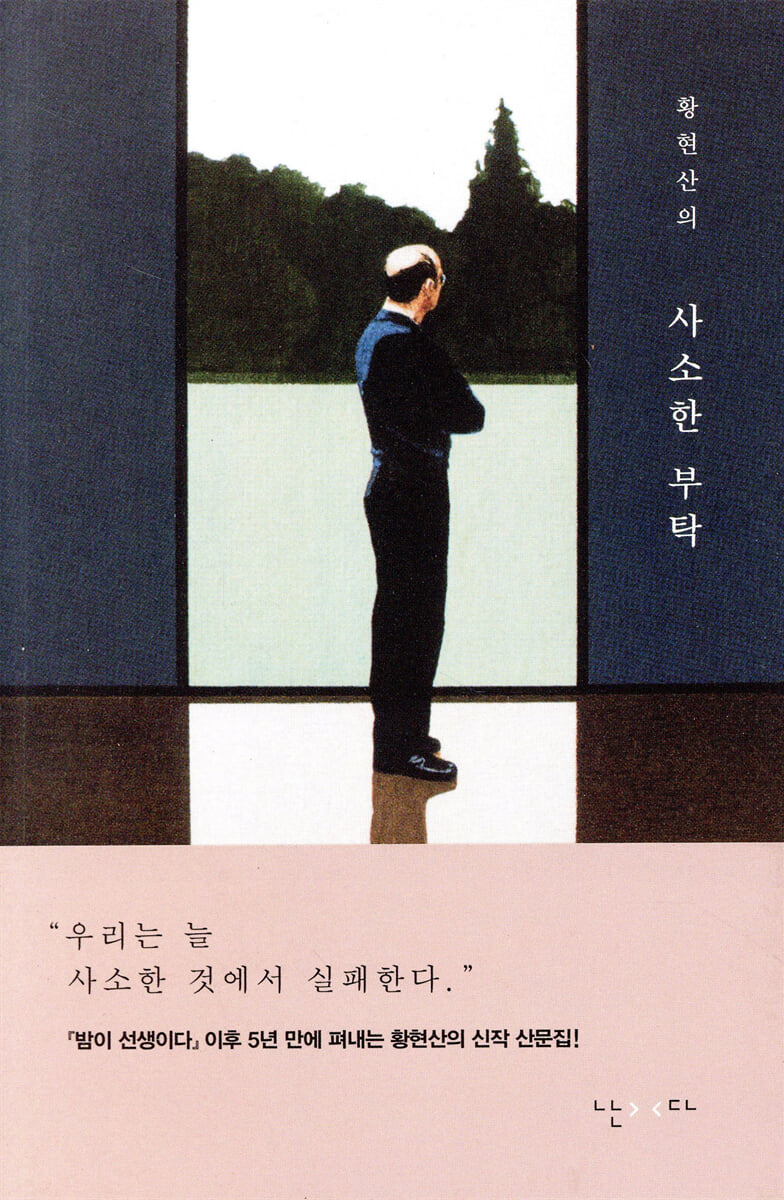
Hwang Hyeon-san's small request
 |
Description
Book Introduction
“We always fail at small things.”
Hwang Hyeon-san's new collection of essays, published five years after "The Night is My Teacher."
We are publishing a new collection of essays by literary critic and French literature scholar Hwang Hyeon-san.
It has been five years since the publication of my first collection of prose, “The Night is My Teacher.”
As he has done throughout his life, in this book, too, he has preserved the 'level' of his writing's shadow, which has led us to follow his thoughts rather than his emotions, with the elegance of the precious lines at the end.
The prose begins on March 9, 2013 and ends on December 23, 2017.
The reason why the nearly 900 pages of writing were divided into five parts and organized by time is because it is in itself a political and cultural history of Korea, and it becomes our history during that complex and multifaceted time.
『Hwang Hyeon-san's Small Request』, which he wrote with his whole body, is wrapped in the smallness of 'smallness' on the outside, but it contains some tips from the teacher to always touch and hold onto the real heart.
When we trace back the instances of our failures throughout our lives, the true causes are often small rather than large.
This book, filled with the teacher's small requests, will thus become something like a star.
When we feel unfamiliar with the darkness of life, when we are afraid, when we feel like giving up, he will guide us without hesitation as our guide.
Hwang Hyeon-san's new collection of essays, published five years after "The Night is My Teacher."
We are publishing a new collection of essays by literary critic and French literature scholar Hwang Hyeon-san.
It has been five years since the publication of my first collection of prose, “The Night is My Teacher.”
As he has done throughout his life, in this book, too, he has preserved the 'level' of his writing's shadow, which has led us to follow his thoughts rather than his emotions, with the elegance of the precious lines at the end.
The prose begins on March 9, 2013 and ends on December 23, 2017.
The reason why the nearly 900 pages of writing were divided into five parts and organized by time is because it is in itself a political and cultural history of Korea, and it becomes our history during that complex and multifaceted time.
『Hwang Hyeon-san's Small Request』, which he wrote with his whole body, is wrapped in the smallness of 'smallness' on the outside, but it contains some tips from the teacher to always touch and hold onto the real heart.
When we trace back the instances of our failures throughout our lives, the true causes are often small rather than large.
This book, filled with the teacher's small requests, will thus become something like a star.
When we feel unfamiliar with the darkness of life, when we are afraid, when we feel like giving up, he will guide us without hesitation as our guide.
- You can preview some of the book's contents.
Preview
index
In lieu of the preface, the servant bird and the 'skeleton going to the field' - 5
Part 1
There is much to prepare, but nothing to eat - 16
The Ability to Avoid War - 20
The problem is democracy again - 24
I have many friends at the Hankook Ilbo - 28
His Defeat and Our Defeat - 32
National Day Song - 36
Smart Spelling of Foreign Words - 40
Dialectics of Dialects and Standard Language - 44
Hong-eo and Modernism - 48
Artist Employment - 52
Sharp Happy New Year - 56
The Power of Words - 60
What Colleges Should Do and What Janitors Should Do - 64
Public Question - 68
The Devil's Way of Being - 72
The Politics of Authenticity - 76
Part 2
Paper and Digital Dictionaries - 82
A Hippie's Nature and Yoo Byeong-eon's Nature - 86
Some Complexity Theory - 90
A Small Request for Hangeul Day - 94
Humanities Yesterday and Today - 98
1700 Islands - 102
What good is a "blue sheep" without change? -106
Character Education - 110
Fate and Human Peril - 114
Another Way - 117
Mother Goose Song - 120
How to Eat Braised Duck - 125
On Plagiarism - 129
A New Look at "The Little Prince" - 135
The Fate of Academic Terminology - 140
Language: A Journey to the Hidden Truth - 145
Part 3
"Oh, South Korea" and "Hell Joseon" -152
Marianne of the Colonies - 157
Misunderstandings About the Translation of "The Little Prince" - 162
The Roots of Sorrow - 167
Two Hours - 170
The World of Indirect Communication - 174
Translation Theory of the Term "Misogyny" - 180
Sexual harassment and corruption within the literary community - 186
The Rooster's Crowing and the Superman's Song - 192
Girl Statue and Girls of All Nations - 198
The Unconsciousness of Voting - 204
Writing about Customs - 210
Victim's Narrative - 216
Slow and Slow Liberation - 220
What I Know - 226
Part 4
To talk about the closed narrative film [The Wailing] - 232
A Smaller, Smaller Reality - Reading Kwon Yeo-seon's "Spring Night" - 243
Memories of the Future - 253
The Phenomenology of Kissing - 263
Beyond Time and Symbols: A Short Essay on the Movie [Contact] - 273
A Short Note on the 2-Movie [Contact] Beyond Time and Symbols - 282
Mirabeau Bridge and Korea - 292
Part 5
The Upside-Down World of Avatamsaka - Kim Hye-sun's Poetry Collection, "Bloom, Pig" - 304
Liberation at the End of the Century - Lee Su-myeong's Critical Collection, "The Age of Air Raids" - 307
Editor's Novel and the Goat - Kim Seon-jae's Short Story Collection "Nowhere, Nowhere" - 310
This breezy anxiety - Kim Gaemi's poetry collection, "My Lover, I Listen Even While Sleeping" - 313
The Universal Grammar of Poetry - Cheon Yang-hee's Poetry Collection, "Thinking at Dawn" - 316
A New Place - Shin Young-bae's Poetry Collection, "Shall We Meet You in That Forest?" - 319
The Origins of Korean Romance - Cho Seon-hee's Novel "Three Women" - 322
Managing Grief - Shin Cheol-gyu's poetry collection, "They Say I Was as Sad as the Earth" - 325
Midang's "But" - "The Complete Works of Midang Seo Jeong-ju" - 328
Poet and Novelist - Lee Kyung-ja's Biography, "Poet Shin Kyung-rim" - 331
Second Person: Of Literature, By Literature, For Literature - Kim Ga-kyung's Short Story Collection, "Tuesday, When We Blow Molly Mo" - 334
Unplanned Blossoming - Jeong Jin-gyu's Poetry Collection, "Unknown Ears," 337
Epitaphs to be Written in the Wind - Jang Seok-nam's Poetry Collection, "Worried About Stepping on Flowers" - 340
Part 1
There is much to prepare, but nothing to eat - 16
The Ability to Avoid War - 20
The problem is democracy again - 24
I have many friends at the Hankook Ilbo - 28
His Defeat and Our Defeat - 32
National Day Song - 36
Smart Spelling of Foreign Words - 40
Dialectics of Dialects and Standard Language - 44
Hong-eo and Modernism - 48
Artist Employment - 52
Sharp Happy New Year - 56
The Power of Words - 60
What Colleges Should Do and What Janitors Should Do - 64
Public Question - 68
The Devil's Way of Being - 72
The Politics of Authenticity - 76
Part 2
Paper and Digital Dictionaries - 82
A Hippie's Nature and Yoo Byeong-eon's Nature - 86
Some Complexity Theory - 90
A Small Request for Hangeul Day - 94
Humanities Yesterday and Today - 98
1700 Islands - 102
What good is a "blue sheep" without change? -106
Character Education - 110
Fate and Human Peril - 114
Another Way - 117
Mother Goose Song - 120
How to Eat Braised Duck - 125
On Plagiarism - 129
A New Look at "The Little Prince" - 135
The Fate of Academic Terminology - 140
Language: A Journey to the Hidden Truth - 145
Part 3
"Oh, South Korea" and "Hell Joseon" -152
Marianne of the Colonies - 157
Misunderstandings About the Translation of "The Little Prince" - 162
The Roots of Sorrow - 167
Two Hours - 170
The World of Indirect Communication - 174
Translation Theory of the Term "Misogyny" - 180
Sexual harassment and corruption within the literary community - 186
The Rooster's Crowing and the Superman's Song - 192
Girl Statue and Girls of All Nations - 198
The Unconsciousness of Voting - 204
Writing about Customs - 210
Victim's Narrative - 216
Slow and Slow Liberation - 220
What I Know - 226
Part 4
To talk about the closed narrative film [The Wailing] - 232
A Smaller, Smaller Reality - Reading Kwon Yeo-seon's "Spring Night" - 243
Memories of the Future - 253
The Phenomenology of Kissing - 263
Beyond Time and Symbols: A Short Essay on the Movie [Contact] - 273
A Short Note on the 2-Movie [Contact] Beyond Time and Symbols - 282
Mirabeau Bridge and Korea - 292
Part 5
The Upside-Down World of Avatamsaka - Kim Hye-sun's Poetry Collection, "Bloom, Pig" - 304
Liberation at the End of the Century - Lee Su-myeong's Critical Collection, "The Age of Air Raids" - 307
Editor's Novel and the Goat - Kim Seon-jae's Short Story Collection "Nowhere, Nowhere" - 310
This breezy anxiety - Kim Gaemi's poetry collection, "My Lover, I Listen Even While Sleeping" - 313
The Universal Grammar of Poetry - Cheon Yang-hee's Poetry Collection, "Thinking at Dawn" - 316
A New Place - Shin Young-bae's Poetry Collection, "Shall We Meet You in That Forest?" - 319
The Origins of Korean Romance - Cho Seon-hee's Novel "Three Women" - 322
Managing Grief - Shin Cheol-gyu's poetry collection, "They Say I Was as Sad as the Earth" - 325
Midang's "But" - "The Complete Works of Midang Seo Jeong-ju" - 328
Poet and Novelist - Lee Kyung-ja's Biography, "Poet Shin Kyung-rim" - 331
Second Person: Of Literature, By Literature, For Literature - Kim Ga-kyung's Short Story Collection, "Tuesday, When We Blow Molly Mo" - 334
Unplanned Blossoming - Jeong Jin-gyu's Poetry Collection, "Unknown Ears," 337
Epitaphs to be Written in the Wind - Jang Seok-nam's Poetry Collection, "Worried About Stepping on Flowers" - 340
Into the book
Without further ado, for us war means the destruction of our nation.
If life in the North and South is destroyed to its core and the nation falls into irreversible misfortune, what good is the accumulation of economic wealth? What value is there in the honing of young minds and the blossoming of literary talents?
It is we who must help prevent one side of the nation from making bad decisions.
The North and South are bound by the closest bloodline, have faced the same fate for thousands of years, and are once again grappling with the same fate as they face imminent danger.
The wisdom to realize and practice what it means to prosper together is true knowledge, and the power to help one's fellow countrymen avoid tragic decisions is true national strength.
Where else can we find national pride if not there?
(2013.
4. 13.)
---From "The Ability to Not Go to War"
It is a recurring issue every time a heinous crime occurs, but many people argue that the death penalty, which was practically abolished, should be reinstated.
This proves our defeat, as it amounts to saying that we should eliminate the problem rather than solve it.
Besides, the problem doesn't go away.
Because what criminals fear is not death, but daily life.
(2013.
7. 20.)
---From "His Defeat and Our Defeat"
It is true that art is a job that requires a living, so it is important to make a living.
But what is this thing called a profession?
If we narrow the discussion down to literature, many writers who graduated from literature-related departments work in publishing or cultural fields, but if a writer doesn't get a job, it also means that he or she has succeeded as a writer.
Many writers have quit their teaching jobs because they say it interferes with their writing.
Have they brought dishonor to their alma mater?
The president mentioned somewhere that singer Psy was a model for the creative economy, but is Psy an employee of one of the four major insurance companies?
I don't know anything about the creative economy, but I can't say I don't know about creation.
Knowing that getting a job isn't just about wearing a suit and going to work at one of the four major insurance companies is the beginning of creation.
(2013.
12.
7.)
---From "Employment of Artists"
The devil waited for the government to panic and sink the ship even at the moment when it opened its eyes and lost those children who were as good as new.
Rumors that all the children had been saved were spread through the mouths of those in charge.
The devil didn't miss anything.
Of course I don't believe in the devil.
But not believing in the devil doesn't erase the fact that people on this earth have committed things that only the devil would do.
If it was the devil's doing, it would end up as the devil's research, but since it is our sin, we must now shake off our seats and rise up.
I have to do whatever it takes, whether it's tying a ribbon or holding a candle, without forgiving myself.
(2014.
5. 3.)
---From "The Devil's Way of Being"
The same goes for reading books.
Nietzsche said that a book is an axe.
The axe cuts us down.
If you already have a book open in front of you, you shouldn't be circling around it and looking around.
We must give ourselves completely to what we read.
We who fall then rise up as new people.
It is also a festival to offer ourselves before the axe called a book.
Neither food for the body nor food for the mind provide a feast for those who wander.
(2015.
6. 22.)
If life in the North and South is destroyed to its core and the nation falls into irreversible misfortune, what good is the accumulation of economic wealth? What value is there in the honing of young minds and the blossoming of literary talents?
It is we who must help prevent one side of the nation from making bad decisions.
The North and South are bound by the closest bloodline, have faced the same fate for thousands of years, and are once again grappling with the same fate as they face imminent danger.
The wisdom to realize and practice what it means to prosper together is true knowledge, and the power to help one's fellow countrymen avoid tragic decisions is true national strength.
Where else can we find national pride if not there?
(2013.
4. 13.)
---From "The Ability to Not Go to War"
It is a recurring issue every time a heinous crime occurs, but many people argue that the death penalty, which was practically abolished, should be reinstated.
This proves our defeat, as it amounts to saying that we should eliminate the problem rather than solve it.
Besides, the problem doesn't go away.
Because what criminals fear is not death, but daily life.
(2013.
7. 20.)
---From "His Defeat and Our Defeat"
It is true that art is a job that requires a living, so it is important to make a living.
But what is this thing called a profession?
If we narrow the discussion down to literature, many writers who graduated from literature-related departments work in publishing or cultural fields, but if a writer doesn't get a job, it also means that he or she has succeeded as a writer.
Many writers have quit their teaching jobs because they say it interferes with their writing.
Have they brought dishonor to their alma mater?
The president mentioned somewhere that singer Psy was a model for the creative economy, but is Psy an employee of one of the four major insurance companies?
I don't know anything about the creative economy, but I can't say I don't know about creation.
Knowing that getting a job isn't just about wearing a suit and going to work at one of the four major insurance companies is the beginning of creation.
(2013.
12.
7.)
---From "Employment of Artists"
The devil waited for the government to panic and sink the ship even at the moment when it opened its eyes and lost those children who were as good as new.
Rumors that all the children had been saved were spread through the mouths of those in charge.
The devil didn't miss anything.
Of course I don't believe in the devil.
But not believing in the devil doesn't erase the fact that people on this earth have committed things that only the devil would do.
If it was the devil's doing, it would end up as the devil's research, but since it is our sin, we must now shake off our seats and rise up.
I have to do whatever it takes, whether it's tying a ribbon or holding a candle, without forgiving myself.
(2014.
5. 3.)
---From "The Devil's Way of Being"
The same goes for reading books.
Nietzsche said that a book is an axe.
The axe cuts us down.
If you already have a book open in front of you, you shouldn't be circling around it and looking around.
We must give ourselves completely to what we read.
We who fall then rise up as new people.
It is also a festival to offer ourselves before the axe called a book.
Neither food for the body nor food for the mind provide a feast for those who wander.
(2015.
6. 22.)
---From "How to Eat Duck Stew"
Publisher's Review
“We always fail at small things.”
Hwang Hyeon-san's new collection of essays, published five years after "The Night is My Teacher"!
Hwang Hyeon-san's Small Request
“It’s literally a small request, but
“I do hope that these trivial requests will become some kind of allegory.”
We are publishing a new collection of essays by literary critic and French literature scholar Hwang Hyeon-san.
It has been five years since the publication of my first collection of prose, “The Night is My Teacher.”
In the meantime, he presented a poem called “Looking at the Sky from a Well,” which is a guide to reading poetry.
He was the one who made me hold in my hands the works of authors of the century, such as Mallarmé, Baudelaire, Apollinaire, Rimbaud, and Saint-Exupéry, one after another, as if it were no big deal, even though it was obviously a big deal.
As is known, he was appointed as the 6th Chairman of the Korea Arts and Culture Committee in 2017, but resigned after 3 months due to health reasons and has been battling illness ever since.
I dare to guess that his past five years have been filled with such busyness and pain.
While fulfilling his duty as a translator, he tirelessly criticized the aspects of our political society that were never smooth sailing and were tragically ruined, and he sat down in every place where he could find a place to speak, taking up his pen, in order to open our folded ears, closed eyes, and shut mouths.
And I have been doing my best to be polite in every word I write, with my ears wide open, my eyes wide open, and my mouth wide open.
The morality of this time could be replaced with a certain 'etiquette' that is the responsibility and duty of an intellectual who must be observed as a teacher of the times and a writer in the field.
"Hwang Hyeon-san's Small Request" is a book that captures all of his difficult times.
As he has done throughout his life, in this book, too, he has preserved the 'level' of his writing's shadow, which has led us to follow his thoughts rather than his emotions, with the elegance of the precious lines at the end.
In any situation, he never shouts loudly.
However, he is a person who listens to the other person until the end and often expresses his inner thoughts metaphorically.
In any situation, he neither laughs nor cries easily.
However, there are times when he turns around and washes his face after the other person stops laughing and crying.
In any situation, he does not boast of his fast pace.
However, he is a person who is skilled at observing the opponent's stride keenly, instinctively breathing, and then matching his steps.
In this way, he has spent his entire life bending his spine to the idea that you and I should become one and live together, and that we should live together in a way that makes sense and is natural.
"Hwang Hyeon-san's Small Request" is a book that reflects his judgment in a more active and proactive way.
The prose begins on March 9, 2013 and ends on December 23, 2017.
When I divided the nearly 900 pages of writing into five parts and organized them chronologically without any doubt or hesitation, I was quite certain that it would become, in itself, Korea's political and cultural history, our history during that complex and turbulent time.
Although I wrote this in response to requests from various media outlets, I held the subject matter to my own subjective opinion, so I think this book, which accurately records the direction of the person called 'Hwang Hyeon-san' from the first to the last word without any disarray or the usual sidelong glances, is the very evidence.
Compared to other books, I think the pages soaked with tears and swollen with moisture made this book thicker.
When it comes to writing, he has always had a firm mind and a firm body, but in this writing, he seems to have pretended not to notice even a slightly open mind and a slightly loose body.
We have all gone through times where we had no choice but to live that way, so we can cautiously assert that the keyword he sought to serve throughout his life was 'love.'
Because it was love, he would have kept his eyes open even while sleeping, because it was love, he would have had busy hands even while being busy, and because it was love, he would have had a caring heart even while being in pain.
It goes without saying that the target is directed at all of us.
『Hwang Hyeon-san's Small Request』, which he wrote with his whole body, may be wrapped in the smallness of 'smallness' on the outside, but its true essence is a tip from the teacher on life that always touches and grabs the heart.
If we trace back the instances of our failures throughout our lives, the true causes are often small rather than large.
I didn't know that easy thing, so I'll learn it from now on.
This book, filled with the teacher's small requests, will thus become something like a star.
When we look up, it's there, and when we lie down, it's a face. Whether we look or not, that star always shines in its own way. This silent navigation of life shines especially brightly at night.
When we feel unfamiliar with the darkness of life, when we are afraid, when we feel like giving up, He will guide us without hesitation as our guide.
The teacher is the one who is by our side, the one who was born to do this, the one who wants us to read 『Hwang Hyeon-san's Small Request』, the one who wants us to do well in the end.
Author's Note
In the private sector, the sparrow is commonly called a servant bird.
It is a nickname given to them because they cry out loudly, like cattle being driven to the field, at dusk or around sunrise.
Once upon a time, there was a servant who worked under a harsh master.
The master made his servant work day and night without rest.
The farmhand who worked the field during the day was made to work the field at night as well.
The servant collapsed from exhaustion and died.
The servant who died and became a servant bird still drives the oxen to the fields in the dusk of the evening and dawn of the dusk of the morning.
But why do servants who suffered so much while alive have to continue to suffer so much even after death?
Now that the body has been liberated from that painful world, shouldn't the soul at least be at peace?
This question is quite solemn.
Because it asks the question of human destiny at its core.
The French poet Baudelaire asked the same question we do in the mid-19th century.
Baudelaire discovers a curious painting among the piles of old books in the old bookstores lining the banks of the Seine River in Paris.
This anatomical diagram, intended to show the human skeleton, shows more than just a bare skull.
The artist added one of his own ideas to the painting, depicting a skeleton plowing a field with its skeleton upright.
Even for this skeleton who has already become a body in the other world, the suffering of this world is not over yet.
I quote the latter part of this poem, which consists of two verses, although a little long.
You sad, resigned country bumpkins,
Your spines and skins are peeled off
With all the toil of those muscles,
From the land that is dug and cultivated,
Speak, you prisoners drawn from the charnel house,
What a strange harvest
will be pulled out, and which farm
Should I fill the light?
You guys (of such a cruel fate)
(a scary and obvious symbol!), you guys
What I want to show you is that even in the graveyard
The promised sleep is not guaranteed,
The void is a traitor who turns his back on us,
Everything, even death, deceives us,
Sad! Forever and ever, unchanging,
We must
In some unknown country
The rough ground must be peeled off
With our bare feet, our blood flows
Does this mean I have to push through heavy moisturizing?
The skeletons had already entered the realm of death, the realm of nothingness, but the promise of eternal rest with death was not fulfilled.
They are still forced to “pee off the rough ground” in some country unknown to us, and toil with their bleeding bare feet, pushing the plowshares.
They must continue to do hard labor even after death.
Why are we keeping silent about this injustice?
Isn't it because we ourselves are "sad, resigned country bumpkins" who believe that those who suffer are destined to suffer forever?
I call the moment when I suddenly question a contradiction I had never even considered before literary time.
Literary time is mostly connected to individual lives, but when it is connected to social themes, it becomes historical time.
It is also an aesthetic time, a time of grace, a time of enlightenment.
I have long wondered what literature can do in this world.
I have always been concerned about whether I can do that, especially with French literature, which is only the literature of a distant country.
If I have gained any wisdom of my own, it is thanks to these questions and struggles. This book, a collection of writings I wrote after "The Night is My Teacher" and "Looking at the Sky from a Well," is, like the others, a testimony to that struggle.
I would like to express my deepest gratitude to poet Kim Min-jeong of Nanda.
Early summer 2018
Hwang Hyeon-san
Hwang Hyeon-san's new collection of essays, published five years after "The Night is My Teacher"!
Hwang Hyeon-san's Small Request
“It’s literally a small request, but
“I do hope that these trivial requests will become some kind of allegory.”
We are publishing a new collection of essays by literary critic and French literature scholar Hwang Hyeon-san.
It has been five years since the publication of my first collection of prose, “The Night is My Teacher.”
In the meantime, he presented a poem called “Looking at the Sky from a Well,” which is a guide to reading poetry.
He was the one who made me hold in my hands the works of authors of the century, such as Mallarmé, Baudelaire, Apollinaire, Rimbaud, and Saint-Exupéry, one after another, as if it were no big deal, even though it was obviously a big deal.
As is known, he was appointed as the 6th Chairman of the Korea Arts and Culture Committee in 2017, but resigned after 3 months due to health reasons and has been battling illness ever since.
I dare to guess that his past five years have been filled with such busyness and pain.
While fulfilling his duty as a translator, he tirelessly criticized the aspects of our political society that were never smooth sailing and were tragically ruined, and he sat down in every place where he could find a place to speak, taking up his pen, in order to open our folded ears, closed eyes, and shut mouths.
And I have been doing my best to be polite in every word I write, with my ears wide open, my eyes wide open, and my mouth wide open.
The morality of this time could be replaced with a certain 'etiquette' that is the responsibility and duty of an intellectual who must be observed as a teacher of the times and a writer in the field.
"Hwang Hyeon-san's Small Request" is a book that captures all of his difficult times.
As he has done throughout his life, in this book, too, he has preserved the 'level' of his writing's shadow, which has led us to follow his thoughts rather than his emotions, with the elegance of the precious lines at the end.
In any situation, he never shouts loudly.
However, he is a person who listens to the other person until the end and often expresses his inner thoughts metaphorically.
In any situation, he neither laughs nor cries easily.
However, there are times when he turns around and washes his face after the other person stops laughing and crying.
In any situation, he does not boast of his fast pace.
However, he is a person who is skilled at observing the opponent's stride keenly, instinctively breathing, and then matching his steps.
In this way, he has spent his entire life bending his spine to the idea that you and I should become one and live together, and that we should live together in a way that makes sense and is natural.
"Hwang Hyeon-san's Small Request" is a book that reflects his judgment in a more active and proactive way.
The prose begins on March 9, 2013 and ends on December 23, 2017.
When I divided the nearly 900 pages of writing into five parts and organized them chronologically without any doubt or hesitation, I was quite certain that it would become, in itself, Korea's political and cultural history, our history during that complex and turbulent time.
Although I wrote this in response to requests from various media outlets, I held the subject matter to my own subjective opinion, so I think this book, which accurately records the direction of the person called 'Hwang Hyeon-san' from the first to the last word without any disarray or the usual sidelong glances, is the very evidence.
Compared to other books, I think the pages soaked with tears and swollen with moisture made this book thicker.
When it comes to writing, he has always had a firm mind and a firm body, but in this writing, he seems to have pretended not to notice even a slightly open mind and a slightly loose body.
We have all gone through times where we had no choice but to live that way, so we can cautiously assert that the keyword he sought to serve throughout his life was 'love.'
Because it was love, he would have kept his eyes open even while sleeping, because it was love, he would have had busy hands even while being busy, and because it was love, he would have had a caring heart even while being in pain.
It goes without saying that the target is directed at all of us.
『Hwang Hyeon-san's Small Request』, which he wrote with his whole body, may be wrapped in the smallness of 'smallness' on the outside, but its true essence is a tip from the teacher on life that always touches and grabs the heart.
If we trace back the instances of our failures throughout our lives, the true causes are often small rather than large.
I didn't know that easy thing, so I'll learn it from now on.
This book, filled with the teacher's small requests, will thus become something like a star.
When we look up, it's there, and when we lie down, it's a face. Whether we look or not, that star always shines in its own way. This silent navigation of life shines especially brightly at night.
When we feel unfamiliar with the darkness of life, when we are afraid, when we feel like giving up, He will guide us without hesitation as our guide.
The teacher is the one who is by our side, the one who was born to do this, the one who wants us to read 『Hwang Hyeon-san's Small Request』, the one who wants us to do well in the end.
Author's Note
In the private sector, the sparrow is commonly called a servant bird.
It is a nickname given to them because they cry out loudly, like cattle being driven to the field, at dusk or around sunrise.
Once upon a time, there was a servant who worked under a harsh master.
The master made his servant work day and night without rest.
The farmhand who worked the field during the day was made to work the field at night as well.
The servant collapsed from exhaustion and died.
The servant who died and became a servant bird still drives the oxen to the fields in the dusk of the evening and dawn of the dusk of the morning.
But why do servants who suffered so much while alive have to continue to suffer so much even after death?
Now that the body has been liberated from that painful world, shouldn't the soul at least be at peace?
This question is quite solemn.
Because it asks the question of human destiny at its core.
The French poet Baudelaire asked the same question we do in the mid-19th century.
Baudelaire discovers a curious painting among the piles of old books in the old bookstores lining the banks of the Seine River in Paris.
This anatomical diagram, intended to show the human skeleton, shows more than just a bare skull.
The artist added one of his own ideas to the painting, depicting a skeleton plowing a field with its skeleton upright.
Even for this skeleton who has already become a body in the other world, the suffering of this world is not over yet.
I quote the latter part of this poem, which consists of two verses, although a little long.
You sad, resigned country bumpkins,
Your spines and skins are peeled off
With all the toil of those muscles,
From the land that is dug and cultivated,
Speak, you prisoners drawn from the charnel house,
What a strange harvest
will be pulled out, and which farm
Should I fill the light?
You guys (of such a cruel fate)
(a scary and obvious symbol!), you guys
What I want to show you is that even in the graveyard
The promised sleep is not guaranteed,
The void is a traitor who turns his back on us,
Everything, even death, deceives us,
Sad! Forever and ever, unchanging,
We must
In some unknown country
The rough ground must be peeled off
With our bare feet, our blood flows
Does this mean I have to push through heavy moisturizing?
The skeletons had already entered the realm of death, the realm of nothingness, but the promise of eternal rest with death was not fulfilled.
They are still forced to “pee off the rough ground” in some country unknown to us, and toil with their bleeding bare feet, pushing the plowshares.
They must continue to do hard labor even after death.
Why are we keeping silent about this injustice?
Isn't it because we ourselves are "sad, resigned country bumpkins" who believe that those who suffer are destined to suffer forever?
I call the moment when I suddenly question a contradiction I had never even considered before literary time.
Literary time is mostly connected to individual lives, but when it is connected to social themes, it becomes historical time.
It is also an aesthetic time, a time of grace, a time of enlightenment.
I have long wondered what literature can do in this world.
I have always been concerned about whether I can do that, especially with French literature, which is only the literature of a distant country.
If I have gained any wisdom of my own, it is thanks to these questions and struggles. This book, a collection of writings I wrote after "The Night is My Teacher" and "Looking at the Sky from a Well," is, like the others, a testimony to that struggle.
I would like to express my deepest gratitude to poet Kim Min-jeong of Nanda.
Early summer 2018
Hwang Hyeon-san
GOODS SPECIFICS
- Date of issue: June 25, 2018
- Page count, weight, size: 344 pages | 394g | 152*223*30mm
- ISBN13: 9791188862139
- ISBN10: 1188862138
You may also like
카테고리
korean


korean

![GQ KOREA Mark (Monthly): December [2025]](http://librairie.coreenne.fr/cdn/shop/files/8ef265dbbfbf186523ed75ba7319009d.jpg?v=1765340328&width=3840)


