

Ten thousand actions
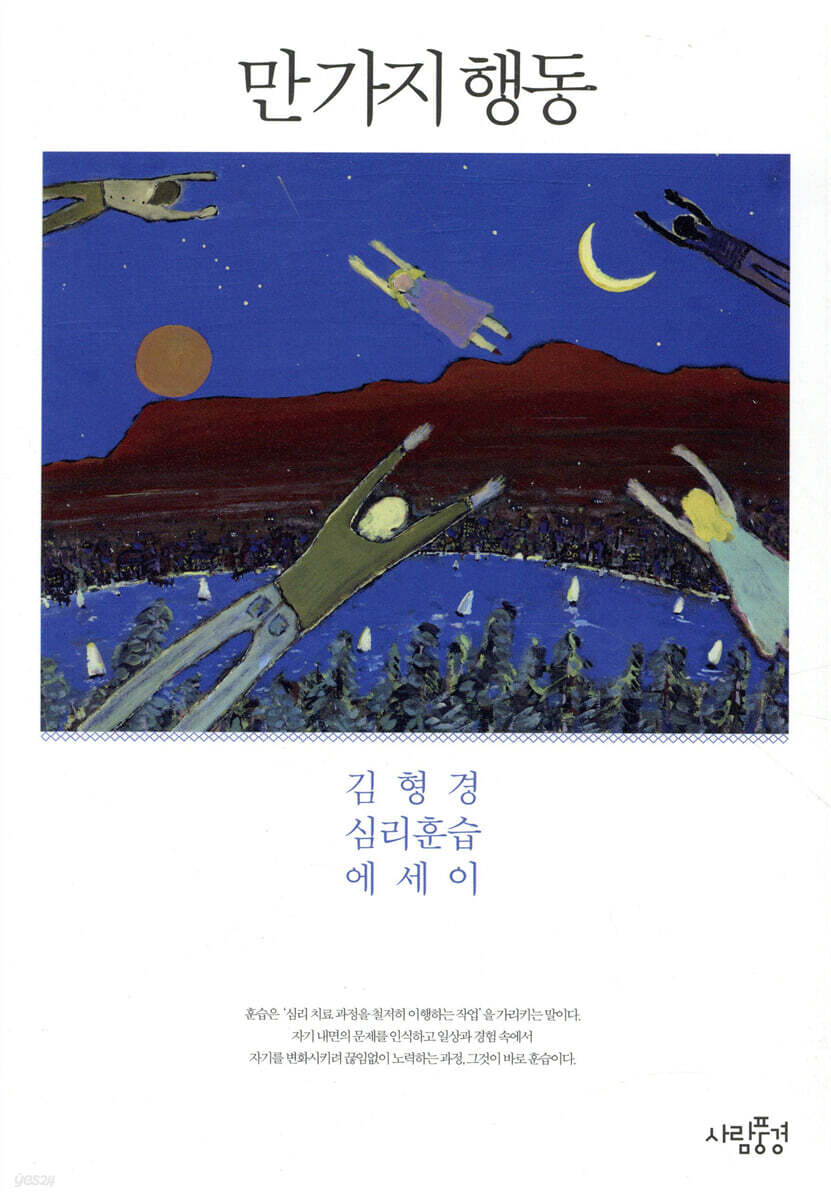 |
Description
Book Introduction
This is a psychological essay by Kim Hyeong-gyeong, who has written psychological essays that have the power of insight to bring about change in life by facing one's inner self and accepting it without embellishment, such as 『Human Landscape』, 『A Thousand Sympathies』, and 『Good Breakup』.
The book presents a psychotherapeutic process called training.
For psychoanalytic psychotherapy to be successful, one must first gain insight into one's inner self and then spend time practicing it so that it becomes ingrained in one's body and changes occur in one's personality and behavior.
The author's various attempts, experiences, and actions are reflected in this book, including the process of discarding outdated survival methods, attempts to be reborn, times spent sharing psychoanalytic experiences with younger women, and specific methods for maintaining spiritual health.
Kim Hyung-kyung's psychological essays delve deeply into the human mind, yet they are also filled with a subtle literary flavor, making them easy to read and moving.
The author, who has transformed her life through psychoanalysis and training, whispers and shares her experiences in detail, like a caring older sister.
Listening to his story, you slowly begin to look inside yourself and take action.
If you find it difficult to connect with others, if you've ever felt hurt by someone's seemingly insignificant actions, or if you ever feel like anxiety is a giant monster threatening to consume you, you need to stop and take a moment to reflect.
'Have I ever looked inside myself?' If you quietly gaze into your inner self, you will come to the realization that 'the world will change only when I change.'
Changes in behavior come later.
The book presents a psychotherapeutic process called training.
For psychoanalytic psychotherapy to be successful, one must first gain insight into one's inner self and then spend time practicing it so that it becomes ingrained in one's body and changes occur in one's personality and behavior.
The author's various attempts, experiences, and actions are reflected in this book, including the process of discarding outdated survival methods, attempts to be reborn, times spent sharing psychoanalytic experiences with younger women, and specific methods for maintaining spiritual health.
Kim Hyung-kyung's psychological essays delve deeply into the human mind, yet they are also filled with a subtle literary flavor, making them easy to read and moving.
The author, who has transformed her life through psychoanalysis and training, whispers and shares her experiences in detail, like a caring older sister.
Listening to his story, you slowly begin to look inside yourself and take action.
If you find it difficult to connect with others, if you've ever felt hurt by someone's seemingly insignificant actions, or if you ever feel like anxiety is a giant monster threatening to consume you, you need to stop and take a moment to reflect.
'Have I ever looked inside myself?' If you quietly gaze into your inner self, you will come to the realization that 'the world will change only when I change.'
Changes in behavior come later.
- You can preview some of the book's contents.
Preview
index
Chapter 1 Stopping What You Were Doing
Life is somewhere else… change and training
That heart is my heart… Don't project or externalize.
Rigidity is a characteristic of the corpse… not defending, not controlling.
Love does not boast… Integrating jealousy and ambivalence
Six Years with a Fur Coat… Not Pursuing Automatic Compulsive Repetition
A place free from attachment and hatred… Separated and guarded.
Letting go of the authority figure in your heart… and not seeking recognition or support.
Chapter 2 Doing Things You Never Did Before
The Alchemist of My Heart… Time and Space of Differentiation
Letting go of the love-struck rascal… Autonomy and self-use
A wise man is like a fool… staying in ignorance and confusion.
Patience is the key… staying powerless
Respect, learn, or… a new framework for building relationships
Life is an opportunity to become something… Protecting innocence and simplicity
A place where you don't want anything… to exist as yourself.
Chapter 3: Sharing Experiences
Hug or hold… Intermediate space and facilitating environment
Sharing experiences… Letting go of old survival methods
The mind is but a mirror… Transference and role reactivity
When you step back, step over, or stop in the face of resistance
Thoughts exist without the thinker… projective identification, emotional contagion
For the 880,000 Won Generation… A Generation Embracing Parental Issues
Learning from Kang Ho-dong… A role model for self-actualization
Chapter 4 Beyond Psychoanalysis
I can't do anything on my own... The first step in addiction treatment
Analysis that can be completed, analysis that cannot be completed… Vegetarianism and spiritual health
When I Change, the World Changes… Psychoanalysis and Personality Transformation
Wisdom is what you see, and the return is the yang… Psychoanalysis and existential issues
Reaching Heaven's Heart Forever... Unifying Through Success
Whereof we cannot speak, whereof we must remain silent… Integrating Life and Death
Life is somewhere else… change and training
That heart is my heart… Don't project or externalize.
Rigidity is a characteristic of the corpse… not defending, not controlling.
Love does not boast… Integrating jealousy and ambivalence
Six Years with a Fur Coat… Not Pursuing Automatic Compulsive Repetition
A place free from attachment and hatred… Separated and guarded.
Letting go of the authority figure in your heart… and not seeking recognition or support.
Chapter 2 Doing Things You Never Did Before
The Alchemist of My Heart… Time and Space of Differentiation
Letting go of the love-struck rascal… Autonomy and self-use
A wise man is like a fool… staying in ignorance and confusion.
Patience is the key… staying powerless
Respect, learn, or… a new framework for building relationships
Life is an opportunity to become something… Protecting innocence and simplicity
A place where you don't want anything… to exist as yourself.
Chapter 3: Sharing Experiences
Hug or hold… Intermediate space and facilitating environment
Sharing experiences… Letting go of old survival methods
The mind is but a mirror… Transference and role reactivity
When you step back, step over, or stop in the face of resistance
Thoughts exist without the thinker… projective identification, emotional contagion
For the 880,000 Won Generation… A Generation Embracing Parental Issues
Learning from Kang Ho-dong… A role model for self-actualization
Chapter 4 Beyond Psychoanalysis
I can't do anything on my own... The first step in addiction treatment
Analysis that can be completed, analysis that cannot be completed… Vegetarianism and spiritual health
When I Change, the World Changes… Psychoanalysis and Personality Transformation
Wisdom is what you see, and the return is the yang… Psychoanalysis and existential issues
Reaching Heaven's Heart Forever... Unifying Through Success
Whereof we cannot speak, whereof we must remain silent… Integrating Life and Death
Into the book
1.
The feeling of frequent loss of consciousness during my trip to Egypt seems to be due to the average age of the ruins, which are said to be around 4,000 years.
It also seems to have been because of their desire for eternal life and its transience.
Ramses II's countless ancestors, his massive buildings, and his more than 100 children were evidence of his dream of eternal power and life.
But what the ruins most clearly showed was the self-evident truth that everything changes, decays, and disappears.
Looking at the mummies on display in the museum, it seemed as if the desire for eternal life and the natural law of extinction were brightly displayed in one place.
---p.21, Chater 1 "Not doing what you were doing", life is somewhere else... change and training
2.
'What is it about my heart that makes me feel uncomfortable in this situation?'
'What makes me uncomfortable with that person's aggression?'
By changing my perspective in that way, I discovered that all the emotions and tendencies I saw in others were within me.
Even when I felt strong emotions about the other person's mistake, it was 'my anger', and even in the voice that I felt was justified in criticizing, there was 'my jealousy'.
Every time I became aware of how I reacted in conflict situations or what I said to people, my inner self would shine brightly.
The moment I realized it, I would stop doing it and just quietly feel the shame that came over me.
---pp.31~32, Chater 1 "Not doing what you were doing", That heart is my heart
3.
I also experienced a special emotional state in Greece.
It was a peaceful and satisfying feeling.
(……) But as soon as I arrived in Egypt, the peace and happiness I felt in Greece disappeared without a trace.
Even though I had only walked for three hours on the first day, I already felt my heart starting to feel heavy.
As I sensed the heat, dust, and misogynistic atmosphere, I felt sad and complicated no matter where I went or what I saw.
By the fourth day, my face had taken on a gloomy and heavy expression, like the Egyptians I met on the street.
I stared at the gloomy expression in the mirror and wondered where this expression came from.
---pp.204~205, Chater 3 "Sharing Experiences", Thoughts exist without a thinker.
4.
Every time I muttered, “I want to live differently,” and tried to change my life, I also guessed the innermost meaning of what I wanted.
I felt that the 'true life' that might exist somewhere else might be the realm of emotions, intuition, and mystery that we have suppressed and ignored.
It seems like I wanted to reach that place where wisdom, energy, and creativity are contained.
Integrating the inner and outer world was the sixth way to maintain spiritual health.
The feeling of frequent loss of consciousness during my trip to Egypt seems to be due to the average age of the ruins, which are said to be around 4,000 years.
It also seems to have been because of their desire for eternal life and its transience.
Ramses II's countless ancestors, his massive buildings, and his more than 100 children were evidence of his dream of eternal power and life.
But what the ruins most clearly showed was the self-evident truth that everything changes, decays, and disappears.
Looking at the mummies on display in the museum, it seemed as if the desire for eternal life and the natural law of extinction were brightly displayed in one place.
---p.21, Chater 1 "Not doing what you were doing", life is somewhere else... change and training
2.
'What is it about my heart that makes me feel uncomfortable in this situation?'
'What makes me uncomfortable with that person's aggression?'
By changing my perspective in that way, I discovered that all the emotions and tendencies I saw in others were within me.
Even when I felt strong emotions about the other person's mistake, it was 'my anger', and even in the voice that I felt was justified in criticizing, there was 'my jealousy'.
Every time I became aware of how I reacted in conflict situations or what I said to people, my inner self would shine brightly.
The moment I realized it, I would stop doing it and just quietly feel the shame that came over me.
---pp.31~32, Chater 1 "Not doing what you were doing", That heart is my heart
3.
I also experienced a special emotional state in Greece.
It was a peaceful and satisfying feeling.
(……) But as soon as I arrived in Egypt, the peace and happiness I felt in Greece disappeared without a trace.
Even though I had only walked for three hours on the first day, I already felt my heart starting to feel heavy.
As I sensed the heat, dust, and misogynistic atmosphere, I felt sad and complicated no matter where I went or what I saw.
By the fourth day, my face had taken on a gloomy and heavy expression, like the Egyptians I met on the street.
I stared at the gloomy expression in the mirror and wondered where this expression came from.
---pp.204~205, Chater 3 "Sharing Experiences", Thoughts exist without a thinker.
4.
Every time I muttered, “I want to live differently,” and tried to change my life, I also guessed the innermost meaning of what I wanted.
I felt that the 'true life' that might exist somewhere else might be the realm of emotions, intuition, and mystery that we have suppressed and ignored.
It seems like I wanted to reach that place where wisdom, energy, and creativity are contained.
Integrating the inner and outer world was the sixth way to maintain spiritual health.
---pp.204~205, Chapter 3, "Beyond Psychoanalysis," Reaching Heaven's Heart Forever
Publisher's Review
《Ten Thousand Actions》 is a book that presents a psychological treatment process called training.
For psychoanalytic psychotherapy to be successful, one must first gain insight into one's inner self and then spend time practicing it so that it becomes ingrained in one's body and changes occur in one's personality and behavior.
The author's various attempts, experiences, and actions are reflected in this book, including the process of discarding outdated survival methods, attempts to be reborn, times spent sharing psychoanalytic experiences with younger women, and specific methods for maintaining spiritual health.
Following “Human Landscape,” “A Thousand Sympathies,” and “A Good Goodbye”
Novelist Kim Hyung-kyung's fourth psychological essay
Finding the way to become the master of my life and my mind
If Kim Hyung-kyung's previous psychological essays, such as "Human Landscape," "A Thousand Sympathies," and "A Good Breakup," had the power of insight that brought about change in life by facing one's inner self and accepting it without embellishment, "Ten Thousand Actions" goes a step further and has the power of "training" that allows one to live life with a richer personality.
Training is a term borrowed from Buddhism, which translates to ‘working through the psychoanalytic process.’
To put it simply, it means that I have to train myself to become accustomed to it.
Kim Hyung-kyung's psychological essays delve deeply into the human mind, yet they are also filled with a subtle literary flavor, making them easy to read and moving.
The author, who has transformed her life through psychoanalysis and training, whispers and shares her experiences in detail, like a caring older sister.
Listening to his story slowly makes you look inside yourself and take action.
If you find it difficult to connect with others, if you've ever felt hurt by someone's seemingly insignificant actions, or if you ever feel like anxiety is a giant monster threatening to consume you, you need to stop and take a moment to reflect.
'Have I ever looked inside myself?' If you quietly gaze into your inner self, you will come to the realization that 'the world will change only when I change.'
Changes in behavior come later.
I thought that being an adult meant not relying on others for even a single branch of my life.
A 'perfect' person who doesn't depend on anyone, is kind to everyone, is rational, but knows how to express his or her emotions richly.
That's what it means to be a real adult.
He blamed himself for not being able to achieve the desired result.
"Who hasn't been hurt? Who hasn't felt like they'd hit rock bottom, curled up alone and cried?" The thought that everyone was hurting and suffering, that everyone was like that, was deeply ingrained in my mind.
I smiled as if nothing was wrong and ignored something boiling inside me.
I found out much later.
I am so immature in expressing my emotions, and there is still a child inside me crying who has not yet fully grown.
Let go of the old "survival methods" you've been using without question.
It is said that from infancy, humans learn their own survival skills to survive in the world.
And it is said that we live on without any doubts about the survival methods that have become so familiar to our bodies.
Perhaps it is because it is difficult for me to remove the thick, hardened protective barrier that is familiar to me and look straight into my inner self.
I'm a much more dependent person than I thought, and it's probably because it's painful to admit that even though I'm smiling on the outside, jealousy and anger are simmering inside.
“Only when you become the master of your mind do you become an adult.”
“I just felt like I had become an adult”, I was momentarily dumbfounded when I saw this sentence.
The first feeling I had was one of wonder.
So this is what it means to be an adult! Wasn't there something a little more mysterious? The feeling I had afterwards was one of bewilderment.
Am I really the master of my own heart?
“It was only around that time that I was able to truly understand the meaning of ‘seeing oneself.’
“Seeing my emotional reactions in relationships with others and my actions in response to certain situations was a way of seeing my true self.” - p. 32
I thought he was a person who knew how to comfort other people's emotions.
I enjoyed doing things for others, and I felt a strange sense of pride when someone needed me.
Behind that desire to be recognized and loved, there was a hidden fear of being hated by others.
I thought that if someone gave me a bad look, they might hate me.
The desire to be a good person to others brought about uncomfortable feelings and anger towards those who were perceived as not being so.
At the time, I thought it was because 'they' acted that way towards me.
'What is it about my heart that makes me feel uncomfortable right now?'
I thought about it as I ran so as not to be late for the appointment.
Who is the master of my heart?
I felt sorry for having to wander around without a destination all this time because of my incompetent owner.
Sorry, I didn't know.
From now on, I will try to be the master of my heart.
In this busy world, wouldn't it be okay to briefly close our eyes to the place where our hearts belong? Would we have the leisure to look within ourselves? Where can we find the energy to grow through such a painful process?
Whenever I have doubts like this, I think I should look at this passage again.
“It wasn’t easy to ‘not live hard’ among those who wanted to run ahead.
Remaining powerless and ignorant among those who want more power and information felt like a defeatist approach.
But it seemed like there was a secret there to solving modern people's anxieties and obsessions." 157p
For psychoanalytic psychotherapy to be successful, one must first gain insight into one's inner self and then spend time practicing it so that it becomes ingrained in one's body and changes occur in one's personality and behavior.
The author's various attempts, experiences, and actions are reflected in this book, including the process of discarding outdated survival methods, attempts to be reborn, times spent sharing psychoanalytic experiences with younger women, and specific methods for maintaining spiritual health.
Following “Human Landscape,” “A Thousand Sympathies,” and “A Good Goodbye”
Novelist Kim Hyung-kyung's fourth psychological essay
Finding the way to become the master of my life and my mind
If Kim Hyung-kyung's previous psychological essays, such as "Human Landscape," "A Thousand Sympathies," and "A Good Breakup," had the power of insight that brought about change in life by facing one's inner self and accepting it without embellishment, "Ten Thousand Actions" goes a step further and has the power of "training" that allows one to live life with a richer personality.
Training is a term borrowed from Buddhism, which translates to ‘working through the psychoanalytic process.’
To put it simply, it means that I have to train myself to become accustomed to it.
Kim Hyung-kyung's psychological essays delve deeply into the human mind, yet they are also filled with a subtle literary flavor, making them easy to read and moving.
The author, who has transformed her life through psychoanalysis and training, whispers and shares her experiences in detail, like a caring older sister.
Listening to his story slowly makes you look inside yourself and take action.
If you find it difficult to connect with others, if you've ever felt hurt by someone's seemingly insignificant actions, or if you ever feel like anxiety is a giant monster threatening to consume you, you need to stop and take a moment to reflect.
'Have I ever looked inside myself?' If you quietly gaze into your inner self, you will come to the realization that 'the world will change only when I change.'
Changes in behavior come later.
I thought that being an adult meant not relying on others for even a single branch of my life.
A 'perfect' person who doesn't depend on anyone, is kind to everyone, is rational, but knows how to express his or her emotions richly.
That's what it means to be a real adult.
He blamed himself for not being able to achieve the desired result.
"Who hasn't been hurt? Who hasn't felt like they'd hit rock bottom, curled up alone and cried?" The thought that everyone was hurting and suffering, that everyone was like that, was deeply ingrained in my mind.
I smiled as if nothing was wrong and ignored something boiling inside me.
I found out much later.
I am so immature in expressing my emotions, and there is still a child inside me crying who has not yet fully grown.
Let go of the old "survival methods" you've been using without question.
It is said that from infancy, humans learn their own survival skills to survive in the world.
And it is said that we live on without any doubts about the survival methods that have become so familiar to our bodies.
Perhaps it is because it is difficult for me to remove the thick, hardened protective barrier that is familiar to me and look straight into my inner self.
I'm a much more dependent person than I thought, and it's probably because it's painful to admit that even though I'm smiling on the outside, jealousy and anger are simmering inside.
“Only when you become the master of your mind do you become an adult.”
“I just felt like I had become an adult”, I was momentarily dumbfounded when I saw this sentence.
The first feeling I had was one of wonder.
So this is what it means to be an adult! Wasn't there something a little more mysterious? The feeling I had afterwards was one of bewilderment.
Am I really the master of my own heart?
“It was only around that time that I was able to truly understand the meaning of ‘seeing oneself.’
“Seeing my emotional reactions in relationships with others and my actions in response to certain situations was a way of seeing my true self.” - p. 32
I thought he was a person who knew how to comfort other people's emotions.
I enjoyed doing things for others, and I felt a strange sense of pride when someone needed me.
Behind that desire to be recognized and loved, there was a hidden fear of being hated by others.
I thought that if someone gave me a bad look, they might hate me.
The desire to be a good person to others brought about uncomfortable feelings and anger towards those who were perceived as not being so.
At the time, I thought it was because 'they' acted that way towards me.
'What is it about my heart that makes me feel uncomfortable right now?'
I thought about it as I ran so as not to be late for the appointment.
Who is the master of my heart?
I felt sorry for having to wander around without a destination all this time because of my incompetent owner.
Sorry, I didn't know.
From now on, I will try to be the master of my heart.
In this busy world, wouldn't it be okay to briefly close our eyes to the place where our hearts belong? Would we have the leisure to look within ourselves? Where can we find the energy to grow through such a painful process?
Whenever I have doubts like this, I think I should look at this passage again.
“It wasn’t easy to ‘not live hard’ among those who wanted to run ahead.
Remaining powerless and ignorant among those who want more power and information felt like a defeatist approach.
But it seemed like there was a secret there to solving modern people's anxieties and obsessions." 157p
GOODS SPECIFICS
- Date of publication: February 27, 2012
- Page count, weight, size: 312 pages | 570g | 153*224*30mm
- ISBN13: 9788996773214
- ISBN10: 8996773212
You may also like
카테고리
korean


korean

![GQ KOREA Mark (Monthly): December [2025]](http://librairie.coreenne.fr/cdn/shop/files/8ef265dbbfbf186523ed75ba7319009d.jpg?v=1765340328&width=3840)


