

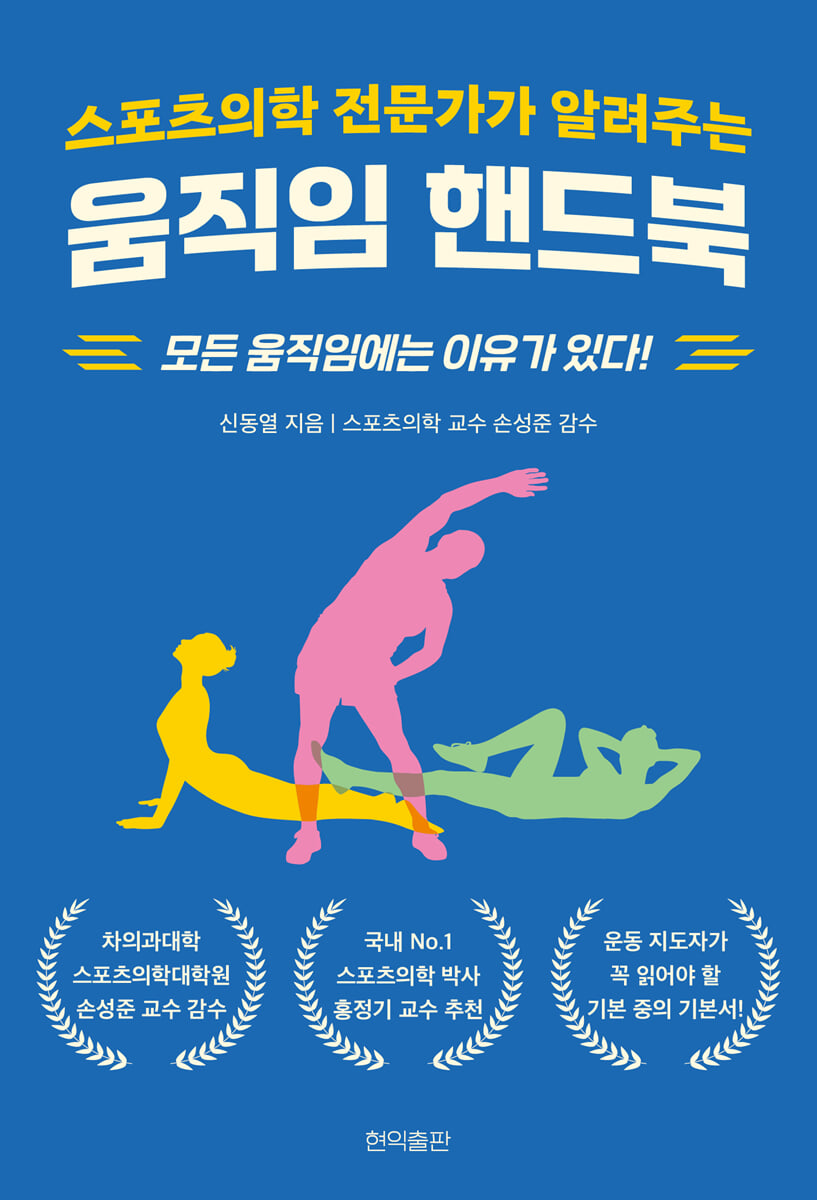
Movement Handbook from a Sports Medicine Expert
 |
Description
Book Introduction
One, two, three...
Are you simply counting numbers next to the members?
We must understand the essence that we have been overlooking: the 'principle of movement'!
An introductory book on movement recommended by Professor Hong Jeong-gi of Cha University!
Are you simply counting numbers alongside your members? Are you worrying about how to fill a 50-minute class? Are you focused solely on sales to attract repeat enrollments, neglecting personalized instruction? Even though you have a fitness instructor certification, are you struggling with the fundamental question of how to train? Are you focusing solely on visuals, ignoring important signals like pain? How well do you truly understand which muscles are being used and how they are being used during exercise? To answer all these questions, you need to have a solid understanding of the fundamental "principles of movement."
The author, who has extensive experience as a sports medicine specialist, analyzes movement from four aspects: structure, adaptation, prediction, and context.
First, we identify the 'structure' of the individual's musculoskeletal system that determines movement.
Second, we examine the process of 'adaptation', whereby humans adjust and optimize their movements for survival.
Third, we look at the five steps to creating optimal movement, including 'anticipation', and the pain caused by incorrect anticipation.
Fourth, it explains that good movement varies depending on the 'context' in which it occurs, because movement does not occur in isolation.
The movement principles based on sports medicine, which can be difficult, are explained in an interesting and easy-to-understand way for anyone.
Once you understand the principles of movement and focus on your individual, unique movements, sales will follow naturally.
That is the core role of a 'movement leader'.
This book will serve as a fundamental guide for exercise instructors who must develop individual exercise strategies for members with varying physical structures, pain areas, and exercise goals.
Just 5 minutes before class starts is enough.
Let's hold it in one hand and read it lightly.
The principles behind the members' movements will begin to become apparent.
It contains only the essence of the 'principle of movement', stripping away all the unnecessary details.
Pilates instructors who struggle with the daily class sequence, fitness trainers who diligently teach but struggle to keep up, and those who work out diligently after work but feel a bit unwell—all should pay attention to this book! You'll discover the essential "principles of movement" you've been overlooking.
Are you simply counting numbers next to the members?
We must understand the essence that we have been overlooking: the 'principle of movement'!
An introductory book on movement recommended by Professor Hong Jeong-gi of Cha University!
Are you simply counting numbers alongside your members? Are you worrying about how to fill a 50-minute class? Are you focused solely on sales to attract repeat enrollments, neglecting personalized instruction? Even though you have a fitness instructor certification, are you struggling with the fundamental question of how to train? Are you focusing solely on visuals, ignoring important signals like pain? How well do you truly understand which muscles are being used and how they are being used during exercise? To answer all these questions, you need to have a solid understanding of the fundamental "principles of movement."
The author, who has extensive experience as a sports medicine specialist, analyzes movement from four aspects: structure, adaptation, prediction, and context.
First, we identify the 'structure' of the individual's musculoskeletal system that determines movement.
Second, we examine the process of 'adaptation', whereby humans adjust and optimize their movements for survival.
Third, we look at the five steps to creating optimal movement, including 'anticipation', and the pain caused by incorrect anticipation.
Fourth, it explains that good movement varies depending on the 'context' in which it occurs, because movement does not occur in isolation.
The movement principles based on sports medicine, which can be difficult, are explained in an interesting and easy-to-understand way for anyone.
Once you understand the principles of movement and focus on your individual, unique movements, sales will follow naturally.
That is the core role of a 'movement leader'.
This book will serve as a fundamental guide for exercise instructors who must develop individual exercise strategies for members with varying physical structures, pain areas, and exercise goals.
Just 5 minutes before class starts is enough.
Let's hold it in one hand and read it lightly.
The principles behind the members' movements will begin to become apparent.
It contains only the essence of the 'principle of movement', stripping away all the unnecessary details.
Pilates instructors who struggle with the daily class sequence, fitness trainers who diligently teach but struggle to keep up, and those who work out diligently after work but feel a bit unwell—all should pay attention to this book! You'll discover the essential "principles of movement" you've been overlooking.
index
prolog
Components of Movement: Structure, Adaptation, Prediction, and Context
CHAPTER 1.
structure
From instability to stability
The Key to Stability: Uprightness and Axis
Understanding the Structure of the Body: Turtle Neck and the Scapulothoracic Joint
Stretching Misconceptions: Autoinhibition and Reciprocal Inhibition
Personalized Fitness Approach: Body Type and Structure
Movement and Structure
CHAPTER 2.
adaptation
How the body adjusts to adapt
The smallest unit of movement: sensory information
Harmony of Rich Senses: A Sense of Balance
The duality of adaptation
A Personalized Exercise Approach: Sensory and Cognitive
Principles of isolation movement
Movement and Adaptation
CHAPTER 3.
prediction
5 Steps to Creating Optimal Movement
Tools of Prediction: Categorization and Conceptualization
No movement without prediction
The impact of incorrect predictions
Personalized Exercise Approach: Patterns
Movement and prediction
CHAPTER 4.
context
Repetition without repetition: same goal, different movements
Motor Learning Through Context: Intrinsic and Extrinsic Focus
What is a good move?
Personalized Exercise Approach: Context
Movement and context
Epilogue
References
Components of Movement: Structure, Adaptation, Prediction, and Context
CHAPTER 1.
structure
From instability to stability
The Key to Stability: Uprightness and Axis
Understanding the Structure of the Body: Turtle Neck and the Scapulothoracic Joint
Stretching Misconceptions: Autoinhibition and Reciprocal Inhibition
Personalized Fitness Approach: Body Type and Structure
Movement and Structure
CHAPTER 2.
adaptation
How the body adjusts to adapt
The smallest unit of movement: sensory information
Harmony of Rich Senses: A Sense of Balance
The duality of adaptation
A Personalized Exercise Approach: Sensory and Cognitive
Principles of isolation movement
Movement and Adaptation
CHAPTER 3.
prediction
5 Steps to Creating Optimal Movement
Tools of Prediction: Categorization and Conceptualization
No movement without prediction
The impact of incorrect predictions
Personalized Exercise Approach: Patterns
Movement and prediction
CHAPTER 4.
context
Repetition without repetition: same goal, different movements
Motor Learning Through Context: Intrinsic and Extrinsic Focus
What is a good move?
Personalized Exercise Approach: Context
Movement and context
Epilogue
References
Detailed image

Into the book
If you observe a lying baby closely, you will see that when he first rolls over and begins to crawl, rather than moving his most distal arms and legs first, he moves his mouth and eyes in the direction he wants to go, then pushes his torso in the direction of his head, and the remaining arms and legs follow.
The reason we use our torso first is because it provides stability to our body through the force that pushes us forward.
--- p.21 From “The Core of Stability: Uprightness and Axis”
Turtle neck posture is often perceived as a bent neck, but in reality, the head is in front of the body's center, so the weight of the head must be supported solely by the neck and back muscles.
If these muscles fail to hold on, the structural characteristics of the scapulothoracic joint cause the thoracic spine to curve and the shoulder blades to roll forward.
In other words, what we can learn from this is that we need to understand the principles of movement by considering not only the neck but also the surrounding connected structures as a whole.
--- p.26 From “Understanding the Structure of the Body: Turtle Neck and the Scapulothoracic Joint”
Because human adaptability is ambivalent, maintaining certain patterns and postures for long periods of time can lead to pain and injury.
So the first thing we need to do is to find ways to make changes in our daily lives by moving lightly so that our bodies don't adapt to negative situations.
--- p.69 From “The Duality of Adaptation”
People who only superficially interpret the advice, "People with a herniated disc should never bend over because bending over is dangerous," may mistakenly assume that "bending over causes a herniated disc," and make the wrong prediction.
While this advice may be appropriate during the initial inflammatory phase, it may actually limit range of motion and increase pain as the recovery phase progresses.
--- p.98 From “The Impact of Incorrect Predictions”
If you were to place a cone outside and instruct them to keep their knees parallel to the cone, they would try to achieve that posture by focusing externally, even though their legs would shake.
The lunge movement, which seemed complicated, becomes clearer with the introduction of an intuitive object called a color cone.
By using tools to create a pattern, you can self-regulate your movements and learn new movements more effectively.
The reason we use our torso first is because it provides stability to our body through the force that pushes us forward.
--- p.21 From “The Core of Stability: Uprightness and Axis”
Turtle neck posture is often perceived as a bent neck, but in reality, the head is in front of the body's center, so the weight of the head must be supported solely by the neck and back muscles.
If these muscles fail to hold on, the structural characteristics of the scapulothoracic joint cause the thoracic spine to curve and the shoulder blades to roll forward.
In other words, what we can learn from this is that we need to understand the principles of movement by considering not only the neck but also the surrounding connected structures as a whole.
--- p.26 From “Understanding the Structure of the Body: Turtle Neck and the Scapulothoracic Joint”
Because human adaptability is ambivalent, maintaining certain patterns and postures for long periods of time can lead to pain and injury.
So the first thing we need to do is to find ways to make changes in our daily lives by moving lightly so that our bodies don't adapt to negative situations.
--- p.69 From “The Duality of Adaptation”
People who only superficially interpret the advice, "People with a herniated disc should never bend over because bending over is dangerous," may mistakenly assume that "bending over causes a herniated disc," and make the wrong prediction.
While this advice may be appropriate during the initial inflammatory phase, it may actually limit range of motion and increase pain as the recovery phase progresses.
--- p.98 From “The Impact of Incorrect Predictions”
If you were to place a cone outside and instruct them to keep their knees parallel to the cone, they would try to achieve that posture by focusing externally, even though their legs would shake.
The lunge movement, which seemed complicated, becomes clearer with the introduction of an intuitive object called a color cone.
By using tools to create a pattern, you can self-regulate your movements and learn new movements more effectively.
--- p.121 From “Motor Learning through Context: Intrinsic Focus and Extrinsic Focus”
Publisher's Review
When doing squats, your knees shouldn't go outside your feet?!
There is no one absolute right answer when it comes to movement!
'Good movement' should be different for each person and each situation!
YouTube, Instagram, short-form content… Just scroll down and you're in a world overflowing with information about exercise.
Anyone who has ever tried to do squats by watching one of the countless workout videos on YouTube knows that
I listen to the teacher's explanations on the screen and try to follow the movements diligently, but it's not easy.
You've clearly heard that your knees shouldn't go beyond your feet, but strangely enough, you can see that your movements don't do that.
Why do my knees extend beyond my feet? What's the problem? What constitutes a good movement?
The author, who has been researching and coaching movement in the field of sports medicine in Korea, says that 'good movement' is not an absolute standard that applies to everyone.
There is no single correct answer to what constitutes a 'good movement'; it can vary depending on the purpose and context of the movement and the individual's body structure.
This principle of movement is why the necessary tools and the guidance of exercise instructors must be slightly different.
There are complex principles hidden in countless movements that we are not aware of.
There are many factors to consider when performing a squat, such as the structure of the pelvis and the difference in length between the calf and thigh bones.
That is why you must first understand the principles of movement, then find the movement that suits you and develop an appropriate exercise strategy.
It's time to check the misunderstandings about the movement we believed to be true!
The principles of movement analyzed by a sports medicine expert!
The best value movement handbook you can read in one day!
‘If you bend your back, you will get a herniated disc’, ‘When doing squats, your knees should not go beyond your feet’.
You've probably heard things like, "To keep your core still, you have to keep your torso still."
There are many methods introduced with the expectation of immediate results, such as miracle exercises and pain relief methods, but there is a core essence that everyone overlooks.
This is the ‘principle of movement’.
Now is the time to examine the misunderstandings about the movement we have long believed to be true.
When you hold a glass of hot water, when you sit in a chair for a long time, when a baby rolls over for the first time, when a ballerina performs a difficult movement while balancing on one foot, when you step on the car brake, when you do a squat.
The hidden principles in movements that appear natural and simple because we are not conscious of our arms and legs are explained in an easy and fun way from the four aspects of ‘structure, adaptation, prediction, and context.’
By understanding the unique structure of our musculoskeletal system, the five stages of optimal movement, including the "adaptation" process and "anticipation" that allow us to adjust our movements for survival, and the "context" within which our movements occur, we will realize that every movement has a purpose.
The ultimate value-for-money movement handbook you can read in a single day! Once you've finished reading, you'll find yourself viewing movement from a new perspective.
There is no one absolute right answer when it comes to movement!
'Good movement' should be different for each person and each situation!
YouTube, Instagram, short-form content… Just scroll down and you're in a world overflowing with information about exercise.
Anyone who has ever tried to do squats by watching one of the countless workout videos on YouTube knows that
I listen to the teacher's explanations on the screen and try to follow the movements diligently, but it's not easy.
You've clearly heard that your knees shouldn't go beyond your feet, but strangely enough, you can see that your movements don't do that.
Why do my knees extend beyond my feet? What's the problem? What constitutes a good movement?
The author, who has been researching and coaching movement in the field of sports medicine in Korea, says that 'good movement' is not an absolute standard that applies to everyone.
There is no single correct answer to what constitutes a 'good movement'; it can vary depending on the purpose and context of the movement and the individual's body structure.
This principle of movement is why the necessary tools and the guidance of exercise instructors must be slightly different.
There are complex principles hidden in countless movements that we are not aware of.
There are many factors to consider when performing a squat, such as the structure of the pelvis and the difference in length between the calf and thigh bones.
That is why you must first understand the principles of movement, then find the movement that suits you and develop an appropriate exercise strategy.
It's time to check the misunderstandings about the movement we believed to be true!
The principles of movement analyzed by a sports medicine expert!
The best value movement handbook you can read in one day!
‘If you bend your back, you will get a herniated disc’, ‘When doing squats, your knees should not go beyond your feet’.
You've probably heard things like, "To keep your core still, you have to keep your torso still."
There are many methods introduced with the expectation of immediate results, such as miracle exercises and pain relief methods, but there is a core essence that everyone overlooks.
This is the ‘principle of movement’.
Now is the time to examine the misunderstandings about the movement we have long believed to be true.
When you hold a glass of hot water, when you sit in a chair for a long time, when a baby rolls over for the first time, when a ballerina performs a difficult movement while balancing on one foot, when you step on the car brake, when you do a squat.
The hidden principles in movements that appear natural and simple because we are not conscious of our arms and legs are explained in an easy and fun way from the four aspects of ‘structure, adaptation, prediction, and context.’
By understanding the unique structure of our musculoskeletal system, the five stages of optimal movement, including the "adaptation" process and "anticipation" that allow us to adjust our movements for survival, and the "context" within which our movements occur, we will realize that every movement has a purpose.
The ultimate value-for-money movement handbook you can read in a single day! Once you've finished reading, you'll find yourself viewing movement from a new perspective.
GOODS SPECIFICS
- Date of issue: July 1, 2024
- Page count, weight, size: 156 pages | 128*188*20mm
- ISBN13: 9791193217641
- ISBN10: 1193217644
You may also like
카테고리
korean


korean

![GQ KOREA Mark (Monthly): December [2025]](http://librairie.coreenne.fr/cdn/shop/files/8ef265dbbfbf186523ed75ba7319009d.jpg?v=1765340328&width=3840)


