

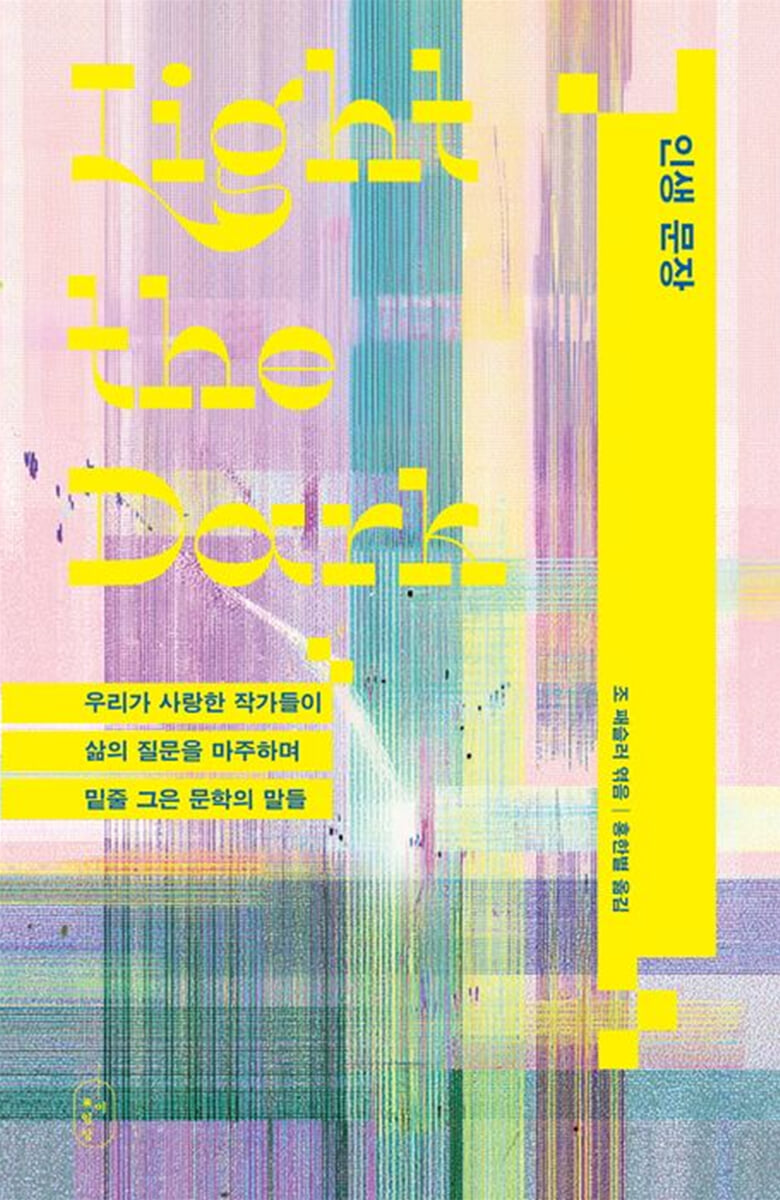
Life sentences
 |
Description
Book Introduction
What answers will we get from the book?
Hear the answer from the master
A collection of essays by 32 great writers, including Stephen King, Elizabeth Gilbert, Viet Thanh Nguyen, and Hanya Yanagihara, has been published, titled "Life Sentences."
This book is a compilation of prose responses from leading figures in English and American literature to the question, “Choose the one passage from literature that most strongly struck your mind.”
Authors pick out passages from literature and honestly explain why they are important and how they have influenced them.
It contains a variety of stories about sentences and literature, from sentences that I came across inadvertently in a book I read as a child and kept in my heart my whole life, to sentences that became a breakthrough when I faced difficult questions such as identity or a crossroads in life when I was at a dead end, or when I felt lost when writing.
This essay, which features the stories of the most beloved authors at the forefront of Anglo-American literature, including those from the United States, the United Kingdom, and Ireland, will inspire empathy and a love for literature in book lovers, and provide insight to those seeking to confront life's questions and gain insight.
Hear the answer from the master
A collection of essays by 32 great writers, including Stephen King, Elizabeth Gilbert, Viet Thanh Nguyen, and Hanya Yanagihara, has been published, titled "Life Sentences."
This book is a compilation of prose responses from leading figures in English and American literature to the question, “Choose the one passage from literature that most strongly struck your mind.”
Authors pick out passages from literature and honestly explain why they are important and how they have influenced them.
It contains a variety of stories about sentences and literature, from sentences that I came across inadvertently in a book I read as a child and kept in my heart my whole life, to sentences that became a breakthrough when I faced difficult questions such as identity or a crossroads in life when I was at a dead end, or when I felt lost when writing.
This essay, which features the stories of the most beloved authors at the forefront of Anglo-American literature, including those from the United States, the United Kingdom, and Ireland, will inspire empathy and a love for literature in book lovers, and provide insight to those seeking to confront life's questions and gain insight.
- You can preview some of the book's contents.
Preview
index
Entering
Chapter 1: Sentences of Life
Elizabeth Gilbert | I want to be someone like this sentence.
Jonathan Letham | Why I'm Fascinated by Kafka
Emma Donoghue | My Strange and Tasty Role Model
Charles Simic | The Power of Poetry to Help Us See Truths We Don't Want to See
Jessie Ball | The Meaning of Nothingness You Never Knew
Amy Tan | This sentence is my life and my writing.
David Mitchell | A Poem That Melts My Skull
Ayana Mathis | We All Die
Jim Shepard | Can People Change?
Edwige Danticar | Every Immigrant Is an Artist
Tom Perrotta | The Extraordinary Truth in Ordinary Moments
Chapter 2 Author's Sentence
Stephen King | This is the essence of the first sentence.
William Gibson | How to Cut the Perfect First Sentence
Khaled Hosseini | The Most Honest Statement on Writing
Lee Sun Canin | The final sentence that ignites the story
Roxane Gay | Writing with Multiple Identities
Viet Thanh Nguyen | The Most Powerful Sympathizer in "The Sympathizer"
Angela Flournoy | A Sentence That Changed My View of Art
Leslie Jamison | What You Should Never Do When Writing
Lee Yoon Lee | Never turn a blind eye
Mary Gaitskill | A sentence that made me jump
Jane Smiley | What's the most enduring thing in a novel?
TC
Boyle | Principles of a Novel with a Good Ending
Chapter 3: Beloved Sentences
Claire Mesud | This piece holds up my ruins.
Billy Collins | The Perfect Way to Have Poetry
Hanya Yanagihara | Dissecting language to savor its entrails
Marilynne Robinson | The Amazing and Unusual Abilities We Have
Lev Grossman | How to Create Magic Without Casting It
Eileen Miles | A novel that transcends time, literature, and reality
Michael Chabon | The Magical Spell that Unfolds an Infinite World
Ben Marcus | An Ecstatic Mix of Fear and Beauty
Amy Bender | A Life Quote I Met at a Funeral
Chapter 1: Sentences of Life
Elizabeth Gilbert | I want to be someone like this sentence.
Jonathan Letham | Why I'm Fascinated by Kafka
Emma Donoghue | My Strange and Tasty Role Model
Charles Simic | The Power of Poetry to Help Us See Truths We Don't Want to See
Jessie Ball | The Meaning of Nothingness You Never Knew
Amy Tan | This sentence is my life and my writing.
David Mitchell | A Poem That Melts My Skull
Ayana Mathis | We All Die
Jim Shepard | Can People Change?
Edwige Danticar | Every Immigrant Is an Artist
Tom Perrotta | The Extraordinary Truth in Ordinary Moments
Chapter 2 Author's Sentence
Stephen King | This is the essence of the first sentence.
William Gibson | How to Cut the Perfect First Sentence
Khaled Hosseini | The Most Honest Statement on Writing
Lee Sun Canin | The final sentence that ignites the story
Roxane Gay | Writing with Multiple Identities
Viet Thanh Nguyen | The Most Powerful Sympathizer in "The Sympathizer"
Angela Flournoy | A Sentence That Changed My View of Art
Leslie Jamison | What You Should Never Do When Writing
Lee Yoon Lee | Never turn a blind eye
Mary Gaitskill | A sentence that made me jump
Jane Smiley | What's the most enduring thing in a novel?
TC
Boyle | Principles of a Novel with a Good Ending
Chapter 3: Beloved Sentences
Claire Mesud | This piece holds up my ruins.
Billy Collins | The Perfect Way to Have Poetry
Hanya Yanagihara | Dissecting language to savor its entrails
Marilynne Robinson | The Amazing and Unusual Abilities We Have
Lev Grossman | How to Create Magic Without Casting It
Eileen Miles | A novel that transcends time, literature, and reality
Michael Chabon | The Magical Spell that Unfolds an Infinite World
Ben Marcus | An Ecstatic Mix of Fear and Beauty
Amy Bender | A Life Quote I Met at a Funeral
Detailed image

Into the book
As I collected additional writing to complete this book, I felt like a perpetual student.
I learned about not only creative writing and literature, but also sociology, psychology, and political science.
It was like having exclusive access to a new, great teacher every week.
While this was enjoyable, it was also vague because even though I asked all the writers the same questions, the answers were so varied and rich that I couldn't find a single theme that would encompass them all.
It was a difficult task, almost as difficult as choosing one favorite sentence from among the many, many pieces of writing I love.
Then suddenly the road came into view.
As the authors in this book often do when they hit a dead end, they find a breakthrough in another book.
--- pp.7-8 From "Introduction"
As someone who always struggles with anxiety and lack of courage, I am deeply moved by the sheer dedication that allows me to feel wonder in the face of pain and adversity.
Anything becomes a puzzle if you can do that.
The disaster is just a dramatically heightened puzzle.
When I encounter obstacles in my writing, the best approach for me is to cling to stubborn joy.
In fact, writing is a very dramatic pursuit, full of tragedy, disaster, emotion, and failure.
Once I learned to view the pain of things not going well as a tragedy, rather than a miracle, my path as a writer became much easier.
--- pp.26-27 From "Elizabeth Gilbert, I Want to Be a Person Like This Sentence"
A novel cannot be something that I find acceptable and at the same time something that everyone can accept.
--- p.156 From "William Gibson, How to Cut the Perfect First Sentence"
The effect this book has had on me is part of an osmosis process that has been going on for decades.
This is the result of reading countless books and absorbing the writing styles of countless authors, consciously and unconsciously.
Some books are especially precious.
I always keep books by authors whose styles and stories I want to emulate and steal close by.
Then I came across 『The End of the World』.
This book seemed to speak most closely and intimately to me about how I see myself as a writer and how I see my narrator as a character.
It was the culmination of everything that had influenced and inspired me for so long.
--- p.193 From “Viet Thanh Nguyen, The Most Powerful Sympathizer of ‘The Sympathizer’”
It's hard to say exactly what I'm pursuing in my books, but one of them is to broaden our understanding of the world.
That can happen through characters.
A person like Karenin is probably someone I could never get to know deeply in real life.
You could meet someone like Karenin, but you would have nothing to talk to, and you would both find each other boring and unpleasant.
But books like Anna Karenina take us beyond the dull, ordinary facade and allow us to meet the real person beneath the surface.
--- p.231 From "Mary Gaitskill, A Sentence That Made Me Jump Up"
Isn't the tension between the desire to linger, savoring a sentence, and the desire to know what happens next, the very essence of fiction?
You have to keep reading to reach the end of the book.
Especially if it's a long book like Our Common Friend.
But something grabs me, holds me back, and keeps me from moving forward.
Because of this experience, I love novels more than any other form of art.
When reading poetry, it is natural to read slowly.
If a poem has 100 words, you have to pay attention to each and every word.
But when you read a novel, you have to keep moving.
Yet, when a certain sentence catches your eye, you resist the movement to move forward.
--- pp.236-237 From "Jane Smiley, What Lasts the Longest in a Novel?"
What we write are the pieces that hold up our ruins.
The scraps of words written on paper will outlive us.
Like the debris from a tsunami that washes up on the other side of the ocean, writing is something that can be salvaged and saved.
Of course, there are other ways to leave a mark.
If you are rich, you can leave behind a library, a building, or a hospital.
But writing leaves behind a concrete sense of what it was like to live in this world at a particular time.
Writing tells us what it means to be human.
--- p.261 From "This Piece Supports My Ruins" by Claire Methode
Because literature is created when a writer takes a big leap forward.
Whether it's plot, character, structure, tone, or language, a book must take a risk in at least one way.
--- p.287 From "Hanya Yanagihara, Dissecting Language and Savoring Its Inner Vitality"
I considered the magical act of what seemed like an escape to be a path to encountering myself and my problems to be a fundamental principle of reading and novels.
In this way, the portal in The Lion, the Witch and the Wardrobe becomes an excellent metaphor for reading itself.
Lucy opening the closet door is like opening the cover of a book and going through it to another place.
It's the same experience that happens to the reader when he reads that passage.
The reader sees Lucy doing the same thing she does in a dramatic and transformed way.
(Omitted) To me, the closet door seemed to open like a book, pulling Lucy and the readers into a new world of imagination.
I want to be that kind of writer.
A writer who allows readers to pass seamlessly from the real world to the fantasy world, and from real life to the world of reading, without any obstacles.
--- pp.307-308 From "Lev Grossman, How to Create Magic Without Casting Magic"
The author believes that by arranging words in a certain order, he can transport the reader to another world.
It can make you feel something, experience a sensation, and draw out something deep within your imagination.
However, we cannot systematically explain how this happens.
So to speak, 'If you want to write a good short story, you have to do this.
This is how you can write a good novel.
If it's literature, you can't talk about it like, 'It should be like this, it shouldn't be like that.'
We can debate this topic, but just because a method worked doesn't mean we can just repeat it.
The way the book is put together is beyond words.
The fact that I know so little about this process, yet am infinitely drawn to it, is what keeps me coming back.
--- p.345 From "Ben Marcus, The Ecstatic Mixture of Fear and Beauty"
I thought it would be nice to be able to take out this poem and read it at any moment in my life.
So I memorized the poem.
I wanted to have a writing tool that would help me think about and express how I was feeling, whether I was having a hard time or was happy.
The more articles like this, the better.
Our memories of books are generally vague.
A phrase that I cherished fades from my memory and then disappears.
Memorization was a way for me to force a more precise and permanent relationship with the text.
When you memorize a text, some mysterious structure enters your mind and boils inside.
When I touch this language, which has been crafted so intricately, my heart races and I realize, 'Art can do even this.'
I also experienced physical reactions.
I felt drunk on caffeine.
And that feeling lasted a very long time.
I learned about not only creative writing and literature, but also sociology, psychology, and political science.
It was like having exclusive access to a new, great teacher every week.
While this was enjoyable, it was also vague because even though I asked all the writers the same questions, the answers were so varied and rich that I couldn't find a single theme that would encompass them all.
It was a difficult task, almost as difficult as choosing one favorite sentence from among the many, many pieces of writing I love.
Then suddenly the road came into view.
As the authors in this book often do when they hit a dead end, they find a breakthrough in another book.
--- pp.7-8 From "Introduction"
As someone who always struggles with anxiety and lack of courage, I am deeply moved by the sheer dedication that allows me to feel wonder in the face of pain and adversity.
Anything becomes a puzzle if you can do that.
The disaster is just a dramatically heightened puzzle.
When I encounter obstacles in my writing, the best approach for me is to cling to stubborn joy.
In fact, writing is a very dramatic pursuit, full of tragedy, disaster, emotion, and failure.
Once I learned to view the pain of things not going well as a tragedy, rather than a miracle, my path as a writer became much easier.
--- pp.26-27 From "Elizabeth Gilbert, I Want to Be a Person Like This Sentence"
A novel cannot be something that I find acceptable and at the same time something that everyone can accept.
--- p.156 From "William Gibson, How to Cut the Perfect First Sentence"
The effect this book has had on me is part of an osmosis process that has been going on for decades.
This is the result of reading countless books and absorbing the writing styles of countless authors, consciously and unconsciously.
Some books are especially precious.
I always keep books by authors whose styles and stories I want to emulate and steal close by.
Then I came across 『The End of the World』.
This book seemed to speak most closely and intimately to me about how I see myself as a writer and how I see my narrator as a character.
It was the culmination of everything that had influenced and inspired me for so long.
--- p.193 From “Viet Thanh Nguyen, The Most Powerful Sympathizer of ‘The Sympathizer’”
It's hard to say exactly what I'm pursuing in my books, but one of them is to broaden our understanding of the world.
That can happen through characters.
A person like Karenin is probably someone I could never get to know deeply in real life.
You could meet someone like Karenin, but you would have nothing to talk to, and you would both find each other boring and unpleasant.
But books like Anna Karenina take us beyond the dull, ordinary facade and allow us to meet the real person beneath the surface.
--- p.231 From "Mary Gaitskill, A Sentence That Made Me Jump Up"
Isn't the tension between the desire to linger, savoring a sentence, and the desire to know what happens next, the very essence of fiction?
You have to keep reading to reach the end of the book.
Especially if it's a long book like Our Common Friend.
But something grabs me, holds me back, and keeps me from moving forward.
Because of this experience, I love novels more than any other form of art.
When reading poetry, it is natural to read slowly.
If a poem has 100 words, you have to pay attention to each and every word.
But when you read a novel, you have to keep moving.
Yet, when a certain sentence catches your eye, you resist the movement to move forward.
--- pp.236-237 From "Jane Smiley, What Lasts the Longest in a Novel?"
What we write are the pieces that hold up our ruins.
The scraps of words written on paper will outlive us.
Like the debris from a tsunami that washes up on the other side of the ocean, writing is something that can be salvaged and saved.
Of course, there are other ways to leave a mark.
If you are rich, you can leave behind a library, a building, or a hospital.
But writing leaves behind a concrete sense of what it was like to live in this world at a particular time.
Writing tells us what it means to be human.
--- p.261 From "This Piece Supports My Ruins" by Claire Methode
Because literature is created when a writer takes a big leap forward.
Whether it's plot, character, structure, tone, or language, a book must take a risk in at least one way.
--- p.287 From "Hanya Yanagihara, Dissecting Language and Savoring Its Inner Vitality"
I considered the magical act of what seemed like an escape to be a path to encountering myself and my problems to be a fundamental principle of reading and novels.
In this way, the portal in The Lion, the Witch and the Wardrobe becomes an excellent metaphor for reading itself.
Lucy opening the closet door is like opening the cover of a book and going through it to another place.
It's the same experience that happens to the reader when he reads that passage.
The reader sees Lucy doing the same thing she does in a dramatic and transformed way.
(Omitted) To me, the closet door seemed to open like a book, pulling Lucy and the readers into a new world of imagination.
I want to be that kind of writer.
A writer who allows readers to pass seamlessly from the real world to the fantasy world, and from real life to the world of reading, without any obstacles.
--- pp.307-308 From "Lev Grossman, How to Create Magic Without Casting Magic"
The author believes that by arranging words in a certain order, he can transport the reader to another world.
It can make you feel something, experience a sensation, and draw out something deep within your imagination.
However, we cannot systematically explain how this happens.
So to speak, 'If you want to write a good short story, you have to do this.
This is how you can write a good novel.
If it's literature, you can't talk about it like, 'It should be like this, it shouldn't be like that.'
We can debate this topic, but just because a method worked doesn't mean we can just repeat it.
The way the book is put together is beyond words.
The fact that I know so little about this process, yet am infinitely drawn to it, is what keeps me coming back.
--- p.345 From "Ben Marcus, The Ecstatic Mixture of Fear and Beauty"
I thought it would be nice to be able to take out this poem and read it at any moment in my life.
So I memorized the poem.
I wanted to have a writing tool that would help me think about and express how I was feeling, whether I was having a hard time or was happy.
The more articles like this, the better.
Our memories of books are generally vague.
A phrase that I cherished fades from my memory and then disappears.
Memorization was a way for me to force a more precise and permanent relationship with the text.
When you memorize a text, some mysterious structure enters your mind and boils inside.
When I touch this language, which has been crafted so intricately, my heart races and I realize, 'Art can do even this.'
I also experienced physical reactions.
I felt drunk on caffeine.
And that feeling lasted a very long time.
--- pp.251-252 From "Amy Bender, A Life Sentence I Met at a Funeral"
Publisher's Review
A sentence enters someone's life
Shining moments that become 'life sentences'
『Life Sentences』, an anthology of essays that compiles stories about life sentences from various authors, ranging from mega-bestselling authors with hundreds of thousands of readers worldwide, such as Stephen King, Elizabeth Gilbert, and Heled Hosseini, to young writers who are currently the most beloved in Anglo-American literature, such as Viet Thanh Nguyen of 『The Sympathizer』 and Hanya Yanagihara of 『Little Life』, is introduced to domestic readers.
The 32 essays, woven under the single theme of "Sentences that Impacted Life," are filled with individuality, unique perspectives, and stories about life and literature.
The individual sentences chosen by the authors are sometimes chosen for literary or aesthetic significance, and sometimes for extremely personal reasons.
But even for that personal reason, it is meaningful because it gives us a glimpse into the writers' insight into literature and sentences.
Editor Joe Passler was amazed at how diverse the answers to one question could be.
This anthology of essays, which covers a wide range of topics including identity, anxieties, ethics, and aesthetics, is defined as “a memoir, a literary critique, a writing class, and an open workshop.”
This book, which unfolds with a variety of personalities and writing styles how a person encounters a certain sentence, how it influences them, and how they find answers, stands out for its ability to condense 32 lives, stories, and insights, as it is written by a team of 32 writers.
Chapter 1, 'Sentences of Life', deals with stories of finding answers to life through literary texts.
This book contains the memoirs of masters who found answers to their worries and passions in life through literature, such as a story about a sentence they came across by chance one day that became their life motto, and a sentence that became the answer when they were wandering about their identity.
Chapter 2, 'The Writer's Sentences', explains the answers to writing that professional writers have found in literature.
From a consideration of sentences that encapsulate the essence of writing, novels, and poetry, to specific methods for handling first and last sentences and characters, and even the mindset of a writer, this course presents a diverse and three-dimensional lecture.
Chapter 3, 'Beloved Sentences', talks about sentences in literature that readers have kept in their hearts throughout their lives.
Because writers are people who love literature so much that they have made it their profession, the stories about literature they tell are full of life and especially fun to read because of their love for it.
The three chapters are full of sincerity, and while they may seem like a lot of nonsense to those who don't know, they are stories full of sincerity that readers who love literature will deeply empathize with.
An invitation to all who love literature and writing.
As a literary essay, 『Sentences of Life』 is full of stories that anyone who loves books can relate to.
Do you embrace a passage you encountered in a book, using it as a guide for your life? Is there an author or character you looked up to as a role model during your formative years? Is there a passage you always keep on your desk or phone background? If even one of these applies to you, you'll deeply resonate with this book and find yourself underlining every single part.
Even the masters who have won the love of hundreds of thousands of readers around the world and swept prestigious awards like the Pulitzer Prize and the National Book Critics Circle have had experiences similar to ours.
What makes this book special is that it presents these honest experiences in a variety of lives, perspectives, and writing styles.
In Ireland in the 1980s, I realized I was a lesbian, but I couldn't tell anyone.
At that time, I couldn't find anyone in Irish culture with whom I could identify.
So I used Emily Dickinson.
Looking at Dickinson's poems and letters, it seems that she had passionate feelings not only for the men but also for the women around her.
I had this thought.
'I may be a monster right here and now, but I can still be like Emily Dickinson.
Does it have to be normal?'
_Emma Donoghue, from My Strange and Tasty Role Model (p. 44)
By observing the difficulties they faced, the sentences they encountered, and how they incorporated them into their lives, we will not only gain empathy and inspiration, but also insight into how they view literature and how they use it as nourishment.
How do masters gain insight from literature?
Also, since all of the writers chose to be writers as their profession, 'writing' is a large part of the difficulties they face.
This book offers a wealth of insights from writers on writing.
As a professional writer, it's relatable to see someone struggling with their writing, and it's also valuable and helpful to see how they navigate those challenges.
Some writers talk about the macro aspects of writing, such as what makes a great novel and how to communicate a story to readers. Others offer small but specific and practical tips, such as, “Make sure your internet home screen is boring” and “Think of the advance the editor is waiting for your manuscript to be submitted to.”
Just as writers have different personalities, their literary views and methods for overcoming slumps are also diverse.
There are also many specific writing theories on the basic elements of writing, such as the first sentence, last sentence, characters in a novel, and the ending.
This is possible because many of the authors of this book also give writing lectures on the podium.
He also provides practical and friendly 'writing lessons' that address the big and small concerns that aspiring writers encounter in class.
In particular, the two authors who dealt with the first sentence, Stephen King and William Gibson, have very different specific views on the first sentence. Comparing them will not only be interesting but will also allow you to build up your writing knowledge in a three-dimensional way.
Shining moments that become 'life sentences'
『Life Sentences』, an anthology of essays that compiles stories about life sentences from various authors, ranging from mega-bestselling authors with hundreds of thousands of readers worldwide, such as Stephen King, Elizabeth Gilbert, and Heled Hosseini, to young writers who are currently the most beloved in Anglo-American literature, such as Viet Thanh Nguyen of 『The Sympathizer』 and Hanya Yanagihara of 『Little Life』, is introduced to domestic readers.
The 32 essays, woven under the single theme of "Sentences that Impacted Life," are filled with individuality, unique perspectives, and stories about life and literature.
The individual sentences chosen by the authors are sometimes chosen for literary or aesthetic significance, and sometimes for extremely personal reasons.
But even for that personal reason, it is meaningful because it gives us a glimpse into the writers' insight into literature and sentences.
Editor Joe Passler was amazed at how diverse the answers to one question could be.
This anthology of essays, which covers a wide range of topics including identity, anxieties, ethics, and aesthetics, is defined as “a memoir, a literary critique, a writing class, and an open workshop.”
This book, which unfolds with a variety of personalities and writing styles how a person encounters a certain sentence, how it influences them, and how they find answers, stands out for its ability to condense 32 lives, stories, and insights, as it is written by a team of 32 writers.
Chapter 1, 'Sentences of Life', deals with stories of finding answers to life through literary texts.
This book contains the memoirs of masters who found answers to their worries and passions in life through literature, such as a story about a sentence they came across by chance one day that became their life motto, and a sentence that became the answer when they were wandering about their identity.
Chapter 2, 'The Writer's Sentences', explains the answers to writing that professional writers have found in literature.
From a consideration of sentences that encapsulate the essence of writing, novels, and poetry, to specific methods for handling first and last sentences and characters, and even the mindset of a writer, this course presents a diverse and three-dimensional lecture.
Chapter 3, 'Beloved Sentences', talks about sentences in literature that readers have kept in their hearts throughout their lives.
Because writers are people who love literature so much that they have made it their profession, the stories about literature they tell are full of life and especially fun to read because of their love for it.
The three chapters are full of sincerity, and while they may seem like a lot of nonsense to those who don't know, they are stories full of sincerity that readers who love literature will deeply empathize with.
An invitation to all who love literature and writing.
As a literary essay, 『Sentences of Life』 is full of stories that anyone who loves books can relate to.
Do you embrace a passage you encountered in a book, using it as a guide for your life? Is there an author or character you looked up to as a role model during your formative years? Is there a passage you always keep on your desk or phone background? If even one of these applies to you, you'll deeply resonate with this book and find yourself underlining every single part.
Even the masters who have won the love of hundreds of thousands of readers around the world and swept prestigious awards like the Pulitzer Prize and the National Book Critics Circle have had experiences similar to ours.
What makes this book special is that it presents these honest experiences in a variety of lives, perspectives, and writing styles.
In Ireland in the 1980s, I realized I was a lesbian, but I couldn't tell anyone.
At that time, I couldn't find anyone in Irish culture with whom I could identify.
So I used Emily Dickinson.
Looking at Dickinson's poems and letters, it seems that she had passionate feelings not only for the men but also for the women around her.
I had this thought.
'I may be a monster right here and now, but I can still be like Emily Dickinson.
Does it have to be normal?'
_Emma Donoghue, from My Strange and Tasty Role Model (p. 44)
By observing the difficulties they faced, the sentences they encountered, and how they incorporated them into their lives, we will not only gain empathy and inspiration, but also insight into how they view literature and how they use it as nourishment.
How do masters gain insight from literature?
Also, since all of the writers chose to be writers as their profession, 'writing' is a large part of the difficulties they face.
This book offers a wealth of insights from writers on writing.
As a professional writer, it's relatable to see someone struggling with their writing, and it's also valuable and helpful to see how they navigate those challenges.
Some writers talk about the macro aspects of writing, such as what makes a great novel and how to communicate a story to readers. Others offer small but specific and practical tips, such as, “Make sure your internet home screen is boring” and “Think of the advance the editor is waiting for your manuscript to be submitted to.”
Just as writers have different personalities, their literary views and methods for overcoming slumps are also diverse.
There are also many specific writing theories on the basic elements of writing, such as the first sentence, last sentence, characters in a novel, and the ending.
This is possible because many of the authors of this book also give writing lectures on the podium.
He also provides practical and friendly 'writing lessons' that address the big and small concerns that aspiring writers encounter in class.
In particular, the two authors who dealt with the first sentence, Stephen King and William Gibson, have very different specific views on the first sentence. Comparing them will not only be interesting but will also allow you to build up your writing knowledge in a three-dimensional way.
GOODS SPECIFICS
- Date of issue: November 4, 2025
- Format: Hardcover book binding method guide
- Page count, weight, size: 356 pages | 580g | 130*210*25mm
- ISBN13: 9791199429604
- ISBN10: 1199429600
You may also like
카테고리
korean


korean

![GQ KOREA Mark (Monthly): December [2025]](http://librairie.coreenne.fr/cdn/shop/files/8ef265dbbfbf186523ed75ba7319009d.jpg?v=1765340328&width=3840)


