

Everywhere Economics
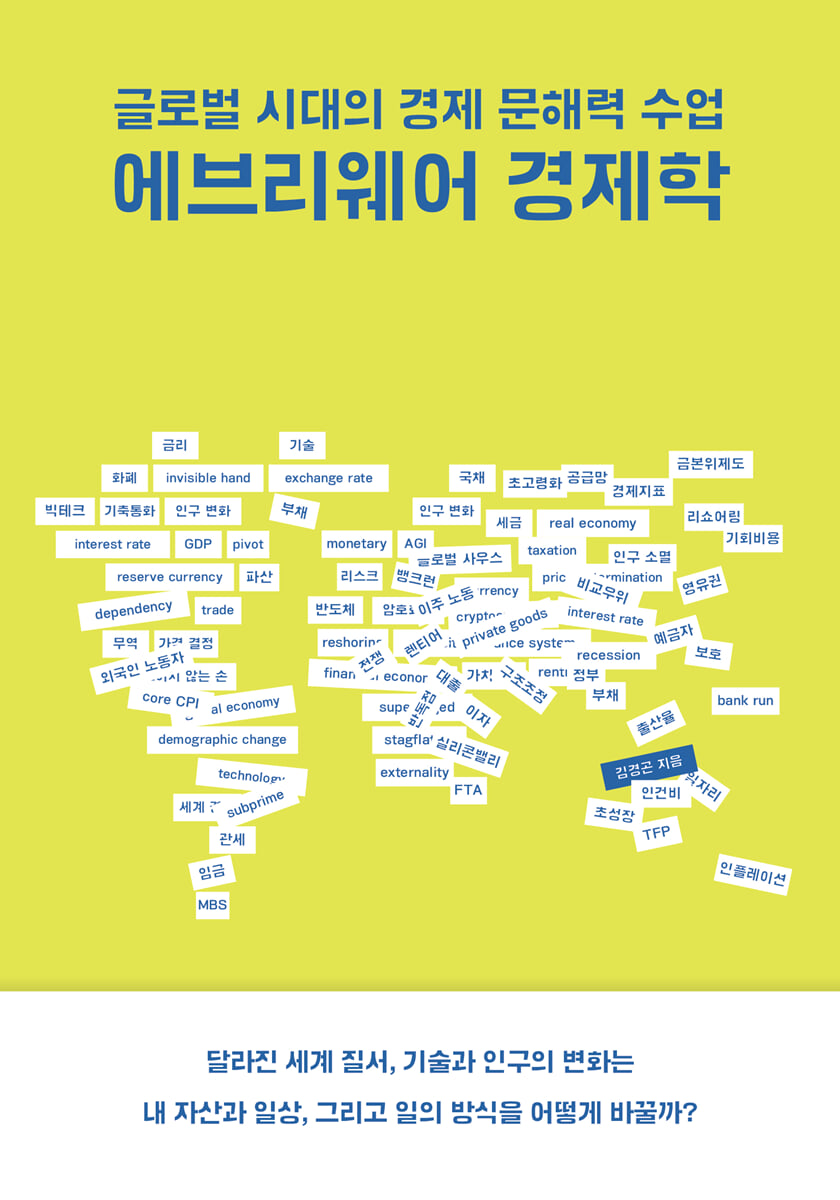 |
Description
Book Introduction
Economics: A New Liberal Arts for Understanding the World Connected to "Me"
“The changing world order, changes in technology and population
“How can I change my assets, my daily life, and the way I work?”
How do "stories from distant worlds" like war, interest rates, exchange rates, technological innovation, and demographic changes infiltrate our lunch budgets, rent, mortgage rates, jobs, and spending habits? Everywhere Economics explains, with concrete examples and in easily understandable language, the intricate interconnection between global news and the macroeconomy and our daily lives.
This book provides a comprehensive overview of the economic phenomena we face today, from the algorithms of Big Tech companies, the rise of Chinese manufacturing, the labor market transformed by AI, the ripple effects of restructuring, and the changes brought about by a hyper-aging society and population decline.
Beyond the interpretation of fragmented news and economic concepts, this guide connects the world order, technological change, and demographic trends to "my daily economics."
Through this book, readers will begin to develop the economic literacy to interpret seemingly complex news and experience a shift in their perspective on the world.
“The changing world order, changes in technology and population
“How can I change my assets, my daily life, and the way I work?”
How do "stories from distant worlds" like war, interest rates, exchange rates, technological innovation, and demographic changes infiltrate our lunch budgets, rent, mortgage rates, jobs, and spending habits? Everywhere Economics explains, with concrete examples and in easily understandable language, the intricate interconnection between global news and the macroeconomy and our daily lives.
This book provides a comprehensive overview of the economic phenomena we face today, from the algorithms of Big Tech companies, the rise of Chinese manufacturing, the labor market transformed by AI, the ripple effects of restructuring, and the changes brought about by a hyper-aging society and population decline.
Beyond the interpretation of fragmented news and economic concepts, this guide connects the world order, technological change, and demographic trends to "my daily economics."
Through this book, readers will begin to develop the economic literacy to interpret seemingly complex news and experience a shift in their perspective on the world.
- You can preview some of the book's contents.
Preview
index
prolog
Chapter 1 - How do economic news stories penetrate my daily life?
There's a war in Ukraine, so why are bread prices rising in our country?
The dollar, the money that quietly shakes our lives
I woke up bankrupt? Is my money in the bank really safe?
Why We Should Continue to Care About Foreign Countries' Debt
Chapter 2 - In an era where technology becomes money, how will my work and life change?
Can Big Tech Really Change the World?
China, which started manufacturing "cheaply and well," is shaking up the world.
Utilizing or replacing, what is the future of work in the AI era?
Chapter 3: A New World: A Growing Older and More Diverse Workplace and Population Change
Current population decline, people who work are disappearing!
Why do young people in the Global South leave their homes?
How will other companies' restructuring affect me?
Economic indicators are improving, but why does my life seem more difficult?
Questions posed by economic giants to us living in the present
Epilogue
main
Chapter 1 - How do economic news stories penetrate my daily life?
There's a war in Ukraine, so why are bread prices rising in our country?
The dollar, the money that quietly shakes our lives
I woke up bankrupt? Is my money in the bank really safe?
Why We Should Continue to Care About Foreign Countries' Debt
Chapter 2 - In an era where technology becomes money, how will my work and life change?
Can Big Tech Really Change the World?
China, which started manufacturing "cheaply and well," is shaking up the world.
Utilizing or replacing, what is the future of work in the AI era?
Chapter 3: A New World: A Growing Older and More Diverse Workplace and Population Change
Current population decline, people who work are disappearing!
Why do young people in the Global South leave their homes?
How will other companies' restructuring affect me?
Economic indicators are improving, but why does my life seem more difficult?
Questions posed by economic giants to us living in the present
Epilogue
main
Detailed image

Into the book
This book begins with the question, "Why do we need to understand economics?"
In this day and age, the economy is not just about making money; it's a tool for reading the world's trends and making better choices.
An era where my spending creates someone's job, my investment decisions send ripples throughout society, and a country's policies can change the lives of someone living halfway around the world.
That's why we need to know the economy.
--- From the "Prologue"
From now on, when you see words like these on the news, don't turn away and say, "What does this have to do with me?"
Because that news could soon be the story that ends up in my bank account, my salary, and my dinner table.
Knowing economics means having the power to read how the world affects me.
And that power will become the most realistic weapon that will help us live smarter in the future.
--- From "The war broke out in Ukraine, so why are bread prices rising in our country?"
What if the U.S. government were to issue a massive amount of Treasury bonds, saying, "We're a little short on money?" Interest rates would naturally rise.
And as US Treasury yields rise, the same thought crosses the minds of investors around the world.
"Is it really necessary to invest in risky places? Let's go with US Treasury bonds." If global investment funds flow to the US like this, it could create a relatively cold wind in Korea's won-denominated bond market.
As investors decrease, the government also becomes more concerned.
“Who will buy our bonds now…?”
There is only one answer.
We'll have to offer a higher interest rate.
As a result, interest rates on Korean government bonds will also rise.
In other words, if the U.S. prints more government bonds, the interest rates on the money we borrow will also rise.
As a result, our government's cost of capital increases.
--- From "Why We Should Continue to Be Concerned About 'Other Countries' Debt"
China has secured competitiveness not only in high-tech industries but also in the ultra-low-cost goods sector.
Representative examples include AliExpress, Temu, and Shen.
Nowadays, they call it 'Altes', a coined word, by taking only the first letters.
Altesh is sweeping the globe as if it were a team, attracting consumers.
China is dominating the global e-commerce market with these platforms.
--- From "China, which started making 'good things cheaply', is shaking up the world"
Just as telephone operators disappeared, but new office and service jobs emerged in the process, we must not forget that AI will create as many new jobs as it eliminates.
And the response varies across industries. If AI makes it possible to produce something cheaper and faster, people might say, "Wow, this is great!" and demand could explode, leading to increased employment.
Conversely, no matter how cheaply a product is made, if you think, “I’ll just buy one anyway,” employment may decrease.
--- From "The Future of Work in the AI Era: Utilized or Replaced?"
An analysis of data from advanced economies from 1870 to 2017 found that the higher the proportion of elderly people, the lower the returns on safe assets.
So, money is increasingly flowing into safe assets, but this paradoxically leads to lower returns.
The life that many people dream of, ‘living on interest and dividends,’ is not as easy as it seems.
In economics, these people are called 'rentiers' because they live off rent.
The more renters there are, the more difficult it becomes to make a living as a renter, creating a collective paradox.
The irony is that when everyone chases interest and dividends, those interest and dividends actually become thinner.
Ultimately, the aging population is creating a situation in which the number of "safe places to invest" in the asset market is decreasing and the number of "people who must invest" is increasing.
--- From "Currently in progress population decline, people without work are disappearing!"
GDP has several limitations.
First of all, it does not reflect the ‘distribution situation’ of income.
In other words, it shows how much was 'earned', but it doesn't show who 'took' it and how much.
For example, if large corporations' exports increase, GDP rises rapidly.
As semiconductor production increases and construction sites bustle, news reports flood in saying, “The economy is doing well now!”
But if the local self-employed person is still running his empty shop at that very moment, then GDP growth is not felt at all by that person.
That is, if the overall economy is growing but my wallet is still thin, people cannot accept the numbers that call it a boom.
In this way, GDP does not contain information about 'who benefited and how much'.
--- From "Economic indicators are improving, but why is my life getting more difficult?"
When trust in free trade is shaken, it doesn't end with just import and export issues.
The entire global supply chain could be shaken.
We actually experienced that with the COVID-19 pandemic.
With international travel restricted and critical component supplies cut off, the flow of goods we normally take for granted has ground to a halt, leading to production disruptions and price spikes.
And that's not all.
When free trade is restricted, trade volume does not just decrease.
If the complex and sophisticated system known as the "global supply chain" were to break down, the cheap and diverse consumer goods, fast delivery, and efficient production structures we have enjoyed so far would no longer be a given.
In this day and age, the economy is not just about making money; it's a tool for reading the world's trends and making better choices.
An era where my spending creates someone's job, my investment decisions send ripples throughout society, and a country's policies can change the lives of someone living halfway around the world.
That's why we need to know the economy.
--- From the "Prologue"
From now on, when you see words like these on the news, don't turn away and say, "What does this have to do with me?"
Because that news could soon be the story that ends up in my bank account, my salary, and my dinner table.
Knowing economics means having the power to read how the world affects me.
And that power will become the most realistic weapon that will help us live smarter in the future.
--- From "The war broke out in Ukraine, so why are bread prices rising in our country?"
What if the U.S. government were to issue a massive amount of Treasury bonds, saying, "We're a little short on money?" Interest rates would naturally rise.
And as US Treasury yields rise, the same thought crosses the minds of investors around the world.
"Is it really necessary to invest in risky places? Let's go with US Treasury bonds." If global investment funds flow to the US like this, it could create a relatively cold wind in Korea's won-denominated bond market.
As investors decrease, the government also becomes more concerned.
“Who will buy our bonds now…?”
There is only one answer.
We'll have to offer a higher interest rate.
As a result, interest rates on Korean government bonds will also rise.
In other words, if the U.S. prints more government bonds, the interest rates on the money we borrow will also rise.
As a result, our government's cost of capital increases.
--- From "Why We Should Continue to Be Concerned About 'Other Countries' Debt"
China has secured competitiveness not only in high-tech industries but also in the ultra-low-cost goods sector.
Representative examples include AliExpress, Temu, and Shen.
Nowadays, they call it 'Altes', a coined word, by taking only the first letters.
Altesh is sweeping the globe as if it were a team, attracting consumers.
China is dominating the global e-commerce market with these platforms.
--- From "China, which started making 'good things cheaply', is shaking up the world"
Just as telephone operators disappeared, but new office and service jobs emerged in the process, we must not forget that AI will create as many new jobs as it eliminates.
And the response varies across industries. If AI makes it possible to produce something cheaper and faster, people might say, "Wow, this is great!" and demand could explode, leading to increased employment.
Conversely, no matter how cheaply a product is made, if you think, “I’ll just buy one anyway,” employment may decrease.
--- From "The Future of Work in the AI Era: Utilized or Replaced?"
An analysis of data from advanced economies from 1870 to 2017 found that the higher the proportion of elderly people, the lower the returns on safe assets.
So, money is increasingly flowing into safe assets, but this paradoxically leads to lower returns.
The life that many people dream of, ‘living on interest and dividends,’ is not as easy as it seems.
In economics, these people are called 'rentiers' because they live off rent.
The more renters there are, the more difficult it becomes to make a living as a renter, creating a collective paradox.
The irony is that when everyone chases interest and dividends, those interest and dividends actually become thinner.
Ultimately, the aging population is creating a situation in which the number of "safe places to invest" in the asset market is decreasing and the number of "people who must invest" is increasing.
--- From "Currently in progress population decline, people without work are disappearing!"
GDP has several limitations.
First of all, it does not reflect the ‘distribution situation’ of income.
In other words, it shows how much was 'earned', but it doesn't show who 'took' it and how much.
For example, if large corporations' exports increase, GDP rises rapidly.
As semiconductor production increases and construction sites bustle, news reports flood in saying, “The economy is doing well now!”
But if the local self-employed person is still running his empty shop at that very moment, then GDP growth is not felt at all by that person.
That is, if the overall economy is growing but my wallet is still thin, people cannot accept the numbers that call it a boom.
In this way, GDP does not contain information about 'who benefited and how much'.
--- From "Economic indicators are improving, but why is my life getting more difficult?"
When trust in free trade is shaken, it doesn't end with just import and export issues.
The entire global supply chain could be shaken.
We actually experienced that with the COVID-19 pandemic.
With international travel restricted and critical component supplies cut off, the flow of goods we normally take for granted has ground to a halt, leading to production disruptions and price spikes.
And that's not all.
When free trade is restricted, trade volume does not just decrease.
If the complex and sophisticated system known as the "global supply chain" were to break down, the cheap and diverse consumer goods, fast delivery, and efficient production structures we have enjoyed so far would no longer be a given.
--- From "Questions Asked by Giants of Economics to Us Living in the Present"
Publisher's Review
The eyes of the economy are opened,
Changes in the world that were previously invisible become visible at a glance!
This book is based on the 'Everyday Economics' series, which was serialized on Toss's content platform 'Toss Speed' and has accumulated over 3.5 million views.
The reason so many readers are so enthusiastic about this series is simple.
This is because it unravels complex and massive economic issues like war, exchange rates, interest rates, and debt in everyday language, and shows with surprising ease how events happening in the world connect to our lives.
Events like war, trade, fiscal policy, and technology wars may seem far-off, but they are the first to impact the prices and choices we face every day.
This book carefully examines how events happening around the world affect our daily lives, such as the price of bread, rent, and salary.
The moment we understand the tight connection between the news and our spending, income, and jobs, we will finally have the power to protect our own economy.
As the way we perceive the world changes, news is no longer just information to be passed around.
It actively interprets my life and becomes a realistic standard for making today's choices.
This book is the most approachable book that opens the reader's eyes to economic perspectives on the world.
Technology and demographic changes,
How will it connect with my life?
As AI rapidly advances and the declining birth rate and aging population accelerate, the way we work and the future of our jobs are completely changing.
But few people truly understand which industries this shift is disrupting, which job gaps it is creating, and how this will impact individuals' incomes, careers, and lifestyles.
This book uses realistic examples to illustrate how technology and demographic change intertwine to create a labor surplus in some places and a labor shortage in others.
For example, digital-based work is the first area to be replaced by AI, but as the aging population deepens, medical, care, and field-focused work become increasingly important, leading to a rapid increase in demand.
Furthermore, the decline in migrant workers creates a labor shortage in the manufacturing, construction, and service sectors, which in turn has a cascading effect on wages, working conditions, and job security.
In this way, this trend is not only changing the prospects of specific jobs, but is also restructuring the entire economy.
This book vividly demonstrates how technological and demographic change are simultaneously disrupting not only individuals' jobs but also their incomes, future plans, and communities.
It also guides readers to answer questions like, “What fields will have opportunities in the future?” and “How will an aging population change the economy?”
A sense of reading the movements of the world,
It starts with the economy
The changes taking place in the world today are not simply a matter of good or bad economic conditions.
It is the result of multiple factors operating simultaneously, including conflicts of interest between countries, market instability, geopolitics, and technological competition.
This book provides a broad overview of the ripple effects this movement is having on various areas of our lives.
U.S. interest rate policy directly impacts Korea's lending rates and corporate investment, emerging countries' debt problems shake Korean companies' export strategies, and disruptions in the global supply chain lead to a chain reaction of price increases for daily necessities like automobiles, appliances, and groceries.
Ultimately, the economy must be understood within a larger system, not as a single event.
After reading this book, you will be able to understand the meaning of your choices as the unfamiliar world unfolds on a single map.
Changes in the world that were previously invisible become visible at a glance!
This book is based on the 'Everyday Economics' series, which was serialized on Toss's content platform 'Toss Speed' and has accumulated over 3.5 million views.
The reason so many readers are so enthusiastic about this series is simple.
This is because it unravels complex and massive economic issues like war, exchange rates, interest rates, and debt in everyday language, and shows with surprising ease how events happening in the world connect to our lives.
Events like war, trade, fiscal policy, and technology wars may seem far-off, but they are the first to impact the prices and choices we face every day.
This book carefully examines how events happening around the world affect our daily lives, such as the price of bread, rent, and salary.
The moment we understand the tight connection between the news and our spending, income, and jobs, we will finally have the power to protect our own economy.
As the way we perceive the world changes, news is no longer just information to be passed around.
It actively interprets my life and becomes a realistic standard for making today's choices.
This book is the most approachable book that opens the reader's eyes to economic perspectives on the world.
Technology and demographic changes,
How will it connect with my life?
As AI rapidly advances and the declining birth rate and aging population accelerate, the way we work and the future of our jobs are completely changing.
But few people truly understand which industries this shift is disrupting, which job gaps it is creating, and how this will impact individuals' incomes, careers, and lifestyles.
This book uses realistic examples to illustrate how technology and demographic change intertwine to create a labor surplus in some places and a labor shortage in others.
For example, digital-based work is the first area to be replaced by AI, but as the aging population deepens, medical, care, and field-focused work become increasingly important, leading to a rapid increase in demand.
Furthermore, the decline in migrant workers creates a labor shortage in the manufacturing, construction, and service sectors, which in turn has a cascading effect on wages, working conditions, and job security.
In this way, this trend is not only changing the prospects of specific jobs, but is also restructuring the entire economy.
This book vividly demonstrates how technological and demographic change are simultaneously disrupting not only individuals' jobs but also their incomes, future plans, and communities.
It also guides readers to answer questions like, “What fields will have opportunities in the future?” and “How will an aging population change the economy?”
A sense of reading the movements of the world,
It starts with the economy
The changes taking place in the world today are not simply a matter of good or bad economic conditions.
It is the result of multiple factors operating simultaneously, including conflicts of interest between countries, market instability, geopolitics, and technological competition.
This book provides a broad overview of the ripple effects this movement is having on various areas of our lives.
U.S. interest rate policy directly impacts Korea's lending rates and corporate investment, emerging countries' debt problems shake Korean companies' export strategies, and disruptions in the global supply chain lead to a chain reaction of price increases for daily necessities like automobiles, appliances, and groceries.
Ultimately, the economy must be understood within a larger system, not as a single event.
After reading this book, you will be able to understand the meaning of your choices as the unfamiliar world unfolds on a single map.
GOODS SPECIFICS
- Date of issue: December 2, 2025
- Page count, weight, size: 272 pages | 346g | 140*200*17mm
- ISBN13: 9791175230194
- ISBN10: 1175230197
You may also like
카테고리
korean


korean

![GQ KOREA Mark (Monthly): December [2025]](http://librairie.coreenne.fr/cdn/shop/files/8ef265dbbfbf186523ed75ba7319009d.jpg?v=1765340328&width=3840)


